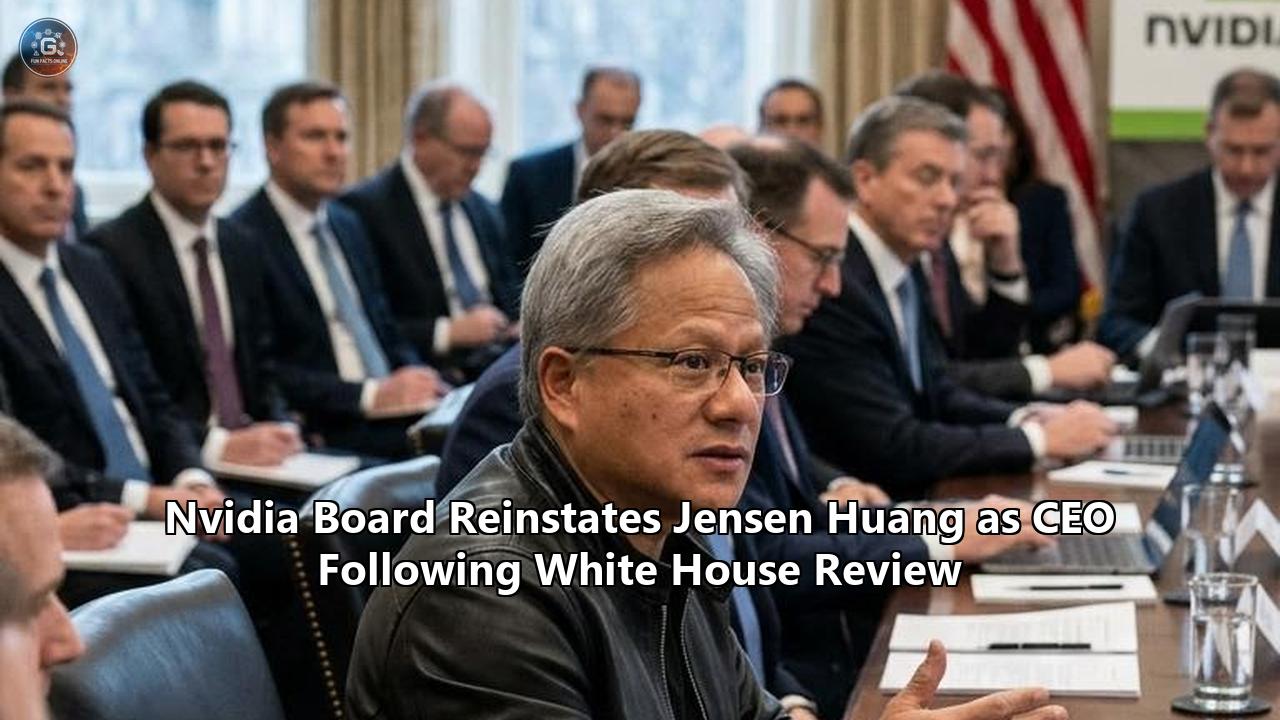
SANTA CLARA, Calif. — In a stunning reversal that upended the global technology sector and erased days of market turmoil, Nvidia’s board of directors voted unanimously to reinstate Jensen Huang as president, chief executive officer, and director. The decision came less than two weeks after his abrupt resignation following disclosures of extramarital relationships, including one with a foreign executive suspected by federal authorities of ties to Chinese intelligence.
The restoration of Jensen Huang, CEO, Nvidia, was neither an internal boardroom reconciliation nor a conventional corporate rehabilitation. It was the direct product of an aggressive, high-stakes intervention orchestrated by the executive branch of the United States government.
Over an intense weekend of backchannel negotiations, President Donald Trump and Vice President JD Vance personally intervened with Nvidia’s directors, offering explicit administration assurances that Huang’s presence at the helm posed no threat to national security.
The board’s capitulation was swift. Just days after public declarations that Huang’s departure was definitive, the company announced that input from senior levels of the federal government had satisfied directors regarding Huang's candor, capability, and clearance.
       CHRONOLOGY OF THE CRISIS

  Nov 12: Resignation Announced
  ├── Internal disclosures of extramarital affairs
  ├── Allegations involve Megaspeed executive Alice Huang
  ├── Colette Kress named interim CEO; Harvey Jones named Chair
  └── Market fallout: NVDA plunges ~25%, wiping out $1T in value

  Nov 15-20: Board Holds Firm
  ├── Harvey Jones tells investors board will not bring Huang back
  ├── AI contagion hits Nasdaq; broader macroeconomic jitters
  └── Silicon Valley allies (Elon Musk, Palmer Luckey) lobby publicly

  Nov 21-22: White House Intervention
  ├── Trump & Vance initiate backchannel talks with Nvidia board
  ├── DOJ/Todd Blanche advise no evidence of direct wrongdoing
  └── Administration gives security assurances to directors

  Nov 23: Reinstatement & Market Rebound
  ├── Board votes unanimously to reinstate Huang immediately
  ├── NVDA surges ~32-35%, regaining $1T in a single trading session
  ├── Trump claims credit: "I convinced them. I made the deal."
  └── Megaspeed placed on U.S. federal trade blacklist

  Nov 24: All-Hands Address & Political Backlash
  ├── Huang addresses staff: "I hurt all of you"
  ├── New oversight: Direct reports to file reviews to the board
  └── Bipartisan congressional inquiries launched; State AG probes continue
The financial reaction was immediate and historic. On Monday, shares of Nvidia surged by more than 32%, regaining approximately $1 trillion in market capitalization in a single trading session and lifting the broader Nasdaq Composite by 6.5%. Yet behind the market euphoria lies an unprecedented case study in corporate governance, sovereign industrial policy, and executive vulnerability.
By using this crisis as an analytical lens, business leaders, legal scholars, and state actors can observe the structural reality of the modern technology ecosystem: leading semiconductor companies are no longer mere public enterprises governed by Delaware corporate law; they have become systemic instruments of national power where conventional standards of executive conduct yield to geopolitical calculations.
Chronology of an 11-Day Crisis: Anatomy of an Unprecedented Ouster
The chain of events that culminated in the White House intervention began with an internal disclosure that threatened to dismantle the world's most valuable artificial intelligence enterprise.
On November 12, Nvidia announced that Huang had resigned his posts effective immediately. The resignation followed an internal probe into personal conduct, marked by revelations that Huang had engaged in extramarital relationships with both an internal subordinate and Alice Huang, a Singapore-based executive at Megaspeed. Megaspeed had previously purchased billions of dollars of high-end enterprise processors, hardware that federal intelligence agencies suspected was being routed past strict American export controls directly into mainland China.
The reaction across the financial markets was violent. Over the subsequent trading days, Nvidia’s equity valuation dropped by a quarter, erasing an estimated $1 trillion in market capitalization. The sell-off quickly metastasized into a broader rout across the technology sector, depressing the valuations of cloud hyperscalers including Microsoft, Alphabet, Meta, and Amazon, all of which depend heavily on Nvidia’s compute pipeline for their capital expenditure programs.
Inside Nvidia, the board attempted to signal institutional stability. Long-time Chief Financial Officer Colette Kress was elevated to interim chief executive, while independent director Harvey C. Jones, an industry veteran and former chief executive of Synopsys, was appointed the company's first independent board chair.
During an earnings update shortly after the ouster, Jones explicitly informed institutional investors that the board had accepted Huang's resignation without dissent and did not entertain any plan to reinstate him.
Outside the boardroom, a counter-campaign gained rapid momentum. Tech luminaries, including Tesla CEO Elon Musk and defense-tech founder Palmer Luckey, took to public platforms to argue that removing Huang crippled American technical leadership at a pivotal geopolitical moment. Over 10,000 current and former Nvidia employees signed an open petition seeking his return.
Simultaneously, Huang expressed public contrition while signaling his willingness to return if invited, declaring in an online statement that he stood ready to serve the enterprise he had led for 33 years.
The tipping point arrived over the weekend of November 21–22. Alarmed by the continued decline in the equity markets and viewing the stagnation of the artificial intelligence sector as an unacceptable drag on the domestic economy, the White House initiated direct communications with Nvidia’s directors.
Trump, who had publicly praised Huang as a "Great Patriot and National Treasure," instructed Vice President JD Vance to deploy his Silicon Valley relationships to break the deadlock. Vance spoke extensively with board members and Huang.
Concurrently, Attorney General Todd Blanche advised executive officials that existing Department of Justice reviews had yielded no evidence of criminal wrongdoing or deliberate trade-compliance violations by Huang himself.
Armed with these administration assurances, the board convened on Sunday evening. By Monday morning, November 23, the outcome was settled. The company published a statement confirming that Huang was resuming his responsibilities as president, CEO, and board director. Kress returned exclusively to her CFO role, while Jones remained independent chair.
In a coordinated measure to manage national security optics, the Commerce Department formally placed Megaspeed on the Bureau of Industry and Security (BIS) Entity List, strictly severing its access to American suppliers.
On Tuesday, November 24, Huang convened a raw, emotional all-hands meeting at the company’s headquarters.
"I hurt all of you," Huang told thousands of employees across an internal broadcast, openly addressing the personal and operational chaos of the preceding fortnight. "This is going to be the hardest company meeting I’ve ever done, and the second hardest meeting I have ever done. The hardest meeting I’ve ever done was with my wife."
Huang attempted to push back against the perception that he was solely saved by political fiat, asserting that the board had "performed their duty" through an independent evaluation of facts, even as he admitted that his abrasive executive style had at times disempowered subordinates.
He announced structural changes: direct reports would henceforth submit formal behavioral reviews regarding his conduct directly to the independent board.
  =============================================================================
                          NVIDIA CRISIS AT A GLANCE
  =============================================================================
  Core Executive Metric       Pre-Crisis (Nov 11)   Post-Reinstatement (Nov 24)
  -----------------------------------------------------------------------------
  Chief Executive Officer     Jensen Huang          Jensen Huang
  Board Chair                 Jensen Huang          Harvey C. Jones (Independent)
  Interim CEO Tenure          N/A                   Colette Kress (11 days)
  One-Day Share Reaction      -4.3% (Nov 12)        +32.0% to +35.0% (Nov 23)
  Market Cap Fluctuation      -$1.0 Trillion (Drop) +$1.0 Trillion (Rebound)
  Governance Safeguards       Internal Code         New Independent National
                                                    Security Committee; CCO
                                                    Search; Subordinate Reviews
  Export Control Actions      Ongoing Commerce DOJ  Megaspeed blacklisted;
                              investigations        Congressional subpoenas set
  =============================================================================
The Geopolitical Imperative: "Too Systemic to Regulate"
The primary structural lesson emerging from this case study is the transition of leading semiconductor firms from conventional market entities into sovereign infrastructure assets.
For decades, antitrust regulators, corporate governance boards, and trade policymakers operated under the assumption that public corporations must submit to standardized compliance architectures: if an executive breaches internal ethical canons or creates serious counterintelligence liabilities, fiduciary duty demands their immediate termination.
The reinstatement of Jensen Huang, CEO, Nvidia, reveals that when an executive's identity is coterminous with a critical technology supply chain, traditional governance assumptions are subordinate to national competitive strategy.
Nvidia’s graphical processing units (GPUs)—specifically the Hopper and Blackwell architectures—function as the foundational compute engines of modern state power. They train the frontier large language models, execute complex quantum simulations, power cryptographic programs, and anchor next-generation autonomous defense networks. The entire software ecosystem supporting this computational infrastructure, Nvidia's proprietary CUDA (Compute Unified Device Architecture), has established a multi-decade developer moat that prevents instantaneous substitution by competing hardware from AMD or custom silicon from Google or Amazon.
       THE MODERN "TOO SYSTEMIC TO REGULATE" ECOSYSTEM

       ┌────────────────────────────────────────────────────────┐
       │             Frontier AI Compute Ecosystem              │
       │    (Nvidia Blackwell / Hopper Silicon + CUDA Stack)    │
       └───────────────────────────┬────────────────────────────┘
                                   │
         ┌─────────────────────────┴─────────────────────────┐
         ▼                                                   ▼
┌─────────────────────────────────┐         ┌─────────────────────────────────┐
│     National Defense Utility    │         │     Macroeconomic Stability     │
│ - Sovereign AI initiatives      │         │ - Hyperscaler capex anchors     │
│ - Cryptanalysis & intelligence  │         │ - Index-level equity weighting  │
│ - Autonomous robotics systems   │         │ - Benchmark tech ETF stability  │
└─────────────────────────────────┘         └─────────────────────────────────┘
         │                                                   │
         └─────────────────────────┬─────────────────────────┘
                                   │
                                   ▼
       ┌────────────────────────────────────────────────────────┐
       │             State Intervention Mechanism               │
       │  Executive Branch overrides corporate code of conduct   │
       │  to prevent systemic compute dislocation & market drop  │
       └────────────────────────────────────────────────────────┘
When Huang stepped down on November 12, the market did not price his exit as a routine executive succession. Investors and industry partners interpreted it as a structural disruption to Nvidia’s long-term product roadmap and a destabilization of its complex supply chain alliances with key fabrication partners like Taiwan Semiconductor Manufacturing Company (TSMC), memory providers SK Hynix, and packaging specialists.
The systemic importance of this supply chain created a scenario where the administration viewed Huang's absence as a broader threat to American hegemony in artificial intelligence.
Inside Washington, this reality exposed an intense ideological divergence between trade hawks and economic mercantilists. Officials aligned with Commerce Secretary Howard Lutnick had argued that maintaining American technological supremacy requires keeping foreign developers tethered to American hardware architectures, even if modified, lower-spec silicon must be exported to Asian markets to crowd out domestic Chinese alternatives.
National security hawks on Capitol Hill took the opposing stance, maintaining that any leak of advanced compute platforms across Asian intermediaries constitutes a catastrophic breach of export regimes.
The counterintelligence concerns surrounding Alice Huang and Megaspeed were central to this dynamic. U.S. export regulations under the Export Administration Regulations (EAR) managed by the Commerce Department forbid the transfer of advanced chips possessing aggregate interconnect bandwidth and total processing performance above defined thresholds to Chinese entities without specific licenses.
Megaspeed, operating out of Singapore, had served as a major buyer. Federal investigators sought to determine whether its purchases served as a transshipment bridge into mainland China.
Huang’s personal entanglement with a central executive of that firm created a direct conflict of interest, combining counterintelligence risk with potential corporate malfeasance.
Yet, when confronted with the alternative—a leaderless Nvidia drifting through executive transition, a tumbling stock market, and frozen capital expenditures across Silicon Valley—the White House resolved the paradox through raw executive power. The administration concluded that the immediate geopolitical cost of a compromised or chaotic American AI champion was vastly higher than the deferred security risks of returning Huang to his desk. In doing so, the state established a clear precedent: platform scale grants strategic immunity.
The Capitulation of Board Governance: Fiduciary Failure or Rational Realism?
The boardroom reversal executed by Nvidia’s directors offers a case study in the structural limits of independent corporate oversight.
In modern governance models, boards of directors operate under Delaware corporate law, tasked with unyielding duties of care, loyalty, and oversight—the latter codified under the seminal Caremark doctrine. When an executive violates baseline codes of conduct by having an undisclosed relationship with a direct subordinate, and compounds that violation by maintaining personal ties to an executive under counterintelligence investigation, board-level intervention is normally irreversible.
  =============================================================================
            THE GOVERNANCE REVERSAL: PROCEDURAL TIMELINE
  =============================================================================
  Standard Governance Protocol          Nvidia Reinstatement Protocol
  -----------------------------------------------------------------------------
  1. Discovery of misconduct / breach   1. Discovery of misconduct / breach
  2. Independent internal investigation 2. Independent internal investigation
  3. Acceptance of resignation          3. Acceptance of resignation
  4. Execution of succession plan       4. Intermediate vacuum; equity down 25%
  5. Permanent separation; no return    5. White House & Silicon Valley pressure
  6. Restructuring under new leadership 6. Total reversal of resignation within 11 days
  =============================================================================
Nvidia's board initially adhered to this traditional playbook. They secured Huang's resignation, formed an independent committee, elevated Kress, and installed Jones as chair. Jones’s unequivocal comment to institutional investors—that the board had accepted the resignation and was not entertaining a return—was standard procedural protocol designed to insulate the firm from personal liability and preserve corporate integrity.
The board's complete reversal within 72 hours of that statement demonstrates how quickly traditional governance mechanisms can fracture under outside pressure.
Jeffrey Sonnenfeld, senior associate dean for leadership studies at the Yale School of Management, delivered a blistering assessment of the directors' actions:
"Huang's reinstatement after an intervention by the president is the worst business and government scandal in at least a century. That he would try this doesn’t surprise me. That the Nvidia board would collapse like furniture is stunning."
Sonnenfeld’s critique reflects standard corporate orthodoxy: independent directors exist specifically to protect the corporate entity from personal overreach, regulatory blowback, and conflicts of interest. By rescinding their decision at the direction of the executive branch, Nvidia’s board appeared to abandon its independent fiduciary posture.
Conversely, an alternative legal and economic argument can be framed: were the directors acting rationally under their fiduciary duty to preserve shareholder value?
                       THE DIRECTORS' DILEMMA

               ┌──────────────────────────────────────┐
               │  Nvidia Board of Directors Mandate   │
               └──────────────────┬───────────────────┘
                                  │
         ┌────────────────────────┴────────────────────────┐
         ▼                                                 ▼
┌─────────────────────────────────┐       ┌──────────────────────────────────┐
│   Traditional Governance Model   │       │   Realpolitik Fiduciary Model    │
│ - Enforce Code of Conduct       │       │ - Avert continued equity drop    │
│ - Eliminate national security   │       │ - Regain $1T in market cap       │
│   counterintelligence risk      │       │ - Retain irreplaceable founder   │
│ - Defend institutional norms    │       │ - Align directly with White House│
└─────────────────────────────────┘       └──────────────────────────────────┘
         │                                                 │
         ▼                                                 ▼
  [Board Resists Reinstatement]             [Board Reinstates Huang]
  - Stock drops an additional 15-20%        - Stock jumps 32-35% in hours
  - Prolonged multi-year transition         - Capital expenditure intact
  - Public fight with White House           - Subject to intense Senate probes
Within eleven days of Huang's departure, the company shed $1 trillion in market capitalization. The broader market faced an escalating confidence crisis.
Had the board stood firm, the prolonged search for a replacement could have precipitated an exodus of top engineering talent, disrupted complex system designs for next-generation platforms, and exposed the firm to deep competitive vulnerabilities.
Furthermore, once the executive branch of the federal government—the ultimate arbiter of export enforcement and national security policy—provided assurances that Huang’s reinstatement posed no threat to the republic, the board was provided with legal and political cover. Under Delaware’s business judgment rule, directors are granted broad latitude to make decisions they believe in good faith serve the best interests of the company and its stockholders.
To balance these conflicting pressures, the board instituted a set of procedural compromises:
- Creation of an Independent Oversight Committee: A newly formed National Security and Export Control Committee, comprised entirely of independent directors, was established to oversee trade compliance and counterintelligence exposure.
- Appointment of Independent Legal Counsel: The committee engaged specialized external national security counsel and intelligence advisers to audit internal procedures.
- Chief Compliance Officer Search: The board authorized the immediate recruitment of an enterprise-level Chief Compliance Officer reporting directly to the Nominating and Corporate Governance Committee rather than the CEO.
- Executive Behavioral Review Architecture: Direct reports to Huang will submit independent evaluations of his conduct, communication, and management practices directly to the board, curtailing his unilateral operational authority.
These structures represent an effort to place institutional guardrails around an executive deemed too economically valuable to fire. Whether these mechanisms will genuinely constrain Huang—or merely function as cosmetic window dressing for an executive who operates with immense authority—remains an open governance question.
The Cult of the Founder and the Key-Person Vulnerability
A fundamental dimension of this case study is the severe vulnerability generated by extreme key-person dependency in modern technology empires.
Unlike legacy industrial corporations, which construct deep benches of managerial talent and institutionalized succession pathways, high-growth technology enterprises systematically elevate the founder-CEO into an irreplaceable visionary. The reinstatement of Jensen Huang, CEO, Nvidia, serves as a clear example of what occurs when an organization’s institutional capacity becomes concentrated in a single individual.
┌─────────────────────────────────────────────────────────────────────────────┐
│                      ORGANIZATIONAL COMPARISON                              │
├──────────────────────────────────────┬──────────────────────────────────────┤
│ Conventional Enterprise Structure    │ Jensen Huang / Nvidia Architecture  │
├──────────────────────────────────────┼──────────────────────────────────────┤
│ - Hierarchical tree (7-10 reports)   │ - Radically flat (40-50 direct       │
│ - Formalized succession planning     │   reports to the CEO)                │
│ - Delegated operational roadmaps     │ - Explicit rejection of succession   │
│ - Dispersed external vendor ties     │   planning                           │
│ - Institutionalized governance culture│ - Centralized architectural control  │
│                                      │ - Personalized relations with TSMC,  │
│                                      │   hyperscalers, and heads of state   │
└──────────────────────────────────────┴──────────────────────────────────────┘
Huang’s leadership style at Nvidia is famously idiosyncratic. He maintains an unusually flat organization where 40 to 50 senior executives report directly to him, eschewing traditional corporate layers.
During his address to employees on November 24, Huang explicitly defended his refusal to establish a formal succession plan, telling staff that he fundamentally "doesn’t believe in succession planning" because he refuses to operate as if he is preparing to depart.
This operational structure created an acute institutional dependency:
- Centralized Architectural Direction: Huang maintains final authority over technical specifications, software-hardware co-design priorities, and research investments.
- Personalized Geopolitical Diplomacy: From direct negotiations with TSMC leadership regarding wafer allocations to closed-door discussions with heads of state concerning "Sovereign AI" infrastructure deployments, international relationships were tied to Huang personally.
- Evangelical Capital Magnetism: The financial markets did not view Nvidia as a portfolio of semiconductor patents; they viewed it as Jensen Huang executing a multi-year master plan to rebuild computing from the transistor level to the cloud data center.
The immediate historical parallel is the brief ouster and subsequent return of Sam Altman at OpenAI in November 2023. In that crisis, a non-profit board attempted to dismiss a founder-figure on grounds of opaque communication and safety concerns.
Within 96 hours, an employee revolt, investor backlash led by Microsoft, and the existential threat of company dissolution forced the board's collapse and Altman’s return.
  =============================================================================
             FOUNDER CRISIS MATRIX: HISTORICAL PARALLELS
  =============================================================================
  Executive / Case       Primary Cause       Resolution           Systemic Impact
  -----------------------------------------------------------------------------
  Jensen Huang (2026)    Personal conduct &  Reinstated in 11     Affirmed sovereign
  Nvidia                 national security   days via White       criticality of AI
                         export scrutiny     House pressure       chip supply chains
  -----------------------------------------------------------------------------
  Sam Altman (2023)      Board communication Reinstated in 4      Exposed failure of
  OpenAI                 & AI safety         days via employee/   non-profit board
                         disputes            investor pressure    oversight in tech
  -----------------------------------------------------------------------------
  Steve Jobs (1985/1997) Strategic dispute   Ousted 12 years;     Demonstrated the
  Apple                  with board over     returned to save     peril of replacing
                         product execution   firm from insolvency a product visionary
  -----------------------------------------------------------------------------
  Travis Kalanick (2017) Workplace culture   Permanent ouster;    Showed governance
  Uber                   & regulatory        board successfully   can prevail if
                         confrontations      retained control     asset isn't sovereign
  =============================================================================
The Nvidia episode escalates this dynamic from an investor-employee revolt to an intervention by the executive branch of the federal government. When an enterprise allows key-person risk to reach systemic proportions, traditional corporate sanctions become virtually impossible to enforce.
The board discovers that removing the leader does not discipline the individual; it threatens to dismantle the asset itself.
Executive Mercantilism: The Transactional State and Corporate Capital
The direct role played by the White House in securing Huang’s reinstatement marks a sharp departure from the conventional boundary separating federal power from private enterprise.
Historically, American regulatory agencies have maintained an arm’s-length posture toward public company boardrooms, relying on formal investigations, Wells notices, consent decrees, and statutory filings through the Securities and Exchange Commission or the Department of Justice.
In this case, the state bypassed administrative channels in favor of direct intervention. Trump’s candid public declarations after the reinstatement removed any doubt about the White House's involvement.
Speaking to CNBC, the president stated openly: "I convinced them. I made the deal. I felt very strongly that he should come back."
Steven Cheung, the White House communications director, affirmed the administration's interventionist posture to The Washington Post, stating: "President Trump was totally involved and this is a great decision by the NVIDIA board. We have to protect our geniuses."
This overt intervention introduces a model of state capitalism reminiscent of mercantilist frameworks, characterized by direct executive patronage, market sensitivity, and transactional alliances:
                     THE TRANSACTIONAL POWER AXIS

    ┌────────────────────────┐              ┌────────────────────────┐
    │     The White House    │              │  Nvidia / Jensen Huang │
    └───────────┬────────────┘              └───────────┬────────────┘
                │                                       │
                │ 1. Political clearance & security     │
                │    assurances against DOJ probes      │
                │ 2. Direct pressure on board directors │
                │ 3. Market stabilization priority      │
                ├──────────────────────────────────────►│
                │                                       │
                │◄──────────────────────────────────────┤
                │ 1. $25M ballroom contribution         │
                │ 2. Sustained US domestic AI capacity  │
                │ 3. Equity rally ($15M personal stake) │
                │ 4. Compliance with targeted blacklists│
                │                                       │
The transactional dimensions of this relationship quickly drew sharp political scrutiny. Analysts noted that Nvidia was among the prominent corporate contributors to Trump’s private White House ballroom construction project, contributing $25 million.
Financial filings revealed that Trump held personal equity positions in Nvidia, with financial estimates suggesting that the 32% single-day stock surge generated roughly $15 million in paper profits for the president's holdings.
The intervention triggered immediate, severe pushback from Capitol Hill, breaking along complex ideological lines:
┌─────────────────────────────────────────────────────────────────────────────┐
│                       CAPITOL HILL FALLOUT & PROBES                         │
├────────────────────────────┬────────────────────────────────────────────────┤
│ Political Coalition        │ Core Criticisms & Scheduled Actions            │
├────────────────────────────┼────────────────────────────────────────────────┤
│ Democratic Leadership      │ - Sen. Ron Wyden: "National security is for    │
│ (Wyden, Warren, Bonta)     │   sale."                                       │
│                            │ - Sen. Elizabeth Warren demands transparency   │
│                            │   on the specific "input" given to the board.  │
│                            │ - California AG Rob Bonta confirms state fraud │
│                            │   and investor disclosure probe continues.     │
├────────────────────────────┼────────────────────────────────────────────────┤
│ Republican Hawks           │ - Sen. Pete Ricketts: Reinstatement unacceptable│
│ (Ricketts, Cornyn)         │   given ties to subordinates & Chinese asset.  │
│                            │ - Sen. John Cornyn: "No national security      │
│                            │   risk? Based on what?"                        │
├────────────────────────────┼────────────────────────────────────────────────┤
│ Upcoming Congressional     │ - Senate Banking Committee (Public Hearing)    │
│ Inquiries                  │ - House Intelligence Committee (Closed Session)│
│                            │ - House Foreign Affairs Committee              │
│                            │ - House Select Committee on the CCP            │
└────────────────────────────┴────────────────────────────────────────────────┘
Democratic lawmakers characterized the reinstatement as an abuse of executive authority.
"Jensen Huang’s reinstatement shows that under Trump, Vance, and Rubio, our national security is for sale," stated Sen. Ron Wyden (D-Ore.), focusing on the speed with which the administration brushed aside ongoing counterintelligence questions.
Sen. Elizabeth Warren (D-Mass.) emphasized that the executive branch's backchannel assurances could not supersede federal law:
"The reckless decision to bring Jensen Huang back as CEO does not change the fact that Mr. Huang, Nvidia executives, and the company’s board still owe Congress answers about the company’s compliance with U.S. export controls. The Trump Administration also needs to explain to Congress what 'input' was given."
The criticism was not limited to Democrats. Republican national security hawks expressed alarm over the optics and substance of the White House intervention.
GOP Senator Pete Ricketts of Nebraska condemned the reinstatement directly: "Jensen Huang had multiple affairs including with subordinates and an alleged Chinese spy. His behavior does not support reinstatement. This decision doesn’t absolve Nvidia of answering for national security concerns and unaccounted-for chips."
Texas Republican Senator John Cornyn posted succinctly on social media: "No national security risk? Based on what?"
The administration’s defense rested on economic realpolitik. White House officials argued that the United States is engaged in a decisive struggle for technological supremacy against the Chinese Communist Party. In their view, allowing America’s chief AI enterprise to falter over personal ethical violations or ambiguous transshipment connections would represent a self-inflicted strategic wound.
By trading personal immunity for strategic alignment, the executive branch positioned itself not as a neutral regulator, but as an active participant in corporate leadership.
Management Principles and Governance Rules Extracted from the Case
The reinstatement of Jensen Huang, CEO, Nvidia, offers critical management lessons for executive suites, legal counsel, and state authorities.
The episode exposes structural changes in how large-scale technology enterprises must manage risk, governance, and state relations.
1. The Principle of Sovereign Systemic Criticality
When an enterprise controls a foundational technology layer upon which broad capital markets, national defense systems, and economic productivity depend, traditional governance autonomy becomes conditional.
Boards of directors must recognize that decisions concerning the retention or dismissal of visionary leaders will invite state intervention if those decisions threaten macroeconomic equilibrium.
Corporate governance frameworks must formally integrate geopolitical impact assessments into enterprise risk management frameworks alongside conventional compliance audits.
2. The Illusion of Board Preeminence in Founder-Centric Firms
Independent directors frequently misjudge their leverage against charismatic founder-CEOs who retain deep customer, supplier, and political loyalty.
Nvidia’s board attempted to execute a standard ouster, only to discover that the market, industry peers, and the White House viewed the board, rather than the CEO, as the secondary component.
Boards facing similar crises must prepare for the external operational consequences of executive removal, securing alignment with institutional investors and government stakeholders before executing public leadership changes.
                ENTERPRISE SUCCESSION READINESS AUDIT

    [Operational Metric]                [Vulnerability Level]

    Executive Span of Control           HIGH (Over 20 direct reports)
    -----------------------------------------------------------------
    Key Supplier Relationships          HIGH (Tied to founder persona)
    -----------------------------------------------------------------
    Developer Mindshare Moat            CRITICAL (CUDA software lock-in)
    -----------------------------------------------------------------
    Export Compliance Integration       CRITICAL (Hardware-level tracking)
    -----------------------------------------------------------------
    State Transactional Dependence      HIGH (Direct executive ties)
3. Counterintelligence Exposure as an Executive-Level Risk
Export compliance can no longer be compartmentalized within legal departments or relegated to supply chain logistics.
In a contested international environment, foreign intelligence services target the personal vulnerabilities and social networks of executive leadership.
Interactions involving foreign distributors, transshipment hubs (such as Singapore, the UAE, or Malaysia), and enterprise clients require counterintelligence vetting.
Executive personal conduct and institutional trade compliance are now inseparable issues.
4. The Institutional Cost of Executive Backchannel Immunity
Securing operational survival via presidential intervention carries severe long-term institutional liabilities.
While the White House’s backing neutralized the immediate board action, it exposed Nvidia to sustained scrutiny from legislative committees, state attorneys general, and opposition lawmakers.
Short-term executive relief obtained through political intervention often trades private corporate friction for extended public legal battles.
What Lies Ahead: Subpoenas, Legal Scrutiny, and Operational Realities
Huang’s return to his executive desk resolves the immediate leadership vacuum, but it opens an intense, unpredictable operational chapter for Nvidia.
The company must now navigate a complex web of legal challenges, legislative hearings, and internal structural adjustments.
                  THE ROAD AHEAD: UPCOMING MILESTONES

  December 2026                 Q1 2027                      Mid-2027
  ┌────────────────────────┐    ┌────────────────────────┐   ┌────────────────────────┐
  │ Congressional Hearings │    │ Internal Restructuring │   │ Regulatory Decisions   │
  │ - Public: Senate       │    │ - Install Chief        │   │ - California AG probe  │
  │   Banking Committee    │    │   Compliance Officer   │   │   determinations       │
  │ - Closed: House Intel, │    │ - Independent board    │   │ - Commerce export      │
  │   Foreign Affairs,     │    │   reviews of Huang     │   │   rule revisions       │
  │   Select Committee CCP │    │ - BIS export audits    │   │ - Blackwell production │
  └────────────────────────┘    └────────────────────────┘   │   volume ramp checks   │
                                                             └────────────────────────┘
The immediate threat environment is centered on Capitol Hill.
Huang is scheduled to appear for a public hearing before the Senate Banking Committee, where senators will probe the exact timeline of the board’s interactions with the White House, the nature of the "assurances" provided, and whether inside information was traded prior to the market-moving reinstatement announcement.
Following that public appearance, Huang will face a series of classified, closed-door depositions before the House Permanent Select Committee on Intelligence, the House Foreign Affairs Committee, and the House Select Committee on the Chinese Communist Party.
Lawmakers will seek granular disclosures regarding:
- The precise volume of Blackwell and Hopper silicon delivered to Megaspeed and its affiliated entities across Southeast Asia prior to its blacklisting.
- Counterintelligence debriefings detailing Huang’s communications with Alice Huang and the extent of technical data shared.
- Internal communications between White House emissaries, Vice President JD Vance, and members of the Nvidia board between November 20 and November 23.
Simultaneously, state-level law enforcement remains an active threat.
California Attorney General Rob Bonta confirmed that his office’s investigation will proceed uninterrupted by executive actions in Washington. The state probe is examining whether Nvidia’s executive leadership misled public shareholders and state institutional pension funds regarding the integrity of its Asian distribution networks and the circumstances surrounding Huang's sudden departure and rapid return.
A parallel inquiry by the Securities and Exchange Commission is examining trading patterns in Nvidia call options executed in the hours immediately preceding the Monday morning announcement.
Internally, Huang must manage a reshuffled corporate hierarchy.
For the first time in his 33-year tenure, he is not the chair of his own board. Harvey Jones remains independent chairman, backed by a National Security and Export Control Committee armed with independent subpoenaed legal counsel.
Huang's direct reports have been instructed to file behavioral evaluations directly to this independent committee, creating a system of internal checks within Nvidia’s executive suite.
Whether an entrepreneur who built a multi-trillion-dollar empire through absolute control can operate effectively within this constrained environment will dictate the company's operational tempo.
               THE DUAL-REALITY OPERATIONAL MATRIX

    External Market Dynamics            Internal Governance Realities
    ┌───────────────────────────────┐   ┌───────────────────────────────┐
    │ - Stock near historic highs   │   │ - Independent Chair in place  │
    │ - Hyperscaler capex flowing   │   │ - Independent security audits │
    │ - Blackwell chips in demand   │   │ - Subordinate reviews of CEO  │
    │ - Sovereign AI contracts grow │   │ - Subpoenas & state AG probes │
    └───────────────────────────────┘   └───────────────────────────────┘
The broader technology ecosystem must also adjust to this new precedent.
Allied governments in Europe and Asia are watching closely. By demonstrating that the leadership of the world's primary AI hardware architect is subject to the intervention of the American presidency, the reinstatement has accelerated calls in foreign capitals for domestic technological sovereignty.
European Union regulators and Asian industrial ministries are already evaluating policies to subsidize independent chip architectures, seeking insulation from sudden political shifts in Washington.
The episode leaves Nvidia with its founding visionary back in command, its market valuation restored, and its product roadmap intact.
Yet the company has crossed a clear threshold. Jensen Huang returns to his post not simply as the celebrated chief executive who built the engine of the artificial intelligence boom, but as an executive operating under the active oversight of the state.
The dramatic events of this November demonstrate that as artificial intelligence becomes the core battlefield of global power, the corporate boardroom is no longer the final authority. That authority now rests at the intersection of capital, industrial supply chains, and sovereign power.
Reference:
- https://www.forbes.com/sites/alisondurkee/2026/11/24/jensen-huang-tells-employees-its-completely-untrue-trump-got-him-his-job-back-report-says/
- https://www.foxnews.com/live-news/ai-news-tech-markets-nvidia-11-23-26
- https://www.theguardian.com/technology/2026/nov/23/jensen-huang-reinstated-as-nvidia-chief-executive
- https://nvidianews.nvidia.com/news/nvidia-board-reinstates-jensen-huang-as-president-ceo-and-board-director
- https://edition.cnn.com/2026/11/23/politics/trump-administration-jensen-huang-reinstated
- https://www.pbs.org/newshour/nation/nvidia-board-unanimously-reinstates-jensen-huang-as-ceo-and-chairman
- https://www.afp.com/en/nvidia-reinstates-huang-ceo-after-trump-intervention
- https://finance.biggo.com/news/076de844-fc1d-4928-982a-7686e25ac2e7
- https://www.independent.co.uk/news/world/americas/nvidia-donald-trump-ceo-beijing-malaysia-b3084263.html
- https://techcrunch.com/2026/11/24/in-all-hands-meeting-jensen-huang-thanks-white-house-and-says-hes-in-therapy/