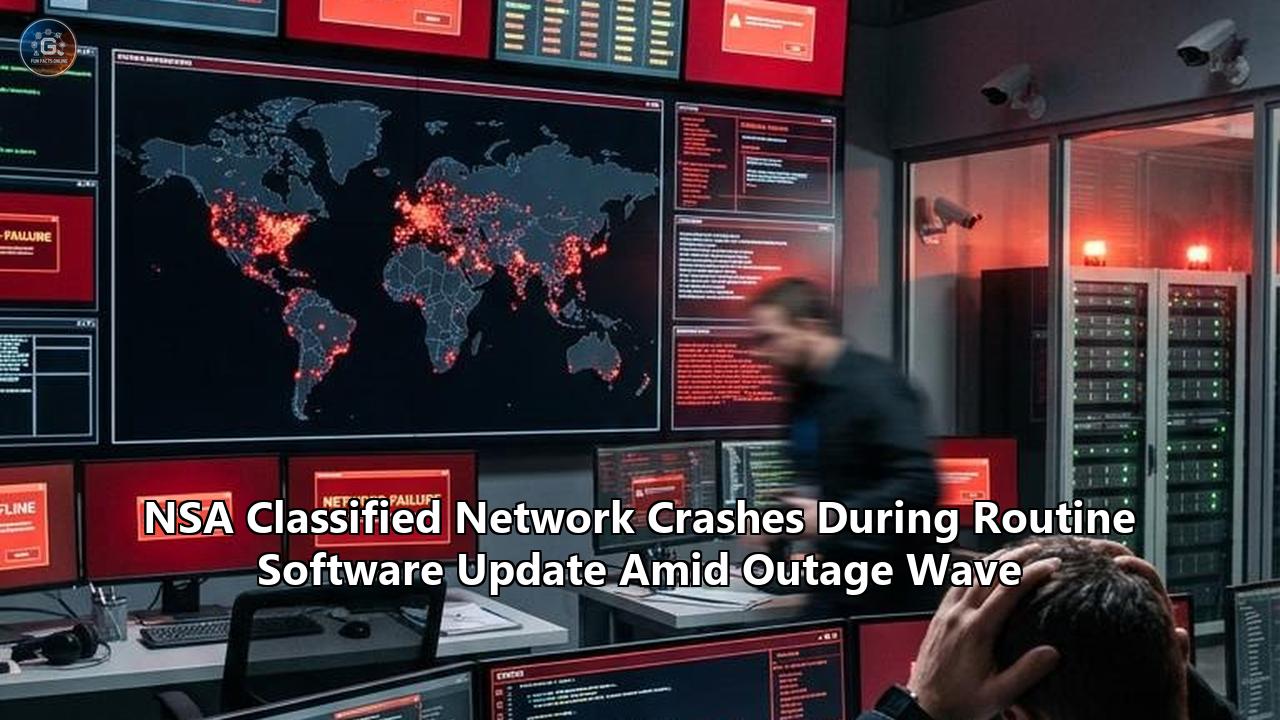
The primary classified communications network of the National Security Agency collapsed into an unexpected blackout on November 17, 2026, when an urgent software patch caused core servers across Fort Meade, Maryland, to fail on reboot. The network, known as NSANet, serves as the central digital circulatory system for America’s signals intelligence apparatus, carrying top-secret intelligence assessments, cryptologic data, and real-time surveillance traffic.
The crash triggered a sequence of emergency operational adjustments at the agency's headquarters. Personnel arriving early Tuesday morning were greeted with a “Code Yellow” directive mandating staggered arrivals to limit traffic on the fragile internal network. After an initial assessment prompted officials to declare a tentative “Code Green” by early evening, restoration efforts hit a severe snag, forcing leadership to reverse course and issue a late-night “Code Orange” that shuttered the Fort Meade campus to all but essential staff. By early Wednesday, the agency instituted a “Code Gray,” permitting a delayed, phased entry beginning at 10:00 a.m. to prevent tens of thousands of simultaneous authentication requests from overwhelming recovering servers.
Director of National Intelligence Jay Clayton confirmed the root cause hours later, linking the failure to an urgent patch rollout intended to neutralize critical security vulnerabilities in the PHP programming language discovered in late October. Known among cybersecurity researchers as the "PHP2Shell" flaws, the memory-leak vulnerabilities had prompted joint emergency directives from the FBI, the Cybersecurity and Infrastructure Security Agency (CISA), and the NSA itself, requiring immediate patching or system isolation.
"The patching that has gone on following that has caused some of these systems to not come back up when you patch them as expected," Clayton acknowledged in a public briefing. "That is what has happened at the NSA today."
The NSA network outage did not occur in an operational vacuum. It landed during an unsettling week of widespread domestic infrastructure failures that has disrupted commercial aviation, cloud enterprise software, and national banking systems. While federal officials moved quickly to state that the incident was an internal engineering failure rather than a hostile cyberattack, the sudden incapacitation of the nation's premier signals intelligence agency has prompted urgent inquiries into the fragility of air-gapped defense networks and the hazards of rapid software updates across aging architecture.
Anatomy of the Crash: From Accelerated Patching to Boot Failures
The mechanics behind the NSANet disruption trace back to an urgent security advisory issued on October 21, 2026. Artificial intelligence-assisted vulnerability scanners used by federal researchers and private security firms uncovered two critical zero-day vulnerabilities in PHP, an open-source scripting language that underpins approximately 70 percent of web applications worldwide. The flaws allowed unauthorized entities to bypass server validation, read sensitive memory segments, and execute arbitrary commands—a devastating hazard for systems handling sensitive data.
Classified defense enclaves are often assumed to be immune to the standard hazards of public web development, but modern intelligence networks rely heavily on web-based graphical user interfaces, browser-driven internal analytical dashboards, and legacy portal frameworks built on open-source code. NSANet is not a single, isolated mainframe; it is a sprawling, heterogeneous ecosystem of interconnected intranets, secure database clusters, and specialized processing engines. Portions of its front-end interfaces, document retrieval portals, and internal tasking management systems utilize PHP services.
When Fort Meade system administrators pushed the hotfix across internal servers, the patch interfered with low-level dependencies and custom system configurations, causing core nodes to enter boot loops or fail to restart entirely.
"NSANet is an intricate patchwork of legacy infrastructure married to ultra-modern cryptographic and analytical tools," said a former senior NSA cybersecurity official who spoke on the condition of anonymity. "When an agency-wide directive orders an emergency patch across thousands of interconnected machines, you run into severe dependency deadlocks. If a web daemon fails to initialize, the security layer above it refuses to authenticate connections, and the dominoes fall all the way down to the analyst's terminal."
The agency insisted that the incident represented a transient operational obstacle. In a formal statement released Tuesday afternoon, the NSA downplayed the severity: "The National Security Agency experienced temporary degradation during scheduled routine maintenance. While some internal systems were affected, mission-critical capabilities remain fully operational and our ability to defend national security continues. NSA’s infrastructure is designed with multiple layers of redundancy to maintain operations during planned maintenance or unexpected events."
Despite those assurances, internal operations at the agency’s central hub ground to an uncharacteristic crawl.
Systematic Impact Breakdown: Who Is Affected?
An impact analysis of the disruption reveals that while national defense command structures remained functional, operational friction surged across multiple tiers of the global intelligence enterprise.
Fort Meade Analysts and Signals Triage
The most direct impact was absorbed by the thousands of intelligence analysts, linguists, and cryptanalysts who operate inside the agency’s headquarters. NSANet is the mandatory conduit through which raw intercepts from foreign signals intelligence (SIGINT) collection platforms—satellite relays, undersea cable taps, and foreign sensor networks—are indexed, decrypted, and served to analysts.
When terminals went dark or became unresponsive, the real-time processing of foreign military movements, diplomatic communications, and counterterrorism intercepts stalled. Non-emergency personnel were unable to log in, leaving analysts locked out of classified repositories. For specialists monitoring active conflict zones, the outage forced an immediate pivot to alternative terminals and delayed daily briefings slated for interagency dissemination.
Field Stations and Distributed Cryptologic Centers
While Fort Meade serves as the strategic brain, much of the NSA’s daily collection is executed through major regional cryptologic centers across the continental United States and overseas—including facilities in Augusta, Georgia; San Antonio, Texas; Aurora, Colorado; and Kunia, Hawaii.
Because NSANet functions as a federated system with local redundancies, regional hubs were able to maintain collection and localized processing. However, the central distribution mechanism was impaired. Field stations that rely on Fort Meade for heavy cryptographic processing, complex target modeling, and national-level database cross-referencing experienced severe pipeline latency. An intelligence hub that directly supports Central Command and Middle Eastern military operations experienced severe analytical friction as communications with Fort Meade flickered, requiring data to be rerouted to alternative military servers.
                  [FOREIGN INTERCEPTS & SATELLITE ARRAYS]
                                     │
                                     ▼
                      [REGIONAL CRYPTOLOGIC CENTERS]
                     (Texas, Georgia, Colorado, Hawaii)
                                     │
                                     │ (Data Pipeline Backlog)
                                     ▼
               ┌───────────────────────────────────────────┐
               │         FORT MEADE NSANet CORE            │
               │   * Boot Loop Failures Post-PHP Patch     │
               │   * Web Interfaces & Dashboards Down      │
               │   * Terminal Authentications Offline      │
               └─────────────────────┬─────────────────────┘
                                     │
         ┌───────────────────────────┴───────────────────────────┐
         ▼                                                       ▼
[CLASSIFIED REPORTING]                                 [TACTICAL OPERATIONS]
Delayed SIGINT Triage                                  Rerouted via JWICS /
Backlogged Analytical Portals                          Secondary Command Links
Executive Consumers and the Traveling Commander-in-Chief
The outage took place as President Donald Trump was traveling aboard Air Force One in Asia, conducting high-stakes diplomatic stops in Manila before planned summits with Chinese President Xi Jinping and Russian President Vladimir Putin. The prospect of an intelligence blackout while the president was in transit adjacent to regional flashpoints triggered immediate concern on Capitol Hill.
Officials confirmed that the flow of top-tier intelligence to the White House and the presidential delegation was shielded from the crash. The president’s military aides and national security advisers utilize independent, highly resilient communications conduits, including specialized satellite communications packages and direct feeds from the Defense Intelligence Agency's Joint Worldwide Intelligence Communications System (JWICS) and the Pentagon's SIPRNet.
"An outage at NSANet would not impact the agency’s ability to communicate urgent intelligence to President Trump," confirmed a senior administration official. "There are multiple, air-gapped redundancies specifically engineered to bypass local headquarters infrastructure when national leadership is mobile."
Nonetheless, the granularity of real-time intelligence feeds supporting presidential briefers was temporarily constrained, relying on aggregated summaries produced by regional centers rather than deep-dive analytical products generated at headquarters.
The Five Eyes Alliance and International Partners
A critical question in the immediate aftermath was whether the failure compromised Stone Ghost—the ultra-secure network that binds the "Five Eyes" intelligence alliance consisting of the United States, the United Kingdom, Canada, Australia, and New Zealand.
Both Western intelligence liaisons and former U.S. officials confirmed that partner-sharing conduits remained fully functional. International exchange gateways run through fortified cross-domain validation guards designed to isolate partner feeds from domestic agency intranets. While the volume of newly minted NSA finished intelligence reports declined during the downtime, the physical networks linking GCHQ in Cheltenham, the Australian Signals Directorate in Canberra, and the Communications Security Establishment in Ottawa remained operational.
The Outage Wave: Routine Maintenance or Compounding Fragility?
The crash of NSANet landed amidst an unprecedented wave of technological disruptions that swept across the United States over a nine-day span, generating intense public anxiety and speculation about coordinated cyber sabotage.
- November 9–13: Microsoft experienced an extensive global outage that degraded Outlook, Teams, and core cloud enterprise services for government and commercial users, later attributed to a dormant, months-old server configuration bug.
- November 13: The Federal Aviation Administration took the extraordinary step of declaring a nationwide ground stop, halting domestic departures for over four hours. The failure was traced to a telecom router malfunction in Arkansas during communication cable work performed by defense contractor L3Harris.
- November 16: JPMorgan Chase customers suffered widespread online banking and transaction blackouts caused by a software defect, while United Airlines was forced to pause domestic flights due to an internal system glitch.
- November 17: NSANet crashed during routine patching, forcing staffing restrictions at Fort Meade.
The convergence of these events led lawmakers, financial markets, and the public to question whether foreign state actors—such as Chinese or Russian advanced persistent threat (APT) groups—had launched a synchronized, low-signature campaign against U.S. infrastructure.
Administration officials moved aggressively to decouple the events. Secretary of State Marco Rubio and Homeland Security Secretary Markwayne Mullin both stated that intelligence agencies found no evidence of hostile intervention. Instead, Mullin pointed to a structural vulnerability: the compounding weight of technical debt and brittle software integration across the public and private sectors.
"Some of the technology that they’re pushing out there, they’re pushing new technology on top of really old computer systems, and it just seems to overwhelm the system," Mullin said during a national television appearance. "It has nothing to do with cyberattacks, and I believe we’re going to see more of this as new technology strains legacy architecture."
Former senior intelligence officials echoed that conclusion. Beth Sanner, a former deputy director of national intelligence, noted that the NSA’s internal networks are among the most heavily defended and thoroughly firewalled on the planet.
"This system is firewalled, and by the most competent cyber agency in the world," Sanner observed. "A cyberattack is the least likely scenario, and outside our current context, this probably would not be reported."
The episode underscores a core vulnerability of modern digital infrastructure: human error, uncoordinated patch management, and configuration drift can inflict the exact same operational paralysis as a sophisticated foreign offensive.
Short-Term Consequences: Tactical Friction and Operational Workarounds
In the immediate wake of the crash, the NSA’s technical leadership faced a dual crisis: repairing broken system dependencies while managing the physical flow of personnel inside one of the world’s most secure military installations.
The Thundering Herd Problem at Fort Meade
The primary driver of the agency’s fluctuating access codes—moving from yellow to green, orange, and finally gray—was the classic computational problem known as the "thundering herd."
When a classified network experiences partial restoration, allowing all personnel to return to their desks simultaneously can prove fatal to recovery efforts. Tens of thousands of high-security workstations attempting to authenticate certificates, decrypt local drives, launch background synchronization routines, and query directory servers at the same instant will drive CPU utilization to 100 percent, immediately crashing recovering domain controllers.
Normal Operation:
[Distributed Workstations] ──(Steady Traffic)──> [Authentication / Directory Clusters]

Uncontrolled Post-Crash Influx ("Thundering Herd"):
[30,000+ Workstations] ════(Simultaneous Logins)════> [Recovering Servers] ──> [Secondary Crash]

Controlled Staggered Entry ("Code Gray"):
[Batch A: Essential Staff]  ───(08:00 AM)───> [Authentication Infrastructure]
[Batch B: Non-Emergency]    ───(10:00 AM)───>   (Load Monitored & Stable)
[Batch C: Remaining Units]  ───(12:00 PM)───>   (Full Service Achieved)
By imposing staggered shifts and restricting campus access, network engineers created controlled traffic windows, bringing service clusters back online one segment at a time.
Fallback to Alternate Classified Networks
To maintain intelligence exchange with external defense consumers, the NSA leaned heavily on alternative, shared defense networks. While internal NSANet files remained temporarily inaccessible, analysts shifted to JWICS terminals to communicate with military commands and the Central Intelligence Agency.
However, cross-domain communication has built-in limits. NSANet houses specialized, Compartmented Information (SCI) and Special Access Programs (SAP) that are strictly prohibited from existing on general-purpose networks like JWICS or SIPRNet. Highly sensitive cryptanalytic breakthroughs, raw data sources, and covert intelligence collection methods were effectively locked in computational stasis until internal servers could cleanly reboot.
Echoes of the 2000 System Collapse
Veteran cryptologists at Fort Meade were quick to draw comparisons to the agency's historic computer failure in January 2000. In that incident, an obscure software glitch in a commercial networking device triggered an overload that knocked out the NSA's primary data processing system for nearly 72 hours. That outage severed intelligence processing across the headquarters, required thousands of emergency engineering hours, and forced the agency to spend $1.5 million on immediate infrastructure rebuilding.
The 2026 NSA network outage demonstrated that while architectural resilience has improved significantly over the past quarter-century—distributed data centers prevented a complete global blackout—the agency still struggles with single-point dependencies when software updates are rolled out across its flagship enterprise.
Long-Term Repercussions: What Changes Across the Defense Enterprise?
The crash of NSANet during a standard maintenance window will force structural, operational, and budgetary changes across both the NSA and the wider intelligence community. The incident demonstrates that the push to accelerate cybersecurity patching can paradoxically introduce operational vulnerabilities that mirror the very threats agencies seek to prevent.
1. Mandatory Overhaul of Air-Gapped Patch Management
Classified networks have traditionally adhered to slow, deliberate update schedules to avoid configuration conflicts. In recent years, that policy was aggressively reversed to counter fast-moving zero-day exploits. The rapid rollout of the PHP2Shell fix proves that the pendulums swung too far toward speed at the expense of regression testing.
The NSA's Directorate of Capabilities and the Intelligence Community Chief Information Officer (IC CIO) will face intense pressure to overhaul update protocols. Key changes will likely include:
- Mandatory "Canary" Deployments: Strict prohibitions on enterprise-wide simultaneous updates. Patches must be deployed across non-critical test enclaves and monitored over multiple days before touching production systems.
- Automated Rollback Systems: Implementation of transactional deployment architectures that automatically revert servers to previous, operational kernel states if initialization thresholds are not met within specific time limits.
- Air-Gapped Sandbox Validation: Creating mirrored digital-twin environments that replicate the exact heterogeneous software stack of NSANet, allowing administrators to observe how patches interact with classified proprietary applications before wide release.
2. The Acceleration of Technical Debt Elimination
Homeland Security Secretary Mullin’s public comments regarding modern updates overwhelming legacy architecture struck a chord within defense contracting circles. Across the Department of Defense and intelligence agencies, critical operations frequently rely on software applications constructed decades ago, wrapped in modern translation layers.
The NSANet crash will accelerate funding for deep-code refactoring. Intelligence agencies will look to systematically purge non-essential open-source runtime environments—such as legacy PHP components—from secure enclaves. The Department of Defense will prioritize transitioning critical internal portals to memory-safe, modular programming languages and microservice architectures that prevent a failure in a web interface from pulling down the broader operating environment.
3. Congressional Inquiries and Oversight Scrutiny
The House Permanent Select Committee on Intelligence and the Senate Select Committee on Intelligence have already initiated briefings regarding the crash. Lawmakers are focused not only on the mechanics of the NSA network outage itself, but also on the public messaging inconsistencies that unfolded over a 24-hour period.
Congressional investigators are expected to examine:
- Why the agency initially reported only "temporary degradation" while simultaneously closing its primary campus to non-essential personnel.
- The exact timeline of the patch deployment and whether standard quality assurance procedures were bypassed under the pressure of the CISA/NSA emergency directive.
- Whether contractors or direct federal personnel were responsible for the botched deployment, and what financial or contractual penalties apply.
- How the agency coordinates with civilian infrastructure operators when widespread technical outages hit the country simultaneously.
┌────────────────────────────────────────────────────────────────────────┐
│                   TIMELINE OF THE NSANET DISRUPTION                    │
├───────────────────┬────────────────────────────────────────────────────┤
│ Late October 2026 │ AI-assisted discovery of critical PHP2Shell        │
│                   │ vulnerabilities (memory-leak / command injection)  │
├───────────────────┼────────────────────────────────────────────────────┤
│ October 21, 2026  │ Joint FBI/CISA/NSA directive mandates urgent       │
│                   │ patching or immediate system isolation            │
├───────────────────┼────────────────────────────────────────────────────┤
│ November 17, 2026 │                                                    │
│ 06:00 AM EST      │ Patch applied during scheduled maintenance;        │
│                   │ multiple server clusters fail to reboot            │
│ 08:00 AM EST      │ NSA issues "Code Yellow" (staggered arrivals)      │
│ 02:00 PM EST      │ Agency public statement cites "routine maintenance │
│                   │ degradation"; mission-critical capabilities active │
│ 04:30 PM EST      │ Brief shift to "Code Green" as systems show signs  │
│                   │ of partial recovery                                │
│ 05:15 PM EST      │ DNI Jay Clayton publicly links outage to PHP patch │
│ 10:30 PM EST      │ Reversal to "Code Orange"; Fort Meade campus       │
│                   │ closed to non-essential staff due to instability   │
├───────────────────┼────────────────────────────────────────────────────┤
│ November 18, 2026 │                                                    │
│ 06:00 AM EST      │ "Code Gray" announced; controlled, staggered entry │
│                   │ beginning at 10:00 AM to prevent server thrashing  │
│ Afternoon         │ Core services stabilized; analytical backlog triage│
│                   │ and interagency post-mortem inquiries begin        │
└───────────────────┴────────────────────────────────────────────────────┘
The Broader Dilemma of AI-Accelerated Security
Beneath the immediate logistical crisis lies a deeper, systemic paradox reshaping cybersecurity: the double-edged sword of automated and artificial intelligence-driven vulnerability discovery.
The PHP2Shell flaws that crippled NSANet were identified not by human code reviewers, but by automated, AI-driven security auditing engines. As artificial intelligence models become increasingly proficient at identifying zero-day vulnerabilities in ubiquitous open-source codebases, the time window between the discovery of a flaw and the development of an active exploit by foreign adversaries has shrunk from months to hours.
This dynamic creates an intense dilemma for system operators. If an agency like the NSA does not patch instantly, it risks catastrophic exploitation by rival nation-states possessing similar automated discovery capabilities. If it rushes the patch across complex, legacy environments without extensive validation, it risks paralyzing its own operations from within.
The November 17 crash demonstrated that the defensive cure can be just as debilitating as the disease. Moving forward, the intelligence community will need to build architectures where automated patching does not require full-system restarts, relying instead on containerized micro-enclaves that can be isolated, updated, and verified without threatening the uptime of the broader classified network.
Strategic Outlook: What to Watch Next
As Fort Meade works through the operational backlog created by the downtime, several critical milestones will indicate how the defense establishment intends to prevent similar failures:
- The Interagency Software Audit: The Defense Information Systems Agency (DISA) and the Office of the Director of National Intelligence will conduct a joint inventory of open-source dependencies embedded within classified networks, identifying legacy codebases that must be removed.
- Contractor Accountability Inquiries: Attention will focus on external systems integration contractors who maintain enterprise software across defense networks. Following the Arkansas router issue at the FAA and the NSA patch failure, federal acquisition officers will face pressure to tighten performance criteria and error-liability clauses for IT modernization contracts.
- Adversary Probing and Opportunistic Moves: U.S. intelligence will closely monitor whether foreign cyber threat actors attempt to probe the boundaries of alternative classified networks (such as JWICS and SIPRNet) that absorbed redirected data traffic during the NSANet downtime.
- CISA Emergency Directive Revisions: The joint directives governing vulnerability mitigation will likely be modified to include explicit guidance on deployment velocity and testing requirements, explicitly recognizing that mandated deadlines for emergency patches must account for operational complexity in mission-critical networks.
The primary lesson of the NSANet crash is not that America's classified digital perimeter was breached by a foreign adversary. It is that the nation's most sophisticated surveillance apparatus remains deeply vulnerable to internal complexity, unmanaged dependencies, and the friction between legacy infrastructure and urgent updates. The modern digital fortress is uniquely susceptible to self-inflicted wounds, and in the high-stakes theater of global intelligence, an internal software failure can take down collection systems just as effectively as any adversary's offensive cyber weapon.
Reference:
- https://finance.biggo.com/news/9e28b992-a7ee-41d3-b1de-1134bc664cdd
- https://edition.cnn.com/2026/11/17/politics/highly-classified-national-security-communications-network-goes-down
- https://www.nextgov.com/digital-government/2026/11/classified-nsa-communications-network-down-people-familiar-say/417277/
- https://tob.news/software-error-triggers-major-outage-across-nsa-classified-network/
- https://therecord.media/nsa-net-disruptions
- https://www.cbsnews.com/news/national-security-agency-network-outage-software-vulnerability/
- https://www.theguardian.com/us-news/2026/nov/17/nsa-national-security-classified-communications-network-down
- https://www.jpost.com/international/article-915216
- https://news-hongkong.com/en/post/456197/nsa-net-internal-communications-network-experiences-outage
- https://www.forbes.com/sites/zacharyfolk/2026/11/17/national-security-agencys-highly-classified-internal-network-went-down-during-maintenance-agency-says/
- https://www.forexfactory.com/news/1437192-nsa-classified-network-outage-linked-to-software-update
- https://www.itp.net/cybersecurity/threats-incident-response/us-government-network-outage-linked-to-software-patch-intelligence-chief-says