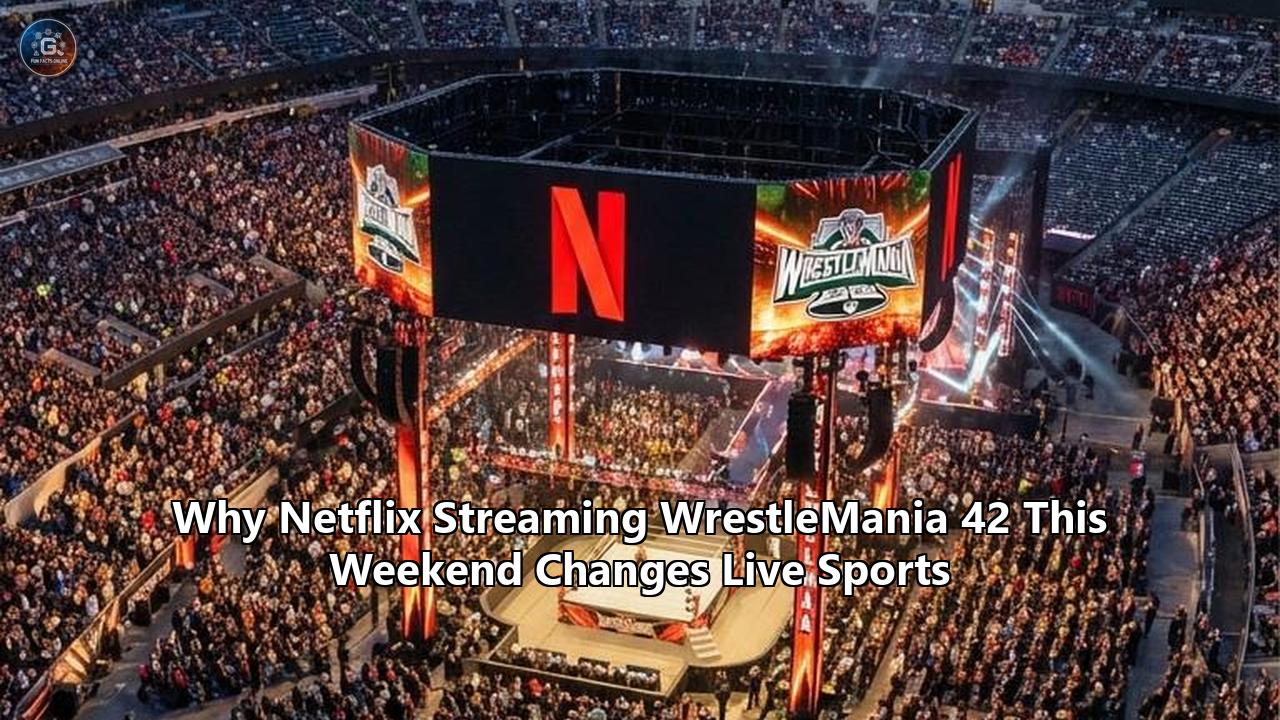
Right now, beneath the translucent roof of Allegiant Stadium in Paradise, Nevada, tens of thousands of fans are filing into their seats for a weekend defined by pyrotechnics, scripted violence, and legacy-defining championships. Saturday, April 18, and Sunday, April 19, 2026, mark the execution of WrestleMania 42. In the ring, Cody Rhodes prepares to defend the Undisputed WWE Championship against Randy Orton, while Sunday night promises a gargantuan clash between CM Punk and Roman Reigns for the World Heavyweight Championship.
Yet, the most consequential battle of the weekend is not happening on the canvas. It is taking place inside server farms located in Frankfurt, Tokyo, London, and São Paulo.
When the opening video package rolls, millions of viewers outside the United States will not be tuning in via traditional pay-per-view providers or legacy cable networks. Instead, they will be watching through the familiar red interface of a Silicon Valley streaming behemoth. The execution of Netflix WrestleMania 42 represents the apex of a $5 billion, decade-long global rights agreement signed in early 2024. But more than that, it serves as the ultimate live-fire test for the future of sports broadcasting.
For decades, the live sports ecosystem relied on a predictable infrastructure: television networks paid astronomical rights fees, subsidized by cable bundle subscribers, and beamed broadcast signals via satellite and coaxial cable with virtually zero latency. Streaming platforms, built for the on-demand delivery of massive, static files like Stranger Things or The Crown, operated on an entirely different technological foundation.
This weekend, those two worlds violently collide. The sheer scale of WWE's premier event forces a reckoning. Through interviews with media executives, a close examination of Q1 2026 earnings data, and an analysis of the shifting regulatory environment surrounding sports distribution, a clear picture emerges: the broadcast of WrestleMania 42 is not just another content drop. It is the keystone of a multi-billion-dollar strategy designed to permanently alter how global audiences consume live entertainment.
Tracing the Evidence: The $5 Billion Pivot
To understand why this weekend is a watershed moment, one must follow the money trail back to January 2024. At that time, WWE's parent company, TKO Group Holdings, announced a sprawling agreement with Netflix. The headline figure was staggering: $500 million annually over ten years.
Initially, the industry focused on the domestic implications—the flagship Monday night program, Raw, leaving linear cable television after 31 years to stream exclusively on Netflix starting in January 2025. However, the fine print of the contract revealed an even more ambitious global play. Outside the United States, Netflix acquired the rights to the entire WWE library, weekly shows like SmackDown and NXT, and the highly lucrative pay-per-view events.
By April 1, 2026, the legacy WWE Network was effectively dissolved in its remaining international territories, finalizing the migration of the global fanbase to Netflix.
"Our partnership dramatically expands the reach of WWE, and brings weekly live appointment viewing to Netflix," TKO President and Chief Operating Officer Mark Shapiro stated when the architecture of the deal was first unveiled. TKO CEO Ariel Emanuel echoed the sentiment, categorizing the maneuver not as a retreat from television, but as an aggressive capture of the new frontier: "This is the streaming play. For us, it's the next step".
The transition was methodical. Throughout 2025, Netflix absorbed the weekly global delivery of Raw. But a weekly three-hour show, while technically demanding, does not generate the concurrent viewership spikes of a 'Big Four' pay-per-view. WrestleMania is a different beast entirely. It is a cultural monolith, routinely ranking alongside the Super Bowl and the UEFA Champions League Final in terms of global social media engagement and live viewership metrics.
By taking control of the international distribution for this specific weekend, Netflix has deliberately placed itself in the crosshairs of a massive technical and commercial audit. If the stream buffers during Seth Rollins' entrance, or if the feed drops precisely when Stephanie Vaquer locks up with Liv Morgan, the subscriber backlash will be instantaneous and unforgiving.
The Infrastructure Investigation: From On-Demand to Real-Time
Investigating Netflix's readiness for this weekend reveals a company that has quietly, yet frantically, rewired its internal architecture. The platform was fundamentally built on viewer control and flexibility—a localized caching model where highly anticipated shows are stored on edge servers deep inside internet service providers' networks before they are even requested. Live video bypasses this safety net.
Chief Content Officer Bela Bajaria provided crucial insight into this internal evolution just days ago. Speaking alongside Netflix sports lead anchor Elle Duncan at the CAA World Congress of Sports on April 16, 2026, Bajaria admitted that the transition to live programming required a fundamental rewriting of the company's DNA.
"To actually do something live and say, 'This is the time we want you to watch something,' is just a different strategy," Bajaria noted. "We want to be great at everything."
The evidence of this strategic shift is written in the company's recent acquisitions and broadcast tests. Netflix did not dive straight into WrestleMania. They waded in through a series of escalating stress tests. In 2023, there was the relatively low-stakes Netflix Cup golf tournament. That was followed by influencer boxing bouts and the rocky, technically flawed live reunion of Love is Blind, which served as a painful but necessary learning experience for the engineering teams.
By the first quarter of 2026, the training wheels were off. Netflix successfully broadcast Major League Baseball's opening night matchup between the Yankees and Giants, averaging 3 million viewers. More importantly for the global infrastructure being tested this weekend, Netflix served as the lead broadcaster for the World Baseball Classic (WBC) in Japan.
Internal data revealed from the company's Q1 earnings call this past Thursday indicated that the WBC in Japan delivered 31.4 million viewers. It became the most-watched program ever on Netflix in the country and drove the largest single-day surge of new subscriptions in the platform's history.
"It was also the first big regional live event for us outside of the US, and we got to flex a new muscle—streaming multiple games concurrently—so a big expansion of our capabilities," Co-CEO Ted Sarandos explained on the April 16 earnings call. "We were excited, the fans were thrilled, and the leagues were excited. There is much more to come."
The WBC was the final dress rehearsal. The main event is Netflix WrestleMania 42.
"Eventizing" Sports: The Economic Motive
Why subject the engineering department to such immense pressure? The answer lies in the shifting economic realities of the streaming industry. The era of pure subscriber growth—fueled by endless, debt-financed original programming—is over. Wall Street now demands profitability, high operating margins, and diversified revenue streams.
During the Q1 2026 earnings presentation, Netflix projected revenue growth of 12% to 14% and a healthy operating margin of 31.5%. But the most telling metric was the advertising tier. Netflix is aggressively pushing to double its advertising business to approximately $3 billion by the end of the year.
Live sports are the ultimate Trojan horse for advertising revenue. Unlike a prestige drama, which viewers consume at their own pace over weeks, live events demand simultaneous, appointment viewing. This creates a captive audience for advertisers, mirroring the highly lucrative model of traditional broadcast television but enhanced by the granular data targeting capabilities of a tech company.
However, Netflix's strategy diverges sharply from legacy networks. When evaluating the ROI on sports rights, Sarandos has made it clear that the company is not interested in buying up massive, season-long packages of mid-tier Tuesday night games. They are hunting for spectacles.
Bajaria characterized this internal mandate as a "go big or go home" philosophy. The company targets moments that feel culturally relevant, unpredictable, and "buzzy". They do not want the grind of the regular season; they want the soap opera.
Professional wrestling is the literal embodiment of this strategy. It merges the emotional, long-term storytelling of a serialized drama with the real-time, visceral engagement of a live athletic competition. When Jacob Fatu and Drew McIntyre face off in an Unsanctioned Match this weekend—the culmination of a bitter feud that has raged across SmackDown for months—it triggers exactly the type of synchronized, high-emotion viewership that commands premium ad rates.
By controlling the international feed of Netflix WrestleMania 42, the streaming service has acquired a marquee asset that drives both new subscriber acquisition in emerging markets and high-yield ad inventory.
The Split-Rights Reality: TKO's Masterclass in Leverage
While international fans are streaming the event through Netflix, the domestic distribution of WrestleMania 42 reveals a deeply fragmented, highly strategic media landscape. Within the United States, the event is airing live on ESPN's linear channels, with the first hour of each night simulcast on ESPN2 and ESPN, and streaming via the ESPN app.
This bifurcation is not an accident; it is a calculated masterpiece of negotiation by TKO Group Holdings. By refusing to bundle global rights into a single package, TKO forced traditional broadcasters and tech platforms into a bidding war, ultimately extracting maximum value from both sides of the aisle.
ESPN, desperate to maintain its dominance in the US sports market and feed its own streaming ambitions, secured the domestic live events from NBCUniversal's Peacock (a transition announced in August 2025 and executed in early 2026). Meanwhile, Netflix, flush with cash and eager to expand its footprint in Latin America, Europe, and Asia, eagerly swallowed the international rights.
This split-rights model fundamentally changes the live sports market. Leagues no longer have to choose between the immense reach and legacy prestige of a network like ESPN and the deep pockets and global scalability of a tech giant. They can have both.
The strategy creates a complex web for the consumer—a fan in London opens Netflix to watch WrestleMania, while a fan in Chicago authenticates via their cable provider on the ESPN app. But for the rights holders, the financial rewards are unprecedented. TKO's ability to seamlessly service two distinct technological pipelines this weekend proves that the era of the monolithic, one-size-fits-all broadcasting contract is officially dead.
Regulatory Shadows and Market Tremors
The aggressive push into live sports by streaming platforms is not occurring in a vacuum. As billions of dollars flow into exclusive streaming rights, the regulatory environment is beginning to shift.
Investigative reports surfaced on Friday, April 17, indicating that the U.S. Department of Justice plans to expand an existing antitrust inquiry into sports media rights. Originally focused on the NFL's streaming deals, the probe is reportedly widening to include Major League Baseball and other entities covered by the Sports Broadcasting Act of 1961.
The legislation, drafted long before the invention of the internet, allowed leagues like the NFL, NBA, and NHL to pool and sell team media rights collectively under an antitrust exemption. However, the law specifically applies to "sponsored telecasting of the games". The sudden migration of exclusive sports content behind the paywalls of streaming services like Apple TV+, Amazon Prime Video, and Netflix has sparked a fierce debate over whether the 1961 exemption still applies.
Traditional broadcasters, feeling the squeeze of cord-cutting and escalating rights fees, are pushing back. Legacy entities have submitted public comments to the FCC, arguing against placing game broadcasts on what they term "paywalled streamers," insisting it harms the consumer and violates the spirit of the original antitrust exemptions.
WWE, crucially, operates outside the confines of the Sports Broadcasting Act, as it is a single entertainment entity rather than a collective of independent franchises. However, Netflix is deeply entangled in this broader ecosystem. The streamer's success in broadcasting WWE internationally this weekend is being closely monitored by regulators and rival leagues alike.
If Netflix proves it can handle the immense traffic of a global wrestling demographic without the feed collapsing, it solidifies its position as a primary bidder for future, highly regulated sports packages. If the platform stumbles, it could provide ammunition to critics who argue that streaming infrastructure is not yet robust enough to completely replace traditional over-the-air and cable broadcasting.
The End of the Hastings Doctrine
To fully grasp the magnitude of this weekend, one must view it against the backdrop of Netflix's corporate history. For the better part of two decades, under the leadership of co-founder and former CEO Reed Hastings, the company actively avoided live sports.
Hastings transformed Netflix from a DVD-by-mail service into the architect of the streaming revolution by adhering to a strict doctrine: own the content in perpetuity, prioritize global scalability, and avoid the ephemeral, expensive nature of live event rights. The company famously quipped that it wasn't "anti-sport, just pro-profit".
Hastings stepped down as chairman earlier this year, marking the definitive end of that era. The modern iteration of Netflix, guided by Sarandos and Co-CEO Greg Peters, operates under entirely different market pressures. The subscription video on-demand landscape is saturated. To combat churn and drive the new advertising tier, the platform must offer content that demands immediate consumption.
The shift is evident in the data. In Q1 2026, Netflix walked away from an $82.7 billion mega-deal to acquire the streaming and studios businesses of TNT Sports parent company Warner Bros. Discovery. According to Sarandos, the deal was evaluated as a "nice to have" rather than a necessity. The company realized that it did not need to buy a legacy media conglomerate to acquire sports rights; it could simply outbid them for the specific, high-impact events it actually wanted.
Instead of buying a decaying cable network, Netflix bought the Mexican broadcast rights to the Concacaf Gold Cup and Nations League Finals. It secured the 2027 and 2031 FIFA Women's World Cups in North America. And it wrote a $5 billion check for WWE. The strategy is surgically precise: bypass the low-margin daily grind and monopolize the cultural phenomenons.
Inside the Command Center: What Happens When the Bell Rings
As the lights dim inside Allegiant Stadium this weekend, the true test begins. Delivering a live, low-latency video feed to tens of millions of concurrent users across dozens of distinct geographical regions is an engineering tightrope walk.
Traditional live broadcasting relies on a linear path: a camera captures the action, feeds it to a production truck, beams it to a satellite, and bounces it down to local affiliates or cable headends. The signal degradation is minimal, and the latency is generally under five seconds.
Streaming live video requires a vastly more complex, resource-intensive process. The raw video feed from Las Vegas must be instantly compressed, encoded into multiple bitrates and resolutions, and pushed out to a global Content Delivery Network (CDN). As user demand spikes—say, during the final moments of the Cody Rhodes vs. Randy Orton match—the CDN must dynamically route traffic, spinning up localized servers to handle the load and prevent buffering.
If the system works perfectly, the user at home notices nothing. The video plays smoothly in 4K resolution, the audio syncs flawlessly with the impact of a steel chair, and the targeted advertisements slot seamlessly into the commercial breaks.
If the system fails, it fails catastrophically. The internet is littered with the digital wreckage of high-profile streaming collapses. When millions of users rapidly refresh a frozen feed, it creates a self-inflicted Distributed Denial of Service (DDoS) attack on the provider's servers, compounding the outage.
Netflix knows this. The company has spent the last year aggressively upgrading its live encoding infrastructure, prioritizing stability over ultra-low latency. They have built robust fallback systems and invested heavily in dynamic load balancing. But lab tests and regional baseball games are one thing; a global WWE pay-per-view is another.
The Next Media Battlefield: What to Watch For Monday
When the final bell rings in Las Vegas on Sunday night and the pyrotechnics fade, the sports media industry will wake up to a new reality. The data collected from the international broadcast of Netflix WrestleMania 42 will immediately inform the next round of multi-billion-dollar negotiations.
The most pressing immediate question centers on the National Football League. The NFL is currently finalizing its 2026 regular-season schedule and actively fielding bids for an exclusive five-game package of live rights.
During the Q1 earnings call, Sarandos explicitly confirmed that Netflix is aggressively pursuing this package. "The NFL is a great property, and it delivers value as part of our total offering," he stated. "We are in discussions right now, because we think there's an opportunity to expand the relationship. We've learned a lot about what works, and how to value the NFL and live content generally over the last couple of years".
If the infrastructure holds up this weekend, it proves to the NFL—and to every other major sports league—that Netflix possesses not only the capital to acquire premium rights but the technical fortitude to deliver them flawlessly to a massive, simultaneous audience.
Furthermore, the integration of the advertising tier will face deep scrutiny in the coming weeks. Analysts will be watching closely to see how effectively Netflix monetized the massive international audience tuning in for WWE. If the $3 billion ad revenue target begins to look conservative as a result of live event monetization, expect Amazon, Apple, and Google to escalate their own live sports acquisitions, triggering a new, wildly expensive arms race.
This weekend in Paradise, Nevada, the spectacle is undeniable. The athletes are larger than life, the storylines are meticulously crafted, and the crowd is deafening. But pull back the curtain, look past the ring, and follow the fiber-optic cables running out of Allegiant Stadium. They point toward the definitive future of global sports distribution. The execution of this broadcast is a bold, highly calculated gamble by a tech giant determined to prove that the age of traditional sports television is drawing to a close, and a new, algorithmically driven era of live entertainment has arrived. The bell has rung; now the industry waits to see who is left standing.
Reference:
- https://www.cbsnews.com/news/netflix-wwe-raw-partnership-live-sports-streaming/
- https://mashable.com/article/netflix-wwe-raw-live-streaming-tv-deal
- https://uk.pcmag.com/video-streaming-services/150574/netflix-reaches-5-billion-deal-to-stream-wwe-raw-exclusively
- https://en.wikipedia.org/wiki/WWE_Network
- https://fr.wikipedia.org/wiki/WrestleMania_42
- https://www.allegiantstadium.com/events/detail/wrestlemania-42
- https://barrettmedia.com/2026/04/16/netflix-bela-bajaria-sports-events-strategy/
- https://www.youtube.com/watch?v=osmV7gvN-zs
- https://www.sportsmediawatch.com/2026/04/doj-streaming-rights-sba-mlb-netflix-sports-liv-golf-funding/
- https://frontofficesports.com/netflix-reports-strong-q1-earnings-touting-importance-of-live-sports/
- https://www.sportspro.com/broadcast-ott/netflix-nfl-mlb-streaming-sport-hastings-wwe/
- https://ca.investing.com/news/company-news/netflix-inc-nflx-q1-2026-earnings-call-highlights-strong-growth-and-strategic-shifts-4570392
- https://en.wikipedia.org/wiki/WrestleMania_42