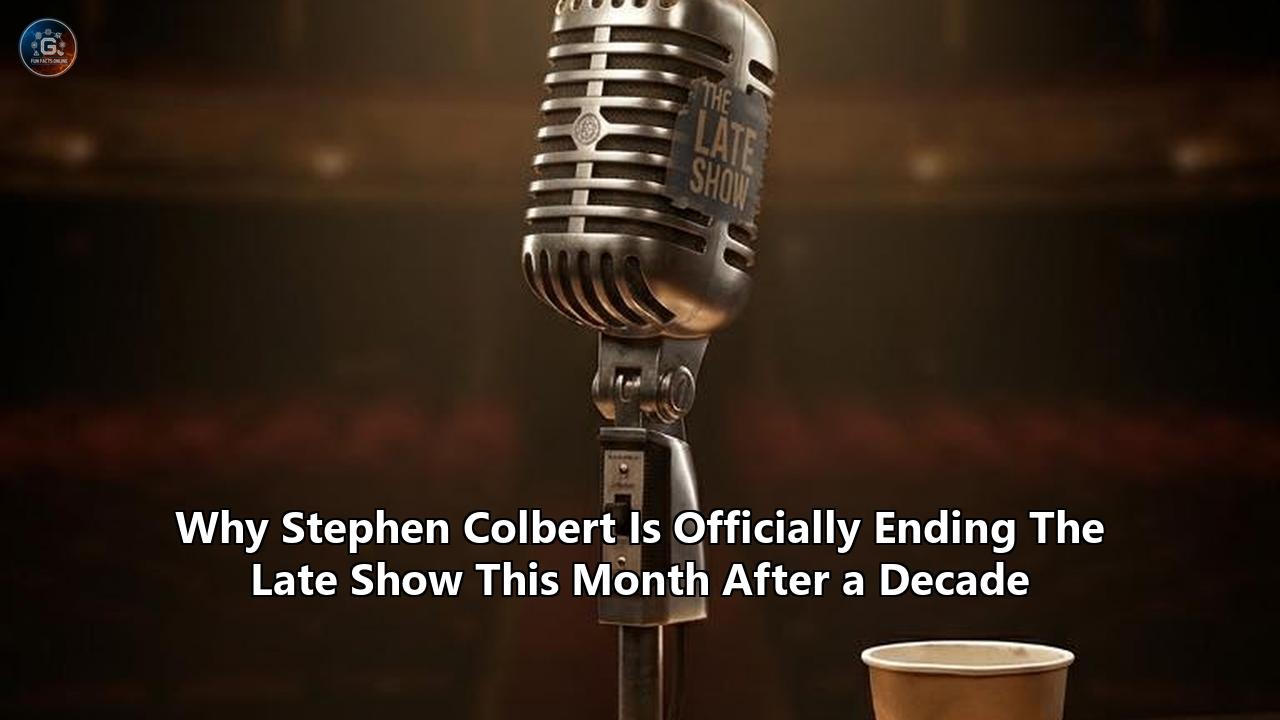
The marquee outside the Ed Sullivan Theater will power down for the final time at 11:35 p.m. on Thursday, May 21, 2026. The impending final episode of The Late Show with Stephen Colbert brings an abrupt and highly contested halt to the most-watched program in late-night television. Unlike the ceremonial handoffs that defined the historic departures of Johnny Carson, Jay Leno, or David Letterman, there is no successor waiting in the wings to take over the desk. The legendary television franchise is simply being erased, permanently clearing out one of the most prestigious blocks of broadcast real estate.
The Stephen Colbert Late Show ending represents far more than the culmination of a single comedian's 11-season run. It serves as the explosive result of a multi-year collision between collapsing broadcast economics, high-stakes corporate mergers, and direct political retaliation. The network plans to replace the hour with syndicated reruns of Comics Unleashed With Byron Allen, turning a timeslot that historically anchored American political satire into a holding pen for low-cost alternative programming.
Understanding how a profitable, award-winning, number-one program reached a point of total execution requires tracing a complex timeline. The cancellation did not happen in a vacuum. It was the product of a slow-moving corporate crisis that rapidly accelerated when the host refused to provide cover for his parent company's political compromises.
1993: The Birth of a Television Institution
To fully grasp the magnitude of the May 2026 cancellation, one must look back to the inception of the franchise. The Late Show was born from one of the most famous conflicts in television history. When NBC executives chose Jay Leno to succeed Johnny Carson on The Tonight Show, a spurned David Letterman defected to CBS in 1993. At the time, CBS lacked any competitive late-night programming. The network invested massively in Letterman, purchasing and completely renovating the historic Ed Sullivan Theater in Manhattan—the very stage where The Beatles and Elvis Presley famously performed—specifically to serve as his television home.
For 22 years, Letterman broadcast from that stage, establishing The Late Show as a critical darling and a formidable competitor to NBC’s late-night dominance. The franchise became a cornerstone of CBS’s brand identity, generating immense advertising revenue and cementing the network's cultural relevance long after prime-time audiences went to sleep. Handing over this meticulously built empire in 2015 was a momentous corporate decision.
2015 to 2022: Building the Unassailable Ratings Fortress
When Jon Stewart departed Comedy Central's The Daily Show in the summer of 2015, a massive vacuum opened in the realm of televised political satire. Colbert, who had spent years playing a right-wing pundit on The Colbert Report, assumed the CBS desk weeks later. The early months were marked by a search for identity, but as the chaotic 2016 presidential campaign escalated, Colbert discovered his authentic voice. He merged the traditional late-night format with the biting, news-driven analysis he had honed on cable. Viewers who felt unmoored by the political climate flocked to his opening monologues, which served as daily, blistering indictments of the political landscape. By 2018, he had decisively overtaken NBC's Jimmy Fallon in the ratings. He would go on to hold the title of the number-one show at 11:30 p.m. for nine consecutive years.
This dominance made him seemingly untouchable. Television networks operate on a simple calculus: high ratings justify high production costs. The Late Show required an enormous budget, carrying a staff of over 200 writers, producers, and technicians, alongside a live musical outfit—Jon Batiste and Stay Human, followed by Louis Cato and The Late Show Band. Despite these costs, the ad revenue generated by his massive audience kept the operation highly lucrative.
June 2023: The Rejected Five-Year Extension
The first major fracture in this stable foundation occurred behind closed doors during contract negotiations in the summer of 2023. At the time, CBS executives were desperate to lock their late-night star into a long-term agreement. The network offered a massive five-year contract extension designed to keep him safely behind the desk through 2031.
Colbert, represented by the powerful talent agent James "Baby Doll" Dixon, executed a strategic maneuver that would later prove catastrophic for the show's survival. Dixon also represents ABC’s Jimmy Kimmel, whose contract with Disney was scheduled to expire in May 2026. Recognizing the shifting dynamics of linear television, Colbert declined the five-year offer. He opted instead for a shorter, three-year extension that perfectly aligned his expiration date with Kimmel's.
By synchronizing the contract cycles of the two biggest stars in late night, the host and his agent sought to manufacture immense future leverage against the networks. If both men were free agents at the same time, it would force a bidding war or grant them unprecedented bargaining power.
"Less than two years before they called to say it's over, they were very eager for me to be signed for a long time," Colbert revealed in a late April 2026 interview with The New York Times. "So, something changed".
Had the comedian signed the five-year deal, CBS would have been legally obligated to continue producing the show—or pay out tens of millions in contractual penalties—during the exact window when its parent company became desperate to slash costs and appease federal regulators. Instead, the three-year extension inadvertently gave Paramount Global a clean exit strategy right when they needed it most.
Late 2024 to Early 2025: Collapsing Economics and the Skydance Merger
While the host performed his nightly duties, the financial ground beneath broadcast television began to fracture. The traditional late-night model relies heavily on linear advertising sales. As audiences aggressively migrated to YouTube clips, TikTok recaps, and next-day streaming on Paramount+, live viewership plummeted across the board. CBS President and CEO George Cheeks would later accurately describe the advertising marketplace as being in "significant secular decline".
The economic pressure was visible across the network's entire late-night block. Following the departure of James Corden, CBS attempted to run a cheaper, game-show format at 12:30 a.m. with Taylor Tomlinson's After Midnight. When that program was quietly canceled due to budget constraints, the industry recognized that the financial models sustaining late-night television were deeply broken.
However, financial headwinds alone rarely result in the immediate termination of a network's highest-rated asset. The true catalyst for the Stephen Colbert Late Show ending was massive corporate consolidation.
By late 2024, Paramount Global—the parent company of CBS, controlled by media heiress Shari Redstone—was bleeding cash and carrying crushing debt. Redstone sought an exit, eventually engineering a multi-billion dollar merger with Skydance Media, led by David Ellison.
Because broadcast networks utilize public airwaves, major media mergers require stringent approval from both the Federal Communications Commission (FCC) and the antitrust division of the Department of Justice. As 2025 commenced, the newly returned Donald Trump administration held complete authority over those regulatory bodies.
Paramount Global had a massive political problem. Trump harbored a deep, highly publicized vendetta against CBS. Beyond his hatred for Colbert’s nightly monologues, the President was actively suing Paramount Global. The lawsuit stemmed from a 60 Minutes interview with Democratic candidate Kamala Harris broadcast in the fall of 2024. Trump's legal team alleged the network deceptively edited her responses, and they pursued aggressive litigation. This pending legal battle became a giant roadblock threatening to delay or destroy the Skydance merger entirely.
July 14, 2025: The Settlement and the Monologue
The corporate tension reached a breaking point in the second week of July 2025. Desperate to eliminate any hurdles to the Skydance deal, executives at CBS and Paramount agreed to pay $16 million to settle the 60 Minutes lawsuit. Within corporate media circles, the payout was viewed as a strategic necessity—a mechanism to placate an angry administration and secure a clear path for FCC merger approval.
For Colbert, the settlement represented an intolerable compromise of journalistic ethics and comedic integrity. He refused to look the other way.
On Monday, July 14, 2025, Colbert walked onto the stage at the Ed Sullivan Theater and delivered a monologue that effectively sealed the fate of his program. Bypassing his standard lighthearted opening, he aimed his satirical focus directly at his own employers.
He told his studio audience he was profoundly "offended" by the $16 million settlement. "I don't know if anything — anything — will repair my trust in this company," he stated firmly into the camera. "But, just taking a stab at it, I'd say $16 million would help".
Colbert then escalated the critique to a level rarely seen on network television, explaining to viewers that the technical legal term for Paramount's strategic settlement was a "big fat bribe".
The monologue ignited a media firestorm, dominating social media networks and cable news cycles the following morning. Inside the executive suites at Paramount and CBS, the reaction was sheer panic. Their highest-paid television personality had just utilized the company’s own airwaves to accuse them of bribing the President of the United States in exchange for federal regulatory favors.
July 17, 2025: The Wednesday Night Call and the Announcement
Corporate retaliation occurred with staggering speed.
On Wednesday evening, July 16, Colbert received a phone call from network executives. He was informed that his contract would not be renewed when it expired in May 2026. Furthermore, the executives explained that the network was entirely shuttering The Late Show franchise, ending a prestigious television lineage that David Letterman had launched 33 years prior.
The following afternoon, Thursday, July 17, CBS released a carefully calibrated public statement. The network praised the host as an "irreplaceable" talent who would forever reside in the "pantheon of greats that graced late night television". Crucially, the corporate communications team insisted the cancellation was "purely a financial decision against a challenging backdrop in late night" and claimed it was "not related in any way to the show's performance, content or other matters happening at Paramount".
Hours later, Colbert stood before his live studio audience to deliver the news personally. The atmosphere inside the theater immediately shifted from festive to furious.
"I found out just last night," Colbert told the crowd. A loud, sustained chorus of boos rained down from the seats.
"Yeah, I share your feelings," the 61-year-old comedian replied, maintaining a tight, visible emotional composure. "It's not just the end of our show, but it's the end of The Late Show on CBS. I'm not being replaced. This is all just going away".
He spent the remainder of the segment expressing deep gratitude to his 200 staff members, his band, and the network that gave him the platform for a decade. He then added a distinctly sharp addendum: "It is a fantastic job. I wish somebody else was getting it".
Fall 2025: Political Shockwaves and Congressional Inquiries
The fallout from the July announcement was swift, widespread, and intensely partisan. The official narrative—that CBS had canceled its undisputed top-rated late-night show strictly over secular advertising declines—was fundamentally rejected by media watchdogs, competing hosts, and political figures.
The dynamic was further inflamed by the administration's reaction. Donald Trump quickly took to social media platforms to publicly celebrate the cancellation. "I absolutely love that Colbert got fired," the President wrote. "His talent was even less than his ratings".
Colbert's peers and predecessors reacted with open disgust. David Letterman, who originally built The Late Show into a juggernaut after his acrimonious split from NBC, issued a rare, blistering public condemnation of CBS executives. Letterman labeled the decision an act of "pure cowardice," warning that "the people at CBS who have manipulated and handled this are going to be embarrassed". Late-night contemporaries Seth Meyers and Jimmy Fallon also utilized their respective broadcasts to express dismay, framing the termination as a devastating blow to the broader late-night ecosystem. Online communities and social media discussion threads focused heavily on the program's legacy, with viewers circulating past monologues and mourning the sudden loss of sharp political satire on broadcast television.
By August 2025, the controversy caught the attention of Capitol Hill. House Democrats launched an official investigation into the Paramount-Skydance merger. The congressional probe specifically questioned whether the sudden cancellation of The Late Show served as a quiet quid pro quo demanded by the administration in exchange for regulatory approval of the massive corporate deal. Lawmakers requested internal communications between CBS executives, Paramount leadership, and the White House, seeking to uncover if direct pressure had been applied.
Though the investigation ultimately stalled amid partisan gridlock in Congress, it forced CBS executives to play defense on multiple fronts. George Cheeks reiterated the company line in late summer, deflecting the political accusations and pointing strictly toward the balance sheet. "The economics made it a challenge," Cheeks told reporters. "At the end of the day, it just wasn't sustainable to continue".
The host, however, refused to provide his employers with any corporate cover. In a highly publicized November 2025 interview with GQ, Colbert thoroughly dismantled the network's financial defense.
"Listen, every show's got to end at some time," he noted. "And I've been on a bunch of shows that have ended sometimes by our lights and sometimes by the decision of other people. That's just the nature of show business. You can't worry about that. You got to be a big boy about that. But I think we're the first number one show to ever get cancelled".
That undeniable metric—the reality that The Late Show had dominated the 11:30 p.m. timeslot for nine consecutive years—made the Stephen Colbert Late Show ending an unprecedented historical anomaly. Television networks frequently cancel struggling, expensive shows; they rarely execute their absolute highest performers unless massive external pressures force their hand.
Early 2026: The Slow Dismantling of a Television Institution
As the calendar turned to 2026, the reality of the impending finale began to alter the nightly tone of the broadcast. The show entered a bizarre, extended lame-duck period, operating every night with the explicit knowledge of its own execution date.
The massive staff at the Ed Sullivan Theater faced an incredibly uncertain future. While the host’s personal wealth heavily insulated him from the professional fallout, the writers, producers, camera operators, and stagehands were left counting down the weeks until their severance packages kicked in. The writers' room leaned heavily into institutional nostalgia, bringing back long-running bits and beloved recurring characters that had defined the program's early years.
Colbert’s interviews took on a distinctly reflective, occasionally cynical quality. Freed from the burden of future network contract negotiations and corporate politics, his political commentary grew sharper and more unrestrained. He frequently referenced his "short-timer status," utilizing his pending termination as a persistent punchline to needle the CBS executives who had sealed his fate.
During this final stretch, the entertainment industry began to grapple with what the loss of the 11:35 p.m. CBS hour actually meant for the medium of television. Since 1993, the Ed Sullivan Theater had served as a vital cultural anchor. The entire format of the late-night talk show was built upon a promise of institutional continuity. Johnny Carson eventually handed the baton to Jay Leno; David Letterman ultimately yielded the desk to Stephen Colbert.
The absolute termination of the franchise signaled a massive, permanent retreat by broadcast networks. With After Midnight canceled and competing networks aggressively slashing their own budgets, the late-night television landscape actively contracted. The shared cultural experience of millions gathering around the television at 11:30 p.m. was being aggressively dismantled, replaced by fragmented digital algorithms, isolated social media feeds, and cost-effective syndication blocks.
May 2026: The Final Weeks and the Future of Late Night
Now, in May 2026, the year-long escalation has reached its terminal point. The final string of episodes is currently airing, characterized by a mix of high-profile farewells, biting satire, and genuine melancholy.
On Tuesday, May 5, former President Barack Obama made his final scheduled appearance on the program. He sat down with Colbert for a lengthy, highly reflective interview about the fractured state of American democracy, the vital role of political satire, and the dangers of media consolidation. The studio audience, acutely aware of the historical weight of the broadcast, provided the host with an extended standing ovation that brought the live-to-tape production to a temporary halt.
As the May 21 finale looms over the Ed Sullivan Theater, Colbert is keeping his future professional plans deliberately vague. Beyond co-writing a new Lord of the Rings project, he has publicly committed to nothing. "The show takes like 95 percent of my brain," he explained during his recent press run, adding that he requires "a little time to breathe" before assessing his next move in the entertainment industry.
The question of what will fill the massive void left by his departure remains a contentious subject among television critics. By opting to air syndicated reruns of Comics Unleashed With Byron Allen, the network is employing a strategy traditionally reserved for local affiliate stations struggling to fill dead air. Comics Unleashed, a low-budget panel show featuring rotating stand-up comedians, requires zero original production costs for CBS. Rather than launching a cheaper, scaled-down successor or attempting to find the next generational comedic talent, CBS has effectively conceded defeat in the 11:30 p.m. hour. The network’s decision to cede the timeslot completely validates the fears of industry analysts who warned that the Stephen Colbert Late Show ending was not merely a localized cancellation, but the definitive death knell for the broadcast late-night format itself.
The chronology of this cancellation exposes the remarkably fragile reality of modern broadcast television. It reveals exactly how quickly a decades-old institution can be dismantled when corporate financial vulnerability intersects with aggressive political pressure. What began in the summer of 2023 as a standard strategic contract negotiation regarding leverage and term limits mutated over 24 months into a high-stakes standoff. It involved a vindictive administration, a multi-billion dollar merger desperate for regulatory approval, and a fiercely independent host unwilling to read the corporate script.
When Colbert signs off for the final time on May 21, the stage lights in the Ed Sullivan Theater will not just be turning out on his deeply influential 11-year run. They will be extinguishing a 33-year legacy of late-night television on the network, leaving behind a silent stage, a deeply frustrated audience, and a fundamentally altered media landscape. The true cost of that silence—both for the necessity of political satire and for the survival of the television industry—will not be fully understood until the laughter stops entirely.
Reference:
- https://www.youtube.com/watch?v=3MiFplEkeso
- https://en.wikipedia.org/wiki/The_Late_Show_with_Stephen_Colbert
- https://www.pbs.org/newshour/nation/stephen-colberts-late-show-canceled-by-cbs-ends-may-2026
- https://www.youtube.com/watch?v=QD_Yi9EbA30
- https://www.comingsoon.net/guides/news/2126344-stephen-colbert-cbs-late-show-cancellation-5-year-deal
- https://parade.com/news/stephen-colbert-was-offered-contract-extension-before-cbs-canceled-late-show
- https://www.theguardian.com/tv-and-radio/2025/nov/03/stephen-colbert-late-show-cancellation-cbs
- https://movieweb.com/the-late-show-stephen-colbert-canceled-2026-cbs/
- https://www.cbsnews.com/news/the-late-show-stephen-colbert-end-may-2026/
- https://www.youtube.com/watch?v=AuqEZx6TmfI
- https://www.tvinsider.com/1262380/the-late-show-with-stephen-colbert-final-episode-details/