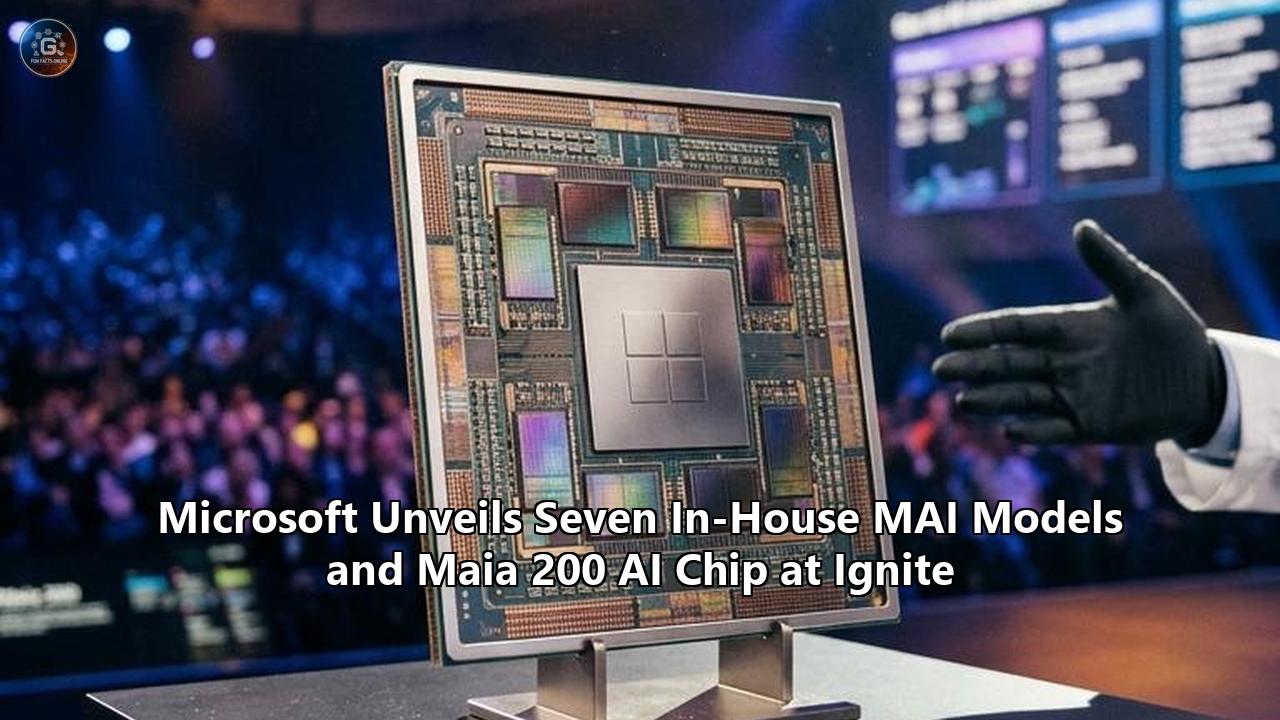
Microsoft deployed the most aggressive vertical integration maneuver in its corporate history at its annual Ignite conference, simultaneously releasing seven proprietary foundation models under its Microsoft AI (MAI) brand and placing its second-generation custom AI accelerator, the Microsoft Maia 200 chip, into active production across global datacenters.
The twin announcements mark a calculated shift in the company’s artificial intelligence strategy. After spending three years and tens of billions of dollars acting primarily as the computational backstop, distribution pipeline, and primary benefactor for OpenAI, Microsoft is asserting full-stack independence. The seven in-house models—spanning agentic software development, automated cybersecurity defense, real-time multimodal voice, high-fidelity image editing, clinical transcription, and low-latency system routing—are engineered not to chase theoretical parameter records, but to drastically reduce the cost of enterprise AI execution.
Leading the software slate is MAI Code 2, a coding model that Microsoft claims achieves 96% of Anthropic’s Claude Opus 5.5 performance at roughly 5% of the cost, and 98% of OpenAI’s GPT-6.1 Sol coding quality at approximately 40% of the price. In tandem, the software giant announced that the Microsoft Maia 200 chip is now live in production datacenters, delivering a 1.7-fold improvement in tokens generated per watt and a 30% reduction in query costs compared to the commercial hardware previously dominating its fleet.
+-----------------------------------------------------------------------------+
|                      MICROSOFT VERTICAL AI STACK (IGNITE)                   |
+-----------------------------------------------------------------------------+
| APPLICATION LAYER     GitHub Copilot | M365 Copilot | Azure Security MDASH  |
+-----------------------------------------------------------------------------+
| MODEL LAYER (MAI)     MAI Code 2 / Flash  | MAI Cyber 2 Flash | Image 2.7   |
|                       Realtime 1 | Transcribe 2 | Decision 1.1              |
+-----------------------------------------------------------------------------+
| PLATFORM CONTROL      MAI Licensed Weights (Customer-Owned Azure Enclaves)  |
+-----------------------------------------------------------------------------+
| HARDWARE ACCELERATION Microsoft Maia 200 Chip (3nm TSMC, 216GB HBM3e, FP4)  |
|                       Azure Cobalt 200 ARM CPU Infrastructure               |
+-----------------------------------------------------------------------------+
Speaking to enterprise customers, Microsoft Chief Executive Officer Satya Nadella and Microsoft AI CEO Mustafa Suleyman framed the dual rollout as a pragmatic realignment around inference unit economics.
“Our mission at MAI is to build you the very best models in the world and keep every developer and every enterprise at the frontier of capability,” Suleyman said during his keynote address. “We don't just hill-climb on frontier quality alone. We co-optimize quality and price together. Customers want models at a price point that lets you run agents 24/7 doing real engineering work”.
By pairing custom silicon with workload-specific in-house models and wrapping them in an enterprise licensing framework termed MAI Licensed Weights, Microsoft has begun systematically insulating itself from third-party model dependency, easing its exposure to commercial GPU margins, and setting off a pricing realignment across enterprise cloud software.
The Hardware Foundation: Inside the Maia 200 Architecture
The economic viability of Microsoft’s model offensive rests entirely on physical infrastructure. High-volume agentic software requires millions of tokens per developer per day; running those loops on third-party merchant silicon at standard cloud margins creates prohibitive operational costs. At the core of this infrastructure maneuver sits the Microsoft Maia 200 chip, an application-specific integrated circuit (ASIC) built expressly to drive down the total cost of ownership (TCO) for frontier inference workloads.
+-----------------------------------------------------------------------------+
|                     MICROSOFT MAIA 200 ACCELERATOR TOPOLOGY                 |
+-----------------------------------------------------------------------------+
| Fabrication Node      | TSMC 3-nanometer (N3) Process                       |
| Transistor Count      | Over 100 Billion Transistors                        |
| On-Die Memory Cache   | 272 MB High-Bandwidth SRAM Cache                    |
| High-Bandwidth Memory | 216 GB HBM3e (7.0 TB/s Aggregate Memory Bandwidth)  |
| Precision Arithmetic  | Native Tensor Cores: FP8, Microscaling FP4, INT4    |
| Interconnect Fabric   | Standard Ethernet Architecture, 2.8 TB/s Bi-dir     |
| Cluster Scalability   | Up to 6,144 Accelerators per Unified Pod Domain     |
| Deployment Footprint  | Des Moines (Iowa), Phoenix, Europe, Australia       |
+-----------------------------------------------------------------------------+
Fabricated on TSMC’s 3-nanometer process node, the Microsoft Maia 200 chip addresses the physical bottleneck that has plagued enterprise language models: memory bandwidth starvation. While general-purpose training processors prioritize high-precision 16-bit and 32-bit floating-point compute to continuously adjust billions of parameter weights, inference tasks require high throughput and sustained data movement.
Every token generated by an autoregressive model requires reading the entire parameter set and the accumulated key-value (KV) cache from memory. When thousands of enterprise agents run parallel loops, standard chips spend compute cycles idling while waiting for memory busses to clear.
To break this bottleneck, Microsoft engineered the Maia 200 with 216 gigabytes of high-bandwidth memory (HBM3e), yielding an aggregate memory bandwidth of 7 terabytes per second, backed by 272 megabytes of on-chip static random-access memory (SRAM) cache. This allows massive models to reside directly on-chip or across tightly coupled pairs without spilling into slower system memory.
Crucially, the accelerator features native tensor engine support for sub-byte and narrow-precision arithmetic, specifically 8-bit floating point (FP8) and microscaling 4-bit floating point (FP4) formats. By quantizing operational models into FP4 without significant degradation in perplexity, Maia 200 cuts memory footprints in half and doubles effective tensor core throughput.
System-level networking reflects an equal emphasis on cost control. Rather than licensing proprietary fabrics such as Nvidia's NVLink and InfiniBand, Microsoft built Maia 200 around an open, dual-tier scale-up network using custom transport protocols layered over standard Ethernet. Each accelerator die exposes 2.8 terabytes per second of bidirectional scale-up bandwidth.
This custom network interface card (NIC) and transport layer integration enables clusters of up to 6,144 Maia accelerators to function as a unified, non-blocking fabric. The result is an infrastructure footprint capable of hosting 100-billion-plus parameter models across distributed clusters at commodity networking costs.
The chip is already fully energized and processing production traffic. Microsoft revealed that initial production clusters are operational within its Des Moines, Iowa datacenter complex, with secondary clusters rolling out in Phoenix, Arizona, alongside regional installations across Western Europe and Australia.
Beyond hosting Microsoft's internal workloads, Maia 200 instances are actively running OpenAI’s GPT-5.2 inference tasks and underpinning core computational pathways for Microsoft 365 Copilot and internal synthetic data generation pipelines.
Nadella also offered a preview of the company's long-term silicon cadence. Microsoft has already placed the Maia 300 onto its hardware roadmap for 2027 production, targeting an additional 40% improvement in tokens per watt. At the same time, the company announced general availability for its Cobalt 200 instances—custom 64-bit ARM-based server processors designed to manage non-AI application tiers, database operations, and microservices with 50% better price-performance than previous-generation cloud VMs.
By deploying custom silicon across both the host CPU layer and the tensor acceleration tier, Microsoft is systematically squeezing merchant silicon premiums out of its cloud operating expenditure.
The Seven In-House MAI Models: Targeted Competence Over Parameter Bloat
While hardware provides the economic chassis, the software layer represents Microsoft’s most direct challenge to the AI market hierarchy. Under Mustafa Suleyman, Microsoft AI has largely bypassed the race to publish trillion-parameter monolithic research models. Instead, the division executed an engineering strategy centered on task-specialized foundation models co-designed to match specific corporate use cases.
The seven models introduced at Ignite are not general-purpose chatbots; they are targeted enterprise engines tuned to optimize what Microsoft terms "price per completed workflow".
+----------------------------------------------------------------------------------------------------+
|                               THE MAI FOUNDATION MODEL PORTFOLIO                                   |
+----------------------+--------------------+--------------------------------------------------------+
| Model Identifier     | Primary Domain     | Stated Benchmark Performance vs. Price Benchmark       |
+----------------------+--------------------+--------------------------------------------------------+
| MAI Code 2           | Enterprise Software| 98% of GPT-6.1 Sol quality at ~40% cost;               |
|                      | Engineering        | 96% of Claude Opus 5.5 quality at ~5% cost             |
+----------------------+--------------------+--------------------------------------------------------+
| MAI Code 2 Flash     | Low-Latency Coding | Matches GPT-6 Luna quality at 65% cost;                |
|                      | & Targeted Edits   | Matches Claude Haiku 5.5 quality at 20% cost           |
+----------------------+--------------------+--------------------------------------------------------+
| MAI Cyber 2 Flash    | Threat Hunting &   | 92.3% on CyberGymE2E (beats GPT-6 Astra's 91.5%);      |
|                      | SecOps Automation  | Delivers parity at under 2% of the cost per task       |
+----------------------+--------------------+--------------------------------------------------------+
| MAI Image 2.7        | Asset Generation & | Ranked #1 on Artificial Analysis image editing;        |
|                      | Precise Editing    | Outperforms GPT Image 2.6 Sunburst at 1/5th cost       |
+----------------------+--------------------+--------------------------------------------------------+
| MAI Realtime 1       | Full-Duplex Voice  | Exceeds GPT-Realtime 2.1 on conversational fluidity;   |
|                      | Interaction        | Base tier pricing begins at $0.01 per audio minute     |
+----------------------+--------------------+--------------------------------------------------------+
| Dragon Copilot       | Clinical Medical   | Powered by MAI Transcribe 2; halves multilingual error |
| Transcribe           | Transcription      | rates; live across 10M monthly patient encounters      |
+----------------------+--------------------+--------------------------------------------------------+
| MAI Decision 1.1     | Dynamic Model      | 50x faster and 79x cheaper than GPT-6.1 Sol;           |
|                      | Routing & Grading  | Dedicated structured triage (boolean, score, choice)   |
+----------------------+--------------------+--------------------------------------------------------+
1. MAI Code 2: Everyday Enterprise Engineering
The flagship of the software rollout is MAI Code 2, an agentic programming model built specifically to handle complex repository-level modifications, automated test generation, multi-file refactoring, and continuous integration triage. Microsoft evaluated the model across a composite evaluation suite comprising DeepSWE 1.1, Terminal Bench 2.1, SWE-Atlas, and FrontierCode v1.1—benchmarks that evaluate an agent's ability to navigate terminal interfaces, identify code bugs across multi-directory trees, and generate production pull requests.
According to internal evaluations, MAI Code 2 captured 98% of the composite performance of OpenAI’s GPT-6.1 Sol while consuming roughly 40% of the token cost. Against Anthropic’s Claude Opus 5.5, long viewed as the industry standard for autonomous code reasoning, Microsoft claims MAI Code 2 delivers 96% of the output quality at approximately 5% of the operational expense.
In double-blind human preference evaluations conducted with enterprise software developers assessing front-end pull requests, engineers preferred MAI Code 2 implementations over GPT-6.1 Sol 64% of the time. The model has been injected immediately into GitHub Copilot's paid enterprise tiers.
Crucially, Microsoft disclosed the intentional limitations of the model. MAI Code 2 has not been trained for open-ended mathematical research, synthetic biological modeling, or theoretical computer science. By stripping out the weights required for esoteric academic reasoning, the engineering team compressed the effective parameter scale, allowing the model to run on fewer accelerator instances at elevated inference speeds.
2. MAI Code 2 Flash: High-Frequency Utility
Designed to operate as a low-latency companion, MAI Code 2 Flash targets the micro-operations of software development: inline code completion, docstring generation, syntax explanations, regex generation, and localized unit test construction. Running on minimal memory allocations, Code 2 Flash matches the benchmark performance of OpenAI's GPT-6 Luna at 65% of the price, and rivals Anthropic’s Claude Haiku 5.5 while slashing token costs by 80%.
Microsoft made the model instantly available within GitHub Copilot’s free and educational tiers, and launched a developer preview inside the Azure AI Foundry catalog.
3. MAI Cyber 2 Flash: Specialized SecOps Defense
Cybersecurity represents one of Microsoft’s most lucrative commercial software domains, generating over $20 billion annually across its Defender, Sentinel, and Purview suites. MAI Cyber 2 Flash is an in-house model engineered specifically for defensive security operations. Trained on threat telemetry collected across Microsoft's global enterprise sensor network, the model features a 1-million-token context window designed to ingest entire security incident timelines, firewall log dumps, and memory traces in a single inference call.
On the standardized CyberGym End-to-End benchmark (CyberGymE2E), which measures an autonomous agent’s ability to triage malware indicators, generate detection rules, and isolate lateral network movements, MAI Cyber 2 Flash posted a score of 92.3%, eclipsing the 91.5% mark established by OpenAI’s GPT-6 Astra.
The financial divergence is sharp: Microsoft set API pricing for Cyber 2 Flash at $0.10 per million input tokens and $0.50 per million output tokens, allowing enterprise security operations centers (SOCs) to automate continuous log analysis at less than 2% of the per-task cost of running frontier general-purpose models.
The model will replace legacy detection components inside Microsoft’s Managed Detection and Response (MDASH) systems beginning in mid-December.
4. MAI Image 2.7 & Image 2.7 Flash: Professional Asset Control
Moving beyond conversational image creation, MAI Image 2.7 focuses on deterministic asset generation, canvas expansion, and instruction-based image manipulation. The model processes up to five simultaneous reference images to preserve structural, stylistic, and character consistency across sequential generations, rendering outputs at native 2048-by-2048 pixel resolution with native alpha-channel transparency support.
Independent evaluations by benchmark aggregator Artificial Analysis positioned MAI Image 2.7 as the number-one ranked model globally for text-guided image editing, overtaking OpenAI’s GPT Image 2.6 Sunburst while operating at one-fifth of the inference cost. A high-throughput distillation, MAI Image 2.7 Flash, was deployed concurrently to serve high-frequency visual ideation workloads via Vercel AI Gateway, Fal.ai, and OpenRouter.
5. MAI Realtime 1: Full-Duplex Voice
MAI Realtime 1 is Microsoft’s first fully native speech-to-speech foundation model. Unlike legacy systems that cascade separate automated speech recognition (ASR), text generation, and text-to-speech (TTS) pipelines, Realtime 1 operates as a unified audio token engine. The architecture enables full-duplex conversations with natural interruption handling, dynamic tone shifting, and emotional inflection across 17 languages.
Priced at an entry point of $0.01 per audio minute, Realtime 1 significantly undercuts OpenAI’s GPT-Realtime 2.1 API pricing, clearing a path for budget-predictable automated customer support agents, field dispatch workflows, and real-time accessibility translations.
6. Dragon Copilot Transcribe: Clinical Healthcare
Leveraging the institutional medical footprint of Nuance Communications—which Microsoft acquired for $19.7 billion in 2021—Dragon Copilot Transcribe incorporates the newly finalized MAI Transcribe 2 model. Engineered for clinical acoustic environments, the model halves transcription error rates across non-native English speakers, complex multi-speaker physician-patient dialogues, and specialized pharmacological vocabularies.
The underlying pipeline is already processing more than 10 million real-world clinical encounters each month across hospital networks, generating structured electronic health record (EHR) summaries in near-real-time.
7. MAI Decision 1.1: The Low-Latency Traffic Director
Perhaps the most tactically significant model in the lineup is MAI Decision 1.1, an ultra-compact classification and routing model. As enterprise systems shift toward multi-agent designs, applications require constant micro-decisions: routing a customer prompt to the correct database tool, classifying an intent as transactional or informational, or grading whether an agent's intermediate output meets safety thresholds.
Using standard reasoning models for these micro-tasks wastes computational resources and introduces hundreds of milliseconds of unnecessary latency.
MAI Decision 1.1 returns deterministic, structured outputs restricted to boolean flags, categorized selections, or normalized floating-point confidence scores. Priced at $0.042 per million input tokens, Decision 1.1 runs 50 times faster and 79 times cheaper than general frontier models like GPT-6.1 Sol.
By embedding Decision 1.1 as the frontline gatekeeper in its Azure AI Foundry gateway, Microsoft can intelligently route incoming enterprise prompts to tiny task-specific models, preventing expensive frontier calls unless complex cognitive planning is genuinely required.
MAI Licensed Weights: Redefining Enterprise Cloud Ownership
Beyond raw model metrics, Microsoft used Ignite to introduce a commercial deployment mechanism called MAI Licensed Weights, striking at a core anxiety of enterprise Chief Information Officers.
For the past three years, the corporate deployment of frontier AI has followed a hosted Software-as-a-Service model: enterprise applications connect via secure API to proprietary model weights running inside black-box infrastructure operated by OpenAI, Anthropic, or cloud providers. While enterprise agreements guarantee data isolation, heavily regulated organizations—such as defense contractors, global investment banks, pharmaceutical research divisions, and national healthcare systems—have resisted committing their most valuable domain knowledge to vendor-managed environments.
HOSTED BLACK-BOX API MODEL (PRE-IGNITE)
+------------------------+      Public / Managed API     +------------------------+
| Enterprise Proprietary | ---------------------------> | Third-Party Vendor     |
| Data & Custom Prompt   |                              | Black-Box Model Fleet  |
+------------------------+                              +------------------------+
                                                                     |
                                  Vendor Retains Architectural Control
                                  Weights Non-Inspectable & Ephemeral

MAI LICENSED WEIGHTS ARCHITECTURE (POST-IGNITE)
+------------------------------------------------------------------------+
| ISOLATED AZURE SOVEREIGN TENANT                                        |
|  +------------------------+             +---------------------------+  |
|  | Enterprise Proprietary | Fine-Tuning | In-House MAI Weights      |  |
|  | Training & RAG Data    | ----------> | (MAI Code 2 / Cyber 2)    |  |
|  +------------------------+             +---------------------------+  |
|                                                       |                |
|  +----------------------------------------------------+                |
|  | Hardware Tier: Dedicated Microsoft Maia 200 Chip Cluster            |  |
|  +------------------------------------------------------------------+  |
|  Result: Complete IP Isolation | No External Telemetry | Fixed Cost    |
+------------------------------------------------------------------------+
Under the MAI Licensed Weights framework, verified enterprise customers acquire direct contractual licenses to the weights of Microsoft’s frontier foundation models. Customers can import these weights into isolated, air-gapped Azure private enclaves, execute direct parameter-efficient fine-tuning (PEFT) using their proprietary codebases and internal documentation, and run inference exclusively within their enterprise perimeter.
Microsoft guarantees that neither model inputs, fine-tuned weight deltas, nor operational telemetry will flow back into baseline training sets.
“No one wants to pour their IQ into someone else's model,” Suleyman summarized during the presentation, acknowledging enterprise resistance to vendor lock-in.
This commercial architecture fundamentally changes the enterprise procurement equation. By packaging weights as licensable corporate assets managed on Azure virtual machines, Microsoft offers organizations the intellectual property protections of open-weights models (such as Meta’s Llama family) alongside enterprise-grade indemnity, strict service-level agreements (SLAs), and silicon co-optimization on the Microsoft Maia 200 chip.
Stakeholder Impact Analysis: Winners, Losers, and the Adapting Ecosystem
The arrival of a full-stack, vertically integrated AI ecosystem from Redmond creates immediate friction across several distinct market participants.
+----------------------------------------------------------------------------------------------------+
|                                    STAKEHOLDER IMPACT MATRIX                                       |
+---------------------+-------------------+----------------------------------------------------------+
| Stakeholder Group   | Immediate Impact  | Strategic Realignment Required                           |
+---------------------+-------------------+----------------------------------------------------------+
| Nvidia              | Negative / Loss   | Accelerated margin defense; must preserve CUDA lock-in   |
|                     | of Monopoly Rents | as hyperscalers migrate inference to custom 3nm ASICs    |
+---------------------+-------------------+----------------------------------------------------------+
| OpenAI & Anthropic  | Highly Negative / | Compelled to lower API rates; threatened by enterprise   |
|                     | Pricing Squeeze   | flight toward "good enough" task models at 95% discount  |
+---------------------+-------------------+----------------------------------------------------------+
| Enterprise CIOs &   | Strongly Positive | Immediate relief on token burn; ability to enforce       |
| FinOps Teams        | / Cost Deflation  | strict model routing and license isolated weights        |
+---------------------+-------------------+----------------------------------------------------------+
| Software Developers | Positive / High   | Copilot workflows become radically cheaper; shift toward |
| & DevOps Engineers  | Productivity      | automated, long-running 24/7 background agents           |
+---------------------+-------------------+----------------------------------------------------------+
| Hyperscale Clouds   | Neutral to        | Accelerated custom silicon battle; Google and AWS must   |
| (AWS, Google Cloud) | Competitive       | defend custom TPU/Trainium economics against Maia fleet  |
+---------------------+-------------------+----------------------------------------------------------+
1. Merchant Silicon Providers (Nvidia)
For the past three years, Nvidia has maintained near-monopolistic control over the AI hardware landscape, enjoying gross margins exceeding 75% as cloud providers raced to stockpile H100, H200, and Blackwell GPU clusters. Microsoft has historically been Nvidia’s largest individual customer, accounting for an estimated 15% to 20% of the chipmaker’s data center revenue.
The operational reality of the Microsoft Maia 200 chip signals that the period of unchecked merchant silicon dominance is closing. While Microsoft will continue purchasing commercial GPUs to service generalized external training demand on Azure, it is aggressively transitioning its largest internal consumer applications—Microsoft 365 Copilot, Teams real-time summarization, Windows Copilot, and GitHub Copilot—onto first-party Maia hardware.
Every first-party token served on Maia 200 is a token that bypasses the "Nvidia tax". If Microsoft successfully achieves a 30% reduction in query costs across its internal workloads, competing cloud providers will face intense financial pressure to accelerate their custom silicon deployments (such as Google TPU v6 and AWS Trainium 3) or force Nvidia into structural price concessions.
2. Independent Frontier Labs (OpenAI and Anthropic)
The relationship between Microsoft and OpenAI has officially entered a complex phase of "coopetition". While Microsoft maintains its multi-billion-dollar equity stake and continues to serve as OpenAI’s exclusive cloud partner, the MAI portfolio proves that Redmond will not allow its product roadmap to be held hostage by OpenAI’s pricing models, capacity constraints, or release timelines.
The economic challenge for OpenAI and Anthropic is severe. Venture-backed foundation model labs rely heavily on high-margin API consumption to fund capital-intensive research clusters.
When Microsoft publicly advertises that MAI Code 2 achieves 96% of Claude Opus 5.5 capability at a 95% discount, or that Cyber 2 Flash delivers parity with GPT-6 Astra at less than 2% of the cost, enterprise procurement departments will inevitably demand pricing renegotiations.
Independent frontier labs are caught in a pincer movement: open-source consortia are eroding margins from below, while their own primary cloud distributor is now competing with them directly from above.
3. Enterprise CIOs and FinOps Directors
For enterprise technology executives, Microsoft’s announcement provides immediate budgetary relief. Over the past eighteen months, corporate AI pilot projects have routinely stalled during production transitions due to unpredictable token spending. Running autonomous software engineering agents across large enterprise codebases using frontier models can quickly run up bills of several hundred dollars per resolved bug—an operational reality that breaks the ROI equation for internal automation.
The availability of specialized models such as MAI Code 2 and Decision 1.1 establishes a defensible architectural tier:
- Routine Triage Tier: MAI Decision 1.1 filters, validates, and directs corporate data streams for pennies per million tokens.
- Task Execution Tier: MAI Code 2 Flash and Cyber 2 Flash handle 90% of tactical implementation loops, maintaining low latency and predictable costs.
- Escalation Frontier Tier: Massive, expensive models (GPT-6.2 or Claude Opus) are reserved exclusively for complex algorithmic refactoring, edge cases, and high-level architectural decisions.
This multi-tier approach, combined with the option to deploy via MAI Licensed Weights, gives IT finance leaders the ability to forecast AI operational costs accurately for the first time.
4. Software Engineers and Developer Tooling
For professional software engineers, the shift will be felt immediately within their IDEs. GitHub Copilot will no longer operate as a simple, single-prompt autocomplete tool. With MAI Code 2 and Code 2 Flash running directly on Maia silicon, Copilot can operate as an asynchronous background agent—continuously compiling code, discovering edge-case testing vulnerabilities, writing regression suites, and checking dependency compatibility in real-time without introducing billing shock.
The developer experience shifts from waiting on a single model to orchestrating teams of specialized agents executing continuously within the development environment.
Architectural and Economic Realignment: The "Inference Pivot"
The technical disclosures at Ignite reflect a broader paradigm shift across the technology industry: the pivot from pre-training scale to continuous inference efficiency.
PRE-TRAINING CAPITAL ERA (2022-2024)
+---------------------------------------------------------------------------+
| Primary Cost Center: Massively Parallel Pre-Training Clusters             |
| Hardware Requirement: High-Precision FP16/BF16 Compute (Nvidia H100 Fleet)|
| Optimization Goal: Pushing Frontier MMLU / Benchmark Scaling Laws         |
| Commercial Bottleneck: Access to Raw Compute and Massive Datacenter Power  |
+---------------------------------------------------------------------------+
                                     |
                                     v
CONTINUOUS INFERENCE ERA (2025-POST IGNITE)
+---------------------------------------------------------------------------+
| Primary Cost Center: 24/7 Enterprise Agentic Execution Loops              |
| Hardware Requirement: High-Bandwidth Memory, FP4 Tensor Math (Maia 200)   |
| Optimization Goal: Minimizing Cost per Merged PR / Completed SecOps Task  |
| Commercial Bottleneck: Memory Bandwidth, Token-per-Watt Datacenter Caps   |
+---------------------------------------------------------------------------+
Between 2022 and 2024, the artificial intelligence sector was defined by pre-training capital expenditures. Tech giants raised and spent billions to construct 100,000-GPU clusters, betting that scaling parameter counts would unlock human-level general reasoning. However, as foundation models crossed the 1-trillion parameter threshold, laboratories encountered diminishing returns on traditional pre-training scaling laws, paired with severe electrical grid constraints.
The industry has entered the inference era. In 2026, over 85% of global AI compute cycles are dedicated to model inference—the ongoing, repeated generation of tokens across enterprise workflows. In an inference-dominated market, the competitive metric is no longer raw FLOP capacity; it is tokens generated per watt per dollar.
This reality exposes why generic GPU infrastructure is poorly optimized for production enterprise software. A server sled hosting eight high-end commercial GPUs draws between 10 and 14 kilowatts of power, with significant thermal headroom dedicated to FP64, FP32, and FP16 execution units that sit idle during 4-bit inference routines.
By moving substantial Copilot inference traffic onto the Microsoft Maia 200 chip, Redmond is stripping out unneeded silicon hardware. The chip’s dedicated FP4 execution units and custom Ethernet scale-up fabric match the exact mathematical matrix operations required for token generation, delivering 1.7 times more tokens per watt of power consumed. In an environment where major metropolitan datacenters face strict electrical grid caps, generating 70% more output within the exact same power envelope is an operational prerequisite for enterprise-scale AI.
Furthermore, the introduction of MAI Decision 1.1 operationalizes this efficiency at the software level. In legacy deployments, every conversational interaction—even a basic greeting or a simple format-checking request—is routed to a multi-hundred-billion-parameter generalist model.
By placing an ultra-cheap, 50-times-faster routing layer in front of the infrastructure, Microsoft can resolve trivial queries locally on Maia silicon in single-digit milliseconds, keeping its most compute-heavy clusters clear for complex agentic workloads.
Short-Term Market Consequences: The Next 3 to 12 Months
The immediate shockwaves of Microsoft's announcements will ripple through cloud procurement, model pricing structures, and enterprise pilot deployments over the coming year.
+-----------------------------------------------------------------------------+
|                  CHRONOLOGICAL IMPACT HORIZON (3-12 MONTHS)                 |
+-----------------------------------------------------------------------------+
| MONTHS 1-3   | * Rapid deployment of MAI Code 2 in GitHub Copilot Enterprise |
|              | * Price compression hits API gateways (OpenRouter, Vercel)   |
|              | * SOC migrations: MAI Cyber 2 Flash replaces legacy tooling  |
+--------------+--------------------------------------------------------------+
| MONTHS 4-6   | * Enterprise procurement audits: FinOps teams demand price   |
|              |   parity from OpenAI, Anthropic, and independent model labs   |
|              | * Maia 200 clusters expand from Iowa/Phoenix to EMEA & APAC  |
|              | * Early enterprise adopters activate MAI Licensed Weights    |
+--------------+--------------------------------------------------------------+
| MONTHS 7-12  | * Azure Copilot gross margins expand as Maia silicon scales  |
|              | * Competitive retaliation: OpenAI & Anthropic ship optimized  |
|              |   distillations and lower enterprise subscription pricing    |
|              | * Regulatory reviews focus on sovereign model weight enclaves |
+-----------------------------------------------------------------------------+
Price Compression Across API Gateways
The aggressive price-performance ratio established by MAI Image 2.7, Cyber 2 Flash, and Decision 1.1 will trigger immediate price cuts across developer aggregators. Third-party API routing platforms such as OpenRouter, Vercel AI Gateway, and Fal.ai have already onboarded the preview endpoints.
Developers paying $15 to $30 per million tokens for general-purpose frontier models will rapidly re-route their baseline image processing, transcription, and tool-dispatch routines to MAI alternatives to protect software margins. In response, competitive labs will be forced to release compressed distillations or compress their own developer API margins.
Copilot Gross Margin Expansion
For several quarters, Wall Street analysts have questioned the underlying unit economics of generative AI products. When a software company sells a fixed-fee SaaS subscription (such as GitHub Copilot at $19 to $39 per user per month) while paying floating variable compute costs to third-party chipmakers and model creators, power users can easily push the unit economics into negative territory.
By deploying MAI Code 2 directly onto in-house Maia 200 accelerators, Microsoft transforms Copilot’s underlying cost profile. Hardware depreciation replaces third-party compute rental, and in-house weights eliminate external API royalties. This structural shift positions Microsoft to turn its high-volume AI consumer and enterprise applications into high-margin businesses.
Enterprise Pilot Migrations
Over the next two quarters, enterprise IT departments will evaluate Microsoft’s claims regarding task specialization. Corporate security teams will benchmark MAI Cyber 2 Flash against proprietary detection rules, while systems integrators will test MAI Code 2 within enterprise Java, C#, and TypeScript repositories.
If Microsoft’s assertion holds true—that blind evaluations favor MAI Code 2 64% of the time over more expensive generalist models—large enterprises will begin shifting default developer environments away from generic frontier models.
Long-Term Structural Consequences: Vertical Integration as the Terminal State
Looking beyond the next year, Microsoft’s announcements outline the long-term endgame for the broader artificial intelligence industry: the re-emergence of deep vertical integration as the only sustainable competitive moat.
+-----------------------------------------------------------------------------+
|                    THE THREE-TIER INDUSTRIAL STACK OF AI                    |
+-----------------------------------------------------------------------------+
| TIER 1: COMMODITY UTILITY  | Custom Silicon + Co-Designed Models + Cloud    |
| (Microsoft, Google, AWS)   | Infra. Dominates 90% of High-Volume Enterprise |
|                            | Workloads. Low Unit Cost, High Scale.          |
+----------------------------+------------------------------------------------+
| TIER 2: PURE RESEARCH      | Pure-Play Model Labs (OpenAI, Anthropic).      |
| (Frontier Exploration)     | Pushing Synthetic Reasoning, Broad Scientific  |
|                            | Discoveries. High Risk, Premium Pricing.       |
+----------------------------+------------------------------------------------+
| TIER 3: OPEN ECOSYSTEM     | Open-Weights Models (Meta Llama, DeepSeek).    |
| (Sovereignty & Academic)   | Broad Base Ecosystem, Driving Standardization  |
|                            | and Preventing Complete Proprietary Capture.   |
+-----------------------------------------------------------------------------+
The enterprise software landscape has witnessed this cycle before. In the early era of client-server computing and cloud infrastructure, software companies initially relied on fragmented third-party hardware, operating systems, and database vendors. Over time, the market consolidated around unified providers that owned the complete stack.
The production validation of the Microsoft Maia 200 chip proves that hyperscalers can no longer afford to operate purely as server hosts renting external silicon to run third-party model weights.
In this terminal state, the AI market is bifurcating into two distinct operational categories:
- The High-Volume Utility Tier: High-frequency, day-to-day enterprise tasks—writing pull requests, managing threat detections, transforming documents, generating design variations, and triaging customer calls—will be dominated by vertically integrated cloud providers. These players will use custom ASICs, specialized internal models, and unified enterprise distribution engines to drive marginal token costs toward zero.
- The Frontier Exploration Tier: The pursuit of general intelligence, novel biological discovery, and complex cross-domain scientific problem-solving will remain the domain of specialized research organizations. However, these labs will face a much tougher commercial reality: they will no longer be able to monetize everyday enterprise software tasks at inflated pricing to fund their blue-sky research ambitions.
Microsoft’s deployment of MAI Licensed Weights also establishes a template for data sovereignty. In an era of escalating geopolitical competition, national data privacy mandates, and corporate copyright litigation, the era of unmonitored data transfer via public endpoints is waning.
By delivering containerized model weights that live inside dedicated corporate enclaves, Microsoft is positioning Azure as an isolated operating system for corporate intelligence—a modern equivalent of the on-premises enterprise database, redesigned for the era of autonomous agents.
Unresolved Questions and the Horizon Ahead
Despite the confident metrics presented at Ignite, Microsoft’s strategy faces significant operational tests and unanswered questions as these systems deploy at global scale.
The Verification Gap
All benchmark claims released at Ignite—including the cost-per-task assertions for MAI Cyber 2 Flash and the preference scores for MAI Code 2—represent internal Microsoft evaluations. The models have not yet been evaluated by independent benchmarking consortia or subjected to peer-reviewed public audits.
Aggregated metrics like DeepSWE and Terminal Bench can mask blind spots in non-traditional programming languages, legacy architectures, or complex domain frameworks. The broader software engineering community will ultimately determine whether MAI Code 2 genuinely rivals Claude Opus 5.5 in production environments, or whether its performance degrades outside Microsoft's optimized test suites.
The Fragility of the OpenAI Partnership
The commercial equilibrium between Microsoft and OpenAI will face mounting stress. OpenAI recently introduced its own search integrations, enterprise workspaces, and developer platforms—directly challenging Microsoft 365 Copilot and Azure AI Foundry.
Now, Microsoft is openly marketing an internal coding model intended to displace OpenAI’s GPT models from enterprise budgets. While the two companies remain structurally intertwined through infrastructure agreements, their commercial interests are actively diverging.
How long Microsoft can maintain its role as OpenAI's preferred cloud provider while actively building products that undercut OpenAI's core enterprise pricing remains an open question.
The Hardware Ramp-Up
While Microsoft confirmed that Maia 200 is in production in Des Moines and Phoenix, building custom ASICs at global scale involves complex supply-chain risks. The advanced packaging required for TSMC's 3nm process node, coupled with intense industry competition for HBM3e allocations, creates potential manufacturing chokepoints.
If Microsoft encounters packaging yields issues or packaging bottlenecks, it may struggle to deploy enough Maia silicon to satisfy its rapidly expanding Copilot customer base, forcing it back onto more expensive third-party hardware.
Strategic Milestones to Monitor
As the industry digests the announcements from Ignite, enterprise leaders and market analysts should track several critical milestones over the coming quarters:
- Early Developer Adoption Metrics: Tracking GitHub Copilot telemetry to confirm whether developers maintain MAI Code 2 as their default generation engine or revert to GPT-6 or Claude Opus endpoints.
- Third-Party Evaluation Audits: Independent results from organizations such as LMSYS Chatbot Arena, Artificial Analysis, and academic benchmarking teams evaluating MAI foundation models under real-world conditions.
- Cloud Infrastructure Capital Expenditures: Microsoft’s upcoming quarterly earnings reports, specifically examining whether custom silicon deployment begins to moderate the explosive trajectory of its datacenter capital expenditures.
- The OpenAI Countermove: How OpenAI structures pricing, context window capacity, and enterprise terms for its upcoming model releases to protect its developer ecosystem.
- The 2027 Silicon Horizon: Technical disclosures regarding the Maia 300 architecture and its integration with next-generation high-density power architectures.
Microsoft's announcements at Ignite demonstrate that the opening phase of generative AI—defined by venture-fueled model testing and unchecked hardware spending—is ending. By deploying its own silicon, its own foundation models, and an enterprise licensing framework designed to contain costs, Microsoft has laid down the blueprint for the next phase of the AI economy: an era defined by custom silicon, targeted software intelligence, and strict industrial efficiency.
Reference:
- https://www.testingcatalog.com/microsoft-launches-seven-mai-models-at-ignite-2026/
- https://www.geekwire.com/2026/microsoft-unveils-maia-200-ai-chip-claiming-performance-edge-over-amazon-and-google/
- https://explainx.ai/blog/microsoft-ignite-mai-code-2-seven-models-november-2026
- https://microsoft.ai/news/microsoft-ignite-2026/
- https://mlq.ai/news/microsoft-launches-seven-mai-models-at-ignite-pitching-its-coding-model-at-5-of-claude-opuss-price/
- https://blogs.microsoft.com/blog/2026/01/26/maia-200-the-ai-accelerator-built-for-inference/
- https://blogs.microsoft.com/blog/2026/11/17/ignite-2026-building-the-frontier-ecosystem/
- https://www.thurrott.com/a-i/microsoft-ai/343999/ignite-2026-microsoft-ai-announces-7-new-models
- https://www.youtube.com/shorts/U4MtNAtMunQ
- https://www.constellationr.com/insights/news/ignite-2026-microsoft-makes-case-be-your-work-operating-system-intelligence-layer
- https://cellcog.ai/blog/microsoft-mai-code-2/
- https://daily.dev/posts/microsoft-ignite-new-mai-models-azure-agent-tooling-for-net-and-satya-nadella-on-verifying-ai-co-simnryld6