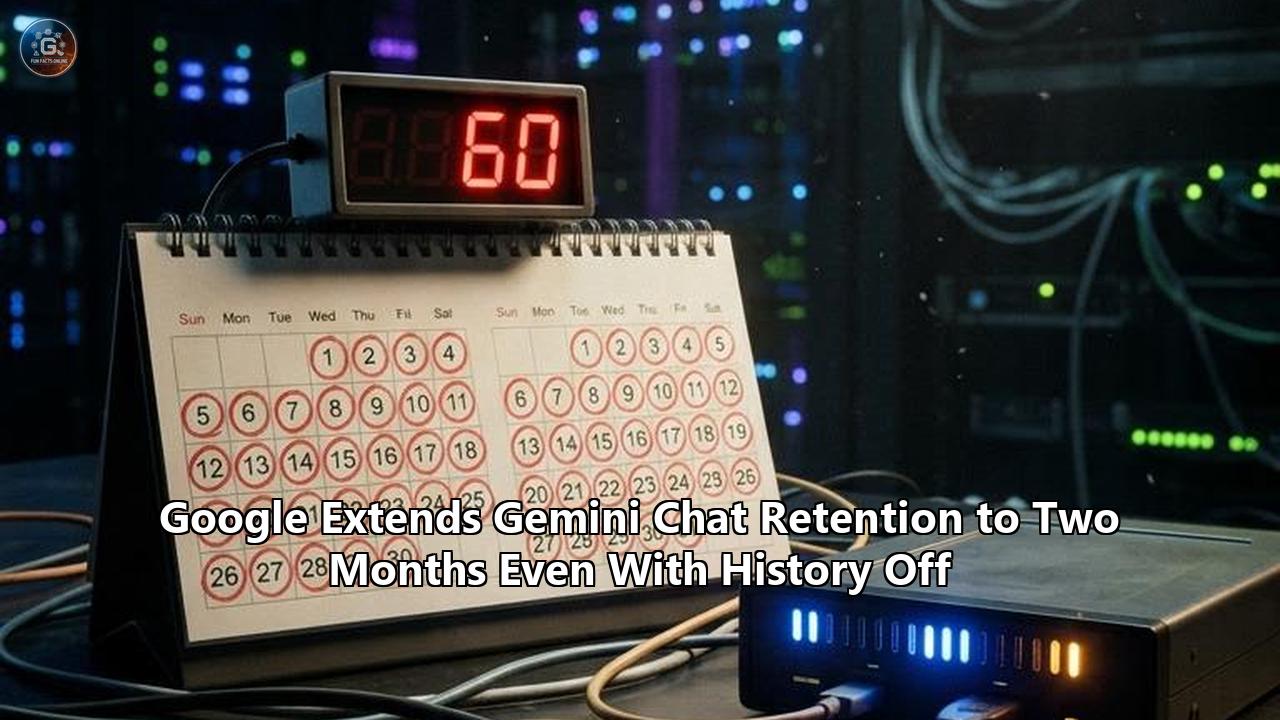
Google has updated its Gemini Apps Privacy Hub, quietly executing a structural change to how it stores user interactions. Under the revised policy, conversations conducted while chat history is explicitly turned off—as well as those initiated within "Temporary Chat" sessions—are now retained on Google's backend servers for approximately two months, up from the previous window of 72 hours.
The change, which rolls out globally across the consumer Gemini web and mobile applications, represents a twentyfold increase in the operational retention timeline for sessions users believe to be ephemeral. It arrives alongside an interface restructuring: Google has officially decoupled its legacy "Keep Activity" toggle into two distinct switches—one controlling conversational history in the user timeline, and another controlling whether user submissions train Google's frontier generative AI models.
While privacy advocates and enterprise compliance officers have long demanded the right to keep conversational history without feeding proprietary data back into training runs, the sixty-day retention window for history-disabled sessions creates a fresh data-governance challenge. By extending server-side storage to two months, Google now holds "off-the-record" prompts, attached documents, audio streams, and multimodal system artifacts twice as long as primary competitors OpenAI and Anthropic, both of which enforce a 30-day retention ceiling on non-logged sessions.
For consumers who turn history off to discuss medical questions, developers who paste debugging logs containing operational credentials, and enterprise employees using personal Google accounts to parse confidential internal memos, this policy shift fundamentally recalibrates the threat model of conversational AI.
The Challenge: The Illusion of Ephemeral AI
The core operational dilemma exposed by Google's policy shift is the growing gulf between user mental models of privacy and backend enterprise engineering requirements. For more than a decade, consumer software design has trained users to equate "history off," "incognito," or "temporary" toggles with ephemerality. In a browser setting, closing a private tab flushes local storage, cookies, and session tokens from memory. In conversational AI, however, off does not mean gone.
Under the new policy architecture, Google splits account controls into two distinct levers:
- The History Setting: Dictates whether conversations are indexed into the user's visible timeline, where they can be recalled, searched, and manually referenced later. When turned on, records are stored by default for 18 months, with user-configurable auto-deletion intervals of 3 months or 36 months. When turned off, conversations vanish from the left-hand navigation pane immediately.
- The Model Improvement Setting: Dictates whether the contents of those chats—including prompts, file uploads, photos, audio snippets, video frames from Gemini Live, and connected workspace extensions—are ingested into machine-learning pipelines to train future base and fine-tuned models.
┌────────────────────────────────────────────────────────────────────────┐
│                   NEW GEMINI PRIVACY CONTROLS ARCHITECTURE             │
└────────────────────────────────────────────────────────────────────────┘

              ┌──────────────────┐
              │   User Action    │
              └─────────┬────────┘
                        │
       ┌────────────────┴────────────────┐
       ▼                                 ▼
┌──────────────┐                  ┌──────────────┐
│ History: OFF │                  │ Training: OFF│
└──────┬───────┘                  └──────┬───────┘
       │                                 │
       │ Visible chats vanish            │ Prompts excluded from
       │ from timeline                   │ future model weights
       │                                 │
       └────────────────┬────────────────┘
                        ▼
         ┌──────────────────────────────┐
         │     BACKEND RETENTION        │
         │   ~2 MONTHS (60 DAYS)        │
         │   (Up from 72 Hours)         │
         └──────────────┬───────────────┘
                        │
      Flagged for safety / User feedback?
                        │
         ┌──────────────┴───────────────┐
         ▼                              ▼
      [ YES ]                        [ NO ]
         │                              │
         ▼                              ▼
  Human Review Pipeline          Hard-deleted from
  Stored separately up           systems (60 days)
  to 3 YEARS (anonymized)        Backups purge (180 days)
The friction lies in what happens between client-side rendering and backend storage. When a user disables history or launches a Temporary Chat, Google’s backend server clusters do not discard the conversational session. Instead, the system logs the session data, associates it with the underlying Google account infrastructure, and holds it active for approximately sixty days.
This presents an acute architectural problem. The expanded operational window for Gemini chat history retention blurs the boundary between active user archiving and passive corporate telemetry. If an unauthorized party gains access to a user’s authentication tokens or active Google session within that two-month window, or if enterprise forensic teams audit an endpoint, conversations believed to have expired after three days remain fully accessible via backend retrieval interfaces, data subject access requests, or internal administrative queries.
The Multimodal Ingestion Trap
The risk surface is significantly wider than plain text. Gemini is deeply integrated across the Google services ecosystem. When users interact with the platform, they are not simply submitting search-like queries; they are submitting:
- Source code repositories and terminal outputs containing uncommitted logic or forgotten hard-coded environment variables.
- High-resolution photographs and scanned PDF documents containing personally identifiable information (PII), intellectual property, or confidential financial statements.
- Continuous audio streams and live camera feeds processed during Gemini Live sessions.
- Dynamic data queried through extensions that bridge Gemini to Google Workspace, including real-time contents of Gmail inboxes, Google Drive folders, Google Maps locations, and Google Calendar schedules.
When a user switches history off to analyze a sensitive corporate contract or a personal health diagnostic scan, the assumption of safety hinges on prompt deletion. A 72-hour window was already viewed with skepticism by strict data-protection officers; an expansion to two full months elevates the data-spill exposure risk by an order of magnitude.
The Human Review Pipeline and the Three-Year Shadow
The second layer of the challenge involves Google’s human annotation pipeline. According to Google's updated documentation, sessions retained during the two-month holding period remain accessible to internal automated security scanners, policy enforcement systems, and human review teams.
Google clarifies that if a conversation—whether conducted with history on, history off, or inside a temporary session—is flagged by automated filters or submitted through user feedback mechanisms (such as clicking "thumbs down" on an answer), a segment of that interaction can be forwarded to trained human reviewers.
Once a chat transcript enters the human review workflow:
- It is programmatically detached from the user’s Google Account identity to preserve external anonymity.
- It is ingested into specialized evaluation datasets where annotators evaluate factual accuracy, hallucination rates, tone, and policy adherence.
- Crucially, it is retained on Google systems for up to three years.
Manual deletion requests executed by the user do not affect transcripts that have already been routed to human reviewers. Even if an individual turns off history, never touches the conversation again, and attempts to purge their entire Google Activity log, data extracted for annotation remains preserved within Google’s internal benchmarking archives for thirty-six months.
Behind the Decision: Why Did Retention Jump from 72 Hours to 60 Days?
To understand why Google abandoned the 72-hour timeline, it is necessary to examine the technical pressures facing frontier AI developers. Modern large language model operations do not behave like stateless web servers. Operating a platform with hundreds of millions of weekly active users requires balancing real-time safety classification, post-hoc abuse detection, stateful multi-turn reasoning, and distributed system resilience.
Google’s updated Gemini Apps Privacy Hub outlines four specific reasons for the retention expansion:
- To respond to user prompts using the previous 24 hours of conversational context.
- To process feedback submitted directly by the user.
- To protect Google, its users, and the public from safety and security threats.
- To maintain data availability in the event of an infrastructure or database system failure.
Behind these corporate statements lie complex engineering challenges.
┌────────────────────────────────────────────────────────────────────────┐
│               TECHNICAL DRIVERS FOR 60-DAY RETENTION                   │
└────────────────────────────────────────────────────────────────────────┘

  1. ADVANCED THREAT AUDITING
     ┌─────────────────────────────────────────────────────────────────┐
     │ 72 hours proved too short to detect coordinated jailbreaks,     │
     │ agentic prompt injections, and multi-day malicious campaigns.   │
     └─────────────────────────────────────────────────────────────────┘

  2. AGENTIC STATE PRESERVATION
     ┌─────────────────────────────────────────────────────────────────┐
     │ As Gemini executes autonomous tasks (Gemini Tasks), long-running│
     │ workflows require access to historical artifacts and logs.      │
     └─────────────────────────────────────────────────────────────────┘

  3. USER FEEDBACK ANCHORING
     ┌─────────────────────────────────────────────────────────────────┐
     │ When users flag problematic outputs days later, engineers need  │
     │ the preceding 24-hour interaction context to diagnose errors.   │
     └─────────────────────────────────────────────────────────────────┘

  4. DISTRIBUTED DISASTER RECOVERY
     ┌─────────────────────────────────────────────────────────────────┐
     │ Cryptographic purging across multi-region datacenters conflicts │
     │ with rolling enterprise backup snapshots (retained up to 180d). │
     └─────────────────────────────────────────────────────────────────┘
1. The Post-Hoc Threat Auditing Dilemma
In late 2023 and throughout 2024, basic automated safety filters relied on synchronous pattern matching. If a user submitted a prohibited prompt—such as requesting chemical weapon synthesis or generating malicious exploit payloads—input-output guardrails intercepted the generation immediately.
By 2026, the landscape of AI abuse evolved. Threat actors increasingly deploy multi-turn jailbreaks, prompt-injection attacks distributed across dozens of separate prompts, and steganographic data extraction techniques. Under a 72-hour retention limit, Trust & Safety teams faced an impossible investigative window.
If a bad actor leveraged Gemini over the course of a week to stage a complex social engineering attack or reverse-engineer software vulnerabilities, the initial interaction logs vanished before automated heuristics or external law enforcement notifications flagged the campaign. A 60-day window provides security analysts the temporal depth required to run retrospectives across clusters of suspicious accounts, trace coordinate attacks, and refine defensive system prompts.
2. The Mechanics of Multi-Turn Context and User Feedback
Google’s documentation notes that temporary chats use the prior 24 hours of conversation as functional context. In conversational agents, users frequently return to a tab opened the previous afternoon, expect the assistant to recall an ongoing coding problem, and submit follow-up prompts.
Furthermore, if a user experiences an abusive, defamatory, or dangerous output, they rarely file an administrative complaint within minutes. If a user flags a generation two weeks after it occurred, Google’s diagnostic systems require the source prompt, the model version, the sampling temperature parameters, and the preceding context to recreate the error.
Under the old 72-hour rule, if an investigation took four days to assign to an engineer, the source log was already wiped. The 60-day holding tank prevents support and quality teams from investigating "ghost errors" where the evidence has evaporated.
3. Agentic Execution and Long-Running Workflows
Gemini is no longer just a predictive text window; it is an agentic operating layer. With the introduction of features like Gemini Tasks and automated background research agents, interactions are increasingly asynchronous.
When an agent executes an autonomous chain-of-thought workflow—navigating web pages, querying external APIs, compiling code in remote virtual environments, or formatting spreadsheets—the execution cycle can span hours or days. Retaining the underlying chat records for only 72 hours created severe race conditions in remote execution environments. If a background task failed mid-cycle over a weekend, error-reporting subsystems were unable to pull context from the originating chat thread.
4. Database Immutability and Disaster Recovery Realities
At Google's scale, user data is sharded, replicated, and geographically distributed across global Spanner databases and Colossus storage architectures. Executing a true "hard purge" of specific user records within 72 hours across live read-replicas, hot standby nodes, and immutable cold backups creates immense engineering overhead.
When a record is deleted in a production database, it typically receives a "soft delete" flag; physical sectors on storage drives are not immediately overwritten. Google’s infrastructure policies indicate that while active operational records are flagged, full physical purging from backup media can take anywhere from two months to 180 days. The 60-day policy change effectively aligns Google's legal commitments in the Privacy Hub with the physical reality of its asynchronous disaster recovery pipelines.
The Systemic Risks: Privacy, Compliance, and Shadow IT
The decision to extend backend retention has triggered immediate alarm among enterprise chief information security officers (CISOs), privacy attorneys, and international data regulators. The move deepens the divergence between consumer-facing AI terms and enterprise governance frameworks.
┌────────────────────────────────────────────────────────────────────────┐
│                   COMPETITIVE RETENTION LANDSCAPE                      │
└────────────────────────────────────────────────────────────────────────┘

Provider          History-Off Window       Human Review Term   Model Training Opt-Out
──────────────────────────────────────────────────────────────────────────────
Google Gemini     ~60 Days (Two Months)    Up to 3 Years       Decoupled (Independent)
OpenAI ChatGPT    Up to 30 Days            Up to 30 Days*      Decoupled (History Off)
Anthropic Claude  30 Days                  30 Days*            Default Opt-Out
Private/OSS LLMs  0 Seconds (Stateless)    None                Zero

*Unless flagged for legal, safety, or explicit policy violations.
The Regulatory Friction: GDPR and Data Minimization
Under the European Union’s General Data Protection Regulation (GDPR), data controllers must operate under the strict mandates of Article 5(1)(c) (Data Minimisation) and Article 5(1)(e) (Storage Limitation). These articles mandate that personal data must be "adequate, relevant and limited to what is necessary in relation to the purposes for which they are processed" and kept for no longer than necessary.
When a European citizen explicitly toggles their Gemini settings to "History Off," they express an unambiguous intent: they do not wish for that session to be stored. By overriding that preference and enforcing a 60-day server-side holding period, Google invites regulatory scrutiny from European data protection authorities, including the Irish Data Protection Commission (DPC) and France’s CNIL.
The primary legal point of contention centers on whether "safety monitoring" and "protection against system failure" constitute a valid legitimate interest under Article 6(1)(f) sufficient to override the fundamental rights of the data subject who has specifically requested that their data not be retained.
Furthermore, Article 17 of the GDPR outlines the Right to Erasure ("Right to be Forgotten"). Google’s documentation notes that while users can manually delete their past Gemini activity at any time, complete removal across all backup and processing systems takes approximately two months—and does not retroactively erase snippets forwarded to human evaluation pools.
The Corporate Enterprise Blindspot
The most severe threat emerging from this update is the phenomenon of "Shadow AI" inside corporate networks. While enterprise-grade tiers—such as Gemini Enterprise, Gemini for Google Workspace, and Vertex AI APIs—operate under strict, legally binding non-retention agreements where prompts are never reviewed by humans or used for training, millions of corporate employees interact with AI via free consumer accounts on personal or company-issued laptops.
Consider a senior financial analyst preparing an unreleased quarterly earnings report. The analyst opens gemini.google.com, toggles the History switch to "Off" under the assumption that the session is ephemeral, and pastes financial tables alongside proprietary internal revenue projections to ask for summarization.
Under the old architecture, that data lived on Google's operational servers for three days. Under the new rules:
- The financial data remains stored on Google’s systems for sixty days.
- The data is linked to the employee’s account identifiers.
- If an automated safety filter flags an anomaly in the formatting, a human contractor could view an excerpt of those confidential projections, retaining it in separate systems for three years.
- If the analyst’s corporate machine or personal Google account is compromised within that two-month span, the prompt data is subject to lateral discovery.
This reality destroys conventional Data Loss Prevention (DLP) baselines. Organizations that previously categorized consumer Gemini use as "low risk if history is disabled" now face an unmonitored sixty-day external data liability.
Surveillance and Subpoena Windows
A longer retention timeframe directly widens the window for civil litigation discovery, administrative subpoenas, and national security data requests.
Under the United States Stored Communications Act (SCA) and related electronic surveillance frameworks, law enforcement agencies and civil litigants can serve preservation requests (such as 18 U.S.C. § 2703(f) letters) on cloud service providers. When a preservation letter is served, the provider is legally mandated to freeze all account records currently residing on its servers.
When Google maintained a 72-hour retention cycle for history-disabled chats, the temporal window for an external legal entity to identify a target, draft a preservation request, and serve it to Google's legal team before the logs were overwritten was vanishingly small. With the timeline extended to sixty days, the discovery aperture expands significantly. Any interaction that occurred six weeks prior remains fully intact and subject to formal preservation, subpoena, and disclosure.
Solutions: How Leaders, Engineers, and Users Are Responding
The expansion of backend retention requires systematic countermeasures across personal workflows, enterprise security baselines, and legal compliance structures. Managing corporate risk under modern Gemini chat history retention frameworks demands moving away from passive trust in interface toggles toward active technical enforcement.
┌────────────────────────────────────────────────────────────────────────┐
│            ENTERPRISE DEFENSE-IN-DEPTH ARCHITECTURE                    │
└────────────────────────────────────────────────────────────────────────┘

  [Corporate Endpoint]
           │
           │  (Pasting Source Code, M&A Docs, Customer PII)
           ▼
  [Cloud Access Security Broker (CASB) / SASE Gateway]
           │
           ├───► Rule 1: Block `gemini.google.com` (Consumer)
           │
           └───► Rule 2: Redirect to Authorized Enterprise AI Portal
                       │
                       ▼
         [Self-Hosted / Proxy Gateway]
                       │
                       ├─── Data Loss Prevention (DLP) Tokenizer
                       │    (Regex masks API keys, names, SSNs)
                       │
                       ├─── Client-Side Redaction Engine (e.g., Presidio)
                       │
                       ▼
         [Approved Vertex AI / Gemini API Tier]
                       │
                       ├── Contractual Zero Data Retention (ZDR)
                       ├── Human Review Prohibited
                       └── Model Training Prohibited
1. Enterprise Infrastructure Countermeasures
Enterprise security teams must treat consumer generative AI applications as unauthorized external cloud file-sharing services. Relying on employee compliance to toggle "History Off" is no longer an acceptable security control.
Blocking Consumer Endpoints via SASE and CASB
Security teams must enforce immediate policy rules within Secure Access Service Edge (SASE) and Cloud Access Security Broker (CASB) platforms—such as Cloudflare One, Zscaler Internet Access, Palo Alto Networks Prisma Access, or Netskope:
- Domain-Level Restriction: Block outbound traffic from corporate-managed devices to gemini.google.com and bard.google.com.
- Header Injection for Workspace Tenancy: If an organization licenses Google Workspace Enterprise, configure network proxies to inject Google Workspace tenant restriction headers (X-GoogApps-Allowed-Domains). This prevents employees from authenticating into personal @gmail.com accounts on corporate networks while preserving access to corporate-managed Gemini side-panels that operate under zero-training, non-human-review commercial terms.
Enforcing Enterprise and API Tiers
Security architectures must redirect developer and business demand toward approved interfaces with contractually enforced data life cycles.
- Vertex AI Deployments: Deploy Gemini models strictly via Google Cloud Platform's Vertex AI engine. Under GCP’s standard Data Processing Addendum (DPA), customer prompts, responses, and embeddings are never used to train Google models, are never routed to human annotation contractors, and adhere to deterministic customer-controlled deletion lifecycles.
- Paid Gemini API Routing: For internal application integration, mandate the use of paid tiers of the Google AI Studio / Gemini API. Paid API endpoints do not log prompts for model training, and while Google maintains temporary abuse monitoring logs (retained up to 55 days under strict access controls), these logs are walled off from consumer human-review pools.
2. Client-Side Sanitization and Privacy Proxy Gateways
For development teams and technical users who interact with LLMs programmatically or through web interfaces, technical solutions must strip identifying attributes before packets leave local memory.
Implementing Local Data Loss Prevention (DLP) Proxies
Organizations should deploy open-source privacy-preserving gateway proxies between local development environments and upstream AI APIs. Tools like Microsoft Presidio, Private AI, or custom edge-layer Envoy proxies can be configured to execute real-time anonymization:
# Conceptual Architecture: Client-Side Tokenization Proxy
from presidio_analyzer import AnalyzerEngine
from presidio_anonymizer import AnonymizerEngine

analyzer = AnalyzerEngine()
anonymizer = AnonymizerEngine()

def process_prompt_before_gemini(raw_user_prompt: str) -> str:
    # Scan prompt for PII (emails, IP addresses, credit cards, SSNs)
    results = analyzer.analyze(text=raw_user_prompt, language='en')

    # Replace sensitive tokens with synthetic cryptographic placeholders
    anonymized_result = anonymizer.anonymize(
        text=raw_user_prompt,
        analyzer_results=results
    )

    return anonymized_result.text

# Outbound payload sent to Gemini backend lacks real-world PII
safe_payload = process_prompt_before_gemini(sensitive_corporate_prompt)
By ensuring that prompts containing source code strip internal server hostnames, internal domain paths, employee names, and cryptographic secrets before transmission, the threat posed by a sixty-day backend retention window is minimized. If a sanitized prompt is reviewed by a third-party human contractor or preserved on a backend backup, the data cannot be resolved back to a specific corporate entity or individual.
Ephemeral Sandbox Execution
Developers processing high-risk data should abandon hosted consumer web chatbots entirely in favor of local, self-hosted open-weight language models.
Frameworks like Ollama, llama.cpp, and vLLM execute inference locally on consumer GPUs (such as Apple Silicon unified memory systems or local NVIDIA RTX workstations). When executing locally:
- Model weights run entirely within local system RAM.
- Data retention is mathematically zero once the process termination signal (SIGTERM) is issued.
- Network telemetry can be completely severed via local firewall isolation rules (e.g., Little Snitch, LuLu, or standard Linux iptables).
3. Policy and User-Level Remediation Strategies
For individual users, researchers, and small teams that must continue utilizing consumer Gemini interfaces, operational tradecraft must shift to match the realities of the updated privacy policy.
Disentangling History from Training
Users should immediately navigate to their Gemini Apps Activity settings to configure the new decoupled privacy switches according to their operational security requirements:
┌────────────────────────────────────────────────────────────────────────┐
│             ACTIONABLE STEPS: GEMINI PRIVACY CONFIGURATION             │
└────────────────────────────────────────────────────────────────────────┘

  STEP 1: ACCESS GEMINI ACTIVITY
  Navigate to: `myactivity.google.com/product/gemini`

  STEP 2: DISABLE MODEL TRAINING
  Toggle the "Model Improvement / Training" setting to OFF.
  (Prevents prompts, media, and code from being ingested into
  Google's base training sets)

  STEP 3: EVALUATE THE HISTORY TOGGLE
  Option A: Keep History ON with a 3-Month Auto-Delete Timer.
            (Allows you to track, audit, and manually purge what
            Google stores, making the retention visible)
  Option B: Turn History OFF.
            (Be aware that chats will remain on Google servers for
            ~60 days on the backend, invisible to your dashboard)

  STEP 4: AVOID THE FEEDBACK TRAP
  Never click "Thumbs Down" or "Report" on chats containing sensitive
  personal or corporate data. Submitting feedback bundles the prior
  24 hours of context and can route the transcript to human annotators
  for up to 3 years.
The realization that turning history off does not grant immediate deletion leads some privacy researchers to a counter-intuitive conclusion: it may be safer to keep History turned ON, but paired with aggressive manual auditing.
When History is turned on, every interaction is rendered visibly in the user's Google Activity dashboard. The user can see exactly what logs exist, inspect the metadata, and manually click "Delete All Time" or schedule automated 3-month purges.
Conversely, when History is turned off, the user operates blind: the logs vanish from their personal view, but continue to exist on Google’s backend infrastructure for 60 days, accessible to automated security agents and potential human reviewers without the user retaining any visual record of what was submitted.
Avoiding the User Feedback Retention Escalation
A critical defensive rule is to refrain from submitting product feedback on sensitive prompts.
When an output is inaccurate, offensive, or hallucinated, users frequently click the thumbs-down icon to register dissatisfaction. In Gemini’s architecture, clicking thumbs-down packages the output, the input prompt, and up to 24 hours of preceding conversational context into a high-priority diagnostic payload.
This payload is specifically flagged for review by human contractors to understand why the generation failed. Consequently, an employee attempting to correct a hallucination regarding a corporate financial balance sheet may inadvertently authorize the permanent extraction of that entire conversation into human-accessible training and evaluation databases for three years.
Technical Audit: Consumer vs. Developer vs. Enterprise Tiers
Navigating Google’s multi-layered infrastructure requires understanding how Gemini chat history retention operates across different commercial and technical access points. Data handling rules are not uniform across the Gemini brand name.
┌────────────────────────────────────────────────────────────────────────────────────────────────────────────────┐
│                           COMPREHENSIVE GEMINI DATA LIFECYCLE MATRIX                                           │
└────────────────────────────────────────────────────────────────────────────────────────────────────────────────┘

SURFACE               RETENTION (ACTIVE)     RETENTION (HISTORY OFF)    HUMAN REVIEW      TRAINS PUBLIC MODELS?
──────────────────────────────────────────────────────────────────────────────────────────────────────────────────
Consumer Gemini App   18 Months (Default)    ~60 Days (Two Months)      Yes (Flagged)     Configurable (New Toggle)
                      (Configurable 3-36m)                              (Up to 3 Years)

Free API / Studio     Indefinite / Uncapped  N/A (Stateless Session)    Yes (Permitted)   Yes (Default)

Paid Gemini API       55-Day Abuse Log       N/A (Stateless Session)    Authorized Abuse  No
                      (Encrypted)                                       Scenarios Only

Workspace Enterprise  Admin Configured       Up to 72 Hours             Strictly No       Strictly No
(Side Panel)          (0 Days to Indefinite)

Google Cloud          Customer Controlled    Customer Controlled        Strictly No       Strictly No
(Vertex AI)           (Zero via custom architecture)
The Personal Gemini Consumer Application
This tier applies to anyone visiting gemini.google.com or utilizing the mobile app with a standard Google account (@gmail.com).
Under the November 2026 update, retention is pegged at 60 days minimum for off-the-record or temporary chats, and 18 months default for standard chats. Data is stored on Google's primary consumer infrastructure. Even when users opt out of model training, the retention window for safety auditing remains locked at sixty days.
Human review remains an active, non-negotiable operational component for safety, policy enforcement, and feedback analysis.
The Google AI Studio and Developer API Tiers
When interacting via API keys, the retention equation changes based on billing status:
- Free Tier API: Prompts and responses can be used by Google for model training and can be reviewed by human annotators. Data retention is not bound by a strict consumer-facing auto-delete calendar, creating significant security vulnerabilities if used for production workloads.
- Paid Tier API (Pay-as-you-go): Google explicitly commits that prompts and generated responses are not used to train generative AI models. Prompts are retained in encrypted abuse-monitoring logs for up to 55 days, accessible only to authorized Google security engineers investigating verified violations of the Generative AI Prohibited Use Policy. After 55 days, logs are automatically purged unless a legal hold applies.
Google Workspace and Gemini Enterprise
For businesses running Google Workspace (Business Standard/Plus, Enterprise, or Education), the privacy architecture is fundamentally insulated from the consumer web application:
- Data processed within Google Docs, Sheets, Slides, or the Gemini Workspace side-panel is governed by the Google Workspace Terms of Service and Customer Data Processing Addendum (CDPA).
- Prompts and proprietary corporate data are never used to train base foundation models.
- Interactions are not accessible to human reviewers outside the customer's domain.
- Retention is bound to enterprise administrative settings: administrators can configure data retention rules, audit logs via the Google Admin Console, and execute immediate cryptographic purges that comply with corporate legal holds.
The profound policy changes enacted in the consumer tier underscore why running enterprise workloads through consumer interfaces presents an untenable compliance risk.
Regulatory Outlook and the Horizon for Data Retention
The quiet expansion of Gemini’s history-off retention policy highlights a broader structural friction in generative AI: the irreconcilable conflict between AI safety engineering and data protection law.
AI model developers argue that as models approach frontier capabilities—gaining the ability to write multi-stage software exploits, execute autonomous agentic actions across the web, and synthesize dangerous technical instructions—long-term retention is necessary.
Without historical conversation logs, safety researchers cannot audit delayed-action cyber attacks, verify attribution for AI-assisted security breaches, or identify novel prompt injection strategies targeting enterprise systems. From the perspective of AI safety and Trust & Safety engineering, a 72-hour retention window was an operational liability.
Conversely, from the perspective of global privacy regulators and civil liberties advocates, forcing a two-month retention period onto users who explicitly turn history off undermines user autonomy and contravenes the basic tenets of privacy by design. If a user demands that an interaction not be saved, maintaining that interaction on cloud infrastructure for sixty days—linked to their real-world identity and subject to human annotation—creates an architectural backdoor that renders the "Off" switch misleading.
┌────────────────────────────────────────────────────────────────────────┐
│                   UPCOMING REGULATORY FLASHPOINTS                      │
└────────────────────────────────────────────────────────────────────────┘

  1. EUROPEAN DATA PROTECTION BOARD (EDPB) INQUIRIES
     Scrutiny under GDPR Article 5(1)(e) (Storage Limitation) regarding
     whether 60 days of retention is strictly necessary for users who
     have actively disabled chat history.

  2. FTC ENFORCEMENT ON DECEPTIVE PRIVACY ARCHITECTURES
     Investigations into whether labelling a setting "History Off" while
     storing records server-side for two months constitutes an unfair or
     deceptive trade practice under Section 5 of the FTC Act.

  3. DEMANDS FOR CRYPTOGRAPHIC PURGE VERIFICATION
     Push from enterprise security consortia for third-party auditing
     and zero-knowledge proofs of deletion across distributed cloud nodes.
In the coming months, this policy revision will likely face formal inquiries. European regulators, who have already subjected OpenAI to extensive enforcement investigations over GDPR compliance and training data rights, are poised to examine whether Google's new split-toggle structure provides sufficient transparency.
Particular attention will focus on whether labeling a setting "History Off" while retaining transcripts for two months constitutes a deceptive design pattern under modern consumer protection statutes.
At the same time, the broader technology sector is watching closely. If Google successfully normalizes a 60-day operational retention window for non-logged AI sessions without suffering catastrophic regulatory fines or mass user churn, competitor labs will face strong incentives to follow suit.
Both OpenAI and Anthropic currently absorb substantial infrastructure costs to maintain their 30-day safety review pipelines; extending their own holding tanks would grant their safety teams deeper telemetry to monitor long-horizon abuse.
For organizations, developers, and users, the mandate is clear: absolute ephemerality does not exist within consumer frontier AI. Every prompt, every uploaded document, and every multimodal frame must be treated as persistent corporate and personal data that will reside on cloud infrastructure for months, regardless of how many privacy toggles are switched off. Security architectures must be engineered around this reality, replacing passive reliance on provider settings with client-side sanitization, strict endpoint isolation, and mathematically verifiable data governance.
Reference:
- https://support.google.com/gemini/answer/13594961?hl=en-GB
- https://www.notebookcheck.net/Gemini-separates-history-from-AI-training-but-keeps-chats-longer.1452356.0.html
- https://techcrunch.com/2026/11/17/google-to-keep-gemini-chats-for-two-months-up-from-72-hours-even-with-history-off/
- https://explainx.ai/blog/google-gemini-temporary-chat-two-month-retention-privacy-hub-november-2026
- https://gizmodo.com/google-to-keep-ai-chat-logs-for-two-months-even-with-gemini-history-turned-off-2000841271
- https://cryptobriefing.com/google-gemini-ai-training-opt-out/
- https://proton.me/lumo/ai/gemini-privacy-policy
- https://anarlog.so/blog/google-gemini-data-retention-policy/
- https://ground.news/article/google-to-keep-gemini-chats-for-2-months-up-from-72-hours-even-with-history-off