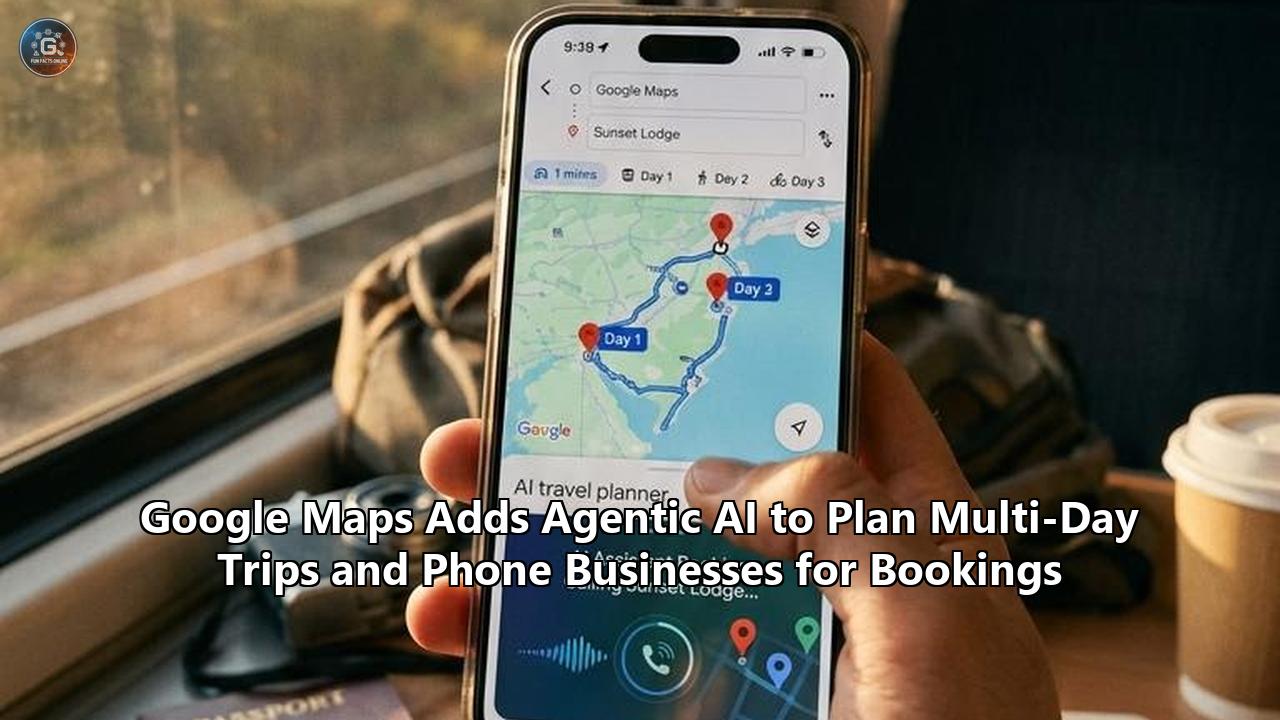
Google has officially pushed its navigation platform into autonomous execution. The company rolled out a series of updates to Ask Maps, embedding automated multi-day itinerary generation and autonomous phone-calling capabilities directly into Google Maps on Android and iOS. Framed around the peak holiday travel rush—a period when AAA projects roughly 73 million Americans will take to the roads—the release transitions Maps from a passive spatial directory into an active digital concierge.
Through natural language prompts, users can instruct the application to construct complete, multi-day road trips complete with chronologically ordered stops, real-time traffic considerations, operating hours, and numbered map pins. Beyond algorithmic routing, the system can autonomously dial local merchants to secure service appointments for automotive repair, pet grooming, hair styling, and home maintenance.
The rollout of Google Maps agentic AI marks a calculated shift in how major technology firms deploy automated software agents. Rather than asking consumers to navigate standalone chat interfaces, prompt-driven browser extensions, or dedicated hardware peripherals, Google is anchoring agentic autonomy inside an established utility that commands more than one billion monthly active users.
This release sets up a clash between competing technological philosophies: native geospatial data graphs versus computer-using web agents, embedded utility ecosystems versus paid subscription models, and cloud-driven algorithmic automation versus privacy-first, on-device architectures.
The Announcement: What Ask Maps Can Now Do
According to Maz Khorasani, Product Director at Google Maps, the latest Ask Maps release targets both long-distance travel preparation and immediate local logistics. The update introduces four primary capabilities that alter the software’s underlying utility:
+-----------------------------------------------------------------------------------+
|                        GOOGLE MAPS AGENTIC ARCHITECTURE                           |
|                                                                                   |
|  [ User Prompt ] ---> ( Ask Maps Orchestrator: Gemini Engine )                   |
|                                     |                                             |
|        +----------------------------+----------------------------+                |
|        |                            |                            |                |
|  [ Places Agent ]            [ Routes Agent ]           [ Telephony Agent ]       |
|  - Real-time Hours           - Traffic & Delays         - Autonomous Dialing      |
|  - Live Venue "Vibe"         - EV Charging / Parking    - Duplex Speech Engine    |
|  - Saved Lists Inventory     - Toll Calculations        - Slot Negotiation        |
|        |                            |                            |                |
|        +----------------------------+----------------------------+                |
|                                     |                                             |
|  [ Output Execution ]                                                             |
|  - Numbered Map Itineraries (Exportable to Google Docs)                           |
|  - Real-Time Mid-Route Dynamism (Add stops on the fly)                            |
|  - Direct In-App Appointment Confirmation                                         |
+-----------------------------------------------------------------------------------+
1. Conversational Multi-Day Itinerary Building
Users can supply natural language constraints—such as requesting a three-day Pacific Coast Highway excursion balancing dog-friendly coastal hiking trails with oceanfront dining. Rather than generating a text-only list, Ask Maps structures a sequenced, day-by-day plan with custom numbered pins placed directly across the geographic canvas.
These plans calculate drive times between waypoints, account for historical business congestion, and package the trip into a shareable format that can be exported directly into Google Docs or accessed through an "Itinerary" badge in chat history.
2. Autonomous Telephony and Appointment Discovery
In the United States, Ask Maps can now bridge the gap between online inventory and legacy offline service providers. When a user asks for an afternoon oil change or a 4:00 PM manicure, the assistant scans integrated booking software such as Toast and Square.
If open time slots are not listed on digital booking platforms, the system uses natural-sounding synthetic voice protocols to telephone nearby establishments directly. It queries the business's human receptionist regarding open availability, confirms service parameters, and presents confirmed slots within the app interface for final user confirmation.
3. Real-Time Spatial Queries Against Saved Lists
Users who maintain extensive saved collections—such as "Bookmarked Cafes" or "Weekend Dinner Spots"—can run multi-variable availability queries across their curated lists. A prompt such as "Which restaurants on my downtown list have an open table for five people within the next thirty minutes?" filters static bookmarks through live table-management APIs, current operating hours, and active customer volume.
4. Route Intelligence ("Know Before You Go")
Before departure, Google Maps generates proactive situational briefs that outline expected parking difficulty at the target destination, compatibility and availability at electric vehicle (EV) charging stations, pending toll charges, and micro-climate weather forecasts along specific highway corridors.
The itinerary builder and saved-list query tools rolled out across more than 200 countries and territories, including an expansion into 30 European markets such as Germany, Spain, and the United Kingdom. The voice-calling agent and "Know Before You Go" route briefs remain restricted to US users while Google navigates regional regulatory environments and language localization.
Architectural Paradigms: Spatial Knowledge Graphs vs. Web Browsing Agents
To understand how this development diverges from existing artificial intelligence tools, one must examine the fundamental architectural divide between spatially grounded systems and general-purpose computer-using agents.
+--------------------------------------------------------------------------------------------------+
|                     COMPETING AGENTIC ARCHITECTURES FOR TRAVEL & TASKS                           |
+--------------------------+---------------------------------------+-------------------------------+
| Attribute                | Spatially Grounded (Google Maps)      | Web-Action (OpenAI Operator)  |
+--------------------------+---------------------------------------+-------------------------------+
| Core Data Foundation     | Real-time internal spatial database   | Unstructured HTML DOM trees   |
| Verification Source      | Verified merchant profiles, GPS telemetry| Visual screenshots, mouse input|
| Tool Execution           | Native APIs, Duplex-derived SIP calls | Headless browser interactions |
| Offline Resilience       | Cached spatial routing, local maps    | None (requires live web DOM)  |
| Latency Profile          | Milliseconds (internal index lookups) | Seconds to minutes per click  |
| Failure Modes            | API misconfiguration, bad hours data  | CAPTCHAs, DOM drift, anti-bot |
+--------------------------+---------------------------------------+-------------------------------+
The prevailing industry trend—exemplified by OpenAI’s Operator and Anthropic’s Computer Use—relies on multimodal models that "see" a standard computer screen via screenshot buffers and interact with it through emulated mouse clicks and keystrokes. When tasked with assembling a travel plan, these general-purpose web agents navigate to online travel aggregators (OTAs) such as Expedia, Booking.com, or Priceline. They parse document object model (DOM) trees, attempt to circumvent bot-detection firewalls, and fill out checkout fields on behalf of the consumer.
While technically versatile, the browser-use paradigm carries heavy structural overhead:
- High Latency: An agent navigating an interactive web portal must wait for page hydration, evaluate visual elements, execute intermediate clicks, and adjust for dynamic pop-ups or CAPTCHAs.
- Fragile DOM Dependencies: A minor change in a merchant’s checkout button ID or layout can cause visual and programmatic navigation to fail.
- Detached Spatial Understanding: Web agents read reviews and text descriptions, but they often lack native comprehension of real-time transit telemetry, road elevation, dynamic speed traps, or complex urban geometries.
In contrast, Google Maps agentic AI does not scrape web pages or emulate human browsing. It operates atop Google's comprehensive geographical knowledge graph. The core reasoning engine—built upon Gemini—queries structured, low-latency internal databases that compile satellite imagery, Street View telemetry, live GPS breadcrumbs from hundreds of millions of active smartphones, and verified Google Business Profiles.
When Ask Maps evaluates whether a restaurant stop fits into a broader road-trip timeline, it does not query an external review blog. Instead, it runs an internal optimization routine:
$$\text{Arrival Time} = T_{\text{current}} + \Delta t_{\text{route}}(\text{Traffic}_{\text{live}}) + \Delta t_{\text{buffer}}$$
It evaluates the business’s verified holiday operating schedule, checks whether the venue historically experiences peak occupancy on Friday afternoons, and identifies nearby parking structures that match the user’s vehicle type.
Where general-purpose foundation models rely on third-party scrapers, Google Maps agentic AI builds directly upon a closed telemetry feedback loop: every driver following an Ask Maps itinerary actively updates the platform’s live traffic algorithms, refining the travel calculations for every agent operating behind them.
The Telephony Front: Google Duplex Roots vs. Meta Muse
The most provocative element of Google’s update is the autonomous telephone booking agent. By authorizing an artificial intelligence to place phone calls to human workers, Google has directly entered territory recently staked out by Meta’s Muse assistant. However, their underlying technologies, economic motivations, and operational safeguards diverge significantly.
+--------------------------------------------------------------------------------------------------+
|                              AUTONOMOUS VOICE AGENTS COMPARED                                    |
+--------------------------+---------------------------------------+-------------------------------+
| Strategic Factor         | Google Maps (Ask Maps Agent)          | Meta Muse                     |
+--------------------------+---------------------------------------+-------------------------------+
| Primary Commercial Model | Free ad/commerce ecosystem integration| $20 to $100 monthly sub|
| Voice Engine Lineage     | Evolved Google Duplex architecture   | Superintelligence Labs Voice  |
| Calling Scope            | Local services (pet, auto, beauty)| Broad (DMV, cable, restaurants)|
| Underlying Incentives    | Defend local search and Maps utility  | Direct consumer monetization  |
| Transparency Protocol   | Standardized automated disclosure     | Inconsistent self-disclosure  |
| Verification Framework   | Merchant-claimed profile cross-checks | General telephone directories |
+--------------------------+---------------------------------------+-------------------------------+
The Duplex Heritage
Google’s telephony engine is not an unvetted prototype; it is the production evolution of Google Duplex. When Google first unveiled Duplex in 2018, its hyper-realistic synthetic speech patterns—replete with conversational disfluencies like "um" and "mm-hmm"—ignited fierce debate over consent and technological deception.
That public pushback forced Google to institute rigid conversational protocols: modern iterations must clearly disclose that an automated assistant is calling on behalf of an identified client.
Furthermore, Google’s telephony agent operates within bounded domains. In Ask Maps, calls are restricted to narrow task vectors: inquiring about specific scheduling availability for beauty, pet care, automotive services, and home maintenance. The dialogue tree is tightly constrained:
[Agent Initiates Outbound Call]
               |
               v
[Mandatory Disclosure: "I'm the automated booking service for Google Maps calling for a customer..."]
               |
               v
[Query Target: Specific Date / Service / Time Window]
               |
        +------+------+
        |             |
        v             v
[Slot Available]    [Slot Unavailable]
        |             |
        |             +---> [Request Nearest Alternative Time]
        v
[Log Slot Data to Internal App Cache]
        |
        v
[End Call & Display Choice to User]
The Meta Muse Strategy
Meta recently introduced autonomous business-calling capabilities into its Muse agent, overseen by Alexandr Wang, chief AI officer of Meta's Superintelligence Labs. But Meta's delivery mechanism is fundamentally different.
First, Meta positions calling as a premium subscription feature, with pricing tiers starting at $20 per month for 500 million tokens and scaling to $100 per month for heavy usage.
Second, Meta targets generalized consumer friction. Rather than restricting the model to specific local appointments, Muse is designed to sit on hold with municipal agencies, negotiate cable bill discrepancies with internet service providers, or ring up restaurants that refuse to adopt online reservation widgets.
This generalized approach introduces friction. Early testers of Meta’s Muse noted instances where the synthetic voice did not explicitly identify itself as an automated agent, leading human staff to suspect prank calls or identity fraud.
Moreover, receptionists, medical clerks, and small business owners are increasingly hanging up on synthetic voices. When an office staff member earns an hourly wage to answer incoming calls, managing a multi-minute back-and-forth with an artificial agent can feel like an unwelcome burden.
The Threat of Agentic Gridlock
The proliferation of voice agents risks precipitating a systemic breakdown in telephonic business operations: agentic gridlock.
As tools like Ask Maps, Meta Muse, and voice startups dial businesses simultaneously, local merchants are turning to automated virtual receptionists to answer their primary phone lines. The result is an inefficient algorithmic loop: an outbound AI agent (acting for a consumer) calls an inbound AI agent (defending a business) to negotiate an appointment over a public switched telephone network (PSTN) voice channel.
Converting structured digital data into synthetic human speech, routing it over legacy copper and cellular lines, and running it back through speech-to-text models introduces transcription lag, packet loss, and semantic hallucinations. While Google frames phone-calling as a bridging technology for non-digital merchants, it acts as an inefficient stopgap until businesses adopt structured machine-to-machine APIs.
Direct Comparison: Specialized Itinerary Platforms vs. The Default Navigation Layer
Google's entry into multi-day itinerary building places it in direct competition with specialized travel planning platforms that spent the last several years building AI-assisted trip tools. Startups such as Wanderlog, Mindtrip, and Layla have created specialized interfaces to solve the problem of multi-stop travel logistics.
+----------------------------------------------------------------------------------------------------+
|                         TRIP PLANNING PLATFORMS: TRADEOFF MATRIX                                   |
+--------------------------+--------------------+--------------------+-------------------------------+
| Capability               | Google Maps (2026) | Wanderlog          | Mindtrip                      |
+--------------------------+--------------------+--------------------+-------------------------------+
| Real-Time Navigation     | Native turn-by-turn| External app handoff| External app handoff         |
| Dynamic Route Updates    | Live traffic/vibe  | Manual re-sort     | Static conversational update  |
| Booking Integration      | Native Duplex calls| Affiliate links    | In-app checkout (GDS/OTAs)|
| Multi-User Collaboration | Docs export only   | Real-time co-edits | Shared boards                 |
| Expense Splitting        | None               | Built-in ledger    | None                          |
| Mobile Distribution      | Pre-installed core | App Store download | App Store download            |
+--------------------------+--------------------+--------------------+-------------------------------+
The Specialist Model
- Wanderlog: Built as a collaborative workspace, Wanderlog operates like a purpose-built Notion for travelers. It excels at group dynamics, letting multiple travelers drop pins, vote on locations, organize lodging confirmations parsed from email inboxes, and track shared expenses. While Wanderlog integrates AI to auto-populate itineraries and optimize daily driving loops, it treats AI as an assistant to manual planning rather than an autonomous decision-maker.
- Mindtrip: Mindtrip takes a conversational, chat-first approach to travel inspiration. It processes links, social media videos, and text prompts to output interactive itineraries that connect directly to global distribution systems (GDS), enabling users to purchase airline tickets and book hotel rooms within its native application.
- Layla: Operating as a hybrid discovery platform, Layla pairs conversational generative models with licensed human travel advisors who review algorithmic itineraries, apply corporate discounts, and execute bookings on behalf of users.
The Google Maps Friction Advantage
Specialized applications build deeper niche features, but they run into a major consumer hurdle: execution fragmentation.
A traveler planning a vacation inside Wanderlog or Mindtrip must eventually close that application and launch Google Maps or Apple Maps the moment they step into a vehicle. The standalone planner does not provide low-level lane-level guidance, cannot alert a driver to debris on the highway, and cannot instantly reroute around a sudden collision.
Ask Maps dissolves this divide entirely. Because the itinerary generator and the navigation engine run on the same platform, an Ask Maps trip plan remains active throughout the journey:
- If a user encounters an unexpected forty-minute delay outside Santa Barbara, Ask Maps dynamically adjusts the arrival window for subsequent dinner stops.
- If a coastal road is closed due to inclement weather, the itinerary shifts its numbered pins automatically, without requiring the user to copy waypoints between separate apps.
- Tapping a pin immediately initiates turn-by-turn guidance, complete with real-time speed monitoring and EV charge tracking.
However, Google’s platform lacks several community-centric elements found in specialized tools. Ask Maps does not handle shared travel budgets, lacks native tools to split fuel bills among friends, and offers basic export workflows—such as generating a static Google Doc—rather than real-time, multi-cursor collaborative itinerary editing.
Google is banking that for most drivers, operational convenience and reliable transit navigation outweigh deep, specialized group-planning features.
Distribution Battles: Native Ecosystems vs. OpenAI’s Odessia Bet
While Google leverages its geographical data moats, OpenAI is attempting to assemble an end-to-end travel and commerce stack through acquisition and external integration.
[OpenAI Commercial Travel Stack]
(ChatGPT Consumer Interface)
             |
             v
(Acquired Odessia Engine) <--- Licensed IATA Agency Accreditations
             |
             v
[Third-Party Global Distribution Systems (GDS)]
             |
             x <--- Pushback / Blockades (e.g., United Airlines AI Lockout)
             v
[Airlines, Hotels, Car Rentals]
In late 2026, OpenAI acquired Odessia, an artificial intelligence travel startup founded by Francis Davidson. Odessia was engineered as a conversational concierge that planned and booked trips within a single chat thread. Crucially, Odessia brought along official accreditation from the International Air Transport Association (IATA).
IATA accreditation allows an entity to operate as a certified travel agency, accessing wholesale hotel rates, agency perks, and global flight inventories directly—bypassing consumer-facing intermediaries like Expedia and Booking.com.
The Resistance: Walled Gardens and Policy Bans
OpenAI’s push to become an autonomous booking broker has met immediate resistance from entrenched travel suppliers. Days after the Odessia transaction surfaced, United Airlines updated its distribution and ticketing policies to block third-party artificial intelligence agents from accessing customer accounts or executing automated flight purchases.
United cited customer cybersecurity and Federal Aviation Administration (FAA) ticketing compliance, explicitly prohibiting automated tools from spending MileagePlus balances or altering booking reservations.
Airlines and hospitality chains resist agentic intermediaries because autonomous software strips away their customer retention strategies:
- Ancillary Fee Bypassing: An artificial agent programmed to secure the lowest net fare systematically bypasses high-margin upsells—such as seat selection fees, priority boarding, travel insurance, and branded credit card pitches.
- Customer Relationship Erosion: If ChatGPT or Operator becomes the primary travel interface, the airline is reduced to a commoditized utility, losing valuable behavioral data and direct guest engagement.
[Google Local Ecosystem Strategy]
(Ask Maps Interface)
        |
        v
(Google Business Profiles) <--- Millions of Claimed, Direct Merchant Records
        |
        v
(Point-of-Sale Integrations: Square, Toast, Uber Eats)
        |
        v
[Local Services: Salons, Mechanics, Cleaners, Independent Diners]
Google’s Local Flank Strategy
Herein lies what makes Google Maps agentic AI unique in its market execution: Google is largely bypassing the contested global airline ticketing war, focusing its initial agentic automation on fragmented, non-unionized local commerce.
An independent pet groomer, auto transmission mechanic, or four-chair nail salon does not maintain automated firewall architectures or retain legal lobbyists to write anti-agent terms of service. These small businesses rely heavily on Google Business Profiles to attract foot traffic.
Instead of fighting United Airlines or Delta over GDS ticket APIs, Ask Maps directs its agentic tools at daily service errands. By coordinating local appointments and regional road-trip planning, Google secures defensible transactional ground where incumbent enterprise travel suppliers have little leverage to intervene.
Apple’s Contrasting Philosophy: On-Device Boundaries and Privacy Guardrails
As Google deploys autonomous agents into Maps, Apple is pursuing a fundamentally different technical path for Apple Maps and Apple Intelligence.
+--------------------------------------------------------------------------------------------------+
|                            GOOGLE VS. APPLE: LOCAL AI PHILOSOPHY                                 |
+--------------------------+---------------------------------------+-------------------------------+
| Engineering Dimension    | Google Maps (Agentic Ask Maps)        | Apple Maps (Apple Intelligence)|
+--------------------------+---------------------------------------+-------------------------------+
| Processing Locus         | Cloud Compute (Gemini clusters)| Neural Engine (On-device)|
| Data Ingestion Pattern   | Centralized telemetry, public calling | Local Private Cloud Compute   |
| Autonomous Actions       | Outbound telephony, automatic booking | App Intents, human handoff    |
| Developer Interaction    | Model Context Protocol (MCP)  | Swift App Intents framework   |
| Monetization Mechanism   | Local ads, merchant ecosystem rank    | Premium hardware ecosystem    |
+--------------------------+---------------------------------------+-------------------------------+
The Apple Architecture
Apple’s navigational upgrades focus on on-device predictive intelligence rather than autonomous external action. Apple Maps utilizes on-device neural engines to learn routine user commutes, map topographic hiking elevations, and track preferred vehicle charging stations without sending location histories to central corporate databases.
When Apple connects its artificial intelligence models to third-party workflows, it does so through the App Intents framework. Under this model:
- The system does not phone a local business via synthetic voice.
- It does not scrape an external web resource using a browser simulator.
- It requests structured data exchange via secure APIs natively provided by applications installed on the user’s device (such as OpenTable, Yelp, or Mindtrip).
- The user is presented with a system-level interface requiring a manual biometric confirmation (FaceID) before any transaction or booking settles.
Strategic Tradeoffs
This architectural divergence highlights a classic technology compromise between capability and privacy:
[Google Philosophy: Maximum Automation]
Consumer Intent ---> Cloud Gemini Engine ---> Autonomous Phone Calls / API Writes ---> Problem Solved
(Tradeoff: Privacy exposure, cloud processing overhead, business disruption)

[Apple Philosophy: Maximum Privacy & Bounded Action]
Consumer Intent ---> On-Device Engine ---> App Intent Prompt ---> Biometric Confirmation
(Tradeoff: Friction remains, cannot book businesses lacking modern API infrastructure)
Apple’s model eliminates the risk of an artificial intelligence agent making unauthorized reservations, hallucinating calendar commitments, or distressing local business owners with unwanted telephone calls.
However, it limits the user to businesses that maintain modern software integrations. If an auto repair shop does not support online reservations through an iOS app, Apple Intelligence cannot book the appointment.
Google embraces the messy reality of the physical world. By deploying voice telephony, Ask Maps acknowledges that much of the local service economy runs on analog phone lines. Google trades away strict on-device data isolation in exchange for an assistant that can interface with analog merchants.
Technical Deep-Dive: Multi-Agent Orchestration in Ask Maps
The internal mechanics of Google Maps agentic AI rely on a multi-agent coordinator pattern grounded in enterprise Gemini clusters. Building a multi-day itinerary that balances drive times, operating hours, and user preferences requires multiple asynchronous software workers collaborating without deadlocking.
+--------------------------------------------------------------------------------------------------+
|                            ASK MAPS RUNTIME EXECUTION SEQUENCE                                   |
+--------------------------------------------------------------------------------------------------+
|                                                                                                  |
|  1. Ingestion Phase:                                                                             |
|     User Prompt: "Plan a 3-day road trip to Big Sur with coastal hikes and vegan dining."         |
|     Orchestrator parses constraints: Duration (72h), Geo (NorCal Coast), Filter (Vegan, Trails).|
|                                                                                                  |
|  2. Asynchronous Fan-Out:                                                                        |
|     ├── Places Agent: Evaluates historical review vectors for "hiking", "vegan", "scenic vibe".  |
|     ├── Routes Agent: Calculates waypoint matrices, elevation profiles, and road closures.       |
|     └── Schedule Agent: Checks operating calendars, daylight curves, and parking constraints.   |
|                                                                                                  |
|  3. Conflict Resolution Loop:                                                                    |
|     - Candidate Restaurant A closes at 3:00 PM.                                                  |
|     - Arrival estimate from Trail B is 3:45 PM.                                                  |
|     - Orchestrator rejects Candidate A; queries Places Agent for open vegan-friendly alternative.|
|                                                                                                  |
|  4. Grounding & Compilation:                                                                     |
|     - Resolves numbered map pins to verified geographic coordinates (lat/long).                  |
|     - Generates route-specific "Know Before You Go" cards (parking, weather alerts, tolls).       |
|                                                                                                  |
|  5. Telephony Dispatch (If requested):                                                           |
|     - Directs SIP client to telephone unlisted merchants for confirmed openings.                 |
+--------------------------------------------------------------------------------------------------+
Google Cloud documentation outlines how this architecture functions:
- The Orchestrator Agent: Receives the natural language prompt, standardizes the intent, and extracts operational constraints (start location, end location, dietary limits, total time budget, companion count).
- The Places Agent: Interrogates Google Maps Platform data via the Model Context Protocol (MCP). It evaluates localized sentiment across millions of customer reviews, filtering places by specific attributes—such as whether a restaurant patio allows pets or maintains a quiet atmosphere.
- The Routes Agent: Calculates drive times between candidate waypoints. It does not simply measure static distance; it models traffic curves based on historical departure times, factors in planned construction zones, and ensures that mountain passes are accessible given seasonal conditions.
- The Schedule Agent: Manages time-budget allocations. It verifies that the itinerary does not schedule a two-hour hike twenty minutes prior to sunset and ensures that intermediate lunch stops align with midday operating hours.
If a user modifies an itinerary mid-trip—for example, tapping Ask Maps to insert a scenic coastal overlook—the Orchestrator does not recompute the entire three-day sequence. It executes a localized re-routing delta:
$$\Delta \text{Plan} = \text{Optimize}(\text{Waypoints}_{\text{remaining}} \cup \{\text{New Stop}\})$$
It checks whether adding the waypoint causes the traveler to arrive at their evening hotel after check-in hours, warning the user if the impromptu detour conflicts with downstream bookings.
Local Commerce and Merchant Economics
For merchants on the receiving end, Google Maps agentic AI introduces a complex dynamic to local commerce. Small businesses spend years cultivating visibility across local search indexes, responding to consumer reviews, and optimizing search terms. The arrival of intermediate AI callers and autonomous itinerary curators shifts that dynamic.
+--------------------------------------------------------------------------------------------------+
|                            LOCAL COMMERCE VALUE EXCHANGE                                         |
+-----------------------------------+--------------------------------------------------------------+
| Opportunities for Merchants       | Operational Risks & Frictions                                |
+-----------------------------------+--------------------------------------------------------------+
| Captures phone-averse consumers   | Front-desk staff burdened by AI dialogues            |
| Fills distressed mid-week capacity| Phantom bookings and ghosting if plans change                |
| High-intent customer routing      | Disintermediation from direct customer conversation          |
| Free baseline discovery layer     | Inevitable future ad placement (pay-to-be-recommended)|
+-----------------------------------+--------------------------------------------------------------+
1. Intermediation and the Loss of Direct Touch
When an automated agent phones an automotive repair shop or nail salon, the human business operator loses the opportunity to build rapport, assess nuanced consumer requirements, or cross-sell high-margin services. The communication is reduced to a binary data transaction: "Do you have an opening for an oil change at 2:00 PM?"
If the shop’s technician specializes in European cars or needs to advise the customer on complementary preventative maintenance, the agent may overlook these nuances, categorizing the business strictly as a generic service provider.
2. Disruption and Algorithmic Ghosting
Small businesses face real financial consequences from missed appointments. If Ask Maps calls three competing hair salons, checks their openings, and holds a provisional slot while waiting for the consumer to tap "Confirm" on their smartphone, the merchant risks holding empty capacity.
Google’s announcement does not clarify how long the system holds appointment options, nor does it specify the liability structure when an agent books an appointment based on an out-of-date service menu.
3. Monetization Realities
Google indicated that Ask Maps launches without embedded advertisements, but the company noted it has not ruled out future monetization. The commercial trajectory of local search suggests how this could evolve:
- Currently, businesses invest in sponsored pins and Local Services Ads to secure top placement when a user searches for "mechanic near me."
- If consumers transition from reading search listings to asking Ask Maps to pick their stops, Google gains a powerful new advertising lever.
- A future iteration could let an auto shop or restaurant bid to become the "preferred recommendation" within an agent-generated itinerary, nudging the algorithm to select its venue over an organic competitor along that same highway corridor.
Merchants who do not pay for promotion risk becoming invisible to automated assistants, cut off from a new class of travelers who rely entirely on agentic recommendations.
Structural Tradeoffs: The Limits of Autonomous Maps
Despite its technical sophistication, deploying autonomous trip planning and telephony inside a consumer navigation tool involves inherent operational tradeoffs.
+--------------------------------------------------------------------------------------------------+
|                                SYSTEMIC TRADEOFF ANALYSIS                                        |
+--------------------------+---------------------------------------+-------------------------------+
| Strategic Factor         | Benefit                               | Underlying Vulnerability      |
+--------------------------+---------------------------------------+-------------------------------+
| Conversational Agility   | Instant, highly tailored itineraries  | Hallucinated trail closures   |
| Automated Telephony      | Bridges analog local service economy  | Front-desk backlash & hang-ups|
| End-to-End Navigation    | No app switching; live drive-time sync| High battery/data dependency  |
| Cloud Model Scale        | Rich spatial context & Gemini engine  | Fragile or non-existent in dead|
|                          |                                       | zones without cellular signal |
+--------------------------+---------------------------------------+-------------------------------+
The Problem of Wilderness Offline Execution
Road trips frequently cross remote national parks, coastal corridors, and rural routes where high-speed cellular networks fail. A standard Google Maps user can download offline map packets to ensure uninterrupted route guidance across network dead zones.
However, Google Maps agentic AI relies on continuous, server-side Gemini compute. If a traveler encounters a landslide on an isolated stretch of Highway 1 and asks Ask Maps to reconfigure their afternoon stops, the orchestrator cannot resolve the query without an active internet connection.
The system's real-time dynamism is tied to cloud infrastructure, creating a sharp divide between urban errands and off-grid exploration.
Semantic Hallucination in Unstructured Environments
Generative AI models excel at summarizing business directories, but they struggle with seasonal or unpredictable physical realities.
A hiking trail may be legally open according to public spatial listings, but rendered impassable by seasonal rainfall, mudslides, or fallen trees. A beachside bistro may maintain official operating hours on its digital profile while closing early due to a private function or staffing shortages.
When Ask Maps generates an authoritative itinerary with numbered pins, it gives users a strong sense of operational certainty. If a traveler drives two hours out of their way only to find a locked gate or a dark storefront, the friction shifts from a minor digital inconvenience to an expensive physical disruption.
What to Watch Next
As Google rolls out these capabilities across Android and iOS, several technical, legal, and competitive markers will determine whether agentic navigation becomes an industry standard or an experimental detour:
- Merchant Telephony Backlash and Verification: Watch whether merchant trade associations, call-center networks, and small businesses push for an explicit "Do Not Call" registry for automated AI software. The long-term viability of Ask Maps calling depends on whether small business receptionists continue to answer synthetic voices or begin automatically filtering them out.
- In-Car Automotive Native Deployments: The logical home for agentic travel planning is not a smartphone screen held in a driver’s hand, but the vehicle's dashboard. Observe how quickly Google embeds Ask Maps multi-day itinerary building and local calling into Android Auto and Android Automotive OS (AAOS) vehicle architectures, competing with Apple CarPlay's on-device privacy approach.
- Regulatory Pressure Across the European Union: While Google deployed basic itinerary generation to 30 European countries, it held back agentic appointment calling from those markets. Watch how European data protection regulators evaluate Ask Maps under the AI Act and GDPR, specifically regarding synthetic voice consent, automated data extraction, and consumer profile tracking.
- Counter-Moves by OpenAI and Apple: Follow how OpenAI operationalizes its Odessia acquisition to counter carrier blockades, and whether Apple introduces agentic capabilities into Apple Maps at its next worldwide developers conference by opening App Intents to third-party travel planners.
- The Introduction of Sponsored Agent Placement: Track how Google approaches monetization once Ask Maps establishes daily usage. The moment Google introduces paid promotion or sponsored stops into AI-generated itineraries, it will face scrutiny regarding whether its recommendations serve the traveler's preferences or the highest corporate bidder.
By transforming Google Maps from a spatial reference tool into an active agent that negotiates logistics and schedules appointments, Google has altered expectations for consumer software. The coming holiday travel season will serve as an unsparing real-world test, determining whether autonomous software can successfully navigate the unpredictable realities of physical travel.
Reference:
- https://www.ibtimes.com.au/google-maps-ai-trip-planning-appointment-bookings-1878714
- https://ppc.land/google-maps-ai-now-calls-us-salons-groomers-and-garages-to-find-open-slots/
- https://finance.biggo.com/news/e595ec40-22c4-474a-a376-57c2b04bca8d
- https://techcrunch.com/2026/11/16/google-maps-can-now-build-trip-itineraries-with-real-time-details-about-each-stop/
- https://www.polaris7.io/signals/google-maps-adds-agentic-ordering-and-bookings-signal
- https://worldaviationfestival.com/blog/airlines/openais-operator-agent-can-now-browse-and-book-travel/
- https://boutiquehotelnews.com/news/technology/openai-operator-ai-agent/
- https://mapsplatform.google.com/intl/en_in/maps-products/agent-tools/
- https://docs.cloud.google.com/architecture/agentic-ai-system-with-grounding-using-maps
- https://techcrunch.com/2026/11/12/muse-can-now-place-calls-to-u-s-businesses-if-you-pay/
- https://the-decoder.com/metas-muse-now-calls-businesses-for-you-but-many-companies-might-just-hang-up-on-the-ai/
- https://www.pcmag.com/news/metas-muse-ai-agent-now-handles-your-phone-call-chores-for-20-a-month
- https://mlq.ai/news/meta-lets-paying-muse-users-have-the-ai-agent-call-us-businesses-for-them/
- https://savvyjetsetter.ca/blog/ai-travel-planner-comparison-2026
- https://www.techarcade.io/compare/wanderlog-vs-mindtrip/
- https://dopletech.com/guides/ai-trip-planners-compared
- https://mlq.ai/news/google-maps-ask-maps-can-now-plan-multi-stop-trips-and-call-local-businesses-to-find-appointments/
- https://www.hospitalitynet.org/opinion/4135439/why-openai-bought-an-ai-travel-agent
- https://www.pymnts.com/transportation/travel-payments/2026/united-blocks-ai-agents-as-airbnb-and-openai-build-their-own/
- https://uncoverai.co/p/openai-wants-to-book-your-flights-united-just-said-no
- https://www.youtube.com/watch?v=0nuaGAGRrvo
- https://www.reddit.com/r/iosapps/comments/1rpvqty/i_built_my_first_ios_app_an_ai_trip_planner/
- https://blog.google/products-and-platforms/products/maps/ask-maps-holiday-travel-features-2026/
- https://www.androidcentral.com/apps-software/google-maps/google-maps-wants-to-be-your-one-and-only-trip-planner-this-holiday-season