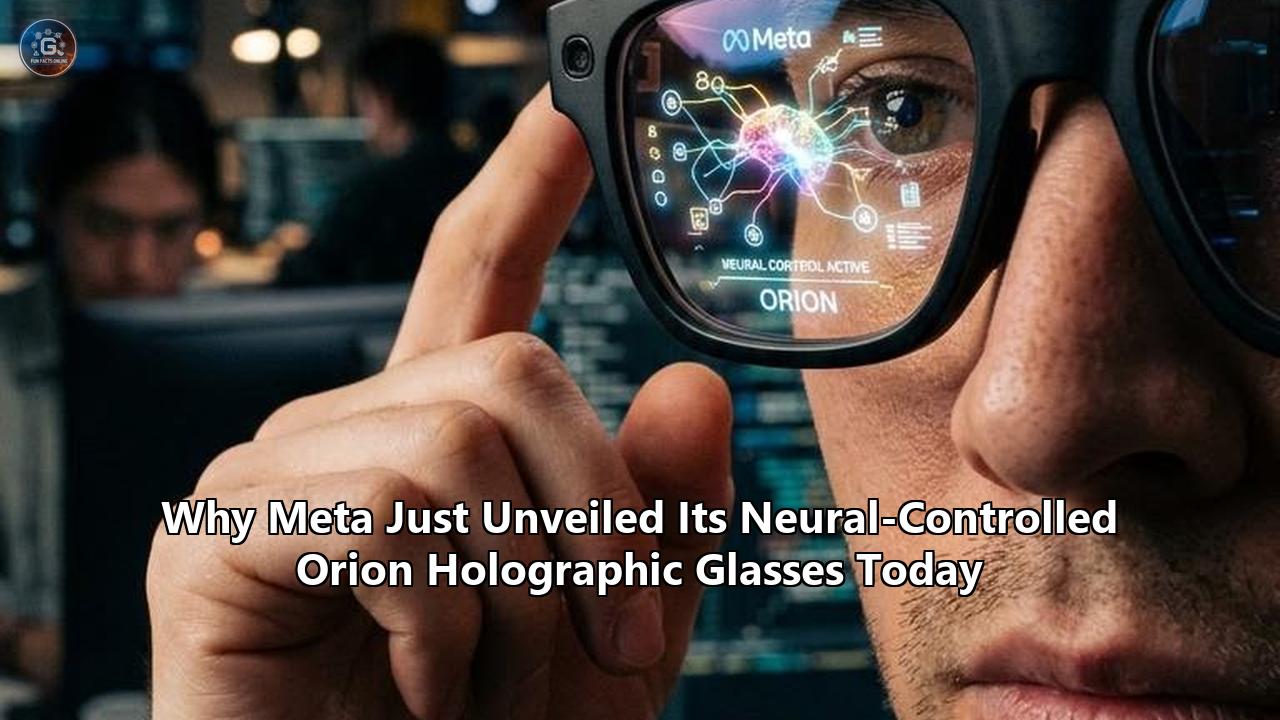
At Meta’s headquarters in Menlo Park, California, Mark Zuckerberg opened a locked, military-grade flight case and pulled out a thick-rimmed pair of dark spectacles that represent a decade of capital expenditure, roughly $65 billion in Reality Labs spending, and an aggressive attempt to replace the smartphone.
Codenamed Orion, the device is the tech industry’s first fully functional, standalone pair of holographic augmented reality glasses equipped with a consumer-viable form factor and a non-invasive neural interface.
Unlike virtual reality headsets or bulky pass-through mixed-reality visors such as the Apple Vision Pro, Orion does not use video cameras to capture the external world and recreate it on micro-OLED screens inside an enclosed helmet. Instead, it is an optical see-through display weighing 98 grams. It projects stereoscopic, dynamic 3D holograms directly into the user’s ocular path across an unprecedented 70-degree diagonal field of view, superimposing interactive compute elements onto physical reality.
Control does not rely solely on vocal prompts or floating gestures caught by optical cameras. It is governed by a companion surface electromyography (sEMG) wristband that reads motor neuron electrical impulses traveling from the brain through the wrist muscles. A user can flick through digital desktop interfaces, respond to messages, or adjust complex 3D holographic models by barely twitching a tendon, with their hands resting inside their coat pockets.
Meta is positioning Orion not as an immediate commercial product for store shelves, but as an operational developer and technology demonstration platform. The company has manufactured roughly 1,000 units intended for internal research, ecosystem developers, and selective industry partners while engineers optimize the device for high-volume manufacturing.
The unveiling marks a decisive pivot point in modern personal technology. Meta has established a definitive hardware architecture for post-smartphone computing, signaling to rival platform holders, component suppliers, and software developers that the physical-to-digital interface is shifting from capacitive touchscreens to neural-perceptual spatial hardware.
The Engineering Teardown: Optical Physics, Custom Silicon, and Split Compute
To grasp why the unveiling of the Meta Orion glasses triggered an immediate reaction across the hardware sector, one must examine the physics constraints that previously rendered wearable optical augmented reality functionally impossible.
Building true augmented reality glasses requires solving three mutually hostile variables simultaneously: visual immersion, thermal power dissipation, and industrial form factor. Expanding the field of view typically demands massive, heavy optical lenses. Pumping enough light through diffractive waveguides so holograms remain visible against ambient sunlight requires high-draw projection engines that generate skin-scalding heat. Packing batteries, graphics processing, and spatial tracking into glasses frames makes them too heavy to rest comfortably on human ears for more than minutes at a time.
Meta spent ten years systematically building custom materials and sub-assemblies to break this trilemma.
                     ORION DISTRIBUTED ARCHITECTURE

  [ Magnesium Frames ] <---- Low-Latency RF ----> [ Compute Puck ]
    - 98 grams                                      - Dual Processors
    - Custom ASICs (SLAM/Sensors)                   - Main Graphics/Compute
    - MicroLED Engines                              - Primary Battery Pack
    - Silicon Carbide Lenses (~70° FOV)             - Meta AI Engine
             ^
             |
             | Wireless Motor Unit Pulses
             v
     [ EMG Wristband ]
    - Reads neuromuscular impulses
    - Sub-millisecond latency
    - Micro-gesture control
Optical-Grade Silicon Carbide Waveguides
Every major optical AR attempt over the past decade—from Microsoft HoloLens 2 to Magic Leap and Snap Spectacles—relied on high-refractive-index glass or optical polymers. These materials impose severe physical boundaries:
- Optical glass possesses an index of refraction hovering between 1.5 and 1.9.
- This metric dictates how sharply light bouncing within the waveguide can bend via total internal reflection before escaping the substrate.
- Because of this refractive index ceiling, earlier devices were optically constrained to narrow fields of view, typically between 30 and 52 degrees, creating a restrictive "letterbox" viewing window where digital objects clipped abruptly out of sight.
For Orion, Meta abandoned conventional glass and polymer optics entirely. The lenses are manufactured from optical-grade synthetic silicon carbide (SiC).
Silicon carbide boasts an extraordinarily high refractive index of roughly 2.65 to 2.7. This allows light introduced by the temple projectors to enter the waveguide and ricochet at significantly sharper internal angles without scattering or bleeding out of the substrate. The direct result is a 70-degree diagonal field of view—more than double the display area of contemporary smart glasses—housed inside an optical lens only millimeters thick.
Furthermore, silicon carbide features high thermal conductivity and mechanical rigidity, resisting the warped optical distortion that occurs when standard lenses heat up during heavy computational loads.
The manufacturing tradeoff, however, is brutal. Synthetic monocrystalline silicon carbide is notoriously hard to synthesize without lattice defects, and polishing optical-grade SiC to sub-nanometer planar precision requires specialized diamond-abrasive chemical-mechanical planarization (CMP). Etching nanoscale diffractive surface-relief gratings into SiC demands advanced reactive-ion beam etching systems, driving prototype manufacturing yields down and costs up into the tens of thousands of dollars per lens pair.
MicroLED Optical Engines
Driving light through a diffractive waveguide involves staggering optical transmission losses; often, less than 5% to 10% of the light fired by a display engine actually reaches the user’s pupil through the internal reflection pathways. To make digital graphics legible in bright indoor environments or broad daylight, the light source must emit intense luminance.
Meta avoided Liquid Crystal on Silicon (LCoS) and micro-OLED panels, opting instead for custom-engineered MicroLED projectors embedded directly into the magnesium frame temples. These microscopic engines utilize gallium nitride (GaN) semiconductor arrays where each individual pixel measures less than a few micrometers.
The MicroLED projectors blast luminance levels measured in hundreds of thousands of nits into the silicon carbide in-coupling gratings while drawing a fraction of the power of traditional micro-displays. This yields an optical system efficient enough to sustain dual stereoscopic projections without requiring bulky heat sinks or active fan cooling on the temples.
Split-Compute Topography and Custom ASICs
To maintain a total device mass of just 98 grams, Meta stripped all heavy computing and high-density battery cells out of the frame assembly.
The system relies on a three-tier distributed compute topology:
- The Magnesium Glasses Frame: The frame acts as a heat spreader and houses seven miniaturized tracking cameras and ambient sensors, directional audio arrays, custom radio transmitters, micro-batteries, and two proprietary Meta-designed ASICs. These specialized silicon chips execute Simultaneous Localization and Mapping (SLAM), eye tracking, sensor fusion, and display serialization at ultra-low latency, running dedicated algorithms at a sliver of the wattage of general mobile processors.
- The Wireless Compute Puck: Heavy app logic, operating system routines, 3D graphics rendering, and multimodal artificial intelligence pipelines run on a smooth, pocket-sized wireless puck. The puck connects to the glasses via an ultra-low-latency, proprietary wireless protocol that bypasses the latency overhead of conventional Bluetooth and standard Wi-Fi bands. Graphics rendered on the puck are compressed, streamed wirelessly to the glasses, and uncompressed on the custom frame silicon within single-digit milliseconds.
- The Neuromotor sEMG Wristband: The wristband houses high-rate analog sensor arrays that capture neuromuscular impulses, running localized machine learning models to decode muscle actions into discrete input signals before beaming them directly to the compute puck and glasses.
┌────────────────────────────────────────────────────────────────────────┐
│                        HARDWARE SPECIFICATIONS                         │
├────────────────────────┬───────────────────────────────────────────────┤
│ Frame Material         │ Magnesium Alloy (Heat-Spreading Architecture) │
├────────────────────────┼───────────────────────────────────────────────┤
│ Weight                 │ 98 grams                                      │
├────────────────────────┼───────────────────────────────────────────────┤
│ Lens Material          │ Optical-Grade Synthetic Silicon Carbide (SiC) │
├────────────────────────┼───────────────────────────────────────────────┤
│ Field of View          │ ~70 Degrees Diagonal                          │
├────────────────────────┼───────────────────────────────────────────────┤
│ Display Engines        │ Miniaturized MicroLED Projectors              │
├────────────────────────┼───────────────────────────────────────────────┤
│ Primary Control        │ Surface Electromyography (sEMG) Wristband     │
├────────────────────────┼───────────────────────────────────────────────┤
│ Auxiliary Input        │ Eye-Tracking Cameras, Hand Tracking, Voice    │
├────────────────────────┼───────────────────────────────────────────────┤
│ Compute Architecture   │ Distributed: Custom On-Frame ASICs + Pocket   │
│                        │ Wireless Puck                                 │
├────────────────────────┼───────────────────────────────────────────────┤
│ Target Unit Cost (Est) │ ~$10,000 (Current Prototype Build)            │
└────────────────────────┴───────────────────────────────────────────────┘
The Neuromotor Interface: Why sEMG Bypasses the Limits of Optical Tracking
The technological achievement of Orion is not restricted to optics; it fundamentally reshapes the human-computer interface through surface electromyography (sEMG).
For five decades, human interaction with computers has centered on mechanical transducers: the keyboard, the physical mouse, the trackpad, and the capacitive glass touchscreen. When virtual and mixed reality headsets arrived, designers defaulted to two interaction schemes: optical computer-vision hand tracking and physical tracked controllers. Both carry glaring structural flaws for daily human use:
- Controllers are cumbersome, socially awkward outside the living room, and require active physical retrieval.
- Optical Hand Tracking—used in headsets like the Apple Vision Pro—forces the user’s hands to remain inside the visual field-of-view of downward-facing cameras. The user must lift their arms, causing biomechanical fatigue known in human factors engineering as "gorilla arm syndrome." Furthermore, optical hand tracking suffers from occlusion: if one hand crosses over another, or if lighting dips, tracking fails.
The neural wristband introduced with Orion resolves these failure states by shifting the input layer from optical post-movement observation to electrical pre-movement detection.
                     NEUROMUSCULAR SIGNAL CASCADE

[ Motor Cortex ]
       │
       ▼ (Efferent Neural Signal)
[ Spinal Cord ]
       │
       ▼ (Action Potential)
[ Carpal Motor Neurons ]
       │
       ▼
[ Wrist Muscles / Tendons ] ──> [ sEMG Electrodes ] ──> [ Neural ML Decoders ] ──> [ Orion OS ]
                                (Reads Micro-Voltages)   (Decodes Spatial Intent)   (Sub-10ms UI Action)
The underlying system stems directly from Meta’s acquisition of CTRL-Labs, the neural interface startup founded by neuroscientist Thomas Reardon and Patrick Kaifosh, which Meta bought for an estimated sum near $1 billion.
The wristband incorporates an array of medical-grade electromyographic sensors that maintain passive skin contact around the lower wrist. When a user intends to move their hand, the motor cortex of the brain fires an electrical action potential down the spinal cord and through the peripheral nerves to the muscles in the forearm and hand.
As these motor units depolarize to contract muscles, they generate microvolt-level electrical fields. The sEMG band reads these voltage differentials across the surface of the skin.
Because the wristband reads the motor unit action potentials directly, it possesses critical advantages over camera-based systems:
- Zero Optical Occlusion: The system does not need line-of-sight. A user can hold their hand completely flat against their outer thigh, bury their hands inside deep pockets, or rest their arms on an airplane tray table.
- Microscopic Gestures: The neural wristband does not require sweeping hand sweeps. Because the sensors detect motor unit depolarization rather than gross physical displacement, a movement of a single millimeter—or even the isometric intention to move without physical displacement—can register as a valid input event.
- Latency Compression: In optical hand tracking, photons must bounce off a moving hand, reach an image sensor, get processed by an ISP, run through a convolutional neural network to build a 26-joint hand skeleton, and trigger a UI response—a pipeline that consistently takes 30 to 60 milliseconds. With sEMG, the wristband captures the electrical excitation of the muscle before the limb finishes physical movement, dropping input latency into sub-perceptual thresholds under 10 milliseconds.
By pairing sEMG with high-speed internal eye-tracking cameras, Meta has constructed an interaction loop that mimics biological intent. The user looks at a holographic window or object (eye-tracking provides the coordinate addressing), and then applies a subtle micro-pinch between thumb and index finger (sEMG executes the action trigger).
It is discrete, invisible to bystanders, and executable during a physical conversation without breaking social eye contact.
Who Is Affected: Mapping the Industry Shockwaves
The public arrival of the Meta Orion glasses does not occur in an industrial vacuum. It reverberates across five intersecting sectors of the global technology economy, disrupting long-term roadmaps and accelerating hardware deployment timelines.
                              ORION IMPACT VECTORS

      Apple / Google Duopoly               Semiconductor Supply Chain
  ┌─────────────────────────────┐        ┌──────────────────────────────┐
  │ Threatens smartphone tax,   │        │ Shifts demand to optical-    │
  │ circumvents app store gates │        │ grade SiC & MicroLED foundries│
  └──────────────┬──────────────┘        └──────────────┬───────────────┘
                 │                                      │
                 │                META                  │
                 ├──────────────> ORION <───────────────┤
                 │              GLASSES                 │
                 │                                      │
  ┌──────────────┴──────────────┐        ┌──────────────┴───────────────┐
  │ Contextual Llama processing │        │ Enterprise shifts from flat  │
  │ replaces touchscreen UI     │        │ 2D monitors to spatial setups│
  └─────────────────────────────┘        └──────────────────────────────┘
       AI Ecosystem Dynamics                  Enterprise & Developers
1. The Mobile Operating System Duopoly: Apple and Google
For twenty years, Meta has suffered under the platform dominance of Apple’s iOS and Alphabet’s Android. Every service Meta runs—Instagram, WhatsApp, Facebook, Threads—relies on hardware gatekeepers who control the APIs, levy 30% digital transaction fees, and set systemic privacy constraints.
Apple’s implementation of App Tracking Transparency (ATT) in iOS 14.5 instantly wiped away an estimated $10 billion in Meta ad revenue in a single calendar year, exposing Meta’s vulnerability as a software tenant on third-party hardware.
Orion represents Meta’s direct bid to build the next generation's primary computing platform, evading Apple and Google entirely.
If spatial holographic eyewear successfully supplants the personal smartphone over the next ten to fifteen years, the power to collect contextual telemetry, define display operating systems, and govern developer monetization flows shifts to Meta.
The presentation of Orion also delivers a harsh strategic critique of Apple’s Vision line. Apple spent decades perfecting industrial precision, yet the Apple Vision Pro remains a 600-plus-gram mixed-reality helmet that encases the user’s skull, isolates them behind glass pass-through panels, and costs $3,499.
By showing that a 98-gram pair of real-world glasses can produce wide-FOV holographic computing without pass-through video, Meta seized the technological initiative, forcing Cupertino to reassess whether its long-term XR roadmap can remain viable without dedicated micro-optics and non-invasive neural inputs.
2. The Optical and Semiconductor Supply Chain
The materials bill for Orion signals a fundamental redirection of capital across specialized semiconductor and optical fabrication sectors:
- Silicon Carbide Wafer Fabricators: Companies specializing in synthetic silicon carbide—such as Wolfspeed, STMicroelectronics, and Coherent—have historically targeted automotive power inverters and electric vehicle drivetrains. The emergence of optical-grade SiC establishes a high-margin market tier. Fabricators will now face demands to supply crystalline SiC wafers devoid of microscopic inclusions, pitting consumer technology procurement directly against the electric automotive sector for global SiC output.
- MicroLED Foundries: Display manufacturers like Jade Bird Display (JBD), PlayNitride, and Plessey have spent years navigating low production yields for micro-scale GaN arrays. Meta’s institutional commitment to MicroLED over micro-OLED validates MicroLED as the definitive light engine for true AR, pulling venture capital and industrial foundries away from legacy display approaches.
- Ultra-Precision Nanofabrication: The nano-imprint lithography and ion-beam etching equipment utilized to imprint diffractive waveguide structures at sub-wavelength tolerances is moving from experimental laboratories to scaled semiconductor lines. Companies specializing in nano-imprint machinery will see increased purchase orders from tier-one hardware manufacturers scrambling to mirror Meta’s waveguide design.
3. The Artificial Intelligence Ecosystem
Orion shifts AI from a passive chatbot interface to an ambient perceptual agent.
When large language models reside on a smartphone, the user must manually unlock the device, launch an application, and type or speak a prompt. The AI possesses no native real-time sensory grounding; it understands only what the user explicitly inputs.
With Orion, Meta couples its open-source Llama model family directly to the glasses’ egocentric sensor array. The device sees the user’s physical environment through persistent, outward-facing cameras; it tracks their gaze vectors to pinpoint the exact visual target of human attention; and it processes ambient acoustics through beamforming microphones.
During live demonstrations, users looking at the contents of a refrigerator could summon Meta AI to analyze remaining ingredients, calculate nutritional values, and float visual recipe instructions above the kitchen counter.
This transforms artificial intelligence into an active cognitive co-processor, fundamentally altering how enterprise workers, engineers, and everyday consumers ingest real-time situational data.
What Changes: The Shift to Ambient Egocentric Computing
The technical jump exhibited by Orion changes the core structural paradigms of user interface design, workplace organization, and consumer electronics consumption.
┌────────────────────────────────────────────────────────────────────────┐
│                        COMPUTING PARADIGM SHIFT                        │
├────────────────────────┬───────────────────────────────────────────────┤
│ Dimension              │ Smartphone Paradigm    │ Orion AR Paradigm    │
├────────────────────────┼────────────────────────┼──────────────────────┤
│ Physical Form          │ Opaque glass slab      │ Transparent glasses  │
├────────────────────────┼────────────────────────┼──────────────────────┤
│ Visual Channel         │ Occluded flat screen   │ Contextual hologram  │
├────────────────────────┼────────────────────────┼──────────────────────┤
│ Input Layer            │ Mechanical touch       │ sEMG neural pulses   │
├────────────────────────┼────────────────────────┼──────────────────────┤
│ Primary Sensation      │ Distraction / Head down│ Ambient / Head up    │
├────────────────────────┼────────────────────────┼──────────────────────┤
│ AI Context             │ Prompt-response        │ Persistent vision    │
├────────────────────────┼────────────────────────┼──────────────────────┤
│ Screen Real Estate     │ 6.1 - 6.7 inches       │ Infinite spatial canvas│
└────────────────────────┴────────────────────────┴──────────────────────┘
The Elimination of the Single-Display Bottleneck
Knowledge work is currently chained to physical monitors. Even modern laptops are bound by physical diagonal dimensions—typically 13 to 16 inches of static visual real estate. Orion renders physical displays redundant.
With a 70-degree field of view, the system can dynamically render multiple high-resolution virtual monitors floating in physical space, anchored to real-world coordinates.
An enterprise user sitting at an empty cafe table can populate their visual field with a central code editor, an active holographic browser window, and a vertical messaging stream. When they stand up and leave, the spatial compute environment persists or folds into a compact contextual HUD.
Telepresence via Photorealistic Volumetric Holograms
Video conferencing through platforms like Zoom or Microsoft Teams compresses human three-dimensional communication into flat, 2D tile matrices, eliminating stereoscopic depth perception, mutual eye contact, and contextual spatial acoustics.
Orion enables true volumetric spatial telepresence. Leveraging Meta’s Codec Avatar technology, Orion projects a fully modeled, 3D holographic rendering of remote participants into the user's physical room.
Because the glasses feature interior eye-tracking cameras and frame microphones, the user's facial micro-expressions, gaze directions, and vocal inflections are captured and mapped to their own holographic avatar in real time. Remote colleagues appear to physically occupy the empty chair opposite your desk, complete with directional audio that shifts naturally as you turn your head.
The Death of App-Centric Navigation
Since 2007, personal computing has been defined by the application model: a grid of rounded icons, each serving as an isolated, sandboxed environment. Users must identify an app, launch it, conduct a task, exit, and switch to another.
In a persistent, neural-augmented environment, this model dissolves. Computing becomes contextual, ambient, and intent-driven.
If you glance at a physical package on your desk, the Orion interface—driven by eye-tracking and egocentric computer vision—queries your logistics feeds and overlays tracking numbers, shipping provenance, and delivery confirmation without manual app invocation.
If you navigate an unfamiliar airport, navigation lines are traced directly along the physical floor via the silicon carbide waveguides, dynamically adjusting based on flight terminal changes pushed through the compute puck.
The Roadblocks: Cost, Physics, and the Packaging Crisis
Despite the technical triumph of the Menlo Park presentation, serious manufacturing barriers stand between Orion’s prototype iteration and widespread consumer ubiquity. Meta’s leadership acknowledged that Orion is not ready for broad retail deployment.
The primary hurdles are economic and structural.
                         THE ROAD TO CONSUMER SCALE

  [ Current Orion Prototype ]                   [ Consumer Market Target ]
  ───────────────────────────                   ──────────────────────────
  • Cost: ~$10,000 per unit                     • Cost: $799 - $1,299
  • Materials: Silicon Carbide                  • Materials: High-Index Glass
  • Optical FOV: 70 Degrees                     • Optical FOV: ~50 Degrees
  • Thermal Envelope: 2 Hours                   • Thermal Envelope: All-Day Power
  • Yields: Single-digit %                      • Yields: >85% Scaled Fab
The $10,000 Prototype Cost Profile
Zuckerberg and Reality Labs executives confirmed that manufacturing each Orion unit currently costs on the order of $10,000. The primary cost drivers are:
- Silicon Carbide Synthesis: The growth of optical-purity SiC boules requires extreme temperatures exceeding 2,000 degrees Celsius and weeks of crystal growth, with catastrophic defect rates.
- Sub-Wavelength Gratings: Nano-etching the input and output gratings onto ultra-hard SiC requires cleanroom processing that cannot yet achieve consumer-level throughput.
- MicroLED Backplane Integration: Bonding millions of individual microscopic GaN emitters onto silicon CMOS backplanes without dead pixels remains one of the most yield-sensitive procedures in the semiconductor assembly world.
To achieve mass-market consumer viability—which Meta internally pegs at a retail price bracket between $799 and $1,299—the company will likely have to compromise on materials for early retail editions.
Internal roadmaps suggest the consumer version, internally nicknamed Artemis, may temporarily abandon silicon carbide in favor of high-index glass. This substitution would depress manufacturing costs by an order of magnitude, but at the cost of compressing the field of view from 70 degrees down to roughly 50 degrees.
Battery Density and Thermal Throttling
The Orion glasses currently achieve roughly two hours of active run-time before the localized magnesium frame cells require induction recharging.
While offloading core processing to the wireless puck removes the primary source of computational heat, the on-frame cameras, custom ASICs, audio drivers, and MicroLED engines still consume power within a tight thermal envelope.
Because the device sits directly against human facial skin and temple arteries, the chassis cannot exceed 40 degrees Celsius (104 degrees Fahrenheit) without causing physical discomfort or tissue irritation.
Until commercial battery chemistries make significant leaps in volumetric energy density—or until low-power silicon design shaves another 40% of microamp draw from the camera and sensor pipelines—true all-day, 16-hour wearable augmented reality will remain an elusive industrial target.
The Long-Term Consequences: Geopolitics, Society, and Visual Sovereignty
As Meta works through component scaling to bring neural-controlled eyewear to broad markets over the next four to five years, the systemic fallout will challenge legal frameworks, privacy norms, and international technological dominance.
The Perceptual Panopticon and Privacy Erasure
The societal disruption caused by Google Glass in 2013 was triggered by a single low-resolution camera with a glowing status LED, prompting widespread bans in restaurants, bars, and public spaces over privacy concerns.
Orion and its subsequent commercial descendants integrate seven outward-facing spatial cameras that map physical reality continuously. They are effectively impossible to distinguish from conventional designer eyewear at a distance of a few feet.
┌────────────────────────────────────────────────────────────────────────┐
│                        THE PRIVACY & SURVEILLANCE PARADOX              │
├────────────────────────────────────────────────────────────────────────┤
│ • 7 Outward-facing cameras tracking environment continuously           │
│ • Real-time facial identification matched with public scrapers         │
│ • Gaze tracking exposing micro-fixations, pupil dilation, interests    │
│ • Passive sEMG monitoring recording physiological stress & intent      │
│ • Seamless form factor rendering recording imperceptible to bystanders │
└────────────────────────────────────────────────────────────────────────┘
When billions of individuals wear devices that passively record, classify, and transcribe their visual and auditory surroundings in real time, the concept of unmonitored public space ceases to exist.
Real-time facial recognition algorithms run via multimodal AI models could allow a wearer to look at a stranger walking down the street and instantly pull up their name, employer, LinkedIn profile, or public arrest records overlaid above their head.
Furthermore, the internal telemetry captured by eye-tracking cameras exposes subconscious user vulnerabilities:
- Where your pupil dilates
- How many milliseconds your gaze lingers on an advertisement or an individual
- Micro-saccades that betray medical conditions or emotional states
This transforms perceptual telemetry into an unprecedented corporate surveillance asset.
The Battle for "Perceptual Sovereignty"
When physical screens disappear and computing is projected directly onto the user's retina, whoever owns the augmented reality platform commands the visual filter of physical existence.
This introduces the concept of Perceptual Sovereignty:
- Who controls the default spatial layer of reality?
- Can Meta inject commercial advertisements onto the blank wall of a physical building you walk past, monetizing real-world architecture without the property owner's consent?
- Can an operating system algorithmically censor, alter, or blur physical objects, political graffiti, or individuals in the physical environment based on platform content guidelines?
If a single corporate entity controls the primary hardware layer through which millions of citizens perceive their daily environments, that platform wields more direct psychological influence over public consciousness than any print, television, or internet medium in human history.
Strategic Tech Sovereignty: The US-China AR Race
The unveiling of the Meta Orion glasses intensifies an existing technological cold war between the United States and China over advanced hardware ecosystems.
While the United States currently leads in foundational large language model architectures and high-end AI accelerator silicon, China holds massive dominance in the consumer electronics manufacturing supply chain, particularly in:
- Precision optics fabrication
- Rare earth elements crucial for MicroLED phosphors
- Rapid-iteration hardware prototyping ecosystems in Shenzhen
Chinese technology champions, including Tencent, ByteDance, and Huawei, are aggressively funding their own optical see-through smart glasses pipelines. The race to develop domestic silicon carbide optical lithography and indigenous MicroLED display foundries will become a focal point of export controls, national industrial subsidies, and trade restrictions over the coming decade.
Platform dominance in spatial computing will not merely dictate which company earns hundreds of billions in hardware sales; it will determine which geopolitical bloc dictates the technical standards, data residency laws, and communication protocols of the post-mobile era.
What to Watch: Critical Milestones Leading to Consumer Scale
The Orion unveiling transitions Meta’s hardware ambitions from speculative research and development into an engineering execution phase. Over the next 24 to 36 months, several specific benchmarks will reveal whether Meta can translate this prototype into an everyday consumer device or if the device faces the same fate as other complex, cost-prohibitive tech platforms.
                           DEVELOPMENT MILESTONES

      2024 - 2025                  2026 - 2027                 2028 - 2030
  ┌──────────────────┐         ┌──────────────────┐        ┌──────────────────┐
  │ Internal Orion   │         │ Artemis Consumer │        │ Orion Gen-2 Mass │
  │ Dev Kits Seeded  │ ──────> │ Launch (Glass    │ ─────> │ Scale (SiC /     │
  │ to Select Devs   │         │ Optics, ~50° FOV)│        │ Sub-$1,000 Retail│
└──────────────────┘ └──────────────────┘ └──────────────────┘- The sEMG Developer Kit Rollout: Meta must release the electromyography wristband as an open developer hardware accessory ahead of the glasses themselves. Developers must begin building neuromotor input mapping, gesture lexicons, and UI libraries for software ecosystems before the glasses reach commercial distribution. Watching when and how Meta opens the sEMG API to third-party engineers will indicate the software platform’s operational readiness.
- Material Pivots for Project Artemis: Watch for supply chain leaks regarding Meta’s upcoming display-enabled smart glasses, designed as a direct bridge product between the current Ray-Ban Meta frames and Orion. The bill of materials for this interim hardware will demonstrate whether Meta has successfully lowered glass waveguide manufacturing costs or if it must rely on compromised visual specs to hit sub-$1,000 retail thresholds.
- The Response from Apple and Google: With Orion officially demonstrated, Cupertino and Mountain View must adjust their public roadmaps. Look for Apple to redirect resources from high-weight spatial pass-through helmets toward specialized optical waveguide research teams, and monitor Google’s renewed efforts to pair Android XR software with foreign optical hardware partners like Samsung.
- Semiconductor Yield Announcements: Track earnings reports and technical papers emerging from optical-grade silicon carbide synthesizers and MicroLED foundries. Breakthroughs in wafer-bonding yields and nano-imprint defect reductions will serve as the true canary in the coal mine for Orion's commercial launch timeline.
By presenting a working 98-gram pair of wide-FOV holographic glasses controlled by motor neuron impulses, Meta closed the debate over whether true optical augmented reality is physically possible.
The technical architecture has been locked in. The remaining challenge is no longer one of optical physics, but of industrial scaling—a high-stakes manufacturing race to drive down unit costs before competitors can copy the blueprint.
Reference:
- https://arizonadigitalfreepress.com/meta-unveils-augmented-reality-glasses-with-orion-prototype/
- https://www.uploadvr.com/meta-connect-2024-orion-prototype-ar-glasses/
- https://www.youtube.com/watch?v=B0gAe-wXrdQ
- https://180by2.co.za/blogs/news/meta-orion-ar-glasses-prototype
- https://www.meta.com/emerging-tech/orion/
- https://www.facebook.com/techinsider/posts/metas-cto-andrew-bosworth-said-smart-glasses-will-need-to-take-a-longer-journey-/1085477890118353/
- https://www.prelaunch.com/product-blog/meta-orion-glasses
- https://www.youtube.com/watch?v=n_Ky-wpjWEA