At 04:12 UTC this morning, the algorithmic trading desks in Frankfurt experienced something that violates the core principles of high-frequency finance: silence. For a span of roughly forty-seven minutes, data packets that normally travel between financial hubs in mere milliseconds took an agonizing 1,422 milliseconds to complete their round trips.
This was not a severed undersea cable. It was not a conventional distributed denial-of-service attack. When network engineers at major European exchanges ran routine traceroutes to diagnose the latency, they found their data was not moving through terrestrial fiber optics. Instead, European internet traffic—everything from banking transactions in London to hospital communications in Paris—was being beamed into low-Earth orbit, bounced across a mesh network of optical satellite links, and beamed down to a frozen patch of ice at coordinates 72°00'S 2°32'E.
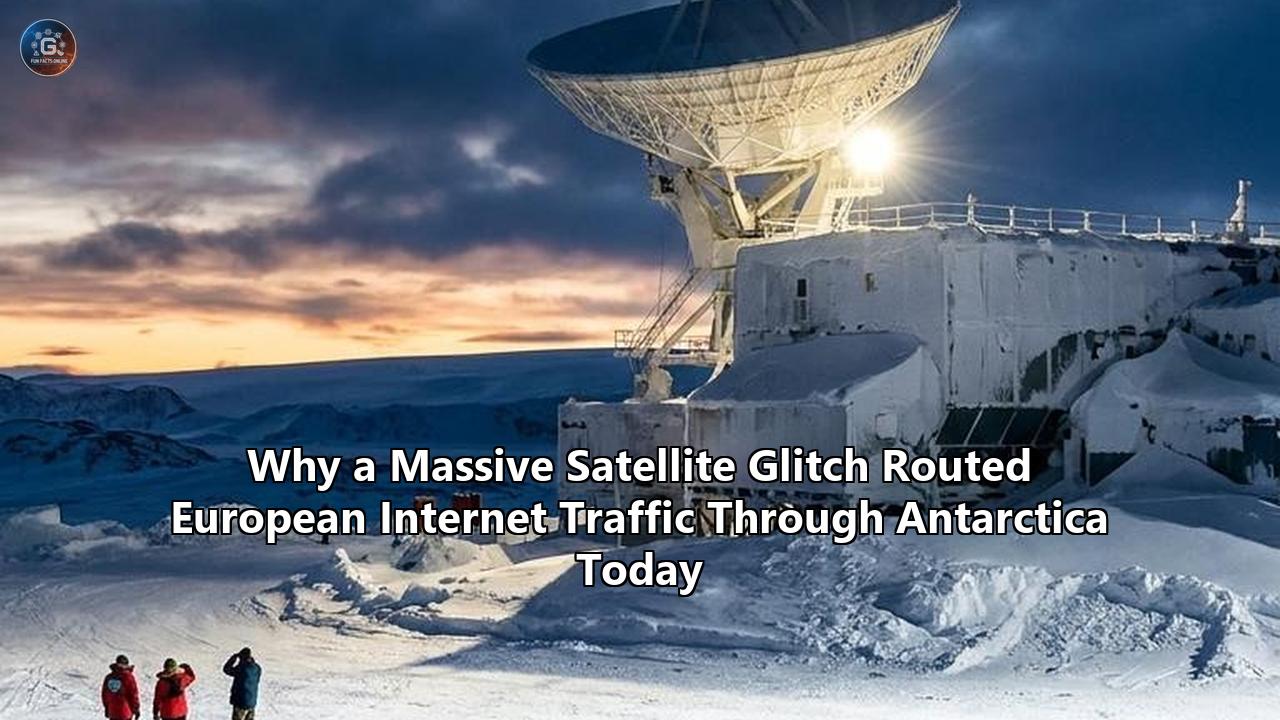
That coordinate belongs to the Troll Satellite Station in Queen Maud Land, Antarctica.
Through a cascading series of autonomous routing errors, a massive low-Earth orbit (LEO) satellite constellation designated a remote Antarctic research uplink as the primary gateway for nearly 30 percent of Europe’s digital infrastructure. The resulting traffic jam caused a satellite internet outage that has left regulators, network architects, and space agencies scrambling to understand how terrestrial internet protocols failed so spectacularly in orbit.
By following the digital footprints left in the border gateway protocol (BGP) tables, cross-referencing telemetry data from orbit, and speaking with the engineers who spent the morning untangling the mess, a deeply unsettling picture emerges. The internet’s core navigational system, designed in the 1980s for physical cables, is fundamentally incompatible with the dynamic, constantly shifting topology of modern orbital networks.
The 04:12 UTC Anomaly
The first signs of trouble did not appear in space, but in the server farms of a major content delivery network (CDN) located just outside Amsterdam.
"We monitor packet transit times on a microsecond basis," says Dr. Elias Varga, a lead network architect who was on call when the anomaly began. "At exactly 04:12 and 44 seconds, our latency graphs for Central Europe didn't just spike; they flatlined and then reappeared with a baseline delay of over a second. When you see a 1,400-millisecond ping on a local connection between Amsterdam and Berlin, you assume a routing loop. You assume a router somewhere is just tossing the data back and forth."
Varga's team initiated a traceroute, a network diagnostic tool that records the path a data packet takes from source to destination. Under normal conditions, a packet from Amsterdam to Berlin hops through three or four terrestrial nodes, identifiable by IP addresses registered to European telecom providers.
This morning, the traceroute returned something entirely different. The first hop was normal. The second hop jumped to an IP address block known to belong to a major commercial LEO satellite provider's uplink facility in northern France.
"That was the first red flag," Varga explains. "Unless a customer is explicitly using a satellite dish, terrestrial traffic shouldn't default to an orbital uplink. But it gets weirder. The third, fourth, and fifth hops returned IP addresses that didn't belong to any known geographic registry. They were dynamic IPs assigned to the satellites themselves."
Data was moving off the ground and into space. Once in orbit, the packets were handed off between satellites using optical inter-satellite links (OISLs)—lasers that transmit data across the vacuum of space. Because LEO satellites orbit the Earth at approximately 27,000 kilometers per hour, the physical network is never static. Satellites must constantly hand off connections to one another as they move in and out of view of ground stations.
The traceroute showed the packets making seven distinct hops across the orbital laser mesh. Finally, the data hit a downlink.
"We looked up the ASN [Autonomous System Number] of the downlink," Varga says. "It was registered to KSAT—Kongsberg Satellite Services. Specifically, their Troll Station facility in Antarctica. Our data had traveled from Amsterdam, up to space, across the curvature of the Earth via laser, down to Antarctica, and was now trying to find a route back to Berlin."
The View from the Ice
While European engineers were staring at confounding traceroutes, the technicians at Troll Station were dealing with a physical manifestation of the error.
Located 235 kilometers from the Antarctic coast, Troll Station operates one of the most critical, yet least known, satellite ground stations in the world. Because many LEO satellites utilize polar orbits—circling the globe from pole to pole rather than along the equator—Antarctica is prime real estate for downloading telemetry and uploading commands. A satellite in a polar orbit passes over the poles on every single revolution, roughly every 90 minutes.
Dr. Linnea Strom is a systems operator for KSAT stationed at Troll. In a satellite phone interview conducted hours after the event, she described the sudden onslaught of data.
"Our commercial downlinks are robust, but they are built for telemetry, climate data, and scheduled payload dumps from Earth observation satellites," Strom says. "At 04:13 UTC, alarms started going off on our main gateway routers. We were seeing a massive influx of TCP/IP traffic trying to route through our local servers. The volume was astronomical."
Strom and her team watched as their isolated local network was flooded with European consumer data.
"We were seeing unencrypted metadata for European streaming services, highly secure financial transaction packets, database syncs, you name it," she notes. "The satellite constellation was essentially using our 7.3-meter radome as a drainpipe for the entire European internet. Our outbound terrestrial link—which relies on a completely different geostationary satellite to get data back to Norway—was instantly saturated. It was like trying to fit the Amazon River through a garden hose."
Because the outbound link from Antarctica was instantly overwhelmed, millions of data packets simply timed out and died on the ice. This massive packet loss is what triggered the initial satellite internet outage reported by users across Germany, France, and the UK. If a data packet did manage to squeeze through the geostationary bottleneck, it took over a second to reach Europe, causing the devastating latency observed by Varga’s team in Amsterdam.
By 04:25 UTC, Troll Station engineers made the unprecedented decision to physically sever the connection between their commercial LEO terminals and their main routing switches to prevent their own life-support and critical communications networks from crashing under the weight of the European data.
"We essentially had to pull the plug on the sky," Strom says.
The Autopsy of a Routing Black Hole
With the Antarctic downlink severed, the LEO constellation was forced to recalculate its routing tables. By 04:59 UTC, the autonomous system recognized the dead end and began rerouting traffic back to terrestrial European gateways. The outage ended as abruptly as it began.
But the mystery remained: How did the European internet end up in Antarctica?
The investigation centers on the Border Gateway Protocol (BGP). Often described as the postal service of the internet, BGP is the mechanism that allows different autonomous systems (like an ISP in France and a server farm in Germany) to announce which IP addresses they control and what the most efficient route is to reach them.
When BGP works, it is invisible. When it fails, it causes catastrophic routing black holes. BGP is entirely trust-based. If an autonomous system falsely announces that it is the best route to a specific destination, other systems will blindly send their traffic there.
According to preliminary incident reports and telemetry logs reviewed by network security researchers, the root cause of this unprecedented satellite internet outage lay in a software patch pushed to the LEO constellation at 04:00 UTC.
The operator of the constellation (whose identity remains officially unconfirmed, though routing tables heavily implicate a major US-based aerospace firm's commercial network) was updating the firmware that governs the optical inter-satellite links.
Dr. Aris Thorne, a researcher specializing in orbital network topologies at the University of Surrey, has spent the day analyzing the leaked BGP tables. He explains the exact mechanism of the failure.
"The firmware update contained a seemingly minor syntax error in how the satellites calculate their physical proximity to ground stations," Thorne says. "Terrestrial BGP bases its routing decisions on network topology—how many 'hops' a packet takes. It doesn't care about physical geography. But a satellite network must care about geography because the satellites are moving."
The LEO network uses a proprietary dynamic routing algorithm that interfaces with standard BGP. This algorithm assigns a "cost" to various routes. A lower cost means a more efficient route.
"When the patch went live at 04:00 UTC, it corrupted the geographic coordinate database for the constellation's ground stations," Thorne explains. "Specifically, it inverted the latitude values for the European downlinks. The satellites thought the ground stations in northern France and Germany were located at 48 degrees South, rather than 48 degrees North."
This inversion effectively erased the European ground stations from the Northern Hemisphere map. When a massive volume of European internet traffic hit the constellation's uplink—likely due to a separate, simultaneous terrestrial fiber cut in Frankfurt that caused traffic to failover to the satellite backup—the orbital network looked for the nearest downlink to deliver the data to its European destination.
Because the satellites believed the European ground stations were in the extreme Southern Hemisphere, the algorithm calculated that the absolute closest functioning downlink to those inverted coordinates was the KSAT facility in Antarctica.
"The orbital mesh network did exactly what it was programmed to do," Thorne points out. "It found the most efficient path through the laser links to the Southern Hemisphere and dumped the data in Antarctica. The satellites were essentially shouting, 'I have found the shortest route to Europe!' and the rest of the terrestrial internet said, 'Great, take it all.'"
The Collision of Two Eras
The Antarctica incident exposes a severe vulnerability in how next-generation space infrastructure interfaces with legacy internet protocols. BGP was invented in 1989. It was designed for stationary routers connected by stationary cables.
Over the past five years, the deployment of thousands of LEO satellites equipped with optical cross-links has effectively built a parallel internet in space. This orbital internet operates on entirely different physics. Routers are no longer stationary; they are orbiting at 7.5 kilometers per second. Connections between nodes are not copper or fiber; they are beams of light that can be broken by atmospheric interference, solar radiation, or orbital mechanics.
When these two networks—the static terrestrial and the dynamic orbital—meet, the translation layers are incredibly fragile.
"We are trying to map a three-dimensional, highly kinetic mesh network onto a two-dimensional, static routing protocol," says Elena Rostova, a former network engineer for the European Space Agency who now consults on orbital cybersecurity. "It is a mathematical nightmare. The fact that a single minus sign on a latitude coordinate can siphon a continent's data to the South Pole shows how brittle the translation layer is."
Rostova notes that monitoring services trying to diagnose the satellite internet outage noticed the anomalies because the physical limitations of the speed of light could not be bypassed.
"Even with lasers in a vacuum, data takes time to travel," she says. "From Europe, up to 500 kilometers in orbit, across thousands of kilometers of space via satellite-to-satellite handoffs, down to Antarctica, and then back over a geostationary satellite link to Europe—that physical distance requires over 1,000 milliseconds of transit time. To an algorithmic trading bot, a second is an eternity. It’s a lifetime."
The Economic Fallout in Frankfurt
The impact of that 1,422-millisecond delay was felt most acutely in the financial sector. At 04:12 UTC, European markets were pre-opening, but algorithmic high-frequency trading (HFT) networks were already actively balancing global portfolios, reacting to Asian market closes and anticipating the European open.
HFT relies on latency arbitrage—the ability to execute trades fractions of a millisecond faster than a competitor. Firms spend hundreds of millions of euros laying specialized fiber optic cables straight through mountains simply to shave three milliseconds off a data transit time between Frankfurt and London.
When the routing error hijacked the traffic and sent it to Troll Station, these algorithms collided with an impenetrable wall of latency.
"The trading algorithms are built to detect latency and automatically pause trading to prevent executing on stale pricing data," explains Marcus Kessel, a market infrastructure analyst in Frankfurt. "But this wasn't a total disconnection. It was an extreme delay. Some packets made it through the Antarctic bottleneck, while others dropped. The data feed became a scrambled, out-of-sequence mess."
According to Kessel, several major automated market makers (AMMs) began receiving execution confirmations for trades they hadn't placed yet, while simultaneously timing out on active orders. The synchronization between the Frankfurt Stock Exchange's central matching engine and remote brokers completely fractured.
By 04:18 UTC, automated circuit breakers at three major European exchanges tripped, halting pre-market trading for specific derivatives and commodity futures.
"We don't have a final tally on the financial impact yet," Kessel notes. "But when you blind the algorithms for forty-seven minutes, the opportunity cost alone runs into the hundreds of millions. More concerning is the realization that a software bug in space can reach down and literally halt the physical economy in Central Europe. That is a systemic risk that no one has accurately priced into the market."
Incompetence or Rehearsal?
Whenever critical infrastructure fails in such a bizarre and spectacular manner, the immediate question among security analysts is one of attribution. Was this genuinely a misplaced minus sign in a geographic coordinate database, or was it a deliberate manipulation of orbital routing tables?
BGP hijacking—where a malicious actor deliberately announces false routes to siphon traffic through their own servers—is a known tactic in terrestrial cyber warfare. It has been used to steal cryptocurrency, intercept secure communications, and disrupt services.
However, BGP hijacking in space represents a terrifying new frontier.
"If I wanted to intercept European data, routing it through Antarctica is not a bad strategy," says a senior cybersecurity analyst at a NATO-affiliated cyber defense center, who requested anonymity to discuss sensitive network vulnerabilities. "Antarctic ground stations are isolated, highly dependent on satellite uplinks, and operate outside standard national jurisdictions. They are blind spots."
The analyst points to the precise timing of the incident. "04:12 UTC is the exact window when European network operations centers are operating on skeleton night crews, right before the morning shift arrives. It is the optimal time to test a capability with maximum delay in human response."
Despite these suspicions, the prevailing consensus among independent researchers like Dr. Thorne leans toward catastrophic human error.
"Never attribute to malice what can be adequately explained by a bad software deployment," Thorne counters. "To deliberately hijack the optical mesh routing to target Antarctica, a threat actor would need to compromise the core firmware signing keys of the satellite operator, bypass internal simulations, and push the update directly to the constellation. If a state actor had that level of access, they wouldn't use it to create a highly visible anomaly that gets resolved in an hour. They would use it to quietly mirror traffic without altering the latency."
Furthermore, KSAT's immediate and aggressive response—physically severing the connection at Troll Station—demonstrated that even isolated ground stations possess the manual overrides necessary to halt a runaway automated process.
The Fragility of the Orbital Mesh
The events of this morning highlight a growing tension in global telecommunications: the rapid privatization and centralization of space-based internet.
A decade ago, a satellite internet outage meant that a specific ship at sea or a remote cabin lost connection. The infrastructure was niche, slow, and expensive. Today, constellations comprising thousands of LEO satellites are deeply integrated into the backbone of terrestrial internet. Telecom providers use them for automated failovers when fiber lines are cut. Financial institutions use their optical cross-links as low-latency paths between continents.
"We have allowed private companies to build a parallel internet backbone in orbit, completely outside the regulatory frameworks that govern terrestrial telecom," argues Rostova. "When an undersea cable is laid, there are years of environmental reviews, geopolitical treaties, and redundancy testing. When a satellite operator updates the routing firmware for 4,000 orbiting lasers, they just push an update over the air. If they make a mistake, half of Europe goes to Antarctica."
The lack of standardized protocols for optical inter-satellite routing exacerbates the problem. The Internet Engineering Task Force (IETF) and the International Telecommunication Union (ITU) are currently years behind the commercial sector in developing standards for space-based routing.
Currently, each LEO constellation operator uses proprietary algorithms to manage their mesh networks. There is no open standard for how a satellite should negotiate a BGP route with a ground station.
"It is a black box," Varga says from his Amsterdam office. "When terrestrial BGP fails, I can look at public routing tables and see exactly which ISP in which country messed up. When the orbital mesh fails, I am entirely reliant on the satellite operator to tell me what went wrong. We are flying blind."
Rebuilding the Sky's Navigational Charts
In the immediate aftermath of the Antarctica routing anomaly, satellite operators and network engineers are racing to implement safeguards.
The most urgent fix involves hardcoding geographical bounds into the translation layer between terrestrial BGP and the orbital routing algorithms. Essentially, network architects are building digital geofences. If a routing table claims that the fastest path between Frankfurt and London involves a node located south of the 60th parallel, the terrestrial routers will automatically reject the route as invalid.
"We are having to teach the internet basic geography," Thorne explains. "The protocol needs to understand that a satellite moving at Mach 22 cannot simply dump data onto the nearest piece of ice. There has to be logic applied to the physical destination of the data."
Furthermore, discussions have accelerated within the European Union regarding the sovereignty of data routing. The fact that internal European traffic could be exported to orbit and routed through an international zone in Antarctica solely due to the automated decision of a private satellite network has alarmed policymakers.
Proposals for "terrestrial-only" routing mandates for critical financial and government data are gaining traction in Brussels. Under these proposed rules, data packets designated as critical infrastructure would be legally prohibited from entering an orbital mesh network, even during a terrestrial fiber outage.
The Unresolved Questions
As European markets close today and network engineers finalize their incident reports, several anomalies remain unexplained.
First, while the corrupted geographic database explains why the satellites targeted Antarctica, it does not fully explain why the initial terrestrial connection in Frankfurt failed over to the satellite backup in the first place. Some network logs show a brief, microsecond flutter in terrestrial BGP announcements originating from a major German exchange just seconds before the orbital network took over.
Second, the exact volume of data that reached Troll Station remains classified. While KSAT engineers confirmed they received consumer and financial data, the Norwegian authorities, who oversee the station's operations, have not released the packet captures. What data sits on those servers in Queen Maud Land?
Finally, there is the reality of the constellation itself. The satellites are still up there, continually passing data back and forth via lasers, silently orbiting the Earth every 90 minutes. The firmware has been patched, and the minus sign has been corrected.
But the infrastructure remains deeply experimental. The internet was not built for space. It was built for wires in the ground. As we continue to tear the internet from the earth and project it into orbit, the friction between stationary protocols and kinetic networks will only increase.
Future protocols designed to prevent another polar-routed satellite internet outage will need to account for a network topology that is literally in constant motion. Until those protocols are standardized and rigorously tested, the global internet remains highly vulnerable to the mathematical complexities of orbital mechanics.
The next time a software engineer pushes an update to the sky, the destination might not be Antarctica. It might be nowhere at all.