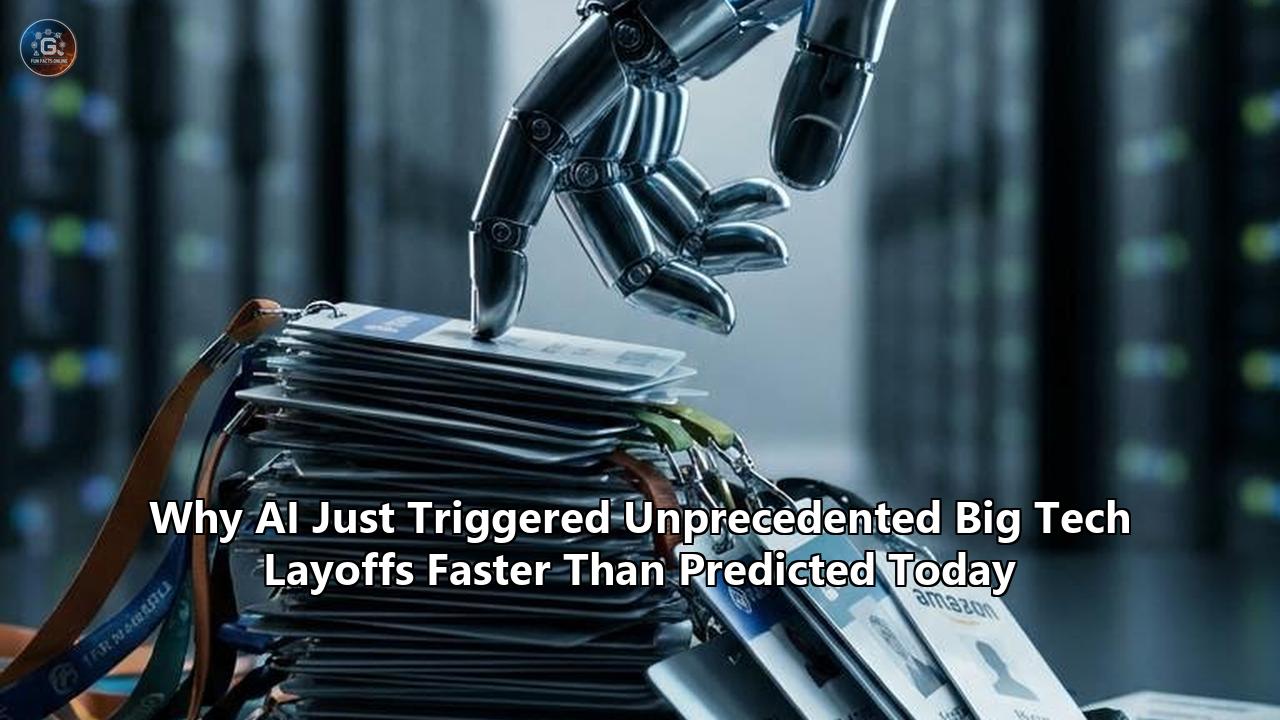
On the morning of May 5, 2026, the quiet hum of Silicon Valley was shattered by a synchronized wave of corporate restructuring that defied the broader economic indicators. The stock market was stable. Consumer spending remained steady. Yet, within a span of 72 hours, the technology sector purged thousands of jobs in a highly coordinated, structural shift.
Meta announced the elimination of 8,000 positions, explicitly citing the reorganization of its engineering divisions into "AI Pods". Hours later, Coinbase confirmed a 14% headcount reduction—roughly 700 employees—as CEO Brian Armstrong pushed the company toward a flatter, "AI-native" operational model designed around "one-person teams". The bleeding did not stop there. The April 2026 report from Challenger, Gray & Christmas, released the same week, confirmed what many engineers had whispered about for months: job cuts had spiked 38% month-over-month, with artificial intelligence cited as the leading cause for the second consecutive month.
The sudden AI impact on tech layoffs has caught labor economists entirely off guard. For the past three years, think tanks and management consultancies insisted that the transition to an automated white-collar workforce would take a decade. McKinsey and Goldman Sachs published reports in 2023 and 2024 suggesting a slow, manageable integration of generative tools that would augment human workers rather than replace them.
They were wrong.
The timeline has radically compressed. The integration of autonomous agents—software capable of taking a complex project from a raw prompt to a fully deployed application without human intervention—has crossed a critical threshold. Tech companies are no longer using artificial intelligence simply to help junior developers write faster code. They are using it to execute complete engineering lifecycles, effectively severing the need for the traditional corporate pyramid of junior coders, mid-level project managers, and quality assurance testers.
This investigation traces the evidence trail of how a highly speculative technology in 2024 became the executioner of the tech industry’s middle class by the spring of 2026.
The Phantom Codebase: From Assistants to Autonomous Actors
To understand why the workforce contraction is happening now, you have to look at the underlying architecture of software development and how drastically it changed over a 24-month period.
In early 2024, the industry experienced a brief media frenzy surrounding a tool called Devin, built by the startup Cognition Labs. It was marketed as the first "AI software engineer." At the time, skeptics correctly pointed out that Devin was mostly a proof-of-concept. In initial benchmark tests, like the SWE-Bench, the 2024 iteration of Devin could only resolve about 13.86% of real-world open-source GitHub issues end-to-end. Human developers scoffed. The consensus was that these tools were glorified auto-complete engines, prone to hallucinations, and requiring constant human supervision to prevent catastrophic system failures.
But the skeptics misunderstood the compounding nature of machine learning. They evaluated the technology as a static product rather than an accelerating curve.
By late 2025, the underlying models powering these coding agents had moved beyond simple text prediction. They evolved into complex, multi-agent systems. Instead of a single model attempting to write a script, modern AI architectures split the workload. One agent acts as the system architect, designing the database schema. Another agent writes the backend logic. A third agent continuously runs tests against the code being generated, flagging errors and instantly prompting the coding agent to rewrite the flawed logic. A fourth agent handles deployment and cloud infrastructure setup.
"We stopped acting like pair programmers and started acting like factory overseers," says Julian Reed, a former Level 6 senior software engineer who was laid off from a major cloud provider in March 2026. Reed’s entire 12-person team was dissolved. He was offered a transition package, while the work his team managed was handed over to two principal engineers utilizing an array of parallel cloud agents.
"In 2023, my job was to write code," Reed explains. "By the end of 2025, my job was just to review pull requests generated by the machine. And the machine was relentless. It didn't sleep. It didn't complain about sprint planning. If a massive refactoring project was required, the autonomous agent could spin up fifty parallel instances of itself, process millions of lines of legacy code, and submit a flawless migration overnight. Once management realized the AI wasn't just faster, but mathematically more reliable at repetitive tasks, the layoffs were inevitable."
The efficiency gains reported internally at these companies are staggering. According to case studies leaked from enterprise deployments, complex legacy migrations that historically required a multi-year effort from hundreds of engineers are now completed with 12x efficiency and 20x cost savings using parallel autonomous agents. When executives see infrastructure costs plummet by 95% for a single project, W-2 salaries immediately become a target for elimination.
The Middle-Management Massacre
The AI impact on tech layoffs extends far beyond software engineers. The most aggressive cuts in the May 2026 purge targeted a completely different demographic: middle management.
The traditional software development lifecycle required a vast bureaucratic apparatus. Product managers defined the features. Scrum masters managed the workflow. Quality Assurance (QA) leads orchestrated the testing. Engineering managers handled personnel, resource allocation, and cross-team communication.
When the actual creation of software is handed over to deterministic algorithms, the entire managerial superstructure built around human fallibility collapses.
Dr. Elena Rostova, an organizational psychologist who consults for Fortune 500 tech firms, has watched this demographic hollow out over the last eight months. "You have to look at what middle management actually does in a tech company," she says. "A massive portion of their day is spent synthesizing information, writing status updates, translating technical constraints to business stakeholders, and managing bottlenecks. AI agents do all of this natively and instantly."
In an "AI-native pod"—the exact terminology used by Meta and Coinbase in their May restructuring announcements—the workflow is radically flattened. A single senior human engineer or product visionary interacts directly with a master agent. The human dictates the high-level business objective: Build a secure, scalable payment gateway that supports three new European currencies.
The master agent instantly breaks this objective into thousands of sub-tasks. It spins up the necessary coding agents, assigns them specific repositories, monitors their output, runs the integration tests, and generates a plain-English progress report for the human supervisor. The need for Jira tickets, daily stand-up meetings, and cross-departmental alignment syncs evaporates.
"We are seeing the complete erasure of the translation layer," Rostova adds. "When machines talk perfectly to other machines, you do not need humans to pass messages between them. The 2026 layoffs are highly targeted at those messenger roles. Entire layers of directors and vice presidents are being excised because the CEO can now get a direct, real-time dashboard of every single codebase operation without them."
This structural flattening was practically previewed in 2023 when Mark Zuckerberg declared a "Year of Efficiency," removing multiple layers of management. But the 2026 version is permanent. The roles are not just being vacated; they are being technologically deprecated.
The Economics of the Execution
Following the evidence trail of the May 2026 restructuring requires looking at the intense pressure originating from Wall Street. The technology sector spent the pandemic years operating under a growth-at-all-costs mandate, hoarding talent as a defensive mechanism to prevent competitors from acquiring brilliant minds.
The macroeconomic shifts of 2023 forced a correction, but the discovery of generative AI’s true operational capability birthed a new, aggressive financial metric among activist investors: "Revenue per Human."
By early 2026, investment banks began actively downgrading the stock of technology companies that maintained high human headcounts. Financial analysts published brutal teardowns comparing traditional SaaS companies to emerging AI-native startups. The math was impossible to ignore. A traditional software firm with 5,000 employees might generate $1.5 billion in revenue. A newly formed AI-native competitor, leveraging autonomous coding pods, could generate $200 million in revenue with only 40 human employees.
The AI impact on tech layoffs was thus weaponized by the boardroom.
Internal memos obtained from a leading enterprise software company just weeks before the May purge reveal the exact financial calculus. The documents explicitly benchmark the cost of human engineering hours against the cost of API tokens required to run advanced logic models.
One document, titled Resource Allocation 2026/2027, included a direct comparison chart:
- Human QA Engineer (L4): $165,000 base salary + equity + benefits. Capacity: 40 hours/week. Error detection rate: 82%.
- Automated QA Agent Cluster: $4,200 annual compute/token cost. Capacity: 168 hours/week. Error detection rate: 97%.
Faced with a 97% cost reduction and an increase in operational uptime, executives had fiduciary cover to authorize massive workforce reductions. The narrative shifted from "AI will help our employees do more" to "AI allows us to achieve the exact same output with a fraction of the payroll."
This is precisely why companies are framing their layoffs not as a sign of financial distress, but as strategic triumphs. When Coinbase announced its 14% reduction, the messaging centered on agility and a "reorientation toward AI-enabled efficiency". The stock market typically rewards these announcements with a surge in share price, validating the executives' decision to prioritize computational overhead over human capital.
The Entry-Level Freeze and the Lost Generation
Perhaps the most severe long-term consequence of the May 2026 reality is the deliberate destruction of the junior talent pipeline.
Historically, tech companies hired massive cohorts of recent college graduates. These entry-level developers (often labeled L3 or Junior Engineers) were given the tedious, low-stakes work: writing boilerplate code, updating documentation, writing basic unit tests, and fixing minor bugs. This grunt work served a crucial purpose. It was the apprenticeship phase. By spending three years fixing minor bugs, a junior engineer learned the sprawling architecture of the company's codebase, eventually becoming a senior engineer capable of making high-level architectural decisions.
Autonomous coding agents are exceptional at grunt work. They can ingest an eight-year-old, multi-million-line codebase, detect patterns, and update boilerplate code across tens of thousands of sub-tasks in a matter of hours.
Consequently, the entry-level software engineering job has essentially ceased to exist.
A massive global study conducted by LHH (a division of the Adecco Group), covering over 8,000 career transition candidates between January 2024 and March 2026, laid the statistics bare. Nearly half of all surveyed employers explicitly stated that their headcount had declined directly due to AI. Furthermore, 66% of enterprises reported completely reducing or eliminating entry-level hiring due to automation tools.
"We are eating our seed corn," warns Dr. Aris Thorne, a computer science professor at a major engineering university. "We are graduating brilliant students who understand computer science theory, but they cannot find a company willing to pay them to learn the practical realities of enterprise software. The companies only want to hire Staff-level engineers—the veterans who can architect systems and manage the AI pods. But how do you create a Staff engineer in 2030 if no one will hire a Junior engineer in 2026?"
The data supports Thorne's grim assessment. The LHH study revealed a chilling reality for those displaced: workers laid off specifically because of AI restructuring are significantly harder to re-employ. Only 36.9% of candidates laid off due to AI were reemployed within three months, compared to 46.2% of those laid off for general macroeconomic reasons. The AI-displaced workers were also twice as likely to remain out of work for a year or more.
This discrepancy exists because the jobs are not moving to another company; the job category itself has been vaporized. You cannot simply apply for the same role at a competitor if the competitor has also installed an autonomous AI agent to do that specific task. The result is forced career pivots. In 2024, 58% of respondents in the LHH survey said they had to pivot to a completely new occupation after an AI-related layoff. By mid-2026, that number is expected to climb higher.
The Paper Trail: What the Layoff Data Actually Says
Tracking the precise AI impact on tech layoffs requires cutting through thick layers of corporate public relations. For years, executives deliberately obfuscated the role of automation in workforce reductions.
During the initial layoff waves of 2023 and 2024, companies rarely used the acronym "AI" in their severance memos. They used euphemisms like "macroeconomic headwinds," "realigning resources," and "removing layers to simplify execution". A 2024 Bloomberg analysis found that companies aggressively kept AI's role in layoffs "under the radar" to avoid negative press and political backlash from labor regulators.
The dam broke in early 2026.
As AI integration transitioned from an experimental beta test to the core operational framework of enterprise tech, the stigma vanished. Instead of hiding the automation, CEOs began advertising it to appease shareholders. In March 2026 alone, U.S. employers announced over 60,000 job cuts. For the first time in history, the Challenger, Gray & Christmas report listed Artificial Intelligence as the primary reason for cutting jobs—cited in 25% of all announcements, officially surpassing "economic conditions" and "restructuring".
By April 2026, that trend violently accelerated. Job cuts surged 38% from the previous month. The tech sector alone eliminated over 50,000 positions in the first quarter of the year. Nearly half of these tech layoffs were directly attributed to AI.
The facade has dropped. Companies are no longer pretending that natural attrition or economic downturns are driving these decisions. They are actively tearing up their organizational charts to build infrastructure optimized for non-human labor. Salesforce's CEO Marc Benioff previewed this sentiment candidly when discussing AI operations, stating bluntly, "I need less heads". That bluntness has now become the industry standard.
The gap between employer actions and employee awareness remains alarmingly wide. The same LHH data revealed that while 54% of employers expect more layoffs due to AI in the immediate future, only 12.4% of the workers transitioning between jobs actually recognized AI as the factor in their dismissal. Many workers still falsely believe they were let go due to a temporary budget shortfall, waiting for a market rebound that will never result in their rehiring.
A Fundamental Shift in the Nature of Work
The engineers who survive the purges of 2026 are finding themselves in a drastically altered daily reality. The profession of "Software Engineer" is fundamentally morphing into "Systems Overseer."
Developers no longer spend hours hunting down a missing semicolon or debating syntax in a pull request. They supervise. They set the strategic constraints. They act as the final human arbiter of taste, security, and business logic.
"The best developers of tomorrow will be those who direct AI engineers effectively—not necessarily those who write the most code," notes a recent architectural review from Amplifi Labs regarding the shift to autonomous software engineering. AI-native development forces humans to focus entirely on system design and architecture.
This creates an incredibly high-stress, high-leverage environment for the remaining workers. In a 2024 tech company, a failure in a specific software module could be blamed on a Junior Developer who misunderstood the requirements. The blast radius of the error was small. In 2026, a human overseeing a cluster of autonomous agents has immense leverage. A single architectural misstep dictated by the human supervisor will be flawlessly and rapidly executed by the AI across the entire codebase, potentially causing catastrophic system outages.
The psychological toll on the remaining workforce is palpable. A recent industry survey noted that 51% of American workers worry about AI replacing their jobs entirely. Furthermore, there is a growing trend of silent resistance; a May 2026 labor report highlighted that 28% of white-collar workers are deliberately withholding their full effort or refusing to document their specific workflows, out of fear that management will use that data to train an AI agent to replace them.
This dynamic creates a toxic, low-trust environment. Management demands that senior engineers train the proprietary corporate LLMs on their unique workflows. The engineers, highly aware of the May layoffs, recognize that fully digitizing their expertise is tantamount to signing their own termination papers.
The Ripple Effect: Beyond Silicon Valley
If the creators of artificial intelligence are being aggressively displaced by their own invention, the implications for the broader global economy are staggering.
The technology sector serves as the canary in the coal mine for global labor markets. Tech companies have the capital, the infrastructure, and the early access necessary to deploy these models first. But the underlying mechanics of an AI agent—its ability to read documentation, process rules, synthesize logic, and execute deterministic outcomes—are entirely sector-agnostic.
The World Economic Forum's Future of Jobs Report projects that 92 million jobs will be displaced by AI globally by 2030. The May 2026 layoffs prove that this displacement will not be a slow, steady trickle. It will happen in sudden, violent bursts as soon as a specific industry's software crosses the threshold of autonomy.
Consider the legal profession. A massive percentage of billable hours at corporate law firms is generated by junior associates reading thousands of pages of discovery documents, drafting boilerplate contracts, and conducting precedent research. Autonomous agents optimized for legal frameworks are already achieving end-to-end task completion rates that rival human associates. When a major law firm realizes it can replace an army of $200,000-a-year junior associates with a scalable cloud agent, the structural collapse seen in tech will replicate in the legal sector.
The same applies to finance, accounting, logistics management, and administrative healthcare. Bloomberg Intelligence estimates that global banks may slash up to 200,000 jobs within the next few years as AI automates routine knowledge work. The 116-year-old logistics giant UPS already eliminated 12,000 management jobs, explicitly stating those positions "won't return" even when package volume increases, thanks to the deployment of machine learning in their pricing and routing functions.
The AI impact on tech layoffs is merely a localized preview of a universal restructuring. The tech industry has established the playbook:
- Adopt assistive AI tools to boost human productivity.
- Train proprietary models on the resulting human output.
- Transition from assistive tools to autonomous end-to-end agents.
- Flatten management, freeze entry-level hiring, and execute massive layoffs under the banner of "efficiency."
The Next 18 Months: Rebuilding on Shifting Sand
The events of May 2026 have irreversibly altered the trajectory of white-collar labor. The immediate question is no longer if AI will replace jobs, but rather how society will function when the primary ladder to the middle class—entry-level knowledge work—is permanently dismantled.
Looking ahead to the next 18 to 24 months, several critical developments are primed to unfold.
The Rise of the Ultra-Lean UnicornVenture capital funding has almost entirely pivoted away from companies with high headcount projections. Over the next year, we will see the emergence of multiple "Ultra-Lean Unicorns"—startups that reach a $1 billion valuation with fewer than 10 human employees. These companies will consist of a visionary founder, a handful of elite system architects, and an armada of parallel cloud agents handling all coding, marketing, sales outreach, and customer support.
The Unionization of the Knowledge WorkerLabor unions, historically the domain of blue-collar manufacturing and public sector workers, are about to see a massive influx of interest from six-figure software engineers, product managers, and digital marketers. In South Korea, tech workers recently attempted a "survival pact" regarding AI integration. We will likely see coordinated strikes in the U.S. tech sector before the end of 2027, demanding transparency in how employee data is used to train corporate models and establishing strict quotas on the ratio of human workers to autonomous agents.
The Crisis in Higher EducationUniversities will face a severe reckoning. The value proposition of a traditional four-year computer science degree is collapsing if companies refuse to hire entry-level graduates. Academic institutions will be forced to radically alter their curriculums, moving away from rote coding syntax and focusing entirely on high-level systems architecture, AI auditing, and algorithmic psychology.
The Legislative ResponseAs the layoffs bleed from the insulated world of Silicon Valley into mainstream corporate America, political pressure will become insurmountable. Expect fierce debates in Washington regarding "AI Taxation"—proposals to tax the computational output of autonomous agents to fund retraining programs or universal basic income for displaced white-collar professionals. Policymakers will have to grapple with an economy where productivity and corporate profits skyrocket, but aggregate wage growth stalls out completely.
The massive, sudden reduction of the tech workforce in early May 2026 was not a market correction. It was a technological eviction. The tools built to make developers’ lives easier have evolved into their direct replacements. We have entered a new economic reality where the most valuable skill a human can possess is the ability to do the one thing the machine still cannot: decide what to build in the first place. Once that objective is set, the machine will take it from there. And it will do it alone.
Reference:
- https://www.sfbayareatimes.com/posts/coinbase-layoffs-2026
- https://podcasts.apple.com/us/podcast/the-ai-labor-report/id1804690692
- https://www.forbes.com/sites/maryroeloffs/2026/04/02/ai-blamed-heavily-for-march-job-cuts-report-says/
- https://medium.com/@vixal/devin-ai-an-ai-software-engineer-your-job-is-in-danger-efe44d89c442
- https://www.amplifilabs.com/post/what-is-devin-ai-the-rise-of-autonomous-software-engineering
- https://www.quora.com/Will-Devin-the-AI-software-engineer-effect-the-jobs-of-software-engineers
- https://devin.ai/
- https://www.itpro.com/business/business-strategy/tech-layoffs-in-2024-show-the-year-of-efficiency-is-here-to-stay-it-just-wont-be-quite-as-ruthless
- https://www.staffingindustry.com/news/global-daily-news/ai-driven-job-cuts-surge-study-warns
- https://high5test.com/ai-replacing-jobs-statistics/
- https://infinitive.com/the-looming-impact-of-ai-on-us-jobs/