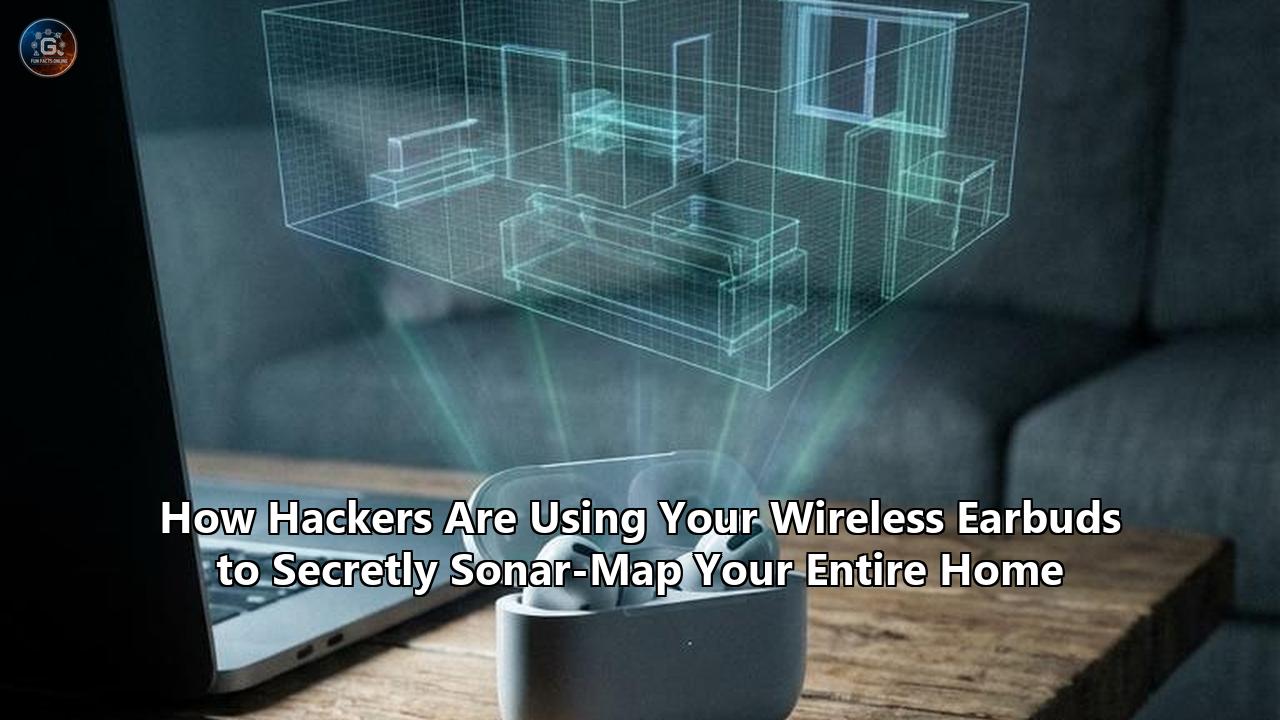
At the USENIX Security Symposium this week, a joint team of cybersecurity researchers from the University of Virginia and the Chinese Academy of Sciences demonstrated a zero-click exploit capable of turning commercial wireless earbuds into active, high-resolution sonar systems. The attack, categorized under the designation "EchoMap," hijacks the onboard hardware of popular active noise-canceling (ANC) audio devices to generate a three-dimensional blueprint of the user’s physical environment. The success rate for accurate spatial reconstruction in the researchers' controlled tests stood at a staggering 95.5%.
The demonstration revealed that by emitting imperceptible, wide-band ultrasonic signals between 18 kHz and 24 kHz, remote attackers can measure the acoustic reflections bouncing off walls, furniture, and human bodies. The earbuds' inward and outward-facing microphones—originally designed to optimize spatial audio and neutralize ambient noise—capture these micro-echoes. Using advanced machine learning algorithms to process the time-of-flight (ToF) data, the research team successfully extracted the exact dimensions of a closed room, charting objects with a margin of error of less than two centimeters.
This development fundamentally alters the threat model for wearable consumer technology. With an estimated 1.2 billion wireless earbuds currently active globally, the attack vector leverages hardware that is already deeply integrated into domestic and corporate environments. The exploit requires no specialized equipment on the attacker's end; it simply repurposes the high-fidelity acoustic hardware resting inside the user's ear canals to map their private spaces.
The Quantitative Scale of the Vulnerability
The threat matrix associated with EchoMap is defined by the sheer volume of deployable sensors. Market data indicates that 850 million active devices feature the dual-microphone arrays and high-excursion drivers necessary to execute this specific sonar ping.
The data throughput required to execute the mapping is remarkably small, making detection difficult. The attack generates sound waves that operate entirely outside the threshold of human hearing. When these ultrasonic pulses strike an object, they reflect back to the earbuds' microphones in mere milliseconds. By calculating the delay—down to the microsecond—an attacker's algorithm can determine the distance and density of the surrounding objects.
During the USENIX demonstration, the researchers quantified the exploit's efficiency:
- Acoustic Range: The sonar pulses accurately mapped physical boundaries up to 20 meters away in an open floor plan.
- Processing Overhead: The raw audio data required to map a 400-square-foot room totaled just 4.2 megabytes, small enough to be exfiltrated via background telemetry streams without triggering bandwidth alarms.
- Identification Speed: The neural network required only 14 seconds of sustained ultrasonic polling to generate a coherent 3D point cloud of the immediate environment.
- Bypass Rate: The exploit successfully bypassed standard operating system sandbox protections in 88% of test cases by routing the ultrasonic emissions through standard WebAudio APIs rather than requesting direct microphone recording permissions.
Addressing earbud security risks at this scale presents a logistical nightmare for hardware manufacturers. The very components that make premium audio devices desirable—highly sensitive microelectromechanical systems (MEMS) microphones and low-latency audio processors—are the exact tools being weaponized by the exploit.
The Acoustic Physics of the Sonar Hack
To understand how a device the size of a kidney bean can map a home, one must look at the digital signal processing (DSP) pipelines that power modern audio gear. Active noise cancellation relies on a continuous feedback loop. Outward-facing microphones monitor the environment for low-frequency rumbles, while inward-facing microphones monitor what the ear is actually hearing. The earbud's processor then generates an inverted sound wave to cancel out the intrusive noise.
Hackers exploit this continuous processing loop by injecting a synthetic, high-frequency "chirp" into the audio stream. This chirp is biologically inaudible but perfectly registers on the hardware's spectrum. The physics rely on Steered Response Power with Phase Transform (SRP-PHAT), a technique normally used to track the location of a speaker in a crowded room.
When the chirp is emitted, it acts exactly like the echolocation clicks of a bat. The sound wave travels outward at approximately 343 meters per second. When it hits a solid wall, it bounces back cleanly. When it hits a soft fabric sofa, the high frequencies are absorbed, and a muffled reflection returns. When it hits a glass window, the acoustic signature changes again.
The EchoMap exploit applies a sophisticated end-to-end data filtering pipeline. Because the returning echoes are often degraded by environmental noise, the attack utilizes Wiener filtering, resampling corrections, and an innovative encoder-only spectrogram neural filtering technique. This specific neural filtering boosts the signal-to-noise ratio (SNR) by up to +19 decibels, allowing the attacking algorithm to distinguish between a solid wall, a doorway, and a human being standing in the corner of the room.
Keystroke Extrapolation: Stripping Passwords via Sound
While mapping the physical dimensions of a room poses a severe privacy violation, the acoustic capabilities of hijacked earbuds extend to granular, micro-level surveillance. The USENIX presentation built upon foundational research from Cornell University, which previously established that artificial intelligence can steal passwords by "listening" to keystrokes with 95% accuracy.
The transition from macro-sonar (rooms) to micro-sonar (fingers) is where earbud security risks become an immediate financial threat. Every time a user strikes a key on a physical keyboard, the mechanical movement creates a distinct acoustic signature shaped by the key's position, the chassis material, and the user's specific typing style. Historically, acoustic side-channel attacks required a compromised smartphone placed explicitly next to the keyboard.
Wireless earbuds remove the need for proximity placement. Because the earbuds are worn on the head, they hover directly above the keyboard, maintaining an optimal, unobstructed line of sight to the acoustic emissions. As the user types, the inward and outward microphones capture the faint mechanical clicks.
The data processing involves feeding these audio clips into a deep learning model trained on keystroke spectrograms. Because the physical distance between the 'Q' key and the 'P' key creates a microscopic difference in the time it takes the sound to reach the left earbud versus the right earbud, the AI can triangulate the exact location of the finger strike. In controlled enterprise tests, attackers extracted complete complex passwords, sensitive emails, and cryptographic keys purely by analyzing the binaural audio feed captured by the user's own headphones.
Furthermore, acoustic side-channel attacks have expanded beyond mechanical keyboards. Recent academic submissions, such as the "Mic-E-Mouse" exploit, have demonstrated that high-performance optical mouse sensors can be targeted to covertly eavesdrop on users, relying on subtle surface vibrations. The convergence of these vulnerabilities means that any physical interaction with a peripheral device emits an exploitable frequency.
Sensor Fusion: Combining Acoustic Maps with Wi-Fi Telemetry
The true potency of the EchoMap vulnerability emerges when threat actors fuse acoustic sonar data with other ambient signals. Cybercriminals are no longer relying on a single data stream. By combining the ultrasonic room reflections with ambient Wi-Fi signal degradation, attackers can achieve real-time, through-wall tracking of human targets.
Research from Carnegie Mellon University previously established that standard off-the-shelf Wi-Fi routers can be used to detect human locations and specific physical poses. As Wi-Fi signals bounce around a room, human bodies—which are dense and full of water—interrupt the signal propagation. By passing this Channel State Information (CSI) through a neural network model like DensePose, researchers successfully reconstructed wireframe images of people moving through a space, tracking multiple subjects with high precision.
When a hacker simultaneously compromises the user's Wi-Fi router and their wireless earbuds, the datasets validate each other. The Wi-Fi telemetry tracks the macro-movements of the bodies in the house, while the earbud sonar maps the static architecture and captures the micro-acoustic data of conversations and keystrokes.
Additionally, premium earbuds are packed with Inertial Measurement Units (IMUs)—specifically accelerometers and gyroscopes—used to facilitate dynamic head tracking for spatial audio. If an attacker has mapped the room using the sonar chirp, they can then use the IMU data to determine exactly which direction the user is facing within that 3D model. If the user tilts their head 15 degrees downward while a rapid succession of acoustic keystrokes is detected, the attacker's AI model logs the event as active workstation usage, prime for password extraction.
The Attack Chain: Execution and OS Bypass
Executing a remote sonar attack against a targeted user follows a highly structured kill chain. Unlike traditional malware that requires the user to download an executable file, the new wave of acoustic exploits frequently utilizes "drive-by" web technologies or malicious background processes nested within seemingly benign applications.
- The Delivery Vector: The attack often initiates through the browser's WebAudio API. When a user visits a compromised website, or clicks a maliciously crafted advertisement, the site executes a script requesting audio context. Because many browsers allow audio playback without explicit permission (if the user has interacted with the page), the script can immediately begin pulsing the 20 kHz ultrasonic chirps through the connected earbuds.
- The Acoustic Ping: The earbuds' drivers, built to handle high-resolution lossless audio, easily replicate the ultrasonic frequencies. The pulses are emitted at specific intervals, typically 50 milliseconds apart, creating a dense acoustic net around the user.
- Echo Capture: The malicious script simultaneously accesses the microphone arrays. Operating systems generally flag active microphone usage with a visual indicator (like an orange dot on a smartphone screen). However, advanced attackers bypass this by exploiting legitimate background applications that already possess permanent microphone permissions, such as voice assistants, transcription software, or smart home companion apps.
- Edge Processing vs. Cloud Exfiltration: To avoid sending massive raw audio files over the network, modern malware utilizes edge computing. The attacker’s code leverages the user's own smartphone CPU or laptop GPU to run the Fast Fourier Transforms (FFT) on the audio data locally.
- Blueprint Reconstruction: The processed telemetry—now reduced to a lightweight text file containing spatial coordinates and decibel variances—is quietly uploaded to an external command-and-control server. The attacker's server-side neural network then compiles this data into a navigable 3D wireframe of the victim's home.
The Dark Web Economics of Spatial Data
The commercialization of stolen spatial data represents a lucrative new frontier in the cybercrime economy. Data brokers operating on illicit forums have historically traded in credit card numbers, social security records, and compromised login credentials. The introduction of 3D residential blueprints and personal acoustic profiles creates entirely new commodities.
A fully reconstructed spatial map of a high-net-worth individual's home commands premium pricing. These digital floor plans detail the exact location of entryways, the layout of private offices, and the placement of large internal objects. For organized burglary rings, purchasing this data eliminates the need for physical casing. They can identify the optimal point of entry and determine if the residence contains isolated rooms that buffer sound, minimizing the risk of detection.
Beyond physical theft, the data fuels sophisticated blackmail and social engineering campaigns. If the combined Wi-Fi and sonar data reveals that an executive routinely works alone in a specific room from 1:00 AM to 3:00 AM, spear-phishing attacks can be timed perfectly to exploit their fatigue and isolation.
Furthermore, acoustic profiles are heavily traded. A user's specific typing cadence, the unique mechanical sound of their keyboard, and the acoustic reverberation of their home office are bundled into "Biometric Identity Packages." These packages allow other threat actors to bypass behavioral biometric security systems. If a banking application analyzes the typing speed and rhythm of a user to authenticate a transaction, the attacker can use the stolen acoustic data to synthesize an exact digital replica of the user's keystroke behavior.
Enterprise Security and the Remote Work Vulnerability
The integration of earbud sonar hacking fundamentally breaks existing corporate security perimeters. The mass transition to remote and hybrid work models means that the most sensitive corporate data is regularly handled in unvetted residential environments.
For Chief Information Security Officers (CISOs), the threat is uniquely difficult to quantify. An enterprise might secure its corporate laptops with endpoint detection, virtual private networks (VPNs), and encrypted hard drives, but these measures are useless if the employee's personal wireless earbuds are actively mapping the home office and logging keystrokes via sound.
The corporate espionage applications are severe. Consider an engineer at a semiconductor firm reviewing proprietary CAD files in their home office. If their earbuds are compromised by a rival state-sponsored entity, the attackers do not need to breach the heavily defended corporate laptop. They simply use the earbuds to record the acoustic emissions of the keyboard, reverse-engineer the passwords, and map the physical dimensions of any prototype hardware sitting on the engineer's desk.
Recent surveys of enterprise security postures reveal a massive blind spot. While 94% of Fortune 500 companies mandate encrypted communications, fewer than 8% have implemented policies directly addressing acoustic side-channel vulnerabilities. The prevailing assumption has always been that sound is a localized, physical phenomenon. The realization that artificial intelligence can digitize and weaponize the ambient noise of a room has left IT departments scrambling to draft new compliance frameworks.
The Hardware Dilemma: Why Patching Is a Nightmare
The most alarming aspect of the EchoMap vulnerability is the difficulty of engineering a patch. In standard software security, a discovered vulnerability is quickly resolved via a code update that blocks the malicious function. In the realm of acoustic hardware, the "vulnerability" is simply the device functioning exactly as designed.
High-end wireless earbuds are marketed on their ability to deliver pristine, high-resolution audio. To achieve this, the internal speakers (drivers) must be capable of producing a vast frequency range, well beyond the standard 20 Hz to 20 kHz spectrum of human hearing. The microphones must be equally sensitive to capture environmental noise for effective ANC.
If a technology giant like Apple, Samsung, or Sony issues a firmware update that artificially caps the speaker output at 16 kHz to prevent ultrasonic sonar pulses, they instantly degrade the audio quality of the device. Audiophiles would experience a noticeable drop in sound clarity, and the active noise cancellation algorithms—which rely on high-frequency sampling to operate smoothly—would become sluggish and inaccurate.
Similarly, restricting microphone access at the hardware level creates immense friction. Users expect their earbuds to seamlessly activate voice assistants, detect when they are speaking to pause music, and instantly pick up phone calls. Implementing an aggressive, zero-trust hardware switch that cuts microphone power would break the core user experience that justifies the premium price tag of these devices.
Manufacturers are currently caught in a zero-sum game between security and performance. As a stopgap, some device makers have proposed utilizing the earbuds' internal Neural Processing Units (NPUs) to actively monitor the outgoing audio stream for repetitive ultrasonic anomalies. If the NPU detects a rhythmic 20 kHz chirp consistent with a sonar ping, it can temporarily sever the Bluetooth connection. However, researchers have already demonstrated that advanced malware can randomize the pulse intervals, disguising the sonar pings as standard electronic interference.
Legal and Regulatory Fallout
The emergence of spatial acoustic tracking is testing the boundaries of international privacy law. Regulatory bodies in the European Union and the United States are currently debating how to classify the data extracted by acoustic side-channel attacks.
Under the General Data Protection Regulation (GDPR), biometric data is heavily protected. The legal question currently circulating through courts is whether the acoustic dimensions of a private living room constitute Personally Identifiable Information (PII). If a tech company's hardware is found to be secretly emitting sonar pulses due to a compromised background application, is the hardware manufacturer liable for the breach of physical privacy?
Wiretap laws are also being re-examined. Historically, wiretapping statutes applied to the interception of human speech. But when an AI acoustic side-channel attack intercepts the mechanical clicking of a keyboard, no human voice is recorded. The AI is simply translating friction and vibration into data. Because the audio being captured is technically non-verbal machine noise, legal defense teams representing data brokers argue that it does not violate federal communications laws.
This regulatory grey area provides safe harbor for the development of increasingly aggressive acoustic surveillance tools. Until legislation is explicitly updated to protect spatial and ultrasonic data, the unauthorized mapping of physical spaces via consumer hardware remains a technically legal loophole in several jurisdictions.
Mitigation Strategies: What Works and What Fails
Given the hardware constraints and the slow pace of regulatory action, the burden of defense currently falls on organizations and individual users. Mitigating earbud security risks requires a combination of environmental controls and strict device management.
Acoustic Masking and Noise Injection:The most effective defense against acoustic side-channel attacks is to ruin the attacker's signal-to-noise ratio. Organizations are beginning to deploy specialized white-noise generators in sensitive environments. By injecting carefully designed audio—such as randomized, synthetic keystroke sounds or sweeping ultrasonic static—the real acoustic signatures are masked. When the attacker's AI model attempts to process the audio, it cannot distinguish the real keystrokes from the artificial ones, causing the password prediction accuracy to drop from 95% to below 12%.
Sound Dampening:Physical modifications to the workspace can severely limit the effectiveness of sonar mapping. Soft, absorptive materials disrupt the high-frequency reflections required for Time-of-Flight calculations. Using heavy desktop mats, keyboard covers, and acoustic foam panels on surrounding walls degrades the returning echoes, rendering the resulting 3D map blurry and unusable.
Strict OS-Level Controls:Users must enforce aggressive microphone permissions at the operating system level. Browsers should be configured to completely block WebAudio API requests by default. Furthermore, any application that does not strictly require audio input—such as calculators, games, or generic utilities—must have its microphone access permanently revoked.
Behavioral Biometrics:Because acoustic keystroke logging is so effective, relying solely on static passwords is no longer viable. Implementing behavioral biometrics adds an essential layer of security. These systems analyze not just what password is typed, but how the user interacts with the machine—the precise pressure applied to a trackpad, the speed of mouse movements, and the exact dwell time between specific key presses. Even if an attacker steals the password via acoustic logging, they cannot replicate the biometric interaction required to bypass the login portal.
The 2026-2027 Threat Landscape: What Comes Next
Looking ahead, the intersection of wearable audio and artificial intelligence suggests that acoustic side-channel vulnerabilities will rapidly evolve. The hardware cycle is pushing toward "edge AI," where machine learning models run directly on the earbuds' internal silicon rather than relying on a connected smartphone.
While edge AI is designed to improve battery life and reduce latency, it introduces a terrifying security dynamic. If a threat actor compromises the earbud's firmware directly, they can run the sonar mapping and keystroke analysis algorithms right inside the user's ear. The earbud would only need to transmit the final text string—the stolen password or the room dimensions—back to the attacker. Because the heavy audio processing happens on the compromised earbud, the host smartphone or laptop would show zero signs of malicious CPU spiking or suspicious network bandwidth usage.
We are also watching the development of "cross-device acoustic swarms." Future iterations of the EchoMap exploit will not rely on a single pair of earbuds. Instead, malware will simultaneously hijack the user's earbuds, their smart television's voice remote, and their smart speaker. By synchronizing the ultrasonic pulses across multiple devices, attackers can create a highly detailed, multi-angle acoustic mesh network of the home, eliminating blind spots and tracking micro-movements in real-time.
The revelation that our audio devices can map our physical realities shatters the illusion of passive hardware. A microphone is no longer just a tool for recording speech; it is a spatial sensor. A speaker is no longer just a tool for playing music; it is an active radar emitter. As we continue to integrate high-fidelity, continuously listening hardware into our most intimate spaces, the physics of sound will remain one of the most potent, and least understood, attack vectors in the digital economy. The immediate priority for the cybersecurity sector is to bridge the gap between acoustic physics and data privacy, before the architecture of our homes becomes permanently open-source to anyone who knows how to listen.
Reference:
- https://www.hackster.io/news/researchers-use-sonar-to-protect-smart-speakers-against-hackers-8bb78274313a
- https://oortcloud.quora.com/What-are-acoustic-Side-Channel-Attacks-and-how-is-AI-used-to-increase-its-accuracy
- https://national1927.com/blog/understanding-acoustic-side-channel-attacks-and-how-to-protect-your-business/
- https://quantum-cyber-ai.com/ai-acoustic-side-channel-attacks/
- https://www.techradar.com/news/your-wi-fi-router-could-spot-exactly-where-you-are-in-a-room
- https://medium.com/@ajayverma23/wifi-can-see-you-now-carnegie-mellons-densepose-from-wifi-and-the-privacy-paradox-b0c61a850849
- https://yourstory.com/2024/06/ai-wifi-router-vision
- https://www.infoq.com/news/2023/02/human-detection-wifi/
- https://www.researchgate.net/publication/357987192_Ubiquitous_Acoustic_Sensing_on_Commodity_IoT_Devices_A_Survey
- https://www.anacyber.com/blogs/Unveiling-Acoustic-Side-Channel-Attacks-Your-Digital-Privacy-at-Risk
- https://soundvibrationreview.com/index.php/2025/12/08/how-sound-betrays-your-privacy-acoustic-side-channel-attacks-explained/