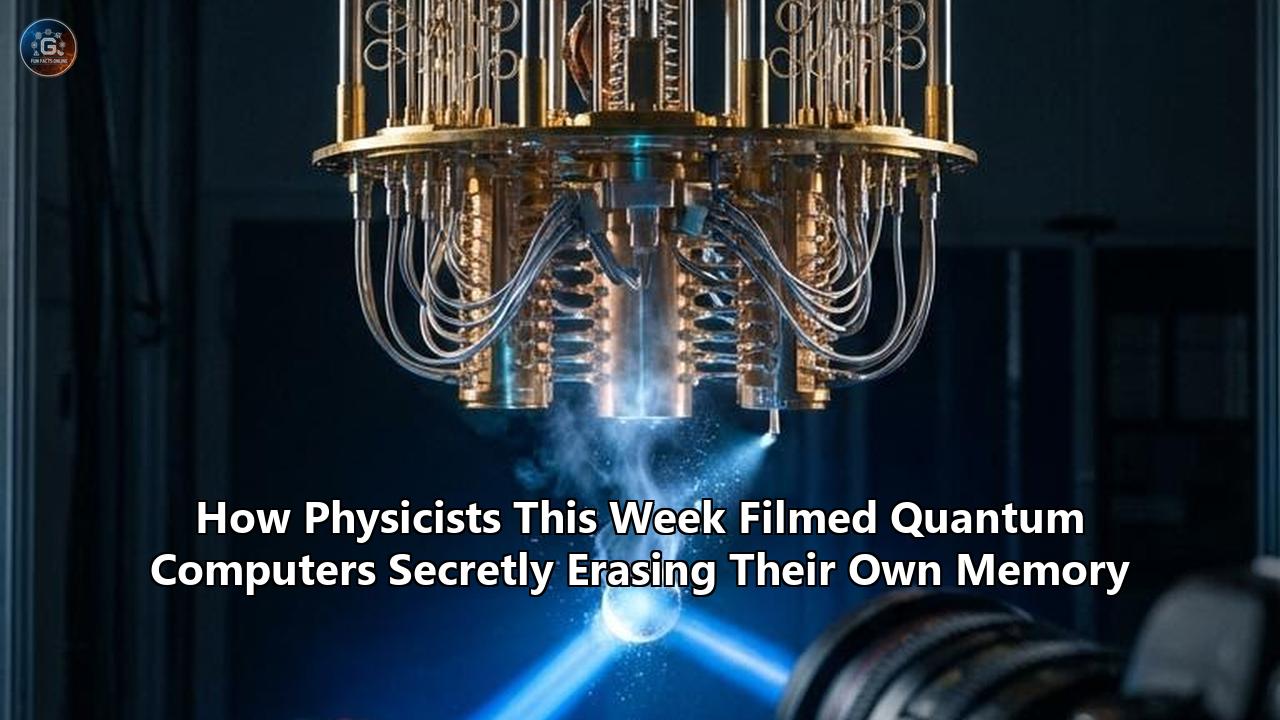
Physicists have caught quantum systems in a lie. By recording the microsecond-by-microsecond evolution of qubits, an international team of researchers this week revealed that quantum computers secretly retain information while appearing to permanently erase it.
The findings, published in the journal PRX Quantum by researchers from the University of Turku, the University of Milan, and Nicolaus Copernicus University, fundamentally rewrite the rules of quantum time evolution. The team proved that a quantum process can appear entirely memoryless—actively discarding its past—from one mathematical viewpoint, while actively hoarding that exact memory from another.
The research addresses a persistent ambiguity in quantum mechanics: how to define memory when the act of measurement itself alters reality. By utilizing high-fidelity, time-resolved measurements to effectively "film" a quantum system as it interacted with its environment, the physicists documented a bizarre duality. Depending on whether they tracked the system's evolving states or its measurable properties, the hardware was either bleeding data into the void or carefully keeping it intact.
The Mechanics of "Filming" a Qubit
To understand how physicists film a quantum computer erasing its own data, one must discard the concept of an optical camera. You cannot shine a light on a superposition without collapsing it. Instead, physicists use a technique called quantum state tomography, which acts as a stroboscopic camera for the subatomic realm.
Researchers prepare thousands of identical qubits in the exact same initial state. They then allow the system to evolve and measure the first batch after one microsecond, the second batch after two microseconds, the third after three, and so on. By stitching these sequential statistical snapshots together, they create a frame-by-frame reconstruction of the quantum state’s density matrix over time.
When the European research team ran their analysis, the "film" showed exactly what decades of quantum theory predicted. As the system interacted with the thermal and electromagnetic noise of its surrounding environment, the off-diagonal elements of the density matrix—the fragile mathematical bridges that maintain quantum coherence—flattened out. The system was decohering. The information encoded in the qubits was draining away, leaving behind a randomized, thermalized state.
In physics terminology, the system was exhibiting Markovian dynamics. A Markovian process is entirely memoryless; its next state depends exclusively on its current state, completely untethered from its past. A coin flip is classical Markovian behavior. The coin does not remember the last five flips. According to the tomographic reconstruction of the quantum states, the qubits were actively wiping their own history.
But this apparent erasure was an optical illusion generated by the mathematical lens the physicists were using to interpret the data.
The Schrödinger-Heisenberg Illusion
Since the late 1920s, physicists have relied on two mathematically equivalent frameworks to describe how quantum systems change over time. The first, formulated by Erwin Schrödinger, dictates that the quantum state itself evolves while the operators (the observables you measure) remain static. The second, developed by Werner Heisenberg, flips the architecture: the quantum state is frozen in time, and the observables evolve.
For a century, textbooks have taught that these two pictures are strictly interchangeable. They yield the exact same experimental probabilities. If a qubit has a 50 percent chance of yielding a "1" in the Schrödinger picture, it has a 50 percent chance in the Heisenberg picture.
The researchers discovered that while the probabilities align, the concept of memory does not.
"Our work shows that memory is not a single concept but can manifest in different ways depending on how the evolution of a system is described," said Federico Settimo, a doctoral researcher at the University of Turku and first author of the study.
When Settimo and his colleagues analyzed the time evolution of their system through the Schrödinger picture, they witnessed a one-way erasure of data. The state decayed into a Markovian void. Yet, when they shifted their mathematical framework to the Heisenberg picture—tracking the evolution of the observables rather than the state—the memory effects were unmistakably present. The system had not destroyed the information; it had simply moved it.
The Architecture of Quantum Computer Memory
To grasp the magnitude of this discrepancy, it is necessary to look at how quantum computer memory physically operates compared to the classical devices sitting on our desks.
Classical random access memory (RAM) is binary and physical. It stores data using billions of microscopic capacitors that are either charged with electrons (a 1) or emptied (a 0). Erasing this data is a blunt-force thermodynamic process. You apply a voltage to flush the charge.
Quantum memory does not rely on the presence or absence of charge, but on the delicate phase relationships and probability amplitudes of a subatomic particle, such as the spin of a single electron or the energy level of an artificially trapped ion. A qubit can hold a 0, a 1, or any continuous superposition of both simultaneously.
Because the data is encoded in a probability wave, it is extraordinarily sensitive to external stimuli. If a stray photon from the laboratory environment strikes a qubit, or if there is a minute fluctuation in the Earth’s magnetic field, the environment becomes entangled with the qubit. This entanglement acts as a leak. The information stored in the quantum computer memory drains out of the isolated qubit and dilutes into the vast, uncontrollable ocean of the surrounding environment.
Historically, hardware engineers have viewed this leakage as an irreversible erasure. Once the environment absorbs the information, gathering it back into the qubit is as impossible as un-stirring cream from a cup of coffee. The new findings out of Turku, Milan, and Toruń indicate that this assumption is fundamentally flawed. The cream has not vanished; it is just being viewed through the wrong filter.
The Thermodynamics of Forgetting
The concept of erasure in computation is deeply tethered to thermodynamics, specifically Landauer’s principle. Proposed by IBM physicist Rolf Landauer in 1961, the principle states that any logically irreversible manipulation of information, such as erasing a bit, must be accompanied by a corresponding increase in the entropy of the environment. Erasing data physically generates heat.
In a classical computer, this heat dissipation is the limiting factor for how densely you can pack transistors onto a silicon wafer before the chip melts. In a quantum processor operating at 15 millikelvins—colder than deep space—even a microscopic release of heat can devastate the system.
When a quantum system is observed to be erasing its memory in the Schrödinger picture, physicists assume that Landauer’s principle is exacting its toll. The information is scrubbed, entropy increases, and heat is exchanged.
However, the Heisenberg perspective reveals that the process is not a true erasure. Because the memory of the past state is preserved in the evolving observables, the information still exists within the localized boundaries of the system-environment interaction. The system is engaging in non-Markovian dynamics. Unlike the coin flip, a non-Markovian system acts more like a biological immune system—it remembers its past interactions, and those past interactions dictate how it will respond to future stimuli.
By hiding the data in the observables, the system avoids the absolute thermodynamic cost of a total erasure. The information is temporarily masked from the state vector, allowing the system to behave as if it has been reset, while secretly holding the blueprint of its prior state.
Reclaiming the Lost Data
The revelation that memory can be simultaneously absent in the states and present in the observables is not merely a philosophical curiosity. It provides an immediate, pragmatic roadmap for hardware engineers struggling to build fault-tolerant processors.
Current generation quantum machines suffer from severe limitations due to environmental noise. Error rates are orders of magnitude too high to execute complex algorithms like prime factorization or molecular simulation. Engineers spend immense resources attempting to isolate qubits from their environment using vacuum chambers, superconducting shields, and dilution refrigerators.
"Our findings open up new research avenues into the dynamics of quantum systems," noted Jyrki Piilo, Professor of Theoretical Physics at the University of Turku. "Moreover, our work has implications beyond its foundational significance for quantum technologies, where the external environment induces noise and memory effects. Knowing how memory can be witnessed is essential for developing strategies to mitigate noise or exploit environmental effects in realistic quantum devices".
If the environment is no longer viewed as an absolute data-destroyer, but rather as a temporary holding cell for quantum information, algorithms can be redesigned. Instead of fighting the environment, a quantum processor could theoretically allow a qubit to temporarily decohere, letting the environment "erase" the state. Because the memory is preserved in the observables, a specifically tuned control pulse could later reverse the flow of information, pulling the data back from the environment and reconstructing the state.
This mechanism relies on the precise mathematical mapping established by Settimo, Smirne, and Chruściński. By knowing exactly where the memory resides in the Heisenberg picture, engineers can target those specific observables to trigger a revival of the quantum state.
Fault Tolerance and Erasure Qubits
This theoretical breakthrough intersects perfectly with a recent shift in how quantum hardware manufacturers are managing errors. Over the last two years, leading laboratories have moved toward an architecture based on "erasure qubits."
In standard quantum error correction, a qubit might suffer a bit-flip (changing a 0 to a 1) or a phase-flip (altering the sign of the superposition). These are known as Pauli errors. They are insidious because the computer does not know the error occurred until it runs a complex, resource-heavy diagnostic check.
Erasure qubits operate differently. Researchers engineer the physical hardware—often using neutral atoms like Ytterbium-171 trapped in laser tweezers, or specialized superconducting circuits—so that the dominant source of noise does not subtly alter the data, but instead ejects the qubit entirely from the computational subspace. The error becomes a known erasure. The system immediately flags that a specific qubit has been erased, much like a classical server flagging a missing packet of internet data.
Because the location of the error is known instantly, correcting an erasure requires significantly fewer resources than tracking down a hidden Pauli error. A standard surface code might require thousands of physical qubits to protect a single logical qubit from random noise. With erasure conversion, that overhead drops drastically.
The new framework regarding how quantum systems hide their memory provides the missing thermodynamic and theoretical backing for these erasure architectures. When an erasure qubit is flagged as "empty," the information it previously held is not deleted from the universe. It has transitioned into the observable-dependent memory mapped by the Turku team.
This suggests that future error-correcting codes will not just replace the erased qubit with a blank slate, as they do now. Instead, they could deploy localized microwave or laser pulses designed to interrogate the non-Markovian memory of the surrounding lattice, effectively forcing the environment to hand the erased data back.
The Entropy Loophole
The preservation of memory in quantum systems also revitalizes a 15-year-old debate regarding the cooling mechanisms of quantum hardware.
In 2011, theoretical physicists at ETH Zurich proposed that under very specific conditions of entanglement, the erasure of data could actually cool a quantum computer instead of heating it. This required a concept called negative conditional entropy. If a computer’s memory qubit is perfectly entangled with the data qubit it intends to erase, the computer mathematically possesses more information than the raw data itself. Breaking that entanglement and erasing the data puts the system into a zero-entropy state while removing heat from the surroundings.
For years, this remained a purely mathematical thought experiment, primarily because physicists assumed that the act of erasure would strictly follow the Markovian decay seen in the Schrödinger picture. The noise would destroy the entanglement before the cooling effect could be triggered.
Now that researchers have filmed systems maintaining their memory through the Heisenberg picture, the ETH Zurich cooling theory has a physical mechanism to exploit. If the entanglement history is preserved in the observables, the conditional entropy remains intact even as the state vector appears to decohere.
This presents a scenario where optimizing quantum computer memory is not just about data retention; it is a thermal management strategy. By carefully controlling how a system shifts between its memoryless state and its memory-rich observables, hardware developers could create processors that utilize data erasure as an active cooling loop, effectively turning the act of forgetting into a localized refrigeration cycle.
The Next Frontier
The realization that quantum memory is subjective—contingent upon the mathematical lens used to observe it—marks a severe departure from classical information theory. A classical hard drive is either wiped or it isn't. The data exists, or it has been overwritten. The physical universe demands a binary truth.
The quantum universe demands no such thing. The time-resolved data captured by the international team proves that an event can be simultaneously irreversible and reversible. A qubit can be completely stripped of its data, yielding nothing but thermal noise to a state-based measurement, while a concurrent measurement of its observables yields a pristine record of everything it used to be.
The immediate challenge for the quantum computing industry is translating this theoretical duality into compiler software. Current quantum algorithms are written entirely in the Schrödinger picture. The code assumes that if a state decoheres, the data is gone, and the algorithm must be restarted.
Future software stacks will need to be bilingual. Programmers will have to design algorithms that track the evolution of states and observables concurrently. When a noise spike causes a chunk of the processor to lose coherence, the compiler will instantly switch to a Heisenberg-based recovery protocol, reading the memory traces hidden in the observables to reconstruct the collapsed states.
The successful mapping of this hidden memory fundamentally alters the trajectory of quantum scaling. For the past decade, the singular goal of hardware design has been to build thicker walls—better vacuums, colder fridges, stronger magnetic shields—to protect quantum computer memory from the ravages of the environment.
This research suggests those walls may not need to be impenetrable. If a system can secretly remember everything it appears to forget, physicists no longer need to perfectly isolate the machine from the universe. They just need to learn how to read the memory the universe kept for them.
Reference:
- https://www.sciencedaily.com/releases/2026/04/260413043150.htm
- https://quantumzeitgeist.com/university-turku-quantum-memory-research-2/
- https://www.utu.fi/en/news/press-release/new-study-sheds-light-on-fundamental-aspect-of-quantum-systems-and-memory
- https://physicsworld.com/a/erasing-data-could-keep-quantum-computers-cool/
- https://www.sciencedaily.com/releases/2020/10/201016100926.htm
- https://www.sciencedaily.com/releases/2026/04/260413043150.htm
- https://scitechdaily.com/quantum-memory-isnt-what-we-thought-physicists-reveal-a-hidden-duality/
- https://arxiv.org/html/2312.14060v1
- https://pmc.ncbi.nlm.nih.gov/articles/PMC9363413/