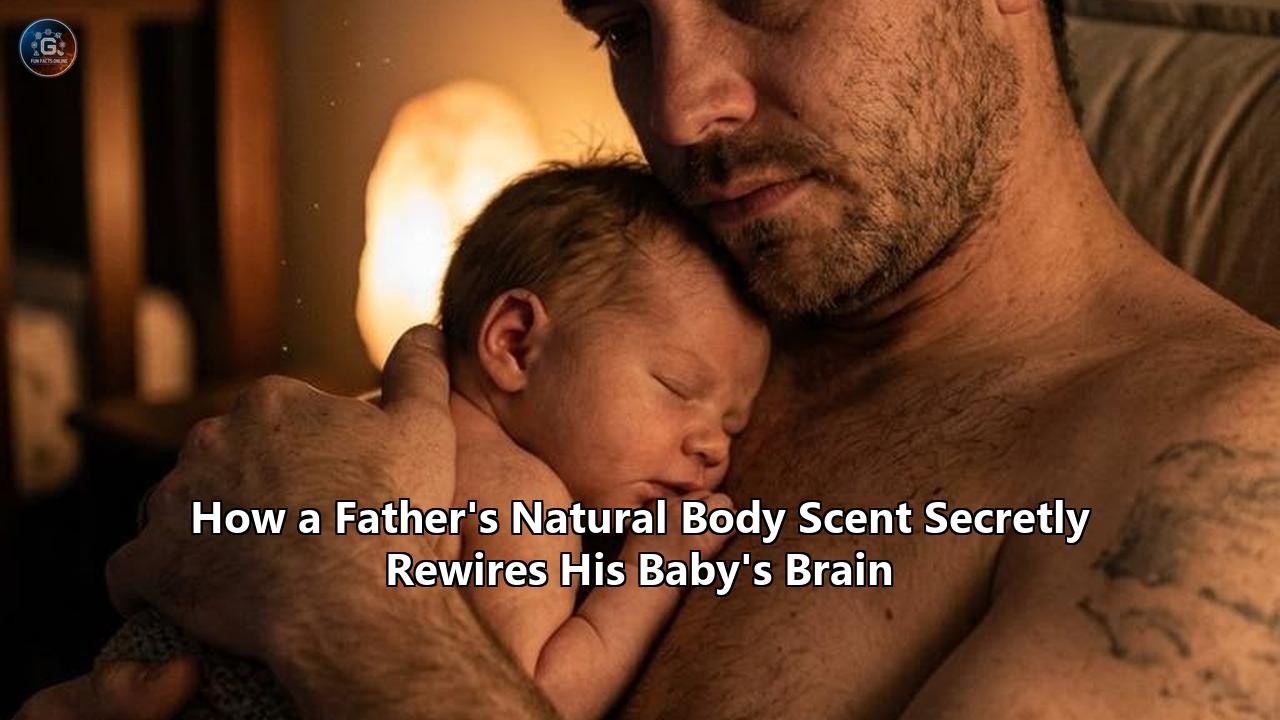
When a father enters a room, picks up his infant, or leans over a crib, a invisible cascade of airborne chemistry begins to flood the nursery. While science has long documented how a mother’s scent calms a newborn’s heart rate and triggers feeding instincts, a landmark study published in Science Advances reveals that a father’s body scent performs a very different, highly specialized neurobiological task. It acts as a neural key, quietly tuning and accelerating early social circuits in the infant brain.
The research, led by Professor Ruth Feldman and Dr. Yaara Endevelt-Shapira at Reichman University’s Developmental and Social Neuroscience Lab, demonstrates that an infant’s brain reacts to paternal body odor not merely with behavioral familiarity, but with a structural realignment of neural rhythms. Utilizing dual-electroencephalography (EEG) hyperscanning—a technique that records brain activity simultaneously from two interacting individuals—the researchers discovered that a father’s natural body odor triggers inter-brain synchronization between an infant and an unfamiliar adult, elevating the baby's social readiness and environmental curiosity to match the exact neural resonance seen when interacting directly with their biological father.
This finding upends decades of developmental bias. For over thirty years, infant olfaction research focused almost exclusively on maternal chemosignals, dismissing paternal scent as biologically negligible or secondary. The new data reveals an elegant evolutionary division of labor: while a mother’s scent acts as a physiological anchor—reducing cortisol and soothing stress—a father’s scent operates as a neurodevelopmental launchpad, priming the infant's prefrontal and limbic networks to engage with the wider social world.
Inside the Hyperscanning Lab: How the Experiment Was Conducted
To isolate the precise neural impact of paternal chemosignals, Feldman’s team constructed a rigorous multi-stage paradigm designed to strip away visual, auditory, and tactile confounding variables. Forty infant-father pairs were enrolled, with infants ranging from 5 to 13 months old.
[ Father Scent Collection ]
  └── 100% Untreated Cotton T-Shirt worn for 48 consecutive hours
  └── Zero artificial soaps, perfumes, or antiperspirants
  └── Preserved in inert, argon-purged glass containers

[ Dual-EEG Testing Protocol ]
  ┌────────────────────────────────────────────────────────┐
  │ Infant wearing 64-Channel EEG Cap                      │
  │ Interacting with Unfamiliar Male Adult (Stranger)       │
  └──────────────────────────┬─────────────────────────────┘
                             │
            ┌────────────────┴────────────────┐
            ▼                                 ▼
   [ No Paternal Scent ]           [ Concealed Paternal Scent ]
   - Baseline neural activity      - Rapid surge in frontocentral Nc wave
   - Low inter-brain synchrony     - Inter-brain phase locking surges
   - Standard social hesitation    - Stranger perceived as safe partner
The scent collection protocol required fathers to wear a 100% untreated cotton T-shirt for two consecutive nights. During this 48-hour window, the men adhered to strict hygiene restrictions: no fragranced soaps, no deodorants, no shampoos, and no exposure to pungent foods like garlic, onions, or alcohol. The worn shirts were immediately sealed in airtight glass jars to preserve the volatile organic compounds (VOCs) emitted by axillary apocrine glands.
In the testing suite, infants were fitted with wireless 64-channel EEG caps and seated opposite an unfamiliar male adult. The interaction was restricted: no physical contact was permitted, isolating social cues strictly to facial expressions, vocalizations, and eye contact. The experiment unfolded under three distinct conditions:
- Infant interacting with their biological father.
- Infant interacting with an unfamiliar male adult in a neutral scent environment.
- Infant interacting with the unfamiliar male adult while the father’s worn T-shirt was silently concealed nearby in a perforated container.
When infants interacted with strangers in the absence of paternal scent, dual-EEG recordings showed standard baseline brain activity with low phase-locking values (PLV) across theta (4–8 Hz) and low-gamma (30–45 Hz) frequency bands between the adult's and child's prefrontal regions.
However, the moment the father's concealed body scent was introduced into the room, the infant’s brain dynamics underwent a dramatic shift.
The inter-brain phase synchronization between the infant and the stranger surged instantly, reaching levels indistinguishable from the synchronization measured when the infant played directly with their own father. The subtle presence of the father’s airborne chemistry transformed how the infant's brain processed the unfamiliar adult, reframing a novel social encounter from a potential threat into an opportunity for engagement.
The Molecular Chemistry of Paternal Olfaction
To understand why a baby’s brain responds so powerfully to a father’s smell, one must examine human axillary biochemistry. Freshly secreted sweat from human skin is virtually odorless. The distinct chemical signature of an adult male body odor is synthesized when apocrine and sebaceous secretions are metabolized by resident skin microflora, particularly species of Corynebacterium and Staphylococcus epidermidis.
   [ Apocrine Secretions ]
   (Steroids, Lipids, Proteins)
              │
              ▼  (Metabolized by skin microbiota: Corynebacterium)
   [ Volatile Chemosignals ]
   ├── 3-Methyl-2-hexenoic acid (3M2H)
   ├── Androstenol (5α-androst-16-en-3α-ol)
   ├── Hexadecanal
   └── Short-Chain Carboxylic Acids
              │
              ▼  (Airborne Transmission)
   [ Infant Nasal Cavity ]
   ├── Main Olfactory Epithelium (MOE)
   ├── G-Protein-Coupled Receptor Activation (Golf)
   └── Cyclic Nucleotide-Gated (CNG) Ion Channel Opening
              │
              ▼  (Direct Subcortical Direct Projection)
   [ Olfactory Bulb ] ──► [ Piriform Cortex ] ──► [ Cortical Amygdala & VTA ]
Male axillary secretions contain a higher concentration of lipophilic steroids and specific volatile organic compounds compared to female secretions. Key constituents include:
- Androstenol (5α-androst-16-en-3α-ol): A volatile steroid produced in the testes and adrenal glands, present in axillary sweat, which acts as a subconscious social chemosignal modulating mood and empathy.
- 3-Methyl-2-hexenoic acid (3M2H): An organic acid that contributes to the unique individual odor profile ("odorprint") of adult males.
- Hexadecanal: An odorless volatile compound emitted from human skin that directly alters brain activity in conspecifics, specifically suppressing aggressive impulses in males while elevating positive social alertness.
When these airborne molecules enter the infant’s nasal cavity, they bind to specialized odorant receptors embedded within the cilia of the Main Olfactory Epithelium (MOE). This binding event activates $G_{\text{olf}}$ proteins, triggering an intracellular cascade of adenylyl cyclase, an elevation of cyclic AMP (cAMP), and the opening of cyclic nucleotide-gated (CNG) ion channels. The resulting influx of sodium and calcium ions depolarizes the olfactory receptor neurons, sending electrical signals directly along the olfactory nerve to the glomeruli of the olfactory bulb.
Subcortical Architecture: Why Olfaction Bypass Control Centers
Unlike visual, auditory, or tactile stimuli—which must first pass through the sensory gatekeeper of the dorsal thalamus before reaching conscious cortical processing—olfactory information possesses an exclusive subcortical direct path within the human brain.
VISUAL / AUDITORY PATHWAY:
[ Sensory Input ] ──► [ Sensory Thalamus ] ──► [ Primary Cortex ] ──► [ Limbic System ]
                                                     (Filtering & Delay)

OLFACTORY PATHWAY:
[ Chemosignals ]  ──► [ Olfactory Bulb ]   ──► [ Piriform Cortex ] ──► [ Limbic System ]
                                                     (Direct Subcortical Access)
Projections from the olfactory bulb extend directly into:
- The Piriform Cortex: The primary olfactory processing hub responsible for pattern recognition of complex odor blends.
- The Cortical Nucleus of the Amygdala: The epicenter for emotional processing, fear modulation, and social valuation.
- The Entorhinal Cortex: The gateway to the hippocampus, encoding spatial and episodic memory.
- The Ventral Tegmental Area (VTA) and Nucleus Accumbens: The core structures of the dopaminergic reward pathway.
Because paternal chemosignals hit the limbic system and reward circuits directly without thalamic filtering, they trigger immediate neurochemical and electrophysiological responses before the infant is even consciously aware of the smell.
This rapid subcortical activation profoundly influences baby brain development by establishing foundational pathways for social cognition. When researchers analyzed event-related potentials (ERPs) from the infant EEG caps, they observed a significant amplification of the frontocentral Nc (Negative Central) component. The Nc component, an electrophysiological marker occurring between 400 and 800 milliseconds post-stimulus, reflects automatic attentional allocation and cognitive resource deployment.
When paternal odor was present, the Nc amplitude spiked dramatically when infants observed male faces. The father’s scent acts as an implicit neuro-booster, instructing the infant's brain to pay closer attention to social features, encode facial expressions, and build robust models of human interaction.
┌────────────────────────────────────────────────────────────────────────┐
│               MATERNAL VS. PATERNAL NEURO-SIGNALING                    │
├───────────────────────────────────┬────────────────────────────────────┤
│ MATERNAL SCENT SIGNALS            │ PATERNAL SCENT SIGNALS             │
├───────────────────────────────────┼────────────────────────────────────┤
│ • Downregulates HPA Axis          │ • Stimulates LC-Noradrenergic Tone │
│ • Lowers Cortisol & Heart Rate    │ • Elevates Positive Arousal        │
│ • Suppresses Amygdala Threat      │ • Enhances Nc Component (Attention)│
│ • Promotes Rest & Digestive State │ • Promotes Social Exploration      │
│ • Function: "Safe Harbor"         │ • Function: "Launchpad"            │
└───────────────────────────────────┴────────────────────────────────────┘
Maternal and paternal odors act as complementary forces on early brain state. Maternal odor acts as a neurobiological brake: it calms the hypothalamic-pituitary-adrenal (HPA) axis, downregulates sympathetic nervous system activation, and signals safety. Paternal odor acts as a neurobiological accelerator: it gently stimulates locus coeruleus noradrenergic activity, boosting positive arousal, environmental curiosity, and social risk-taking.
Experience-Dependent Plasticity: The Caregiving Feedback Loop
A critical finding from the Reichman University study is that this olfactory priming effect is not a hardwired biological instinct present at birth. Rather, it is an acquired, experience-dependent neural program shaped by real-world interactions.
The researchers tracked the daily hands-on caregiving habits of the participating fathers—quantifying hours spent feeding, holding, bathing, soothing, and playing with their infants. The statistical analysis revealed a direct linear relationship: the more time a father spent in active, hands-on caregiving, the stronger his scent's ability to induce inter-brain synchronization between his baby and strangers.
[ Active Hands-On Paternal Caregiving ]
  (Holding, Feeding, Soothing, Floor Play)
                    │
                    ▼
[ Co-Occurrence of Stimuli ]
  Paternal Axillary VOCs + Positive Neurochemical Surges (Oxytocin/Dopamine)
                    │
                    ▼
[ Hebbian Plasticity in Infant Brain ]
  "Neurons that fire together, wire together"
  Olfactory Bulb Projections ──► Long-Term Potentiation (LTP) ──► Basolateral Amygdala
                    │
                    ▼
[ Consolidated Olfactory Memory ]
  Paternal Scent becomes an implicit biological signal of safety, reward, & social openness
This phenomenon relies on Hebbian synaptic plasticity within the infant’s piriform-amygdala pathway. When a father engages in caregiving, his natural body scent co-occurs with tactile comfort, gentle vocalizations, and eye contact. These rewarding social interactions trigger endogenous surges of oxytocin from the paraventricular nucleus of the hypothalamus and dopamine from the VTA.
Over hundreds of caregiving repetitions, the infant’s brain links the specific chemical profile of the father’s body odor with these neurochemical reward cascades. Glutamatergic synapses connecting olfactory processing neurons to the basolateral amygdala undergo Long-Term Potentiation (LTP).
Through this process, the father's scent becomes a consolidated biological cue for safety and social reward. Later, when the infant encounters a stranger in the presence of that scent, the olfactory stimulus automatically activates those consolidated reward pathways, disarming the brain's stranger-danger threat architecture and enabling rapid inter-brain resonance.
The Paternal Brain Structural Shifts
This neurobiological rewiring is not a one-way street. The father's own brain undergoes structural neuroplasticity as he engages with his infant.
Longitudinal MRI imaging tracking fathers from the first week postpartum through 24 weeks shows significant gray matter remodeling across early caregiving. During the first six weeks, fathers experience targeted reductions in gray matter volume—a process of neural streamlining and synaptic pruning—across the frontal, temporal, and parietal cortices, insula, and hippocampus.
POSTPARTUM WEEKS 1–6:
- Synaptic pruning & gray matter consolidation
- Structural changes across insula, cingulate, and hippocampus
- Heightened amygdala-hippocampal functional connectivity

POSTPARTUM WEEKS 6–24:
- Target gray matter expansion in reward & caregiving circuits
- Testosterone reduction (averaging 20–30% drop)
- Oxytocin baseline elevation (correlating with tactile contact)
This structural pruning is followed by rapid volume expansions in key caregiving circuits. Research from Translational Psychiatry reveals that fathers who demonstrate stronger functional connectivity between the amygdala, hippocampus, and cingulate cortex report higher subjective attachment and exhibit more attunement to their infants' physical cues.
Simultaneously, a father’s endocrine system adapts: baseline testosterone drops by 20 to 30 percent, while oxytocin and prolactin surge—endocrine shifts triggered by skin-to-skin contact and inhaling the baby's own body odor.
Evolutionary Neurobiology: Why Human Evolution Wire-Tapped Paternal Smell
To understand why human evolutionary history encoded this olfactory mechanism, one must look at the immense energetic demands of raising human infants.
Human infants are born altricial—helpless, neurodevelopmentally immature, and entirely dependent on adult care. The human brain consumes nearly 60 percent of a newborn’s total resting metabolic energy. In ancestral hunter-gatherer environments, a human mother could not single-handedly forage for food, protect herself from predators, and satisfy the relentless caloric requirements of an encephalized infant.
Human survival hinged on cooperative breeding (alloparenting)—a social system where fathers, grandmothers, and non-kin community members shared the physical burden of infant care.
       [ Human Encephalization & Altricial Birth ]
                          │
                          ▼
       [ Energetic Crisis: High Caloric Demand ]
                          │
                          ▼
       [ Requirement for Cooperative Breeding ]
                          │
                          ▼
  ┌───────────────────────┴───────────────────────┐
  ▼                                               ▼
[ Maternal Scent Mechanism ]            [ Paternal Scent Mechanism ]
- Anchors infant to primary feeder      - Signals extended kin availability
- Suppresses acute stress (HPA)         - Lowers social neophobia
- Maintains physiological stability     - Enables safe handoff to non-maternal care
Herein lies the evolutionary necessity of paternal scent signaling. If an infant’s brain reacted to every non-maternal caregiver with terror or acute stress, cooperative breeding would fail. The hypothalamic-pituitary-adrenal axis would remain chronically elevated, burning precious glucose on fight-or-flight responses rather than directing calories toward rapid baby brain development.
Paternal body scent evolved as a biological "passkey". By learning and consolidating the chemical signature of the father, the infant's brain acquired a mechanism to evaluate the social environment.
When paternal chemosignals were present in the camp, the infant's brain received a subconscious signal: The social environment is secure; familiar protective males are near; it is safe to interact with this non-maternal adult. This lowered social neophobia and allowed infants to be safely handled, carried, and fed by alloparents without triggering metabolic stress spikes.
The Hexadecanal Aggression Circuit
Evolutionary pressures shaped how paternal and infant scents interact in reciprocal loops. Studies led by Prof. Noam Sobel at the Weizmann Institute of Science uncovered a striking chemical mechanism involving hexadecanal, an odorless volatile organic compound emitted from the skin and scalp of human newborns.
                          [ Newborn Scalp Emits Hexadecanal ]
                                          │
                   ┌──────────────────────┴──────────────────────┐
                   ▼                                             ▼
          [ Inhaled by Adult Males ]                    [ Inhaled by Adult Females ]
                   │                                             │
                   ▼                                             ▼
  [ Ventromedial Hypothalamus ]                 [ Ventromedial Hypothalamus ]
  - Activates Left Angular Gyrus                - Attenuates Frontal Control
  - Downregulates Aggressive Motor Output       - Up-regulates Protective Defense
  - Prevents Infanticidal Impulses              - Enhances Resource Defense
When adult males inhale hexadecanal, brain scans reveal a marked increase in functional connectivity between the left angular gyrus and executive control networks, accompanied by a sharp decline in aggressive behavior. In contrast, when adult females inhale the same compound, aggressive behavior increases.
This biological dichotomy serves a clear evolutionary purpose:
- In males, infantile chemosignals trigger subcortical dampening of physical aggression, neutralizing infanticidal impulses that are common in many non-human primates.
- In females, the compound elevates maternal protective aggression, equipping the mother to defend her offspring against external threats.
Overcoming 30 Years of Methodological Flaws
The discovery of paternal scent's role in infant neurodevelopment was delayed for decades by persistent methodological flaws in early developmental psychology experiments.
Between 1980 and 2010, several studies attempted to measure whether fathers could recognize their newborns by smell, or whether infants responded to paternal odor. The results were often contradictory or inconclusive. A granular examination of those early protocols reveals why early paradigms failed to capture the phenomenon:
┌─────────────────────────────────────────────────────────────────────────────┐
│                    EVOLUTION OF OLFACTORY METHODOLOGY                       │
├───────────────────────────────┬─────────────────────────────────────────────┤
│ 20TH-CENTURY PARADIGMS        │ MODERN NEUROSCIENCE PARADIGMS               │
├───────────────────────────────┼─────────────────────────────────────────────┤
│ • Sample: Infant Head/Scalp   │ • Sample: Axillary Apocrine Secretions      │
│ • Scent Storage: Open Fabric  │ • Scent Storage: Inert Glass Containers     │
│ • Uncontrolled Hygiene Variables│ • Strict 48-Hr Fragrance-Free Hygiene   │
│ • Single Behavioral Metrics   │ • High-Density Dual-EEG Hyperscanning       │
│ • Static Visual Face Testing  │ • Live, Interactive Social Paradigms        │
└───────────────────────────────┴─────────────────────────────────────────────┘
1. Sampling the Wrong Anatomical Sites
Early studies frequently sampled odors from the infant’s scalp or used worn baby undershirts to test fathers, or presented fathers' hair samples to infants. However, the human scalp produces primarily sebaceous lipid breakdowns, whereas the complex volatile steroids (like androstenol) and volatile carboxylic acids responsible for social chemosignaling are produced in high concentrations within the axillary apocrine glands.
2. Olfactory Noise and Chemical Contamination
Until recently, studies rarely controlled for the chemical contamination introduced by modern personal care products. Fragrances from commercial laundry detergents, synthetic fabric softeners, scented body washes, and deodorants bind tightly to skin and textiles. These artificial aromatic compounds mask biological volatile organic compounds, overwhelming the subtle chemosignals required to trigger subcortical infant responses.
3. Reliance on Overt Behavior vs. Neural Coherence
Early experimental protocols relied almost exclusively on crude behavioral metrics, such as head-turning preference, non-nutritive sucking rates, or crying duration. These behavioral measures lack the sensitivity needed to capture subcortical neural processing. An infant might remain physically still while their brain undergoes profound changes in inter-brain synchronization, event-related potentials, and limbic activation.
Modern Technical Innovations
The breakthrough achieved by Feldman and colleagues relied on advanced technical controls:
   [ Clean-Air Olfactory Chamber ]
                │
                ▼
   [ Ultra-High Gas Chromatography-Mass Spectrometry (GC-MS) ]
   (Verifies absence of synthetic terpenes, phthalates, & artificial musks)
                │
                ▼
   [ Wireless 64-Channel EEG Hyperscanning ]
   (1000 Hz Sampling Rate with Active Shielding)
                │
                ▼
   [ Wavelet Transform & Phase-Locking Value (PLV) Algorithms ]
(Isolates millisecond-level inter-brain coherence)- Ultra-High Gas Chromatography-Mass Spectrometry (GC-MS): Odor samples undergo GC-MS analysis to verify the exact concentration of human volatile compounds and ensure the complete absence of synthetic fragrance chemicals.
- HEPA-Filtered Olfactory Delivery Systems: Testing chambers utilize continuous clean-air displacement systems to eliminate ambient background scents, delivering target chemosignals directly into the infant's micro-environment without altering air pressure or temperature.
- Dual-EEG Signal Decomposition: High-density 64-channel EEG caps record brain activity at 1000 Hz. Advanced signal-processing pipelines run Independent Component Analysis (ICA) to strip out blink and muscle artifacts, followed by wavelet transform algorithms to extract phase-locking values across theta and gamma bands in real time.
Clinical Applications and Neonatal Medicine
The realization that paternal body odor actively shapes early brain circuitry has immediate, practical implications for healthcare—particularly in premature infant care and family mental health.
┌────────────────────────────────────────────────────────────────────────┐
│                   CLINICAL APPLICATIONS OF PATERNAL VOCS              │
├───────────────────────────────────┬────────────────────────────────────┤
│ NEONATAL INTENSIVE CARE (NICU)    │ THERAPEUTIC INTERVENTIONS          │
├───────────────────────────────────┼────────────────────────────────────┤
│ • Dual-Scent Incubator Protocols  │ • Paternal Postpartum Depression   │
│ • Autonomic Nervous Stabilization │ • Non-Biological / Adoption Care   │
│ • Reduction of Apneic Episodes    │ • Fragile X & Autism Biomarkers    │
│ • Enhanced Synaptic Arborization  │ • Military Separation Bonding      │
└───────────────────────────────────┴────────────────────────────────────┘
1. Redesigning NICU Protocols
In Neonatal Intensive Care Units (NICUs), premature infants spend weeks or months inside plastic incubators (isolettes). They are surrounded by sterile odors, harsh fluorescent lighting, and constant mechanical alarms, while missing out on natural parental sensory input.
While many advanced NICUs now implement "Maternal Scent Cloth" programs—placing a worn maternal cloth inside the incubator—paternal scent has been almost entirely neglected.
Translating these findings into clinical settings could redefine how medical teams support baby brain development in vulnerable preemies:
- Dual-Scent Rotation Protocols: Alternating worn maternal and paternal scent cloths within NICU incubators exposes premature infants to both physiological anchors (maternal) and social catalysts (paternal).
- Autonomic Stabilization: Pre-term infants exposed to paternal chemosignals demonstrate improved autonomic nervous system regulation, characterized by higher heart rate variability (HRV), reduced baseline cortisol, and fewer episodes of idiopathic apnea (bradycardia).
- Accelerated Feeding Transition: Olfactory-driven limbic activation accelerates the transition from gavage tube feeding to oral sucking, shortening overall NICU lengths of stay.
       [ Sterile Isolette Environment ] ──► Cortisol Spikes & Autonomic Instability
                                                      │
                                                      ▼
[ Dual-Scent Protocol Introduced ] ──► [ Maternal Cloth ]  ──► Autonomic Stabilization (HRV)
                                   └── [ Paternal Cloth ]  ──► VTA Dopaminergic Activation
                                                              │
                                                              ▼
                                             [ Accelerated Brain Arborization ]
2. Interventions for Paternal Postpartum Depression (PPD)
Postpartum depression affects approximately 1 in 10 new fathers, a condition often characterized by emotional withdrawal, guilt, and difficulty forming an attachment with the infant.
[ Paternal Postpartum Depression (PPD) ]
  └── Reduced Oxytocin Surges
  └── Emotional Detachment & Withdrawal
  └── Impaired Parent-Infant Attunement
                    │
                    ▼
[ Olfactory-Driven Sensory Therapy ]
  ├── Father wears bio-sampling chest pad during sleep
  ├── Infant exposed to scent pad during routine play/feeding
  └── Reciprocal EEG feedback shows restored inter-brain synchrony
                    │
                    ▼
[ Biological Re-Engagement ]
  Elevated oxytocin feedback loop breaks emotional depression cycle
When a father struggles with PPD, his interactive behaviors—such as vocal pitch modulation, exaggerated facial expressions, and eye contact—become muted. This reduction in social feedback can impair the infant's neural development.
Olfactory-driven therapy offers a non-invasive way to bridge this gap. By having depressed fathers wear a bio-sampling chest pad during sleep and placing that scent pad near the baby during feeding and play, clinicians can trigger subcortical inter-brain synchronization.
As the infant's brain responds with positive arousal, babbling, and smiles, this positive feedback activates oxytocin release in the father's brain, helping to break the depressive cycle and restore biological attunement.
3. Early Neurodevelopmental Biomarkers
Children diagnosed with neurodevelopmental conditions such as Autism Spectrum Disorder (ASD) or Fragile X Syndrome often exhibit early alterations in multisensory integration and olfactory processing.
By using dual-EEG hyperscanning to measure an infant's inter-brain synchronization in response to paternal olfactory stimuli, researchers can establish normative neurodevelopmental benchmarks.
An absence of frontocentral Nc wave amplification or a failure to achieve inter-brain theta synchronization in the presence of familiar chemosignals could serve as an early functional biomarker for atypical social brain development—enabling clinical interventions long before behavioral delays manifest.
Unresolved Questions in Paternal Neuroscience
While the 2026 Science Advances paper settled the long-standing question of whether a father’s smell impacts an infant's brain, it opens several new frontiers for neuroscientists and bioengineers.
┌────────────────────────────────────────────────────────────────────────┐
│                   FUTURE FRONTIERS IN PATERNAL NEUROSCIENCE            │
├────────────────────────────────────────────────────────────────────────┤
│ 1. Chemical Isolation                                                  │
│    - Mass-spectrometry mapping of specific olfactory receptor (OR)     │
│      ligands responsible for inter-brain phase locking.                │
│                                                                        │
│ 2. Longitudinal Trajectories                                           │
│    - Tracking whether high infant paternal-scent synchronization       │
│      predicts elevated executive function & empathy at age 5+.         │
│                                                                        │
│ 3. Epigenetic Cross-Talk                                               │
│    - Investigating how paternal preconception stress alters sperm      │
│      small RNAs and shapes the infant's olfactory bulb architecture.    │
│                                                                        │
│ 4. Non-Biological Caregiver Dynamics                                   │
│    - Mapping olfactory neural plasticity in adoptive, surrogate,       │
│      and same-sex female caregiving environments.                      │
└────────────────────────────────────────────────────────────────────────┘
1. Pinpointing the Molecular Key
While scientists know that axillary secretions contain steroids, volatile fatty acids, and aldehydes, the exact chemical compound—or precise ratio of compounds—that activates the infant’s frontocentral Nc component remains unidentified.
Researchers are using high-throughput fluorometric imaging of human olfactory receptors expressed in vitro to map which specific volatile molecules activate human OR families associated with limbic pathways.
2. Long-Term Cognitive and Emotional Trajectories
Does early olfactory-driven inter-brain synchronization leave a permanent structural mark on the brain? Longitudinal studies are tracking children evaluated in infant hyperscanning trials through childhood.
Researchers aim to determine whether infants who experienced high levels of paternal scent synchronization demonstrate advanced executive functioning, enhanced theory of mind, superior emotional self-regulation, and lower social anxiety later in life.
3. Non-Biological and Same-Sex Caregiving Dynamics
An essential question centers on biological specificity: Is this neural response unique to a biological father's genetic chemosignals, or can it be induced by any secondary caregiver who performs hands-on care?
Preliminary data suggests that experience shapes this neural response: non-biological adoptive fathers, stepfathers, and non-gestational mothers who engage in extensive skin-to-skin caregiving build distinct, learned chemosensory signatures in the infant brain. The infant's olfactory cortex prioritizes caregiving experience over genetic alignment.
4. Epigenetic Cross-Talk
Recent insights from the University of Colorado Anschutz demonstrate that a father's experiences before conception—such as chronic stress, diet, and environmental exposures—alter small non-coding RNA molecules (microRNAs like let-7f-5p) within his sperm.
These paternal epigenetic markers directly shape embryonic gene expression, influencing neural development in the offspring's limbic system long before birth.
Scientists are studying the intersection of these fields: how a father’s preconception epigenetic inheritance interacts with his postpartum chemosignals to guide baby brain development.
The Chemical Blueprint of Fatherhood
The discovery that a father's natural body scent secretly tunes his baby's brain activity changes our understanding of human development. Fatherhood is not merely a social role, an economic responsibility, or a cultural construct—it is a distinct biological state hardwired into human evolution down to the airborne molecules floating through a home.
Every time a father holds his child, carries them on his shoulder, or sits beside their crib, his axillary chemistry releases an invisible signal into the air. Without a word spoken or a touch delivered, those airborne molecules travel directly into the infant's subcortical neural circuits. They quiet anxiety, focus attention, stir curiosity, and instruct the infant brain that the world outside is a safe place to explore.
Reference:
- https://biz.chosun.com/en/en-science/2026/07/16/R27J4DKMTBAENHME7HLEJNWAD4/
- https://pmc.ncbi.nlm.nih.gov/articles/PMC12982682/
- https://doi.apa.org/doi/10.1037/1524-9220.3.2.79
- https://www.timesofisrael.com/babies-emit-smell-to-get-aggressively-loyal-moms-and-mellow-dads-israeli-study-says/
- https://neuroscience.stanford.edu/our-science/funded-projects/how-do-early-life-experiences-shape-neural-underpinnings-caregiver-olfactory-recognition
- https://www.zmescience.com/medicine/mind-and-brain/new-fathers-show-rapid-brain-changes-in-the-first-six-weeks-after-birth/
- https://www.researchgate.net/publication/314812496_Fathers'_recognition_of_their_newborns_by_visual-facial_and_olfactory_cues
- https://neurosciencenews.com/paternal-anxiety-embryonic-growth-30776/