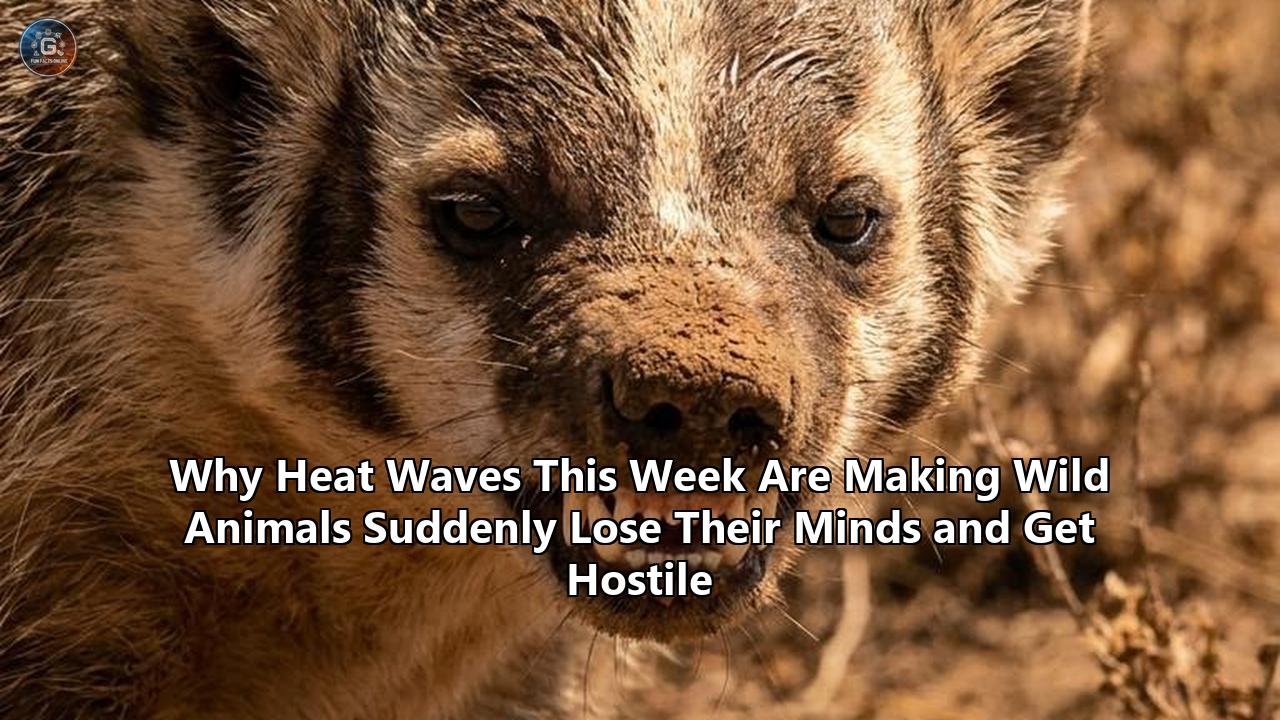
A series of relentless, record-shattering heat waves is currently blanketing major portions of the Northern Hemisphere. From the parched chaparral of Southern California to the high-altitude meadows of the European Alps, local authorities and wildlife rehabilitators are reporting an alarming, seemingly bizarre phenomenon: wild animals are acting erratic, losing their fear of humans, and launching uncharacteristic, hostile attacks.
In suburban backyards, normally nocturnal raccoons and skunks are wandering aimlessly in broad daylight, showing intense agitation. In mountain passes, territorial ungulates are engaging in violent, escalating brawls over dry patches of grass. In rivers and streams, fish and amphibians are turning on their own species with unprecedented ferocity.
This sudden spike in animal hostility is not random madness. It is the visible manifestation of a profound biological crisis.
This week, the scientific community provided a crucial framework for understanding this ecological breakdown. On June 8, 2026, an international team of scientists led by Josep M. Serra-Diaz of the Botanical Institute of Barcelona published a landmark study in Nature Climate Change. The researchers introduced the first global early warning system designed to forecast when and where vertebrate species will be exposed to unprecedented, life-threatening thermal stress.
The model predicts that over 3,500 species are currently crossing physiological thresholds they have never encountered in their evolutionary history. What the study—and a wave of concurrent behavioral research—makes clear is that extreme heat does not merely threaten animals with physical collapse or heat stroke. Long before temperatures reach lethal limits, extreme thermal stress acts as a potent neurotoxin.
Understanding how heat waves affect animal behavior requires going far beyond simple headlines about "grumpy" animals. It requires an exploration of compromised neural pathways, metabolic panics, and the rapid unraveling of evolutionary survival strategies.
The Neuropathology of the "Stupid Hot" Brain
When ambient temperatures exceed an animal’s thermal neutral zone, the brain is the first organ to suffer. For decades, conservation models treated heat waves as simple binary events: either an animal survived by finding shade, or it died of hyperthermia. But neurobiologists are now discovering that sublethal heat waves fundamentally rewrite brain chemistry.
[Ambient Temperature Spikes]
         │
         ▼
[Preoptic Area (POA) Hyper-Excitation]
         │
         ├─────────────────────────────────────────┐
         ▼                                         ▼
[pPVT Pathway Saturation]               [Neuroinflammation in Hippocampus]
         │                                         │
         ▼                                         ▼
[Persistent Anxiety & Hyper-Arousal]    [Microglial Activation & Cognitive Deficits]
         │                                         │
         └───────────────────┬─────────────────────┘
                             ▼
              [Hostile & Irrational Behaviors]
At the center of this neurological disruption is the Preoptic Area (POA) of the hypothalamus, the brain’s central thermostat. Research published in eLife mapping the neural circuits of mice under sustained heat stress revealed that the POA maintains a direct excitatory pathway to the posterior Paraventricular Thalamus (pPVT). The pPVT is a key hub for regulating emotional states, fear responses, and vigilance.
Under normal conditions, this pathway fires occasionally to prompt behavioral thermoregulation, such as seeking shade or water. However, during sustained heat waves, the POA-pPVT pathway undergoes chronic, persistent hyper-excitation.
This continuous firing literally saturates the brain's neuroplasticity. The neural circuit becomes "locked" in a state of permanent high alert, inducing severe, chronic anxiety and hyper-arousal. The animal is trapped in a biological feedback loop of panic, rendering it highly reactive to external stimuli that it would ordinarily ignore or easily tolerate.
Simultaneously, the physical structures responsible for memory, learning, and spatial navigation begin to degrade. In mammalian brains, extreme heat triggers an inflammatory cascade within the hippocampus. Microglia—the brain's resident immune cells—become hyperactive, releasing pro-inflammatory cytokines that disrupt synaptic transmission.
In lab settings, mice subjected to temperatures mimicking severe heat waves show a dramatic loss of structural integrity in hippocampal neurons, leading to cellular death in extreme cases.
For animals in the wild, this translates to a state of cognitive delirium. They cannot think straight, their memory fails them, and their spatial maps dissolve. When an animal's cognitive processing is muddled, its ability to evaluate risk vanishes. It can no longer distinguish between a genuine predator, a harmless passerby, or a static object, often defaulting to immediate, explosive aggression as a survival mechanism.
Neurotransmitter Chaos: Serotonin Depletion and Dopamine Spikes
The behavioral shift observed during extreme heat is heavily driven by the disruption of key monoamine neurotransmitters: serotonin, dopamine, and noradrenaline. These chemical messengers dictate mood, impulse control, and the delicate balance between aggression and self-preservation.
- Serotonin (5-HT) Depletion: Often called the "calming" neurotransmitter, serotonin plays a crucial role in suppressing impulsive aggression and stabilizing mood. When an animal undergoes severe thermal stress, the synthesis of serotonin in the prefrontal cortex declines rapidly. This depletion is exacerbated by sleep disturbances caused by hot nights, preventing the brain from replenishing its neurotransmitter reserves. Without adequate serotonin to dampen raw, amygdala-driven impulses, animals suffer a profound drop in impulse control. Minor irritations or territorial boundary crossings that would normally be resolved with a submissive posture instead trigger violent confrontations.
- Dopamine Fluctuations: Dopamine governs the brain’s reward systems, spatial awareness, and motor initiation. During heat waves, particularly those accompanied by high ultraviolet (UV) radiation and elevated surface ozone, dopamine levels in the striatum fluctuate erratically. Environmental neurobiologists have noted that these spikes can create a state of chemical over-excitation. The animal becomes hyper-vigilant, eager for immediate rewards, and highly sensitive to perceived threats.
- Cortisol and Adrenaline Spikes: Under thermal stress, the hypothalamic-pituitary-adrenal (HPA) axis is permanently activated, flooding the animal's bloodstream with glucocorticoids (cortisol) and adrenaline. This sustained hormonal bath keeps the animal’s cardiovascular system red-lined, priming the body for immediate, violent physical action.
The convergence of these neurochemical alterations means that as heat waves affect animal behavior, they strip away the behavioral buffers built over millions of years of evolution. The wild animal experiencing extreme heat is not simply uncomfortable; it is chemically altered, operating with a hyper-active threat-detection system, diminished cognitive capacity, and virtually no impulse control.
Metabolic Panic: Why Ectotherms and Endotherms Explode
While the neurological pathways of heat-induced aggression are remarkably consistent, the underlying metabolic drivers differ sharply depending on whether an animal is cold-blooded (ectothermic) or warm-blooded (endothermic).
| Animal Class | Primary Metabolic Response | Impact on Energy & Resources | Resulting Aggressive Behavior |
|---|---|---|---|
| Ectotherms (Salamanders, Fish, Insects) | Body temperature rises with the environment. | Metabolic rate skyrockets, burning calories exponentially. | Hyper-aggressive foraging and hyper-territoriality to secure immediate calories. |
| Endotherms (Mammals, Birds) | Divert vast energy to active cooling (sweating, panting, wing-spreading). | Energy reserves depleted; foraging efficiency drops. | Severe irritability, collapse of social tolerance, and violent resource competition. |
The Ectothermic Calorie Deficit
For ectotherms—such as reptiles, amphibians, fish, and insects—body temperature is entirely dictated by the ambient environment. When air or water temperatures rise, their internal biological clocks run faster. According to thermodynamic principles, chemical reactions speed up at higher temperatures, meaning an ectotherm’s basal metabolic rate skyrockets during a heat wave.
To survive, the animal suddenly requires an exponential increase in caloric intake just to maintain basic physiological homeostasis.
This sudden, desperate need for food triggers a state of metabolic panic. Ectotherms must forage far more aggressively, pushing them into dangerous territories and putting them on a collision course with rivals.
A prime example of this was documented by ecologist Kristen Cecala of the University of the South. In what she termed "salamander fight club," black-bellied salamanders (Desmognathus amphileucus) from Appalachian streams were placed in controlled thermal chambers. When the water temperature was raised from a natural 15°C (59°F) to 25°C (77°F), the salamanders' behavior shifted dramatically.
They became nearly four times more likely to launch violent, physical attacks against one another, engaging in relentless thrashing, chasing, and biting. The biological explanation was clear: the elevated water temperatures had spiked their metabolic needs, rendering the salamanders entirely unwilling to tolerate any competitors near their dwindling, oxygen-depleted stream territories.
This metabolic-driven hostility is equally evident in aquatic ecosystems. During recent heat spikes, researchers studying the golden julie (Julidochromis ornatus), a highly territorial tropical cichlid fish, noted a massive surge in intra-species aggression.
Under normal water temperatures of 78°F, the fish maintain structured, relatively peaceful social hierarchies. However, when water temperatures were raised to 84°F, the fish became hyper-confrontational, relentlessly attacking group members and even viciously biting and tail-slapping their own reflections in a mirror.
[Elevated Water Temperature]
            │
            ▼
[Thermodynamic Speedup of Ectotherm Chemistry]
            │
            ▼
[Spike in Basal Metabolic Rate]
            │
            ▼
[Desperate Search for Dwindling Calories]
            │
            ▼
[Hyper-Aggressive Defense of Territory & Food]
The Endothermic Energy Drain
For endotherms, the equation is reversed but equally devastating. Mammals and birds must expend immense amounts of energy to keep their core body temperatures down. They must pant, sweat, seek shade, and spread their limbs to dump excess heat into the environment. This active cooling process is incredibly exhausting, leaving the animal with very little energy for normal social maintenance or cognitive processing.
When an animal is operating on an extreme energy deficit, it cannot afford the energetic cost of complex, cooperative social behaviors. Social structures rely on tolerance, negotiation, and impulse inhibition—all of which require significant prefrontal executive control.
As the heat intensifies, mammalian social structures collapse. The animal’s primary goal becomes raw survival, and any other individual—even a close family or troop member—is viewed as a direct threat to its immediate comfort and resource access.
Muddled Minds and Shattered Social Contracts
The behavioral shifts triggered by heat waves are dismantling some of the most complex social systems in the animal kingdom, leading to what field researchers describe as a total breakdown of group cohesion.
The Collapse of Capuchin Societies
In May 2026, researchers from UCLA and the Max Planck Institute of Animal Behaviour published the results of a staggering 33-year continuous study tracking 335 white-faced capuchin monkeys (Cebus capucinus) across 12 distinct social groups in Costa Rica. The paper, published in Nature Ecology and Evolution, provided a masterclass in how extreme environmental stressors shatter animal societies.
Under normal seasonal conditions, capuchins rely heavily on the strength of their group. Large troops easily dominate smaller ones, securing prime access to food, water, and shade near riverbanks. Within the troop, monkeys engage in extensive grooming, food sharing, and collaborative infant care.
[Normal Conditions] ──────────────> Strong Social Cohesion & Troop Cooperation
                                    (Grooming, food sharing, group defense)

[Extreme Heat & Drought] ─────────> Internal Competition Spikes
                                    (Resource scarcity, hormonal stress)
                                              │
                                              ▼
                                    Troop Fragmentation
                                    (Violent expulsions, solitary roaming)
However, when extreme heat waves and severe droughts strike, this social contract disintegrates. The cost of finding food and staying cool becomes so high that the advantages of group living evaporate.
The researchers documented a massive surge in internal competition, with dominant individuals violently attacking subordinates over water holes and fruit trees. The stress of the heat wave triggered a cascade of troop fragmentations.
Monkeys began abandoning their social groups entirely, wandering as highly aggressive, stressed, and vulnerable solitaries. The social hierarchies collapsed into raw, unmitigated violence, with weaker individuals being actively hounded, physically battered, and driven out into marginal, life-threatening habitats.
The "Stupid Hot" Southern Pied Babbler
The cognitive muddledness that drives this aggression is beautifully—and terrifyingly—illustrated by the ongoing work of Amanda Ridley, a behavioral ecologist at the University of Western Australia. Ridley has spent years studying the southern pied babbler (Turdoides bicolor), a cooperative, medium-sized bird native to the hyper-arid Kalahari Desert of Southern Africa.
The Kalahari is currently warming at twice the global average, making it a living laboratory for how extreme heat waves reshape wildlife cognition.
In field experiments, Ridley and her team tested the babblers' cognitive function under varying thermal conditions. The birds were presented with a simple puzzle: a highly coveted mealworm placed behind a transparent plastic barrier. On cooler, normal days, the babblers effortlessly solved the puzzle, quickly realizing they simply had to hop around the plastic shield to grab the treat.
But when the ambient temperature climbed above 35.4°C (95.7°F), the birds’ cognitive processing failed.
Instead of navigating the barrier, the heat-stressed babblers would stand in front of the plastic, stubbornly and frantically pecking at the transparent shield over and over again, completely unable to process the spatial detour required. They grew increasingly frustrated, displaying agitated wing-spreading and panting.
[Cooler Days] ─────────────────────> Easily solve puzzle (detour around plastic)
[Hot Days (>35.4°C / 95.7°F)] ─────> Frantically peck at plastic (cognitive lock)
More alarmingly, the heat waves completely wiped out the babblers’ threat-assessment capabilities. Under normal conditions, if a babbler is shown a model of a predator—such as a taxidermied genet (a small nocturnal carnivore)—the bird immediately goes on high alert, emitting warning calls, scanning the sky, or fleeing.
However, when temperatures spiked, the babblers’ response to the predator was identical to their response to a harmless cardboard box. Their brains were so overwhelmed by the physiological toll of thermoregulation that they literally could not identify a lethal threat.
For a wild animal, this cognitive blindness leads to a state of constant, low-level panic. Because they cannot accurately assess what is dangerous and what is safe, they treat everything as a threat, resulting in highly defensive, hostile, and sudden lashing-out behaviors.
Suburban Hot Zones: Urban Wildlife on a Wire
While these dynamics are playing out in deep wilderness areas, they are crashing into human civilization with frightening intensity in suburban and urban spaces.
Cities are notoriously subject to the "urban heat island" effect, where concrete, asphalt, and building structures absorb and re-emit the sun’s heat, making urban centers up to 10°F warmer than surrounding rural areas. During the heat waves gripping cities this week, urban wildlife is being pushed to its absolute physiological and psychological limits.
The Crawlspace Temptation and Backyard Battles
In suburban communities across North America, residents are reporting a massive surge in daytime encounters with normally reclusive, nocturnal mammals: raccoons, striped skunks, and opossums. Local wildlife control agencies are being flooded with calls about these animals showing up on porches, panting heavily, and refusing to move.
These animals are not invading neighborhoods out of boldness; they are in the throes of a desperate, heat-induced search for shade and moisture.
To a skunk or raccoon, the unsealed crawlspace under a wooden deck, a concrete porch, or a raised house foundation represents a cool sanctuary. The temperature of the dirt beneath these structures can be 15°F cooler than the surrounding air.
However, because these animals are suffering from severe thermal cognitive decline and hyper-arousal, these encounters are turning highly combative.
A homeowner stepping onto their deck to let a dog out can surprise a heat-stressed raccoon that, under normal conditions, would immediately flee. Under the influence of a hot, muddled brain, the raccoon’s preoptic-pPVT pathway is red-lined; it perceives the human as an immediate, lethal threat and attacks with vicious, frantic defensive aggression.
[Urban Heat Island Effect]
           │
           ▼
[Wildlife Desperately Seeks Shade/Moisture]
           │
           ▼
[Sanctuary found in Suburban Yards/Decks]
           │
           ▼
[Accidental Human/Pet Encounters]
           │
           ▼
[Cognitively Scrambled Animal Attacks instead of Fleeing]
The Dog Bite Surge
This heat-induced irritability is not restricted to wild species. Our closest domestic companions are suffering from the exact same neurological disruption.
In a massive epidemiological study, researchers analyzed nearly 70,000 reported dog bites across eight major U.S. cities, including Chicago, Houston, and Baltimore. The data revealed a direct, undeniable link between rising temperatures and animal hostility.
On days when temperatures reached 90°F, the incidence of dogs biting humans spiked by 10 percent compared to cooler, 60°F days. When the researchers controlled for seasonal factors, holidays, and weekends—to account for the fact that more people are outside interacting with dogs on warm days—the correlation remained robust.
The risk was further compounded by high UV radiation and elevated surface ozone levels, which increased the bite risk by 11 percent and 3 percent, respectively.
Neuroscientists studying this data, such as Clas Linnman of the University of Miami, point out that the combination of physical discomfort, heat-stress-induced cortisol spikes, and the chemical alterations of dopamine in the brain leaves domestic animals with a incredibly low threshold for frustration.
When a well-meaning child grabs a dog's collar or a stranger approaches too quickly on a sweltering afternoon, the dog’s normal tolerance mechanisms are entirely offline, resulting in a sudden, defensive snap.
The Conservation Conundrum: Early Warning vs. Landscape-Scale Impotence
The publication of the new global early warning system in Nature Climate Change this week highlights a major political and logistical divide in modern environmental management.
The predictive tool developed by Josep M. Serra-Diaz and his international team is a technological triumph. By marrying NASA’s GEOS-S2S subseasonal-to-seasonal forecasting system with the historical temperature tolerances of more than 30,000 mammals, birds, reptiles, and amphibians, the model can identify looming heat threats up to nine months in advance.
For example, if this tool had been fully operational in early 2024, it would have warned conservationists in Mexico’s Tabasco state three to five months in advance that temperatures were going to cross lethal thresholds, potentially preventing the horrific mass mortality of howler monkeys that fell dead from canopy trees due to heat stroke that year.
However, the existence of this predictive data exposes a stark, uncomfortable truth: wildlife agencies are completely unequipped to intervene at the scale required.
[Serra-Diaz Global Early Warning System]
                  │
                  ▼
[Predicts Extreme Heat 9 Months in Advance]
                  │
                  ▼
   [The Bureaucratic & Logistical Gap]
                  │
       ┌──────────┴──────────┐
       ▼                     ▼
[Local Band-Aids]     [Landscape Realities]
- Water stations      - Billions of animals
- Shade sails         - Remote wilderness
- Indoor enclosures   - No funding/personnel
For highly managed, small populations of critically endangered species, active intervention is highly effective. During severe heat waves, the San Diego Zoo Alliance successfully moved desert tortoise hatchlings and delicate eggs from exposed outdoor pens into climate-controlled indoor enclosures.
Similarly, local volunteer groups in South Africa and Australia routinely set up water provisioning stations and hang reflective shade cloth over critical nesting sites during extreme spikes.
But for billions of wild animals living in remote, unmanaged ecosystems, these hands-on interventions are functionally impossible.
- How do you provide shade sails for an entire national park?
- How do you pump cooled water into hundreds of miles of wilderness streams to save Appalachian salamanders from their own metabolic "fight clubs"?
- How do you manage the behavioral degradation of thousands of elephant or primate troops when their social cohesion dissolves into violent civil wars over drying waterholes?
The logistics are staggering, and the funding does not exist. Furthermore, traditional conservation policies are slow, bureaucratic, and highly reactive, taking years to approve management plans for single species.
Extreme heat waves, driven by a changing climate, are arriving far faster than these bureaucratic cycles can move. As a result, even when scientists can predict precisely where a wildlife mental health crisis is going to erupt months in advance, conservationists are left to watch the disaster unfold in real-time.
What Lies Ahead: The Long-Term Cascades of Wild Delirium
The immediate, headline-grabbing consequence of heat waves affecting animal behavior is the surge in animal-on-human hostility and backyard panics. But the far-reaching, systemic threat lies in how these micro-behavioral changes cascade through entire food webs and ecosystems.
                 [Extreme Heat Wave]
                         │
                         ▼
             [Cognitive Scrambling]
                         │
        ┌────────────────┴────────────────┐
        ▼                                 ▼
 [Prey Species]                    [Pollinators]
- Fail to identify predators      - Forget floral scents
- High predation rates            - Failure of crops/plants
        │                                 │
        └────────────────┬────────────────┘
                         ▼
            [Ecosystem Collapse]
When key species experience cognitive scrambling, the delicate, highly tuned dynamics of predator-prey relationships are thrown into chaos.
If prey species like the Southern Pied Babbler can no longer identify their predators during a heat wave, their local populations can be absolutely decimated in a matter of weeks, leading to local extinctions.
Conversely, if apex predators become cognitively impaired, they may fail to hunt effectively, leading to starvation and forcing them to target easier, domestic prey—such as livestock or pets—deepening human-wildlife conflict.
Insects represent another terrifying ecological tipping point. In controlled experiments conducted by Emily Baird at Stockholm University, bumblebees were trained to associate the color blue with sweet sucrose and yellow with bitter quinine. Under normal temperatures, nearly all the bees quickly mastered the association.
However, when the temperature inside the testing chamber was raised to 32.2°C (90°F), fewer than half of the bumblebees could perform the task.
If key pollinators are experiencing cognitive deficits during summer heat waves, they will fail to locate resources, fail to return to their hives, and fail to associate specific floral scents with food rewards. This does not merely threaten the survival of bee colonies; it threatens the reproductive success of countless wild plants and agricultural crops that rely entirely on the precise, cognitively demanding work of insect pollination.
As we move deeper into an era of unprecedented global temperatures, scientists are beginning to realize that static models of wildlife conservation are fundamentally broken.
We can no longer assume that an ecosystem is safe simply because we have preserved its physical habitat. If the animals within that habitat are driving themselves to extinction through heat-induced aggression, cognitive failure, and social fragmentation, the preserve becomes a beautifully intact, empty shell.
The wild animals displaying erratic, hostile, and desperate behaviors this week are sending us an unmistakable warning. They are the functional equivalent of the canary in the coal mine, demonstrating that extreme heat is not just a threat to physical survival.
It is an active, insidious assault on the biological minds of the wild, and the cognitive fabric of our planet's ecosystems is beginning to tear.
Reference:
- https://insideclimatenews.org/news/09062026/todays-climate-heat-wildlife-forecast/
- https://www.12news.com/article/life/animals/upcoming-heat-wave-will-affect-our-furry-friends-too/75-4c8cc056-9ede-4cdf-ac44-f0e0c729d0ec
- https://www.reddit.com/r/sgv/comments/1u1if3v/the_summer_heat_wave_urban_wildlife_whats/
- https://www.reddit.com/r/InterstellarKinetics/comments/1ttwyfx/study_a_growing_body_of_research_shows_that_heat/
- https://www.smithsonianmag.com/science-nature/stupid-hot-heat-waves-muddle-the-minds-of-animals-and-humans-as-confusion-and-aggression-seem-to-rise-with-the-temperature-180988902/
- https://www.sciencenews.org/article/animals-aggressive-heat
- https://www.accuweather.com/en/climate/heat-disrupts-animal-brains-affecting-behavior-and-learning-ability-studies-show/1897268
- https://www.eurekalert.org/news-releases/1131454
- https://www.celloraa.com/2026/05/31/rising_temperatures_disrupt_animal_behavior_and_learning_processes/
- https://news.uvic.ca/2026/extreme-heat-wave-impact-on-species/
- https://developingchild.harvard.edu/wp-content/uploads/2024/10/ECSCEE-Heat-Paper.pdf
- https://elifesciences.org/reviewed-preprints/101302v1
- https://journals.plos.org/climate/article/file?id=10.1371/journal.pclm.0000958&type=printable
- https://pmc.ncbi.nlm.nih.gov/articles/PMC11981607/
- https://www.livescience.com/animals/stupid-hot-heat-waves-cause-cognitive-changes-in-animals-making-them-more-aggressive-and-unable-to-complete-basic-tasks
- https://www.researchgate.net/figure/The-one-day-lag-regression-model-exploring-air-pollution-effects-on-social-conflict-Ln_tbl1_348419960
- https://en.clickpetroleoegas.com.br/extreme-heat-is-making-animals-more-aggressive-and-confused-scientists-warn-comunikeila/
- https://english.elpais.com/science-tech/2023-06-15/dogs-are-more-aggressive-when-temperatures-rise.html
- https://pmc.ncbi.nlm.nih.gov/articles/PMC7084567/
- https://pmc.ncbi.nlm.nih.gov/articles/PMC6773005/
- https://timesofindia.indiatimes.com/etimes/trending/heat-makes-animals-more-aggressive-research-shows-which-species-are-affected-most/articleshow/124090502.cms
- https://www.sciencenews.org/article/animals-aggressive-heat
- https://journals.physiology.org/doi/full/10.1152/physiol.00040.2018
- https://knowablemagazine.org/content/article/living-world/2026/heat-waves-scramble-animal-minds-trigger-aggression
- https://www.yourweather.co.uk/news/science/extreme-weather-makes-animals-more-aggressive-what-a-33-year-ucla-study-revealed.html
- https://gigazine.net/gsc_news/en/20260608-heat-waves-scramble-animal-minds/
- https://gigazine.net/gsc_news/en/20260608-heat-waves-scramble-animal-minds/