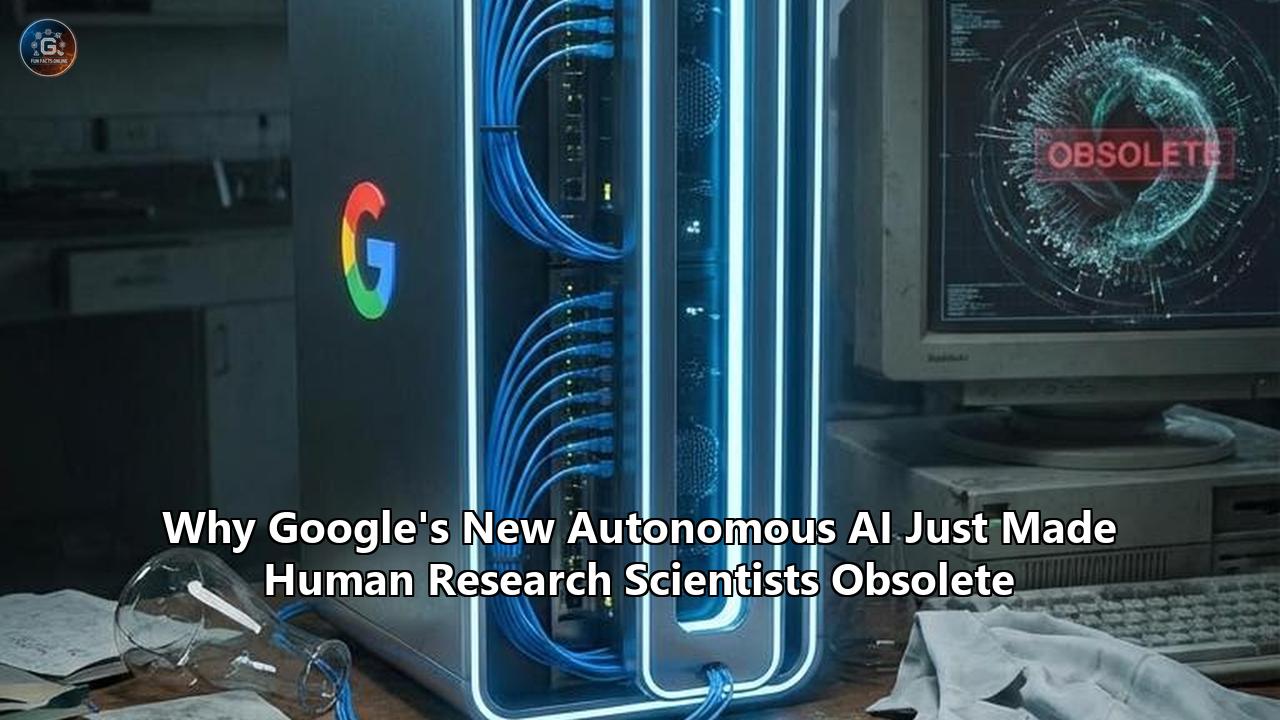
On April 21, 2026, Google DeepMind abruptly redefined the threshold of machine intelligence, pushing the technology out of the conversational realm and directly into the core of the scientific method. The company released two new agents into public preview via the Gemini API: Deep Research and Deep Research Max. Built on the new Gemini 3.1 Pro architecture, these systems do not simply answer questions or summarize documents. They execute the kind of exhaustive, multi-day investigative work that previously required a team of human research scientists, financial analysts, or post-doctoral students.
The headline metric from the launch was the performance jump: Deep Research Max scored 93.3% on the DeepSearchQA benchmark, up from 66.1% just four months prior, and achieved a record 54.6% on the notoriously difficult Humanity’s Last Exam. But the raw numbers obscure the functional reality of what Google just deployed.
According to Philipp Schmid, AI Developer Experience at Google DeepMind, the "Max" variant is designed as an asynchronous background worker. When handed a high-level objective, it iteratively runs approximately 160 distinct search queries per task, consults over 100 discrete sources, cross-references conflicting information, natively generates presentation-ready data visualizations, and delivers a fully cited, comprehensive report by the next morning. Google’s Chief Strategist Neil Hoyne characterized the Max system as "the patient AI who works through the night so you wake up to something exhaustive".
This deployment fundamentally alters the economics and structure of knowledge work. By marrying open-web navigation with secure access to proprietary corporate data through the Model Context Protocol (MCP), Google has delivered a commercially viable engine for autonomous AI research. The role of the human research scientist—particularly those tasked with literature reviews, data synthesis, and preliminary hypothesis generation—has been structurally bypassed.
To understand why this system renders traditional human research workflows obsolete, it is necessary to examine the specific engineering choices Google made, the economic pressures driving enterprise adoption, and the shifting philosophy of what it means to discover new information.
The Mechanics of the "Patient AI"
For years, the artificial intelligence industry focused heavily on zero-shot generation: a user types a prompt, and the model predicts the best possible sequence of words to respond immediately. This constraint forces the model to rely almost entirely on the latent knowledge baked into its neural network weights during pre-training. If the model does not have the answer immediately accessible in its parameterized memory, it guesses, leading to the hallucination problem.
Deep Research Max abandons the zero-shot constraint in favor of extended test-time compute. Instead of optimizing for conversational speed, the system is optimized for reasoning over time. When a pharmaceutical company asks the system to evaluate the viability of a specific protein target for a new therapeutic, Deep Research Max does not simply generate an answer based on its training data. It behaves like a senior investigator mapping out a research project.
First, it uses an orchestrator-worker architecture. The system decomposes the primary question into a series of subordinate hypotheses. It then dispatches specialized sub-agents to hunt down information. These agents execute initial search queries, read the resulting scientific papers, and evaluate the evidence.
Crucially, the system utilizes a feedback loop. If an initial search yields conflicting data—for example, if one clinical trial indicates a protein target is viable while a newer, smaller study suggests it is toxic—the system dynamically adjusts its research plan. It formulates new search queries to find methodological critiques of the conflicting studies, evaluating the sample sizes, p-values, and funding sources of the literature it reads. It does this up to 160 times for a single task.
This iterative refinement process mirrors the exact cognitive labor a human researcher performs, but it happens at computational speed. A human post-doc might read and deeply comprehend five to ten dense academic papers in a day. Deep Research Max processes hundreds of sources, integrating text, complex PDF layouts, and embedded charts simultaneously. It never forgets a detail it read in paper number three when evaluating paper number ninety-seven.
The standard Deep Research model handles interactive, lower-latency requests, but the Max model represents the true realization of autonomous AI research. By allowing the AI to "think" overnight, allocating massive computational resources to the verification and synthesis phase, Google has solved the reliability problem that plagued earlier iterations of enterprise AI. The system shows the user its research plan before execution, allowing a human director to tweak the focus, and then operates completely independently until the final report is compiled.
Breaking the Data Silo: The Model Context Protocol
A research scientist's value is not just in reading public information; it is in connecting public information with private, proprietary data. A financial analyst evaluates market news alongside their firm's internal historical trading data. A biotech researcher evaluates published academic literature alongside their company's private clinical trial results.
Until the April 2026 launch, AI systems struggled with this integration. They were either confined to the open web or locked inside a private corporate instance, securely cordoned off but ignorant of external context.
Google bridged this gap by natively integrating arbitrary Model Context Protocol (MCP) support into the Gemini 3.1 Pro API. MCP acts as the connective tissue between the AI agent and secure, proprietary data environments. It is a standardized technical layer that allows an autonomous agent to securely query internal databases, read local file uploads, and access third-party enterprise intelligence software without exposing that private data to the open web or using it to train the foundational model.
Concurrently with the Deep Research Max launch, Google Cloud unveiled the Agentic Data Cloud, an infrastructure platform specifically built to support this new paradigm. Andi Gutmans, Google’s vice president and general manager of Data Cloud, explained that traditional data lakes were built as "static repositories" designed for humans to query. The Agentic Data Cloud transforms these repositories into dynamic reasoning engines.
Through a "universal context engine," Google ensures that when an agent queries company data via MCP, it relies on a single, governed source of truth, drastically reducing the risk of hallucination. Google announced day-one MCP integration partnerships with major financial data providers like FactSet, S&P Global, and PitchBook.
This means a private equity firm can deploy Deep Research Max to evaluate a potential acquisition. The agent will autonomously pull the target company's private financials from a secure internal folder via MCP, cross-reference those numbers against real-time global supply chain data from the open web, query PitchBook for competitor valuations, natively generate comparative financial charts, and have a fully cited due diligence report ready by 8:00 AM.
The technical friction that previously kept human analysts employed—the sheer manual labor of logging into different databases, exporting CSV files, cleaning the data, and formatting charts—has been completely eradicated.
The Economic Recalculation of R&D
The displacement of human research scientists is fundamentally an economic equation. In a knowledge-driven economy, research and development is one of the most expensive line items on a corporate balance sheet.
Consider the pharmaceutical industry. The traditional drug discovery process requires armies of highly credentialed scientists spending months conducting literature reviews, identifying biological targets, and generating testable hypotheses. The labor cost is astronomical, and the failure rate is high.
Early signals of AI's capability in this space were already visible. By 2024 and 2025, tools like Google DeepMind's AlphaFold had mapped the structures of nearly all known proteins, and systems like GNoME had discovered millions of new crystal structures, including novel lithium-ion conductors. Insilico Medicine pushed the first fully AI-designed drug into Phase II clinical trials at a fraction of the traditional cost and time.
However, those were specialized tools requiring expert human operators. The scientists were still driving the car; the AI was just a vastly superior engine.
The launch of Deep Research Max transitions the AI from the engine to the driver. By automating the cognitive workflow of hypothesis generation and literature synthesis, the cost of deep research drops by orders of magnitude. A financial institution or a life sciences company no longer needs to hire a team of six junior analysts to spend three weeks mapping out a market landscape or a biochemical pathway. They can trigger an API call that costs a few dollars in compute time, runs overnight, and delivers a superior, verifiable product with zero human bias.
This shift creates a brutal reality for the entry-level and mid-level knowledge worker. The apprenticeship model of scientific and analytical work—where junior researchers cut their teeth on tedious data gathering and literature reviews before advancing to senior strategic roles—is collapsing. If an autonomous system handles the foundational research, the economic justification for retaining large staffs of human researchers evaporates.
The remaining human roles become purely supervisory. The job transitions from "doing research" to "managing AI researchers". Humans will define the high-level objectives, allocate computational budgets, and make the final executive decisions based on the AI's synthesized output.
The Evolution of the "AI Scientist"
Google's current dominance with Deep Research Max is the culmination of an intense, multi-year arms race across the artificial intelligence sector to achieve true agentic workflows. The concept of an "AI Scientist" has been the holy grail for major labs since the generative AI boom began.
In August 2024, a smaller lab named Sakana AI made waves by releasing a framework literally called "The AI Scientist," which attempted to automate the entire research lifecycle, from writing code to executing experiments and formatting scientific papers. While an impressive proof of concept, it was prone to severe errors and lacked the robust infrastructure required for enterprise reliability.
Throughout 2025, the major players escalated their timelines. In late 2025, OpenAI leadership, including CEO Sam Altman and Chief Scientist Jakub Pachocki, publicly announced internal goals to develop a "research intern" level system by late 2026, and a fully autonomous "legitimate AI researcher" capable of independently delivering complete research projects by March 2028. Anthropic deployed an orchestrator-worker pattern for its Claude models, aiming to support the life sciences translation process.
Google DeepMind, however, had been quietly building specialized multi-agent systems. They introduced "AI Co-Scientist," a system built on Gemini 2.0 designed specifically for scientific ideation rather than just information retrieval. It used specialized sub-agents to iteratively generate, evaluate, and refine testable hypotheses.
By April 2026, Google leapfrogged the industry timelines by merging the rigorous, iterative hypothesis-generation architecture of their internal science tools with the broad, general-purpose reasoning of Gemini 3.1 Pro, and wrapping it in the secure enterprise framework of MCP. The result is a system that does not just match the theoretical capabilities OpenAI promised for 2028, but operationalizes them for actual enterprise developers today.
This creates immense strategic pressure on Google's rivals. While OpenAI’s o1 and o3 reasoning models excel at complex logic, they lack the native, arbitrary MCP extensibility that allows Deep Research Max to seamlessly integrate with enterprise data lakes and financial systems. By prioritizing secure connections to proprietary data and natively generating presentation-ready visuals directly via the API, Google has lowered the barrier to entry for developers building production-grade research applications.
The Hallucination Hurdle and Verifiability
A persistent criticism of deploying LLMs in critical research environments has been their propensity for confidently stating falsehoods. In fields like life sciences and high finance, a single hallucinated data point can invalidate an entire multi-million dollar strategy.
Google engineered Deep Research Max specifically to combat this vulnerability through a dual-layered approach: source grounding and explicit test-time verification.
Because the system consults over 100 distinct sources per query, it does not rely on its internal neural weights for factual claims. Instead, it uses its reasoning capabilities to extract and synthesize claims directly from the external documents it retrieves via the web or MCP. Every assertion in the final report is explicitly tied to a verifiable citation.
Furthermore, the extended test-time compute allows the model to grade its own homework. During the 160-query loop, a dedicated sub-agent is often tasked with acting as a skeptic. If the primary agent drafts a conclusion based on a specific dataset, the skeptic agent runs a counter-query to search for evidence refuting that conclusion. The system evaluates the credibility of the sources, prioritizing high-signal environments like peer-reviewed journals, verified corporate filings, and internal company databases over general web chatter.
This rigorous verification process is why the system scored 93.3% on DeepSearchQA. It is no longer just predicting the next word; it is executing a computational approximation of the scientific method. It forms a hypothesis, gathers data to test it, evaluates the results, refines the hypothesis, and documents the evidence.
Redefining the Human Role: The AI Philosopher
As the mechanical and analytical tasks of research are offloaded to silicon, the nature of human involvement in science and knowledge creation is shifting toward the philosophical and ethical. The infrastructure is capable; the outstanding questions revolve around direction, alignment, and trust.
Reflecting this transition, in April 2026, Google DeepMind made a highly publicized, unconventional hire: Cambridge academic Henry Shevlin was appointed to a newly created "Philosopher" role, slated to begin in May. Shevlin, previously the Associate Director of the Leverhulme Centre for the Future of Intelligence, built his academic career researching machine consciousness, creativity, and the cognitive capabilities of large language models.
His mandate at DeepMind focuses specifically on "human-AI relationships" and "AGI [artificial general intelligence] readiness". This hiring signals a profound recognition within Google that the technical hurdles of autonomous AI research are largely solved; the next frontier involves integrating these alien intelligences into human society without fracturing trust or accountability.
When an AI system is operating with near-total autonomy—generating its own hypotheses, designing its own experimental parameters, and writing its own conclusions—who is ultimately responsible for the output? The academic community has already begun wrestling with the erosion of the "lone genius" narrative, recognizing that AI agents are now effectively virtual co-workers and co-authors.
A highly capable autonomous AI researcher forces institutions to confront novel ethical risks. If a pharmaceutical AI autonomously discovers a highly effective biochemical pathway that could also be reverse-engineered to create a novel pathogen, the system requires a robust set of ethical guardrails to prevent harmful disclosure. If an algorithmic trading firm uses Deep Research Max to orchestrate a highly complex, autonomous market strategy that triggers a flash crash, the diffusion of accountability becomes a legal nightmare.
Shevlin’s role at DeepMind is to anticipate these intersections of cognitive capability and human values. As humans transition from doing the research to defining the parameters of what should be researched, the skills required to be a "scientist" will morph. The premium will no longer be on data synthesis, but on moral reasoning, strategic foresight, and interdisciplinary problem-solving.
The Inequities of Infrastructure
While the enterprise benefits of systems like Deep Research Max are immediate, the broader scientific community faces a looming crisis of infrastructure inequality.
The Agentic Data Cloud and the compute-heavy API calls required to run 160-query loops overnight are not free. They demand massive, scalable storage, secure networks, and immense financial resources. Well-funded pharmaceutical giants, tier-one financial institutions, and massive technology conglomerates can easily absorb these costs to supercharge their R&D departments.
However, public universities, independent researchers, and institutions in the developing world risk being priced out of the new paradigm of scientific discovery. If the most advanced autonomous AI research tools remain locked behind expensive enterprise API tiers, the gap between well-funded corporate science and public academic science will widen dramatically.
Furthermore, the effectiveness of these agents is bottlenecked by data fragmentation. An AI can only synthesize the data it is allowed to access. Corporate researchers using MCP to connect their AI to vast, private data lakes will have a distinct advantage over academic researchers who rely solely on open-access journals and public datasets. The future of scientific discovery may become increasingly privatized, not because companies are hiding their findings, but because they hold a monopoly on the infrastructure required to make the discoveries in the first place.
Efforts like Hugging Face’s open-source DeepResearch initiative and Stanford’s STORM system represent attempts by the broader community to democratize these tools, prioritizing high-quality data curation over sheer model size. Yet, competing with the raw infrastructural power of Google’s Gemini 3.1 Pro and the seamless enterprise integration of the Agentic Data Cloud remains a daunting challenge for open-source alternatives.
The Path Forward: What Happens Next
The April 2026 deployment of Deep Research Max is not an endpoint; it is the foundation for an entirely new operating system for knowledge work. As developers and enterprise teams integrate these API endpoints into their daily workflows, several major shifts will become apparent in the near term.
First, expect a massive consolidation in the enterprise intelligence software market. Traditional vendors that sell static data dashboards or simple search interfaces will struggle to compete with AI agents capable of active reasoning and autonomous synthesis. If Google can successfully position the Agentic Data Cloud as the default infrastructure for enterprise data, they will capture immense value from companies looking to bypass legacy software suites.
Second, the academic publishing and peer review system will face immense strain. As the marginal cost of producing a deeply researched, heavily cited, beautifully formatted scientific paper drops to near zero, journals will be flooded with AI-generated research. While some of this research will be genuinely novel and valuable, the volume will overwhelm human reviewers. The scientific community will likely be forced to deploy specialized "AI reviewer" agents just to evaluate the output of the "AI researcher" agents, leading to an ecosystem where machines conduct research and other machines verify it.
Third, the definition of a "hallucination" will evolve. As these models move beyond simple factual retrieval into complex scientific hypothesis generation, it will become increasingly difficult for human supervisors to determine if an AI's novel idea is brilliant or structurally flawed. When an AI proposes a chemical structure that has never existed, or a financial correlation that no human has ever noticed, the verification process itself will require entirely new frameworks of cognitive evaluation.
The arrival of a fully competent, autonomous AI research agent effectively closes the chapter on the era of human-exclusive scientific synthesis. We have built systems that can navigate the sum total of human knowledge, cross-reference it against private corporate secrets, identify the gaps, and propose the solutions.
The challenge moving forward is no longer how to build a machine that can think like a scientist. The challenge is figuring out what humanity’s role is in a world where the most exhaustive, relentless, and capable researchers do not require sleep, do not have biases, and can read every paper ever published before their human colleagues have even finished their morning coffee. The technology is here; the societal restructuring is just beginning.
Reference:
- https://www.therift.ai/news-feed/google-deepmind-launches-deep-research-autonomous-agents-with-gemini-3-1-pro
- https://pasqualepillitteri.it/en/news/1191/google-deep-research-max-gemini-3-1-pro-ai-agents
- https://www.edtechinnovationhub.com/news/googles-new-ai-agent-will-run-160-searches-while-you-sleep-and-hand-you-the-report-by-morning
- https://hellomarvisaitoday.com/articles/8775053e-ce29-4395-a41e-08b7b3c396a8
- https://deepaimind.com/articles/20250207-autonomous-ai-agent-research.html
- https://www.researchgate.net/publication/400416146_Autonomous_artificial_intelligence_scientific_research_and_human_values
- https://medium.com/@doubletaken/the-rise-of-research-agents-8ad30a3e8681
- https://www.youtube.com/watch?v=FTjTcrX-aGw
- https://siliconangle.com/2026/04/22/google-delivers-connective-tissue-autonomous-ai-agents-access-data-without-restrictions/
- https://arxiv.org/html/2509.06580v4
- https://en.wikipedia.org/wiki/Google_DeepMind
- https://deepmind.google/research/
- https://podcast.smarterx.ai/shownotes/178
- https://www.varsity.co.uk/news/31553
- https://ai.google/static/documents/ai-responsibility-update-2026.pdf