The first quarter of 2026 has delivered a physical shock to the mobile hardware industry. The latest wave of flagship devices—spearheaded by the Honor Magic V6, the Vivo V50, and the OnePlus 15—have arrived with physical dimensions that seemingly defy the fundamental laws of thermodynamics and energy storage. Devices are hitting sub-5mm thicknesses, yet they are packing massive 6,000mAh to 7,300mAh power reserves. Supply chain leaks confirm that Apple’s highly anticipated iPhone 17 Air and Samsung’s Galaxy S25 Edge will adopt the exact same internal architecture later this year.
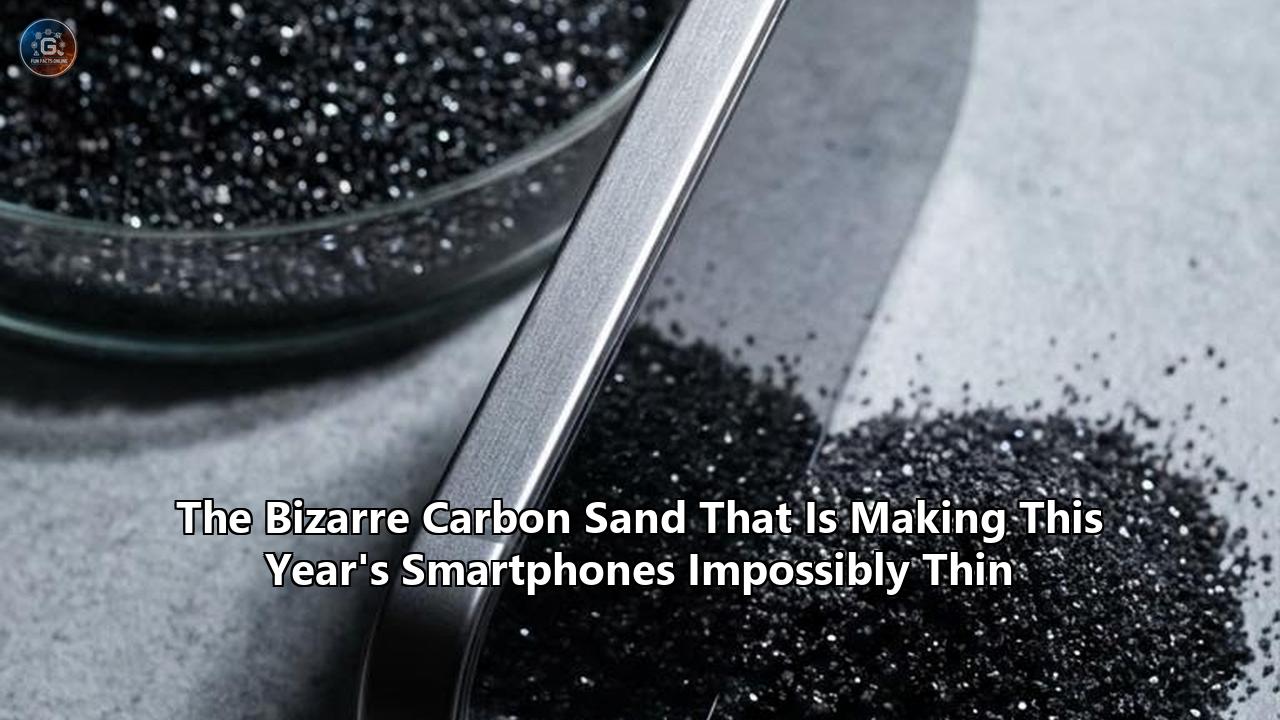
The catalyst for this sudden hardware shrinkage is a granular, black composite material that industry engineers have colloquially dubbed "carbon sand." Technically classified as a silicon-carbon (Si-C) composite anode matrix, this synthetic powder has finally achieved commercial viability at scale. By replacing the solid graphite blocks that have bottlenecked lithium-ion batteries for three decades, carbon sand smartphone technology has abruptly ended the stagnant era of iterative battery upgrades.
This is an analysis of exactly how this chemical breakthrough occurred, who is leveraging it to rewrite the smartphone market, and the cascading consequences this material will have on global supply chains, software engineering, and the broader consumer electronics ecosystem over the next five years.
The Atomic Bottleneck and the Carbon Sand Solution
To understand the sudden proliferation of 4.5mm smartphones, one must look at the atomic failure of traditional battery chemistry. For the past thirty years, the lithium-ion batteries powering everything from laptops to electric vehicles have relied almost exclusively on graphite anodes.
The math governing graphite is stubborn and inflexible. It requires exactly six carbon atoms arranged in a crystalline lattice to securely hold a single lithium ion during the charging process. Because of this atomic ratio, the theoretical energy density ceiling for standard lithium-ion cells was essentially reached years ago, hovering between 250 and 300 Watt-hours per kilogram (Wh/kg). Engineers could not make batteries smaller without sacrificing capacity, and they could not increase capacity without making devices thicker and heavier.
Silicon has always been the obvious alternative. While graphite operates on a six-to-one ratio, a single silicon atom can bond with up to four lithium ions. In theoretical terms, silicon can store nearly ten times the energy by weight compared to graphite.
However, silicon possesses a fatal physical flaw: it expands. When a pure silicon anode absorbs a full charge of lithium ions, it swells by up to 300% of its original volume. Inside the tightly sealed, high-pressure environment of a smartphone battery, this rapid expansion acts like a microscopic localized explosion. The silicon pulverizes itself, crushes the internal battery separators, and effectively destroys the cell’s ability to hold a charge after just a few dozen cycles.
The 2026 breakthrough bypassed this limitation entirely. Instead of attempting to use pure silicon, materials scientists engineered a highly porous, microscopic carbon skeleton. Through a specialized chemical vapor deposition process, nano-scale silicon particles are injected and suspended within this framework. The resulting black powder looks, feels, and pours like ultra-fine dark sand.
This carbon matrix acts as both a highly conductive electrical pathway and a physical shock absorber. When the lithium ions flood the battery during charging, the silicon still expands, but that expansion is contained entirely within the microscopic voids of the porous carbon sand structure. The exterior dimensions of the battery cell remain completely static.
By pushing the silicon content of these composite anodes up to 15%, manufacturers have suddenly shattered the old energy density limits. Commercial cells are now hitting 834 Watt-hours per liter (Wh/L), pushing overall energy density past the 500 Wh/kg threshold. The result is a battery that stores 30% to 50% more power than a graphite equivalent of the exact same physical size.
Who is Affected: The Hardware Market Realignment
The immediate impact of carbon sand smartphone technology is a violent reshuffling of hardware dominance. For years, the physical constraints of graphite batteries acted as an equalizer among smartphone brands. Apple, Samsung, Google, and major Chinese OEMs were all playing by the exact same volumetric rules. That parity is now gone.
The Aggressive Adopters
Chinese manufacturers recognized the potential of silicon-carbon composites early and aggressively funded the necessary metallurgical research. Honor released early, lower-density iterations of the technology in 2023, but the third-generation anodes rolling off assembly lines in Q1 2026 have caught the western market off guard.
By leaning heavily into this new chemistry, brands like OnePlus, Vivo, and Realme are currently dictating the hardware narrative. The OnePlus 15 is shipping with a staggering 7,300mAh battery while maintaining a slim, premium chassis. Vivo’s V50 series is deploying 6,000mAh "Titan" batteries in frames measuring a razor-thin 7.39mm. These companies have effectively eliminated the historical tradeoff between form factor and battery anxiety.
The Forced Pivot of Apple and Samsung
The old guard is currently operating on the defensive. Apple and Samsung have traditionally remained highly risk-averse regarding fundamental battery chemistry changes, a corporate posture largely defined by the catastrophic thermal runaway events that plagued the industry in the mid-2010s.
Up until late 2025, executives at legacy manufacturers privately dismissed silicon-carbon composites, citing internal data that suggested the cells suffered from unacceptable degradation over high-wattage charging cycles. This hesitancy proved costly. As devices like the 6.1mm Honor Magic8 Pro Air hit the market with 5,500mAh capacities, the battery life discrepancy between Android innovators and traditional flagships became too massive for consumers to ignore.
Facing an existential threat to their ultra-premium tiers, both Apple and Samsung have drastically accelerated their supply chain timelines. The upcoming iPhone 17 Air and the Galaxy S25 Edge represent forced architectural pivots, heavily reliant on secured contracts for silicon-carbon composite materials. They are adopting the technology not purely as an innovation, but as a mandatory defensive maneuver to prevent a mass exodus of power users.
Systemic Changes in Device Engineering
The integration of carbon sand smartphone technology is not simply a matter of swapping one battery pouch for another. The sheer density of these new cells is forcing a total rethink of how mobile devices are engineered, cooled, and charged.
The Revival of the "Thin Wars"
The most visible immediate change is the rapid deflation of smartphone chassis. A manufacturer can now take a standard 5,000mAh battery and shrink its physical footprint by 20%. This reclaimed internal volume is the most valuable real estate in consumer electronics.
Engineers are utilizing this space in two distinct ways. The first is raw miniaturization, pushing flagship devices back down to the 5mm territory last seen a decade ago, but this time without the crippling battery life penalties of the past. The second approach involves maintaining the standard 8mm thickness but using the extra space to house massive 1-inch camera sensors, dedicated image signal processors, and advanced periscope lenses without creating a top-heavy, unbalanced device.
The foldable phone sector is the most profound beneficiary of this shift. Historically, book-style foldables suffered from severe dimensional penalties; folding two screens together inherently meant stacking two batteries. By utilizing high-density silicon-carbon cells, devices like the Honor Magic V3 and V6 are achieving folded thicknesses of just 9.2mm—identical to traditional candy-bar smartphones. The physical compromise of owning a folding device has been effectively engineered out of existence.
Thermal Dissipation and Vapor Chambers
A thinner phone presents a severe physics problem: less physical mass means less material to absorb and dissipate heat generated by the processor. While the carbon sand anode allows the battery to shrink, the system-on-a-chip (SoC) still generates the same thermal output.
To prevent these ultra-thin 2026 devices from becoming uncomfortably hot, internal cooling architecture has undergone a radical redesign. Traditional copper vapor chambers rely on gravity and internal fluid dynamics that require a specific minimum thickness to function. With internal tolerances shrinking to fractions of a millimeter, manufacturers are deploying advanced capillary-pumped loop heat pipes. These systems use microscopic etched grooves to force cooling liquid over the processor via capillary action, requiring significantly less vertical space than standard vapor chambers. The carbon matrix of the battery itself also exhibits unique thermal properties; while denser than graphite, the porous nature of the silicon-carbon lattice acts as a mild thermal insulator, protecting the volatile internal chemistry from the heat generated by adjacent motherboards.
Artificial Charging Caps
There is a distinct compromise required to maintain the physical integrity of the carbon sand matrix over years of use: charging velocity.
Silicon-carbon anodes exhibit notably poorer rate performance compared to pure graphite when subjected to extreme fast charging. Forcing massive amounts of current into the battery too quickly exacerbates the silicon expansion, testing the physical limits of the carbon buffer. To ensure these batteries survive standard warranty periods and government regulations requiring 1,000 charge cycles before dropping to 80% capacity, manufacturers are implementing strict software bottlenecks on charging speeds.
While previous years saw companies performing marketing stunts with 240W wired charging, the 2026 devices utilizing silicon-carbon cells are deliberately capped between 90W and 120W. Software now heavily manages the charging curve. A device may pull 100W for the first three minutes to jump from 0% to 25%, but the system rapidly throttles the current down to 30W or 40W to protect the silicon matrix from fracturing. Manufacturers are actively choosing to sacrifice charging speed at the plug to guarantee overall cycle longevity.
Short-Term Consequences (12 to 24 Months)
The commercialization of this anode chemistry will trigger a series of rapid shifts in user behavior, software development, and market dynamics throughout the rest of 2026 and 2027.
The Death of Battery Anxiety
The most immediate consumer consequence is the normalization of multi-day battery life. For the past decade, smartphone usage has been subconsciously tethered to the availability of wall outlets and portable power banks. A 7,000mAh battery fundamentally alters how a user interacts with their hardware.
GPS navigation, continuous 5G tethering, max-brightness 4K video recording, and intense mobile gaming—activities that previously demanded careful battery management—can now be executed without hesitation. When a phone can sustain 17 hours of continuous video playback or 9 hours of heavy 3D gaming on a single charge, the psychological burden of battery conservation disappears.
A Shift in Operating System Priorities
This hardware leap removes a major constraint for software developers. Modern operating systems—whether iOS or Android—are designed to be aggressively defensive. They constantly freeze background apps, throttle CPU speeds, and dim displays to extract an extra hour of screen-on time from a 4,000mAh graphite cell.
With carbon sand smartphone technology pushing capacities past 6,000mAh, software engineers are rewriting power management algorithms. Operating systems will begin allowing persistent background processing for complex on-device AI models. Generative AI features, which require massive local computational power and traditionally drain batteries at an alarming rate, can now run continuously in the background without crippling the device's daily longevity.
Reliable Cold-Weather Performance
A highly practical, yet often overlooked, short-term consequence involves environmental resilience. Traditional graphite lithium-ion batteries suffer severe voltage drops in freezing temperatures; a phone at 20% capacity can suddenly die when exposed to winter conditions.
The integration of silicon into the anode matrix significantly alters the battery's low-temperature electrochemical behavior. These third-generation silicon-carbon batteries remain chemically active, stable, and capable of delivering sustained high voltage in environments as cold as -25°C (-13°F). For millions of users in harsh winter climates, as well as professionals working in refrigeration or high-altitude environments, the functional reliability of their primary communication device has been permanently upgraded.
Long-Term Consequences (3 to 5 Years)
While the smartphone sector is the current focal point, mobile devices are merely the high-margin proving ground for this chemistry. The long-term macroeconomic and geopolitical consequences of this material shift are vast.
The Disruption of Global Supply Chains
The lithium-ion battery economy has spent decades optimizing the extraction, refinement, and distribution of natural and synthetic graphite. China has historically dominated the refinement of battery-grade graphite, creating a tight geopolitical chokepoint for the global consumer electronics and electric vehicle markets.
The pivot toward silicon-carbon matrices begins to alleviate that specific constraint. Silicon is the second most abundant element in the Earth's crust. While producing the highly specialized nano-silicon vapor and engineering the porous carbon framework is a complex, high-energy industrial process, the raw materials required are widely available on every continent. As the reliance on massive volumes of raw graphite decreases, supply chains will reorganize around high-tech chemical deposition facilities rather than traditional mining operations.
However, this does not eliminate the environmental footprint of battery manufacturing. Synthesizing the specific porous carbon structures required to safely house expanding silicon requires immense amounts of thermal energy. Until these manufacturing facilities are powered by renewable grids, the initial carbon footprint of producing a silicon-carbon battery remains higher than that of a traditional graphite cell, a metric that will face intense regulatory scrutiny by the end of the decade.
The Electric Vehicle Threshold
The true economic prize for carbon sand technology is the electric vehicle (EV) market. The physical principles that allow a 5mm smartphone to hold a 6,000mAh charge scale linearly to automotive battery packs.
Currently, EV manufacturers are forced to pack thousands of heavy, bulky graphite cells into the floorboards of vehicles, resulting in cars that often weigh thousands of pounds more than their internal combustion equivalents. If automotive battery manufacturers successfully transition their assembly lines to handle 15% silicon-carbon anodes, the implications are staggering.
An EV manufacturer will face two choices: maintain the current size of the battery pack and increase the vehicle's range by 40%, easily pushing standard ranges past 500 miles per charge. Alternatively, they can reduce the physical size and weight of the battery pack by 30% while maintaining a 300-mile range. This massive reduction in overall vehicle weight would subsequently reduce wear on tires, lower the energy required to accelerate, and dramatically improve the overall efficiency of the global EV fleet.
The Wearable and AR Revolution
Miniaturized electronics, such as smartwatches, fitness trackers, and augmented reality (AR) glasses, are heavily bottlenecked by internal volume constraints. You cannot put a large battery in a device designed to sit on the bridge of a nose or wrap around a small wrist.
Because of this, AR glasses have largely failed to break into the mainstream; they either lack the processing power to be useful or die within an hour of use. A 40% increase in energy density changes the viability of these product categories. Smartwatches will move from requiring daily charges to lasting a full work week. AR glasses will finally possess the necessary power reserves to run continuous outward-facing cameras, real-time translation processing, and bright micro-OLED displays for hours at a time, removing the primary friction point preventing mainstream adoption of spatial computing.
Unresolved Questions and the Future of Mobile Power
Despite the rapid commercialization and undeniable benefits of this new anode chemistry, the industry is stepping into uncharted territory regarding long-term physical hardware aging.
The immediate question hanging over the 2026 smartphone market is the reality of real-world degradation. Laboratory stress tests indicate that the porous carbon framework successfully contains the aggressive expansion and contraction of the silicon particles over 1,000 charge cycles. However, simulated lab conditions cannot perfectly replicate the chaotic reality of consumer usage.
Over the next 18 to 24 months, these devices will be subjected to extreme variables: users leaving their phones on car dashboards in direct summer sunlight, using cheap, non-compliant high-wattage chargers from gas stations, and subjecting the ultra-thin chassis to physical bending and torsion in tight pockets. The true test of carbon sand smartphone technology will be whether the microscopic carbon lattice holds its structural integrity after two years of this abuse. If the carbon matrix micro-fractures under physical stress, the silicon will expand uncontrollably, leading to sudden, catastrophic battery swelling that could shatter the glass back panels of these ultra-thin phones.
Furthermore, the industry must monitor the manufacturing yield rates of these new cells. Producing silicon-carbon composites requires precision chemical engineering. Any defect in the porosity of the carbon skeleton means the silicon has nowhere to expand, turning a microscopic flaw into a dead battery cell. As production scales from millions to hundreds of millions of units to supply the upcoming iPhone and Galaxy device lifecycles, maintaining strict quality control over the vapor deposition process will dictate the financial success or failure of the transition.
Ultimately, silicon-carbon composite anodes serve as the critical bridge technology for the next decade of consumer electronics. They represent the final, maximized optimization of the liquid lithium-ion architecture. By solving the physics of silicon expansion, materials scientists have bought the industry five to ten years of breathing room before the theoretical limits are hit once again.
As the hardware market saturates with sub-5mm devices and multi-day battery life becomes the expected norm rather than a luxury, the baseline for mobile technology has shifted permanently. The devices sitting on store shelves today are not just thinner; they are fundamentally denser, more resilient, and vastly more capable, driven entirely by a microscopic bed of engineered sand.
Reference:
- https://www.smartprix.com/bytes/top-smartphones-with-silicon-carbon-batteries-in-2025/
- https://www.tomsguide.com/phones/i-interviewed-honor-and-oneplus-about-their-silicon-carbon-battery-tech-apple-and-google-are-quickly-falling-behind
- https://www.croma.com/unboxed/what-are-silicon-carbon-batteries
- https://www.howtogeek.com/this-new-battery-tech-is-all-the-rage-so-why-wont-apple-and-samsung-use-it/
- https://bahrainbiznews.com/article/honor-leads-powers-the-future-with-silicon-carbon-battery-technology-1
- https://thetechnologyexpress.com/honor-leads-powers-the-future-with-silicon-carbon-battery-technology/
- https://www.honor.com/sa-en/shop/buying-guide/best-phone-battery-features-for-you/
- https://www.neware.net/news/the-secret-behind-increasing-mobile-phone-battery-capacity-silicon-carbon-anode/230/153.html
- https://www.reddit.com/r/tech/comments/1hb24op/sionic_energy_unveils_100percent_silicon_anode/