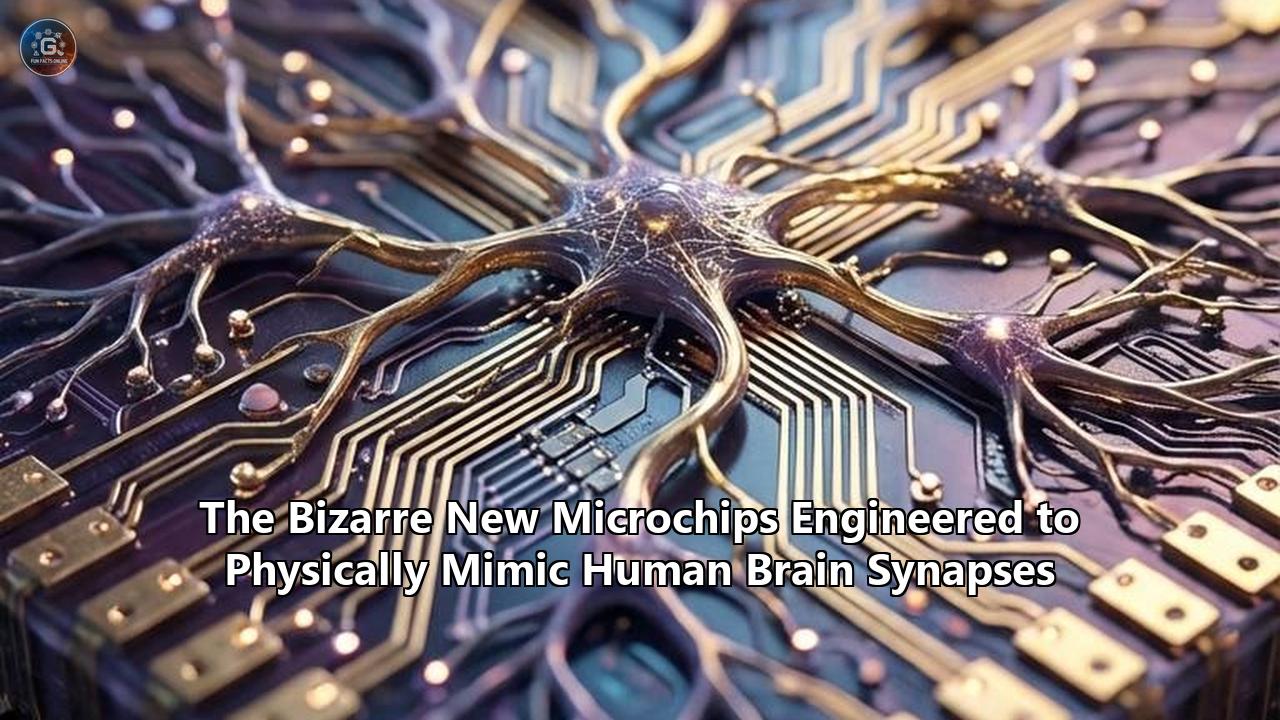
Researchers at the University of Southern California’s Viterbi School of Engineering recently unveiled artificial neurons that do not merely simulate biological brain activity via software, but physically replicate the analog, electrochemical processes of living synapses. Documented in a late 2025 publication in Nature Electronics, the team led by Professor Joshua Yang engineered devices based on “diffusive memristors” that operate using the physical movement of atoms rather than the traditional flow of electrons.
Simultaneously, researchers at China’s State Key Laboratory of Brain-Machine Intelligence at Zhejiang University activated "Darwin Monkey" (Wukong), a supercomputer powered by 960 Darwin 3 neuromorphic computing chips. Operating on a mere 2,000 watts—less power than a standard commercial espresso machine—the system successfully models 2 billion pulsing artificial neurons and 100 billion synapses, directly emulating the cognitive architecture of a macaque monkey.
These parallel developments mark a definitive breach of the theoretical limits of traditional silicon processing. For decades, artificial intelligence has relied on conventional digital processors that use mathematical models to simulate neural networks. Those legacy systems require billions of transistors switching binary states (0s and 1s) to execute massive matrix multiplications, demanding immense energy. The new hardware physically embodies the analog dynamics of biological computation, initiating processing via atomic clustering that directly mimics how neurochemicals trigger brain activity.
The transition from software-simulated neural networks to physically realized analog neurons initiates a profound restructuring of hardware engineering, software development, and energy infrastructure.
Who Absorbs the Impact?
The ripples of this architectural shift extend far beyond academic laboratories, immediately affecting several distinct strata of the global technology ecosystem.
Global Semiconductor Foundries and Materials SuppliersFacilities operated by TSMC, Samsung, and Intel are currently optimized for standard complementary metal-oxide-semiconductor (CMOS) manufacturing, which relies on pristine silicon and electron flow. The USC breakthrough utilizes silver atoms moving through a dielectric matrix. Because silver is highly mobile and prone to contaminating conventional semiconductor manufacturing lines, foundries face a critical pivot. They must either invest heavily in isolating these new atomic-level fabrication processes or accelerate the discovery of alternative, CMOS-compatible ionic species that yield the exact same diffusive properties. Materials science companies specializing in non-volatile memory (NVM) components—such as phase-change materials (PCMs), ferroelectric transistors (FeFETs), and electrochemical RAM (ECRAM)—are positioned to capture massive sudden demand as these designs move toward mass production.
Hyperscalers and Grid OperatorsOperators of massive data centers—Amazon Web Services, Microsoft Azure, Google Cloud—are currently colliding with the physical limits of global electrical grids. Training and operating massive generative AI models requires gigawatt-scale power infrastructure, forcing tech giants to explore nuclear reactor investments to sustain operations. Neuromorphic hardware bypasses this energy cliff. By cutting energy consumption by several orders of magnitude, the widespread deployment of these physical artificial synapses will drastically alter data center economics, alleviating the acute strain on regional power grids and shifting hyperscaler capital expenditure away from cooling and power provisioning toward raw algorithmic scaling.
Edge Computing and Internet of Things (IoT) ManufacturersDevelopers of autonomous drones, industrial sensors, and wearable medical devices have long been bottlenecked by battery life. Advanced AI traditionally requires data to be transmitted to the cloud for processing. Neuromorphic architectures operate in the microwatt range and process sensory data locally in real time. This empowers manufacturers to deploy "always-on" listening, vision, and environmental monitoring systems that do not drain batteries or require constant data center intervention.
Neuroprosthetics and Medical Device EngineersBecause the USC team’s diffusive memristors fundamentally replicate the analog electrochemical dynamics of human brain cells rather than translating them into binary code, a direct hardware-to-tissue interface becomes viable. Medical researchers developing brain-computer interfaces (BCIs), continuous neural monitoring systems, and advanced neuroprosthetics can now design hardware that “speaks” the same physical language as the biological nervous system it aims to repair or augment.
The Mechanics of the Shift: What Fundamentally Changes
To understand why this hardware represents a sharp departure from existing technology, one must examine the specific mechanics of biological mimicry versus digital computation.
Since the 1940s, computing has relied on the Von Neumann architecture. This design physically separates the processing unit (CPU/GPU) from the memory (RAM). Every time an operation occurs, data must be fetched from memory, transported across a bus to the processor, computed, and sent back. For standard applications like spreadsheets or database management, this is highly effective. For artificial intelligence, this constant back-and-forth creates the "Von Neumann bottleneck," burning vast amounts of time and thermal energy just moving data around.
The human brain does not separate memory from processing. Synapses—the connections between neurons—act as both the calculator and the storage unit simultaneously. Furthermore, the brain is event-driven. A biological neuron remains entirely dormant, consuming almost zero energy, until a specific sensory input triggers an electrical spike.
The USC researchers recreated this exact dynamic using diffusive memristors. In a biological synapse, calcium ions flow into a channel to trigger the release of neurotransmitters; once the signal passes, the ions disperse, and the connection weakens. In Yang’s artificial neuron, a voltage spike causes silver atoms to migrate and cluster together, instantly forming a highly conductive nanoscale wire (the “spike”). As soon as the voltage drops, the atomic cluster naturally diffuses back into the matrix, breaking the connection. This physical formation and dissolution of atomic bridges requires merely the footprint of a single transistor per neuron, replacing the billions of digital switches previously required to mathematically simulate the same process.
By pairing these highly efficient physical neurons with Spiking Neural Networks (SNNs), engineers have eliminated the Von Neumann bottleneck. The new systems process information exactly like biological tissue: they remain dark and entirely inactive until relevant data (a sound, a change in light, a vibration) triggers a physical spike, processing the event locally without ever fetching weights from an external memory bank.
Short-Term Consequences: The Edge AI Disruption
Over the next 12 to 24 months, the consequences of this physical hardware breakthrough will materialize outside the data center, specifically at the extreme edges of computing networks.
The primary barrier to neuromorphic adoption has historically been a lack of accessible software. Programming an asynchronous, spiking neural network requires entirely different mathematical approaches than training a standard artificial neural network. However, the software ecosystem is rapidly maturing to meet the hardware. Companies like Innatera have introduced development kits (such as the Talamo SDK) that allow commercial engineers to design and deploy neuromorphic applications without requiring specialized academic backgrounds in biological algorithms.
With developer friction reduced, initial commercial adoption is accelerating in highly constrained environments. Industrial automation and smart city infrastructure will see the first major deployments. Millions of factory sensor nodes, pipeline monitors, and transport network cameras are being equipped with first-generation neuromorphic hardware to perform constant, real-time environmental analysis without draining their independent power supplies or requiring cloud connectivity.
In the consumer electronics sector, this translates to immediate improvements in device autonomy. Always-on smart doorbells, hearing aids capable of isolating specific voices in crowded rooms, and autonomous wildlife cameras can now operate for months or years on a single charge. Because the hardware executes intelligence locally, the data never travels to external servers, providing an inherent privacy firewall that traditional cloud-dependent smart devices cannot offer.
At the institutional level, systems like Intel’s Hala Point—which interconnects 1,125 Loihi 2 chips to emulate 1.15 billion artificial neurons capable of 20 quadrillion operations per second—are being deployed in defense and academic research. These macroscopic systems are testing the limits of real-time optimization, such as dynamically routing city-wide traffic grids or processing massive arrays of incoming radar data at speeds standard silicon cannot achieve.
Long-Term Consequences: Economics, Autonomy, and Bio-Integration
Looking toward the next decade, the successful scaling of physical artificial neurons carries massive economic and structural implications for the trajectory of artificial general intelligence (AGI) and medical science.
Financial analysts project the global market for neuromorphic computing chips will expand from $3.59 billion in 2025 to a staggering $21.8 billion by 2034, registering a compound annual growth rate (CAGR) of 22.5%. This capital influx will fund the necessary retooling of global semiconductor supply chains to handle exotic materials like memristive dielectrics and novel ionic species at commercial yields.
More importantly, the localized, physical nature of these chips resolves one of the primary roadblocks to AGI: continuous learning. Current Large Language Models (LLMs) are frozen in time once their training phase concludes. If an operator wants the model to learn new information, they must typically retrain it at enormous computational expense or rely on superficial contextual prompting. Biological brains, conversely, learn constantly through a process called Spike-Timing-Dependent Plasticity (STDP). Because synapses adjust their connection strength physically and locally based on the timing of spikes, biological organisms learn instantly from single events.
By physically mimicking this biological plasticity, neuromorphic architectures enable machines to learn continuously on the fly. An autonomous rover navigating an alien terrain or an undersea drone mapping a trench can encounter a novel obstacle, physically alter its own synaptic weights to learn how to bypass it, and retain that knowledge permanently without ever phoning home to a server. This self-contained adaptability is a prerequisite for highly autonomous systems operating in unpredictable, real-world environments.
In the medical sector, the consequences are even more profound. The analog operation of these devices perfectly mirrors the electrochemical signaling of the human body. Current neuroprosthetics struggle because they must constantly translate the brain’s messy, analog biological signals into rigid, digital binary code, introducing latency and requiring external power packs. Future iterations of neuromorphic computing chips, engineered with biocompatible materials, will interface directly with organic tissue. These chips will be utilized to bridge severed spinal cords, interpret complex motor commands for advanced prosthetic limbs, and decode neural signals in real-time to suppress epileptic seizures before they fully manifest. The boundary between synthetic computation and biological processing will become increasingly porous.
The Engineering Horizon: What to Watch For Next
The transition from the laboratory success of diffusive memristors to ubiquitous commercial deployment is not guaranteed. Several distinct engineering milestones will dictate the pace of this hardware evolution.
First, the industry must closely monitor the materials science sector’s progress in replacing silver with CMOS-compatible elements. The USC team acknowledges that silver is hostile to standard semiconductor manufacturing lines. Identifying alternative ions that offer the same highly efficient, atomic-level clustering and diffusion without forcing foundries to build entirely isolated multi-billion-dollar clean rooms is the immediate gating factor for mass production.
Second, the algorithmic community must overcome the training bottlenecks inherent to Spiking Neural Networks. The traditional AI boom was fueled by the backpropagation algorithm, which calculates errors and updates weights across digital networks. Backpropagation relies on continuous mathematical functions, which cannot be natively applied to the discrete, discontinuous "spikes" of neuromorphic hardware. Researchers are currently developing surrogate gradient methods—mathematical workarounds that allow SNNs to be trained using established deep learning frameworks. The standardization and optimization of these training algorithms will determine how quickly software developers can migrate complex AI models onto the new physical hardware.
Finally, the global hardware race will increasingly focus on integration density. While Zhejiang University’s deployment of Darwin 3 neuromorphic computing chips achieved 2 billion neurons at the macro-scale, the challenge remains to compress that density onto smaller logic boards suitable for robotics and commercial vehicles.
The successful physical replication of the biological synapse ends the era in which artificial intelligence was purely a software simulation constrained by digital hardware limits. By transferring the mechanisms of cognition directly into the atomic structure of the chip itself, engineers have established the material foundation required for the next phase of autonomous intelligence.
Reference:
- https://scitechdaily.com/new-artificial-neurons-physically-replicate-the-brain/
- https://holistic.news/en/ai-that-thinks-like-a-brain/
- https://viterbischool.usc.edu/news/2025/10/artificial-neurons-developed-by-usc-team-replicate-biological-function-for-improved-computer-chips/
- https://researchintelo.com/report/neuromorphic-computing-chips-market
- https://medium.com/@john.jeremy.morgan/one-to-watch-the-quiet-rise-of-neuromorphic-computing-baeda07bb1a6
- https://openmedscience.com/neuromorphic-chips-transforming-brain-research-through-silicon-intelligence/
- https://ltu.diva-portal.org/smash/get/diva2:2008442/FULLTEXT01.pdf
- https://humanunsupervised.com/papers/neuromorphic_landscape.html