For decades, the search for the biological spark that ignited our planet has focused on boiling extremes: steaming hydrothermal vents in the crushed depths of the ocean, or sun-baked, shallow volcanic pools. Heat was assumed to be the necessary engine for prebiotic chemistry. But a cascade of recent discoveries has violently inverted this assumption, suggesting instead that the first delicate cellular structures emerged from the biting, fracturing cold.
In late April 2026, researchers at the Earth-Life Science Institute (ELSI) at the Institute of Science Tokyo published experimental evidence demonstrating that simple lipid bubbles—the presumed precursors to living cells—experience accelerated growth, fusion, and genetic capture when subjected to repeated freezing and thawing. Rather than destroying these fragile protocells, the expanding ice crystals acted as a mechanical press, forcing simple molecules together with an efficiency that warm water simply cannot match.
The ELSI team built model protocells known as large unilamellar vesicles (LUVs) using different types of lipids, specifically comparing loosely packed, unsaturated lipids like PLPC with more rigid ones like POPC. When they plunged these vesicles into freeze-thaw cycles, mimicking the fluctuating temperatures of early Earth, the results defied classical expectations. The stress of the ice crystal formation destabilized the lipid membranes, forcing them to structurally reorganize.
"Under the stresses of ice crystal formation, membranes can become destabilized or fragmented, requiring structural reorganization upon thawing," noted Natsumi Noda, a researcher at ELSI involved in the study. "The loosely packed lateral organization due to the higher degree of unsaturation may expose more hydrophobic regions during membrane reconstruction, facilitating interactions with adjacent vesicles and making fusion energetically favorable."
The unsaturated PLPC vesicles didn't just survive the freeze; they thrived, fusing into larger compartments and trapping surrounding DNA far more effectively than their rigid counterparts. This selective advantage—driven entirely by the physical dynamics of ice—provides a clear mechanical pathway for how empty lipid bubbles could have acquired the genetic material necessary to kickstart biology.
This discovery does not exist in isolation. It arrives as the latest structural pillar in a rapidly expanding paradigm that points to frost, rather than fire, as the true crucible of early biology.
The Physics of the Prebiotic Deep Freeze
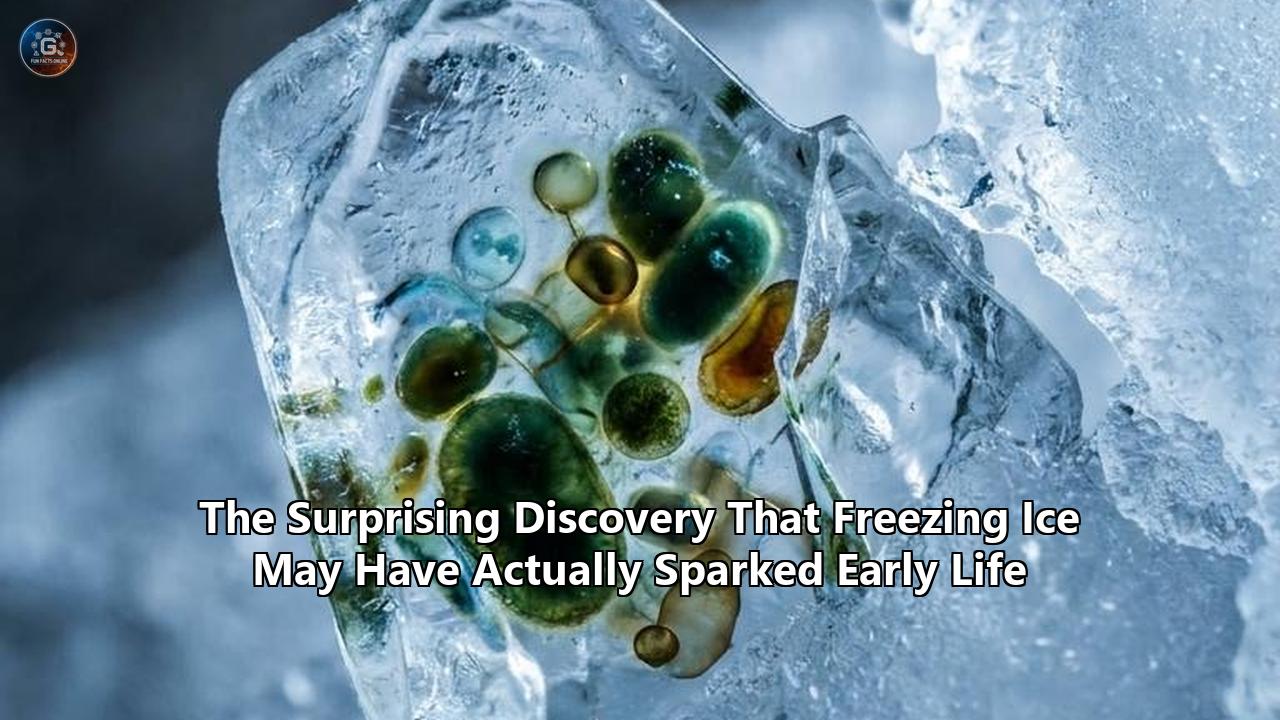
To understand why ice is such a powerful chemical catalyst, one must look at the microscopic behavior of freezing water. When liquid water drops below freezing, it does not solidify into a uniform block of frozen chemistry. Pure water crystallizes first, forming a rigid lattice that violently expels dissolved salts, organic molecules, and gases.
These rejected compounds do not simply disappear. They are pushed into microscopic liquid channels trapped between the expanding ice crystals. This creates a state known as the eutectic phase—a network of briny micro-pockets where the concentration of organic molecules skyrockets.
In origin of life research, scientists have long battled the "water paradox." Water is essential for biological function, but it is deeply hostile to the formation of complex polymers. If you drop basic amino acids or nucleotides into a warm ocean, the surrounding water molecules will relentlessly attack and break apart any nascent chemical bonds in a process called hydrolysis. The vast, warm oceans of early Earth were likely a chemical graveyard, diluting organic compounds until they were too scarce to interact, while tearing apart any short molecular chains that managed to form by chance.
Ice solves the water paradox entirely. By locking up the majority of the H2O molecules in an inert crystalline lattice, ice drastically reduces the chemical activity of the water, preventing hydrolysis. Simultaneously, it crowds the surviving organic molecules into the liquid eutectic pockets, forcing them into incredibly close proximity. In these microscopic brines, molecules that would never interact in a vast, warm ocean are physically pressed together until they bond.
Unzipping the Genetic Code
The structural assembly of protocells is only one half of the equation; the other is the replication of information. For decades, researchers favoring the "RNA world" hypothesis—the idea that ribonucleic acid predated both DNA and complex proteins—faced a mechanical wall.
RNA strands naturally zip together into a highly stable double helix. In modern biology, highly evolved, specialized enzymes physically pry these strands apart so they can be copied. Before life existed, there were no enzymes. If RNA formed spontaneously, it would immediately snap shut into a double helix, resembling a tightly locked zipper. Once zipped, it becomes useless for replication, creating a dead end for chemical evolution.
In May 2025, chemists led by Dr. Philipp Holliger at the MRC Laboratory of Molecular Biology, working alongside researchers at University College London (UCL), shattered this roadblock using the same thermal mechanism highlighted by the Tokyo researchers: the freeze-thaw cycle.
The UK team utilized short, three-letter RNA building blocks called trinucleotides. They found that mild heat could separate the tightly bound RNA double strands. However, if the solution simply cooled, the strands would immediately snap back together. But when the researchers froze the solution, the dynamics changed entirely.
Within the liquid gaps between the ice crystals, the trinucleotide building blocks coated the separated RNA strands, physically blocking them from re-zipping. This allowed the RNA to act as a template, steadily replicating itself. As the researchers cycled the temperature up and down—simulating natural day-night cycles, seasonal shifts, or the movement of water near the frosty edges of a geothermal vent—the RNA replicated exponentially without the need for a single enzyme.
"The changing conditions we engineered can occur naturally, for instance with night and day cycles of temperature, or in geothermal environments where hot rocks meet a cold atmosphere," Holliger's team noted, framing the freeze-thaw cycle as a naturally occurring, mechanical polymerase.
The Poison Catalyst
The push toward a colder origin of life has also resolved mysteries surrounding some of the most toxic compounds on Earth. Hydrogen cyanide (HCN) is universally lethal to modern oxygen-breathing organisms, quickly suffocating cells at the mitochondrial level. Yet, astrophysicists and chemists have long known that HCN was abundant in the early solar system, raining down on early Earth from cometary impacts and atmospheric reactions.
For years, scientists struggled to bridge the gap between volatile hydrogen cyanide and the stable building blocks of biology. The reaction models in warm water were inefficient. Then, in January 2026, researchers at Chalmers University of Technology published computational models demonstrating that HCN exhibits extreme, anomalous reactivity when frozen.
Through detailed quantum chemical modeling, the researchers revealed that as hydrogen cyanide freezes into crystals, the surface of the ice restructures itself, forcing the HCN to shift into an isomer known as hydrogen isocyanide. This isomer acts as a hyper-reactive chemical trigger.
The icy surfaces become catalytic platforms, driving chemical pathways that normally require intense heat or complex enzymes. In the extreme cold, frozen cyanide initiates a chain reaction that eagerly spits out complex polymers, amino acids, and nucleobases—the exact chemical alphabet required to build proteins and DNA.
"We may never know precisely how life began," stated Martin Rahm, a lead author on the Chalmers study, "but understanding how some of its ingredients take shape is within reach." The discovery demonstrated that rather than being dormant, frozen worlds are chemically aggressive environments capable of forging the most complex biological precursors.
Bridging the Gap: Linking RNA and Proteins
The final piece of this frozen puzzle emerged in late 2025 from the laboratory of Professor Matthew Powner at UCL, whose team managed to bridge the two dominant, and previously competing, camps in prebiotic chemistry: the RNA world and the metabolism-first world.
Modern cells rely on a continuous, highly complex translation system where RNA codes for proteins, and proteins construct and maintain the cell. How this symbiotic relationship began before the existence of the ribosome is one of the deepest mysteries in science.
Powner's team achieved what was previously thought impossible without biological enzymes: they spontaneously linked amino acids directly to RNA strands. The mechanism they used relied on thioesters derived from pantetheine—a sulfur-bearing compound found at the core of Coenzyme A, which drives metabolism in every living cell today.
Crucially, the exact environmental condition required for this spontaneous linking was not a warm tidal pool. The reaction achieved its peak efficiency when the mixture was frozen to approximately 19°F (-7°C).
Once again, the eutectic ice phase was the hero. As the water froze, it excluded the salts and forced the thioesters, the RNA, and the amino acids into tightly packed brines. In these sub-zero pockets, the chemistry proceeded rapidly, generating aminoacylated RNA—the direct chemical ancestor of the transfer RNA (tRNA) that builds proteins in our bodies today.
"Our study unites two prominent origin-of-life theories: the 'RNA world' and the 'thioester world'," Powner explained following the publication. The cold did not just preserve the molecules; it actively engineered their fusion.
Astrobiological Shockwaves: Redefining the Habitable Zone
The implications of these interconnected discoveries extend far beyond the history of our own planet. If the mechanical force of freezing water, combined with compounds like hydrogen cyanide and thioesters, is sufficient to spark protocell growth, RNA replication, and protein synthesis, then the parameters for where life can exist in the universe must be violently redrawn.
Historically, astrobiologists have focused the search for extraterrestrial life on the "Goldilocks Zone"—the narrow orbital band around a star where liquid water can exist continuously on a planetary surface. But the revelation that eutectic ice is a superior engine for prebiotic assembly shifts the focus to the frozen outer edges of our solar system.
Jupiter's moon Europa and Saturn's moon Enceladus are encased in miles of thick ice, shielding vast subsurface oceans. Where the ice meets the liquid water, immense tidal forces generate constant thermal fluctuations, creating a permanent, globally distributed freeze-thaw cycle. The exact physical mechanisms that forced Natsumi Noda's lipid vesicles to fuse, and Philipp Holliger's RNA to replicate, are currently operating on a massive scale beneath the crusts of these distant moons.
Furthermore, recent data from deep space missions corroborates the availability of the necessary chemical inventory in the deep freeze. When the James Webb Space Telescope peered into the Chamaeleon I molecular cloud—one of the deepest, coldest environments ever measured—it detected abundant frozen water, ammonia, methane, methanol, and carbonyl sulfide. The raw materials for thioesters and complex organics are synthesized on the surface of interstellar ice grains before stars even form.
Closer to home, the analysis of pristine material returned from asteroids Ryugu (by Japan's Hayabusa2) and Bennu (by NASA's OSIRIS-REx) revealed a stunning array of biological precursors. Ryugu contained all five canonical nucleobases needed for DNA and RNA, alongside vitamin B3, while Bennu yielded a rich harvest of amino acids. These bodies have spent billions of years in the freezing vacuum of space.
The emerging consensus points away from a singular, lucky biological accident in a warm earthly pond. Instead, the chemistry of the cosmos appears to be inherently pre-loaded, waiting only for the right mechanical engine—specifically, the expansion and contraction of freezing water—to force these pre-existing ingredients across the threshold of complexity.
Thermodynamics and the Spark of Complexity
Why does life seem to require this specific mechanical stress to begin? The answer lies in the thermodynamics of phase transitions.
A highly influential theoretical framework recently gaining traction frames the emergence of biology not as a slow, gradual accumulation of parts, but as a sudden, sharp phase transition—much like the physical act of water turning into ice. In this view, early chemical systems were dissipative structures, phenomena described by physical chemist Ilya Prigogine that exist far from equilibrium and are held together by a constant flow of energy.
Warm water, by its nature, pushes chemical systems toward equilibrium. Molecules diffuse outward, concentrations equalize, and complex chains break down. Equilibrium, in chemical terms, is death.
The freeze-thaw cycle operates as a relentless, cyclical energy pump that continually forces the system away from equilibrium. The freezing phase concentrates the molecules, drops the water activity, and physically forces chemical bonds to form via eutectic pressure. The thawing phase then provides a burst of thermal energy, increasing molecular mobility, allowing lipid vesicles to swallow newly formed polymers, and dispersing the products before they can degrade.
This alternating rhythm of mechanical concentration and thermal release provides the precise physical boundaries and energy fluxes required for a dissipative structure to organize itself. The origin of life may not have been a ladder of increasing complexity slowly climbed over millions of years, but a sudden ignition triggered when the four critical components—lipid membranes, replicating RNA, amino acids, and chemical energy—were simultaneously crushed together in a freezing brine pocket.
What Happens Next?
The scientific community is now racing to integrate these isolated experimental successes into a single, comprehensive continuous flow system.
The immediate next step for laboratories like ELSI and UCL is to construct an end-to-end experimental simulation. Researchers are attempting to place basic inorganic gases and minerals into a simulated early-Earth environment, subject them to the exact ultraviolet radiation and freeze-thaw cycles present billions of years ago, and watch the entire sequence unfold without human interference: from hydrogen cyanide forming nucleobases, to thioesters linking amino acids to RNA, to unsaturated lipids encapsulating the entire chaotic mixture and dividing upon thawing.
A major unresolved question remains the transitionary period. If life truly began in the ice, how did it adapt to the hot, volatile oceans of the early Earth? Some researchers theorize that life may have originated in high-altitude glacial ponds or the icy fringes of landmasses, evolving highly robust lipid membranes and rudimentary protein enzymes in the cold before migrating into warmer waters.
Others suggest a dual-origin hypothesis: perhaps the genetic machinery (RNA and amino acids) was forged in the cold brines, while the metabolic pathways emerged in the scalding heat of deep-sea hydrothermal vents. The true biological spark may have occurred when the cold-adapted genetic material washed into the deep ocean and was swallowed by the heat-driven metabolic networks.
As astrobiological missions pivot toward the icy moons of Jupiter and Saturn over the next decade, with the Europa Clipper currently moving toward its destination, the laboratory models will be tested against the reality of the solar system. We are no longer looking exclusively for planets that resemble modern Earth. The search has widened, driven by the profound realization that the cold, dark, and seemingly dead corners of the universe might possess the exact mechanical forces required to spark life into existence.
Reference:
- https://www.sciencedaily.com/releases/2026/04/260428045559.htm
- https://scitechdaily.com/did-life-begin-in-the-cold-new-experiments-point-to-an-icy-origin/
- https://www.earth.com/news/rna-breakthrough-sheds-light-on-the-beginning-of-life/
- https://www.sciencedaily.com/releases/2025/05/250528132057.htm
- https://indiandefencereview.com/scientists-connect-lethal-poison-origin-life-earth-beyond/
- https://www.frontiersin.org/journals/astronomy-and-space-sciences/articles/10.3389/fspas.2026.1736181/full
- https://www.zmescience.com/research/mystery-origin-of-life-proteins-rna-dna/
- https://www.earth.com/news/origin-of-life-on-earth-rna-first-proteins-may-have-formed-in-water/
- https://medium.com/@timventura/the-next-copernican-revolution-lifes-chemistry-is-everywhere-08160a46d623
- https://medium.com/@puodzius/the-spark-is-a-phase-9647370357fe