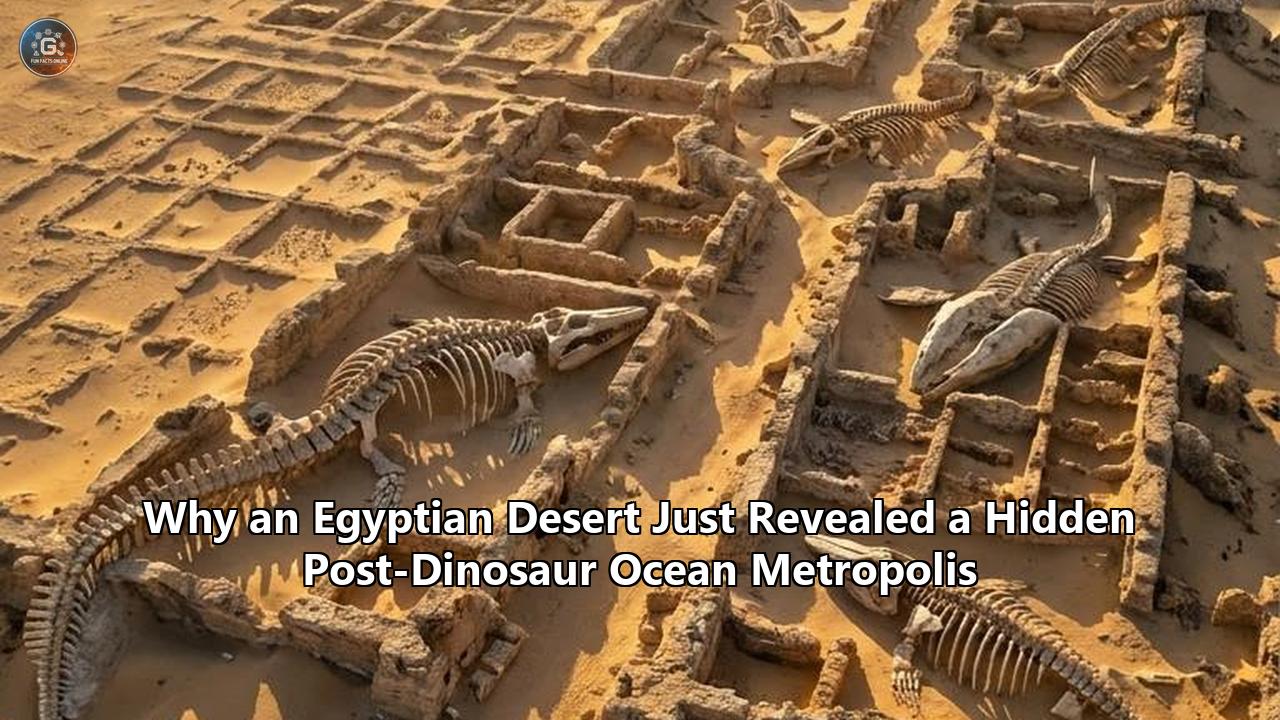
On June 3, 2026, a team of paleontologists operating under the blistering sun of Egypt’s Eastern Desert published a study in Science Advances that fundamentally rewrites our understanding of how life on Earth recovered from the most famous catastrophe in planetary history. The international research effort, led by the Mansoura University Vertebrate Paleontology Center (MUVP) in collaboration with the University of Michigan and KU Leuven in Belgium, documented an extraordinarily well-preserved fossil site known as the Qreiya 3 Lagerstätte.
Dating back 62.2 million years, this site represents a pristine "petrified aquarium"—a fossilized offshore marine ecosystem from the Danian Age of the early Paleocene epoch, which began immediately after the Cretaceous-Paleogene (K-Pg) mass extinction 66 million years ago. Containing hundreds of exquisitely preserved fish skeletons across more than 20 distinct types of ray-finned fishes, Qreiya 3 provides a breathtakingly clear answer to a mystery that has vexed marine biologists and geologists for over a century: how, when, and where did the modern ocean’s fish communities take shape?
For decades, the immediate aftermath of the asteroid impact that wiped out the non-avian dinosaurs was regarded as a blank space in marine history. While the rapid diversification of mammals, birds, and flowering plants on land was well-documented by rich fossil discoveries, the corresponding recovery of marine bony fishes remained shrouded in what paleontologists call "Patterson's Gap"—a frustrating 10-million-year stretch of the fossil record characterized by an almost complete absence of skeletal remains. Qreiya 3 shatters this gap.
The discovery reveals that within just four million years of the global extinction event, the tropical seas covering what is now Egypt were already home to complex, highly organized fish communities that looked remarkably similar to those swimming in our oceans today. Rather than a slow, agonizing recovery dominated by evolutionary holdovers from the Cretaceous, the waters of Qreiya 3 were ruled by Percomorpha, the massive group of modern bony fishes that includes tuna, mackerels, jacks, flatfishes, and seahorses.
       K-Pg Extinction Event (66 Ma)
                 │
                 ├──► 75% of marine species wiped out
                 │
       "Patterson's Gap" (66 Ma – 56 Ma) — Previously a blank slate
                 │
                 ├──► Qreiya 3 Discovery (62.2 Ma)
                 │         │
                 │         └──► First skeletal records of modern fish:
                 │              Jacks, moonfish, pipefish relatives
                 │
       Eocene Marine Boom (56 Ma) — Modern fish global distribution
The Qreiya 3 discovery is not merely a remarkable addition to the global catalog of paleontological finds. It serves as a profound case study in macroevolution, planetary resilience, and the shifting geopolitics of scientific research. By examining this "metropolis" of ancient marine life, we can extract critical lessons about how marine ecosystems restructure themselves under extreme environmental pressure, how geological biases distort our understanding of deep time, and how the decentralization of scientific discovery is unlocking the long-hidden secrets of the Global South.
The Geography of an Oasis: From the Tethys to the Eastern Desert
To stand today in the dry valley of Qreiya, located in Egypt's Eastern Desert, is to stand in one of the most hyper-arid environments on Earth. The landscape is a monochrome expanse of wind-swept limestone, sharp shale ridges, and sun-baked gravel where temperatures routinely soar past 122°F (50°C) during the summer.
Yet, 62.2 million years ago, this very latitude was submerged beneath the southern margin of the Tethys Ocean—a vast, warm seaway that separated the supercontinents of Gondwana and Laurasia. The region that is now upper Egypt was a tropical marine shelf, teeming with life.
The geological layers that compose Qreiya 3 record an offshore marine ecosystem that formed at an estimated paleodepth of 150 to 250 meters. This depth is a crucial element of the find. While most other Danian-aged fossil fish sites around the world represent shallow, nearshore, or coastal environments, Qreiya 3 captures the open, deeper waters of the continental shelf.
The preservation of these delicate skeletons is attributed to a unique combination of global climate trends and local oceanographic conditions. The sediment deposition at Qreiya 3 coincides with the Latest Danian Event (LDE), a short-lived hyperthermal warming interval. During this period, a sudden surge in global temperatures altered ocean circulation patterns, leading to localized stagnation and low-oxygen (anoxic) conditions near the seafloor.
When these ancient fish died, they sank into a quiet, oxygen-depleted basin. The lack of oxygen prevented marine scavengers and burrowing organisms from tearing the carcasses apart, while also inhibiting the bacteria that normally drive rapid skeletal decay. Over millennia, fine-grained muds gently buried the fish, sealing them in a geological time capsule.
The result is a Konservat-Lagerstätte—a site of extraordinary fossil preservation where delicate structures like individual scales, fine fin rays, jaw suspension bones, and even body armor are preserved in immaculate, three-dimensional detail.
These pristine Egyptian desert fossils have lay hidden for over 60 million years, uplifted as the African plate collided with Eurasia, closing the Tethys and exposing the ancient sea floor to the elements. Now, the relentless wind of the Eastern Desert acts as a natural excavator, slowly stripping away the protective mudstones and revealing a fossil treasure trove that challenges some of the most deeply held assumptions in evolutionary biology.
Case Study Framework: Four Core Lessons from Qreiya 3
The true value of the Qreiya 3 discovery lies in its utility as a lens to analyze broader evolutionary and methodological patterns. Rather than treating it as an isolated data point, this case study extracts four core lessons that reshape our understanding of history, biodiversity, and the scientific process itself:
| Scientific Principle | Classical Assumption | Qreiya 3 Insight | Implications |
|---|---|---|---|
| 1. Ecological Coup & Competitive Release | Post-extinction marine recovery was slow and dominated by ancient holdovers. | Modern teleosts (percomorphs) took over dominant niches almost immediately. | Extinctions act as instant ecological resets rather than gradual transitions. |
| 2. Overcoming Observational Bias | Gaps in the fossil record reflect periods of low evolutionary activity. | Gaps are often preservation artifacts of shallow-water sampling. | Deep-time analysis requires diversifying depositional environments (e.g., offshore facies). |
| 3. The Tropical Engine Hypothesis | Evolutionary novelty occurs uniformly across latitudes. | Modern marine fish communities diversified in the tropics before expanding globally. | Low-latitude regions serve as primary cradles for global evolutionary radiation. |
| 4. Decolonization of Deep Science | High-impact paleontology is driven primarily by Western-led expeditions. | Sovereign scientific institutions in the Global South are uncovering major global breakthroughs. | Local capacity building and ownership are critical for the future of global science. |
Lesson I: The Anatomy of an Ecological Coup (Percomorph Dominance)
One of the most striking revelations of the Qreiya 3 discovery is how quickly the "new guard" of the oceans established its rule. To understand the scale of this ecological coup, one must look at the dramatic restructuring of marine ecosystems that occurred across the K-Pg boundary.
The Mesozoic Marine Paradigm
During the Cretaceous period, the world's oceans were dominated by a highly successful, albeit archaic, cast of characters. The top tiers of the marine food web were occupied by massive marine reptiles—mosasaurs, plesiosaurs, and ichthyosaurs—alongside giant ammonites and prehistoric predatory bony fish lineages like the ichthyodectids (exemplified by the terrifying, fanged Xiphactinus) and pycnodontids, which possessed heavy, crushing tooth plates designed to crack open shelled prey.
Bony fishes belonging to the group Percomorpha—which today comprises more than 17,000 species and includes the vast majority of familiar marine fishes like tuna, cod, seahorses, and ocean sunfish—were evolutionary underdogs. During the Age of Dinosaurs, percomorphs were small, ecologically marginalized, and relatively rare in marine ecosystems.
The Asteroid Reset
The Chicxulub asteroid impact 66 million years ago completely shattered this Mesozoic paradigm. The sudden elimination of sunlight, acid rain, global cooling, and the collapse of primary productivity in the oceans wiped out the marine reptiles, ammonites, and many of the dominant Cretaceous fish lineages.
For years, it was assumed that the marine realm spent millions of years as a simplified, depauperate environment, slowly recovering its complexity as ancient survivor lineages gradually gave way to modern groups.
Qreiya 3 shows that this assumption was wrong. Among the nearly 500 fossil specimens recovered by the Mansoura University team, the vast majority are not Cretaceous holdovers. Instead, the community is overwhelmingly dominated by percomorphs.
The site has yielded the oldest skeleton-based fossil records for at least six major, ecologically diverse fish groups that are still prominent today, including:
- Jacks (Carangidae): Sleek, fast-swimming predatory sportfish.
- Moonfishes (Menidae): Deep-bodied, laterally compressed tropical fishes.
- Pipefishes and Seahorse Relatives (Syngnathiformes): Highly specialized, slow-moving fishes protected by dermal body armor.
- Tuna and Mackerel Ancestors (Scombridae): Pelagic, high-speed open-ocean predators.
       CRETACEOUS OCEANS                          PALEOCENE OCEANS (Qreiya 3)
┌─────────────────────────────────┐               ┌─────────────────────────────────┐
│ • Marine Reptiles (Mosasaurs)   │               │ • Modern Percomorphs Dominate   │
│ • Giant Ammonites               │  Asteroid     │   (Jacks, Moonfishes, Tunas)     │
│ • Archaic Predatory Fish        │ ────────────► │ • Specialized Syngnathiforms     │
│ • Marginalized Percomorphs      │   Impact      │   (Pipefish, Seahorse relatives)│
│                                 │               │ • Archaic Predators Absent      │
└─────────────────────────────────┘               └─────────────────────────────────┘
The presence of such diverse ecomorphologies—from the hydrodynamic, high-speed design of ancestral tunas to the slow, structurally complex, armored bodies of pipefishes—indicates that these lineages did not just survive the extinction; they underwent a massive, rapid evolutionary radiation immediately following the catastrophe.
This is a textbook demonstration of ecological release (or competitive release). When a mass extinction sweeps away the dominant, long-established competitors and predators of an ecosystem, it creates an enormous structural vacuum.
For the marginalized percomorphs, the post-impact ocean was a land of infinite opportunity. Unshackled from the pressure of Mesozoic predators and competitors, they rapidly diversified to occupy the newly vacant niches.
The discovery of these Egyptian desert fossils proves that this ecological transition was not a slow, multi-million-year crawl. Within a mere four million years of the impact—a blink of an eye in geological terms—the fundamental trophic structure of the modern ocean was already established.
Lesson II: Dismantling Patterson’s Gap and Geological Observational Bias
The second critical lesson of the Qreiya 3 discovery centers on the nature of the fossil record itself, specifically warning us against the danger of reading geological gaps as evolutionary realities.
The Mystery of Patterson’s Gap
For decades, paleobiologists were puzzled by "Patterson's Gap," named in honor of Colin Patterson, the eminent British paleontologist who dedicated his career to the study of fossil fishes. Patterson and his contemporaries noted that while molecular clock analyses—which estimate the divergence times of species based on genetic mutation rates—suggested that modern bony fish groups must have originated around the K-Pg boundary, the physical fossil record told a very different story.
Skeletal remains of teleost fishes from the first ten million years of the Paleocene were exceedingly rare and poorly preserved, only becoming common and diverse around 56 million years ago.
This discrepancy led to a fierce scientific debate:
- The Evolutionary Lag Hypothesis: Did the oceans remain ecological waste zones for ten million years, delay-launching the rise of modern fish?
- The Preservation Bias Hypothesis: Were the fish diversifying rapidly, but our sampling methods and the geologic record were simply failing to preserve them?
Qreiya 3 provides a definitive victory for the preservation bias hypothesis. The site proves that the modern fish were there all along; scientists were simply looking in the wrong places.
                               Patterson's Gap
       ◄─── [ 66 Ma ] ────────────────────────────────────────── [ 56 Ma ] ───►
                                      ▲
                                      │
                         Qreiya 3 Discovery (62.2 Ma)
                   (Offshore, Low-Oxygen Sedimentation)
                                      │
                                      ▼
                    Provides the skeletal proof that
                  modern communities were already active
The Facies Trap
The primary reason for Patterson's Gap was a systematic bias in the types of sedimentary rock layers (facies) that are typically preserved and studied from the Danian Age. Most well-known Danian fossil deposits, such as those found in Europe and North America, represent shallow-water, nearshore, or coastal environments.
Shallow-water marine settings are energetic, high-oxygen environments. Waves crash, currents shift sand, and oxygen-rich waters support a massive array of scavengers, crabs, and aerobic bacteria. In such settings, the delicate, lightweight skeletons of teleost fishes are quickly broken apart, scattered, and dissolved before they can be buried and fossilized.
Conversely, the heavily built, robust teeth of sharks and the thick, dense bones of marine reptiles from the Cretaceous are much more likely to survive this geological blender.
By recording an offshore marine ecosystem at a paleodepth of 150 to 250 meters, and under anoxic bottom-water conditions, Qreiya 3 bypassed the shallow-water preservation trap. It demonstrates that our understanding of Earth history is often hostage to observational bias.
If we only look at fossil records from one type of environment (shallow coasts), we will build a skewed model of global biodiversity. Qreiya 3 teaches us that reconstructing the history of life requires a deliberate effort to seek out diverse depositional settings, especially those that record offshore, deep-water, and low-oxygen basins.
Lesson III: The Paleotropical Cradle (The Geography of Speciation)
The third major lesson extracted from the Egyptian metropolis concerns the spatial dynamics of evolution: where do new species actually originate during times of planetary recovery?
Cradles vs. Museums
In biogeography, scientists often debate whether certain regions act as "cradles" of evolutionary novelty (where new lineages rapidly originate) or "museums" of biodiversity (where older lineages manage to survive and persist). Modern tropical regions, such as the Indo-Pacific Warm Pool, are known to be epicenters of marine biodiversity, but whether they have always served as the primary engines of global evolutionary recovery remained a matter of debate.
The paleolatitude of the Qreiya 3 site during the early Paleocene places it squarely within the ancient tropics. By comparing the fossil assemblage of Qreiya 3 with the few other known Danian fish sites located at higher latitudes (such as cooler-temperate deposits in Denmark and Sweden), the international research team identified a fascinating geographic pattern.
  EARLY PALEOCENE (62 Ma)                   EOCENE (approx. 50 Ma)

  High Latitudes (Denmark/Sweden)           High Latitudes
  ┌─────────────────────────────┐           ┌─────────────────────────────┐
  │ • Percomorphs rare/absent   │           │ • Percomorphs dominant      │
  │ • Ancient lineages persist  │           │ • Modern fish communities   │
  └─────────────────────────────┘           └─────────────────────────────┘
                ▲                                         ▲
                │                                         │  Migration/
                └─────────────────── Spreads ─────────────┘  Expansion
                                    to North
  Tropics (Egypt / Qreiya 3)
  ┌─────────────────────────────┐
  │ • Percomorphs highly diverse│
  │ • Rapid diversification     │
  └─────────────────────────────┘
During the Danian Age, percomorphs were highly abundant, ecologically diverse, and structurally modern in the tropical Tethys Ocean of Egypt. However, at the same time, higher-latitude marine sites remained dominated by older, non-percomorph fish groups or lacked these modern families entirely.
It was only much later, during the sustained global warming events of the Eocene epoch (which began around 56 million years ago), that these modern percomorph groups expanded northward and established global dominance.
This spatial distribution strongly supports the Tropical Cradle Hypothesis for modern marine fishes. The warm, highly productive tropical waters of the Tethys acted as an evolutionary incubator. The thermal stability and high solar energy of the tropics likely fueled rapid metabolic rates, shorter generation times, and intense ecological interactions, driving accelerated speciation among the surviving percomorph lineages.
Once these modern fish groups perfected their diverse ecological strategies in the tropical "metropolis" of Qreiya 3, they were primed to colonize the rest of the planet as global temperatures warmed during the Eocene, eventually replacing older fish faunas worldwide.
This historical insight carries profound implications for modern conservation biology. If the tropics have historically served as the primary engine for global marine biodiversity and evolutionary recovery, protecting tropical marine ecosystems—such as coral reefs, mangroves, and deep-water shelves—from anthropogenic destruction is not just about preserving current species. It is about protecting the very cradle from which the future diversity of our planet's oceans will eventually emerge.
Lesson IV: The Geopolitical Shift in Paleontology (The Sallam Lab Model)
Beyond the biological and geological discoveries, Qreiya 3 is a landmark moment in the history of science itself. It represents a major case study in the decolonization of deep-time research and the rise of sovereign scientific institutions in the Global South.
The Colonial History of Egyptian Paleontology
For over a century, the rich vertebrate paleontology of Egypt was dominated by Western institutions. During the late 19th and early 20th centuries, European and American paleontologists undertook massive expeditions into the Egyptian deserts.
The famous German paleontologist Ernst Stromer, for instance, discovered some of the most iconic predatory dinosaurs of the Cretaceous—such as Spinosaurus and Carcharodontosaurus—in the Bahariya Oasis of Egypt's Western Desert before shipping the fossils back to Munich.
Similarly, the spectacular Eocene whale fossils of Wadi Al-Hitan (the Valley of the Whales) were heavily studied by American and European teams, with many of the primary specimens transported to Western museums.
While these expeditions undoubtedly advanced scientific knowledge, they also established a "helicopter science" dynamic. Western researchers would fly into developing nations, extract valuable fossil heritage, fly out, and publish their findings in high-impact journals, leaving little local infrastructure, training, or sovereign capacity in their wake.
The Rise of Sallam Lab
The discovery of Qreiya 3 represents a dramatic, structural departure from this colonial model. The research was led and conceptualized not by a Western institution, but by the Mansoura University Vertebrate Paleontology Center (MUVP), colloquially known as Sallam Lab.
Founded in 2010 by Dr. Hesham Sallam, a visionary Egyptian paleontologist and professor at Mansoura University, the MUVP was created with a specific mission: to build a world-class, sovereign research hub within Egypt that could find, study, and curate Egypt’s own paleontological heritage.
Over the past decade, Sallam Lab has systematically dismantled the old paradigm, producing a series of high-profile discoveries that have made global headlines:
- ---Mansourasaurus shahinae (2018): A late Cretaceous sauropod dinosaur that bridged the evolutionary gap between African and European dinosaurs, proved to be a critical link in understanding continental drift.
- ---Phiomicetus anubis (2021):* A four-legged, semi-aquatic walking whale species discovered in the Fayoum Depression, highlighting the transition of whales from land to sea.
- ---Tutcetus rayanensis (2023):* One of the smallest extinct basilosaurid whales ever found, dating back 41 million years and named in honor of King Tutankhamun.
The discovery of Qreiya 3 is the latest, and perhaps most ecologically significant, triumph of this local capacity-building model.
               COLONIAL MODEL                     SOVEREIGN / SALLAM LAB MODEL
        ┌───────────────────────────┐             ┌───────────────────────────┐
        │  • Western-led teams      │             │  • Locally led (MUVP)     │
        │  • Specimen extraction    │             │  • Local capacity building│
        │  • "Helicopter science"   │             │  • Equal international    │
        │  • Little local training  │             │    collaboration          │
        │  • Sovereign loss of data │             │  • Local curation of      │
        │                           │             │    fossils in Egypt       │
        └───────────────────────────┘             └───────────────────────────┘
The Pandemic Detour: A Catalyst for Discovery
The story of how Qreiya 3 was found is itself a testament to the power of local initiative. Sanaa El-Sayed, the lead author of the Science Advances study, was a doctoral candidate at the University of Michigan who had previously been trained at Mansoura University.
When the COVID-19 pandemic struck in 2020, severe travel restrictions and embassy closures forced El-Sayed to return to Egypt. Rather than allowing this forced relocation to derail her Ph.D. research, El-Sayed and her adviser, Hesham Sallam, decided to turn the setback into an opportunity.
During those long pandemic months of isolation, El-Sayed scoured geological literature, searching for any mention of ancient, fish-bearing rock formations in Egypt that dated to the enigmatic Paleocene epoch. She came across an old, obscure geological report by Belgian paleontologist Robert Speijer and his colleagues, which casually mentioned the presence of fish remains in the Danian-aged layers of the Qreiya region.
In July 2021, while the rest of the world was still grappling with travel restrictions, a small, five-person expedition from Sallam Lab set out into the Eastern Desert. Working in brutal conditions, they hiked through remote valleys carrying heavy equipment under the scorching sun.
On their very first day, team member Belal Salem struck a shale layer with his hammer, exposing a perfectly preserved fossil moonfish.
"Seeing one emerge from rocks that were millions of years older felt almost surreal," El-Sayed recalled, "as though the site itself was answering the question that I had first asked during those quiet pandemic days."
Subsequent expeditions in the summer of 2023 secured nearly 500 fossil specimens, laying the groundwork for the monumental study published in 2026. By keeping the primary research, curation, and leadership within Egypt, while collaborating as equals with international institutions like the University of Michigan and KU Leuven, Sallam Lab has provided a blueprint for how paleontological research should be conducted.
This sovereign model ensures that developing nations are no longer just the providers of raw fossil materials for Western intellectual consumption, but are instead active, leading partners in the global production of scientific knowledge.
Methodological Synthesis: Extracting Deep-Time Secrets
The reconstruction of the Qreiya 3 ocean metropolis was not just a triumph of desert field exploration; it was a masterclass in modern, high-tech paleobiological methodology. The transition from dusty, fossil-bearing rocks to high-impact scientific data required a complex synthesis of physical preparation, digital imaging, and geochemical analysis.
       Step 1: Field Excavation
                 │
                 ▼  Excavated from the Eastern Desert (July 2021 & 2023)
                 │  under 50°C (122°F) conditions
                 │
       Step 2: Physical Preparation
                 │
                 ▼  Painstakingly removed matrix using pneumatic scribes
                 │  and microscopes at the MUVP Lab in Mansoura
                 │
       Step 3: High-Resolution CT Scanning
                 │
                 ▼  Non-destructive 3D x-ray scanning at the
                 │  University of Michigan to analyze cranial anatomy
                 │
       Step 4: Biostratigraphy & Geochemistry
                 │
                 ▼  Analyzed calcareous nannofossils and foraminifera
                    to date the deposit precisely to 62.2 Ma
1. Physical Preparation: The Art of Slow Extraction
When these Egyptian desert fossils were first brought back to the Mansoura University laboratories, many of them were encased in hard, fine-grained shale and mudstone matrices. The bones of these Paleocene fishes are incredibly delicate, often measuring only a fraction of a millimeter in thickness.
To expose these delicate structures without destroying them, preparators at MUVP spent years working under high-magnification stereomicroscopes. Using ultra-fine pneumatic air scribes—which act like tiny, highly precise jackhammers—and delicate dental picks, they painstakingly removed the surrounding rock grain-by-grain.
In some cases, where the rock matrix was especially stubborn, researchers used highly controlled, dilute acid preparation techniques to slowly dissolve the mineral matrix while leaving the phosphate-rich fossil bones unharmed.
2. Digital Imaging: High-Resolution CT Scanning
To understand the evolutionary relationships of the Qreiya 3 fishes, the team needed to examine their cranial anatomy in minute detail. Features like the structure of the jaw suspension, the arrangement of the gill arches, and the shape of the braincase are critical for identifying where these fishes sit on the evolutionary tree. However, these features are often buried deep inside the skull or compressed flat by millions of years of geological pressure.
To overcome this, the researchers utilized high-resolution Micro-Computed Tomography (micro-CT) scanning. By bombarding the fossils with X-rays from thousands of different angles, they created highly detailed, three-dimensional digital models of the skeletal remains.
This non-destructive imaging technique allowed scientists to virtually peer inside the limestone blocks, isolating individual bones, rotating them in virtual space, and performing detailed bone-by-bone comparative osteology with both extinct Cretaceous lineages and modern, living species.
3. Geochemical and Biostratigraphical Dating
Establishing the precise age of the Qreiya 3 site was paramount to its scientific impact. To achieve this, the team relied on biostratigraphy—the science of dating rock layers using the microfossils preserved within them.
The mudstones of Qreiya 3 yielded abundant assemblages of calcareous nannofossils and planktonic foraminifera. Because these microscopic marine organisms evolved and went extinct at highly predictable, globally documented intervals, their presence allowed the researchers to place a highly precise timestamp on the deposit: exactly 62.2 million years ago, placing it securely within the Danian Age of the early Paleocene.
This geochemical and biostratigraphical work was led by Professor Robert B. Speijer of KU Leuven, whose decades of experience mapping the Paleogene stratigraphy of Egypt provided the critical chronological framework that validated the rapid, four-million-year recovery timeline of the percomorph communities.
The Species of Qreiya 3: A Closer Look at the Ancient Inhabitants
The exceptional preservation at Qreiya 3 has allowed the research team to document a remarkably diverse cast of characters that lived in this ancient offshore metropolis. Below is a detailed review of the key species and lineages discovered, highlighting their modern relatives and their ecological roles:
1. The Ancestral Jacks (Family Carangidae)
Among the most exciting finds at Qreiya 3 are the earliest known fossil skeletons of jacks. In today’s oceans, jacks are highly active, fast-swimming predatory fishes that patrol reefs and open waters, hunting in coordinated schools.
The Qreiya 3 specimens exhibit the classic carangid morphological blueprint: a streamlined, laterally compressed body, a deeply forked caudal fin, and specialized bony plates (scutes) along the lateral line.
The presence of these swift, pursuit-predators indicates that the pelagic food web of the early Paleocene was already highly stratified and energetic, with modern-looking bony fish filling the fast-swimming predator niches that had been vacated by Cretaceous marine reptiles and large predatory teleosts.
2. The Ancient Moonfishes (Family Menidae)
Moonfishes are characterized by an extremely deep, almost circular, highly compressed body shape and a highly protrusible jaw designed to snatch tiny zooplankton out of the water column. Today, only a single living species of moonfish survives (Mene maculata*), restricted to the warm waters of the Indo-Pacific.
However, in the tropical Tethys of Qreiya 3, moonfishes were exceptionally abundant and represented by several distinct morphotypes.
The high density of moonfishes at the site suggests that they played a critical role in the ancient ecosystem as primary consumers, converting the massive booms of Paleocene plankton into biomass that supported larger predators like the jacks and ancestral tunas.
       ANCIENT MOONFISH (Mene relative)
             ,._
           .'   `".
          /  _   _ \   ◄─── Highly protrusible jaw
         |  (o) (o) |
         |   .-.    |
          \  `-'   /   ◄─── Deep, compressed body
           `.____.'
3. The Proto-Pipefishes (Order Syngnathiformes)
Perhaps the most surprising find at Qreiya 3 is a primitive relative of modern pipefishes and seahorses, preserved with its delicate dermal body armor completely intact.
Modern syngnathiforms are highly specialized, slow-moving fishes that live in complex structural habitats like seagrass beds and coral reefs, relying on camouflage and an elongated, tube-like snout to feed on tiny crustaceans.
The discovery of a well-developed syngnathiform at Qreiya 3—which records an offshore, 150-to-250-meter-deep environment—indicates that this highly specialized body plan evolved far earlier than previously believed and was originally adapted for life in deeper, open-water marine ecosystems before these fishes migrated into the shallow, coastal habitats they occupy today.
Looking Forward: The Oceans of the Anthropocene through the Lens of the Paleocene
As we stand in 2026, the oceans of the world are facing an unprecedented combination of anthropogenic pressures: rapid warming, widespread acidification, overfishing, and a dramatic expansion of marine "dead zones" caused by agricultural runoff and shifting currents. In this context, the fossilized metropolis of Qreiya 3 is not just a portal into the deep past; it is a vital, warning window into our own ecological future.
The Warning of the Latest Danian Event
The Qreiya 3 Lagerstätte was preserved during the Latest Danian Event (LDE)—a short-lived, transient warming interval characterized by sudden global carbon injection and localized ocean deoxygenation. This environmental profile is strikingly similar to the climate trajectory that human emissions are driving in the modern world.
The fact that Qreiya 3 preserves such a diverse, healthy, and structurally modern fish community under these hyperthermal conditions offers a glimmer of evolutionary hope. It shows that bony fishes, particularly the percomorphs, possess an incredible latent capacity for evolutionary resilience, rapid adaptation, and niche reorganization in the face of warming oceans.
However, this resilience carries a severe warning. The rapid rise and dominance of the percomorphs at Qreiya 3 was only possible because of the complete collapse and extinction of the long-dominant Cretaceous marine ecosystems.
The transition from the ancient Cretaceous ocean to the modern Paleocene ocean was a violent, catastrophic regime shift that took millions of years to stabilize. The recovery was not a restoration of the old order; it was a total, irreversible rewrite of the marine world.
If our current actions push the modern ocean’s ecosystems past their tipping points, a recovery will eventually occur—life, as it always does, will find a way to rebuild itself. But the post-Anthropocene "ocean metropolis" that emerges millions of years from now will look vastly different from the oceans we know today.
The iconic marine species of our era—the whales, the reef-building corals, the great sharks, and the majestic tunas—may go the way of the mosasaurs and the ammonites, leaving behind a blank canvas for some currently marginalized, highly adaptable group of organisms to inherit the Earth.
Unresolved Questions: The Future of the Qreiya Exploration
As Professor Hesham Sallam aptly observed following the publication of the study, "What we are publishing now is only the beginning of the story. This study is an initial synthesis from a much broader research effort."
The discovery of the Qreiya 3 metropolis has answered some of our most fundamental questions about marine evolution, but it has also opened up a vast array of new scientific frontiers that will occupy researchers for decades to come:
- Mapping the Global Tropical Network: Was Qreiya 3 an isolated sanctuary, or was there a continuous, interconnected belt of highly diverse tropical marine ecosystems stretching across the ancient Tethys Ocean? The search for similar Danian-aged Lagerstätten in other paleotropical regions (such as northern South America, West Africa, and India) is now a top priority for global paleontology.
- Deciphering the Food Web Dynamics: While the skeletal remains of the fishes are well-preserved, researchers are now turning their attention to trophic analysis. By examining fossilized stomach contents (similar to discoveries in Eocene deposits) and performing isotopic analyses of the fossilized bones, scientists hope to map the precise flow of carbon and energy through this 62-million-year-old food web.
- The Evolutionary Path of Deep-Sea Colonization: Since Qreiya 3 records a deeper, offshore setting than other Danian sites, it raises the fascinating question of how and when modern fish groups colonized the abyssal zones of the deep ocean. Did the deep sea serve as a refuge during the K-Pg extinction, or did modern fish groups invade the deep ocean from the shallow shelves during the hyperthermal warming events of the Paleocene?
- Sovereign Science Expansion: Backed by the success of this breakthrough, Sallam Lab is planning to expand its exploration of Egypt's Eastern and Western deserts. Armed with advanced satellite mapping and AI-driven geological predictive models, the team is hunting for both older and younger rock layers to construct a continuous, high-resolution timeline of how marine life transitioned across the entire 10-million-year span of Patterson's Gap.
The dry, silent sands of the Egyptian desert, which for so long have been famed for preserving the golden tombs of pharaohs, have now proven to be the ultimate guardians of a far older, and far grander, monument: the pristine, petrified cradle of our modern oceans.
As the local researchers of the Sallam Lab continue to crack open the desert’s ancient shales, they are not just uncovering the bones of long-dead fish—they are illuminating the resilient, adaptive heart of life on Earth, offering us a profound lesson in survival that we ignore at our own peril.
Reference:
- https://news.umich.edu/fossil-discovery-fills-in-missing-information-about-modern-fish-evolution/
- https://ecomagazine.com/news/fisheries-aquaculture/the-dawn-of-modern-ocean-fishes/
- https://www.nationalgeographic.com/science/article/fish-fossil-cretaceous-extinction-egypt
- https://cairoscene.com/News/62-Million-Year-Old-Fossil-Site-Discovered-in-Egypt-s-Eastern-Desert
- https://www.sci.news/paleontology/early-paleocene-marine-fish-fossils-egypt-14823.html
- https://www.sci.news/paleontology/early-paleocene-marine-fish-fossils-egypt-14823.html
- https://www.courthousenews.com/modern-marine-fish-communities-formed-soon-after-dinosaur-die-off/
- https://www.independent.co.uk/news/science/fossils-fish-dinosaurs-marine-life-b2989981.html
- https://www.dailynewsegypt.com/2019/12/11/new-fossil-uncovered-in-wadi-al-hitan-reveals-secrets-of-whale-locomotion/
- https://www.discovermagazine.com/62-million-year-old-egyptian-fossil-site-reveals-the-early-rise-of-modern-fish-soon-after-the-dinosaur-extinction-49197
- https://saharaegypttours.com/fossils-and-rock-formations-of-egypts-western-desert-a-geologists-dream/
- https://www.nationalgeographic.com/science/article/fish-fossil-cretaceous-extinction-egypt
- https://www.discovermagazine.com/62-million-year-old-egyptian-fossil-site-reveals-the-early-rise-of-modern-fish-soon-after-the-dinosaur-extinction-49197
- https://www.eurekalert.org/news-releases/1129869
- https://www.reddit.com/r/evolution/comments/1tw5j3t/a_rich_fossil_find_in_egypt_fills_a_gap_modern/
- https://www.arabnews.com/node/2100181/middle-east
- https://2025.cedare.org/wadi-al-hitan-a-window-into-earths-evolutionary-history-2/
- https://al-fanarmedia.org/2026/06/egyptian-fossil-find-rewrites-the-history-of-the-seas/
- https://www.cbsnews.com/news/egypt-tiny-whale-fossil-41-million-years-old-discovered/
- https://iucn.org/content/first-intact-fossil-prehistoric-whale-discovered-wadi-al-hitan
- https://www.modernarabesque.com/en/news/2875
- https://en.clickpetroleoegas.com.br/using-high-resolution-satellite-images-archaeologists-rediscovered-the-egyptian-city-of-imet-buried-for-centuries-in-the-nile-delta-revealin-btl96/