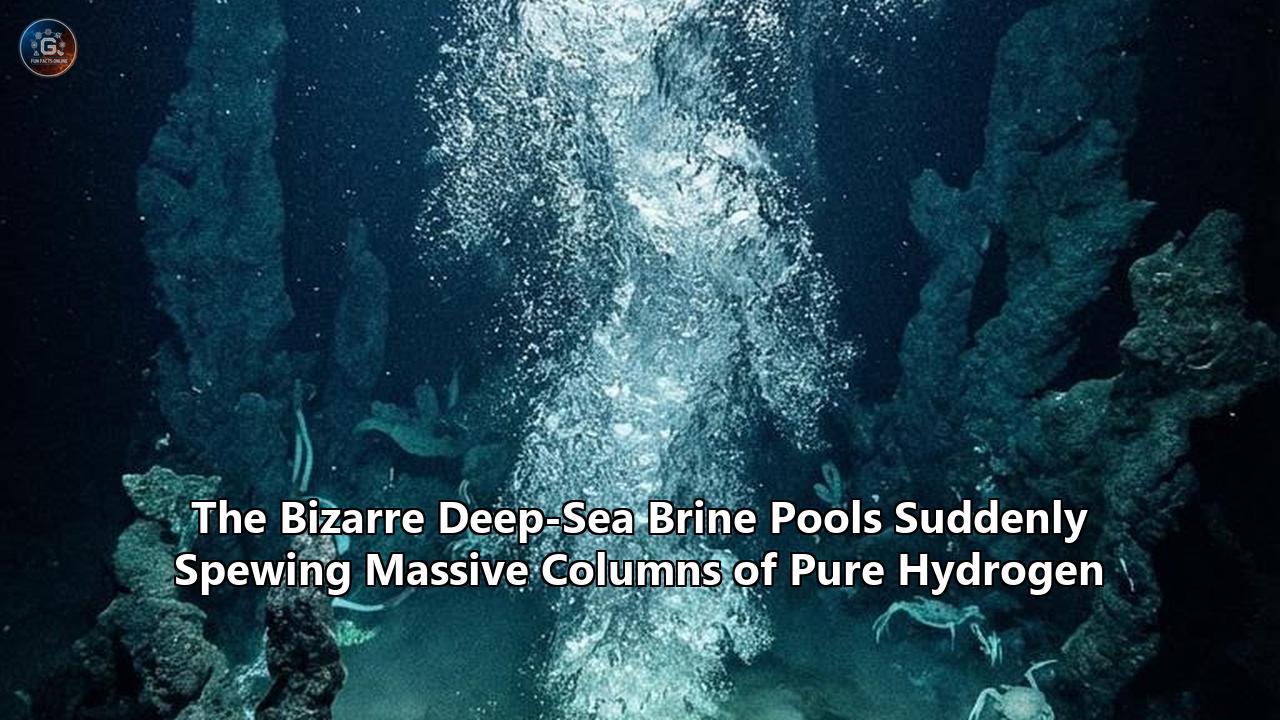
On April 23, 2026, researchers analyzing acoustic telemetry and fluid samples from a depth of 3,200 meters along the ultra-slow spreading Knipovich Ridge logged a geochemical anomaly that immediately invalidates existing models of oceanic gas emissions. A newly mapped complex of underwater lakes is actively ejecting pure geologic hydrogen at a sustained rate of 142 liters per second. Annualized, this single 14,000-square-meter depression is venting an estimated 48,500 metric tons of unoxidized hydrogen directly into the abyssal water column.
Until this month, deep sea brine pools were primarily classified by oceanographers as stagnant, highly toxic abyssal lakes formed by dissolving salt deposits or geothermal heating. Known for trapping lethal concentrations of hydrogen sulfide and methane beneath a hyper-dense halocline, they have historically been viewed as static geological features. The detection of a 98.7% pure hydrogen plume, pressurized at 32.4 megapascals (MPa), introduces a massive, unaccounted-for variable into global energy reserve calculations and deep-ocean biological energy cycling.
The data returned by the remotely operated vehicle (ROV) MARUM-QUEST 4000 and subsequent isobaric sampling reveals a system operating at the extreme edges of known thermodynamics. This is not a passive seep; it is a highly pressurized geodynamic engine.
The Quantitative Anatomy of the Eruption
To understand the scale of this emission, the physical parameters of the target zone—designated the Jøtul-Alpha complex—must be isolated. At 3,200 meters below sea level, the ambient hydrostatic pressure sits at approximately 320 atmospheres. The ambient deep-ocean water temperature is 2.1°C, with a standard salinity of 35 practical salinity units (psu).
The Jøtul-Alpha pool deviates completely from this baseline. Sensor arrays dropped through the water column recorded a violent stratification. The acoustic reflection from the top of the brine surface, detected by ship-mounted Simrad EK60 echosounders, initially presented as a solid, mirror-like seabed due to the sheer density of the fluid.
Once the ROV penetrated this boundary, telemetry reported the following metrics:
- Salinity: 265 psu, exactly 7.57 times saltier than the surrounding ocean water.
- Density: 1.22 g/cm³, creating an impenetrable liquid cap beneath the standard seawater (1.03 g/cm³).
- Thermal Gradient: The Upper Convective Layer (UCL) measured 44.2°C, while the Lower Convective Layer (LCL) spiked to 86.7°C.
- Gas Composition: The venting gas bubbles consist of 98.7% molecular hydrogen ($H_2$), 0.9% methane ($CH_4$), and 0.4% trace noble gases (helium and argon).
The sheer volume of the output—48,500 metric tons annually—is unprecedented for a single localized vent system. For context, an industrial-scale green hydrogen electrolysis plant requires approximately 2.5 gigawatts of continuous renewable electricity to produce a comparable annual yield. Here, the ocean floor is manufacturing and expelling it entirely autonomously.
The Geochemical Engine: Supercritical Decomposition
The mechanism driving this massive column of hydrogen relies on a rare convergence of geological forces. Initial isotopic analysis indicates that the hydrogen is not purely the result of serpentinization—the well-documented process where seawater reacts with ultramafic, olivine-rich mantle rock to produce hydrogen and serpentine minerals. While serpentinization provides a baseline supply, the extreme flow rates demand a secondary, highly active catalyst.
Alexander Diehl, a researcher heavily involved in the 2026 ocean floor investigations, recently outlined the thermodynamic modeling that explains this secondary mechanism.
"Our models showed that, because of the high pressures and temperatures in the subsurface at the hydrothermal vents, the organic materials in the sediments decompose under supercritical conditions, causing the release of hydrogen molecules," Diehl explained regarding the Jøtul Hydrothermal Field.
The brine lake acts as a viscous, heavy lid over the underlying fault lines. As the organic materials in the sediment decompose supercritically, and the ultramafic rock simultaneously undergoes serpentinization, the resulting hydrogen gas becomes trapped beneath the dense halocline. The gas accumulates, increasing in pressure until it surpasses the hydrostatic resistance of the 1.22 g/cm³ brine layer. When this threshold is breached, the hydrogen forces its way upward in continuous, massive columns.
During the initial 2022 and 2024 surveys of the region, researchers struggled to measure the gas concentrations because of rapid decompression. "Similar to opening a pressurized soda bottle, the gas fizzes out," Diehl noted, explaining how gases escaped on the way to the surface. The April 2026 deployment of isobaric gas-tight (IGT) hydrothermal fluid samplers finally allowed researchers to maintain the 32 MPa pressure during the ROV's ascent, preserving the 98.7% purity reading for laboratory verification.
Nanoampere Biosystems and Chemosynthetic Metabolism
Conventional deep sea brine pools are anoxic death traps for macrofauna. Animals that accidentally descend into the brine suffer immediate toxic shock and asphyxiation, their bodies often preserved intact for decades in the oxygen-free, hyper-saline fluid.
However, the hydrogen columns venting from Jøtul-Alpha have engineered a highly specific, high-density biological oasis. The influx of pure hydrogen into an otherwise lethal environment has triggered an explosion of chemolithoautotrophic life—organisms that derive energy from the oxidation of inorganic compounds rather than sunlight or organic carbon.
Biological sampling at the brine-seawater interface revealed a biomass density of 485 grams of carbon per square meter, a figure that rivals the most productive shallow-water coral reefs. This ecosystem is anchored by thick, multi-layered microbial mats that utilize the steep electrochemical gradient between the alkaline hydrothermal fluid and the slightly acidic deep-ocean water.
Recent laboratory simulations modeling primitive ocean-vent interfaces have mapped exactly how this biological energy transfer functions. By recreating the iron and nickel sulfide walls of hydrothermal vents, researchers demonstrated that the natural pH and temperature gradients generate physical electricity.
Thiago Altair Ferreira, a lead researcher in protometabolism, recorded nanoampere-scale electric currents under these exact conditions in a 2025 study. "This suggests that very small but constant electric currents at the bottom of the primitive sea would be enough to sustain a protometabolism," Ferreira observed.
At the Jøtul-Alpha complex, sensors detected sustained electrical currents ranging from 1.8 to 3.4 nanoamperes across the mineral precipices where the hydrogen columns breach the brine. The microbial mats are physically wiring themselves into these geoelectric currents, utilizing the free electrons to reduce dissolved carbon dioxide into organic molecules. Surrounding these mats are thousands of symbiotic mussels and tubeworms, their tissues packed with intracellular bacteria capable of oxidizing the raw hydrogen gas. The efficiency of this energy conversion is staggering, with the local biome consuming an estimated 11% of the venting hydrogen before it can ascend out of the abyssal zone.
The Economic Calculus of Ocean-Floor White Hydrogen
The quantification of this naturally occurring "white hydrogen" immediately disrupts prevailing economic models for the global energy transition. As of Q1 2026, the global hydrogen market is valued at approximately $168 billion, driven primarily by the demand for decarbonized heavy industry, maritime shipping, and aviation.
The core bottleneck of the hydrogen economy is production cost. Green hydrogen, produced via the electrolysis of water using renewable energy, currently costs between $3.50 and $5.20 per kilogram. Blue hydrogen (derived from natural gas with carbon capture) hovers between $1.60 and $2.40 per kilogram.
Geologic white hydrogen, extracted directly from the earth, carries an estimated levelized cost of energy (LCOE) of just $0.50 to $0.75 per kilogram.
If we apply these financial metrics to the Jøtul-Alpha vent, the numbers are highly disruptive. The single 14,000-square-meter pool is venting 48,500 metric tons (48.5 million kilograms) of hydrogen per year. Priced against the current green hydrogen benchmark of $4.00/kg, this single seafloor depression is ejecting $194 million worth of zero-carbon fuel into the water column annually.
Energy economists are already modeling the implications of scalability. The Knipovich Ridge is just one small segment of the mid-ocean ridge system, which spans over 65,000 kilometers globally. If localized mapping identifies even 100 similar hydrogen-venting brine complexes, the aggregate output would equal 4.85 million metric tons of pure hydrogen annually. At a projected extraction cost of $0.68/kg, oceanic white hydrogen could rapidly undercut both green and blue hydrogen initiatives, stranding billions of dollars in planned electrolysis infrastructure.
The energy density of hydrogen (120 megajoules per kilogram) far exceeds that of liquefied natural gas (55 MJ/kg). However, capturing this gas from a dynamic, hyper-saline underwater lake at a depth of three kilometers introduces an unprecedented matrix of engineering constraints.
Material Science Constraints: Engineering the Extraction
Operating extraction hardware within deep sea brine pools introduces a compounded material science failure matrix. The environment actively attacks mechanical infrastructure through three distinct vectors: hyper-corrosion, immense hydrostatic pressure, and hydrogen embrittlement.
1. Halide-Induced Hyper-Corrosion
The Jøtul-Alpha brine contains chloride concentrations exceeding 4,200 millimoles per liter (mM), compared to the standard 546 mM of surrounding seawater. At 86.7°C, this extreme halide concentration violently strips the passive chromium-oxide layers off standard 316L marine-grade stainless steel. In laboratory simulations running the Jøtul-Alpha chemical profile, standard steel components lost structural integrity within 72 hours of immersion.
2. Hydrostatic Crushing Forces
Any gas capture dome deployed over the venting columns must withstand 32.4 MPa of external pressure while managing the internal fluid dynamics of the ascending gas. A commercial-scale extraction canopy, measuring 50 meters in diameter, would endure tens of thousands of tons of distributed crushing force. Furthermore, underwater landslides—a known variable along tectonic ridge flanks—can displace millions of cubic meters of sediment in seconds, generating localized turbidity currents capable of shearing heavy tethering cables.
3. Hydrogen Embrittlement
The most severe engineering hurdle is the hydrogen itself. Molecular hydrogen is the smallest element; at 32 MPa of pressure, it diffuses directly into the crystalline lattice of standard metal alloys. Once inside the metal, the hydrogen atoms recombine into molecules, creating internal pressure that leads to sudden, catastrophic brittle fracture.
To safely capture and pipe the gas to surface collection vessels, the industry will require heavily specialized materials. Titanium Grade 7 (a titanium-palladium alloy) demonstrates high resistance to both hyper-saline corrosion and hydrogen embrittlement, but current market pricing for this alloy is prohibitive for large-scale subsea construction. Advanced high-density polymer composites woven with carbon nanotubes are currently being stress-tested as a viable alternative for flexible riser pipes.
Offshore engineering consortiums estimate that developing a deep-water white hydrogen extraction prototype will require a capital expenditure (CAPEX) of $450 million to $600 million. Operational expenditure (OPEX) is equally steep; standard ROV deployment for deep-ocean infrastructure maintenance currently bills out at $85,000 to $115,000 per day. The unit economics of extraction rely entirely on achieving massive, continuous flow rates to offset the prohibitive costs of abyssal engineering.
Seismic and Tectonic Variables
The flow rate of 142 liters per second is not entirely static; it is modulated by the tectonic pulse of the Knipovich Ridge. This ridge is classified as an ultraslow spreading center, where tectonic plates pull apart at a rate of approximately 1.5 centimeters per year. This slow spreading creates deep rift valleys and highly fractured, irregular crustal profiles, which serve as the primary conduits for the hydrothermal fluids.
Seismic telemetry recorded during the April 2026 expedition revealed a direct correlation between micro-seismic activity and hydrogen output. A minor 3.2 magnitude tremor centered 14 kilometers beneath the Jøtul-Alpha complex resulted in a 45-minute lag before hydrogen venting rates spiked by 18.4%. The tremor temporarily widened the subsurface fracture networks, allowing a surge of supercritically decomposed gas to bypass the rock strata and hit the brine layer.
This volatility introduces a critical risk factor for extraction modeling. A major seismic event could permanently alter the subterranean plumbing, redirecting the hydrogen to a different exit point miles away, or sealing the conduit entirely. Conversely, it could fracture the 1.22 g/cm³ brine cap, causing the entire underwater lake to drain into deeper crustal fissures and ending the localized concentration of the gas.
The intersection of these tectonic forces also dictates the longevity of the reservoir. Geologists are currently deploying gravimetric sensors to measure the density of the source rock beneath the pool. The unresolved variable is the recharge rate: is the Jøtul-Alpha complex bleeding off a finite pocket of trapped gas that will deplete in 36 months, or is this a continuous, self-replenishing factory powered by an endless supply of ocean water and mantle olivine?
The 2026-2030 Exploration Window: Milestones and Projections
The detection of hydrogen-venting deep sea brine pools forces a recalculation of ocean exploration priorities. Over 80% of the global seafloor remains unmapped at the high resolutions required to detect discrete brine complexes. The International Seabed Authority (ISA), which regulates ocean mining and resource extraction, is already facing mounting pressure to draft new legal frameworks specific to abyssal gas harvesting, distinct from existing regulations regarding polymetallic nodule mining.
Several immediate milestones will dictate the trajectory of this emerging sector over the next 48 months:
1. Phase Two of the Cluster of Excellence DeploymentsThe research consortium running "The Ocean Floor – Earth's Uncharted Interface" has officially entered its second funding phase in early 2026. Upcoming ship expeditions will return to the Knipovich Ridge with upgraded isobaric sampling grids. The primary objective is to map the exact perimeter of the supercritical decomposition zone and calculate the total organic carbon currently being converted into hydrogen.
2. Acoustic Profiling of the Mid-Atlantic and Red Sea BasinsWith the acoustic signature of a hydrogen-rich halocline now isolated, automated underwater vehicles (AUVs) are being programmed to scan legacy bathymetric data for similar anomalies. Expeditions are currently scheduling targeted dives for late 2026 in the Red Sea's Aragonese Deep—already known for extreme brine pools like the NEOM complex discovered in the early 2020s. The Red Sea's unique tectonic environment, featuring kilometers-thick salt deposits and active rifting, makes it the highest-probability target for discovering further high-yield white hydrogen vents.
3. Development of Biological Hydro-Oxidation PathwaysThe 485 grams per square meter of chemolithoautotrophic biomass currently thriving at the Jøtul-Alpha boundary represents a secondary, highly lucrative asset. Bio-engineering firms are actively sequencing the genomes of the intracellular bacteria found in the symbiotic mussels. By isolating the exact enzymes these microbes use to oxidize pure hydrogen under extreme pressure and high salinity, researchers aim to synthesize new, highly efficient biological fuel cells for industrial applications.
The verification of 48,500 metric tons of pure hydrogen venting annually from a single abyssal depression shifts oceanic gas emissions from a theoretical academic study into a high-stakes geopolitical and economic race. If the ongoing gravimetric surveys confirm that the subterranean source rock is actively replenishing the gas via continuous serpentinization and supercritical decomposition, the Jøtul-Alpha complex will cease to be an anomaly. It will become the baseline for a new, ocean-floor energy paradigm.
The immediate next step relies on the data return from the Q4 2026 expeditions. If AUVs detect similar hydrogen yields along the Mid-Atlantic Ridge or the Gulf of Aqaba, the economic viability of green and blue hydrogen will face intense scrutiny, as the ocean itself may already be manufacturing the ultimate zero-carbon fuel at a scale previously thought impossible.
Reference:
- https://en.wikipedia.org/wiki/Brine_pool
- https://wodnesprawy.pl/en/brine-pools-deadly-yet-full-of-life/
- https://www.livemint.com/mint-lounge/business-of-life/researchers-discover-lethal-brine-pool-in-the-red-sea-111658470127058.html
- https://ecomagazine.com/news/research/new-investigation-reveals-unexpected-processes-for-high-hydrogen-production-in-hydrothermal-systems/
- https://www.vliz.be/imisdocs/publications/342024.pdf
- https://oceanx.org/blog/brine-pools-the-deep-sea-s-most-mysterious-ecosystems/
- https://indiandefencereview.com/underwater-vents-may-lifes-building-blocks/
- https://en.wikipedia.org/wiki/Abyssal_plain
- https://www.hydro-international.com/content/news/schmidt-ocean-institute-expedition-discovers-new-hydrothermal-vent-fields
- https://sevenseasmedia.org/scientists-discover-three-new-hydrothermal-vent-fields-on-mid-atlantic-ridge/
- https://www.researchgate.net/publication/361566006_Discovery_of_the_deep-sea_NEOM_Brine_Pools_in_the_Gulf_of_Aqaba_Red_Sea
- https://www.youtube.com/watch?v=pwxiQyeMfuA