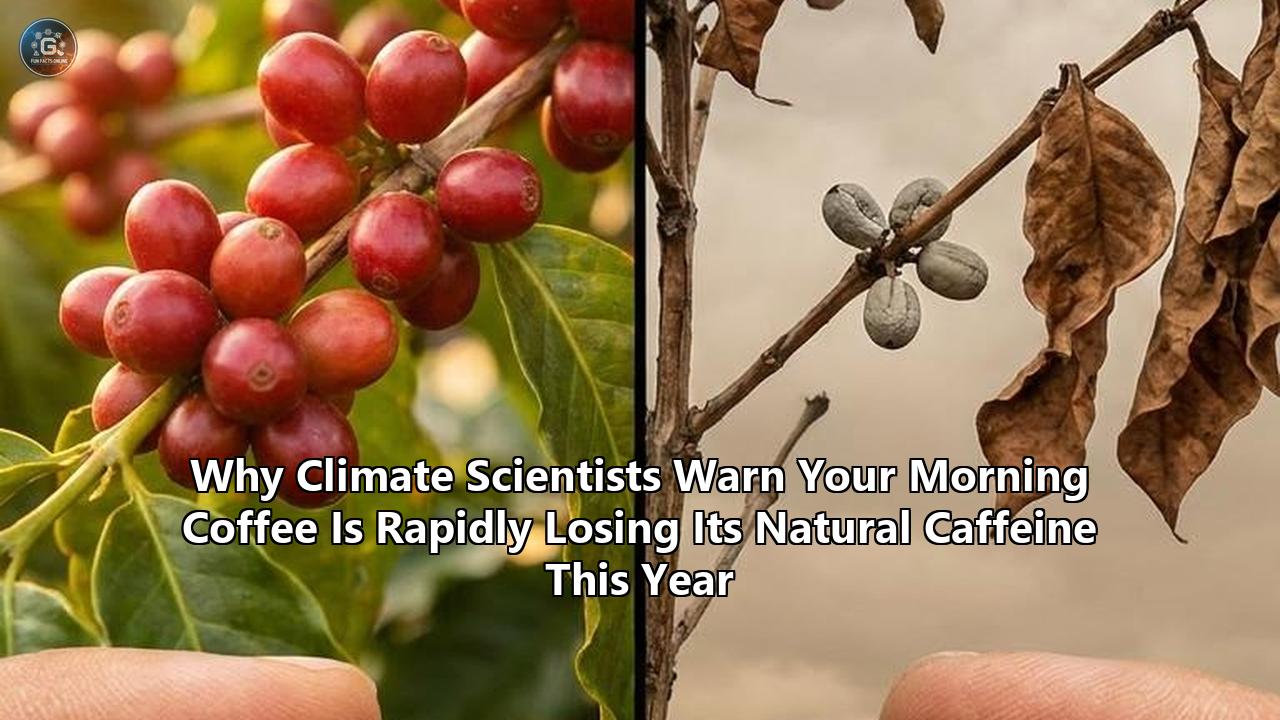
Agricultural data emerging from the 2025–2026 global coffee harvest has confirmed a biological shift that agronomists have warned about for years: the world’s coffee beans are rapidly losing their natural caffeine. Crop analyses across the equatorial Coffee Belt—spanning major production hubs in Brazil, Vietnam, Colombia, and Ethiopia—reveal that extreme heat waves combined with rising atmospheric carbon dioxide have fundamentally altered the chemical composition of the Coffea genus.
This year's yield assessments demonstrate a measurable drop in caffeine concentration in both Arabica (Coffea arabica) and Robusta (Coffea canephora) varieties. The decline is not an anomaly of a single bad season, but the result of sustained physiological stress on the plants. Climate Central data tracking conditions between 2021 and 2025 showed that the top five coffee-producing nations, which account for 75% of the world's supply, experienced an average of 57 additional days of "coffee-harming heat" annually. The result is a bean that looks largely the same but lacks the chemical potency consumers and ecosystems rely on.
Because caffeine is incredibly stable and easily survives the 216°C (420°F) heat of a commercial roaster, the dilution of the world's most popular stimulant is entirely an agricultural crisis, not a processing error. This chemical shift triggers immediate, severe consequences that extend from the soil health of smallholder farms to the neurological benefits of the morning cup, and ultimately to the price of global commodities.
The Carbon Dilution Effect: The Biology of Weakened BeansTo understand why coffee is losing its kick, one must look at the mechanics of photosynthesis in an increasingly carbon-heavy atmosphere. As global atmospheric CO2 levels consistently breach the 420 parts per million (ppm) threshold, plants are absorbing more carbon than they have in millions of years.
In controlled greenhouse studies tracking coffee growth from 300 ppm up to 600 ppm of CO2, researchers found a stark "carbon dilution effect". With an overabundance of carbon dioxide, coffee plants accelerate their vegetative growth, producing larger leaves and a higher overall biomass. However, this accelerated growth comes at a steep qualitative cost. The plant draws down limited soil nutrients—specifically nitrogen—and spreads them across a much larger physical structure.
Caffeine (1,3,7-trimethylxanthine) is a nitrogen-rich alkaloid. When a coffee plant is forced into rapid, carbon-fueled expansion, the ratio of carbon to nitrogen (C:N) within the plant skews heavily. Lacking sufficient nitrogen to maintain previous chemical baseline levels, the plant deprioritizes the synthesis of secondary metabolites like caffeine and chlorogenic acids, leading to a chemically diluted seed.
Heat compounds this dilution. Arabica coffee evolved in the cool, shaded understory of Ethiopian highland forests and requires strict temperature bands—ideally between 64°F and 70°F (18°C to 21°C)—to properly mature. When temperatures spike above 30°C (86°F), the plant experiences severe metabolic stress. The cherry ripens too quickly, interrupting the long, slow developmental phase necessary to pack the seed with complex sugars, organic acids, and alkaloids. Consequently, farmers are harvesting cherries that are physically mature but chemically hollow.
Nitrogen Scarcity and the Plant Defense CrisisFor human consumers, a drop in caffeine means a less effective morning stimulant. For the coffee plant, it represents a catastrophic failure of its immune system.
Caffeine did not evolve for human consumption; it is a highly evolved botanical defense mechanism. The plant secretes caffeine in its leaves, pollen, and seeds to paralyze or kill predatory insects by overloading their nervous systems, while simultaneously using low doses in its nectar to enhance the memory of pollinating bees. When the caffeine concentration in the foliage and the beans drops, the plant essentially loses its armor.
The immediate beneficiaries of this weakened state are agricultural pests. The Coffee Berry Borer (Hypothenemus hampei) is already one of the most destructive pests in the agricultural world. Uniquely equipped with a specialized gut microbiome, the borer is one of the few insects capable of detoxifying caffeine. However, detoxifying high levels of the alkaloid requires metabolic energy from the insect. As climate change coffee production models predicted, lower baseline caffeine in the beans allows the borer to infiltrate, feed, and reproduce with a fraction of the metabolic resistance it previously faced.
Simultaneously, the warmer nights and erratic humidity levels accompanying the changing climate have allowed Coffee Leaf Rust (Hemileia vastatrix)—a devastating fungal disease—to migrate to higher altitudes where it was historically kept at bay by frost. The combination of lowered chemical defenses and expanding pest territories means that farm yields are plummeting right as the biological cost of maintaining those farms is skyrocketing.
The Arabica vs. Robusta IllusionFor the past decade, the global supply chain has relied on a specific mitigation strategy: if Arabica fails, pivot to Robusta. Arabica accounts for roughly 70% of global production and commands the specialty market due to its complex flavor profile. Robusta, which is genetically distinct and possesses nearly double the natural caffeine content of Arabica, has been heavily utilized in instant coffees and commercial espresso blends.
The industry assumed Robusta would serve as the ultimate climate insurance policy due to its higher heat tolerance. The 2026 harvest data shatters that assumption. While Robusta can withstand higher baseline temperatures, recent studies show that it is actually more sensitive to elevated CO2 regarding its caffeine retention than Arabica. In high-CO2 trials, Robusta experienced a proportionally steeper drop in caffeine concentration.
Furthermore, Robusta's shallow root system makes it highly vulnerable to shifting precipitation patterns. It requires well-distributed rainfall throughout the year to thrive. The prolonged, multi-month droughts recently ravaging Southeast Asia and parts of Africa have severely stunted Robusta yields. The assumption that roasters could simply blend more Robusta into their products to make up for Arabica's fading caffeine is colliding with the reality of agricultural limits.
The Economic Toll on the Global Coffee BeltThe decline in bean quality and quantity is sending shockwaves through the commodities market. Coffee is one of the most heavily traded agricultural products in the world, directly supporting the livelihoods of approximately 125 million people globally, the vast majority of whom are smallholder farmers managing plots of less than five acres.
When analyzing climate change coffee production, the most immediate victims are these smallholders. As the plants yield fewer high-quality cherries and succumb to pests, farmers are forced to increase their input costs. They must purchase more synthetic fertilizers to correct the nitrogen imbalance and deploy more chemical pesticides to fight off the surging borer populations.
Because the global coffee price (the "C-price") is dictated by commodity traders in New York and London rather than the actual cost of production, smallholders often operate at a loss when environmental stressors degrade their crop. This year's diminished yields are forcing many farmers to abandon coffee cultivation entirely, transitioning their land to hardier, sometimes illicit, cash crops, or migrating away from rural agricultural zones. This abandonment accelerates supply shortages, triggering aggressive price spikes for the end consumer.
The Funding Shortfall in Agronomic R&DAddressing the vulnerabilities in climate change coffee production requires massive, coordinated investment in agricultural research. However, the industry is currently facing a severe R&D deficit.
A comprehensive analysis by World Coffee Research quantified this gap, revealing that an additional $452 million per year is required in agricultural R&D just to support farmers adapting to current climate realities and to preserve the genetic diversity of the crop. Currently, agricultural R&D investments in coffee for the Global South total roughly $115 million annually—a shockingly low figure for a multi-billion dollar global industry.
Without this funding, the development of climate-resilient F1 hybrids, the mapping of drought-resistant rootstocks, and the distribution of these new plants to impoverished farmers proceed at a glacial pace. A coffee tree takes three to five years to reach full commercial production. Even if a perfect, heat-tolerant, high-caffeine hybrid were distributed globally today, the supply chain would not see the benefits until the end of the decade. The lack of proactive R&D funding ensures that the global supply will remain unstable for the foreseeable future.
Consumer Consequences: Weaker Brews, Altered Flavors, and Higher PricesFor the consumer, the 2026 data translates directly into a different morning ritual. Roasters who meticulously measure the extraction ratios of their beans are finding that maintaining the traditional flavor profile and caffeine kick is becoming increasingly difficult.
Because the synthesis of chlorogenic acids and complex sugars is disrupted by rapid, heat-stressed ripening, the beans inherently taste flatter. Furthermore, to compensate for the reduced caffeine content, commercial coffee entities face difficult choices. They can artificially fortify their blends with synthetic caffeine—a practice common in energy drinks but heavily frowned upon in the specialty coffee sector—or they can alter their roasting and blending ratios.
Consumers, noticing the lack of efficacy in their standard cup, are likely to increase their volume of consumption. This behavioral shift—drinking three cups instead of two to achieve the desired neurological alertness—has profound implications for both personal health and global carbon emissions.
The Consumer Health Impact: Neuroprotection at RiskThe decline of natural caffeine in coffee arrives just as medical science is cementing the alkaloid's role in long-term neurological health. A landmark longitudinal study published recently in JAMA, which tracked over 131,000 participants for 43 years, established a strong link between moderate caffeine consumption and the prevention of cognitive decline.
Researchers from Harvard and Mass General Brigham found that participants who consumed two to three cups of caffeinated coffee daily exhibited an 18% lower risk of developing dementia compared to those who drank little to no caffeine. Crucially, the study noted that decaffeinated coffee and decaffeinated tea did not provide the same protective association, isolating caffeine as the primary active neuroprotective agent, likely due to its ability to block adenosine receptors and reduce cellular inflammation in the brain.
If the baseline caffeine of the global coffee supply continues to erode, consumers will unknowingly receive lower doses of this neuroprotective alkaloid. While artificial caffeine supplementation is an option, early research from institutions like Texas A&M suggests that the health benefits of coffee rely on the synergistic effect of caffeine binding alongside other plant-derived compounds and receptors (like NR4A1). A chemically compromised bean cannot offer the same biological benefits as a healthy one.
The Preparation Carbon Footprint: The Cost of CompensatingIf consumers respond to weaker coffee by brewing larger pots or using higher ratios of grounds to water, they inadvertently trigger a massive environmental feedback loop.
A comprehensive lifecycle analysis of coffee consumption published in Global News revealed that the preparation phase—specifically the brewing method—dictates a massive portion of the beverage's overall greenhouse gas emissions. Traditional drip filter coffee has the highest carbon emissions on a per-cup basis. This is because filter brewing requires a high volume of ground coffee relative to the water used, and the hot plates require sustained electricity.
By contrast, instant coffee—often shunned by specialty drinkers—has the lowest environmental footprint per cup due to its highly efficient extraction process and lower baseline material requirements. If the drop in natural caffeine pushes millions of daily consumers to increase their ground-coffee dosage by even 10% to achieve their expected energy boost, the aggregate increase in water usage, packaging, shipping weights, and electricity consumption will dump millions of additional tons of carbon into the atmosphere. This accelerates the very greenhouse effect that is degrading the crop in the first place.
Deforestation and the High-Altitude MigrationAs lower elevations become entirely unsuitable for coffee cultivation due to extreme heat and pests, farmers are engaged in a desperate geographic migration. Coffee plants that once thrived at 2,000 feet are now struggling, forcing cultivation lines further up the mountainsides into cooler, more stable microclimates. Twenty years ago, cultivating Arabica above 6,000 feet was considered agronomically risky; today, some of the most viable crops are sourced from these extreme elevations.
However, this vertical migration initiates a devastating environmental crisis. The paradox of climate change coffee production is that moving farms to cooler climates almost always requires clearing pristine, high-altitude tropical forests. This deforestation destroys critical biodiversity habitats and eliminates vital carbon sinks. When a farmer cuts down an old-growth forest to plant coffee shrubs, the carbon released from the felled trees and the disturbed topsoil dwarfs whatever minimal carbon the new coffee plants will absorb.
By 2050, predictive models indicate that the total global land area suitable for coffee production will decrease by 50%. In regions like Nicaragua, over 90% of current coffee-growing land will lose its viability within the next three decades. The pressure to clear upper-elevation forests to maintain the global supply is mounting, directly conflicting with international climate goals and corporate zero-deforestation pledges.
Agronomic Mitigation: Shade Canopies and Cultivar EngineeringMitigating the caffeine loss and yield collapse requires an immediate overhaul of how coffee is farmed. The most effective short-term intervention is the widespread adoption of shade-grown agroforestry systems.
By planting a diverse canopy of deep-rooted timber and fruit trees over the coffee shrubs, farmers can artificially lower the ambient temperature of the microclimate by several degrees. Shade canopies also act as windbreaks, reduce soil moisture evaporation during droughts, and provide habitats for natural pest predators, such as birds that feed on the coffee berry borer. While shade-grown systems traditionally yield slightly lower raw tonnages than aggressively fertilized, sun-grown mono-crops, the quality, chemical stability, and caffeine retention of the shaded beans are significantly higher.
Long-term survival, however, relies on genetics. Breeders are urgently working to isolate genetic traits from wild, underutilized coffee species—such as Coffea stenophylla or Coffea liberica—which possess higher inherent heat tolerance and natural pest resistance. The goal is to crossbreed these resilient traits into high-yielding Arabica lines without losing the complex flavor profiles that the global market demands. Yet, as the World Coffee Research funding gap illustrates, this scientific endeavor is severely under-resourced.
Market Dynamics: Consolidation and Roaster AdjustmentsThe intersection of dropping caffeine levels, rising pest pressures, and shrinking arable land points toward a harsh economic reality: market consolidation.
As smallholder farmers are priced out of cultivation, multinational agribusinesses with the capital to invest in advanced irrigation, synthetic pest control, and proprietary hybrid seeds are absorbing the viable land. This consolidation threatens the origin diversity of the coffee market. The distinct terroir that separates a high-acidity Kenyan bean from a chocolate-heavy Sumatran bean is at risk of being homogenized into generic, climate-engineered bulk crops.
For roasters, the immediate challenge is managing consumer expectations. In 2026, many roasters are quietly adjusting their blend formulas, heavily scrutinizing their sourcing contracts, and increasingly leaning on precision fermentation or post-harvest processing methods to extract as much flavor and chemical value from the beans as possible. The era of cheap, abundant, highly caffeinated coffee is definitively ending.
Future Horizons: What to Watch for NextThe confirmation that global coffee supplies are losing their natural caffeine alters the trajectory of the industry. Moving forward, several critical milestones will determine how the market and consumers adapt to this new reality.
First, regulatory frameworks are shifting. The European Union's Deforestation Regulation (EUDR) is placing strict traceability requirements on imported commodities, demanding proof that coffee entering the European market was not grown on recently deforested land. This regulation will directly clash with the high-altitude migration of coffee farms, potentially creating severe supply bottlenecks as farmers who moved uphill to escape the heat find themselves locked out of the world's largest consumer market.
Second, the market for "functional coffees" will likely expand rapidly. As natural caffeine and secondary metabolites wane, expect a surge in coffees that have been post-harvest infused with botanical extracts, synthetic caffeine, or lab-grown neuro-stimulants to artificially recreate the biological benefits the plant can no longer naturally provide.
Finally, the agricultural data from the 2026 harvest serves as a stark biological warning. Coffee is the canary in the coal mine for global agriculture. The carbon dilution effect is not unique to Coffea; it applies to vital nutritional crops like wheat, rice, and soy. The realization that rising atmospheric carbon and heat waves are fundamentally hollowing out the chemical core of our crops forces a reckoning with how we approach food security. The morning cup of coffee will survive, but it will be a fundamentally different, more expensive, and synthetically altered beverage than the one the world has relied on for centuries.
Reference:
- https://www.researchgate.net/publication/340082525_Early_growth_phase_and_caffeine_content_response_to_recent_and_projected_increases_in_atmospheric_carbon_dioxide_in_coffee_Coffea_arabica_and_C_canephora
- https://www.ars.usda.gov/arsuserfiles/5818/31-2020%20-%20Vega%20et%20al%20-%20Early%20growth%20phase%20and%20caffeine%20content%20-%20Scientific%20Reports.pdf
- https://clivecoffee.com/blogs/learn/how-climate-change-is-affecting-coffee
- https://globalnews.ca/news/9576594/coffee-climate-change-impact/
- https://rockcreekcoffee.com/blogs/blog/how-climate-change-is-impacting-coffee-production
- https://www.climatecentral.org/climate-matters/more-coffee-harming-heat-due-to-carbon-pollution-2026
- https://twochimpscoffee.com/blogs/does-coffee-lose-caffeine-when-reheated/
- https://pmc.ncbi.nlm.nih.gov/articles/PMC9824350/
- https://www.american.edu/cas/economics/ejournal/upload/iscaro_accessible.pdf
- https://www.research-collection.ethz.ch/server/api/core/bitstreams/38b47a0e-7745-4171-8a93-f109fb15ed6a/content
- https://cambridgecarbonfootprint.org/actions/drink_less_coffee/
- https://worldcoffeeresearch.org/resources/coffees-innovation-crisis
- https://pmc.ncbi.nlm.nih.gov/articles/PMC8531415/
- https://pmc.ncbi.nlm.nih.gov/articles/PMC5845708/
- https://www.huffingtonpost.co.uk/entry/dementia-signs-coffee-caffeine-brain-health_uk_69fc8839e4b065a1677c5249
- https://www.mindbodygreen.com/articles/case-for-keeping-your-coffee-habit-according-to-new-study-what-the-research-found
- https://news.harvard.edu/gazette/story/2026/02/drinking-2-3-cups-of-coffee-a-day-tied-to-lower-dementia-risk/
- https://www.sciencealert.com/scientists-reveal-one-of-the-ways-coffee-slows-down-aging
- https://globalnews.ca/news/9576594/coffee-climate-change-impact/
- https://www.karboneconomics.com/article/is-climate-change-the-end-of-your-morning-coffee
- https://www.dailyclimate.org/william-h-schlesinger-the-planetary-toll-of-your-morning-coffee-2645035058.html