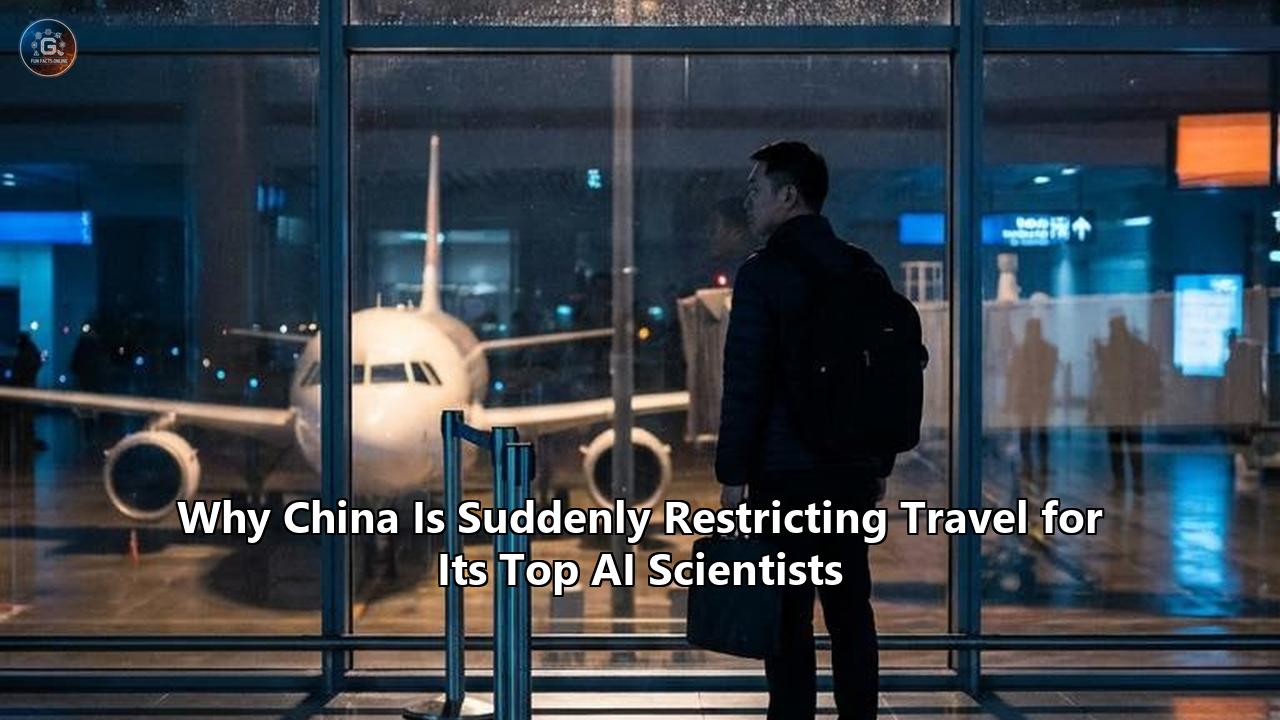
The global race for artificial intelligence has entered a new and highly physical phase. The geopolitical confrontation between Washington and Beijing, once defined by export controls on silicon chips and GPU hardware, is increasingly focusing on the human minds behind the software. In late May 2026, a series of systemic regulatory maneuvers by the Chinese government transformed the landscape of global tech talent, as Beijing quietly but firmly extended travel-approval mandates to private-sector technology professionals, specifically targeting elite researchers, founders, and executives at frontier artificial intelligence firms.
The policy represents an unprecedented extension of national security-related travel controls—traditionally reserved for nuclear scientists, defense personnel, and state-owned enterprise (SOE) executives—directly into the heart of China’s most successful private technology corporations. Highly coveted engineers at prominent AI labs, such as the open-source pioneer DeepSeek and the e-commerce and cloud giant Alibaba Group Holding, now require formal, state-vetted pre-approval before they can board an international flight.
This sudden implementation of China AI travel restrictions is not an isolated bureaucratic whim. It is the culmination of a multi-year effort to build a human fortress around Chinese intellectual property, accelerated by a high-stakes corporate thriller involving a Singaporean startup, a proposed $2 billion acquisition by Meta Platforms, and the physical grounding of some of Asia’s most celebrated computer scientists. As the technological gap between American and Chinese models shrinks to historic lows, Beijing has arrived at a critical realization: the physical containment of its top-tier scientific talent is now a matter of national survival.
The Human Fortress: Beijing's Invisible Wall Around Artificial Intelligence
For years, travel restrictions in China operated under a well-understood, predictable framework. Under the state’s biankong (border control) and internal administrative guidelines, those who held state-secrets clearance—such as military researchers, nuclear scientists, top academics at public institutions, and high-ranking executives at state-owned enterprises—were routinely required to register their travel plans or surrender their passports. Private-sector technology companies, which drove the historic rise of China's internet economy from the early 2000s onward, were largely exempt from these draconian measures. Founders like Jack Ma or Pony Ma traveled the world freely, attending global summits, raising Western venture capital, and listing their companies on the New York Stock Exchange.
That era of structural separation between private enterprise and state security has dissolved.
The transition to a stricter regime was not immediate, but rather developed through a series of incremental escalations:
- March 2025: Chinese authorities issued quiet "advisories" to senior AI entrepreneurs and researchers at private companies. The formal guidance stopped short of an outright travel ban but strongly urged these individuals to avoid traveling to the United States. The stated concern at the time was two-fold: the potential for unintentional disclosure of sensitive Chinese technological capabilities during academic exchanges, and the growing risk of Chinese executives being detained or intensely scrutinized by U.S. customs and law enforcement amid deteriorating bilateral relations.
- July 2025: The guidance began to develop regulatory teeth. DeepSeek, an AI research lab funded by the quantitative trading giant High-Flyer Quant, quietly initiated a passport-collection policy for selected R&D staff. Employees working on core alignment algorithms and large-scale pre-training pipelines were required to surrender their travel documents to corporate security teams. The company cited the protection of commercial secrets, but industry insiders recognized the heavy hand of state administrative pressure.
- December 2025: The travel curbs were quietly applied to some DeepSeek executives on an individual basis, moving from a company-enforced policy to a state-directed exit control list.
- March 2026: The physical enforcement of exit bans became explicit and public. Beijing barred the co-founders of Manus, an advanced AI agent startup, from leaving China during regulatory scrutiny of a major foreign acquisition.
- May 2026: The policy expanded into a comprehensive, sector-wide mandate. According to reports detailing the measures, the National Development and Reform Commission (NDRC) and the Ministry of Industry and Information Technology (MIIT) established a formalized, administrative pre-approval framework.
[March 2025: Advisory] -> Informally warned AI executives against traveling to the US
       |
[July 2025: Passport Surrenders] -> DeepSeek required select R&D staff to hand over passports
       |
[Dec 2025: Executive Curbs] -> Targeted exit bans applied to some DeepSeek executives
       |
[March 2026: Forced Grounding] -> Manus AI founders blocked from leaving mainland China
       |
[May 2026: Full Pre-Approval] -> Alibaba and DeepSeek staff placed under state-vetted travel clearance
Under this new regime, routine work trips, international vacations, and attendance at global academic conferences like NeurIPS or ICML are no longer private decisions. To leave the country, affected scientists must submit a detailed petition to relevant state authorities, secure an institutional sponsor, and receive explicit clearance. This effectively turns the freedom of movement for China's top AI minds into a state-licensed privilege.
The $2 Billion Trigger: How the Unraveling of the Manus Deal Exposed the Leak
To understand why Beijing felt compelled to implement such sweeping measures in May 2026, one must examine the corporate and geopolitical drama of Manus AI. The rise and sudden containment of this startup serve as a textbook study of how private talent and technology can quickly slip past national borders, and why the Chinese state decided to seal the exit doors.
The Genesis of Butterfly Effect
Manus began its life not in Singapore, but inside the Chinese mainland’s domestic tech incubators. The company was originally established under the legal name Beijing Butterfly Effect Technology, a firm closely associated with the popular AI assistant Monica.im. Founded by a trio of elite Chinese engineers—Xiao Hong, Ji Yichao, and Zhang Tao—the startup set out to build what many in the industry considered the holy grail of post-LLM technology: a general-purpose, fully autonomous "AI agent".
Unlike standard chatbots that simply generate text or code, the Manus agent was designed to act as an execution layer. Running inside sandboxed virtual computers equipped with persistent storage, full internet access, and the ability to install and run third-party software, the agent could take a complex, multi-step prompt—such as "conduct market research on the global lithium-ion supply chain, compile the data into a spreadsheet, write a Python analysis script, and email the finished report to my team"—and execute the entire workflow from start to finish without human intervention.
User Prompt -> Manus AI Agent -> Sandboxed Virtual Machine -> persistent storage
                                                           -> internet access
                                                           -> software installation
                                                           -> multi-step execution
In April 2025, the company raised approximately $75 million in a Series B funding round led by the prestigious U.S. venture capital firm Benchmark. The round, which valued the company at roughly $500 million, saw participation from some of China’s most prominent tech entities, including Tencent and HSG (formerly Sequoia China), alongside Meituan co-founder Wang Huiwen. As part of the investment, Benchmark General Partner Chetan Puttagunta joined the company’s board.
The Flight to Singapore
Recognizing the tightening regulatory environment in Beijing and the escalating tech war between the U.S. and China, the founders executed a rapid corporate restructuring in mid-2025. They relocated the company's headquarters and its core leadership team to Singapore, establishing a separate Singaporean operating entity under the same "Butterfly Effect" moniker.
To clean up its corporate profile for global expansion, the company laid off the majority of its Beijing-based staff, keeping only around 40 of its absolute core technical personnel, who were relocated to Singapore. To make the separation from China even cleaner, the company shut down its Chinese-language social media accounts, blocked access to its platform from mainland IP addresses, and quietly shelved a planned joint partnership with Alibaba’s Qwen team.
The strategy worked spectacularly on a commercial level. By late 2025, Manus had scaled to a revenue run-rate exceeding $125 million, powered by millions of users who utilized the agent to spin up over 80 million virtual computers. The product’s sheer efficiency was hailed as a breakthrough, matching and often outperforming the highly anticipated "Deep Research" agents being developed by Silicon Valley heavyweights like OpenAI and Google.
The Meta Acquisition and the State's Counterstrike
On December 29, 2025, Meta Platforms announced a definitive agreement to acquire Manus for an estimated value between $2 billion and $3 billion. For Meta's CEO, Mark Zuckerberg, the acquisition was a massive talent and product coup. It allowed Meta to directly integrate a highly functional, revenue-generating agentic execution layer into its open-source Llama model ecosystem and its massive global business messaging platforms.
But for Beijing, the deal was an alarm bell.
A startup built by Chinese nationals, trained on Chinese engineering talent, and nurtured initially by Chinese infrastructure had successfully packaged its crown-jewel technology, relocated to Singapore, and sold itself to one of the largest technology companies in the United States. The intellectual property and, more importantly, the brilliant human minds who understood how to build autonomous execution agents, were about to be absorbed into the Western AI ecosystem.
In January 2026, China’s Ministry of Commerce and the NDRC launched a joint "evaluative investigation" to determine if the transaction violated Chinese export control laws and national security regulations regarding the cross-border transfer of sensitive AI technologies. To ensure that the primary human assets did not disappear during the investigation, the Chinese government quietly issued exit bans against co-founders Xiao Hong and chief scientist Ji Yichao while they were visiting mainland China, physically preventing them from returning to Singapore.
On April 27, 2026, the NDRC officially blocked the transaction, ordering Meta to completely unwind the acquisition and return the asset to its original state. The decision sent shockwaves through global tech finance. Undoing a multi-billion-dollar transaction months after its closing, particularly when the technology had already begun to be integrated into Meta's massive internal systems, was virtually unprecedented.
[Dec 2025] Meta announces acquisition of Singapore-based, Chinese-founded Manus AI for $2B+
   |
[Jan 2026] Beijing launches regulatory review; blocks exit of co-founders from mainland China
   |
[April 2026] NDRC officially orders Meta to unwind the completed acquisition
   |
[May 2026] Founders seek to raise $1B to buy back the company and fund the technical separation
By late May 2026, the situation has devolved into an incredibly complex, costly recapitalization. Xiao Hong, Ji Yichao, and Zhang Tao are currently scrambling to raise up to $1 billion from a combination of non-US venture capital firms and Chinese joint-venture partners. The goal is to buy out Meta’s ownership interest, fund the excruciatingly complex process of purging Manus’s proprietary algorithms and user data from Meta’s servers, and re-establish the firm under a Chinese joint venture aimed at an eventual Hong Kong IPO.
For regulators in Beijing, the Manus saga was the ultimate proof that legal structures are highly fluid. A company can change its registry to Singapore, Cayman, or Delaware overnight, but the scientists who write the code are physical beings. If the state can control the physical bodies of the researchers, it can effectively veto any corporate maneuver. The implementation of the broader China AI travel restrictions in May 2026 was the direct systemic reaction to this lesson.
The Architecture of State Control: How the Restrictions Work
The new travel clearance regime is a sophisticated, highly targeted administrative apparatus. It represents a shift from blanket, blunt restrictions based on an employee’s institutional affiliation to a precise, data-driven assessment of an individual’s scientific utility to the state.
Dynamic Assessment of Strategic Value
Unlike traditional travel bans that target broad swathes of employees based on their place of employment or corporate hierarchy, the current pre-approval system operates on a individualized, dynamic index of "strategic value."
Government agencies, coordinating with internal security teams at private firms, compile lists of restricted individuals based on the specific technical architectures they work on. This means that a mid-level researcher working on high-efficiency training algorithms might find themselves barred from travel, while a senior vice president in charge of global marketing can travel to Europe or the U.S. without friction.
The primary technical fields that trigger automatic placement on the exit-approval list include:
- Hardware Co-optimization and Low-Level Acceleration: Engineers who specialize in writing compiler layers, kernel optimizations, and custom software that allows advanced neural networks to run efficiently on domestic Chinese GPUs (such as Huawei's Ascend or Moore Threads hardware).
- Agentic Workflows and Planning Models: Researchers who specialize in building autonomous execution agents that can plan, self-correct, and navigate digital environments.
- Large-Scale Pre-training and Data Distillation: Scientists with hands-on experience in managing clusters of tens of thousands of GPUs, optimizing data loading pipelines, and distilling synthetic data to boost model intelligence without expanding compute footprint.
- Reinforcement Learning from Human Feedback (RLHF) and Alignment: Specialists who understand the critical safety and behavioral alignment steps that turn a raw pre-trained model into a highly functional consumer-facing application.
Administrative Friction and the Lack of Legal Recourse
The enforcement of these restrictions is deliberately opaque. There is no public, written statute that explicitly dictates which private AI engineers must surrender their passports. Instead, the system is maintained through a combination of corporate compliance mandates and internal administrative directives.
When a targeted scientist plans an international trip, the process unfolds through a series of administrative layers:
- The Corporate Security Filter: The employee must first log the travel request with their employer's internal security or government relations office.
- State Agency Referral: The company refers the travel profile to local bureaus of the MIIT, the Ministry of State Security (MSS), or the NDRC, depending on the strategic nature of the employee’s project.
- The Decision Loop: Authorities evaluate the destination, the purpose of the trip (e.g., attending a conference, visiting family, or corporate meetings), and the potential exposure of sensitive intellectual property.
- The Outcome: The request is either approved with strict conditions (such as using state-monitored clean devices while abroad and submitting to debriefing upon return) or quietly deferred indefinitely. Because this is an administrative process, there is no judicial avenue of appeal.
The Double Wall: Capital Controls Meet Talent Controls
This containment of human capital is being deployed alongside a parallel, aggressive campaign to decouple Chinese AI startups from Western financial networks. In late April 2026, the NDRC and other key ministries issued strict directives to prominent AI unicorns—including Moonshot AI, StepFun, and ByteDance—instructing them to reject any U.S.-origin venture capital in their upcoming financing rounds unless they receive explicit, prior government clearance.
                THE SOVEREIGN AI FORTRESS
┌───────────────────────────────────────────────────────┐
│                     TALENT WALL                       │
│  • Mandatory pre-approval for international travel    │
│  • Passport surrenders for core R&D personnel         │
│  • Opaque exit-control lists based on strategic value  │
├───────────────────────────────────────────────────────┤
│                     CAPITAL WALL                      │
│  • Mandated rejection of US-origin venture capital    │
│  • Dismantling of Cayman Islands VIE structures        │
│  • Standardized transition to domestic joint-stocks   │
└───────────────────────────────────────────────────────┘
This financial wall has forced a massive, rapid wave of corporate restructuring across the entire Chinese AI ecosystem. Startups that previously utilized the decades-old Variable Interest Entity (VIE) structure—where a shell company registered in the Cayman Islands held contractual control over domestic Chinese operations to allow foreign investment—are systematically dismantling these offshore setups.
For example, in mid-May 2026, Moonshot AI, the unicorn behind the popular Kimi chatbot, formally proposed a plan to its shareholders to unwind its VIE structure and domesticate its entire corporate assets back into mainland China. The goal is to clear the path for a domestic public listing in Shanghai or a debut on the Hong Kong Stock Exchange.
Similarly, Shanghai-based StepFun converted its corporate structure from a limited liability company into a domestic joint-stock company, a standard precursor to a Chinese public offering. The message from Beijing is unambiguous: both the code and the capital must reside entirely within sovereign borders.
The Physics of the Chokepoint: Why Talent Matters More than Chips
To a general audience, Beijing’s sudden decision to build a physical wall around its private-sector AI scientists might seem like an overreaction. After all, the dominant narrative of the tech war has been one of physical hardware. Why go to such extraordinary lengths to restrict individual travel when the United States is already strangling China’s AI ambitions by cutting off its access to advanced microchips?
The answer lies in the fundamental computer science of modern artificial intelligence, and the concept of algorithmic efficiency as an asymmetric weapon.
The Hardware Chokepoint and the Compute Gap
Starting in late 2022 and escalating through successive rounds of export controls, the United States Commerce Department successfully blocked the direct sale of advanced, cutting-edge microchips to China. The restrictions targeted Nvidia’s most powerful training processors—including the A100, H100, B200, and the more recent 5090D V2—alongside the photolithography systems made by companies like ASML that are required to manufacture these chips.
This created an immediate, painful compute deficit inside Chinese labs. Lacking access to massive, hyper-integrated clusters of hundreds of thousands of interconnected advanced GPUs, Chinese AI models faced what many Western analysts believed would be a permanent performance lag.
To some extent, China has adapted by building out a domestic semiconductor supply chain. According to early 2026 data from International Data Corporation (IDC), domestic Chinese accelerator manufacturers—led by Huawei’s Ascend line and specialty GPU designers like Moore Threads—now command a significant 41 percent of the domestic AI accelerator market.
Chinese AI Accelerator Market Share (2026)
┌──────────────────────────────────────┐
│  Domestic Chipmakers (Huawei, etc.)   │ 41%
├──────────────────────────────────────┤
│  Foreign / Legacy Chipmakers         │ 59%
└──────────────────────────────────────┘
However, these domestic accelerators are built using older manufacturing nodes. They are physically larger, run much hotter, consume far more electricity, and have significantly lower interconnect speeds than their cutting-edge Nvidia equivalents. If a Chinese lab attempts to train a frontier model using purely brute-force scaling on domestic chips, they run into massive physical bottlenecks.
The Mathematical Lever: Compute Distillation and Optimization
This is where the human factor becomes the ultimate strategic variable.
When a computer science lab cannot scale up its hardware footprint, it must scale up its software intelligence. Elite AI researchers do not simply write code; they are mathematicians who find clever, hyper-efficient shortcuts to bypass physical hardware limitations. This is known as "algorithmic optimization" or "compute distillation."
If a standard, brute-force training run of a 1-trillion-parameter model requires 50,000 Nvidia H100 GPUs running for three months, an elite team of researchers can use advanced mathematics to restructure the model's architecture. By inventing new attention mechanisms, optimizing activation functions, or deploying custom Mixture of Experts (MoE) routing, they can achieve the exact same performance level using only 10,000 older-generation GPUs running for the same period.
This is not a hypothetical scenario. It is the precise methodology that allowed China’s AI labs to shock the global technology community.
The Case of DeepSeek: Algorithmic Efficiency as a Geopolitical Shock
DeepSeek’s rapid ascent in late 2024 and throughout 2025/2026 is the ultimate validation of this dynamic. While Silicon Valley giants like OpenAI, Microsoft, and Meta spent tens of billions of dollars purchasing massive, energy-intensive data centers packed with Nvidia H100s, DeepSeek’s engineers built open-weights models that matched or exceeded Western performance benchmarks at a tiny fraction of the cost.
DeepSeek achieved this through a series of key architectural innovations:
- Multi-head Latent Attention (MLA): A mathematical redesign of the standard transformer attention mechanism that drastically reduces the Key-Value (KV) cache size during inference. This allows the model to process massive amounts of contextual information while consuming a fraction of the GPU memory that standard Western architectures require.
- DeepSeekMoE (Mixture of Experts): A highly specialized architecture where, instead of activating the entire neural network for every single word generated, the model dynamically routes the query to a tiny, highly specialized subset of "expert" sub-networks. This allows for a massive overall model capacity (hundreds of billions of parameters) while only executing a fraction of the computational math per token.
- Multi-Token Prediction (MTP): An advanced pre-training technique that trains the model to predict multiple words in advance rather than just the single next word. This dramatically increases sample efficiency during training, squeezing far more cognitive ability out of every single training byte.
| Technical Metric | Standard Western Architecture (Brute-Force Scaling) | Frontier Chinese Architecture (Optimized Optimization) |
|---|---|---|
| Compute Strategy | Massively parallel scale, high interconnect dependence | Memory-optimized routing, highly compressed attention layers |
| Hardware Dependency | Extremely high (Nvidia H100/B200 clusters) | Resilient to lower bandwidth, optimized for heterogeneous nodes |
| Training Efficiency | High raw cost per epoch | Multi-Token Prediction (MTP), advanced data pruning |
| Inference Cost | High memory bandwidth demand (large KV cache) | Low memory footprint via Multi-head Latent Attention (MLA) |
These mathematical breakthroughs effectively bypassed the physical constraints of the U.S. chip embargo. They proved that talent is the ultimate chokepoint of the AI revolution.
If the brilliant researchers who know how to design these mathematical shortcuts are allowed to travel freely, they become immediate targets for recruitment by Western firms. A Silicon Valley giant with unlimited capital and infinite GPU clusters can easily offer a Chinese scientist a compensation package worth tens of millions of dollars. By poaching just five or ten key researchers from DeepSeek or Alibaba, a U.S. lab can immediately absorb the algorithmic secrets that took years of constrained engineering to develop.
Thus, from Beijing's perspective, the implementation of China AI travel restrictions is an asymmetric defense mechanism. It is an administrative shield designed to prevent the flight of the only asset that can successfully bridge the physical chip gap between the United States and China.
The Geography of the Big Three: Alibaba, DeepSeek, and the Concentrated AI Landscape
The timing of the travel restrictions in May 2026 is deeply linked to a fundamental consolidation of China’s domestic AI market. The initial, chaotic phase of China’s generative AI boom—historically referred to as the "War of 100 Models" (百模大战), where hundreds of small, underfunded startups raced to build basic language models—has come to an end. It has been replaced by a highly concentrated, state-backed oligarchic showdown.
  THE "WAR OF 100 MODELS"                  THE BIG THREE SHOWDOWN
      (2023 - 2025)                             (Early 2026)
┌────────────────────────┐                ┌────────────────────────┐
│ 100+ Small Startups    │                │      DEEPSEEK          │
│ Uncoordinated Capital  │   ─────────>   │ (Sovereign Algorithms)  │
│ Fragmented GPU Pools   │                │      ALIBABA (Qwen)    │
│ Redundant LLM training │                │ (Industrial Cloud/AI)  │
│                        │                │     BYTEDANCE (Doubao) │
└────────────────────────┘                │ (Consumer Application) │
                                          └────────────────────────┘
This consolidation has yielded what industry analysts now refer to as the "Big Three" of Chinese AI: DeepSeek, Alibaba, and ByteDance. Capital, computing power, and top-tier talent are concentrating into these massive, strategically vital nodes with unprecedented intensity, making their primary developers the functional equivalent of national defense assets.
DeepSeek: The State's Flagship Algorithm
DeepSeek’s valuation skyrocketed from a modest $10 billion in early April 2026 to an astonishing $50 billion by May 2026. This massive surge was driven by a historic funding round of between $3 billion and $4 billion, led for the first time by China's National Integrated Circuit Industry Investment Fund (known as the "Big Fund").
This marks a critical turning point in China’s tech policy. The "Big Fund" was originally established to fund physical, hard-tech semiconductor fabrication plants. Its decision to lead a massive investment round in a pure-play AI algorithm startup is a clear signal that the Chinese state now views software architecture and hardware silicon as a single, inseparable ecosystem. DeepSeek has effectively been designated as China's sovereign model provider—the "national team" tasked with winning the AI race against Silicon Valley.
Alibaba: The Industrial AI Backbone
Alibaba Group Holding remains the bedrock of China’s actual industrial AI integration. Its open-source "Qwen" (Tongyi Qianwen) model series is widely considered by global benchmark indexes to be the most powerful suite of open-weight models originating from Asia, competing directly with Meta's Llama series.
Because Alibaba operates China’s largest public cloud infrastructure, its AI researchers are uniquely skilled at optimizing large-scale models to run efficiently across highly heterogeneous, distributed cloud networks. If China is to successfully automate its manufacturing base, its logistics networks, and its state enterprises, it will do so on top of Alibaba's Qwen model weights and cloud servers.
The Targeted Lockdown
This extreme concentration of technological capability is why the travel restrictions have been applied so aggressively to DeepSeek and Alibaba. These are no longer mere commercial companies competing for market share; they are the literal research laboratories of a nation-state engaged in a high-stakes geopolitical contest.
If a senior researcher at the Qwen team or a principal compiler engineer at DeepSeek decides to relocate or take a sabbatical in the West, it is not merely a loss of corporate headcount. In the eyes of Beijing’s security apparatus, it is the physical extraction of a critical piece of China’s national compute-efficiency infrastructure.
The Golden Cage: The Psychological and Structural Costs of Isolation
While the implementation of China AI travel restrictions makes sense from a national security and competitive protectionist standpoint, it introduces deep, systemic risks to the long-term health of China's artificial intelligence ecosystem. By restricting the physical mobility of its best minds, Beijing is constructing a "golden cage"—one that offers massive domestic funding but limits access to the global scientific community.
               THE GEOPOLITICAL DILEMMA OF THE SCIENTIST
                     ┌───────────────────────────┐
                     │  Chinese AI Scientist in  │
                     │       Early Career        │
                     └─────────────┬─────────────┘
                                   │
                    ┌──────────────┴──────────────┐
                    ▼                             ▼
       [Stay in Mainland China]             [Emigrate to the West]
   • Massive state-backed capital       • Access to cutting-edge GPUs
   • Access to elite domestic teams     • Unrestricted global travel
   • Risk of permanent exit bans        • Separation from home country
The Broken Talent Loop
The historic rise of Chinese computer science was built on a highly fluid, circular talent loop. For decades, the trajectory of a top-tier Chinese AI researcher followed a familiar path:
- Complete an undergraduate degree at elite domestic institutions like Tsinghua University’s "Yao Class" or Peking University.
- Pursue a Ph.D. at premier American universities such as Stanford, Carnegie Mellon, or MIT.
- Acquire valuable industry experience working inside the advanced research divisions of Google, Microsoft, or Meta.
- Return to China—often incentivized by state-backed recruitment programs like the "Thousand Talents Plan"—to establish startups, lead research labs, and train the next generation of domestic engineers.
This loop was already highly strained by geopolitical friction. According to Stanford University’s 2026 AI Index, the physical migration of top-tier Chinese AI talent to the United States had already dropped by a staggering 89 percent since 2017, a result of tightened visa policies, FBI investigations into academic espionage, and growing anti-Asian sentiment in the West.
However, the introduction of hard China AI travel restrictions on private tech workers risks breaking this loop entirely.
If an ambitious, world-class Chinese researcher currently studying at an American university knows that returning to China to work for an elite lab like DeepSeek or Alibaba means they will be subject to state travel clearance and potentially barred from ever leaving the country again, they are faced with a stark, career-defining choice. They must choose between staying home or going abroad earlier in their careers. Rather than returning to contribute to China’s sovereign AI efforts, many of the most brilliant young minds may choose to emigrate permanently to Singapore, Europe, or the United States, starved of the ability to easily maintain global personal and professional networks.
The Danger of Scientific Bifurcation
Modern artificial intelligence is a product of radical, global open-source collaboration. The foundational papers that enabled the generative AI revolution—such as the "Attention Is All You Need" paper that introduced the transformer architecture—were written by international teams of researchers who presented their findings at open global conferences.
By restricting its scientists from traveling to present papers, participate in workshops, and engage in informal, face-to-face peer review, Beijing risks isolating its scientific community. This could lead to a severe "bifurcation of science":
- The Western Tract: Continues to scale on massive, hyper-abundant compute clusters, utilizing highly generalizable, brute-force scaling laws backed by unlimited energy grids and global capital.
- The Chinese Tract: Operates in a computational silo, forced to become hyper-optimized for specific domestic hardware limitations. While this results in brilliant, highly localized software innovations, it risks missing the broader, paradigm-shifting theoretical breakthroughs that occur when diverse, global minds interact without state-supervised boundaries.
The Sovereign AI Split: What the Future Holds for Global Technology
As the middle of 2026 approaches, the global technology sector is settling into a cold-war style division. The implementation of travel restrictions on private-sector AI talent is a clear signal that the geopolitical competition has moved beyond standard trade disputes into an era of structural containment. Both superpowers are building self-sufficient, highly insulated technological fortress walls.
                     THE SOVEREIGN AI SPLIT
       WESTERN ALIGNED BLOC             CHINA ALIGNED BLOC
┌───────────────────────────────┐┌───────────────────────────────┐
│ • Open border talent mobility ││ • Physical talent lockdown    │
│ • Private venture capital     ││ • State-backed mega-funds     │
│ • High GPU abundance (Nvidia) ││ • Local silicon integration   │
│ • Massive scale infrastructure││ • Hyper-optimized software    │
└───────────────────────────────┘└───────────────────────────────┘
For the global technology community, several critical milestones in the coming months will dictate the trajectory of this confrontation:
- The Manus Buyback Close: The tech industry is watching to see if Xiao Hong and his co-founders can successfully raise the $1 billion required to buy out Meta’s stake. If the round closes, the subsequent technical separation of Manus's models from Meta’s systems will serve as a highly watched technical precedent for how cross-border AI integrations are unwound under regulatory duress.
- The VIE Restructuring Wave: The speed and success with which unicorns like Moonshot AI and StepFun dismantle their Cayman structures to domesticate within China will indicate how quickly the Chinese state can assert full legal, financial, and regulatory control over its private tech sector.
- The Conference Attendance Gap: The physical attendance numbers of Chinese researchers at upcoming major AI conferences will be a key metric. A sudden drop in Chinese representation will confirm that the pre-approval travel regime is being applied on a massive, highly restrictive scale.
- The Narrowing Benchmark Gap: Despite the talent lockdown and the hardware embargo, the gap between the best U.S. and Chinese models has shrunk to a mere 2.7 percent, according to the Stanford 2026 AI Index. If Chinese labs can maintain or close this gap over the next two years using highly optimized architectures built by their contained talent pool, it will prove that human capital and algorithmic brilliance can successfully defeat a physical hardware embargo.
The physical containment of elite computer scientists marks a permanent shift in the nature of technological sovereignty. In this new landscape, the ultimate border walls are not made of concrete, steel, or even silicon. They are made of travel pre-approvals, passport custody, and the systematic confinement of human genius within national borders. Beijing has decided that in the race for artificial intelligence, the human mind is too valuable a weapon to ever let leave the country.
Reference:
- https://www.straitstimes.com/asia/east-asia/china-expands-travel-curbs-to-top-ai-talent-at-private-firms
- https://www.tradingview.com/news/invezz:56453b74c094b:0-top-chinese-ai-talent-face-new-overseas-travel-restrictions/
- https://the-decoder.com/china-reportedly-now-requires-top-ai-researchers-to-get-permission-before-leaving-the-country/
- https://aiweekly.co/alerts/china-locks-down-ai-talent-at-alibaba-deepseek
- https://www.kucoin.com/news/flash/china-bans-top-ai-executives-at-private-firms-from-traveling-to-us
- https://cryptobriefing.com/china-travel-restrictions-ai-talent/
- https://thenextweb.com/news/china-expands-travel-curbs-private-ai-talent
- https://aiweekly.co/alerts/china-locks-down-ai-talent-at-alibaba-deepseek
- https://seekingalpha.com/news/4596710-china-limits-overseas-travel-for-top-ai-talent-at-alibaba-deepseek-report
- https://mlq.ai/news/china-requires-government-approval-for-ai-researchers-at-alibaba-deepseek-to-travel-abroad/
- https://www.tomshardware.com/tech-industry/artificial-intelligence/chinese-ai-experts-in-private-firms-now-required-to-secure-approval-before-international-travel-beijing-enforces-policy-to-secure-top-tier-talent-expands-measures-beyond-government
- https://thenextweb.com/news/manus-1bn-raise-unwind-meta-acquisition-china-ndrc
- https://en.wikipedia.org/wiki/Manus_(AI_agent))
- https://medium.com/@writertripathi/what-made-manus-ai-this-big-to-get-backed-by-meta-eb76d1a9ab9e
- https://techfundingnews.com/china-said-no-to-metas-2b-deal-now-manus-ai-needs-1b-to-reclaim-what-it-built/
- https://manus.im/blog/manus-joins-meta-for-next-era-of-innovation
- https://www.youtube.com/watch?v=zct-kc6a-lA
- https://www.channelnewsasia.com/business/meta-acquire-manus-chinese-ai-startup-singapore-based-5753956
- https://americanbazaaronline.com/2026/05/21/manus-founders-seek-1-billion-to-reverse-meta-takeover-481268/
- https://www.straitstimes.com/asia/east-asia/manus-weighs-raising-1-billion-to-unwind-meta-takeover
- https://cryptobriefing.com/china-restricts-travel-ai-talent-alibaba-deepseek/
- https://finance.biggo.com/news/0Ul9EJ4BoQmpnl3630du
- https://www.mexc.com/news/1110412
- https://cryptobriefing.com/china-travel-restrictions-ai-talent/
- https://www.scmp.com/tech/big-tech/article/3354078/chinas-moonshot-ai-moves-unwind-offshore-structure-ipo-pursuit-sources
- https://mlq.ai/news/china-requires-government-approval-for-ai-researchers-at-alibaba-deepseek-to-travel-abroad/