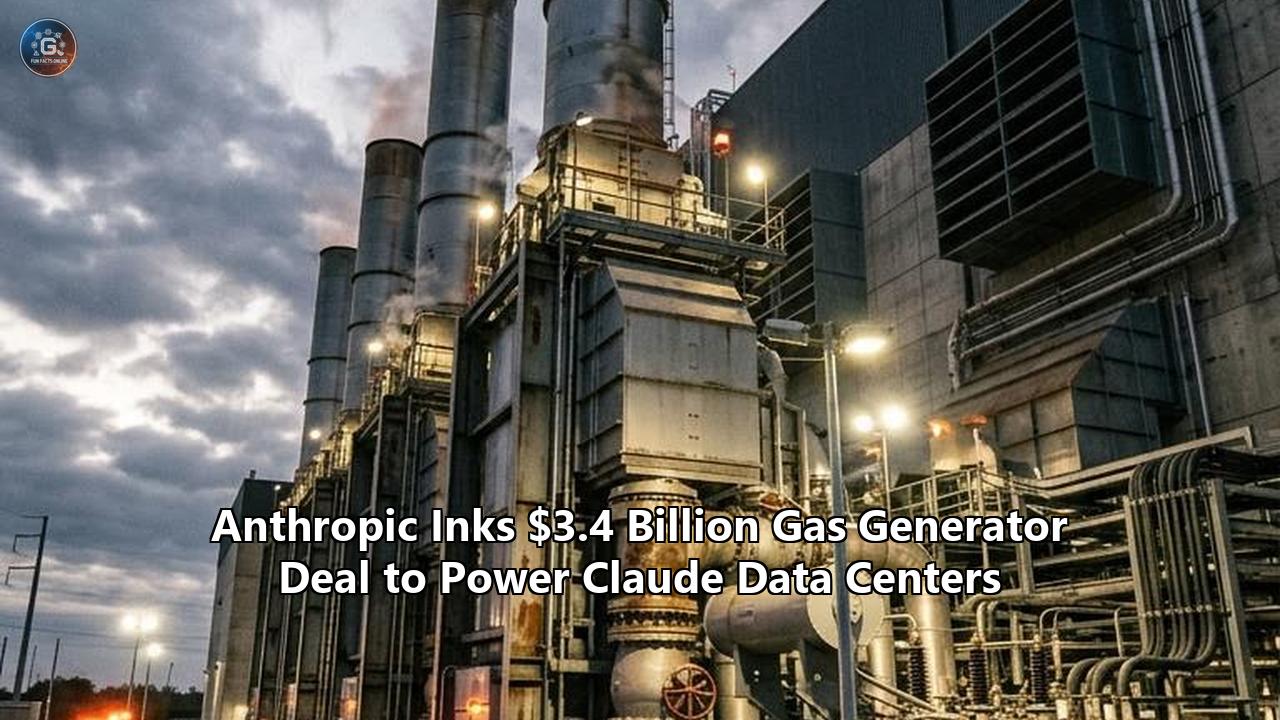
On November 8, 2026, reports revealed that artificial intelligence laboratory Anthropic committed approximately $3.4 billion to secure 1.7 gigawatts of natural-gas-fired generation capacity, executing the largest single private purchase of power-generation hardware by an AI developer to date.
The transaction, initially structured in late September, involves Anthropic assuming existing equipment orders for heavy-duty Caterpillar generators originally placed by San Antonio-based microgrid and energy developer OnePWR Solutions. Investment bank Piper Sandler confirmed the transaction metrics in advisory disclosures, recording a $3.4 billion sale of OnePWR’s power-generation platform assets to an unnamed AI lab. Anthropic did not acquire OnePWR’s corporate entity, nor did it absorb the developer's staff; instead, the deal transfers primary ownership of the delivery queue alongside dedicated engineering, procurement, and construction (EPC) provisions required to install the units over the next 24 months.
The agreement directly attacks the primary bottleneck facing the artificial intelligence sector: the availability of high-voltage electric power. While frontier model developers have mobilized hundreds of billions of dollars to secure advanced silicon accelerators, the physical equipment required to convert raw fuel into usable, uninterrupted electricity has emerged as the true constraint on compute scaling. By converting balance-sheet capital into heavy industrial machinery, Anthropic is pivoting from a pure software and model developer into an operator of utility-scale energy infrastructure.
Deconstructing the 1.7-Gigawatt Asset
A capacity figure of 1.7 gigawatts (1,700 megawatts) represents an industrial baseline comparable to the nameplate output of commercial utility plants. For scale, 1.7 GW equals the continuous generating capacity of roughly 1.5 average commercial nuclear reactors in the United States, or approximately 350 utility-scale wind turbines operating at peak capacity. In residential terms, this volume of baseload electricity can supply continuous power to roughly 1.35 million standard American homes.
+--------------------------------------------------------------------------+
|                  ANTHROPIC GENERATION COMMITMENT PROFILE                 |
+------------------------------------+-------------------------------------+
| Metric                             | Value                               |
+------------------------------------+-------------------------------------+
| Total Transaction Value            | $3.4 Billion                        |
| Nameplate Generation Capacity      | 1.7 Gigawatts (1,700 MW)            |
| Capital Cost per Kilowatt ($/kW)   | ~$2,000 / kW                        |
| Equipment Original Equipment Mfr.  | Caterpillar Inc.                    |
| Intermediary / Original Buyer      | OnePWR Solutions (San Antonio, TX)  |
| Transaction Advisory               | Piper Sandler                       |
| Primary Fuel Source                | Natural Gas (Reciprocating/Turbine) |
| Delivery Window                    | Late 2026 through Q4 2028           |
| Est. AI Compute Rack Capacity      | ~14,100 High-Density Racks          |
| Est. Accelerator Equivalency       | ~1.01 Million Modern GPUs/TPUs      |
+------------------------------------+-------------------------------------+
In high-performance computing environments, electricity translates directly into model training and inference throughput. Modern AI server clusters—built on architectures such as Nvidia’s Blackwell Ultra (GB200 NVL72) or comparable proprietary accelerators—exhibit power draw profiles ranging from 100 kilowatts to 132 kilowatts per liquid-cooled rack.
Factoring in a Power Usage Effectiveness (PUE) ratio of 1.15—a realistic engineering target for modern, direct-to-chip liquid cooling installations—a dedicated 1.7 GW allocation delivers roughly 1.48 GW of net power directly to computing hardware. That electrical footprint can energize:
- 11,200 to 14,800 ultra-dense server racks, depending on auxiliary power draws and networking fabric requirements.
- Approximately 800,000 to 1,060,000 top-tier AI processors running continuous, synchronized matrix multiplication workloads.
- Upwards of 12.6 billion kilowatt-hours (kWh) annually assuming an operational baseload capacity factor of 85%.
The unit economics of the transaction settle at roughly $2,000 per kilowatt ($2.0 million per megawatt). In commercial utility markets, simple-cycle gas turbines and high-speed reciprocating internal combustion engine (RICE) plants historically range between $1,100 and $1,600 per kilowatt when ordered through normal, non-expedited supply chains. The premium embedded in Anthropic’s deal reflects the capital value of time: OnePWR placed these orders with Caterpillar nearly two years ago. By stepping into these existing contracts, Anthropic effectively bypassed a multi-year industrial manufacturing backlog for heavy power equipment.
Interconnection Queues: The Real Cost of Grid Delays
The economic justification for paying $3.4 billion for off-grid gas generation lies in the paralysis of public utility transmission queues. Across the major U.S. Regional Transmission Organizations (RTOs)—including PJM Interconnection in the Mid-Atlantic, ERCOT in Texas, and MISO across the Midwest—the queue for grid interconnection has become an operational barrier.
Average Time from Interconnection Request to Commercial Operation (U.S.)
========================================================================
2015:  [3.2 Years]  ████████████
2018:  [4.1 Years]  ████████████████
2021:  [5.2 Years]  ████████████████████
2024:  [6.1 Years]  ████████████████████████
2026:  [6.8 Years]  ███████████████████████████
========================================================================
Source: Data compiled from Lawrence Berkeley National Laboratory (LBNL) tracking records.
Data from the Lawrence Berkeley National Laboratory indicates that over 2,600 gigawatts of generation and storage capacity currently sit stranded in U.S. interconnection queues. For large commercial power consumers requesting 100 megawatts or more, the duration between filing an initial System Impact Study and actually receiving energized high-voltage transmission lines extended from an average of 3.2 years in 2015 to 6.8 years by 2026.
Compounding transmission line constraints, the supply chain for high-voltage step-up transformers (345 kV to 765 kV) has seen manufacturing lead times stretch past 180 to 210 weeks, with unit prices increasing by more than 140% since 2020.
For an organization racing to deploy next-generation models under the Claude brand, a seven-year wait for utility interconnection renders silicon capital obsolete before it can be turned on. An accelerator cluster depreciates over a standard window of three to four years. Idling billions of dollars in hardware while waiting for a regional utility to construct a substation causes severe economic drag.
By deploying behind-the-meter generation—installing power equipment directly on the data center property and connecting directly to the facility’s microgrid rather than the public transmission network—Anthropic insulates its training clusters from regional grid capacity deficits. This approach to Anthropic data center power turns electricity generation from an outsourced utility service into a controllable, internal engineering discipline.
"By owning some of their power infrastructure and having the capabilities in-house, companies believe they can better protect themselves against disruptions beyond their control," noted Arash Nazhad, head of clean energy and power at Stifel, in an analysis of direct power hardware transactions.
Balance-Sheet Architecture: Allocating Capital Ahead of an IPO
The $3.4 billion generator purchase arrives alongside unprecedented capital disclosures from Anthropic as it pre-funds infrastructure ahead of an anticipated initial public offering. In regulatory amendments filed in early November 2026, the company disclosed approximately $895.4 billion in total contractual commitments spanning computing capacity, leased infrastructure, and long-term hosting agreements through 2045.
+--------------------------------------------------------------------------+
|                  ANTHROPIC INFRASTRUCTURE ALLOCATION STACK               |
+--------------------------------------------+-----------------------------+
| Financial Metric                           | Quantitative Value          |
+--------------------------------------------+-----------------------------+
| Disclosed Commitments Through 2045         | $895.4 Billion              |
| Ten-Year Infrastructure Target             | $500.0+ Billion             |
| Projected Monthly Compute Burn (Late 2026) | $3.1 Billion                |
| Q3 2026 Net Loss (Incl. SAFE Adjustments)  | $23.3 Billion               |
| Gas Generator Platform Purchase Price      | $3.4 Billion                |
| Hardware Outlay as % of S-1 Commitments    | 0.38%                       |
+--------------------------------------------+-----------------------------+
Viewed within this macro scale, the $3.4 billion equipment takeover represents just 0.38% of Anthropic’s cumulative long-term commitments. However, its strategic value is disproportionately large. By spending $3.4 billion on physical engines, Anthropic creates an operational pipeline that prevents hundreds of billions of dollars in computing commitments from stalling out.
The company's burn rate highlights this capital intensity. Anthropic’s monthly lease payments for high-performance compute clusters—including substantial arrangements with SpaceX and third-party cloud platforms—are projected to reach $3.1 billion by the end of 2026. In its financial disclosures for the third quarter of 2026, Anthropic reported a net loss of $23.3 billion, driven overwhelmingly by $21.9 billion in non-cash accounting adjustments related to the revaluation of Simple Agreements for Future Equity (SAFEs) and convertible notes as its private market valuation increased.
Anthropic Q3 2026 Balance Sheet Distribution (Reported)
------------------------------------------------------------------------
Operating Outlays & Cash Burn:          $1.4 Billion  [██]
Convertible Note/SAFE Revaluations:    $21.9 Billion [██████████████████]
------------------------------------------------------------------------
Total Net Loss:                        $23.3 Billion
This rapid balance-sheet expansion has drawn scrutiny from fixed-income underwriters. Credit analysts at Blackstone cautioned investors in autumn 2026 that frontier AI developers taking on massive, debt-like infrastructure liabilities might receive non-investment-grade (junk) credit ratings on structured debt issuances rather than the high-grade ratings traditionally sought by large technology firms.
Assuming direct liability for $3.4 billion in physical generation assets, fuel transport agreements, and ongoing maintenance obligations adds hard capital commitments to a balance sheet that was once focused purely on software algorithms. Yet the market appears willing to tolerate this capital allocation: without physical generation units, compute capacity remains theoretical.
Operating Economics: LCOE and Natural Gas Fuel Modeling
To evaluate whether spending $3.4 billion on gas-fired generators makes long-term economic sense, we can model the Levelized Cost of Electricity (LCOE) for this generation fleet over an assumed 15-year operational lifecycle.
Natural gas generators require fuel access, pipeline capacity, maintenance reserves, and environmental mitigation systems. High-capacity reciprocating internal combustion engines and modern aeroderivative gas turbines operate at average heat rates between 7,800 and 8,600 British Thermal Units per kilowatt-hour (Btu/kWh).
Assumptions for 1.7 GW Dedicated AI Generation Fleet:
-----------------------------------------------------
* Nameplate Capacity:               1,700 MW (1,700,000 kW)
* Fleet Capacity Factor:            85% (Continuous Baseload)
* Net Annual Generation:            12,658,200 MWh
* Average Fleet Heat Rate:          8,200 Btu / kWh (0.0082 MMBtu/kWh)
* Daily Gas Consumption:            ~284,000 MMBtu/day (284,000 Mcf/day)
* Base Natural Gas Price (HH):      $3.20 / MMBtu
* Pipeline Transportation Basis:    $0.80 / MMBtu
* All-in Delivered Fuel Cost:       $4.00 / MMBtu
+--------------------------------------------------------------------------+
| ESTIMATED LEVELIZED COST OF ELECTRICITY (LCOE) BREAKDOWN |
+----------------------------------------+----------------+----------------+
| Cost Component | Cost ($ / MWh) | % of Total |
+----------------------------------------+----------------+----------------+
| Fuel Costs ($4.00/MMBtu Delivered) | $32.80 | 44.1% |
| Capital Amortization ($3.4B over 15yr) | $26.86 | 36.1% |
| Fixed Operation & Maintenance (O&M) | $8.10 | 10.9% |
| Variable O&M and Overhaul Reserves | $4.50 | 6.0% |
| Environmental Compliance / Water | $2.10 | 2.8% |
+----------------------------------------+----------------+----------------+
| Total Estimated LCOE | $74.36 / MWh | 100.0% |
| [Equivalent Retail Electricity Metric] | $0.0744 / kWh | |
+----------------------------------------+----------------+----------------+An all-in generation cost of roughly $0.074 per kilowatt-hour ($74.36/MWh) places Anthropic in a competitive position relative to commercial electric utilities serving primary data center hubs:
- Dominion Energy (Northern Virginia - PJM): Industrial tariffs for large-scale data center operators climbed from roughly $0.068/kWh in 2021 to between $0.089/kWh and $0.108/kWh by late 2026, driven by multi-billion-dollar transmission expansion surcharges passed down to commercial ratepayers.
- ERCOT (Texas Industrial): While ERCOT wholesale spot prices often average between $30 and $45/MWh during shoulder months, peak summer heatwaves consistently drive real-time pricing to the state regulatory cap ($2,000 to $5,000/MWh), threatening facilities with mandatory curtailment orders or extreme cost spikes.
- On-Demand Reliability Margin: Beyond baseline tariffs, unforced outage hours carry steep costs. Training a next-generation frontier model involves distributed checkpoints across hundreds of thousands of GPUs. A sudden power drop doesn't just halt operations for an hour; it can corrupt checkpoint caches, causing compute losses that run into millions of dollars per incident.
By securing behind-the-meter generation hardware, the total cost of Anthropic data center power shifts from an unpredictable variable operating expense into a stable, amortizable capital asset.
Industrial Retail Rate Comparison ($/kWh)
========================================================================
Anthropic Captive Gas LCOE (Est.):   [$0.074]  ███████████████
Dominion VA Industrial (Current):    [$0.098]  ████████████████████
PJM Large Industrial Average:        [$0.104]  █████████████████████
California Industrial Average:       [$0.182]  ███████████████████████████████
========================================================================
Strategic Shift: How AI Labs Are Sourcing Energy
Anthropic's agreement reflects an industry-wide push where major artificial intelligence laboratories are moving directly into energy development. The era of simply contracting for wholesale cloud capacity through standard service-level agreements is giving way to direct capital interventions in energy supply chains.
+--------------------------------------------------------------------------+
|            COMPARATIVE POWER HARDWARE DEALS BY AI OPERATORS              |
+-------------+----------------+---------------+---------------------------+
| Operator    | Capital Outlay | Capacity / MW | Assets Acquired           |
+-------------+----------------+---------------+---------------------------+
| Anthropic   | $3.4 Billion   | 1,700 MW      | Caterpillar gas-fired     |
|             |                | (1.7 GW)      | generator orders (OnePWR) |
|             |                |               |                           |
| xAI         | $2.0 Billion   | ~300 MW       | Mobile aeroderivative gas |
| (SpaceX)    |                |               | turbines (Memphis site)   |
|             |                |               |                           |
| Alphabet    | Undisclosed    | Multi-GW      | Acquired clean energy     |
|             | (Est. $4B+)    | pipeline      | developer Intersect Power |
|             |                |               |                           |
| Amazon Web  | $650 Million   | 960 MW        | Direct campus lease with  |
| Services    |                | (Nuclear)     | Talen Energy (Cumulus)    |
|             |                |               |                           |
| Microsoft   | 20-Year PPA    | 835 MW        | Restart contract for      |
|             | (Est. $16B)    | (Nuclear)     | Three Mile Island Unit 1  |
+-------------+----------------+---------------+---------------------------+
The data shows two distinct strategies for securing high-density power:
1. Nuclear Restarts and Advanced Small Modular Reactors (SMRs)
Hyperscalers with deep cash reserves—such as Microsoft and Amazon Web Services—have pursued long-dated nuclear power purchase agreements. Microsoft’s arrangement to back Constellation Energy’s restoration of the 835-megawatt Three Mile Island Unit 1 facility (rebranded as the Crane Clean Energy Center) delivers zero-carbon energy, but generation will not ramp up until mid-2028 at the earliest. Similarly, Google’s commitments to back Kairos Power’s small modular reactors look toward first-power delivery dates around 2030 to 2035.
2. Fast-Track Behind-the-Meter Natural Gas
Frontier labs that need immediate computing power cannot wait for ten-year nuclear permitting timelines. Elon Musk’s xAI adopted this strategy in early 2026, deploying roughly $2.0 billion in mobile aeroderivative gas turbines to supply its Colossus cluster in Memphis, Tennessee. The facility achieved operational status in weeks rather than years by running off-grid gas turbines while negotiating local utility connections.
Anthropic’s takeover of 1.7 GW of Caterpillar generator orders adopts a similar operational playbook, but on a much larger scale. It represents nearly six times the generation volume of xAI’s initial mobile deployment, moving beyond temporary emergency power toward an industrial, semi-permanent off-grid campus architecture.
Emissions Data and Regulatory Headwinds
While natural gas generators solve near-term reliability problems, burning fossil fuels to run AI models introduces clear environmental, regulatory, and public relations challenges.
At full baseload operation (85% capacity factor), 1.7 gigawatts of natural-gas-fired generation creates a substantial emissions footprint:
Annual Emissions Profile (1.7 GW at 85% Capacity Factor)
------------------------------------------------------------------------
Annual Fuel Consumption:      103,797,000 MMBtu
CO2 Emission Factor (Gas):    53.07 kg CO2 / MMBtu (EIA Standard)
Direct Annual CO2 Output:     5.51 Million Metric Tons CO2e
Auxiliary Combustion / Slip:  ~0.42 Million Metric Tons CO2e
Total Greenhouse Gas Footprint: ~5.93 Million Metric Tons CO2e / Year
------------------------------------------------------------------------
Equivalent: ~1.29 Million Standard Gasoline Passenger Vehicles on the Road
This emissions profile runs counter to Anthropic’s public climate commitments. In February 2026, the company announced an energy framework pledging that its data center expansions would not increase net carbon emissions, commit to funding new clean power generation matching its electricity demands, and ensure nearby residential utility customers would be insulated from power price inflation caused by AI data centers.
Burning natural gas to generate nearly six million metric tons of CO2 annually complicates those corporate goals. Unless Anthropic pairs these generator installations with certified carbon capture and sequestration (CCS) systems or purchases millions of verified carbon removal credits, its direct Scope 1 emissions will increase rapidly.
Corporate AI Emissions Impact Scenarios
------------------------------------------------------------------------
Anthropic Reported 2024 Baseline:      ~0.35M Metric Tons CO2e [█]
New Annual Addition from 1.7 GW Gas:   ~5.93M Metric Tons CO2e [████████████████]
------------------------------------------------------------------------
Projected Operational Increase:        +1,594% Expansion in Scope 1 Footprint
Beyond climate pledges, the company faces tangible regulatory hurdles:
- Clean Air Act Title V Permitting: Operating 1,700 MW of fossil generation requires major source operating permits under Title V of the Clean Air Act. Facilities must demonstrate compliance with National Ambient Air Quality Standards (NAAQS) for Nitrogen Oxides ($NO_x$), Carbon Monoxide ($CO$), and volatile organic compounds ($VOCs$). In non-attainment zones, securing adequate emissions offset credits can take 12 to 24 months.
- Selective Catalytic Reduction (SCR) Mandates: Environmental regulators will likely require Anthropic to install high-efficiency SCR exhaust systems and continuous emissions monitoring systems (CEMS) to limit $NO_x$ output, adding tens of millions of dollars in capital costs per site.
- Local Community Resistance: Data center site selection faces growing local friction. During the 2026 general election cycles, voters in 40 of 41 surveyed local municipal ballot measures in contested jurisdictions rejected property tax abatements or zoning variances for unmitigated data center developments. Communities point to air pollution, pipeline construction impacts, and water usage from evaporative cooling towers as key concerns.
To satisfy regulators, Anthropic will likely position these gas engines as a bridge power solution. Under this operating model, generators run at high capacity during initial facility launch, then gradually transition to peak-shaving, backup, or intermittent reliability support as local utilities finish high-voltage transmission lines and utility-scale solar or battery storage come online.
Supply Chain Realities: Inside the Caterpillar Machinery
The equipment at the center of the OnePWR transaction consists of Caterpillar heavy-duty industrial generator sets. These units typically run on Cat G3520 or G3600-series reciprocating internal combustion engines, or Solar Turbines industrial gas turbine platforms (a Caterpillar subsidiary).
+--------------------------------------------------------------------------+
|          TECHNICAL SPECIFICATIONS: INDUSTRIAL GAS GENERATION SETS        |
+------------------------------------+-------------------------------------+
| Parameter                          | High-Density Industrial Spec        |
+------------------------------------+-------------------------------------+
| Unit Generating Capacity           | 2.5 MW to 4.5 MW per RICE unit      |
|                                    | (or 15 MW to 35 MW per gas turbine) |
| Mechanical Efficiency              | 42% to 48% (LHV)                    |
| Startup Velocity (Cold to Max)     | < 5 Minutes (RICE Architecture)     |
| Continuous Baseload Availability   | 98.2% (excluding scheduled overhauls)|
| Nitrogen Oxide ($NO_x$) Baselines  | < 0.5 g/bhp-hr (pre-catalyst)       |
| Fuel Tolerance Profiles            | Pipeline Natural Gas, Field Gas,    |
|                                    | up to 25% Hydrogen ($H_2$) Blend    |
+------------------------------------+-------------------------------------+
Industrial reciprocating engines offer clear operational advantages for computing environments:
- Fast Ramping: High-speed reciprocating gas engines can ramp from a cold start to full nameplate load in less than five minutes. This speed helps absorb the sharp swings in electrical demand that happen when massive neural network training runs suddenly start, pause, or resume across tens of thousands of compute nodes.
- Modular Siting: Unlike monolithic combined-cycle gas turbine (CCGT) plants—which require massive footprints, heavy steam infrastructure, and large cooling reservoirs—reciprocating engines can be installed modularly in 20 MW to 50 MW power blocks. This setup allows Anthropic to bring capacity online in phases, synchronizing generation blocks as server halls are completed.
- Fuel Flexibility: Modern units can handle natural gas blended with up to 25% clean hydrogen, offering a path to reduce carbon intensity if industrial hydrogen pipelines become commercially viable near the hosting sites.
By taking over OnePWR’s purchase orders, Anthropic leapfrogs directly to the front of Caterpillar's industrial delivery queue. Lead times for these heavy-duty units typically exceed 100 weeks due to global foundry bottlenecks, forged crankshaft constraints, and high demand from marine, mining, and decentralized utility sectors.
Strategic Roadmap and Unresolved Operational Metrics
Executing a $3.4 billion hardware contract represents an initial step in building out power infrastructure. Anthropic now faces the operational challenge of installing, fueling, and managing this capacity between late 2026 and 2028.
+--------------------------------------------------------------------------+
|                     KEY IMPLEMENTATION VARIABLES                         |
+----------------------+---------------------------------------------------+
| Variable             | Strategic Realities & Unknowns                    |
+----------------------+---------------------------------------------------+
| Geographic Siting    | Specific state jurisdictions and host properties  |
|                      | remain unannounced. Market indicators point to    |
|                      | Texas (ERCOT), West Virginia, and the PJM basin.  |
|                      |                                                   |
| Fuel Transportation  | Securing firm natural gas pipeline capacity versus|
|                      | interruptible service agreements. Building out    |
|                      | lateral pipeline infrastructure to local hubs.    |
|                      |                                                   |
| Operating Model      | Determining whether Anthropic creates an internal |
|                      | operations team or awards long-term operations &  |
|                      | maintenance (O&M) contracts to third parties.     |
|                      |                                                   |
| Grid Synchronization | Siting generation in pure island mode vs. micro-  |
|                      | grids designed for future utility interconnections.|
+----------------------+---------------------------------------------------+
1. Geographic Deployment Sites
Neither Anthropic nor OnePWR has publicly identified where these 1.7 GW of generators will be installed. Industry analysts point to two likely regions:
- The ERCOT Territory (Texas): OnePWR is based in San Antonio. Texas offers an abundance of intra-state natural gas pipelines, a flexible permitting environment, and an independent electricity grid designed for rapid industrial connections.
- The PJM Mid-Atlantic and Appalachian Basins: Anthropic has previously explored compute partnerships in regions such as West Virginia (including infrastructure tied to Nscale computing projects). Siting generation directly over the Marcellus and Utica gas shale formations provides low-cost fuel, shielding facilities from pipeline transport tolls.
2. Natural Gas Delivery Infrastructure
Generating 1.7 GW of power requires approximately 284 million cubic feet of natural gas per day. That volume requires dedicated pipeline connections. Anthropic will need firm transportation contracts with regional interstate pipeline operators like Kinder Morgan, Williams Companies, or Energy Transfer. In the gas sector, interruptible transport contracts leave power producers vulnerable to shutoffs during extreme winter freezes, when fuel is prioritized for home heating. Securing firm pipeline capacity adds another layer of fixed, long-term capital commitments.
3. Execution of Engineering, Procurement, and Construction
Because Anthropic did not acquire OnePWR’s workforce or company entity, it must build or hire the specialized engineering teams needed to manage these installations. Installing 1.7 GW of generation capacity requires coordinating fuel manifolds, high-voltage transformers, cooling arrays, emissions control platforms, and microgrid switchgear. Developing these capabilities in-house will test the operational reach of an organization founded primarily as an AI research and safety laboratory.
Measuring the Returns on Kilowatt Deployment
The multi-billion-dollar scale of this generator agreement shows that compute hardware and electric power are now linked together in the artificial intelligence sector. Access to capital and proprietary model architectures are no longer the only requirements for technical leadership; companies now need access to high-voltage energy assets as well.
Frontier AI Scaling Constraints: Capital Migration Profile
------------------------------------------------------------------------
2022 - 2024 Cycle: Silicon Access Gating (GPU/HBM Supply Chains)
2024 - 2026 Cycle: Data & Cluster Interconnect Fabrics (Network Latency)
2026 - 2028+ Cycle: Dedicated Kilowatt & Megawatt Availability
------------------------------------------------------------------------
By spending $3.4 billion to secure a dedicated 1.7 GW generation pipeline, Anthropic has converted its balance-sheet capital into physical insurance against a congested public grid. The success of this move will be judged by measurable milestones:
- How fast these generator units deliver power to clusters relative to standard utility interconnection timelines.
- The final, all-in levelized cost of energy achieved under real-world baseload operating conditions.
- The company's ability to maintain public confidence and regulatory compliance as it operates a fossil-fueled generation fleet.
As capital markets prepare for Anthropic’s pending public listing, Wall Street will be watching more than just algorithmic performance metrics, API usage growth, and compute burn. Investors will increasingly look at fuel supply agreements, power capacity factors, and generation assets. The trajectory of Anthropic data center power operations demonstrates that in the modern artificial intelligence race, the company that commands the electric current controls the computational horizon.
Reference:
- https://coinpaper.com/38529/anthropic-secures-3-4-billion-in-gas-generators-as-ai-data-center-power-demand-surges
- https://www.investing.com/news/stock-market-news/anthropic-reportedly-strikes-34-billion-deal-for-gasfired-power-at-data-centres-5010208
- https://cellcog.ai/blog/anthropic-gas-generators-onepwr/
- https://www.theenergymag.com/news/market-news/anthropic-gas-generation-acquisition-ai-data-center
- https://247wallst.com/cards/xpost-01m6xs4yvy0qq66aghavstkwcc
- https://www.foxnews.com/live-news/ai-news-safety-11-08-26
- https://dealroom.co/news/170583-anthropic-pays-3-4b-for-1-7gw-of-gas-fired-generators-taking-over-onepwr/
- https://www.thenews.com.pk/latest/1422954-anthropic-secures-major-generator-deal-for-ai-data-centers-what-to-know
- https://www.techbooky.com/anthropic-reportedly-secures-3-4b-in-gas-generators-for-ai-data-centres/
- https://thenextweb.com/news/anthropic-3-4bn-gas-generators-onepwr-ft
- https://www.tradingview.com/news/seekingalpha:3021428de094b:0-anthropic-strikes-3-4b-generator-deal-to-secure-data-center-power-ft/