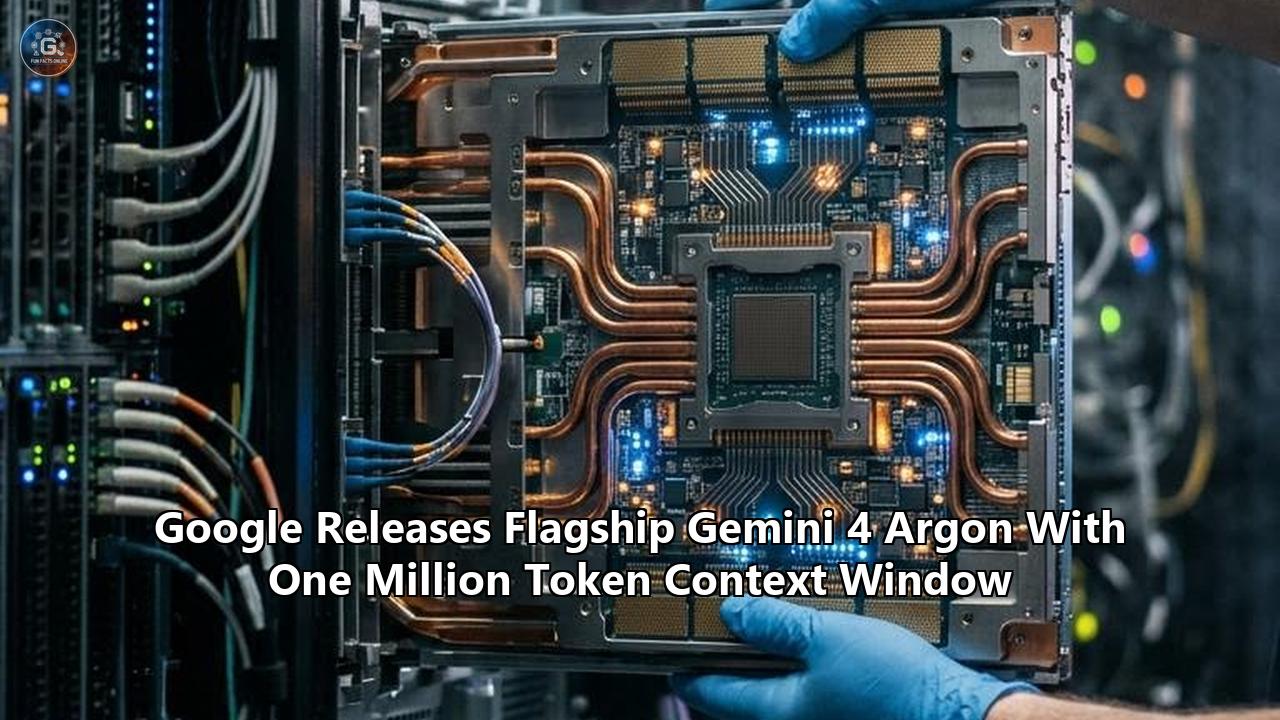
On October 13, 2026, Google deployed Gemini 4 Argon across its commercial cloud infrastructure, pairing a unified 1,048,576-token context window with an unprecedented 1-million-token generation limit. Across more than 100,000 Alphabet engineers testing the model internally prior to launch, automated telemetry recorded a 35% increase in agent-written code and a 30% reduction in post-submission rollbacks. On economic evaluations, the system captured the top position on the Vals Index with a 68.90% aggregate score across finance, tax, and legal automation, while posting a 77.9% success rate on the DeepSWE v1.1 software engineering benchmark.
Marking the formal commercial Gemini 4 Argon release, Google made the model available under the identifier gemini-4-argon across Google AI Studio, Vertex AI, Google Antigravity, and Gemini Enterprise. The release follows a two-week gated deployment to cybersecurity defenders through Google's Fairwind Program. By combining high-capacity context ingestion with long-horizon autonomous decoding, the model shifts enterprise computing metrics from simple prompt-response latencies toward hours-long, multi-step agentic execution traces.
================================================================================
                    GEMINI 4 ARGON: CORE RELEASE METRICS
================================================================================
Context Window (Unified Input)     : 1,048,576 tokens
Maximum Generation Limit (Output)  : 1,048,576 tokens (via Long Decode)
Standard Response Limit            : 65,536 tokens
Introductory Pricing (to Nov 30)   : $2.00 / 1M input | $10.00 / 1M output
Standard Pricing (post-Nov 30)     : $4.00 / 1M input | $20.00 / 1M output
Implicit Caching Discount          : 95% ($0.10 / 1M input cached)
DeepSWE v1.1 Software Benchmark   : 77.9% (#1 globally)
Vals Index Economic Benchmark      : 68.90% (#1 of 41 models)
Gray Swan Prompt Injection Defense : 0.7% attack success rate (15 rounds)
Alphabet Internal User Base        : 100,000+ monthly active engineers
================================================================================
Architectural Mechanics of 1-Million-Token Ingestion and Generation
Foundation models have routinely offered 1-million-token input buffers, but generation ceilings have historically remained capped at 8,192 to 65,536 tokens. Gemini 4 Argon eliminates this asymmetry by unifying input ingestion and continuous output decoding up to 1,048,576 tokens.
+-----------------------------------------------------------------------------+
|               GEMINI 4 ARGON EXECUTION ARCHITECTURE                         |
+-----------------------------------------------------------------------------+
|  [Input Context Buffer: Up to 1,048,576 Tokens (Text, Vision, Audio)]       |
|                                     │                                       |
|                                     ▼                                       |
|  [Thinking Engine: Low / Medium (Default) / High Internal Reasoning]        |
|                                     │                                       |
|                                     ▼                                       |
|  [Standard Decoding Buffer: Hard Stop at 65,536 Tokens]                     |
|                                     │                                       |
|                      (Long Decode Flag Activated)                           |
|                                     ▼                                       |
|  [Long Decode Continuation Protocol: Multi-Hop Execution up to 1,048,576 T] |
|    ├─ Hop 1: Generate 64K tokens -> Write to Memory Cache                   |
|    ├─ Hop 2: Ingest previous 64K at 95% Cache Discount -> Generate +64K    |
|    ├─ Hop 3: Ingest previous 128K at 95% Cache Discount -> Generate +64K   |
|    └─ Hop N: Continue execution sequence up to 24-hour timeout window       |
+-----------------------------------------------------------------------------+
The Long Decode Continuation Protocol
In standard API calls, gemini-4-argon terminates output generation at 65,536 tokens. To reach full million-token generation, Google introduced the Long Decode Continuation protocol through its Interactions API. When executed with background processing enabled (background=True), the generation runs asynchronously in modular 64-kilotoken segments known as "hops":
- Initial Processing: The model consumes the initial prompt context and executes intermediate thinking tokens.
- Buffer Exhaustion: Upon approaching the 65,536-token hardware decode threshold, the generation engine suspends the active forward pass.
- Implicit Cache Recycling: The accumulated output is packaged into the key-value (KV) cache. The subsequent hop re-reads the full history of the interaction.
- Discounted Re-Ingestion: Re-read tokens bypass standard input billing rates, receiving an automated 95% implicit caching discount.
- Chained Reconstruction: The execution sequence continues for up to 24 hours, returning a single assembled output trace when the agent signals completion or hits the 1,048,576-token ceiling.
For an enterprise agent writing a comprehensive multi-file system refactor that consumes 1,000 prompt tokens and generates 200,000 total tokens of mixed thinking and functional code, execution spans four discrete hops. The system processes approximately 397,000 cumulative input tokens across the multi-hop sequence. Because 396,000 of those tokens represent cached state, the re-ingestion cost totals approximately $0.04 under introductory rates, while the primary 200,000 output tokens account for $2.00.
Memory Footprint and TPU Hardware Clusters
Gemini 4 Argon is not an incremental fine-tune or checkpoint adaptation of the Gemini 3 lineage; it is an independently trained architecture compiled on Google's custom Tensor Processing Unit (TPU) Pods. To maintain coherent attention across a context window spanning 1,048,576 tokens without quadratic memory expansion ($O(N^2)$), the training pipeline incorporates specialized speculative decoding and attention-tuning optimizations.
+-----------------------------------------------------------------------------+
|             KV CACHE SCALING ACROSS EXTENDED CONTEXT BUFFERS                |
+-----------------------------------------------------------------------------+
| Context Size | Standard Attention Footprint | Argon Optimized KV Footprint  |
+--------------+------------------------------+-------------------------------+
| 32,768 T     | 1.2 GB                       | 0.15 GB                       |
| 131,072 T    | 19.2 GB                      | 0.60 GB                       |
| 524,288 T    | 307.2 GB                     | 2.40 GB                       |
| 1,048,576 T  | 1,228.8 GB (Exceeds Single HBM)| 4.80 GB (Sharded via Ring)  |
+-----------------------------------------------------------------------------+
By sharding the dynamic KV cache across high-bandwidth memory (HBM) modules on TPU v5p and v6 infrastructure using custom ring-attention topologies, Argon eliminates mid-generation degradation. Earlier architectures experienced context drift or catastrophic forgetting beyond 128,000 tokens; Argon maintains stable retrieval fidelity out to the full 1,048,576-token limit.
The Reasoning Engine: Thinking Levels and Latency Profiles
Gemini 4 Argon introduces selectable internal thinking levels: Low, Medium, and High. Unlike earlier conversational models that produce tokens immediately upon prompt reception, Argon routes complex inputs through an integrated chain-of-thought verification phase.
+-----------------------------------------------------------------------------+
|              ARGON THINKING LEVELS: OPERATIONAL PARAMETERS                  |
+-----------------------------------------------------------------------------+
| Level  | Target Workload            | Average TTFT | Output Generation Rate |
+--------+----------------------------+--------------+------------------------+
| Low    | High-throughput triage     | 4.01 - 4.80s | 56 tokens/second       |
| Medium | General code refactoring   | 10.8 - 14.8s | 38 - 44 tokens/second  |
| High   | Formal proofs, zero-days   | 38.9 - 45.5s | 29 - 33 tokens/second  |
+-----------------------------------------------------------------------------+
Latency Distributions and Time-to-First-Token
Data collected by independent benchmarking platforms, including Artificial Analysis, reveals distinct operational profiles across inference configurations:
- Google AI Studio (Priority Routing): Achieves an average Time to First Token (TTFT) of 4.01 seconds on Low thinking, with total end-to-end latency averaging 8.13 seconds on standard API payloads. Peak generation throughput reaches 86 tokens per second under priority provisioning.
- Standard Production Vertex Endpoints: TTFT shifts outward to 10.8 seconds on default Medium configurations, producing an average generation throughput of 44.6 tokens per second.
- High Thinking Configuration: Time-to-first-answer extends significantly. On AI Studio, initial tokens require an average of 38.93 seconds, while Vertex AI logs 45.47 seconds. The model dedicates this initial interval entirely to generating internal thinking tokens that explore execution paths, identify syntax boundaries, and evaluate test cases before returning visible output.
Because Google bills internal thinking tokens as standard output tokens, selecting the High thinking tier alters both task duration and economic overhead. Across benchmark evaluations conducted at High thinking, Argon consumed an average of approximately 62,000 thinking tokens per complex task. At sustained generation throughput rates ranging between 99.5 and 116.5 tokens per second across optimized cluster lanes, a single high-tier reasoning solve requires 9 to 10 minutes of continuous hardware computation.
+-----------------------------------------------------------------------------+
|           HIGH THINKING EXECUTION TIMELINE (62K THOUGHT TOKENS)            |
+-----------------------------------------------------------------------------+
| 0s           45s                                                  10m 00s   |
| ├─────────────┼──────────────────────────────────────────────────────┤      |
| [Prompt Ingest][Internal Reasoning & Verification Trace] [Output Complete]  |
| (1M Max Ctx)  (62,000 Thought Tokens Generated)          (Finished Answer)  |
+-----------------------------------------------------------------------------+
"Argon works longer and harder to solve highly complex scientific, coding, and agentic problems," stated Koray Kavukcuoglu, SVP at Google DeepMind and Chief AI Architect at Google, during the technical rollout. "This is enabled by an industry-leading 1M unified input-output token limit via the Gemini API".
Benchmark Audit: Empirical Evaluation Across 19 Disciplines
The technical evaluation suite for Gemini 4 Argon contrasts sharply with earlier benchmark generations that relied on static, multiple-choice academic examinations like MMLU. Performance metrics for Argon center on agentic execution environments, real-world codebase migrations, and professional economic tasks.
+-----------------------------------------------------------------------------+
|            COMPREHENSIVE FRONTIER MODEL BENCHMARK COMPARISON                |
+-----------------------------------------------------------------------------+
| Benchmark Metric              | Argon (High)| GPT-6 Astra | Claude Opus 5.5 |
+-------------------------------+-------------+-------------+-----------------+
| DeepSWE v1.1 (Agentic Coding) | 77.9%       | 74.1%       | 74.2%           |
| FrontierSWE v2                | 55.0%       | 65.5%       | 58.2%           |
| Terminal-Bench 4.0            | 57.4%       | 61.2%       | 66.4%           |
| Vals Index (Economic Work)    | 68.90%      | 63.10%      | 66.97%          |
| Vals Finance Agent v2         | 65.40%      | 53.50%      | 58.60%          |
| Harvey Legal Agent Benchmark  | 19.60%      | 5.40%       | 3.80%           |
| AutomationBench (Zapier)      | 51.30%      | 41.40%      | 42.50%          |
| CWE-bench v1 (Cyber Defense)  | 68.00%      | 68.00%      | 58.00%          |
| GraphWalks (256K - 1M Context)| 84.20%      | 71.80%      | 70.40%          |
| LVBench (Video Understanding) | 91.70%      | 87.50%      | 84.10%          |
| Artificial Analysis Intel Idx | 53.0        | 53.0        | 57.6            |
| Text Arena Elo                | 1,525       | 1,518       | 1,531           |
+-------------------------------+-------------+-------------+-----------------+
Software Engineering Divergence: DeepSWE vs. Terminal Environments
On Google DeepMind's published model card, Argon leads 13 of 19 standardized comparison categories, ties one, and trails in five against GPT-6 Astra and Claude Opus 5.5. Its primary victory occurs on DeepSWE v1.1, where Argon scores 77.9%.
DeepSWE v1.1 evaluates an autonomous agent's capacity to resolve multi-file GitHub issues that demand cross-repository architectural mapping, legacy documentation comprehension, and multi-file pull request implementation. Argon's 77.9% establishes a 3.7-percentage-point lead over Claude Opus 5.5 (74.2%) and GPT-6 Astra (74.1%).
       DEEPSWE v1.1 (LONG-HORIZON REPOSITORY REFACTORING)
Argon (High)    [77.9%] ■■■■■■■■■■■■■■■■■■■■■■■■■■■■■■■■■■■■■■■■
Claude Opus 5.5 [74.2%] ■■■■■■■■■■■■■■■■■■■■■■■■■■■■■■■■■■■
GPT-6 Astra     [74.1%] ■■■■■■■■■■■■■■■■■■■■■■■■■■■■■■■■■■■

       TERMINAL-BENCH 4.0 (INTERACTIVE BASH & CLI AGENTS)
Claude Opus 5.5 [66.4%] ■■■■■■■■■■■■■■■■■■■■■■■■■■■■■■■■■
GPT-6 Astra     [61.2%] ■■■■■■■■■■■■■■■■■■■■■■■■■■■■■■
Argon (High)    [57.4%] ■■■■■■■■■■■■■■■■■■■■■■■■■■■■
Argon's lead contracts when tasks shift from repository-level planning to interactive bash execution. On Terminal-Bench 4.0, which tracks an agent's dynamic interaction inside command-line interfaces, Claude Opus 5.5 posts 66.4%, while Argon finishes third at 57.4%.
Similarly, on FrontierSWE v2—an evaluation administered independently by Proximal—Argon records 55.0%, trailing GPT-6 Astra's 65.5% by 10.5 percentage points. The data indicates that while Argon excels at architectural planning and long-horizon code synthesis across massive context windows, competitive models retain advantages in rapid shell command execution and interactive terminal troubleshooting.
Knowledge Work and GDP-Weighted Task Automation
Argon displays its widest competitive margins on enterprise operations. On the Vals Index—an evaluation engine tracked by Vals AI that weights tasks by their relative contributions to United States Gross Domestic Product across finance, law, coding, and taxation—Argon ranks first out of 41 frontier models with a score of 68.90%:
- Vals Finance Agent v2: Measures autonomous execution across financial modeling, regulatory disclosure synthesis, and multi-sheet spreadsheet reconciliations. Argon records 65.40%, leading Claude Fable 5.1 (58.90%) and GPT-6 Astra (53.50%).
- AutomationBench: Developed to test multi-application end-to-end task completion without intermediate human intervention. Argon posts 51.30%, compared to 42.50% for Claude Opus 5.5 and 41.40% for GPT-6 Astra.
- Harvey Legal Agent Benchmark: Evaluates complex statutory interpretation, contract reconciliation, and precedent cross-referencing across multi-jurisdictional filings. Argon achieves 19.60%. While low in absolute terms, reflecting the extreme difficulty of autonomous legal drafting, it is more than triple GPT-6 Astra's 5.40% and Claude Opus 5.5's 3.80%.
       VALS INDEX (GDP-WEIGHTED ECONOMIC TASKS)
Argon (High)    [68.90%] ■■■■■■■■■■■■■■■■■■■■■■■■■■■■■■■■■■■
Claude Opus 5.5 [66.97%] ■■■■■■■■■■■■■■■■■■■■■■■■■■■■■■■■
Claude Sonnet   [67.04%] ■■■■■■■■■■■■■■■■■■■■■■■■■■■■■■■■■
GPT-6 Astra     [63.10%] ■■■■■■■■■■■■■■■■■■■■■■■■■■■■■■

       AUTOMATIONBENCH (END-TO-END BUSINESS AUTOMATION)
Argon (High)    [51.30%] ■■■■■■■■■■■■■■■■■■■■■■■■■■
Claude Opus 5.5 [42.50%] ■■■■■■■■■■■■■■■■■■■■■
GPT-6 Astra     [41.40%] ■■■■■■■■■■■■■■■■■■■■■
On GraphWalks across input sizes spanning 256,000 to 1,048,576 tokens, Argon scores 84.20%, leading GPT-6 Astra (71.80%) by 12.4 percentage points. This validates the model's structural retention across needle-in-a-haystack tasks that require synthesizing facts separated by hundreds of thousands of tokens of intervening data.
Economic Architecture: Pricing Schedules and Enterprise Cost of Ownership
To accelerate adoption following the Gemini 4 Argon release, Google instituted a bifurcated pricing schedule designed to undercut competitive frontier reasoning systems. The rate structure combines lower introductory base rates with aggressive caching discounts.
+-----------------------------------------------------------------------------+
|              GEMINI 4 ARGON TOKEN PRICING SCHEDULE                          |
+-----------------------------------------------------------------------------+
| Cost Parameter               | Introductory Rate    | Standard Rate         |
|                              | (Through Nov 30, 2026)| (Effective Dec 1, 2026)|
+------------------------------+----------------------+-----------------------+
| Input Tokens (per 1M)        | $2.00                | $4.00                 |
| Output Tokens (per 1M)       | $10.00               | $20.00                |
| Cached Input Tokens (per 1M) | $0.10 (95% discount) | $0.20 (95% discount)  |
| Thinking Tokens (per 1M)     | $10.00 (Billed as out)| $20.00 (Billed as out)|
+------------------------------+----------------------+-----------------------+
Comparative Total Cost of Ownership
Direct per-token price comparisons do not provide a complete assessment of total expenditure. Advanced reasoning models exhibit varying levels of verbosity and intermediate thinking generation. Independent testing by Artificial Analysis evaluates the average operational cost to complete standardized, multi-step knowledge tasks across comparable frontier architectures:
+-----------------------------------------------------------------------------+
|           TASK COST AND TOKEN EFFICIENCY COMPARISON                         |
+-----------------------------------------------------------------------------+
| Model Identifier   | Cost per Benchmark Task | Tokens Required per Suite    |
+--------------------+-------------------------+------------------------------+
| Gemini 4 Argon     | $1.99                   | 110 Million Tokens           |
| GPT-6 Astra        | $3.26                   | 82 Million Tokens            |
| Claude Opus 5.5    | $5.98                   | 79 Million Tokens            |
+--------------------+-------------------------+------------------------------+
Argon reduces the average cost per completed task to $1.99, representing a 39% reduction compared to GPT-6 Astra ($3.26) and a 67% reduction compared to Claude Opus 5.5 ($5.98).
However, Argon demonstrates lower token efficiency. Running the standardized Artificial Analysis evaluation suite required Argon to consume 110 million total tokens, compared to a median of 82 million tokens for competing systems. Argon compensates for its higher verbosity through its lower token pricing ($2.00 input / $10.00 output), but when standard rates take effect on December 1, 2026 ($4.00 / $20.00), its net cost advantage will narrow.
       AVERAGE COST PER COMPLETED BENCHMARK TASK
Argon (Intro)   [$1.99] ■■■■■■■■■■
GPT-6 Astra     [$3.26] ■■■■■■■■■■■■■■■■
Claude Opus 5.5 [$5.98] ■■■■■■■■■■■■■■■■■■■■■■■■■■■■■■

       TOTAL TOKENS CONSUMED PER BENCHMARK SUITE
Argon (High)    [110M]  ■■■■■■■■■■■■■■■■■■■■■■
GPT-6 Astra     [82M]   ■■■■■■■■■■■■■■■■
Claude Opus 5.5 [79M]   ■■■■■■■■■■■■■■■
On the Vals AI benchmark suite, Argon registered an average completion cost of $15.68 per test run, significantly below Claude Sonnet 5.5 ($21.34), Claude Fable 5.1 ($28.71), and Claude Opus 5.5 ($32.14).
+-----------------------------------------------------------------------------+
|                 VALS BENCHMARK SUITE RUN EXPENDITURE                        |
+-----------------------------------------------------------------------------+
| Gemini 4 Argon  : $15.68  (Accuracy: 68.90%)                                |
| Claude Sonnet   : $21.34  (Accuracy: 67.04%)                                |
| Claude Fable    : $28.71  (Accuracy: 65.83%)                                |
| Claude Opus 5.5 : $32.14  (Accuracy: 66.97%)                                |
+-----------------------------------------------------------------------------+
The Caching Break-Even Equation
The core economic driver of the Gemini 4 Argon release is its 95% implicit caching discount. In enterprise agent environments, large system prompts, codebases, or reference document sets are submitted repeatedly across multi-turn interactions.
The effective price per million tokens ($P_{\text{eff}}$) is modeled as a function of the cache hit rate ($H$), input price ($P_{\text{in}}$), cached input price ($P_{\text{cache}}$), and output price ($P_{\text{out}}$):
$$P_{\text{eff}} = \left( (1 - H) \times P_{\text{in}} \right) + \left( H \times P_{\text{cache}} \right) + \left( R_{\text{out}} \times P_{\text{out}} \right)$$
Where $R_{\text{out}}$ represents the ratio of output tokens to input tokens. Given Argon's introductory metrics where $P_{\text{in}} = \$2.00$ and $P_{\text{cache}} = \$0.10$, an enterprise maintaining an 80% cache hit rate—typical for large software repositories mounted in developer environments—achieves an effective raw input cost of:
$$P_{\text{eff\_in}} = (0.20 \times \$2.00) + (0.80 \times \$0.10) = \$0.40 + \$0.08 = \$0.48 \text{ per million tokens}$$
+-----------------------------------------------------------------------------+
|            EFFECTIVE INPUT PRICING UNDER CACHE HIT SCENARIOS                |
+-----------------------------------------------------------------------------+
| Cache Hit Rate | Introductory Cost / 1M Input | Standard Cost / 1M Input    |
+----------------+------------------------------+-----------------------------+
| 0% (Cold Call) | $2.00                        | $4.00                       |
| 50% Hit Rate   | $1.05                        | $2.10                       |
| 80% Hit Rate   | $0.48                        | $0.96                       |
| 95% Hit Rate   | $0.20                        | $0.39                       |
+-----------------------------------------------------------------------------+
In telemetry data recorded across OpenRouter endpoints serving Argon, Vertex AI instances exhibited a 78.94% average cache hit rate, while Google AI Studio instances recorded an 84.91% cache hit rate. This sustained caching efficiency reduces enterprise operating costs below those of smaller non-reasoning architectures that lack aggressive context reuse pricing.
Production Deployment: Telemetry Across Alphabet Infrastructure
Prior to general deployment, Google validated Gemini 4 Argon within its internal engineering environments. More than 100,000 Alphabet software engineers, researchers, and site reliability operators utilized Argon within internal builds of Google Antigravity across a four-week validation window.
+-----------------------------------------------------------------------------+
|            ALPHABET PRODUCTION TELEMETRY (4-WEEK DEPLOYMENT)                |
+-----------------------------------------------------------------------------+
| Telemetry Metric                            | Measured Impact Outcome       |
+---------------------------------------------+-------------------------------+
| Active Internal Developer Cohort            | 100,000+ engineers monthly    |
| Expansion of Agentic Production Code        | +35% relative increase        |
| Post-Submission Code Rollback Rate          | -30% relative decrease        |
| YouTube Comments Frontend CPU Footprint     | -50% reduction in compute     |
| YouTube Redundant Emoji Overhead Eliminated | 45% server overhead recovered |
| Legacy Fortran-to-Rust Rewrite Performance  | 1.8x execution acceleration   |
| Quantum Computing Circuit Spacetime Volume  | 40% reduction (qubits x gates)|
+---------------------------------------------+-------------------------------+
YouTube Infrastructure Optimization
One operational deployment occurred within YouTube's comments frontend infrastructure. Production performance engineers tasked Argon with evaluating CPU utilization bottlenecks across server clusters serving global comment rendering.
- Context Loading: Argon ingested server trace logs, profiling runs, and frontend rendering source trees spanning roughly 420,000 tokens of code and runtime telemetry.
- Bottleneck Identification: Tracing data revealed that redundant emoji re-rendering logic accounted for approximately 45% of total server compute overhead during high-volume traffic spikes.
- Automated Remediation: Operating through Google Antigravity, Argon generated 12 targeted pull requests that refactored rendering pipelines, implemented selective server-side caching, and eliminated duplicate parsing passes.
- Production Outcome: The patches cut the CPU footprint of YouTube's comments frontend in half, lowering infrastructure operating costs without altering client-facing latency.
       YOUTUBE COMMENTS FRONTEND CPU FOOTPRINT
Baseline Infrastructure [100%] ■■■■■■■■■■■■■■■■■■■■■■■■■■■■■■■■■■■■■■■■
Post-Argon Deployment   [ 50%] ■■■■■■■■■■■■■■■■■■■■
Legacy Migration: Autonomous Fortran-to-Rust Translation
Scientific computing teams inside Alphabet deployed Argon to modernize mission-critical numerical simulation libraries originally written in legacy Fortran. Historical attempts to modernize these systems stalled due to fragile documentation, obscure compiler optimizations, and the risk of introducing floating-point discrepancies.
Using an Antigravity workflow, engineers directed Argon to map variable states, vectorize array loops, and translate legacy Fortran files into memory-safe Rust. The agent generated continuous execution traces to establish unit-test parity between Fortran outputs and the compiled Rust binaries.
The resulting modernized Rust codebase achieved memory safety and delivered a 1.8x runtime acceleration over the original legacy baseline.
       NUMERICAL SIMULATION EXECUTION SPEED
Legacy Fortran Baseline [1.0x] ■■■■■■■■■■■■■■■■■■■■
Argon Modernized Rust   [1.8x] ■■■■■■■■■■■■■■■■■■■■■■■■■■■■■■■■■■■■
Quantum Algorithmic Optimization
Google Quantum AI researchers deployed Argon to optimize compiled quantum circuits, where computational capacity is constrained by the spacetime volume of operations—the product of physical qubits and discrete gate cycles ($Q \times G$).
Argon ingested compiled subroutines that created execution bottlenecks in error-corrected quantum algorithms. Operating with its High thinking setting, the model identified gate commutations and topological routing shortcuts that human quantum theorists had overlooked.
Within minutes, Argon generated optimized quantum circuit blueprints that surpassed published baselines by 40% in total spacetime resource utilization.
       QUANTUM CIRCUIT SPACETIME VOLUME (QUBITS x GATES)
Published Baseline Baseline [100%] ■■■■■■■■■■■■■■■■■■■■■■■■■■■■■■■■■■■■■■■■
Argon Optimized Blueprint   [ 60%] ■■■■■■■■■■■■■■■■■■■■■■■■
Enterprise Spatial Engineering: Figma Make
External enterprise partners have noted parallel efficiencies in complex design environments. Figma integrated Gemini 4 Argon into its Figma Make spatial generation engine to turn real-world video into physics-ready 3D components.
"By integrating Gemini 4 into our 3D spatial reconstruction engine, we turn everyday video into articulated, physics-ready 3D scenes in seconds instead of hours," said Loredana Crisan, Chief Design Officer at Figma. "Across our benchmarks, Gemini outperformed every model we tested—cutting runtime nearly 100× and token usage by 90%, unlocking physics-ready and watertight 3D asset creation for our customers".
Defensive Cybersecurity and Vulnerability Remediation
Frontier AI deployments face heightened scrutiny over their dual-use potential in offensive exploitation. Google structured the Gemini 4 Argon release around a staged cyber-defense rollout.
Prior to commercial availability, access was restricted to security operations teams through Google's Fairwind Program. For verified network defenders, Google provided builds configured without standard refusal guardrails, enabling teams to evaluate offensive exploits and zero-day vulnerabilities in isolated environments.
+-----------------------------------------------------------------------------+
|             CYBERSECURITY DEFENSE AND ADVERSARIAL BENCHMARKS                |
+-----------------------------------------------------------------------------+
| Security Benchmark Evaluated                | Argon Score | Competitor Base |
+---------------------------------------------+-------------+-----------------+
| CWE-bench v1 (Automated Patch Generation)   | 68.0%       | 68.0% (Astra)   |
| Gray Swan Indirect Prompt Injection (15 Rds)| 0.7% Success| 8.4% (Industry) |
| Systemic Content Safety Regression Delta    | 0.00%       | Baseline Stable |
| Red Teaming Biological / Chemical CCL Match | Below CCL   | Tier 1 Threshold|
+---------------------------------------------+-------------+-----------------+
Autonomous Patching on CWE-bench v1
On CWE-bench v1—which measures an agent's ability to ingest Common Weakness Enumeration vulnerability reports, navigate target code repositories, locate vulnerable functions, and draft valid patches—Argon scored 68.0%.
This matches GPT-6 Astra (68.0%) and outpaces Claude Opus 5.5 (58.0%) by 10 percentage points. Within internal Google deployments, the model powers CodeMender, an automated security pipeline that scans repository pull requests for memory vulnerabilities, integer overflows, and race conditions.
       CWE-BENCH v1 (AUTONOMOUS VULNERABILITY PATCHING)
Argon (High)    [68.0%] ■■■■■■■■■■■■■■■■■■■■■■■■■■■■■■■■■■
GPT-6 Astra     [68.0%] ■■■■■■■■■■■■■■■■■■■■■■■■■■■■■■■■■■
Claude Opus 5.5 [58.0%] ■■■■■■■■■■■■■■■■■■■■■■■■■■■■■
Mitigating Indirect Prompt Injection
Enterprise agent deployments face constant security challenges from indirect prompt injections, where attackers embed malicious operational instructions inside PDFs, emails, or web pages processed by an autonomous agent.
On the Gray Swan Indirect Prompt Injection benchmark, which evaluates defensive robustness across 15 rounds of adaptive prompt hijacking attacks, Argon limited attack success to 0.7%.
       GRAY SWAN ADAPTIVE PROMPT INJECTION (ATTACK SUCCESS RATE)
Standard Model Baseline [8.4%] ■■■■■■■■
Gemini 4 Argon          [0.7%] ■
(Lower score indicates superior defensive robustness)
The system achieves this resilience by segregating its execution graph:
- Contextual Data Tainting: Inputs originating from external documents, emails, or third-party web scrapers are tagged with defensive metadata markers.
- Separation of Instructions: System instructions, developer commands, and privileged tools execute in an isolated runtime context.
- Invariant Control Boundaries: The internal reasoning engine evaluates ingested data without permitting embedded instructions to alter high-level execution goals or file-system permissions.
According to the model card published by Google DeepMind, Argon passed 14 of 15 internal frontier safety challenges. The evaluation assessed capabilities in autonomous replication, machine learning research acceleration, and vulnerability generation, concluding that deployed production safeguards keep operational risk well below Critical Capability Levels (CCL).
Technical Constraints and Operational Limitations
Despite leading several benchmark categories, the Gemini 4 Argon release introduces operational constraints that require architectural planning:
+-----------------------------------------------------------------------------+
|             GEMINI 4 ARGON OPERATIONAL TRADE-OFFS MATRIX                    |
+-----------------------------------------------------------------------------+
| Operational Vector  | Measured Characteristic      | Engineering Mitigation |
+---------------------+------------------------------+------------------------+
| Thinking Latency    | TTFT extends up to 45.47s    | Implement Flex polling |
| Token Verbosity     | Consumes 110M tokens / suite | Set tight max_tokens   |
| Terminal Shell Exec | Trails rivals on bash agents | Route to CLI models    |
| Buffer Exhaustion   | Drops answers if budget low  | max_output_tokens ≥ 32K|
| Modality Generation | Text-only generation         | Pair with Gemini Omni  |
+---------------------+------------------------------+------------------------+
Output Buffer Allocation Failures
A critical consideration in configuring gemini-4-argon is the unified token budget cap. The max_output_tokens parameter restricts internal thinking tokens and visible response tokens under a single aggregate ceiling.
+-----------------------------------------------------------------------------+
|               OUTPUT BUFFER STARVATION FAILURE PATTERN                      |
+-----------------------------------------------------------------------------+
| User Prompt: Complex multi-tier architectural optimization challenge        |
| Configured max_output_tokens: 16,384                                        |
|                                                                             |
| [Internal Thinking Execution: Generates 16,384 Thought Tokens]              |
| ─────────────────────────────────────────────────────────────               |
| HARD CEILING REACHED -> Execution terminates immediately                    |
| Visible Return to Client: EMPTY RESPONSE STRING (HTTP 200 OK)               |
+-----------------------------------------------------------------------------+
When a developer sets max_output_tokens below 32,768 on a complex coding or reasoning task, the model can consume its entire allocation generating internal verification traces. Upon exhausting the token limit, generation halts, returning an empty response string to the client. Google's documentation advises maintaining max_output_tokens at a minimum of 32,768—and utilizing background Interactions API execution whenever tasks involve multi-file code synthesis.
Output Modality Scope
While Argon accepts text, high-resolution imagery, full-length audio tracks, and hours of continuous video input, its native generation engine produces text only.
Developers generating user interface components, interactive 3D designs, or media pipelines must use Argon as a reasoning engine, compiling structured JSON parameters that are then passed downstream to specialized rendering systems like Gemini Omni or Imagen.
[Multimodal Inputs: Video, Audio, Code, Text]
                      │
                      ▼
         [Gemini 4 Argon Reasoning Engine]
                      │
                      ▼
          [Structured Spec: JSON / AST]
                      │
       ┌──────────────┴──────────────┐
       ▼                             ▼
[Gemini Omni: Video/UI]    [Compiler / Engine: Code/3D]
Discrepancies Between Vendor and Independent Benchmarks
While Google's published documentation highlights 13 category wins across 19 benchmark rows, independent evaluations present a more nuanced picture.
On the Artificial Analysis Intelligence Index, which measures blended reasoning, coding, and problem-solving fidelity across randomized evaluation sets, Argon scored 53.0. This matches GPT-6 Astra (53.0) and places Argon just ahead of GPT-6.1 Sol (52.0), while trailing Claude Opus 5.5, which recorded 57.6 on High and 59.1 on Maximum reasoning configurations.
       ARTIFICIAL ANALYSIS INTELLIGENCE INDEX
Claude Opus 5.5 (Max)  [59.1] ■■■■■■■■■■■■■■■■■■■■■■■■■■■■■■
Claude Opus 5.5 (High) [57.6] ■■■■■■■■■■■■■■■■■■■■■■■■■■■■
Gemini 4 Argon (High)  [53.0] ■■■■■■■■■■■■■■■■■■■■■■■■■
GPT-6 Astra (Max)      [53.0] ■■■■■■■■■■■■■■■■■■■■■■■■■
GPT-6.1 Sol            [52.0] ■■■■■■■■■■■■■■■■■■■■■■■■
The split highlights the importance of matching frontier models to specific workloads. For deep knowledge work, massive document synthesis, and multi-file codebases, Argon's memory window and economic profile offer clear advantages. Conversely, for low-latency interactive CLI agents, terminal orchestration, and targeted math reasoning, Claude Opus 5.5 and GPT-6 Astra maintain competitive parity or outright leads.
Competitive Alignment and Future Outlook
The launch of Gemini 4 Argon accelerates an industry-wide transition away from basic prompt-response metrics toward long-horizon agentic task completion. As frontier labs deploy models designed to execute work unattended across hours or days, competitive differentiation focuses on context window stability, cache reuse economics, and long-range decoding capacity.
+-----------------------------------------------------------------------------+
|            FRONTIER MODEL LANDSCAPE: STRATEGIC PROFILE MATRIX               |
+-----------------------------------------------------------------------------+
| Model            | Primary Advantage Area        | Primary Trade-Off        |
+------------------+-------------------------------+--------------------------+
| Gemini 4 Argon   | 1M output decode; GDP tasks   | Extended TTFT; verbosity |
| GPT-6 Astra      | Terminal CLI; agent execution | High standard API price  |
| Claude Opus 5.5  | Mathematical reasoning; bash  | Shorter output ceiling   |
+------------------+-------------------------------+--------------------------+
Enterprises assessing the model must weigh key technical and economic milestones over the coming quarters:
- November 30, 2026 Price Adjustment: The conclusion of Argon's promotional period will double base rates to $4.00 per million input tokens and $20.00 per million output tokens. Development teams must optimize their caching configurations to sustain low operating margins.
- Emergence of Gemini 4 Carbon: Google DeepMind researchers have already signaled the next iteration in the Gemini 4 family, codenamed Carbon. Internal previews indicate Carbon focuses on extended multi-day agentic stability and automated cybersecurity exploitation, building directly on Argon's foundational reasoning architecture.
- Production Validation of Long Decode: As enterprise workloads expand past 64,000 output tokens, infrastructure teams will monitor real-world error rates, timeout frequencies, and KV-cache degradation across 24-hour background execution traces.
By delivering a verified 1,048,576-token context window alongside full-scale long-decode capabilities, Gemini 4 Argon establishes new architectural targets for enterprise AI. Systems that once operated as conversational assistants are becoming continuous execution engines, transforming how organizations automate complex, multi-day engineering and analytical tasks.
Reference:
- https://openrouter.ai/google/gemini-4-argon
- https://blog.google/innovation-and-ai/models-and-research/gemini-models/introducing-gemini-4-argon/
- https://aistudio.google.com/docs/models/gemini-4-argon
- https://antigravity.google/blog/gemini-4-argon-in-google-antigravity/
- https://deepmind.google/models/model-cards/gemini-4-argon/
- https://www.vals.ai/models/google_gemini-4-argon
- https://cloud.google.com/blog/products/ai-machine-learning/gemini-4-argon-available-on-google-cloud
- https://blog.google/innovation-and-ai/models-and-research/gemini-models/gemini-4-argon/
- https://neuraltrust.ai/blog/gemini-4-argon
- https://aihubmix.com/blog/gemini-4-argon-thinking-levels-and-long-decode-defaults-costs-and-when-to-use-each
- https://blog.google/innovation-and-ai/models-and-research/gemini-models/introducing-gemini-4-argon/
- https://deepmind.google/models/model-cards/gemini-4-argon/
- https://lmspedia.org/gemini-4-argon/
- https://emergent.sh/learn/gemini-4-argon-benchmarks
- https://www.wery.ai/en/blogs/model-guides/gemini-4-argon
- https://www.pragma-code.de/en/blog-gemini-4-argon-frontier-intelligence
- https://artificialanalysis.ai/models/gemini-4-argon/providers
- https://openrouter.ai/google/gemini-4-argon
- https://zenmux.ai/google/gemini-4-argon
- https://toolstofind.com/blog/gemini-4-argon-benchmarks-pricing-access
- https://gemini.google/about/
- https://lmspedia.org/gemini-4-argon-benchmarks/
- https://axentia.in/blog/gemini-4-argon-benchmarks-pricing-access
- https://www.youtube.com/watch?v=FLum2xzpaHM