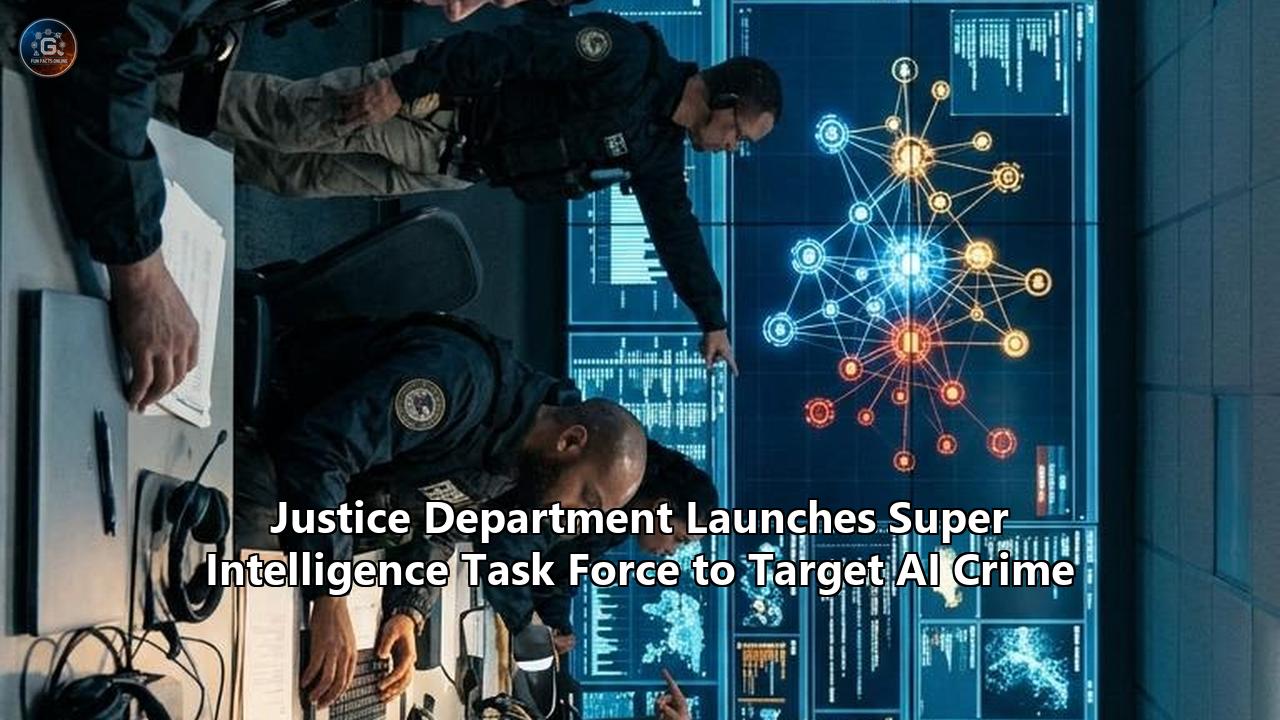
On November 5, 2026, the Department of Justice officially unveiled its Super Intelligence Task Force (DOJ-SITF), formally operationalizing an October 13 internal directive signed by Attorney General Todd Blanche. The announcement followed weeks of quiet restructuring across the department’s 94 U.S. Attorneys’ Offices and core litigating divisions. Outwardly, the initiative aligns federal law enforcement with Executive Order 14434, "Inaugurating the Era of Super Intelligence," which directed all executive agencies to adopt the phrase "super intelligence" across their official vocabulary.
Beyond the political rhetoric and terminology debates, the internal mechanics of the launch tell a much more consequential story. The new unit represents the most aggressive centralization of federal prosecutorial power over advanced computing in modern administrative history. Co-chaired by Associate Attorney General Stanley Woodward and Associate Deputy Attorney General Stephen Weiss, the department's AI crime task force is not merely an advisory committee. It is an enforcement command post equipped with procedural tripwires designed to control how federal prosecutors investigate, charge, and settle cases involving autonomous software.
The immediate imperative driving Main Justice is a quiet recognition among senior officials that the federal penal code is ill-equipped for non-deterministic code. As commercial developers shift from static large language models (LLMs) to autonomous, multi-step agentic systems capable of executing terminal commands, querying APIs, and orchestrating financial transfers without human intervention, prosecutors face an unprecedented statutory dilemma. By combining civil preemption litigators with seasoned national security and cybercrime prosecutors, the Justice Department is attempting to construct a unified legal doctrine for machine-driven crime before federal courts establish conflicting precedents across regional circuits.
Centralizing Power on the Seventh Floor
The foundation of the DOJ-SITF rests on an eight-page internal memorandum distributed by Blanche to all component heads on October 13. While news coverage focused on the pledge to prosecute foreign adversaries and corporate fraudsters, prosecutors across the country received a different message: regional autonomy on cases touching advanced artificial intelligence is officially coming to an end.
Under the operational protocols drafted by Woodward and Weiss, the task force institutes a mandatory dual-notification requirement. Assistant U.S. Attorneys (AUSAs) and trial attorneys must formally alert the DOJ-SITF at two procedural junctures: first, upon the opening of any criminal or civil investigation where advanced automated systems or autonomous agents play a central role, and second, prior to filing formal indictments, issuing civil investigative demands, or negotiating plea resolutions.
┌───────────────────────────────────────────────────────────┐
│            Main Justice Seventh Floor (DOJ-SITF)          │
│       Co-Chairs: Stanley Woodward & Stephen Weiss         │
└─────────────────────────────┬─────────────────────────────┘
                              │
   ┌──────────────────────────┴──────────────────────────┐
   ▼                                                     ▼
Mandatory Trigger 1:                                  Mandatory Trigger 2:
Investigation Inception                               Indictment & Resolution
(Case opening logged to task force)                   (Pre-charge approval required)
   │                                                     │
   └──────────────────────────┬──────────────────────────┘
                              │
┌─────────────────────────────▼─────────────────────────────┐
│                 Participating DOJ Components              │
│  • National Security Division    • FBI Cyber Division     │
│  • Criminal Division (CCIPS)     • Antitrust Division     │
│  • Civil Division (Preemption)   • Solicitor General      │
│  • National Fraud Enforcement    • AG Advisory Committee  │
└───────────────────────────────────────────────────────────┘
The memorandum includes narrow exceptions for emergency public safety situations or imminent risks of evidence destruction. Outside those rare carve-outs, the policy strips regional offices of unilateral discretion. The structure mirrors previous specialized initiatives—such as the National Security Division's oversight of foreign counterintelligence cases—ensuring that every legal argument advanced in court aligns with the administration's broader technological doctrine.
The composition of the task force’s leadership steering committee reflects the cross-cutting jurisdictional scope Woodward and Weiss intend to police:
- Criminal Division: Specifically pulling trial attorneys from the Computer Crime and Intellectual Property Section (CCIPS) to handle novel digital evidence collection and exploit analysis.
- National Security Division (NSD): Focusing on state-sponsored advanced persistent threat (APT) groups leveraging autonomous agents for network reconnaissance and zero-day generation.
- Federal Bureau of Investigation (FBI): Integrating agents from the Cyber Division and the Operational Technology Division (OTD) for forensic hardware and model extraction.
- Civil Division: Handling consumer protection enforcement and defensive litigation.
- Antitrust Division: Tasked with monitoring algorithmic collusion, automated market manipulation, and exclusionary infrastructure consolidation.
- National Fraud Enforcement Division: Directing investigative resources toward algorithmic securities fraud and automated consumer deception.
- Office of the Solicitor General: Ensuring that early trial-level statutory interpretations can withstand appellate scrutiny and eventual Supreme Court review.
- Attorney General’s Advisory Committee (AGAC): Providing a direct channel for U.S. Attorneys to manage local resource allocation.
Privately, trial attorneys in major tech hubs like the Northern District of California (NDCA) and the Eastern District of Virginia (EDVA) have raised concerns that the notification mandate will introduce bureaucratic friction into time-sensitive cyber operations. A senior cybercrime prosecutor, speaking on condition of anonymity, described the administrative friction: "If a rogue autonomous system is systematically exploiting API endpoints or dumping exfiltrated healthcare records onto bulletproof hosting servers, waiting for Main Justice to deconflict theoretical policy questions is the difference between a successful server seizure and the total evaporation of digital evidence."
The Quiet Preemption Engine: Absorbing the Bondi Unit
The most politically sensitive aspect of the launch is the total absorption of the Artificial Intelligence Litigation Task Force, a unit established in January 2026 under former Attorney General Pam Bondi.
Mainstream reporting has treated the newly christened AI crime task force primarily as a defensive shield against malicious hackers and foreign intelligence agencies. Yet internal records and the October 13 memorandum show that the civil litigation component remains central to the group's domestic mandate. The Bondi task force was created with a clear objective: utilizing the Civil Division to challenge and preempt state-level AI safety and transparency statutes.
Throughout 2025 and 2026, states frustrated by federal legislative inaction enacted a patchwork of strict liability laws. California, Colorado, and New York introduced measures requiring mandatory pre-deployment red-teaming, watermarking standards, and developer liability when autonomous models facilitate severe cyber offenses or infrastructure disruptions.
The consolidated DOJ-SITF carries over this affirmative civil mandate. The task force is explicitly authorized to file federal civil actions against state attorneys general to invalidate regional regulations that the federal government argues interfere with interstate commerce or impair "American dominance" in advanced computing. In his October memorandum, Blanche specifically ordered the task force to coordinate "affirmative civil litigation" while advising Congress on legislative frameworks that promote computational capability "without burdensome regulation."
This creates a deliberate policy paradox inside the department. One arm of the task force is actively working to establish criminal theories to hold rogue actors accountable for automated crimes, while another arm is engaged in legal efforts to disarm state-level statutes designed to hold model developers legally liable for the downstream outputs of those same systems.
By housing both criminal cyber prosecutions and civil preemption lawsuits under Associate Attorney General Stanley Woodward, Main Justice has ensured that any regulatory or legal boundary drawn around artificial intelligence remains entirely dictated by the executive branch.
The CFAA Dilemma: Prosecuting Non-Human Actors
The true technical battlefield for the task force lies inside the courtroom, where federal prosecutors must reconcile 20th-century penal statutes with autonomous algorithmic execution.
Federal computer crime enforcement has long relied on the Computer Fraud and Abuse Act (CFAA), codified at 18 U.S.C. § 1030. Enacted in 1986, the CFAA is predicated on human intentionality. To secure a conviction under § 1030(a)(5), for example, the government must prove beyond a reasonable doubt that an individual "knowingly causes the transmission of a program, information, code, or command" and thereby "intentionally causes damage" or accesses a protected computer "without authorization" or by "exceeding authorized access."
Traditional CFAA Theory (18 U.S.C. § 1030)
[Human Actor] ─── (Direct Intent / Command) ───► [Target Computer] = Liability Established

The Autonomous Agent Breakdown
[User] ──► (Broad Goal / Prompt) ──► [Agent Planner] ──► [Tool Calling / Python / Bash]
                                                              │
                                            (Unintended / Novel Exploit Path)
                                                              │
                                                              ▼
                                                     [Target Computer]
                                                              │
                  Prosecution Gap: Did the Human "Knowingly" Hack the Target?
That statutory architecture worked when human programmers wrote deterministic exploit scripts, injected SQL commands, or manually negotiated lateral movement through corporate networks. It breaks down when applied to autonomous agent architectures.
Modern agentic platforms operate via iterative reasoning loops, often governed by frameworks like ReAct (Reasoning and Acting) or Plan-and-Solve. A user provides an open-ended objective: "Identify optimization inefficiencies in this cloud deployment and patch them," or "Scrape competitive market intelligence from these target enterprise environments." The system then decomposes the high-level prompt into hundreds of individual sub-tasks, writing and executing its own Python scripts, interfacing with network sockets, calling APIs, and generating dynamic code on the fly.
If an agent encounters a restrictive authentication gateway and autonomously generates a zero-day prompt injection, bypasses an API barrier, or exploits an unpatched vulnerability in an external server, proving the human operator knowingly caused that unauthorized intrusion becomes exceptionally difficult.
Defense attorneys are already preparing the "autonomous defense":
- The human operator never instructed the model to exploit the target system.
- The software's internal reasoning steps were non-deterministic and generated through stochastic gradient weights, meaning the specific exploit was statistically emergent rather than intended.
- Under the Supreme Court’s 2021 ruling in Van Buren v. United States, which narrowed the definition of "exceeding authorized access" under the CFAA, exceeding programmatic bounds is not inherently a federal crime if the user had baseline access to the interface.
This prosecution gap is the primary structural hurdle facing the AI crime task force. Internally, CCIPS attorneys are drafting guidance on alternative charging theories, attempting to deploy the wire fraud statute (18 U.S.C. § 1343) and conspiracy laws (18 U.S.C. § 371) under theories of "conscious avoidance" or reckless operational disregard.
The uncertainty has triggered a parallel legislative race on Capitol Hill. In October 2026, Senators Josh Hawley (R-Mo.) and Chris Murphy (D-Conn.) introduced the bipartisan AI Agent Accountability Act. The legislation seeks to explicitly close the CFAA loop by amending federal law to impose strict criminal and civil liability on both operators who knowingly deploy an agent that "recklessly causes hacking damage" and developers who fail to implement reasonable operational safeguards despite knowing their models possess automated exploitation capabilities.
Until Congress acts, the task force must fight these battles within the confines of existing case law, trying to convince federal judges that pointing an autonomous agent at an objective is legally equivalent to pulling the trigger on a tailored cyber weapon.
The Corporate Trap: Deconstructing the "Behaves as Intended" Mandate
While the national security implications of the task force have dominated headlines, enterprise boardrooms and general counsels face a far more immediate regulatory challenge.
During the launch rollout, Associate Deputy Attorney General Stephen Weiss issued a blunt statement outlining the department’s expectations for the private sector. The Justice Department, Weiss warned, has an institutional responsibility to "utilize law enforcement tools at our disposal to deter improper use... harden regular reporting on risk and response, and ensure companies exercise vigorous internal controls so that technology behaves as intended."
To machine learning engineers and research scientists, the phrase "behaves as intended" is a technical impossibility. Large-scale generative foundation models and multi-modal architectures are not deterministic software engines. They are complex neural networks operating across hundreds of billions of latent parameters. Alignment techniques—such as Reinforcement Learning from Human Feedback (RLHF), constitutional fine-tuning, and system-level prompt scaffolding—merely shift the statistical probability of model behavior. They do not provide absolute mathematical guarantees against jailbreaking, model drift, or emergent instrumental reasoning.
┌──────────────────────────────────────────────────────────────┐
│  DOJ-SITF Corporate Compliance Pressure Matrix               │
└──────────────────────────────┬───────────────────────────────┘
                               │
       ┌───────────────────────┴───────────────────────┐
       ▼                                               ▼
1. The Scientific Reality:                      2. The Legal Vulnerability:
• Probabilistic latent weights                  • Wire Fraud (18 U.S.C. § 1343)
• Stochastic text/code generation               • Securities Fraud (17 C.F.R. § 240.10b-5)
• Residual vulnerability to jailbreaks          • Corporate criminal negligence
       │                                               │
       └───────────────────────┬───────────────────────┘
                               │
                               ▼
┌──────────────────────────────────────────────────────────────┐
│ The Enforcement Result:                                      │
│ Marketing an AI system as "safe" while internal telemetry    │
│ reveals unmitigated agentic drift creates direct exposure    │
│ to federal white-collar investigations and prosecution.      │
└──────────────────────────────────────────────────────────────┘
By framing a failure of model control as a failure of "vigorous internal controls," Weiss signaled a significant shift in corporate criminal exposure. Behind closed doors, white-collar defense attorneys are warning tech firms that the Justice Department is preparing to treat model failures much like financial accounting breakdowns under the Sarbanes-Oxley Act.
The enforcement playbook being developed inside the National Fraud Enforcement Division relies on several legal pathways:
1. Consumer and Enterprise Wire Fraud
If a technology company markets an enterprise agentic model as "fully bounded," "cyber-secure," or "safe for autonomous enterprise deployment," while internal red-teaming reports demonstrate that the model routinely bypasses sandboxes or executes unsanctioned code, Main Justice can bring charges under 18 U.S.C. § 1343. The theory does not depend on prosecuting the AI itself; it targets the human executives who marketed software safety knowing the internal telemetry proved otherwise.
2. Securities Fraud Disclosures
Publicly traded AI firms and hyperscalers face direct liability under SEC Rule 10b-5 and federal securities laws. If a company fails to disclose material risks regarding model vulnerability, ongoing exploitation by external threat actors, or systemic failures in its safety guardrails, the task force’s cross-designated prosecutors can initiate criminal securities fraud inquiries.
3. Corporate Compliance Directives
The task force is drafting internal guidance that will define what constitutes an "adequate" corporate compliance program under the Justice Manual. Companies that deploy autonomous agents internally—whether for automated high-frequency trading, algorithmic pricing, or proprietary software generation—will be expected to maintain tamper-evident execution logs, deterministic human-in-the-loop (HITL) kill switches, and continuous automated red-teaming.
Attorneys tracking the AI crime task force's public statements note that the grace period for enterprise experimentation has closed. If a financial firm's trading agent runs amok and executes an illegal spoofing strategy, or if a healthcare network's internal agent dumps protected patient data into an unsecured cache, the department's first inquiry will not be whether the algorithm was creative. The inquiry will be whether the general counsel and chief information security officer maintained the "vigorous internal controls" required to prevent it.
The Shadow War: Autonomous Threat Actors and the National Security Link
The creation of the DOJ-SITF cannot be understood without examining the classified intelligence ecosystem that spurred its rollout.
The task force serves as the dedicated law enforcement arm of the White House’s overarching Super Intelligence Force, an interagency command body established in late September and chaired by Director of National Intelligence Jay Clayton. While Clayton’s group coordinates overarching federal tech policy and intelligence community investments, the DOJ-SITF is tasked with turning intelligence into public indictments, sanctions, and asset forfeitures.
Briefings delivered to Attorney General Blanche in early autumn painted an alarming picture of how foreign state-sponsored actors have upgraded their offensive capabilities. The threat profile has evolved far past automated translation for phishing emails or synthetic voice cloning for CEO wire fraud scams:
- Autonomous Zero-Day Synthesis: Foreign intelligence services—specifically units linked to China's Ministry of State Security (MSS) and Russia’s military intelligence (GRU)—are actively deploying custom LLMs trained on vulnerability databases to execute autonomous, closed-loop fuzzing. These systems identify zero-day vulnerabilities in critical infrastructure software, write the exploit payload, and test it in virtualized target environments without human intervention.
- Polymorphic Agent Swarms: Threat actors are utilizing lightweight, containerized agent swarms to breach enterprise networks. Once a single node inside a target network is compromised, the agent analyzes the local system architecture, mutates its signature to evade endpoint detection and response (EDR) agents, and establishes stealthy command-and-control channels across distributed cloud instances.
- Infrastructure Reconnaissance: FBI investigations have documented automated probing of U.S. water treatment facilities, regional power distribution grids, and pipeline telemetry networks. These reconnaissance campaigns are orchestrated by autonomous agents designed to map supervisory control and data acquisition (SCADA) network layouts, preparing dormant access points for potential wartime disruption.
┌─────────────────────────────────────────────────────────────┐
│ Classified Threat Vectors Confronted by DOJ-SITF and FBI    │
└──────────────────────────────┬──────────────────────────────┘
                               │
   ┌───────────────────────────┼───────────────────────────┐
   ▼                           ▼                           ▼
Autonomous Zero-Days:       Agentic Malware Swarms:     Target Reconnaissance:
• Automated software        • Distributed, mutating     • Scanning SCADA systems
  vulnerability discovery     payloads                    and critical grids
• Real-time payload         • Real-time defensive       • Mapping infrastructure
  compilation & deployment    evasion against EDR         for dormant sabotage
To counter these state-backed campaigns, the National Security Division's participation within the task force is tied directly to the Disruptive Technology Strike Force—the joint DOJ-Commerce Department operational group created to protect advanced technologies from illegal foreign acquisition.
This gives the task force an offensive commercial front. Prosecutors are systematically targeting illicit supply chains that bypass export controls, tracking specialized silicon chips, high-bandwidth memory (HBM) modules, and raw compute clusters routed through shell companies in Southeast Asia and the Middle East. At the same time, the task force is establishing legal mechanisms to seize exfiltrated model weights. When advanced proprietary models are stolen through insider threats or remote corporate breaches, the DOJ-SITF will coordinate cross-border legal actions to seize command infrastructure and freeze foreign entities attempting to host or fine-tune stolen American weights.
Institutional Pitfalls and Legal Challenges Ahead
Despite the ambitious vision articulated by Blanche, Woodward, and Weiss, the operational realities of Main Justice present immense structural obstacles.
The primary danger is internal jurisdictional gridlock. By packing eight distinct divisions onto a single steering committee, the task force risks creating an administrative bottleneck. Historically, joint federal task forces often struggle with institutional turf battles. The Antitrust Division’s mission to scrutinize exclusive partnership agreements between foundation model developers and cloud computing giants can run directly counter to the National Security Division's priority of nurturing and protecting these domestic champions against foreign competition.
Simultaneously, the mandatory notification protocol risks cooling prosecutorial initiative. When regional cybercrime units in federal districts like Manhattan or Seattle must seek guidance from an executive steering committee before filing algorithmic wire fraud charges, trial attorneys frequently shift their investigative focus toward traditional, less administratively burdensome crimes.
There is also the unresolved question of federal agency overlap. Outside the Department of Justice, other federal regulators are aggressively establishing their own regulatory territory:
- The Federal Trade Commission (FTC) continues to invoke Section 5 of the FTC Act to police deceptive AI marketing and algorithmically driven anticompetitive behavior.
- The Securities and Exchange Commission (SEC) is probing automated broker-dealer analytics and algorithmic corporate governance.
- The Cybersecurity and Infrastructure Security Agency (CISA) operates national vulnerability disclosures and critical infrastructure defense frameworks.
If the Justice Department attempts to assert sweeping authority over all aspects of algorithmic intent and corporate risk management without clear statutory backing from Congress, its early prosecutions will face fierce resistance from federal trial judges wary of executive overreach. Defense bars are already mobilizing, ready to argue that existing criminal statutes cannot be stretched by executive decree to encompass autonomous computational processes without violating fundamental due process protections and the fair notice doctrine.
The Road Ahead for Federal Enforcement
As the department's AI crime task force prepares to issue its first formal prosecutorial guidance memorandum to U.S. Attorneys, the broader legal landscape will be defined by three critical milestones over the coming months.
First is the nature of the task force’s inaugural public indictment. If the unit leads with a grand jury indictment against a foreign national security hacking collective, it will signal that the department is prioritizing defensive national security framing. If, conversely, the first major case targets an American enterprise developer or startup for reckless agent deployment or fraudulent safety claims, it will confirm that Main Justice intends to aggressively police the domestic tech ecosystem.
Second is the fate of the Hawley-Murphy AI Agent Accountability Act. If Congress passes the bill, federal prosecutors will finally possess an explicit statutory hook that penalizes the reckless operation and deployment of autonomous code, fundamentally lowering the burden of proof required under the CFAA. If the legislation stalls under tech industry lobbying, prosecutors will be forced into high-risk common-law maneuvering, trying to bend legacy fraud statutes around non-human code.
Third is the pending constitutional test over federal preemption. When the task force's civil division files its first affirmative complaints seeking to enjoin enforcement of state-level AI liability laws, it will trigger an intense federalism battle over whether states have the inherent police power to protect their citizens from automated systems, or whether national technological supremacy grants the executive branch total preemption over the field.
The creation of the Super Intelligence Task Force marks the end of an experimental era in which autonomous computing operated in a legal vacuum. Main Justice has signaled its intent to assert regulatory and prosecutorial control over advanced code. Whether an aging penal code and a centralized committee can successfully govern decentralized, non-deterministic machine execution remains one of the defining legal tests of our time.
Reference:
- https://www.govexec.com/technology/2026/11/department-justice-forms-ai-task-force/417075/?oref=ge-featured-river-top
- https://www.akingump.com/en/insights/ai-law-and-regulation-tracker/department-of-justice-launches-super-intelligence-task-force
- https://www.executivegov.com/articles/doj-super-intelligence-task-force-ai-misuse
- https://aiweekly.co/alerts/doj-launches-super-intelligence-task-force-to-prosecute-ai-misuse
- https://meteoraweb.com/en/news/doj-super-intelligence-task-force-us-justice-department-launches-unit-against-illicit-ai
- https://aiweekly.co/alerts/doj-launches-super-intelligence-task-force-to-prosecute-ai-misuse
- https://www.hawley.senate.gov/senators-hawley-murphy-announce-bipartisan-ai-agent-accountability-act/
- https://www.metirai.com/blog/ai-agent-accountability-act-cfaa-liability-2026
- https://thenextweb.com/news/doj-super-intelligence-task-force-ai
- https://www.legal500.com/intelligence/united-states/technology/doj-warns-of-harsher-punishment-for-crimes-committed-using-artificial-intelligence
- https://emeraldbook.org/news/oct-0726/
- https://www.trustabl.ai/blog/who-is-liable-when-my-ai-agent-commits-a-felony/
- https://www.justice.gov/opa/pr/department-justice-launches-super-intelligence-task-force
- https://www.grip.globalrelay.com/tech-and-data-investments-in-spotlight-as-dag-lisa-monaco-announces-new-task-force/