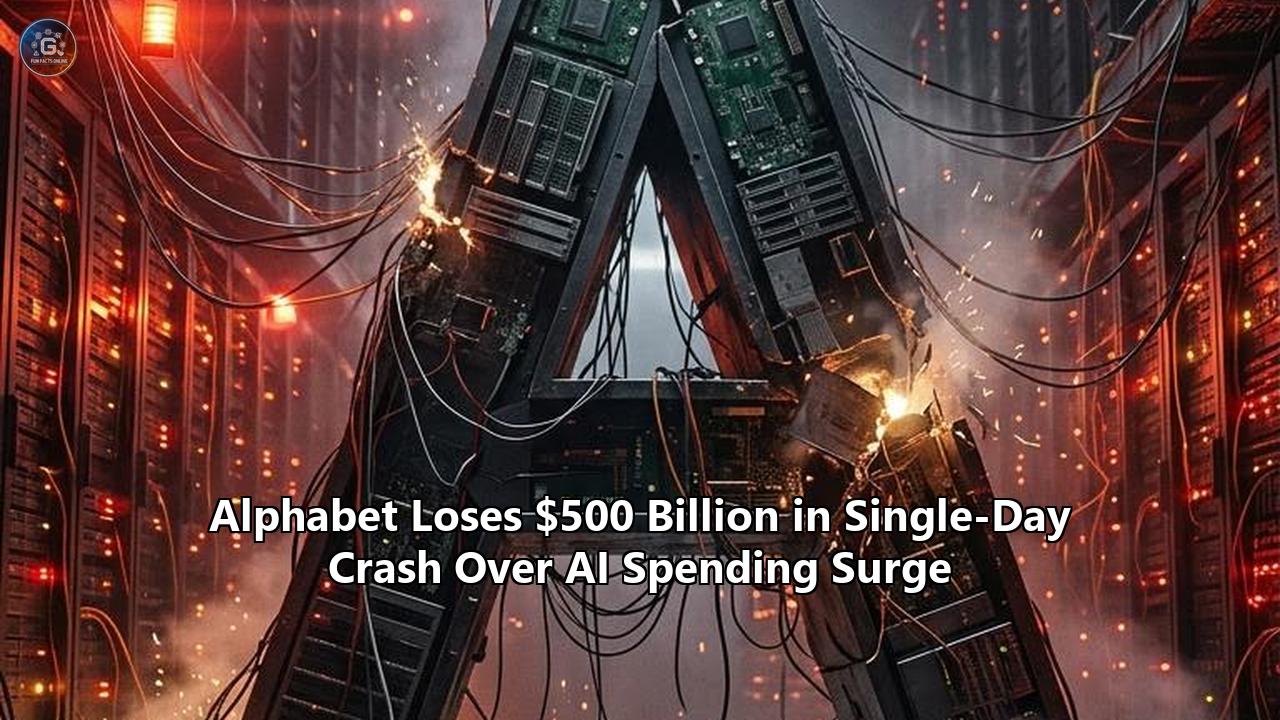
On October 29, 2026, Alphabet suffered the most punishing market retreat in its 28-year history, erasing $499.8 billion in equity value in a single six-and-a-half-hour trading session. The company’s Class A shares plunged 12.64% to close at $283.82 on the Nasdaq, dragging the broader technology sector downward and marking the second-largest single-day destruction of shareholder wealth in Wall Street history, eclipsed only by Nvidia’s $589 billion drop in January 2025.
The immediate catalyst was the company’s third-quarter earnings report, delivered after the bell the previous evening. While Alphabet posted top-line revenue of $127.6 billion—a 25% increase year over year—it fell short of Wall Street’s $128.2 billion consensus estimate. Adjusted earnings per share landed at $2.67, badly missing the $3.02 expected by analysts.
Yet the headline miss alone did not explain the sheer velocity of the selloff. The panic was ignited by a structural divergence inside Alphabet’s cash flow statement: capital expenditures surged to an unprecedented $51.36 billion for the quarter alone—up 114% from the same period last year—propelling the tech giant into a negative free cash flow deficit of $9.07 billion. It marked Alphabet's second consecutive quarter of negative free cash flow, an event without precedent since the company went public in 2004.
With Chief Financial Officer Anat Ashkenazi reaffirming that full-year 2026 capital expenditures would reach up to $205 billion—and warning that spending would expand significantly again in 2027—investors staged an aggressive revolt. For three years, Wall Street had rewarded Big Tech for aggressive artificial intelligence spending on the presumption that massive capital outlays would cement insurmountable technological moats. The sudden Alphabet stock crash signaled a decisive break in that consensus. Investors abruptly stopped valuing generative computing as an unconstrained growth engine and began pricing it as an extraordinary drain on corporate liquidity.
ALPHABET Q3 2026 FINANCIAL PROFILE: EXPECTATIONS VS. REALITY
┌───────────────────────────────┬───────────────────┬───────────────────┐
│ Metric                        │ Wall Street Est.  │ Reported Actual   │
├───────────────────────────────┼───────────────────┼───────────────────┤
│ Total Revenue                 │ $128.20 Billion   │ $127.58 Billion   │
│ Adjusted EPS                  │ $3.02             │ $2.67             │
│ Capital Expenditures (Capex)  │ $46.50 Billion    │ $51.36 Billion    │
│ Operating Cash Flow           │ $49.20 Billion    │ $42.29 Billion    │
│ Free Cash Flow (FCF)          │ +$2.70 Billion    │ -$9.07 Billion    │
│ Search Advertising Growth     │ +17.0% YoY        │ +12.0% YoY        │
│ Google Cloud Revenue          │ $29.20 Billion    │ $30.70 Billion    │
│ FY 2026 Capex Guidance        │ $185-$190 Billion │ $195-$205 Billion │
└───────────────────────────────┴───────────────────┴───────────────────┘
The market's reaction was amplified by rare public concessions from Alphabet's executive leadership. During the earnings call, Google Chief Business Officer Philipp Schindler confirmed what analysts had long feared: the company’s AI-generated search overviews ("AI Mode") are actively cannibalizing its core search advertising engine. Traditional search results display a rich, tiered inventory of commercial sponsored links; generative AI answers, by contrast, deliver synthesized, direct answers that offer far fewer opportunities to present monetizable advertisements. Alphabet finds itself trapped in an operational cross-current: it must spend tens of billions of dollars each quarter on computing infrastructure to deploy conversational search, only to watch those very features dilute the most profitable advertising monopoly in modern corporate history.
Anatomy of the Cash Burn: How $51 Billion Vanished in 90 Days
To comprehend why Alphabet's shares tumbled so violently, one must examine the physical reality behind the line item labeled "Capital Expenditures" on corporate balance sheets. For most of Google's corporate existence, software development represented the pinnacle of high-margin, asset-light capitalism. Once an algorithm or web service was coded, distributing it to an additional hundred million users required negligible marginal expense. A standard text search query consumed tiny fractions of a cent in server compute, ran on commodity central processing units (CPUs), and returned links within 200 milliseconds, generating lucrative pay-per-click revenue along the way.
Artificial intelligence fundamentally breaks this economic architecture. Generative language and multimodal models do not simply fetch static data from an index; they synthesize new answers dynamically through billions of matrix multiplication calculations executed across thousands of specialized chips.
Alphabet’s $51.36 billion capital expenditure in the third quarter of 2026 did not vanish into abstract research and development. It was converted into real physical assets: custom silicon, specialized server chassis, high-bandwidth interconnects, commercial real estate, cooling towers, and electrical substations.
ESTIMATED ALLOCATION OF ALPHABET'S $51.36B Q3 2026 INFRASTRUCTURE OUTLAY
┌──────────────────────────────────────────────┬────────────────┬──────────┐
│ Capital Expense Category                     │ Estimated Cost │ Share    │
├──────────────────────────────────────────────┼────────────────┼──────────┤
│ Custom Silicon (TPU v5p, v6 Trillium)        │ $19.50 Billion │ 38.0%    │
│ Commercial GPU Procurement (Nvidia B200/GB200)│ $11.80 Billion│ 23.0%    │
│ Datacenter Physical Shells & Real Estate     │ $8.20 Billion  │ 16.0%    │
│ Advanced Thermal & Liquid Cooling Systems    │ $5.15 Billion  │ 10.0%    │
│ High-Bandwidth Optical Networking Fabric     │ $3.60 Billion  │ 7.0%     │
│ Grid Interconnection & Power Substation Dev. │ $3.11 Billion  │ 6.0%     │
└──────────────────────────────────────────────┴────────────────┴──────────┘
The scale of this quarterly outlay becomes starker when measured against historical standards. In all of 2025, Alphabet deployed $91.4 billion in total capex. In 2026, the company spent more than half of that full-year figure in a single 90-day stretch.
When capital spending outstrips cash generated by day-to-day operations, the shortfall hits free cash flow. In the third quarter, Alphabet generated $42.29 billion in operating cash flow. After deducting $51.36 billion in infrastructure spending, free cash flow collapsed to negative $9.07 billion. This cash burn forced Alphabet to suspend its aggressive share repurchase program to protect its corporate balance sheet and safeguard its $0.22 per share quarterly dividend, which consumes roughly $2.7 billion each quarter. For institutional investors who held Alphabet as a low-risk, cash-generative staple, the sudden cessation of buybacks removed an indispensable floor supporting the share price.
The Physics and Economics of Hyperscale AI
Understanding the sudden financial strain on Alphabet requires unpacking the technical layers of modern computing infrastructure. The generative models powering the Gemini family and Google’s "AI Mode" rely on deep neural networks containing hundreds of billions, and in some cases trillions, of parameters. Running these systems requires specialized hardware configurations whose unit economics diverge completely from traditional computing.
TRADITIONAL KEYWORD SEARCH VS. GENERATIVE INFERENCE
┌──────────────────────┬────────────────────────────┬─────────────────────────────┐
│ Engineering Vector   │ Traditional Google Search  │ Generative AI Mode Response │
├──────────────────────┼────────────────────────────┼─────────────────────────────┤
│ Core Hardware        │ Commodity x86 Server CPUs  │ Heterogeneous TPU/GPU Arrays│
│ Memory Architecture  │ Standard DDR4/DDR5 DRAM    │ High-Bandwidth Memory (HBM) │
│ Power Draw Per Rack  │ 8 kW to 15 kW              │ 40 kW to 120 kW (Liquid)    │
│ Query Latency Path   │ Inverted Index Retrieval   │ Multi-Layer Autoregression  │
│ Cost Per 1k Queries  │ ~$0.10 to $0.20            │ $3.00 to $12.00             │
│ Primary Monetization │ Multi-Slot Text Ad Auction │ Direct Synthesized Answer   │
└──────────────────────┴────────────────────────────┴─────────────────────────────┘
1. Silicon Architecture: The Raw Hardware Pipeline
Alphabet uses a hybrid hardware strategy, splitting its computing workloads between third-party graphics processing units (primarily Nvidia's Blackwell architecture) and its proprietary application-specific integrated circuits (ASICs), known as Tensor Processing Units (TPUs).
While custom silicon like the TPU v5p and the sixth-generation "Trillium" processor allows Google to sidestep Nvidia’s software premiums, fabricating these custom chips is an intensely capital-intensive endeavor. Both Google’s TPUs and commercial GPUs rely on advanced semiconductor nodes—primarily Taiwan Semiconductor Manufacturing Company’s (TSMC) 3-nanometer and 4-nanometer processes.
The physical bottlenecks in this hardware ecosystem drive severe capital inflation:
- High-Bandwidth Memory (HBM): Advanced AI accelerators cannot function using conventional computer memory. They require stacked HBM3e modules bonded directly alongside the processor using advanced packaging techniques like TSMC’s Chip-on-Wafer-on-Substrate (CoWoS). HBM manufacturing yields remain constrained, driving silicon component costs higher each quarter.
- Network Fabric and Latency: Training frontier models and executing low-latency inference cannot occur on a single chip. Workloads must be distributed across thousands of accelerators operating as a unified supercomputer. Alphabet must install complex optical circuit switches (OCS) and proprietary networking fabrics to prevent bandwidth throttling between servers.
- Depreciation Cycles: Traditional enterprise datacenters house servers with operational lifespans of five to seven years. High-performance AI clusters, subjected to continuous thermal stress and blistering rates of architectural obsolescence, often depreciate within three to four years. Alphabet is effectively spending $50 billion every quarter on hardware that loses its competitive utility within 48 months.
2. The Thermal and Electrical Frontier
The engineering constraints of AI datacenters extend beyond silicon into physical electrical utilities. A standard server rack deployed in 2020 consumed between 8 and 15 kilowatts (kW) of electrical power. Modern high-density compute pods housing cutting-edge AI accelerators routinely require between 40 and 120 kW per rack.
Air-cooling systems are physically incapable of dissipating this level of thermal density. Alphabet has been compelled to re-engineer its datacenter portfolio around closed-loop liquid cooling systems, wherein chilled dielectric fluids or treated water are piped directly across the silicon cold plates. Liquid cooling introduces mechanical plumbing, high-grade pumping stations, and secondary heat exchangers, doubling the physical construction cost per megawatt of capacity.
Simultaneously, the electrical footprint of these facilities has outstripped the capacity of local utility grids. Securing multi-gigawatt power purchase agreements (PPAs)—including capital commitments toward next-generation geothermal installations and small modular nuclear reactors (SMRs)—requires billions of dollars in upfront capital long before a single commercial query is processed by the underlying hardware.
3. The Math of Inference: Floating-Point Operations vs. Search Cents
The fundamental financial disconnect at the heart of the Alphabet stock crash is the cost disparity between information retrieval and algorithmic generation.
When an internet user inputs a query like "best running shoes for flat feet" into traditional Google Search, the query is parsed against an inverted index. The search engine checks a pre-indexed database, ranks the pages based on PageRank and relevance signals, serves up matching links, and holds an instantaneous second-price auction to display text ads from athletic shoe brands. The computational workload involves basic mathematical comparisons and index lookups that cost approximately $0.0001 per query.
When the same user triggers Alphabet’s conversational AI Mode, the technical sequence changes entirely:
- The user's query is converted into high-dimensional numerical vectors (embeddings).
- The model initiates an autoregressive decoding loop, predicting the subsequent token (word fragment) one at a time across dozens of attention layers.
- Every single token generation requires billions of floating-point operations (FLOPs) running across hundreds of parallel processors.
- To reduce factual inaccuracies, the model executes retrieval-augmented generation (RAG), querying the live web, digesting external web pages on the fly, and repassing that dynamic text through the transformer network to synthesize a unified response.
The cost to process an advanced multimodal or conversational AI query sits between $0.003 and $0.012—roughly 30 to 100 times the cost of a traditional keyword search. When applied across billions of daily global queries, this multiplier converts an operational expense into an enormous corporate liability.
The Core Search Dilemma: Cannibalizing the 10 Blue Links
The structural threat that terrified institutional investors on October 29 was not merely that AI costs more to operate; it was the admission that AI actively reduces the monetization efficiency of Alphabet’s primary profit engine.
Google's advertising division generated more than $65 billion in operating profit over the trailing twelve months, serving as the financial engine for the entire enterprise. That profitability is built on a simple visual layout: when a user searches for high-commercial-intent terms (such as insurance, real estate, legal services, or consumer electronics), Google presents three to four paid search ads at the absolute top of the search engine results page (SERP), followed by organic "blue links."
Advertisers bid aggressively for these top positions through dynamic real-time auctions, often paying anywhere from $2 to $50 per click depending on the industry. The clear physical separation between ads and organic links allows Google to monetize user intent without destroying organic search utility.
THE CANNIBALIZATION MECHANIC: SERP LAYOUT EVOLUTION
┌───────────────────────────────────────┬───────────────────────────────────────┐
│ Traditional Search Result Page (SERP) │ Generative AI Overview / "AI Mode"   │
├───────────────────────────────────────┼───────────────────────────────────────┤
│ [Sponsored Ad 1: High-Bid Keyword]   │ ┌───────────────────────────────────┐ │
│ [Sponsored Ad 2: Direct Retailer URL] │ │ AI-Generated Synthesized Answer   │ │
│ [Sponsored Ad 3: Local Merchant Lead] │ │ Comprehensive, direct advice      │ │
│                                       │ │ that fully resolves user intent   │ │
│ Organic Result 1: Specialist Review   │ │ without requiring external clicks │ │
│ Organic Result 2: Comparison Portal   │ └───────────────────────────────────┘ │
│ Organic Result 3: Forum Discussion    │                                       │
│                                       │ [Minimal Sponsored Inline Citation]   │
│ [Side Rail Shopping Carousel]         │                                       │
│                                       │ Pushed Below Fold:                    │
│ Result: High ad density, clear click  │ Traditional Organic Links &           │
│ triggers, high cost-per-click capture │ Standard Pay-Per-Click Ad Units       │
└───────────────────────────────────────┴───────────────────────────────────────┘
Generative AI short-circuits this monetization model. During the Q3 earnings conference call, Philipp Schindler directly addressed the deceleration of Google Search advertising revenue, which slowed to 12% growth year over year—down sharply from 17% in the second quarter and 19% in the first quarter. Paid click growth dropped to 8%, a precipitous drop from 13% in the prior quarter.
Schindler confirmed that user interaction with conversational AI overviews produces a "zero-click" dynamic. When Gemini synthesizes a direct, comprehensive answer to a complex user problem, the user reads the response and closes the browser. They do not click a sponsored link; they do not navigate to an affiliate retailer; they do not scroll through secondary search pages.
Alphabet faces three acute structural hurdles in its attempt to monetize conversational interfaces:
- Ad Real Estate Scarcity: A traditional search page provides extensive visual real estate to insert multiple sponsored units alongside organic results. An AI summary is a coherent block of text. Injecting commercial advertisements directly into an AI answer risks alienating users who perceive the synthetic response as an objective recommendation.
- Auction Fragmentation: In conventional search, advertisers bid on specific text keywords ("mortgage refinance rates"). In conversational AI, users submit open-ended, meandering prompts ("Explain whether it makes sense for me to refinance my 30-year fixed loan given current inflation data and my intention to move in three years"). Matching traditional keyword-bidding algorithms to dynamic, context-heavy prompts requires new programmatic models that Google has yet to scale effectively.
- User Intent Misalignment: Early testing of ads within conversational AI overviews showed sharply lower click-through rates (CTR) compared to traditional search ads. Users interacting with a synthetic agent expect an immediate utility, not a prompt to leave the conversation and visit an external commercial portal.
The result is a classic innovator’s dilemma: if Alphabet holds back AI deployment to protect its search ad margins, alternative conversational platforms—including OpenAI's ChatGPT, Perplexity AI, and Microsoft Copilot—will capture market share. But if Alphabet aggressively scales AI Mode to maintain search dominance, it systematically impairs its own operating margins while escalating its computing costs.
The Google Cloud Paradox: Explosive Demand Meets Capacity Bottlenecks
The earnings report that triggered the Alphabet stock crash contained an ironic paradox: Google Cloud posted the most impressive performance metrics in its history.
Google Cloud revenue surged 103% year over year to $30.7 billion, comfortably surpassing analysts' estimates of $29.2 billion. Operating income for the cloud division more than tripled to $11.1 billion, expanding operating margins to a record 36.2%. Furthermore, the company reported a commercial backlog of contracted cloud commitments valued at an astonishing $561 billion.
GOOGLE CLOUD PERFORMANCE METRICS: Q3 2025 VS. Q3 2026
┌───────────────────────────────┬───────────────────┬───────────────────┐
│ Financial Metric              │ Q3 2025           │ Q3 2026           │
├───────────────────────────────┼───────────────────┼───────────────────┤
│ Cloud Division Revenue        │ $15.12 Billion    │ $30.70 Billion    │
│ Year-Over-Year Growth Rate    │ +35.0%            │ +103.0%           │
│ Operating Income              │ $3.48 Billion     │ $11.10 Billion    │
│ Operating Margin              │ 23.0%             │ 36.2%             │
│ Contracted Backlog            │ ~$240 Billion     │ $561 Billion      │
└───────────────────────────────┴───────────────────┴───────────────────┘
Why did an earnings report featuring a doubling of cloud revenue and expanding cloud margins trigger a massive market selloff? The answer lies in the mechanical relationship between hardware capacity constraints and capital efficiency.
First, Google Cloud’s contracted backlog of $561 billion cannot be recognized as revenue until the underlying compute cycles are physically delivered to clients. Delivering those compute cycles requires active, operational datacenters filled with cutting-edge accelerators. Because enterprise demand for model training and deployment outpaced Alphabet’s own construction timelines, the company was forced to take extraordinary measures to meet customer service-level agreements (SLAs).
Financial disclosures revealed that Alphabet had begun leasing third-party cloud compute infrastructure and external server capacity to service its overflow customer demand. For a company that built its empire on complete infrastructure self-sufficiency, renting compute from external providers at wholesale rates introduces an immediate margin drag. Equity analysts quickly deduced that the cloud division’s 36.2% operating margin represents a near-term ceiling rather than a sustainable trend. As more overflow workloads are routed through rented silicon, cloud gross margins will inevitably compress.
Second, the market recognized that Google Cloud's hyper-growth is actively accelerating Alphabet’s cash burn. Every enterprise customer signing an AI infrastructure contract requires Alphabet to deploy tens of millions of dollars in upfront server clusters. In a recurring subscription business, revenue is collected gradually over three to five years, but the silicon and datacenter infrastructure must be purchased and paid for on day one. The faster Google Cloud expands, the deeper the company’s capital deficit becomes in the short term.
The Hyperscaler Balance Sheet War
Alphabet's October 2026 crisis did not unfold in isolation. It illuminated an escalating, capital-intensive war among the four major tech hyperscalers: Alphabet, Microsoft, Meta Platforms, and Amazon. Collectively, these four corporations are on track to deploy more than $700 billion in capital expenditures in 2026 alone—an infrastructure campaign with few parallels in modern economic history.
HYPERSCALER Q3 2026 FINANCIAL PROFILES COMPARED
┌────────────────────┬──────────────┬──────────────┬──────────────┬──────────────┐
│ Financial Metric   │ Alphabet     │ Microsoft    │ Meta         │ Amazon       │
├────────────────────┼──────────────┼──────────────┼──────────────┼──────────────┤
│ Q3 Capex Outlay    │ $51.36B      │ $39.37B      │ $28.50B      │ $48.20B      │
│ Capex YoY Growth   │ +114.4%      │ +42.0%       │ +85.0%       │ +92.0%       │
│ Operating Cashflow │ $42.29B      │ $58.00B      │ $26.38B      │ $5.80B       │
│ Free Cash Flow     │ -$9.07B      │ +$18.63B     │ -$2.12B      │ -$42.40B     │
│ Share Buybacks     │ Suspended    │ Active       │ Suspended    │ Suspended    │
│ Cash & Equities    │ $56.33B      │ $102.40B     │ $44.10B      │ $62.30B      │
│ Q3 Stock Reaction  │ -12.6%       │ +2.9%        │ -4.8%        │ -4.2%        │
└────────────────────┴──────────────┴──────────────┴──────────────┴──────────────┘
Comparing the financial profiles of these four giants illustrates why Wall Street singled out Alphabet for its steepest punishment.
Microsoft: The Enterprise Buffer
Microsoft managed to escape the broader tech carnage, with its shares trading up 2.9% following its own financial release. While Microsoft deployed an aggressive $39.37 billion in capital expenditures, its commercial enterprise business generated $58.0 billion in operating cash flow, allowing the company to report positive free cash flow of $18.63 billion and return $10.2 billion to shareholders through dividends and buybacks.
Microsoft's enterprise software footprint—anchored by Office 365, Azure infrastructure, and Windows commercial licenses—provides predictable, contractually locked cash flow that is insulated from the volatility of digital advertising auctions. Microsoft can fund its AI infrastructure entirely out of recurring operational cash flows without threatening shareholder capital returns.
Meta Platforms: The Digital Ad Pure-Play
Meta found itself in a financial position broadly similar to Alphabet’s, reporting a free cash flow deficit of $2.12 billion after deploying $28.5 billion in capex. Like Alphabet, Meta suspended its share repurchases.
However, Meta suffered a comparatively modest 4.8% decline. The critical distinction lies in the role AI plays within Meta’s business architecture. Meta does not run a search engine that risks being displaced by conversational overviews. It uses its internal AI infrastructure primarily to optimize content recommendation algorithms across Instagram Reels and automate ad placement through its Advantage+ suite. For Meta, machine learning investments directly drive engagement and immediately lift average revenue per user (ARPU), rather than cannibalizing an existing search ad inventory.
Amazon: The Retail Burden
Amazon logged an eye-watering free cash flow deficit of negative $42.4 billion, driven by a simultaneous ramp in Amazon Web Services (AWS) infrastructure and physical automation within its fulfillment network.
Amazon’s shares fell over 4%. Yet Amazon’s investor base has historically tolerated extended periods of zero-margin capital reinvestment, having spent two decades watching founder Jeff Bezos plow every penny of operating cash back into physical fulfillment centers and AWS server capacity. Alphabet’s shareholder base, conditioned by two decades of reliable 30% operating margins and massive annual share buybacks, proved far less forgiving.
Wall Street’s New Math: The Death of the "AI Pass"
The broader macro significance of the single-day crash lies in how public markets value technology conglomerates. Between late 2022 and mid-2026, technology valuations were governed by an explicit "AI pass": any company expanding its computing capex was rewarded with higher price-to-earnings (P/E) multiples on the assumption that infrastructure dominance would yield monopolistic pricing power in the future.
The events of late October 2026 permanently shattered that dynamic. Institutional analysts have replaced speculative multiple expansion with rigorous Return on Invested Capital (ROIC) frameworks.
ALPHABET ROIC COMPRESSION MODEL: 2023 - 2026
┌───────────────────────────────┬──────────┬──────────┬──────────┬──────────┐
│ Financial Metric              │ FY 2023  │ FY 2024  │ FY 2025  │ FY 2026E │
├───────────────────────────────┼──────────┼──────────┼──────────┼──────────┤
│ Invested Capital Base         │ $280B    │ $325B    │ $410B    │ $590B    │
│ Net Operating Profit (NOPAT)  │ $78B     │ $91B     │ $112B    │ $128B    │
│ ROIC (NOPAT / Invested Cap.)  │ 27.8%    │ 28.0%    │ 27.3%    │ 21.6%    │
│ Free Cash Flow Conversion     │ 85%      │ 82%      │ 68%      │ <10%     │
└───────────────────────────────┴──────────┴──────────┴──────────┴──────────┘
The mathematical reality confronting Wall Street portfolio managers is straightforward. When a company's invested capital base balloons from $410 billion to nearly $600 billion in a matter of months, net operating profit after tax (NOPAT) must surge proportionately to maintain capital returns. If profit expansion slows down because core search advertising decelerates, Return on Invested Capital collapses.
DISCOUNTED CASH FLOW (DCF) IMPACT EQUATION:
              Terminal Value = FCF_{t+1} / (WACC - g)
   Where:
   - FCF (Free Cash Flow) plunges due to $200B+ annual Capex outlays.
   - WACC (Cost of Capital) rises as equity risk premiums adjust upward.
   - g (Long-term growth) is weighed down by core ad cannibalization.
   Result: Immediate, sharp contraction in fair market enterprise valuation.
When valuation models are run through discounted cash flow (DCF) templates, negative free cash flow in the near-term years severely impairs a company's net present value. The immediate driver of the Alphabet stock crash was the simultaneous repricing of Alphabet's terminal value: analysts lowered their medium-term free cash flow forecasts by an aggregate 35% across the 2026–2029 forecast horizon.
Wall Street had modeled Alphabet as a perpetual cash machine that threw off tens of billions of dollars each year in discretionary liquidity to retire its own shares. Suddenly, analysts were forced to evaluate a business that closely resembles a heavily regulated, capital-intensive utility: forced to reinvest nearly 40% of its operating revenues just to maintain its technological relevance and competitive positioning.
Technical Solutions Under Development: Can Google Lower the Compute Bill?
To restore its operating margins and stabilize free cash flow, Alphabet cannot simply halt its infrastructure spending; doing so would cede foundational model leadership to OpenAI, Anthropic, and Microsoft. Instead, Google's research division, Google DeepMind, is pursuing algorithmic and architectural breakthroughs designed to drive down the cost per inference by orders of magnitude.
THE INFERENCE COST REDUCTION STACK
┌────────────────────────────────────────────────────────────────────────┐
│ 1. Speculative Decoding                                                │
│    Small draft model generates tokens; large frontier model verifies   │
│    in parallel batches. Cuts memory access latency by up to 60%.       │
├────────────────────────────────────────────────────────────────────────┤
│ 2. Mixture-of-Experts (MoE) Architecture                              │
│    Total parameters remain massive, but only a sparse fraction of      │
│    specialized sub-networks are activated for any single token.        │
├────────────────────────────────────────────────────────────────────────┤
│ 3. Aggressive Quantization (FP8 / INT4)                                │
│    Weights compressed from 16-bit to 8-bit or 4-bit representations.   │
│    Shrinks memory footprint and allows larger models on fewer TPUs.   │
├────────────────────────────────────────────────────────────────────────┤
│ 4. Optical Circuit Switching (OCS)                                     │
│    Direct optical patching at the datacenter layer eliminates the need │
│    for costly electronic packet switches, lowering latency and power.  │
└────────────────────────────────────────────────────────────────────────┘
1. Mixture-of-Experts (MoE) Sparsity
Early large language models were "dense," meaning that every single mathematical parameter in the network was activated to calculate every single token. Modern production models rely heavily on sparse Mixture-of-Experts (MoE) designs.
In an MoE architecture, the network is subdivided into dozens of specialized sub-networks ("experts"). When a user asks an informational query, a routing gate directs the tokens only to the relevant experts—such as code generation, historical facts, or mathematical reasoning.
While the full model may house 800 billion parameters on disk, any single query may only activate 40 billion parameters at runtime. This sparse activation dramatically reduces the floating-point operations required per token, cutting electricity consumption and server hardware time.
2. Speculative Decoding
One of the most persistent bottlenecks in transformer-based inference is memory bandwidth. Accelerators spend significant energy moving model weights between external memory (HBM) and the compute engine just to calculate a single token.
Google DeepMind has pioneered advanced speculative decoding pipelines. In this configuration, an ultra-small, lightweight "draft model" quickly generates a sequence of potential tokens at low computational cost. A large frontier model (such as Gemini 1.5 Pro or Gemini 2.0) evaluates the entire sequence simultaneously in a single forward pass. Because verifying tokens in parallel requires far less memory bandwidth than generating them sequentially one by one, speculative decoding can accelerate inference speeds by two to three times while slashing the cost per query.
3. Model Quantization: Moving from FP16 to FP8 and INT4
Traditionally, neural network weights were stored using 32-bit or 16-bit floating-point numbers (FP16). While high numerical precision is vital during the initial training run, inference can often be executed with negligible accuracy loss using 8-bit (FP8) or even 4-bit (INT4) integer representations.
Quantizing models down to 4-bit configurations slashes the memory footprint by up to 75%. This allows Google engineers to fit larger, more capable models onto fewer physical chips, eliminating inter-chip networking latency and reducing the overall cluster size needed to serve conversational search.
4. Custom Silicon Maturation: Trillium and Beyond
Alphabet’s long-term defense against soaring hardware bills is its custom silicon roadmap. The company’s sixth-generation TPU, codenamed Trillium, delivers a 4.7-fold increase in compute performance per watt over its predecessor, TPU v5e.
By designing processors tailored exclusively to the mathematical primitives of transformer networks, Google eliminates the silicon overhead present in general-purpose graphics cards. More importantly, custom silicon insulates Alphabet from Nvidia's substantial hardware gross margins, which hover near 75%. As Trillium clusters scale across global datacenters, the physical cost of running AI Mode should trend downward over a two-to-three-year deployment horizon.
Market Repercussions: The Ripple Effect Across Tech
The fallout from Alphabet’s $500 billion wipeout extended across the entire global financial ecosystem. Technology-heavy benchmark indices sustained immediate damage, with the Nasdaq-100 dropping 1.4% on Thursday and another 2.4% the following morning.
The reverberations moved through three distinct tiers:
1. The Semiconductor Supply Chain
The initial market response to rising capex guidance is typically positive for semiconductor fabricators. However, the sheer violence of Alphabet’s share collapse sent a warning signal through chipmakers.
If public markets systematically punish hyperscalers for runaway capital spending, those hyperscalers will eventually be forced to moderate their hardware purchases. Shares of Nvidia, Broadcom, and Marvell Technology traded down between 3% and 6% in sympathy, as fund managers began pricing in an eventual deceleration in commercial hardware orders by late 2027.
MARKET REPERCUSSIONS: EQUITY SECTOR REACTIONS (OCTOBER 29-30, 2026)
┌──────────────────────────────────────┬────────────────────────────────┐
│ Market Asset / Sector                │ Two-Day Performance Shift      │
├──────────────────────────────────────┼────────────────────────────────┤
│ Alphabet Class A (GOOGL)             │ -12.64% (-$499.8 Billion)      │
│ Nasdaq-100 Index                     │ -3.80% Cumulative Decline      │
│ Semiconductor Index (SOX)            │ -4.60% (Broadcom, Nvidia Drag) │
│ Digital Advertising Competitors      │ Mixed (Trade Desk -3%, Meta -4%)│
│ Independent AI Search Providers      │ Private Valuations Questioned  │
└──────────────────────────────────────┴────────────────────────────────┘
2. The Venture Capital AI Ecosystem
For three years, venture-backed generative AI startups raised capital at historic valuations by pitching a straightforward thesis: consumer behavior was shifting permanently away from traditional search bars toward natural-language conversational interfaces.
The earnings report shattered the economic foundation of that thesis. If Google—with an entrenched global distribution channel spanning billions of Chrome browsers, Android devices, and default search agreements—cannot profitably monetize conversational search without recording multi-billion-dollar cash flow deficits, standalone artificial intelligence startups face a daunting path to positive unit economics. Private equity and late-stage venture rounds for AI search applications saw immediate downward revisions in term sheets.
3. The Digital Advertising Industry
Alphabet’s deceleration in paid click growth triggered widespread anxiety across digital marketing agencies and e-commerce brands. For twenty years, corporate Chief Marketing Officers could allocate incremental ad spend into Google Search with guaranteed, measurable conversion tracking.
The shift toward zero-click generative summaries complicates consumer discovery funnels. Brands are finding that their organic search engine optimization (SEO) strategies are failing to drive traffic because AI summaries absorb user attention at the top of the screen.
Without clear visual ad formats to bid on within AI Mode, commercial brands are beginning to reallocate digital advertising budgets toward alternative retail media networks, including Amazon Advertising, Walmart Connect, and TikTok.
What to Watch Next: The 2027 Milestones
As Alphabet navigates the aftermath of its record market loss, company executives and Wall Street analysts are tracking several decisive indicators that will determine whether the stock can mount a sustained recovery or face another leg downward.
CRITICAL RECOVERY METRICS TO MONITOR
┌───────────────────────────┬───────────────────────────────────────────────────┐
│ Strategic Catalyst        │ Key Performance Indicator (KPI) to Track          │
├───────────────────────────┼───────────────────────────────────────────────────┤
│ AI Search Monetization    │ Paid click growth recovery above 10%;             │
│                           │ Successful rollout of high-CTR inline ad units.   │
├───────────────────────────┼───────────────────────────────────────────────────┤
│ Infrastructure Efficiency │ Capex stabilizing below $220B in FY 2027;         │
│                           │ Trillium TPU share crossing 60% of internal loads.│
├───────────────────────────┼───────────────────────────────────────────────────┤
│ Cash Flow Stabilization   │ Return to positive quarterly free cash flow;      │
│                           │ Reinstatement of regular share buyback tranches.  │
├───────────────────────────┼───────────────────────────────────────────────────┤
│ Cloud Margin Health       │ Maintenance of cloud operating margins >30%       │
│                           │ without relying on rented third-party compute.    │
└───────────────────────────┴───────────────────────────────────────────────────┘- The Q4 2026 Earnings Print (January 2027): Alphabet management explicitly promised detailed full-year 2027 capital expenditure guidance during its next financial release. If CFO Anat Ashkenazi forecasts capex topping $220 billion without demonstrating clear monetization gains in search ads, institutional selling could resume. Conversely, any indication that quarterly spending has plateaued will provide immediate valuation relief.
- Ad Formats Inside AI Mode: The commercial rollout of dynamic, context-aware sponsored product units directly embedded within Gemini-generated overviews is the company's highest strategic priority. Investors will monitor whether Google can stabilize paid search click growth back above 10% without triggering a user backlash over ad clutter.
- Antitrust Regulatory Headwinds: Looming over Alphabet's financial challenges is the legal remedy phase of the U.S. Department of Justice’s antitrust search monopoly lawsuit. Any judicial order requiring Google to terminate exclusive default search distribution agreements (such as its multi-billion-dollar annual revenue-sharing payment to Apple) could dramatically reshape Google's traffic acquisition costs (TAC) and free cash flow generation.
- The Custom Silicon Transition: The rate at which Google replaces third-party commercial GPUs with internal Trillium TPUs across its external cloud infrastructure will directly impact Google Cloud’s gross margins. If third-party silicon rental costs decline and the $561 billion backlog converts into high-margin recurring software revenue, cloud operating profits will begin offsetting the capital drain from consumer search.
- Balance Sheet Health and Buyback Resumption: Alphabet closed the third quarter with $56.33 billion in cash and marketable securities. While the company’s balance sheet remains fundamentally solvent, continuous cash burn will force leadership to tap commercial paper markets or issue long-term corporate debt to support its infrastructure commitments. The benchmark signal that the cash crisis has passed will be the formal reinstatement of regular share buybacks.
The October 29 market collapse established a new baseline for the technology sector. The initial chapter of artificial intelligence, characterized by open-ended spending and market enthusiasm, has officially closed. Hyperscalers are now operating in an unforgiving financial environment where every gigawatt of power, every silicon accelerator, and every generative search query must prove its economic return. For Alphabet, the challenge is clear: it must master the unit economics of generative computing before the astronomical costs of the buildout outpace the cash generated by its core business.
Reference:
- https://aroundprague.cz/en/news/us/alphabet-loses-about-500-billion-in-a-day-as-investors-question-ai-spending
- https://www.financialexpress.com/market/global-markets/500-bn-wiped-out-what-triggered-google-alphabets-worst-day-ever/4372874/
- https://www.businesskorea.co.kr/news/articleView.html?idxno=280033
- https://www.forbes.com/sites/fionariley/2026/10/29/google-parents-stock-tank-erases-nearly-500-billion-in-second-biggest-daily-market-cap-loss-ever/
- https://americanbazaaronline.com/2026/10/30/alphabet-loses-nearly-500-billion-in-market-value-as-ai-spending-and-weak-results-rattle-investors-491174/
- https://247wallst.com/investing/2026/10/29/alphabet-stock-drops-12-can-its-dividend-survive-the-ai-spending-boom/
- https://www.bignewsnetwork.com/news/279403971/alphabet-shares-suffer-worst-ever-single-day-fall-usd-500-billion-wiped-off-market-value-amid-ai-spending-concerns
- https://timesofindia.indiatimes.com/business/international-business/google-parent-alphabet-loses-500-billion-in-market-value-as-ai-spending-spooks-investors/articleshow/135342212.cms
- https://www.barchart.com/story/news/8572384/alphabet-s-earnings-horror-show-continues-but-goog-stock-is-a-buy-below-300
- https://www.youtube.com/watch?v=wzfpKatkXCQ
- https://www.entrepreneur.com/business-news/alphabet-just-lost-500-billion-in-one-day-heres-why-wall-street-is-spooked
- https://www.gadgetreview.com/2-trillion-wiped-out-why-the-u-s-stock-market-crashed
- https://indianexpress.com/article/business/market/alphabet-amazon-intel-tech-shares-fall-drop-ai-spending-google-10942846/
- https://seekingalpha.com/article/4959903-alphabet-stock-post-earnings-plunge-google-remains-quant-hold-tech-selloff
- https://aiweekly.co/alerts/alphabet-shares-fall-12-wiping-record-500b-market-cap-after-ai-capex-turns-cash