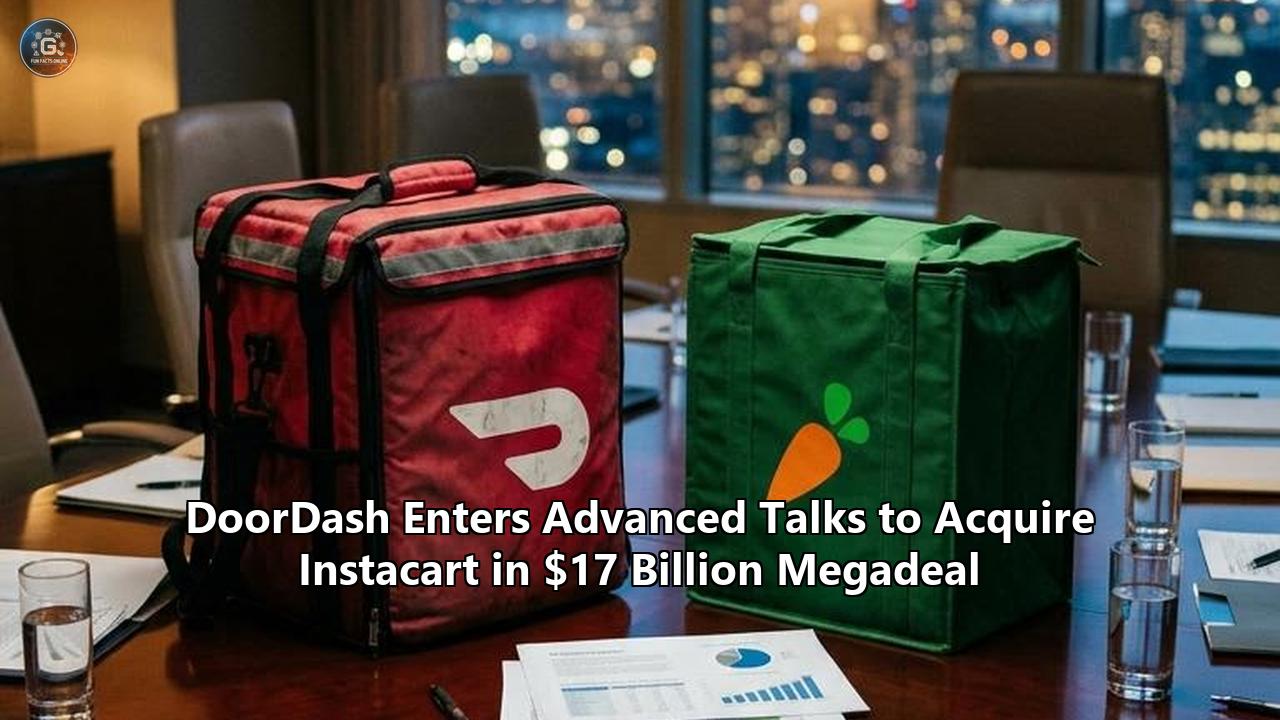
DoorDash is in advanced, late-stage negotiations to acquire grocery delivery pioneer Instacart in an all-cash-and-stock transaction valuing the company at roughly $17 billion. The talks, first disclosed late Monday, October 26, 2026, represent the largest consolidation wave the North American on-demand delivery sector has ever witnessed. If completed, the transaction will forge an undisputed localized commerce titan commanding near-monopolistic scale in suburban restaurant delivery and a dominant position across supermarket fulfillment.
Negotiations between the two San Francisco-based delivery platforms have escalated rapidly over the past 72 hours, with people familiar with the transaction indicating that definitive transaction agreements could be presented to respective boards for final execution before the end of the week. Instacart, which trades publicly under its legal moniker Maplebear Inc. on the Nasdaq, saw its shares surge as much as 9% to surpass $60 per share following initial dispatches. The proposed transaction price of roughly $65 per share represents a 27% to 30% premium over the company’s undisturbed $13.1 billion market capitalization. Conversely, DoorDash shares dropped approximately 6% as institutional desks digested the equity dilution, integration friction, and protracted regulatory gauntlet that invariably accompany a megadeal of this scope.
The prospective DoorDash Instacart acquisition ends a tense multi-year standoff between two fierce rivals that evolved from pandemic-era speculative courtship into open strategic warfare, followed by market share attrition, before finally arriving at corporate absorption. Instacart entered parallel strategic review discussions with rival suitor Uber Technologies during the late summer of 2026, but those talks officially unraveled in mid-October, leaving DoorDash CEO Tony Xu as the sole standing architect with the capital structure and stock currency capable of taking Instacart off the public board.
Simultaneously, Maplebear filed a Form 8-K with the Securities and Exchange Commission announcing an immediate wind-down of its hardware division, specifically its Caper Smart Cart operations, taking a pretax restructuring charge of $55 million to $80 million through mid-2027. The internal pruning removed a capital-intensive hardware liability that had previously stalled valuation models, signaling to investment banks that Instacart was actively stripping itself down to a high-margin software marketplace and retail-media advertising engine ready for absorption.
Tracing how this megadeal materialized requires walking through six years of explosive market expansion, public valuation crashes, platform convergence, and high-stakes executive maneuvering that reshaped the digital commerce landscape.
The Chronological Escalation: From Pandemic Courtship to $17 Billion Consolidation
2021                2022-2023              May 2024             Mid-2026             Late Oct 2026
Early $50B Talks    Post-Boom Divergence   Uber-Instacart Pact  Dual-Track Auction   $17B DoorDash Deal
-------------------------------------------------------------------------------------------------------
• Secret merger     • Instacart resets     • Instacart embeds   • Maplebear hires    • Uber talks die;
  talks collapse      valuation; IPOs        Uber Eats;           bankers; Uber &      DoorDash enters
  over valuation      at $9.9B               seeks defense        DoorDash bid         exclusive talks
  and Biden FTC     • DoorDash buys        • DoorDash buys      • Uber walks over    • Caper Carts axed;
  headwinds           Wolt ($8.1B)           Deliveroo            antitrust/price      $65/share offer
2020–2021: The Pandemic High-Water Mark and the First Aborted Union
To understand the economic friction and strategic necessity driving the current transaction, one must trace the relationship back to the unprecedented demand shocks of the COVID-19 pandemic. In 2020 and 2021, on-demand logistics businesses experienced an unnatural pull-forward of consumer demand that inflated enterprise values across both restaurant delivery and grocery fulfillment.
                          2021 ESTIMATED PEAK          OCTOBER 2026 PROPOSED
COMPANY / METRIC          PRIVATE / DESIRED VALUATION   ACQUISITION TERMS
-----------------------------------------------------------------------------
Instacart (Maplebear)     $39.0 Billion - $50.0B       ~$17.0 Billion
DoorDash Market Cap       ~$68.0 Billion (Late 2021)   ~$73.0 Billion
Implied Deal Structure    Equal-merger / Cash-Stock    DoorDash absorbing Instacart
Regulatory Posture        Lina Khan FTC ascendant      Post-2024 mixed enforcement
Dominant Vertical         Pure-Play Grocery            Multi-category Convenience
Instacart, led at the time by founder Apoorva Mehta, witnessed its platform gross transaction volume (GTV) surge from roughly $5.3 billion in 2019 to over $25 billion by 2021. Venture capital poured into the company at a staggering cadence. In March 2021, following a $265 million financing round backed by Andreessen Horowitz, Sequoia Capital, and D1 Capital Partners, Instacart secured a private valuation of $39 billion.
During the same stretch, DoorDash executed its December 2020 initial public offering, raising $3.4 billion and trading to a market capitalization that briefly breached $70 billion. Awash in liquid stock currency, DoorDash’s executive team recognized early that restaurant delivery, while offering high customer order frequency, suffered from lower average order values (AOVs) and compressed operational margins during non-peak lunch and dinner windows. Grocery fulfillment was the natural counterweight: large average basket sizes ranging between $90 and $130 that could optimize courier routing during mid-morning and mid-afternoon lulls.
In mid-2021, DoorDash made its first documented approach to Instacart. Secret, high-level discussions occurred between Tony Xu and Apoorva Mehta regarding an outright acquisition or mega-merger of the two entities, with bankers discussing potential transaction values floating between $40 billion and $50 billion.
The 2021 discussions deteriorated due to three fundamental sticking points:
- Valuation Euphoria: Flushed with private capital and pandemic tailwinds, Instacart’s board believed the company was bound for an independent public offering that could exceed $50 billion, viewing DoorDash's equity proposals as an unnecessary discount.
- Antitrust Chill: The appointment of Lina Khan as Chair of the Federal Trade Commission in June 2021 sent shockwaves through technology executive suites. Legal advisors cautioned both boards that combining the absolute market leader in prepared restaurant delivery with the undisputed market leader in online grocery delivery would trigger immediate, hostile federal intervention.
- Governance and Cultural Dissonance: DoorDash operated with the brutalist, hyper-quantified operational culture engineered by Xu and co-founders Andy Fang and Stanley Tang. Instacart operated as a merchant-centric platform balancing delicate corporate partnerships with supermarket dynasties like Kroger, Albertsons, and Publix. Mehta’s vision of retail partnership conflicted with DoorDash’s direct, platform-first posture.
By autumn 2021, the merger talks evaporated. Instacart replaced Mehta with former Meta executive Fidji Simo in August 2021 to steer the platform toward an eventual public listing, while DoorDash looked across the Atlantic, deploying $8.1 billion in late 2021 to acquire Finnish delivery company Wolt, taking its platform infrastructure global across 23 international territories.
2022–2023: The Great Valuation Compression and Asymmetrical Expansion
The post-lockdown normalization proved severe for pure-play grocery logistics. As physical retail re-opened and inflation pressured consumer wallets, grocery delivery shifted from an indispensable emergency utility into a high-cost luxury weighed down by delivery surcharges, platform fees, and tip requirements.
Fidji Simo spent her initial two years at Maplebear executing an aggressive, painful internal valuation reset. Between March and December 2022, Instacart took the unusual step of repeatedly marking down its own internal valuation—first from $39 billion to $24 billion, then to $13 billion, and eventually down to $10 billion—to recalibrate employee equity packages and prepare for an intensely skeptical IPO window.
       INSTACART (MAPLEBEAR) VALUATION TIMELINE (2021 - 2026)
  $50B | [Mid-2021 Aborted Talks Valuation: ~$40B-$50B]
  $40B |    * (March 2021 Private Round: $39B)
  $30B |
  $20B |                                                 [DoorDash Offer: $17B]
  $10B |          * ($13B Internal Reset)   * (Sept 2023 IPO: $9.9B)     *
   $0B +-----------------------------------------------------------------------
       2021       2022                      2023                         2026
Simo instituted a structural pivot that altered Instacart's economic DNA. Recognizing that low-margin delivery fees could never sustain public market profitability, she moved to replicate the digital advertising mechanics she oversaw at Meta:
- The Retail Media Engine: Instacart turned its digital shelf space into a high-margin programmatic auction. Consumer packaged goods (CPG) titans like PepsiCo, Mondelez, Kraft Heinz, and Procter & Gamble were compelled to purchase sponsored product listings, brand pages, and display units directly within the checkout workflow. Advertising delivered gross margins exceeding 70%, becoming the core engine of Instacart's adjusted EBITDA.
- The Instacart Platform (B2B SaaS): Simo launched enterprise white-label software, offering supermarket chains proprietary white-label storefronts, fulfillment picking algorithms, and digital inventory tracking. In 2021, Instacart had acquired smart-cart startup Caper for $350 million, promising grocers an automated checkout system featuring computer vision and weight sensors.
- The IPO Reality Check: In September 2023, Maplebear completed its long-delayed IPO, pricing at $30 per share to raise $660 million at a fully diluted valuation of roughly $9.9 billion. The listing provided public market liquidity, but it cemented a harsh reality: Instacart had lost roughly three-quarters of its private peak valuation.
While Instacart fought for survival as a public pure-play grocery platform, DoorDash aggressively expanded its surface area. Under Xu’s direction, DoorDash turned convenience and grocery into its primary capital investment vertical. It built out DashMart—a network of dark micro-fulfillment distribution hubs carrying up to 5,000 SKUs delivered in under 30 minutes—and signed up thousands of retail partners including ALDI, Sprouts Farmers Market, Wegmans, Dollar General, and Target.
DoorDash leveraged its 37 million active monthly diners to aggressively cross-sell grocery orders, eliminating minimum delivery thresholds for members of its $9.99/month DashPass subscription program. Instacart found its enterprise moat under sustained attack by DoorDash’s superior delivery density and customer frequency.
2024–2025: The Uber Proxy Alliance and the Battle of the Subscriptions
By early 2024, competitive lines had blurred entirely. No longer were companies separated by clear category boundaries; restaurant logistics, rapid grocery, retail goods, and convenience had converged into a single war for the consumer’s primary digital commerce home screen.
  CONSUMER EDGE PLATFORM SHARE OF U.S. DELIVERY SPEND (2021 vs. 2026)
  ====================================================================
  Q2 2021:
  [DoorDash: 44%]               [Instacart: 26%]       [Uber/Others: 30%]
  ■■■■■■■■■■■■■■■■■■            ■■■■■■■■■■■            ■■■■■■■■■■■■

  Q3 2026:
  [DoorDash: 59%]                                      [Instacart: 18%] [Others: 23%]
  ■■■■■■■■■■■■■■■■■■■■■■■■■■■                          ■■■■■■■          ■■■■■■■■■
According to U.S. credit and debit card transaction analytics tracked by Consumer Edge, DoorDash’s share of aggregate food and convenience delivery spending marched steadily upward from 44% in the second quarter of 2021 to nearly 59% by the third quarter of 2026. Over the identical interval, Instacart’s share of consumer spend withered from 26% down to 18%.
The divergence left Instacart cornered between two aggressive fronts:
- The Mass-Market Omni-Channel Giants: Walmart invested billions into Walmart+, leveraging its store footprint across 90% of the American populace to capture over 50% of the pure digital grocery order space. Concurrently, Amazon escalated operations with Prime-integrated delivery tiers and Whole Foods expansions.
- The Aggregator Convergence: DoorDash and Uber Eats aggressively rolled out national grocery and pharmacy options directly inside apps consumers already visited multiple times per week for dinner and lunch.
Instacart countered by looking for defensive corporate alliances. On May 7, 2024, Fidji Simo and Uber CEO Dara Khosrowshahi announced an unexpected strategic alliance. Instacart added an official “Restaurants” tab inside its flagship application, completely powered by the backend routing, merchant catalog, and delivery couriers of Uber Eats.
Under the arrangement, Instacart+ subscribers received free restaurant delivery on orders over $35, while Instacart collected a software affiliate bounty on every Uber Eats transaction executed within its app.
The move was an explicit admission by Instacart that a standalone grocery subscription could no longer retain high-lifetime-value suburban consumers against DashPass and Uber One. Simo hoped the tie-up would keep users engaged without requiring Instacart to build a costly restaurant logistics apparatus from scratch.
Yet the alliance was inherently unstable. Instacart surrendered its direct customer delivery touchpoint to Uber Eats drivers, while Uber gathered granular intelligence on Instacart’s core high-spending suburban consumer base.
DoorDash retaliated not through software pacts, but through scale acquisitions. Across late 2024 and 2025, DoorDash closed on the acquisition of hospitality technology platform SevenRooms to entrench its restaurant CRM operations, and finalized its multibillion-dollar absorption of British delivery heavyweight Deliveroo. The Deliveroo acquisition established DoorDash as a pan-European and Middle Eastern powerhouse, elevating its global annualized gross marketplace volume well beyond $80 billion.
Instacart remained trapped within North America, locked into single-digit year-over-year GTV growth rates, an escalating fight with national supermarket banners over data exclusivity, and chronic valuation compression.
Summer 2026: The Strategic Dilemma and the Secret Auction
By June 2026, Maplebear’s board of directors recognized that its competitive runway was narrowing. While Instacart maintained healthy adjusted EBITDA margins—hovering between $700 million and $850 million on an annualized basis, largely sustained by its retail media business—top-line order volume had stagnated. Major retail partners were asserting aggressive independence. Kroger and Albertsons expanded their private micro-fulfillment centers powered by automated picking technologies, pushing direct customer ordering through their proprietary apps and demanding reductions in the commissions paid to third-party marketplaces.
Concurrently, legal and regulatory friction mounted:
- In major metropolitan battlegrounds including New York City and Seattle, local wage ordinances mandated minimum pay scales for delivery couriers exceeding $19 to $20 per active hour.
- The Federal Trade Commission had initiated formal inquiries across late 2025 and 2026 into algorithmic pricing schemes, dynamic service fees, and automated subscription renewal practices deployed by third-party delivery services.
- Instacart agreed to administrative settlements resolving legacy complaints concerning hidden service fees, putting fresh pressure on customer take rates.
In late July 2026, Maplebear’s board, advised by an elite boutique investment banking firm, initiated a discreet strategic review to explore a whole-company sale or privatization.
Two logical corporate buyers were invited to the table: Uber Technologies and DoorDash.
                     THE SUMMER 2026 DUAL-TRACK AUCTION
                     ===================================

                        [ MAPLEBEAR INC. (INSTACART) ]
                        Board explores strategic sale
                                      |
                 +--------------------+--------------------+
                 |                                         |
                 v                                         v
         [ UBER TECHNOLOGIES ]                     [ DOORDASH INC. ]
         • May 2024 partner                        • Long-standing rival
         • Examined buyout at $14B-$15B            • Bids aggressively at ~$17B
         • Blocked by internal integration         • Aligns restaurant frequency
           costs & ezCater commitments               with grocery basket depth
                 |                                         |
                 v                                         v
          TALKS COLLAPSE                            EXCLUSIVE SPRINT
       (Withdrew Mid-Oct 2026)                   (WSJ Leaks Oct 26, 2026)
Uber engaged in preliminary diligence throughout August and September 2026. Dara Khosrowshahi viewed Instacart’s grocery density as the missing puzzle piece in his quest to construct the ultimate global mobility and consumption engine.
However, Uber’s financial balance sheet was already occupied with debt obligations stemming from its aggressive international consolidation sweep, including the $14.8 billion absorption of Delivery Hero assets and its October 2026 buyout of corporate food provider ezCater for $2.3 billion.
Instacart’s valuation demands presented an insurmountable gap for Uber. Maplebear’s negotiating committee insisted on a purchase price approaching $17 billion to deliver an acceptable exit premium to post-IPO shareholders.
Uber's internal modeling concluded that absorbing Instacart's independent contractor network alongside its own would ignite severe labor classification disputes and trigger extensive antitrust remedies. In early October 2026, Uber formally withdrew from discussions.
Tony Xu and the DoorDash M&A committee capitalized on Uber's exit. Xu recognized that permitting Instacart to drift—or worse, fall into the hands of a private equity consortium or an emboldened Amazon—represented a structural threat to DoorDash’s grocery ambitions. For DoorDash, an outright acquisition would permanently neutralize its largest domestic rival, capture Instacart’s high-margin advertising machine, and instantly cement absolute leadership in non-restaurant local delivery.
Mid-October 2026: Stripping the Engine and the Caper Cart Termination
Before any definitive terms could be reached, DoorDash insisted on removing non-core, balance-sheet-heavy operations within Instacart. The primary casualty was Instacart’s in-store hardware venture: Caper Smart Carts.
                          CAPER CARTS ASSET PROFILE
  -------------------------------------------------------------------------
  Acquisition Date:         October 2021
  Acquisition Cost:         $350 Million
  Operational Reality:      High manufacturing unit cost; recurring maintenance;
                            unstable retailer hardware scaling.
  Strategic Fate:           Terminated via Form 8-K on October 26, 2026.
  Financial Impact:         $55M to $80M pretax restructuring write-downs.
  Strategic Purpose:        Clearing hardware drag to deliver a pure-play
                            marketplace and advertising engine to DoorDash.
Instacart had acquired Caper in October 2021 for $350 million, asserting that smart carts equipped with AI cameras, weight plates, and barcode scanners would safeguard its position inside physical brick-and-mortar stores.
While pilot programs launched with retailers like ShopRite, Fairway Market, and select Bristol Farms locations, the operational reality proved financially draining. Smart shopping carts were expensive to manufacture, vulnerable to wear-and-tear, required specialized charging infrastructure in supermarket lobbies, and yielded low recurring software licensing revenues.
DoorDash has historically operated with extreme hardware discipline, preferring software routing, courier application algorithms, and standardized point-of-sale integrations over capital-intensive physical fixtures. DoorDash’s diligence team made it clear that Xu’s management had no interest in owning an enterprise shopping cart fleet.
On Monday, October 26, 2026, Maplebear filed a Form 8-K with the SEC confirming it would completely wind down its Caper Cart operations by the second quarter of 2027.
The filing disclosed pretax restructuring charges of between $55 million and $80 million, consisting of hardware inventory write-offs, contract termination liabilities, and severance provisions.
While market observers initially viewed the announcement as an ordinary operational course correction, corporate finance insiders recognized it as a deliberate transaction-enablement maneuver: Instacart had effectively sanitized its corporate footprint, removing an operational liability to pave the way for DoorDash's acquisition.
October 26–28, 2026: The Breaking Moment and 72-Hour Deal Sprint
The confidential talks shattered into the public domain on the afternoon of Monday, October 26, 2026, when The Wall Street Journal and Reuters broke simultaneous reports that DoorDash had entered late-stage, advanced negotiations to buy Instacart for approximately $17 billion.
The leaks accelerated deal timing. What had been a private boardroom process transformed into an around-the-clock sprint conducted between corporate headquarters in San Francisco and legal advisors in New York.
                         THE DEAL MECHANICS AT A GLANCE
  =============================================================================
  Headline Enterprise Value:       Approximately $17.0 Billion
  Pre-Disruption CART Market Cap:  $13.1 Billion (Friday, Oct 23 close)
  Implied Takeover Price Per Share: ~$65.00 per Maplebear share
  Implied Acquisition Premium:     27% - 30% over undisturbed close
  Transaction Consideration:       Mixed Cash & DoorDash Class A Common Stock
  Target Signing Window:           Late October 2026
  Combined U.S. Third-Party Spend: ~77% of national online delivery volume
  Key Financial Target:            $700M+ in annual run-rate operational synergies
Trading desks reacted immediately across both equities:
- Maplebear Inc. (CART): Instacart stock, which had closed at $51.70 prior to early sale speculation on Friday, October 23, surged upward by nearly 8% to $60.88 during Monday trading, before stabilizing near $62 in extended sessions as institutional volume signaled high conviction of an impending deal.
- DoorDash Inc. (DASH): DoorDash stock traded lower, sliding 6.1% to $168.44. Equity research analysts cited the substantial share dilution required to finance the equity portion of the transaction and market anxiety regarding a multi-year antitrust standoff with regulatory agencies.
- Uber Technologies (UBER): Uber shares shed 3.4% as investors recognized that the collapse of Uber’s partnership with Instacart, combined with DoorDash absorbing the grocery leader, left Uber at a significant competitive disadvantage in domestic non-restaurant fulfillment.
Behind closed doors at DoorDash’s headquarters at 303 2nd Street and Instacart’s offices at 590 Terry A Francois Boulevard, executive teams, joined by Sullivan & Cromwell, Wachtell, Lipton, Rosen & Katz, and Goldman Sachs advisory teams, moved to resolve the remaining transaction provisions:
- The Cash-Stock Consideration Mix: Determining the final ratio of DoorDash Class A common stock versus balance sheet cash. DoorDash held approximately $4.7 billion in liquid cash, cash equivalents, and short-term marketable securities. Structuring the $17 billion deal required a hybrid composition—distributing an estimated $3.5 billion to $4.5 billion in cash alongside roughly $12.5 billion to $13.5 billion in newly issued DASH equity to prevent excessive leverage on DoorDash’s pristine balance sheet.
- Reverse Termination Fees: Given the near-certainty of antitrust scrutiny, Instacart’s special committee demanded an aggressive reverse breakup fee—modeled between $800 million and $1.2 billion—payable by DoorDash if federal regulators successfully petition for an injunction that halts the closing.
- Executive Transition: While Tony Xu will retain absolute operational command as Chairman and CEO of the combined enterprise, provisions were structured around the departure or transition of Fidji Simo and key lieutenants overseeing Instacart’s lucrative retail media and enterprise advertising division.
Strategic Anatomy: Why DoorDash Needs Instacart to Win Localized Logistics
The strategic mechanics anchoring the DoorDash Instacart acquisition extend far beyond vanity market share. The deal is an absolute operational imperative designed to crack the foundational mathematical riddle of on-demand unit economics: order density and basket balancing.
                DELIVERY ORDER ECONOMICS: RESTAURANT VS. GROCERY
  =============================================================================
  METRIC                   RESTAURANT (DOORDASH)          GROCERY (INSTACART)
  -----------------------------------------------------------------------------
  Order Frequency          High (2.8 - 3.5x / month)      Medium (1.2 - 1.8x / month)
  Average Order Value      Low-Medium ($34 - $42)         High ($105 - $135)
  Margin Profile           Tight delivery / high fee      Low retail fee / High Ad take
  Peak Hours               11:30am-1:30pm; 6:00pm-8:30pm  9:00am-11:30am; 1:30pm-4:30pm
  Fulfillment Drag         Wait time at kitchen prep      In-store manual aisle picking
  CPG Advertising Take     Negligible                     Enormous ($1.1B+ annualized)
By fusing these models into a consolidated logistics operating platform, DoorDash secures structural operational advantages that single-vertical platforms cannot match:
1. Smoothing the Courier Supply-Demand Curve
The fundamental drain on gig economy margins is idle time. Food delivery orders peak intensely across narrow two-hour bands during lunch and dinner. Outside those spikes, couriers sit idle or log off, driving up customer wait times and driver acquisition costs when dinner volumes return.
Grocery ordering occurs primarily in the late morning, early afternoon, and weekend mornings. Blending DoorDash’s fleet of over 6 million active Dashers with Instacart’s 600,000 in-store shoppers and delivery couriers allows algorithmically managed multi-order batching. A single courier can fulfill a mid-sized supermarket order at 2:00 PM, bundle it with a convenience item, and transition directly into dinner delivery runs by 5:30 PM, radically elevating fleet utilization rates.
2. The Retail Media Advertising Juggernaut
Instacart's real value to DoorDash is not its delivery fleet; it is its advertising balance sheet. Instacart generates more than $1 billion annually in high-margin retail media revenue, monetizing consumer grocery intent.
When a user searches for "sparkling water" on Instacart, brands bid dynamically against each other to control the top search result.
                          COMBINED RETAIL ADVERTISING FLYWHEEL
   [ 40M+ Diners & Household Shoppers ] ──► High-Intent Search Traffic
                     │
                     ▼
   [ Consolidated Ad Network: Instacart Ads + DoorDash Merchant Suite ]
                     │
                     ▼
   [ CPG / Restaurant Bidding Pool: Multi-Billion Dollar Advertising Spend ]
                     │
                     ▼
   [ 70%+ Gross Margin Flow-Through Directly Subsidizing Platform Deliveries ]
DoorDash has spent four years attempting to build out its own retail media business with mixed success. Integrating Instacart’s established enterprise advertising infrastructure across DoorDash’s broader merchant catalog creates a localized commerce advertising powerhouse second only to Amazon in North America, delivering high-margin ad cash to subsidize platform delivery costs.
3. Subscription Monopolization (DashPass + Instacart+)
Subscription programs dictate the lifetime value of digital consumers. Customers enrolled in DashPass or Instacart+ order at more than triple the frequency of uncommitted users and exhibit dramatically lower platform churn.
A merged enterprise can instantly package an uncontestable bundled subscription tier: unlimited free delivery on restaurant takeout, convenience items, pharmacy products, and full-basket family groceries for a single monthly fee. Such a consolidated consumer bundle would render Uber One and independent grocery platforms non-viable for millions of suburban households.
Merchant Reckoning: Supermarkets Face Platform Dependency
While Wall Street welcomed the transaction's financial scale, the prospect of a completed DoorDash Instacart acquisition has triggered alarm across the executive suites of the American grocery industry.
For more than a decade, regional and national supermarket chains have maintained an uneasy, co-dependent relationship with Instacart. Retailers surrendered catalog data, pricing control, and customer relationships to Instacart in exchange for rapid digital fulfillment capability without building expensive automated warehouses.
  RETAIL SUPERMARKET LANDSCAPE: PLATFORM EXPOSURE MATRIX
  =============================================================================
  RETAIL ENTERPRISE         INSTACART CO-DEPENDENCY    DOORDASH INTEGRATION
  -----------------------------------------------------------------------------
  Kroger Co.                Moderate (Dual-engine)     Active partner
  Albertsons Companies      High (Core fulfillment)    Active partner
  Publix Super Markets      Extremely High             Limited presence
  Costco Wholesale          High (Non-member portal)   Expanding pilot (Sept 2026)
  Ahold Delhaize            Moderate                   Active partner
  Target (Shipt)            Zero (Competitor)          Non-perishable only
  Walmart Inc.              Zero (Independent giant)   None (Direct rival)
The combination creates several operational flashpoints for retail merchants:
- The Monopsony Threat: Grocers fear that a combined DoorDash-Instacart will command unrivaled market power over third-party delivery volume. If a single aggregator controls access to 70% of digital supermarket shoppers within a given metro area, it can unilaterally raise partner commission fees, hike in-app markups, or favor retail chains that purchase programmatic advertising on the platform.
- Costco’s Vulnerability: Instacart has long served as Costco’s digital gateway, providing non-members with an access point to warehouse goods at modest price markups. DoorDash announced its own independent delivery partnership with Costco in September 2026. Consolidating these channels forces the wholesale club to negotiate warehouse delivery economics with a single enterprise counterparty.
- The Private-Label Software Pivot: Regional supermarket operators like Wegmans, H-E-B, and Hy-Vee are expected to accelerate investments into proprietary white-label mobile applications. Retailers will look to prevent DoorDash from sitting between them and their loyal customers, driving fulfillment through internal employees or white-label white-glove logistics services where the supermarket retains ownership of consumer purchasing data.
The Antitrust Gauntlet: Washington's Impending Intervention
No aspect of the proposed transaction carries higher systemic risk than the antitrust clearance process. When DoorDash and Instacart explored transaction models in 2021, the regulatory environment was deemed an insurmountable barrier. Entering 2027, the legal calculus is equally fraught.
                           THE ANTITRUST BATTLEFIELD
  =============================================================================
  REGULATORY AGENCY: Federal Trade Commission (FTC) / Department of Justice (DOJ)
  PRIMARY CHALLENGE: Clayton Act Section 7 (Substantial lessening of competition)

  DOORDASH DEFENSE THEOREM                   DOJ / FTC ENFORCEMENT THEOREM
  ------------------------                   -----------------------------
  "The Broad Omni-Channel Market"            "The Third-Party Aggregator Market"
  • Relevant market includes Walmart+,       • Relevant market is third-party
    Amazon Fresh, Target, physical retail      delivery platforms where DASH + CART
    and proprietary restaurant delivery.       controls ~77% of suburban spend.
  • Combined entity holds under 12% of total • High concentration removes direct
    U.S. grocery sales.                        consumer price and fee competition.
The fundamental battle will hinge upon the legal definition of the relevant product market under Section 7 of the Clayton Act:
1. The Narrow Aggregator Definition
Antitrust regulators will argue that the relevant market is third-party on-demand delivery aggregators. Within this market boundary, the combination represents horizontal consolidation of historic proportions.
DoorDash and Instacart together would control roughly 75% to 80% of independent third-party grocery and prepared meal delivery executed through mobile applications, leaving Uber Eats as a weakened competitor and smaller platforms marginalized.
Regulators will contend that merging these platforms eliminates direct competition, inevitably causing higher consumer service fees, steeper merchant take rates, and diminished pay transparency for independent gig workers.
2. The Omni-Channel Ecosystem Defense
DoorDash and Instacart’s legal defense counsel will counter with an expansive omni-channel market definition. Under this framework, the combined entity’s true competitors are not alternative delivery apps, but corporate retail giants: Walmart (which commands over $600 billion in global sales and more than half of the online grocery fulfillment market), Amazon (with its Prime infrastructure, Whole Foods footprint, and sub-30-minute Amazon Now logistics), and Kroger.
DoorDash will assert that absorbing Instacart is an imperative defense mechanism, providing the scale, software infrastructure, and capital density necessary to prevent Walmart and Amazon from achieving unchecked monopolization over local digital commerce.
Antitrust litigation is practically guaranteed. Legal desks project that the FTC or Department of Justice will issue an extensive Second Request for documents, pushing any formal closing date well into late 2027 or 2028. To clear clearance hurdles, DoorDash may be forced to offer substantial structural remedies, potentially including the complete divestiture of regional grocery networks, commitments to cap merchant commission rates, or guarantees of algorithmic wage transparency for delivery couriers.
2027 and Beyond: The Strategic Landscape Ahead
As DoorDash and Instacart sprint to formalize and execute definitive transaction agreements, the digital delivery sector enters a defining transformational chapter. The speculative multi-app landscape of the past decade is disappearing, replaced by an entrenched duopoly between unified logistics utilities and omni-channel retail behemoths.
  2026-2028 REGULATORY & TRANSACTION ROADMAP
  =============================================================================
  [ Late October 2026 ]   Definitive Acquisition Agreement executed and announced.
            │
            ▼
  [ Q1 2027 ]             Hart-Scott-Rodino (HSR) filing; Shareholder proxy votes;
                          Formal issuance of FTC / DOJ Second Request.
            │
            ▼
  [ Q2 - Q3 2027 ]        Winding down Caper Carts completes ($80M charges taken);
                          Extensive antitrust document production & depositions.
            │
            ▼
  [ Late 2027 / 2028 ]    Federal court litigation or consent decree settlement;
                          Full operational systems integration & DashPass merger.
Several critical operational questions and impending milestones will dictate whether this $17 billion gambit yields a resilient market utility or an unwieldy operational albatross:
- Shareholder Proxy Approval: Maplebear shareholders must formally approve the transaction. Given that early venture backers and post-IPO investors have endured years of depressed equity performance, institutional support for a $65 cash-and-stock buyout is expected to be overwhelmingly positive. However, DoorDash institutional holders will demand clear guidance on run-rate profitability synergies and post-merger dilution limits during upcoming quarterly earnings updates.
- The Uber Retaliation Strategy: Stripped of its Instacart partnership, Uber will face a strategic crossroads. Uber must decide whether to deploy balance sheet capital to acquire a secondary grocery platform, form an exclusive distribution pact with regional retail consortiums, or concede suburban grocery fulfillment to DoorDash to focus exclusively on urban mobility and corporate dining services.
- Algorithmic Fleet Harmonization: Integrating Instacart’s detailed, SKU-level in-store barcode matching systems with DoorDash’s routing engine will require complex engineering coordination. Restaurant couriers are accustomed to rapid counter pickups, whereas grocery shopping requires manual store navigation, product substitutions, and produce weighing. Unifying these vastly different workflows inside a single Dasher application without alienating experienced gig workers will dictate early margin performance.
- Autonomous Delivery Implementations: Both companies have spent 2026 investing heavily in automated logistics, including sidewalk sidewalk rovers, autonomous vehicle pilots, and drone delivery programs. The combined scale of the consolidated platform will create the first private delivery ecosystem commanding the order volume necessary to justify large-scale capital deployments into autonomous robotic fleets across suburban markets.
The long-running courtship between DoorDash and Instacart has finally arrived at its endgame. What began in 2021 as a speculative, high-valuation flirtation between two post-lockdown high-flyers has hardened into a cold, defensive mega-consolidation in late 2026. By absorbing Instacart’s grocery roots and multi-billion-dollar retail media engine, DoorDash is positioning itself to become the universal localized operating system for global commerce—if it can navigate the regulatory, operational, and commercial hurdles waiting on the road to integration.
Reference:
- https://americanbazaaronline.com/2026/10/27/doordash-in-advanced-talks-to-acquire-instacart-in-17-billion-deal-490866/
- https://www.ksl.com/article/51641269/doordash-in-talks-to-buy-instacart-wsj-reports
- https://www.fsrmagazine.com/feature/doordash-in-talks-to-acquire-instacart-in-potential-17-billion-deal/
- https://www.techspot.com/news/114355-doordash-reportedly-talks-acquire-instacart-17-billion-deal.html
- https://thenextweb.com/news/instacart-sale-doordash-uber-talks
- https://finance.biggo.com/news/1ce9124e-170a-4fcd-905a-4adce3a90a2f
- https://www.foxbusiness.com/retail/doordash-advanced-talks-acquire-instacart-potential-17b-deal-report
- https://www.pymnts.com/news/acquiring/2026/doordash-could-finalize-instacart-deal-this-week/
- https://www.reddit.com/r/MarketFluxHub/comments/1xg9zfe/doordash_in_advanced_talks_to_acquire_instacart/
- https://www.youtube.com/watch?v=fD9WGab-4t4
- https://www.clickorlando.com/business/2024/05/07/instacart-partners-with-uber-eats-to-offer-restaurant-deliveries/
- https://www.latimes.com/business/story/2026-10-27/doordash-soon-could-acquire-grocery-delivery-service-instacart
- https://investor.uber.com/news-events/news/press-release-details/2024/Uber-Eats-to-Power-Restaurant-Delivery-on-Instacart/default.aspx
- https://www.grocerydive.com/news/instacart-uber-eats-restaurant-delivery-grocery/735588/
- https://www.foxbusiness.com/retail/doordash-advanced-talks-acquire-instacart-potential-17b-deal-report
- https://www.nrn.com/restaurant-technology/doordash-is-nearing-a-deal-to-buy-instacart-report-says
- https://a47news.ai/story/business/46312/doordash-instacart-17-billion-acquisition-talks