In late July 2026, the National Science Foundation (NSF) announced a series of landmark $20 million funding awards under its Programmable Cloud Laboratories (PCL) initiative, formalizing a structural shift in how chemical research is conducted. Led by institutions including North Carolina State University, Carnegie Mellon University (CMU), the University of North Carolina at Chapel Hill, and the Massachusetts Institute of Technology, the program creates a nationwide network of autonomous, software-defined facilities. Simultaneously, the U.S. Department of Energy (DOE) expanded its Genesis Mission, linking specialized self-driving labs at Argonne National Laboratory and Lawrence Livermore National Laboratory directly to university researchers through cloud-integrated platforms.
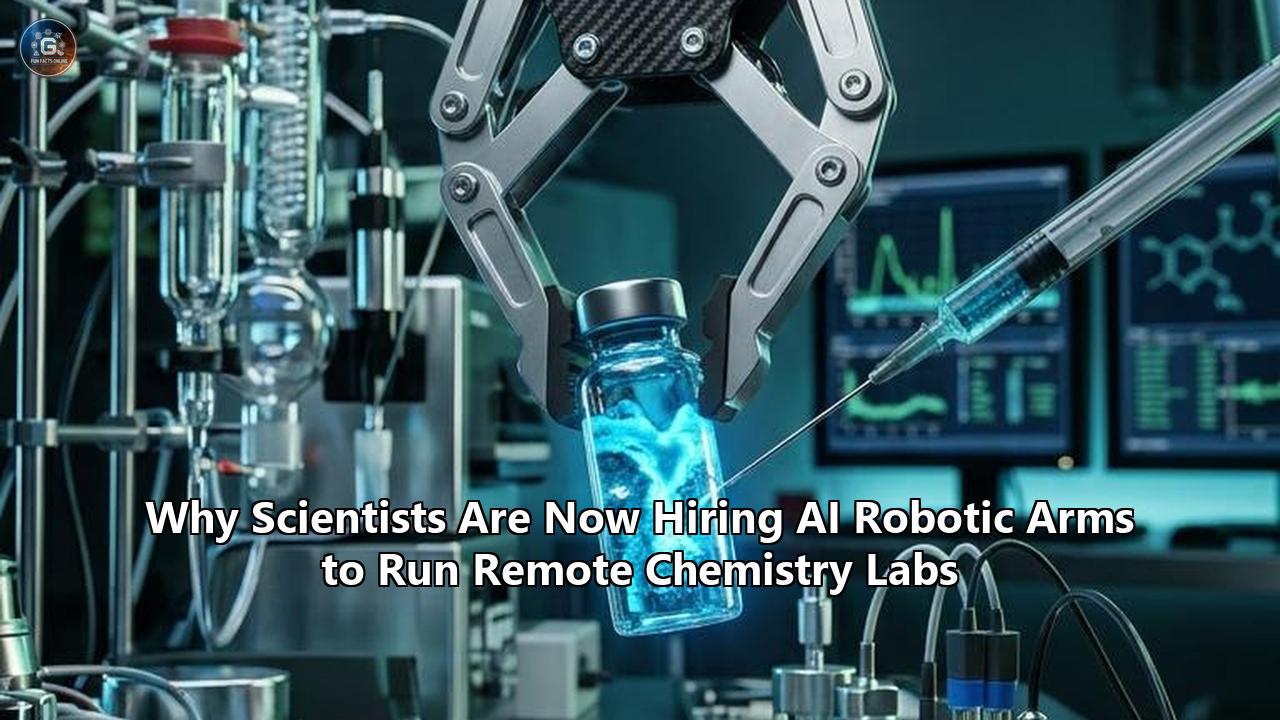
Across these facilities, the traditional image of a synthetic chemist—wearing safety goggles, standing at a fume hood, and manually transferring reagents with micro-pipettes—is being replaced. Researchers thousands of miles away are now leasing time on central processing facilities where multi-axis robotic arms, automated liquid handlers, and closed-loop artificial intelligence agents conduct physical chemistry experiments on demand.
This transition marks the maturation of the "Lab-as-a-Service" (LaaS) model in experimental science. Rather than investing millions in dedicated physical hardware, academic departments and biotechnology firms are "hiring" automated infrastructure. By delegating physical execution to algorithms and robotic limbs, research teams are compressing multi-year discovery pipelines into days while establishing a new operational blueprint for scientific inquiry.
+-----------------------------------------------------------------------------------+
|                        THE CLOSED-LOOP DISCOVERY ENGINE                           |
+-----------------------------------------------------------------------------------+
|                                                                                   |
|   +---------------------------------------------------------------------------+   |
|   | 1. COGNITIVE REASONING (AI Brain / LLM Orchestrator)                      |   |
|   |    - Evaluates target molecular properties & SMILES strings               |   |
|   |    - Generates synthetic pathways & reaction parameters                   |   |
|   |    - Translates hypotheses into API executable code (Python/SiLA2)        |   |
|   +-------------------------------------+-------------------------------------+   |
|                                         |                                         |
|                                         v                                         |
|   +---------------------------------------------------------------------------+   |
|   | 2. PHYSICAL EXECUTION (AI Robotic Arms & Cloud Hardware)                  |   |
|   |    - Precision liquid handling, solid dispensing, valve control          |   |
|   |    - Multi-axis robotic arms transport reaction vials                     |   |
|   |    - Maintains air-free glovebox environments & thermal profiles          |   |
|   +-------------------------------------+-------------------------------------+   |
|                                         |                                         |
|                                         v                                         |
|   +---------------------------------------------------------------------------+   |
|   | 3. REAL-TIME CHARACTERIZATION (Analytical Suite)                          |   |
|   |    - Benchtop NMR, UPLC-MS, and X-ray Diffractometry                      |   |
|   |    - Spectral data ingested and converted to machine-actionable metadata |   |
|   +-------------------------------------+-------------------------------------+   |
|                                         |                                         |
|                                         v                                         |
|   +---------------------------------------------------------------------------+   |
|   | 4. ACTIVE LEARNING & OPTIMIZATION                                         |   |
|   |    - Bayesian algorithms & Physics-Informed Neural Networks (PINNs)       |   |
|   |    - Self-corrects code errors, updates parameter space                    |   |
|   |    - Triggers subsequent reaction run without human latency               |   |
|   +---------------------------------------------------------------------------+   |
|                                                                                   |
+-----------------------------------------------------------------------------------+
Inside the SPEED and CMU Cloud Nodes: Anatomy of an Autonomous Reaction
To understand why institutions are outsourcing experimental execution, consider the workflow at the newly established SPEED (Self-Driving Platforms for Experimental co-Design) Lab, centered at NC State and operating within the NSF PCL framework.
[Remote Researcher Prompt]
         |
         v
[Multi-LLM Agent (e.g., Coscientist)]
         |
         +---> (Search Literature & Chemical Databases)
         +---> (Write Hardware API Commands / Python Scripts)
         |
         v
[Cloud Laboratory Infrastructure]
         |
         +---> [AI Robotic Arm] ---> Dispense Reagents / Load Vials
         +---> [Microfluidic Reactor] ---> Heat, Shake, Flow Control
         +---> [Analytical Suite] ---> HPLC / NMR / Mass Spec Readout
         |
         v
[Data Feedback Loop] ---> Update AI Model ---> Next Experiment Cycle
A project investigating catalyst optimization for carbon-capture polymers begins not with manual liquid preparation, but with a high-level natural language instruction submitted through a web API. The prompt is ingested by a multi-LLM orchestration layer—building on architectures like Carnegie Mellon’s Coscientist—which parses the request into discrete chemical sub-tasks.
The software reasoning engine queries open public databases for reaction parameters, structural notations (such as Simplified Molecular Input Line Entry System, or SMILES), and thermodynamic boundaries. It then writes machine code to interface directly with laboratory hardware.
At the physical node, articulated multi-axis mechanical limbs, such as Universal Robots UR5 or UR20 units, move along linear tracks. These mechanical systems perform physical manipulations: picking up sealed reaction vials, transferring them between microfluidic synthesis modules, operating liquid handling systems, and placing samples into integrated analytical instruments.
In deployment scenarios combining AI robotic arms chemistry systems with automated characterization suites, the physical arm delivers reaction aliquots to benchtop Nuclear Magnetic Resonance (NMR) spectrometers and Ultra-Performance Liquid Chromatography-Mass Spectrometers (UPLC-MS). The analytical outputs are converted back into machine-readable format and fed directly into the active learning algorithm.
If a reaction fails or yields unexpected side-products, the system does not pause for human intervention. In documented runs within CMU's AI Science Foundry, when the orchestration software encountered a code error while controlling a sample heater, the agent automatically retrieved the hardware’s technical documentation, identified the syntax error, rewritten the script, and re-executed the heating cycle successfully.
"The automated robotic experimentation capabilities that have been developed over the past few years provide an extraordinary opportunity for accelerating the discovery and improvement of chemical reactions," notes Alex Miller, professor of chemistry at UNC Chapel Hill and co-lead on the SPEED project. "Our team expands the scope of reactions studied in self-driving labs while deploying robust remote communication tools with the physical instruments."
Lesson 1: Eliminating the Latency of Human Intermediaries
The primary operational benefit extracted from the PCL deployments is not merely the replacement of human hands, but the removal of procedural latency.
In traditional exploratory chemistry, the "predict-make-measure-analyze" cycle is bottlenecked by human schedules and fragmented equipment availability. A chemist designs a series of reactions on Monday, prepares reagents and runs syntheses on Tuesday, waits for instrument time on a shared HPLC or NMR system through Thursday, and processes the spectral data by Friday. A single iterative loop takes five to ten business days.
Self-driving laboratories operate continuously. By coupling active learning models directly with robotic execution, the decision-making loop compresses from weeks down to minutes.
| Operational Metric | Traditional Lab Workflow | Cloud-Based AI Autonomous Lab |
|---|---|---|
| Active Operating Hours | 8–10 hours/day (5 days/week) | 24 hours/day (7 days/week) |
| Iteration Loop Duration | 3 to 10 business days | 15 to 45 minutes per cycle |
| Data Collection Consistency | Variable (Operator-dependent logging) | Automated metadata capture at microsecond intervals |
| Primary Failure Point | Human error / Pipetting variance | Network latency / Software API mismatch |
| Resource Allocation | CapEx heavy (Dedicating equipment per lab) | OpEx heavy (Leasing shared cloud robotics) |
At Argonne National Laboratory's RAPID-200 (Robotic Autonomous Platforms for Innovative Discovery) facility, multi-axis robotic arms operate inside inert gas gloveboxes to synthesize and test next-generation battery electrolytes. Air- and moisture-sensitive compounds that would take human researchers hours of delicate preparation inside glovebox sleeves are handled continuously by physical manipulators.
By eliminating the manual transit of samples between synthesis stations and characterization tools, autonomous platforms complete hundreds of targeted experimental iterations per day. The algorithm evaluates reaction outputs in real time, mapping high-dimensional chemical parameter spaces—temperature profiles, solvent ratios, catalyst loadings, and dwell times—far faster than human intuition allows.
Lesson 2: Hardware Is No Longer the Bottleneck—Software Middleware Is
A key insight emerging from the 2026 self-driving lab rollouts is that physical hardware—pipettors, heating blocks, centrifuges, and articulated arms—has reached mature reliability. The primary obstacle to scaling remote experimentation has historically been the software translation layer required to connect disparate vendor instruments into a cohesive ecosystem.
+--------------------------------------------------------------------+
|                   THE SOFTWARE MIDDLEWARE STACK                    |
+--------------------------------------------------------------------+
|  USER INTERFACE / INTENT LEVEL                                     |
|  - Natural Language Prompting ("Optimize reaction yield for X")   |
+--------------------------------------------------------------------+
                                  |
                                  v
+--------------------------------------------------------------------+
|  COGNITIVE ORCHESTRATION LAYER                                     |
|  - Multi-LLM Reasoning Engine (GPT-4 / Claude / Custom Domain Models)|
|  - Retrosynthetic Planning & Bayesian Active Learning              |
+--------------------------------------------------------------------+
                                  |
                                  v
+--------------------------------------------------------------------+
|  STANDARDIZED API INTERFACE                                        |
|  - Model Context Protocol (MCP) & SiLA2 Protocols                  |
|  - Dynamic Translation of Intent into Code (Python / JSON RPC)     |
+--------------------------------------------------------------------+
                                  |
                                  v
+--------------------------------------------------------------------+
|  HARDWARE CONTROL LAYER                                            |
|  - Low-level machine drivers for robotic arms (UR5/UR20)           |
|  - Fluidic pump actuation, valve switching, thermal control        |
+--------------------------------------------------------------------+
Historically, connecting a liquid handler from one manufacturer to a spectrometer from another required writing custom, rigid driver scripts. If a physical setup changed, the entire pipeline broke.
The current generation of cloud labs addresses this by deploying standardized abstraction layers and API middleware, such as SiLA2 (Standardization in Lab Automation) and open communication standards like the Model Context Protocol (MCP). These standards allow large language model agents to read hardware documentation dynamically and write executable execution scripts on the fly.
In modern AI robotic arms chemistry setups, the robotic arm functions as a flexible physical agent rather than a hard-coded assembly line tool. When the central AI agent determines that a sample requires photolytic activation prior to mass spectrometry, it queries the available instrument inventory, identifies an idle photoreactor, writes the driver code to set light exposure intensity, and commands the mechanical arm to transport the vial to that specific module.
This software flexibility transforms rigid automated assembly lines into dynamic, programmable research environments. Rather than re-engineering physical equipment for every new experiment, researchers adjust software parameters remotely.
Traditional Automation Workflow:
[Fixed Code] ---> [Specific Robot] ---> [Single Pre-defined Task] ---> (Fails if setup shifts)

Modern Autonomous Cloud Workflow:
[User Goal] ---> [AI Reasoning Engine] ---> [Dynamic API Translator] ---> [Adaptive Robotic Arm Execution] ---> [Self-Correction Loop]
Lesson 3: The Democratization of Advanced Physical Infrastructure
Capital equipment costs represent one of the highest barriers to entry in cutting-edge molecular discovery. High-field NMR spectrometers, automated high-throughput crystallographic systems, and ultra-high-resolution mass spectrometers cost hundreds of thousands to millions of dollars apiece. This financial barrier concentrates breakthroughs within well-funded corporate R&D divisions and elite research universities.
Remote autonomous facilities change this distribution model. The NSF's $20 million investment into the PCL Testbed specifically addresses equity of access across the scientific community. Under this architecture, a regional college or an early-stage startup with a modest operating budget can execute sophisticated synthetic programs by purchasing compute and machine time at remote nodes.
+---------------------------------------------------------------------------+
|               DEMOCRATIZATION OF EXPERIMENTAL CAPITAL                     |
+---------------------------------------------------------------------------+
|                                                                           |
|   TRADITIONAL CAPITAL EXPENDITURE (CapEx) MODEL                           |
|   +-------------------------------------------------------------------+   |
|   | High-Field NMR ($1.2M) + UPLC-MS ($500k) + Custom Robotics ($800k)|   |
|   | Total Barrier to Entry: > $2.5 Million per physical laboratory    |   |
|   +-------------------------------------------------------------------+   |
|                                                                           |
|                                     vs.                                   |
|                                                                           |
|   CLOUD-BASED OPERATIONAL EXPENDITURE (OpEx) MODEL                        |
|   +-------------------------------------------------------------------+   |
|   | Secure API Gateway Access + Pay-per-Run Robotic Execution          |   |
|   | Total Barrier to Entry: API Credentials + Cloud Time Subscriptions|   |
|   +-------------------------------------------------------------------+   |
|                                                                           |
+---------------------------------------------------------------------------+
The Carnegie Mellon AI Science Foundry integrates over 80 robotically controlled instruments across two cloud laboratories into a unified, cybersecure framework. Researchers log into a web dashboard, specify experimental parameters, and allow the platform’s distributed scheduler to run the reactions overnight.
"A remote-controlled automated lab, often called a cloud lab or self-driving lab, brings access to scientists everywhere, democratizing science," states Gabe Gomes, assistant professor of chemistry and chemical engineering at Carnegie Mellon University. "Using LLMs helps us overcome one of the most significant barriers for using automated labs: the ability to write complex machine code for every instrument."
This paradigm mirrors the cloud computing transition in information technology during the late 2000s. Just as software startups stopped purchasing physical server racks in favor of Amazon Web Services, chemical researchers are increasingly shifting physical operations to shared, high-availability robotic hubs.
Lesson 4: Data Fidelity, Standardization, and the End of the "Replication Crisis"
A persistent challenge in traditional organic synthesis is the replication crisis. Subtle variations in human execution—how quickly a reagent is added, minor fluctuations in ambient humidity, slight calibration offsets in hotplates, or incomplete procedural logging—frequently render experimental results difficult to reproduce in other facilities.
Autonomous platforms solve this challenge by generating complete, machine-actionable metadata logs for every execution step.
Physical Telemetry Collection Points:
[Reagent Dispense] ---> Record volume to nearest microliter & flow velocity
[Thermal Control]   ---> Log continuous temperature curves at 100Hz
[Mechanical Transit] ---> Track arm force dynamics, vial dwell times, torque
[Analytical Readout]---> Direct raw spectral file link (Unprocessed baseline data)
In an integrated AI robotic arms chemistry node, every movement is recorded:
- Mechanical torque on vial caps during sealing.
- Micro-liter liquid transfer velocities.
- Exact thermal profile logs recorded at microsecond intervals.
- Environmental sensor data tracking ambient glovebox pressure, oxygen levels, and moisture content.
When a reaction yields a novel molecule or optimized yield, the entire procedure is stored not as narrative text in a paper notebook, but as structured, reproducible machine code. Any other node connected to the network can re-execute the identical script on equivalent hardware to reproduce the result precisely.
Furthermore, these structured datasets address the chronic shortage of high-quality training data for AI foundation models in chemistry. Traditional literature suffers from publishing bias, where only successful reactions are reported, leaving negative results unrecorded.
Autonomous laboratories automatically record both successful reactions and failed attempts, building unbiased, high-dimensional training sets. These rich datasets enable active learning models to refine their predictive understanding of chemical physics rapidly.
Risk Management, Security, and Safety Protocols in Autonomous Labs
Delegating physical chemical synthesis to remote software agents presents clear biosecurity and chemical safety challenges. An AI system capable of navigating chemical literature and commanding physical hardware to produce beneficial pharmaceuticals could theoretical be tasked with synthesizing restricted toxins, chemical weapons precursors, or dangerous explosives.
Addressing these risks has required the design of multi-layered hardware and software safety architecture across all NSF and DOE cloud laboratory nodes.
+------------------------------------------------------------------------+
|                   MULTI-LAYERED SAFETY ARCHITECTURE                    |
+------------------------------------------------------------------------+
|  1. INTENT & PROMPT FILTERING                                          |
|     - Natural language checks against GDM & chemical threat lists      |
+------------------------------------------------------------------------+
                                   |
                                   v
+------------------------------------------------------------------------+
|  2. STRUCTURAL SCREENING                                               |
|     - SMILES string analysis against scheduled controlled substances   |
+------------------------------------------------------------------------+
                                   |
                                   v
+------------------------------------------------------------------------+
|  3. HARDWARE & INVENTORY CONSTRAINTS                                   |
|     - Physical isolation of hazardous precursors                       |
|     - Automated volumetric rate-limiting on pumps                      |
+------------------------------------------------------------------------+
                                   |
                                   v
+------------------------------------------------------------------------+
|  4. HUMAN-IN-THE-LOOP CHECKPOINTS                                      |
|     - Required sign-off for novel energetic pathways or high-risk targets|
+------------------------------------------------------------------------+
1. Pre-execution Software Screening
Before an AI agent generates execution code, target structures (SMILES) and synthetic routes are screened against databases of controlled substances, known chemical weapons building blocks, and highly toxic compounds. If a target molecule matches restricted profiles, the execution pipeline terminates immediately, and security protocols flag the request.
2. Hardware-level Physical Constraints
Cloud facilities do not stock universal reagent inventories. Physical hardware limits reagent access via hardwired fluidic connections. Highly reactive or dangerous chemicals require physical keycard overrides and manual installation by facility managers, preventing unauthorized execution.
3. Thermodynamic and Physical Boundaries
AI agents operate within strict operating envelopes enforced at the firmware level. Valve actuators, heating elements, and pressurization systems are constrained by hardcoded physical limits. If an AI model generates an experimental instruction that violates thermodynamic safety profiles—such as heating a volatile solvent above its flash point inside a sealed vessel—the local hardware controller overrides the command.
4. Regulatory Governance
The implementation of these systems aligns with regulatory frameworks established jointly by international standards bodies and federal agencies, such as the FDA/EMA Guiding Principles for AI in Drug Development. These guidelines mandate human-in-the-loop validation for critical steps in regulated manufacturing and drug development, ensuring that while execution is automated, ultimate governance remains with accountable human operators.
Strategic Principles for Implementing Autonomous Laboratory Workflows
As self-driving laboratories move from specialized academic demonstrations to standard industrial infrastructure, several core engineering and organizational principles have emerged.
+-----------------------------------------------------------------------+
|              STRATEGIC LESSONS FOR AUTONOMOUS TRANSITION              |
+-----------------------------------------------------------------------+
|                                                                       |
|   1. DESIGN FOR API FIRST, HARDWARE SECOND                            |
|      Prioritize instruments with open, robust software control over   |
|      standalone physical features.                                    |
|                                                                       |
|   2. TREAT METADATA AS A FIRST-CLASS CITIZEN                          |
|      Capture continuous sensor telemetry, not just endpoint results.  |
|                                                                       |
|   3. EMBRACE PHYSICS-INFORMED AI BOUNDARIES                           |
|      Combine data-driven models with fundamental thermodynamic rules |
|      (PINNs) to avoid physically impossible experimental plans.       |
|                                                                       |
|   4. TRANSITION HUMAN ROLES TO ORCHESTRATION                          |
|      Shift researchers from manual execution to goal formulation and  |
|      algorithmic guardrail management.                                |
|                                                                       |
+-----------------------------------------------------------------------+
Principle A: Design for Software Accessibility
When building or upgrading experimental facilities, hardware selection must be dictated by software API open-access rather than isolated physical specifications. An instrument without a reliable, documented programmatic interface cannot participate in an autonomous loop, regardless of its analytical precision.
Principle B: Incorporate Physics-Informed Neural Networks (PINNs)
Purely data-driven large language models lack innate physical common sense. Unchecked, they can generate mathematically logical synthetic plans that violate physical laws. Modern architectures integrate Physics-Informed Neural Networks (PINNs) that embed thermodynamic equations, conservation laws, and fluid dynamics into the decision-making model.
Principle C: Redefine the Scientist’s Role as "System Orchestrator"
The adoption of AI robotic arms chemistry setups does not eliminate the human chemist; it elevates their operational focus. Instead of spending hours performing manual pipetting or monitoring liquid transfers, scientists act as AI System Orchestrators.
The primary duties of the human researcher shift to:
- Defining high-level research objectives and target property profiles.
- Establishing safety boundaries and material constraints.
- Interacting with active learning outputs to evaluate scientific hypotheses.
- Designing novel experimental paradigms that expand the platform’s physical capabilities.
Future Outlook: The Scaling of Programmable Discovery Networks
The expansion of the NSF Programmable Cloud Laboratories network and DOE Genesis Mission initiatives signals a long-term transformation in how physical science is executed. Looking ahead through the late 2020s, several technical and structural milestones will define the next phase of development.
+-------------------------------------------------------------------------+
|                  AUTONOMOUS LAB EVOLUTION TIMELINE                      |
+-------------------------------------------------------------------------+
|                                                                         |
|  2023 - 2024: PROOF OF CONCEPT                                          |
|  - Standalone LLM agent demonstrations (Coscientist in Nature)          |
|  - Initial integration with isolated cloud facilities                   |
|                                                                         |
|  2025 - 2026: NETWORK INTEGRATION & INFRASTRUCTURE                      |
|  - NSF PCL $20M Awards & DOE Genesis Mission Deployments                |
|  - Multi-node cloud labs linked via standardized API middleware (SiLA2) |
|                                                                         |
|  2027 - 2030: FEDERATED DISCOVERY & INDUSTRIAL SCALE                    |
|  - Multi-facility dynamic load balancing (Cross-lab automated execution)|
|  - End-to-end autonomous scale-up from milligram to kilogram production |
|                                                                         |
+-------------------------------------------------------------------------+
Multi-Facility Dynamic Load Balancing
As cloud laboratory nodes proliferate, AI orchestration engines will move beyond managing single physical rooms. Future platforms will route individual reaction steps across national network nodes dynamically—dispatching precursor synthesis to a high-throughput microfluidic facility in North Carolina, sample transport to a specialized spectroscopy center in Pittsburgh, and characterization to a synchrotron beamline at a national laboratory—based on instrument availability, cost, and transit times.
Standardized Vendor-Agnostic Operating Systems
The emergence of platform-agnostic operating systems—such as Automata LINQ and joint commercial initiatives like Chemspeed/SciY—will continue to bridge vendor-specific hardware siloes. This software standardization will allow AI agents to deploy synthetic programs seamlessly across different physical robotic arms and liquid handlers without requiring specialized code adjustments.
Intellectual Property and Attribution Frameworks
The transition to AI-generated experimental workflows raises unresolved legal questions regarding patent eligibility and invention ownership. Patent offices globally are currently evaluating frameworks for inventions where the hypothesis, experimental execution, and spectral verification were conducted autonomously by closed-loop robotic systems. Establishing clear rules for human attribution versus machine discovery will be critical for commercial biopharma and materials deployment.
Summary of Key Takeaways
The integration of remote artificial intelligence with multi-axis laboratory hardware represents a fundamental structural evolution in scientific experimentation.
By shifting from manual, trial-and-error benchwork to cloud-integrated, software-defined physical execution, researchers are removing traditional time bottlenecks, improving experimental reproducibility, and democratizing access to high-grade scientific instrumentation.
As these programmable cloud networks expand, the speed of scientific discovery will increasingly depend not on physical manual capacity, but on the clarity of the questions scientists pose to their automated networks.
Key References & Source Nodes
- National Science Foundation (NSF) Programmable Cloud Laboratories (PCL) Program (July 2026): $20 million awards supporting the SPEED Lab (NC State, UNC Chapel Hill, MIT) and CMU AI Science Foundry nodes.
- Carnegie Mellon University & DOE Genesis Mission (July 2026): Federated cloud lab initiative linking CMU National Robotics Engineering Center with Argonne (ANL) and Lawrence Livermore (LLNL) National Laboratories.
- Coscientist Autonomous Agent Architecture (Nature): Multi-LLM research framework developed by Gabe Gomes et al., proving natural language orchestration of remote physical cloud experiments.
- Argonne National Laboratory RAPID-200 Facility: Closed-loop materials and battery chemistry discovery engine utilizing central UR5 robotic arms in inert glovebox environments.
Reference:
- https://www.unc.edu/posts/2026/07/28/national-science-foundation-to-help-build-ai-enabled-labs/
- https://www.cmu.edu/news/stories/archives/2026/july/carnegie-mellons-ai-science-foundry-selected-by-nsf-to-help-build-national-infrastructure-for-ai
- https://www.cmu.edu/news/stories/archives/2026/july/connecting-autonomous-laboratories-to-speed-scientific-advancement
- https://chemenggcalc.com/ai-is-transforming-chemical-engineering/
- https://www.chemcopilot.com/blog/self-driving-labs-the-rise-of-autonomous-chemical-discovery-in-2026
- https://www.anl.gov/autonomous-discovery/rapid200-autonomous-lab-for-materials-and-chemistry
- https://qpillars.com/blog/self-driving-labs-2026-what-works-vs-hype
- https://www.cmu.edu/mcs/news-events/2023/1220-ai-coscientist-automates-discovery
- https://www.labmanager.com/artificially-intelligent-coscientist-automates-scientific-discovery-31555
- https://hunterheidenreich.com/notes/chemistry/llm-applications/autonomous-chemical-research-coscientist/
- https://clinlabint.com/meet-coscientist-your-new-super-efficient-ai-lab-partner/
- https://pmc.ncbi.nlm.nih.gov/articles/PMC11602721/
- https://pubs.rsc.org/dd/article/4/7/1672/889013/Autonomous-laboratories-in-China-an-embodied
- https://www.youtube.com/shorts/D_4wIA3jvYU
- https://www.ornl.gov/project/autonomous-chemistry-lab-accelerated-materials-discovery-and-innovation
- https://pharmaphorum.com/digital/ai-scientists-and-robotic-labs-tomorrow
- https://news.ucsb.edu/2026/022721/ucsb-lead-national-cloud-laboratory-advanced-materials