On that Wednesday, Maryland Governor Wes Moore signed the Protection From Predatory Pricing Act into law, making Maryland the first state in the nation to outright ban dynamic, surveillance-based pricing in supermarkets. The legislation, which mandates that food prices remain stable for at least one full business day, effectively outlawed the minute-by-minute digital price fluctuations that had quietly taken over the retail industry.
The immediate catalyst for this historic legislative hammer wasn’t a slow, creeping inflation. It was a bizarre, spectacular software collapse that occurred just weeks prior—a digital anomaly that tore through the aisles of hundreds of Mid-Atlantic supermarkets, leaving shoppers baffled, store managers frantic, and regulators armed with the exact evidence they needed.
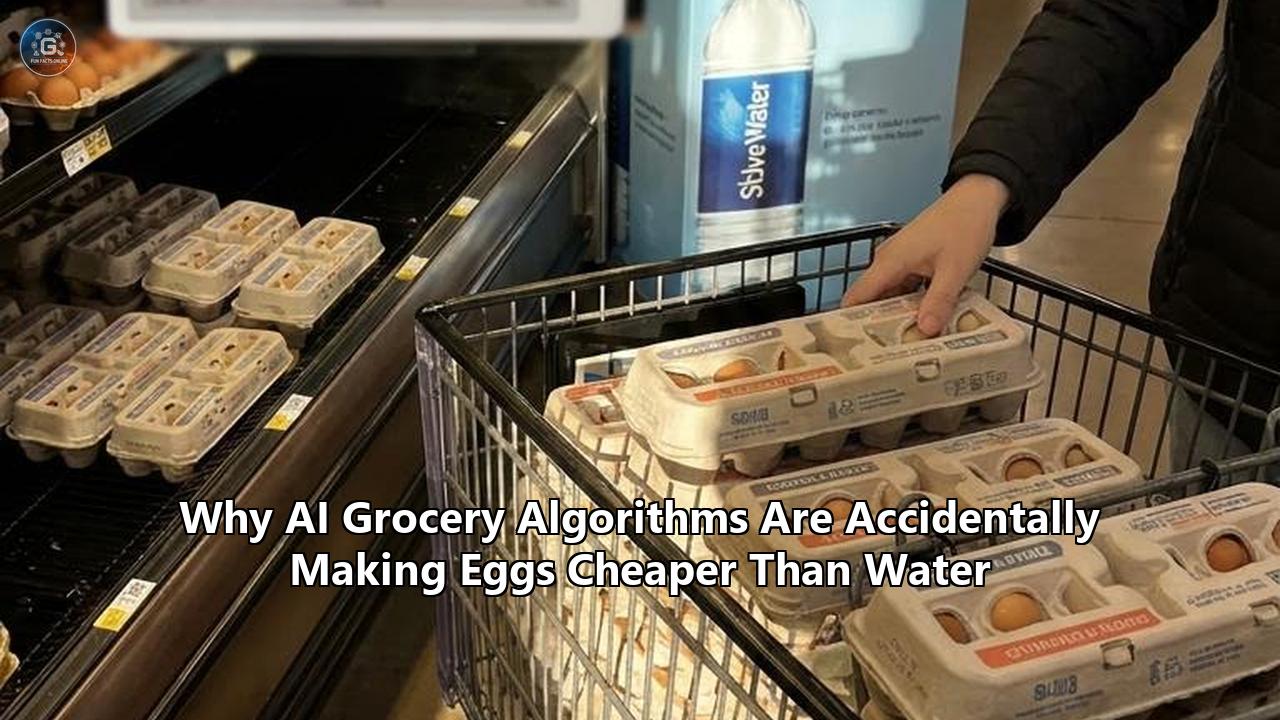
For a chaotic 72-hour window in early April, a cascading logic failure inside centralized retail software resulted in a jarring inversion of basic economic staples. Across dozens of towns, a dozen Grade A large eggs plummeted to 41 cents. A few aisles over, standard store-brand gallons of purified water surged to $4.29, and individual bottles at the checkout lane crossed the $3.50 mark.
This was not a typo. It was not a localized manager’s error. It was the mathematical endgame of automated retail systems operating exactly as they were designed to, devoid of human context.
To understand how a basic protein source became cheaper than tap water alternatives, we have to pull apart the black box of the modern supermarket. The spring anomaly of 2026 was the direct result of a multi-variable collision inside the servers of some of the world's largest retail tech providers. It exposed the hidden, hyper-optimized intelligence dictating what you pay for your morning breakfast—and laid bare the urgent need for guardrails on autonomous commerce.
The Architecture of the Invisible Hand
For decades, the price of a can of soup or a carton of milk was a static, deeply manual variable. A corporate merchandising team would set a regional price, print paper tags, and ship them to stores where clerks spent overnight shifts snapping them into plastic shelf channels. Prices changed weekly, at most, driven by broad promotional cycles or significant supply chain disruptions.
That era is over. Over the last five years, national grocers have aggressively retrofitted their physical locations with Electronic Shelf Labels (ESLs)—small, battery-operated digital screens that receive pricing updates via store-wide wireless transmitters. Initially pitched to lawmakers and labor unions as a way to save employees from the drudgery of manual tag-swapping, ESLs unlocked a far more lucrative capability: real-time dynamic pricing.
The digital tags are merely the output. The brain of the operation is housed in AI grocery pricing algorithms—complex machine learning models engineered to maximize a retailer's gross margin while minimizing inventory spoilage.
These algorithms do not look at a grocery store as a place where families buy food. They view the store as a high-frequency trading floor.
To calculate the absolute optimal price of a single item at any given hour, these systems ingest a staggering volume of real-time data APIs. The ingestion layer processes internal variables: current warehouse stock, the specific expiration dates of the items on the shelf, historical sales velocity, and localized foot-traffic data captured by overhead cameras.
But the systems also pull in external variables. They constantly scrape the digital storefronts of regional competitors to monitor their pricing. They monitor municipal data, local event schedules, and, crucially, hyper-local weather forecasts.
Once this data is aggregated, the system utilizes reinforcement learning to set the price. The AI agent operates on a continuous feedback loop. If it raises the price of peanut butter by 4 cents at 10:00 AM and sales volume drops by 12% over the next two hours, the agent logs that consumer elasticity threshold. If it drops the price by 2 cents and volume spikes, it records the win. It is constantly probing, testing, and adjusting, executing thousands of micro-fluctuations per day across a 40,000-item inventory.
Under normal, stable economic conditions, these fluctuations are invisible to the average consumer. A box of cereal might be $4.19 on Tuesday morning and $4.22 on Thursday evening. The retailer squeezes out an extra fraction of a percent in profit margin, and the shopper remains completely unaware.
But machine learning models are inherently brittle when faced with edge cases. When multiple unusual data inputs converge simultaneously, the algorithm’s attempts to optimize can result in profound, runaway feedback loops. In April 2026, the variables for eggs and water entered a perfect storm.
Dissecting the Egg Crash: The Race to the Bottom
Eggs have always been a volatile commodity. Between 2022 and 2024, waves of highly pathogenic avian influenza (HPAI) decimated commercial flocks, sending wholesale prices on a wild, unpredictable roller coaster. Consumers grew accustomed to sticker shock in the dairy aisle, sometimes paying upwards of $6 or $7 for a standard dozen.
By the first quarter of 2026, however, the supply chain had aggressively over-corrected. Flocks were fully restocked, feed prices had normalized, and production was operating at peak efficiency. Warehouses were suddenly overflowing with eggs.
This oversupply was the first domino. The algorithms governing store inventory immediately recognized that inbound stock was outpacing sell-through rates.
But eggs possess a fatal algorithmic flaw: a hard, non-negotiable expiration date. Unlike canned beans or frozen vegetables, which an algorithm can hold at a high price indefinitely, eggs carry a ticking clock. If a carton of eggs expires on the shelf, the retailer suffers a 100% loss on the product, plus the labor and waste-disposal costs of physically destroying it.
The pricing models are programmed with a specific "spoilage minimization" function. As a perishable item approaches its expiration curve with excess inventory, the system is authorized to aggressively slash prices to guarantee a sale, calculating that taking a 90% hit on profit margin is mathematically superior to a 100% total loss.
In early April, the algorithm initiated a standard markdown to clear the excess egg inventory, dropping prices from $2.19 to $1.89.
This is where the second variable triggered: automated competitor price-matching.
When Store A’s system dropped its egg prices to $1.89, Store B’s web-scraping bots detected the change within minutes. Store B’s algorithm, programmed with a strict "market competitiveness" rule for staple goods, immediately matched the price, undercutting it slightly to $1.85 to capture market share.
Store A’s system saw Store B’s drop. Because Store A was still facing an inventory glut and an approaching expiration cliff, its algorithm fired back, dropping the price to $1.60.
Because both systems operated entirely autonomously, with no human circuit-breakers engaged, they entered a hyper-speed localized price war. The reinforcement learning agents recognized that every time they dropped the price, they sold a few more cartons, rewarding their spoilage-minimization function. They failed to recognize that they were mutually destroying the category’s profit margin.
Over a 48-hour period, the algorithms scraped, matched, and undercut each other in a death spiral. By the time shoppers in Maryland and Virginia began noticing and posting videos to social media, the digital tags in the dairy aisle were flashing $0.41.
"The systems lacked semantic awareness," explains Dr. Aris Thorne, a former retail data scientist and current researcher at the Open Markets Institute. "The AI doesn’t know what an egg is. It doesn't know that 41 cents is a historically absurd price for agricultural labor and logistics. It only knows three things: I have too many of SKU #4492, they will become worthless in six days, and my competitor down the street is selling them for 45 cents. The math dictates a drop to 41 cents. It was a flawless execution of flawed logic."
The Water Surge: The Inelasticity Trap
While the algorithms were gleefully tanking the dairy department, a completely different logic matrix was quietly driving up the price of bottled water on the other side of the store.
Water economics are the polar opposite of egg economics. Bottled water is heavy, space-intensive, and expensive to transport, but it has a near-infinite shelf life. There is no expiration panic. Furthermore, consumer demand for water is usually remarkably flat—except during environmental crises.
To maximize margins on weather-dependent goods, AI grocery pricing algorithms are deeply integrated with localized weather forecasting APIs. If a blizzard is forecast for Thursday, the algorithm knows to incrementally raise the prices of shovels, rock salt, and bread on Tuesday, capitalizing on the inevitable panic-buying surge.
In the first week of April 2026, an unseasonably severe micro-heatwave struck the Mid-Atlantic. Temperatures spiked into the low 90s. The weather APIs flagged the anomaly, and the grocery systems began a standard, incremental markup on hydration products—Gatorade, iced tea, and bottled water.
Simultaneously, a localized municipal issue occurred. A major water main break in a densely populated Maryland county resulted in a 24-hour boil-water advisory.
The algorithms detected an immediate, massive spike in the sell-through rate of bottled water. Shoppers were clearing shelves.
This is where the reinforcement learning engine turned predatory. The system calculates "price elasticity of demand"—a metric that measures how sensitive consumers are to price changes. For luxury items, elasticity is high; if the price of premium chocolate doubles, sales collapse. But for survival necessities during a perceived crisis, elasticity drops to zero. People will pay whatever it takes.
The algorithm began testing the ceiling. It raised the price of a 24-pack of water from $4.99 to $5.99. The sell-through rate did not slow down.
The system was instantly rewarded for finding a higher margin. It bumped the price to $6.99. The shelves continued to empty.
By the time the system pushed the price to $8.50 for a multi-pack, and $3.50 for a single gallon, it had reached a terrifying conclusion: bottled water, in this specific zip code, on this specific afternoon, was essentially a premium luxury asset. The consumer had no choice but to pay.
"This is the core danger of unsupervised machine learning in retail," says Thorne. "The algorithm isn't malicious. It is simply optimizing for gross margin capture. When it identifies a localized monopoly on a necessity—driven by a municipal failure—it doesn't have an ethical subroutine that says, 'we shouldn't price-gouge our neighbors during a water crisis.' It just sees a chart where the demand line remains flat regardless of how high the price line goes. So, it keeps pushing."
The Multi-Agent Collision and the Human Blind Spot
When these two events—the egg crash and the water surge—happened simultaneously in the same stores, it created a surreal retail environment. Shoppers walking into supermarkets found themselves in a funhouse-mirror economy.
Arbitrage shoppers, alerted by rapid-fire posts on TikTok and localized Discord servers, descended on the stores to exploit the algorithms. People were loading minivans with hundreds of cartons of 41-cent eggs, planning to freeze them or supply local bakeries, while outright abandoning their water purchases at the register upon realizing a single gallon cost more than their entire dairy haul.
The obvious question is: where were the humans? Why didn't a store manager walk down the aisle, look at the digital tag, and pull the plug?
The answer lies in the sheer scale of modern algorithmic pricing. A typical large-format grocery store stocks between 35,000 and 50,000 distinct items. Under the old static model, a store manager might review a weekly printout of 500 price changes.
With AI-driven ESLs, prices can change multiple times a day. A store might process 15,000 to 20,000 price fluctuations in a single 24-hour period. The system operates entirely in the background. Store managers do not approve these changes; they are dictated centrally by corporate servers and transmitted directly to the shelf tags. The human workers on the floor are completely bypassed.
It wasn't until the corporate accounting dashboards in regional headquarters began flashing red—alerting executives that their dairy margins had been entirely wiped out and customer service lines were melting down over water prices—that the physical "kill switches" were thrown. Corporate IT departments had to sever the API connections to the pricing vendors and manually revert the entire database to a static, week-old backup.
The Legislative Reckoning
The spring pricing anomaly was a public relations nightmare for the retail sector, but it was a gift to consumer protection advocates and lawmakers who had been warning about algorithmic pricing for years.
The groundwork for the backlash had already been laid in late 2025. Just months prior, the FTC finalized a massive $60 million settlement with grocery delivery giant Instacart over consumer protection violations. Following an explosive report by the Groundwork Collaborative and Consumer Reports, it was revealed that Instacart had been using AI software—developed by a subsidiary called Eversight—to run randomized algorithmic price experiments on its users.
The Eversight experiments proved that algorithms were charging different consumers wildly different prices for the exact same grocery items based on behavioral profiling. The resulting outrage forced Instacart to publicly backtrack, announcing that retailers would no longer be permitted to use the software for targeted item price tests.
But while Instacart retreated in the digital delivery space, the physical grocery stores had continued to quietly expand their in-aisle dynamic pricing. The egg-and-water inversion of April 2026 was the tipping point. It proved that algorithmic pricing wasn't just unfair; it was fundamentally unstable.
Maryland Governor Wes Moore seized the political momentum. The Protection From Predatory Pricing Act had been moving sluggishly through the state legislature, facing heavy lobbying from the Maryland Retailers Alliance. The retail lobby argued that dynamic pricing reduced food waste and allowed stores to offer real-time discounts to consumers.
But after the April anomaly, the defense crumbled. The bill was fast-tracked and signed into law on April 29, 2026.
The law is sweeping in its scope. It strictly prohibits grocery stores and third-party delivery services from utilizing "surveillance data"—which includes consumer behavior, loyalty card tracking, characteristics, and location data—to set individualized prices.
More importantly for the stability of the physical aisle, the law explicitly bans intra-day dynamic pricing. It mandates that once a price is set for a consumer good at the opening of the business day, it cannot be altered by an algorithm or a human until the following day.
"Marylanders deserve to know that the price they see on the shelf is the price they will pay at the register," Governor Moore stated during the signing ceremony. The law specifically targets the core mechanism of the algorithms, aiming to eliminate the high-frequency trading aspect of grocery shopping.
However, consumer advocates warn that the fight is far from over. While the Maryland law is a landmark first step, AI grocery pricing algorithms are highly adaptable, and the retail industry is already searching for legal workarounds.
Grace Gedye, a senior policy analyst at Consumer Reports who helped spearhead the initial investigations into grocery algorithms, noted the immediate limitations of the new legislation.
"Surveillance pricing allows companies to take advantage of that information asymmetry and charge you as much as they think you're individually willing to pay," Gedye said in a statement following the bill's passage. "While it's encouraging to see the Maryland Legislature take up this issue, this bill has loopholes that will limit its real-world impact".
Chief among those loopholes is the exemption for subscription services. Retailers with premium paid membership tiers can still legally offer highly dynamic, personalized discounts to their members, effectively creating a two-tiered pricing system where the "static" shelf price acts as an artificially inflated baseline for non-members.
Furthermore, the law does not prevent retailers from using aggregate, non-individualized data to set the baseline daily price. A store cannot change the price of water at 2:00 PM during a heatwave, but the algorithm can still ingest the weather forecast on Monday night and set an exorbitant, fixed price for the entirety of Tuesday.
Building Circuit Breakers into the Aisle
The events of Spring 2026 have forced a profound reckoning within the retail technology sector. Software engineers are now grappling with a reality that financial institutions learned decades ago: autonomous trading systems require hardcoded safety nets.
When the stock market experiences a sudden, algorithmic free-fall, exchanges trigger a "circuit breaker"—a mandatory halt in trading to allow human logic to intervene and stabilize the system.
Retail tech developers are now frantically retrofitting AI grocery pricing algorithms with similar semantic guardrails. Moving forward, reinforcement learning models cannot simply be unleashed to find the absolute floor or ceiling of a product's elasticity. They must operate within constrained optimization parameters.
"We are moving from pure math to bounded math," explains an engineer at a leading retail analytics firm, who requested anonymity due to ongoing FTC inquiries into their employer. "The algorithm can still dynamically price a carton of eggs, but we have to hardcode a rule that says an egg can never be priced below 80 cents, regardless of the expiration date or competitor behavior. And water can never increase in price by more than 15% over a 30-day moving average, no matter what the localized demand signals are screaming."
These guardrails require a massive overhaul of how machine learning interprets the physical world. The systems must be taught the difference between an elastic luxury (where aggressive pricing tests are economically safe) and an inelastic necessity (where aggressive pricing tests trigger regulatory action and public relations disasters).
The Future of the Checkout Line
The Maryland ban takes full effect in October 2026, and it is already serving as a blueprint for national regulation. Federal lawmakers, spurred by the FTC's aggressive stance on consumer data protection, are drafting federal equivalents that would severely restrict how physical retailers can leverage behavioral data to extract margin from the working class.
But the supermarket is not going to revert to paper tags and manual labor. The infrastructure for the digital aisle is already bolted into the shelves. The capital expenditure has been spent. Electronic Shelf Labels are here to stay.
What happens next will be a tense, invisible negotiation between algorithmic efficiency and human boundaries. Retailers will continue to push the absolute limits of legal pricing optimization, relying on vast troves of non-individualized data to squeeze fractions of a penny out of every transaction. They will get better at hiding the micro-fluctuations, smoothing out the aggressive spikes that caused the spring anomaly.
Consumers, meanwhile, will have to adapt to a retail landscape where the concept of a "fair price" is entirely subjective, calculated by a server farm hundreds of miles away.
The bizarre week when eggs were cheaper than water will likely be remembered not just as a software glitch, but as the moment the curtain slipped. It revealed that in the modern economy, we are no longer just shopping for food. We are negotiating with machines—and until the laws catch up with the code, the machines hold all the leverage.
Reference:
- https://www.washingtontimes.com/news/2026/apr/29/wes-moore-maryland-governor-signs-law-banning-dynamic-pricing-grocery/
- https://www.reddit.com/r/FortCollins/comments/1es6z6z/dynamic_pricing_at_major_grocery_chain_kroger_can/
- https://www.priceintelguru.com/article/ai-price-monitoring-software-for-fmcg-grocery
- https://www.bcg.com/publications/2024/overcoming-retail-complexity-with-ai-powered-pricing
- https://www.grocerydive.com/news/promise-peril-artificial-intelligence-driven-pricing-retailers/812037/
- https://www.oracle.com/retail/grocery/grocery-ai/
- https://www.youtube.com/watch?v=ELEKXnmLWV0
- https://www.mdra.org/blog
- https://www.reddit.com/r/EatCheapAndVegan/comments/1qpjo0l/has_anyone_here_seen_dynamic_pricing_yet_in/