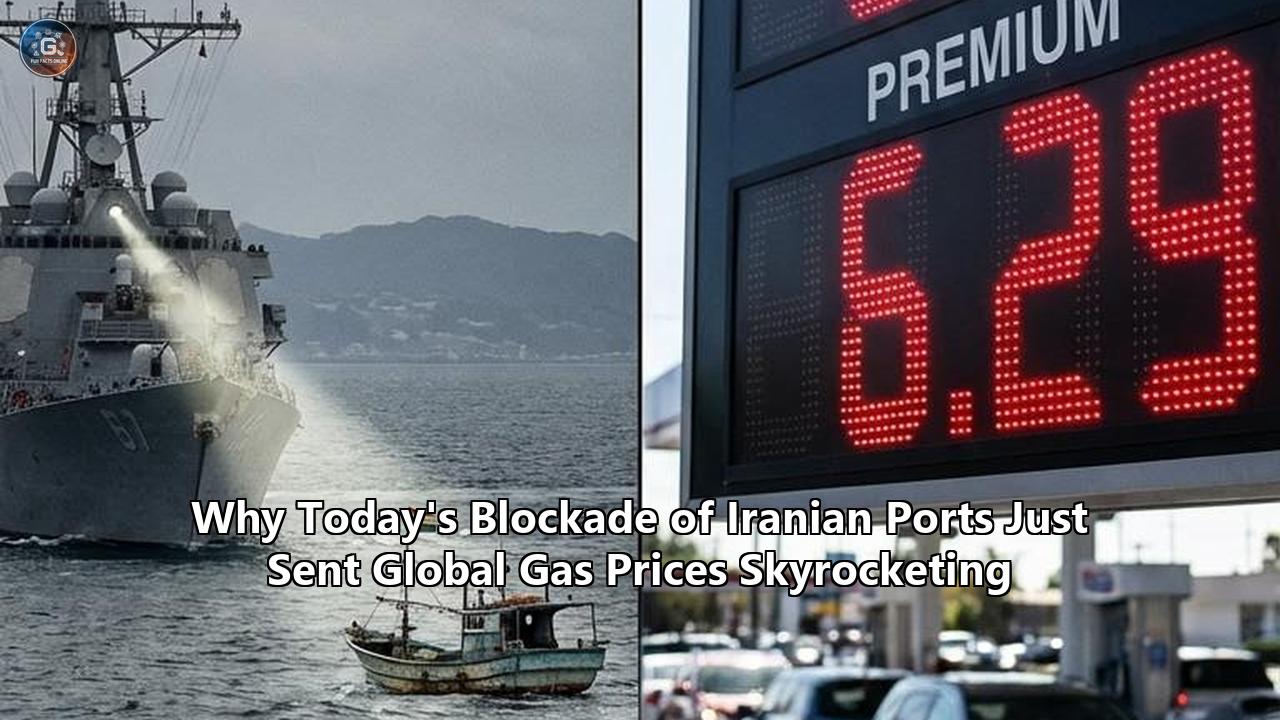
At exactly 10:00 a.m. Eastern Time on Monday, April 13, the global energy apparatus fractured. Two fuel tankers, heavily laden and attempting to navigate the precarious coastline of the Gulf of Oman, abruptly reversed course. MarineTraffic transponders blinked out or showed aggressive U-turns. The United States Central Command (CENTCOM) had officially lowered the maritime iron curtain, executing a comprehensive naval blockade against all vessels entering or exiting Iranian ports.
The market response was instantaneous and violent. ICE Brent crude blew past the psychological threshold of $100 a barrel, hitting $101.88 and peaking near $104.69 by Monday afternoon, representing a staggering jump. New York Mercantile Exchange (NYMEX) WTI followed suit. But the bleeding did not stop on the trading floors of London and New York. By Tuesday morning, the national average for regular gasoline in the United States hit $4.12 per gallon—a brutal spike from the $2.98 average recorded just six weeks prior, before the United States and Israel launched their initial military strikes against Iran on February 28.
This unprecedented severing of one of the world's most critical maritime arteries follows the total collapse of weekend peace negotiations in Islamabad. The objective, articulated directly by President Donald Trump following the diplomatic rupture, is total economic strangulation: cutting off the billions Iran has been securing through illicit oil exports and forced maritime "tolls" to force Tehran to surrender its stockpiles of highly enriched uranium.
However, the rapid execution of this military maneuver has exposed the fragility of global supply chains. Roughly one-fifth of the world’s petroleum and liquefied natural gas (LNG) traverses the Strait of Hormuz. By slamming the door shut on Iranian port traffic, the U.S. has triggered a cascading crisis that extends far beyond the gas pump.
The Anatomy of a Chokepoint
To comprehend how the geopolitical chessboard arrived at this stalemate, one must examine the specific mechanics of the conflict over the past six weeks. Since late February, Iran has operated a de facto, one-sided closure of the Strait of Hormuz. Tehran leveraged its asymmetric naval capabilities and coastal missile batteries to restrict passage to only those international vessels that negotiated safe transit directly with the Iranian government—effectively turning the world’s most vital energy corridor into a toll booth.
The strategy was enormously profitable for Iran. Pre-war data from February showed Iran earning approximately $115 million daily from crude oil exports, or about $3.45 billion monthly. Following the outbreak of hostilities, panic buying and the artificially constrained supply through the Strait pushed Iranian crude variants—Iranian Light, Heavy, and Forozan blend—well above $90 a barrel.
According to the trade intelligence firm Kpler, Iran actually increased its export volume under the cover of war. The nation exported 1.84 million barrels per day (bpd) in March and maintained a pace of 1.71 million bpd into early April, up from its 2025 average of 1.68 million bpd. Between March 15 and April 14, Tehran exported 55.22 million barrels of oil. Through "dark transits" that evade Western sanctions and illicit ship-to-ship transfers, Iran earned nearly $4.97 billion in a single month—a 40% increase in revenue compared to its pre-war baseline.
The U.S. naval blockade is designed to surgically dismantle this revenue engine. CENTCOM forces are positioning heavily in the Gulf of Oman, east of the Strait of Hormuz. This tactical deployment keeps American destroyers and interdiction vessels outside the immediate, dense threat ring of Iran's coastal anti-ship missile batteries and drone swarms, while still allowing them to choke off the deep-water approaches to critical Iranian coastal facilities.
Assessing the immediate impact of iran port blockade reveals a profound disconnect between physical supply realities and market expectations.
The Crude Reality and Pump Panic
For weeks, algorithmic trading and speculative positioning had priced in a swift resolution to the conflict. The fragile two-week ceasefire, which still technically has a week remaining on paper, had lulled markets into a false sense of security.
Fatih Birol, executive director of the International Energy Agency (IEA), dismantled this optimism during a grim address at the Atlantic Council in Washington.
"Prices are, in my view, already high, but they are not reflecting the severity of the problem," Birol warned. "I think soon we will see that they will converge."
Birol categorized the current geopolitical standoff as the largest energy security threat in modern history. The coordinated release of 400 million barrels of oil from emergency reserves earlier in the conflict merely served as a temporary anesthetic. Now, with the blockade actively repelling merchant vessels, the physical scarcity of crude is unavoidable.
The ripple effects are visible in the futures markets. Speculators drastically altered their positioning over the past 48 hours. ICE Brent net long positions were reduced by 5,583 lots to 424,270 lots by Tuesday, indicating deep uncertainty among institutional investors regarding the Middle Eastern supply. Conversely, speculators aggressively increased their net long positions in NYMEX WTI by 7,121 lots, retreating to the relative safety of domestic American crude production.
Yet domestic production cannot insulate American consumers from a globally integrated petroleum market. The pain at the pump has handed Tehran a potent psychological weapon. Iranian Parliament Speaker Mohammad Bagher Ghalibaf openly taunted American policymakers on the social media platform X, posting a screenshot of inflated gas station prices near the White House.
"Enjoy current gas station figures," Ghalibaf wrote. "With the so-called 'blockade,' you will soon be nostalgic for $4-5 gasoline."
Beyond the Barrel: The Hidden Supply Chain Contagion
While crude oil commands the headlines, the secondary impact of iran port blockade is quietly dismantling global agricultural and industrial supply chains. The Middle East is a central hub for the production and transit of petrochemicals, plastics, and essential fertilizers.
India’s agricultural sector offers a stark preview of the impending global shortage. In March, India saw its urea fertilizer production plummet by 800,000 tonnes from typical monthly levels due to acute natural gas supply constraints linked to the Strait of Hormuz disruptions. While the Indian government recently increased domestic gas allocations to the fertilizer sector to stave off a catastrophic crop yield failure, the broader global market enjoys no such safety net.
Patrick Penfield, a professor of supply chain practice at Syracuse University, points out that regional food security in the Persian Gulf is heavily dependent on maritime imports. Nations that rely heavily on the Strait of Hormuz for their basic sustenance—such as the United Arab Emirates, Qatar, and Bahrain—are facing a logistical nightmare.
With bulk cargo ships unable or unwilling to navigate the blockaded waters, these import-dependent nations will be forced to shift basic commodities to air freight. Shipping grain, fresh produce, and commercial fertilizers via cargo plane is exponentially more expensive than maritime freight, setting the stage for "dramatic food price increases" across the Middle East within weeks.
Vidya Mani, a visiting associate professor at Cornell University specializing in supply chain dynamics, emphasizes the long-tail risks of the military standoff. Aluminum, essential industrial chemicals, and base manufacturing metals are trapped in the region.
"The problem with a two-side blockade is that you know it's going to take much longer for the strait to open up and for some kind of agreement to come about — and that's what's going to send these prices further skyrocketing," Mani stated.
Mani explicitly warned against viewing this event in isolation. The global economy is already carrying the scars of pandemic-era bottlenecks and preceding geopolitical skirmishes. "We just have to be prepared for constant higher prices, irrespective of how this blockade turns out," she noted. "Each crisis has a lingering effect on the next one."
The Military and Legal Tightrope
Executing a blockade of this magnitude requires navigating a labyrinth of international maritime law and intense military risk. A naval blockade is historically classified as an act of war under international law. While the United States and Israel are already engaged in direct military hostilities with Iran, the dragnet cast by CENTCOM invariably entangles neutral third-party nations.
The CENTCOM mandate asserts that the blockade is "enforced impartially against vessels of all nations" attempting to utilize Iranian port facilities in the Gulf and the Gulf of Oman. To maintain a shred of legal cover regarding the freedom of navigation, U.S. forces have explicitly stated they will not impede vessels transiting the Strait of Hormuz to and from non-Iranian ports.
However, the physical geography of the 21-mile-wide Strait of Hormuz makes this distinction incredibly difficult to execute in practice. Commercial maritime insurers have essentially frozen their coverage for vessels entering the sector, deeming the risk of crossfire or accidental interdiction too high. If a neutral tanker is suspected of carrying illicit Iranian petroleum, U.S. naval forces may be forced to board and seize the vessel. Such an operation carries massive tactical risks; a stray anti-ship missile or a miscalculated warning shot could trigger a catastrophic oil spill in one of the world's most delicate marine ecosystems.
Iran has vehemently rejected the legality of the U.S. maneuvers. A spokesperson for Iran’s Islamic Revolutionary Guard Corps (IRGC), quoted by the semi-official ISNA news agency, branded the blockade as an act of "maritime piracy."
The IRGC issued a chilling counter-threat: "The security of ports in the Persian Gulf and the Sea of Oman is either for all or for none." This explicit warning implies that if Iranian ports are systematically choked, Tehran will utilize its surviving coastal artillery and fast-attack swarm boats to target port infrastructure in neighboring Gulf states.
President Trump has matched this rhetoric, posting on Sunday that the U.S. Navy will interdict any vessels that have paid tolls to Iran, even if those ships are navigating international waters. "No one who pays an illegal toll will have safe passage on the high seas," Trump declared.
The Diplomatic Fracture in Islamabad
The catalyst for this drastic escalation was the spectacular failure of diplomatic talks in Islamabad over the weekend of April 11-12. Negotiating teams from the United States and Iran, brokered by Pakistani and Gulf intermediaries, reached an absolute impasse over the core issues driving the conflict.
The U.S. demands were maximalist. Washington insisted not only on the immediate cessation of Iranian hostilities and the lifting of Tehran's unilateral toll system in the Strait of Hormuz, but also the total dismantlement of Iran's highly enriched uranium program. President Trump publicly vowed to retrieve what he termed Iran's nuclear "dust," stating the U.S. would take it by force if necessary.
Iranian delegates flatly rejected the nuclear concessions, pivoting instead to focus entirely on the lifting of economic sanctions and the cessation of Israeli airstrikes. The structural failure of the talks triggered the immediate enactment of the CENTCOM blockade on Monday morning.
Measuring the long-term impact of iran port blockade requires looking at the shifting sands of global alliances. The geopolitical fallout has been isolating for Washington. Traditional NATO allies have explicitly refused to participate in the blockade. United Kingdom Prime Minister Keir Starmer announced that British naval forces would not support the interdiction efforts, signaling a deep fracture in Western military cohesion. The European Union, whose member states are currently enduring natural gas prices that have surged over 50% since the war began in late February, is increasingly desperate for a diplomatic off-ramp.
India finds itself walking the most precarious diplomatic tightrope. As a massive consumer of Iranian petrochemicals and a key strategic partner to the United States, New Delhi is caught in the crossfire. Iranian Ambassador to New Delhi, Mohammad Fathali, sought to reassure Indian officials on Monday, explicitly stating that Indian vessels transiting the Strait had not been forced to pay the controversial Iranian tolls. Yet, with U.S. destroyers now actively repelling traffic, diplomatic exemptions mean little against a physical naval barrier.
The Asymmetric Economic Bleed
Assessing the broader consequences requires looking at the profound domestic vulnerabilities inside the Islamic Republic. While Tehran has successfully exploited the chaos to maximize crude oil revenues over the past six weeks, its broader macroeconomic picture is dire.
According to data released by Iran’s Customs Administration and reported by the Tehran Times, the country’s total non-oil trade reached $94 billion for the fiscal period running up to January 20. Crucially, imports vastly outpaced exports, resulting in a severe trade deficit. Iran is deeply reliant on international shipping for its survival, heavily importing industrial machinery, consumer electronics, and vital food supplies from China, Turkey, and the UAE.
The CENTCOM blockade severs these vital import arteries. By denying commercial freighters access to Bandar Abbas—Iran's primary southern maritime hub—the U.S. is engineering a domestic supply shock. Warehouses will rapidly deplete, industrial manufacturing will grind to a halt due to missing components, and basic consumer goods will become prohibitively expensive for the average Iranian citizen.
Economic analysts project that if non-hydrocarbon trade is completely paralyzed by the blockade, the domestic shortages will dwarf the economic pain inflicted by the pre-war sanctions regime. The Iranian rial is expected to plunge further on the black market, triggering hyperinflationary conditions that could spark widespread domestic unrest.
The strategy relies on a brutal calculation: that the Iranian populace will break under the economic strain before Western consumers revolt against $5-a-gallon gasoline. It is a high-stakes war of attrition where the primary battlefield is the global commodities market.
LNG Disruptions and the European Crisis
While American consumers fixate on the price of gasoline, European policymakers are watching a different metric entirely: Liquefied Natural Gas (LNG). Approximately 20% of the world's LNG supply has been directly disrupted by the localized conflict and the ensuing closure of export routes.
Qatar, one of the world's largest exporters of LNG, shares the massive South Pars/North Dome gas field with Iran and relies on the Strait of Hormuz to deliver its cargo to European and Asian markets. With commercial maritime insurers pulling coverage and U.S. warships flooding the zone, LNG carriers are effectively trapped.
For Europe, the timing is perilous. Having spent the last several years painfully decoupling from Russian pipeline gas, the continent pivoted heavily to seaborne LNG from the United States and the Middle East. The compounding impact of iran port blockade on these alternative energy routes has erased years of strategic diversification.
European spot prices for natural gas reacted violently on Monday morning, compounding the 50% surge witnessed since February 28. Industrial powerhouses like Germany and Italy are facing the grim prospect of energy rationing if the blockade persists into the high-demand summer months. Factory output across the Eurozone is already contracting as energy-intensive industries—ranging from glass manufacturing to steel smelting—scale back operations to absorb the margin shock.
The Brink of Global Recession and Future Horizons
The global economy currently rests on a knife-edge. The International Monetary Fund (IMF) has already downgraded its growth outlook, issuing a stark warning that the world economy will teeter into a severe recession if the conflict worsens and oil prices establish a new floor above $100 a barrel into 2027.
Despite the escalating rhetoric and the ironclad military posture in the Gulf of Oman, diplomatic backchannels remain faintly active. Gulf and Pakistani officials indicated on Tuesday that negotiating teams could potentially return to Islamabad later this week, though no official timetable has been confirmed by either Washington or Tehran.
The immediate window for de-escalation is narrowing. The original two-week ceasefire agreement, while functionally dead in the water following the blockade, officially expires next week. Once that timeline lapses, the U.S. and Israeli militaries will no longer be bound by the temporary pause, opening the door for a massive resumption of kinetic warfare on Iranian soil.
Moving forward, the energy markets will hyper-fixate on specific data points to gauge the effectiveness and longevity of the blockade. Satellite imagery of Iranian ports, the weekly API crude inventory draws in the United States, and the shifting of global LNG carrier fleets will serve as the true indicators of this geopolitical stalemate.
If CENTCOM can maintain the airtight interdiction without triggering a regional war or sinking a neutral vessel, the economic pressure on Tehran will become mathematically unsustainable by late summer. Conversely, if global oil prices sustain their current trajectory and push toward the catastrophic $110 to $120 range, the domestic political pressure on Washington may force a premature withdrawal from the Strait.
The coming days will dictate whether the naval maneuvers of April 2026 force a historic nuclear capitulation from Tehran, or simply break the back of the post-pandemic global economy. The ships in the Gulf of Oman have stopped moving, but the economic shockwaves are just beginning to make landfall.
Reference:
- https://www.investing.com/analysis/oil-surges-amid-hormuz-blockade-threat-200678305
- https://www.businesstoday.in/amp/world/us/story/enjoy-the-current-gas-prices-while-iran-warns-as-us-blocks-all-ships-at-iranian-ports-from-april-13-525287-2026-04-13
- https://www.cbsnews.com/live-updates/iran-war-us-iran-ports-blockade-strait-of-hormuz-trump/
- https://unn.ua/en/news/iran-threatens-us-with-gasoline-price-hike-over-port-blockade
- https://www.bnnbloomberg.ca/markets/oil/2026/04/13/how-a-us-blockade-near-the-strait-of-hormuz-could-work-and-the-impact-ahead-for-the-global-economy/
- https://www.theguardian.com/us-news/2026/apr/14/first-thing-us-starts-naval-blockade-of-iranian-ports-after-deadline-passes
- https://www.al-monitor.com/originals/2026/04/us-blockade-iran-will-be-major-military-endeavor-experts-say
- https://www.aljazeera.com/news/2026/4/14/how-much-will-us-hormuz-blockade-hurt-iran-and-does-tehran-have-an-escape
- https://japantoday.com/category/world/us-iran-may-resume-talks-this-week-despite-port-blockade4?comment-order=latest