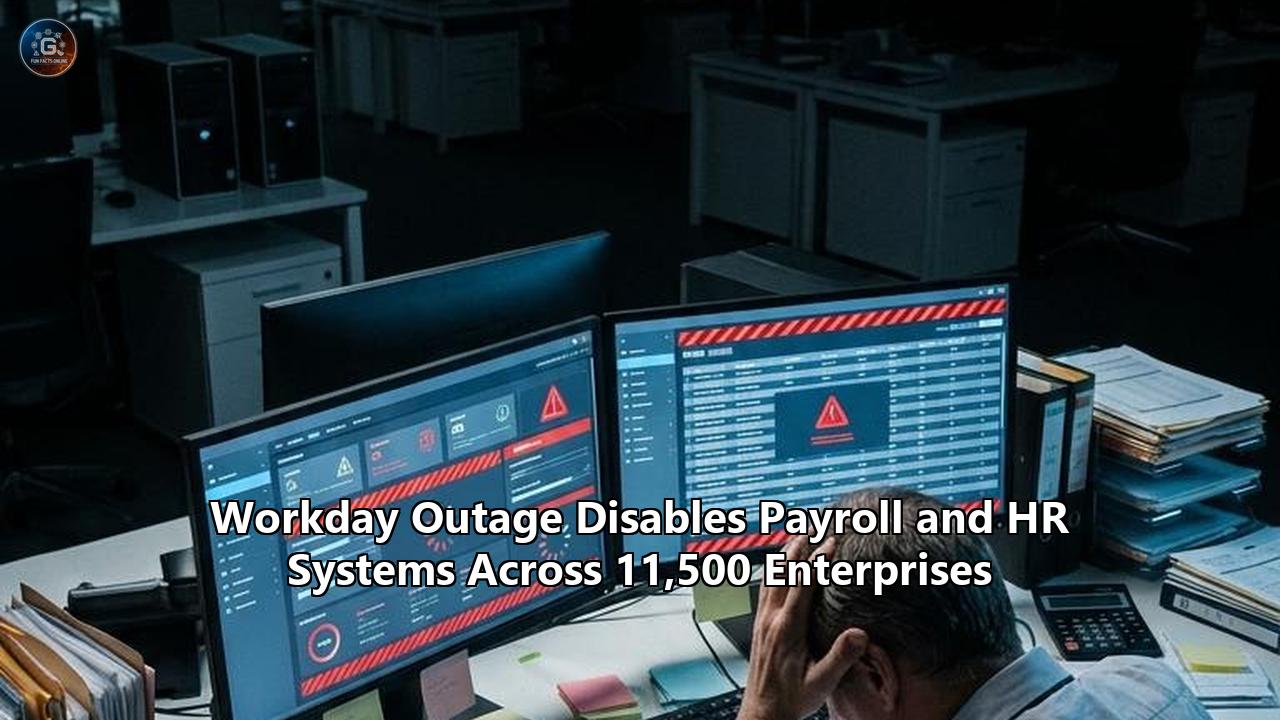
When an automated disaster-recovery drill went awry on Friday, November 13, 2026, the failure did not simply bring down a software vendor—it froze the administrative core of corporate America. A configuration error during a routine failover validation caused backup systems to bridge directly into live production databases, triggering data inconsistencies that forced Workday Inc. to plunge its multi-tenant cloud into an emergency inspection and maintenance mode.
The disruption disabled human resources, timekeeping, shift scheduling, benefits enrollment, and payroll management for more than 11,500 organizations worldwide. Within minutes of the 5:00 p.m. Eastern shutdown, Downdetector logged thousands of simultaneous failure reports. The outage severed access for a client roster that encompasses roughly 65 million workers, spanning retail giants like Walmart Inc. and Target Corp., tech leaders including Netflix Inc. and Salesforce Inc., Wall Street heavyweights Morgan Stanley and Charles Schwab, aerospace operations at NASA’s Jet Propulsion Laboratory, and public administrations in cities like Seattle, Dallas, and Philadelphia.
The incident struck during one of the most volatile administrative junctures on the corporate calendar: mid-November, the precise confluence of statutory open benefits enrollment, seasonal workforce ramp-ups for the global holiday retail push, and bi-weekly payroll reconciliations. Although Workday restored production databases by Saturday morning, November 14, the reverberations have laid bare the structural fragility of relying on a monolithic Software-as-a-Service (SaaS) provider for foundational human capital management (HCM).
More than a software glitch, the Workday system outage serves as a case study in operational risk, exposing deep contrasts across technical disaster-recovery protocols, competing enterprise resilience frameworks, and divergent executive containment strategies.
The Breakdown: How a Disaster Drill Induced a Production Blackout
The sequence that incapacitated Workday's data centers originated not from an external cyberattack, but from the very mechanism designed to ensure operational continuity.
According to incident disclosures shared with enterprise administrators and verified by IT infrastructure teams, Workday engineering personnel were conducting a scheduled disaster-recovery (DR) validation test. In cloud software architectures, continuous DR validation ensures that if a primary data center experiences power failure, network truncation, or hardware corruption, workloads will transfer cleanly to secondary geographic locations without data loss or prolonged recovery time objectives (RTO).
During this test, services operating inside Workday’s isolated disaster-recovery environment established unauthorized read-write connections to live production database clusters across two primary data centers. This connection bridged two environments that must remain strictly air-gapped or cryptographically partitioned.
Once the standby nodes began interacting with production state data, writes collided. Stale test metadata, synthetic heartbeat transactions, and duplicate state records intermingled with real-time transactional data.
                                  DISASTER RECOVERY VALIDATION FAILURE

  [ Isolated DR Site ]                                              [ Primary Production Site ]
           │                                                                     │
  Standby Node Cluster                                                Live Production Clusters
  (Synthetic Heartbeats,                                              (Employee Timecards,
   Failover Simulations)                                               Benefits, Pay Ledgers)
           │                                                                     │
           └─── Unintended Network Route (Configuration Breach) ─────────────────┘
                                           │
                                [ Cross-Environment Write ]
                                           ▼
                                 State Desynchronization
                                 (Dual-Source Data Drift)
                                           │
                                           ▼
                             EMERGENCY FAIL-SAFE TRIGGERED
                                           │
                                           ▼
                     Hard Cut to Read-Write Lock / Maintenance Mode
                     (11,500 Enterprise Tenants Severed to Preserve
                                  Database Integrity)
In distributed systems, this phenomenon mirrors a split-brain scenario: multiple authoritative clusters write conflicting states to the same data store simultaneously. In Workday’s proprietary in-memory database architecture—where customer tenant data is kept resident in RAM to accelerate complex relational calculations across employee records—data consistency is non-negotiable. An in-memory object graph cannot tolerate dual-source data drift without corrupting downstream ledger calculations.
Confronted with corrupting live tenant data or shutting down the platform, Workday engineers selected the nuclear option. They severed public and private API gateways and forced their database nodes into an aggressive, tenant-wide maintenance lock.
The decision preserved transactional integrity, but it also left thousands of enterprise operations teams flying blind on a Friday evening. For millions of shift workers attempting to clock out, HR directors finalizing health coverage plans, and payroll clerks submitting automated clearing house (ACH) batches ahead of banking cutoff windows, the platform returned a blank status screen: "Service Interruption".
Triage Strategies: How Different Industries Responded
The systemic shock caused by the Workday system outage triggered divergent, and often conflicting, emergency playbooks across affected industries. Because enterprise HCM platforms sit at the nexus of labor laws, union contracts, regulatory compliance, and core business operations, each sector was forced to weigh operational continuity against regulatory liability.
Retail and Logistics: Prioritizing Floor Operations Over Data Fidelity
At large retailers like Walmart and Target, the outage struck at the critical transition between day and evening weekend shifts. These organizations operate massive, low-margin, high-turnover shift workforces governed by strict meal-break, rest-break, and overtime labor laws.
When Workday’s mobile app, web interface, and integrated digital timeclocks locked up, managers faced an immediate dilemma: halt operations to prevent untracked labor, or let employees work without real-time tracking, risking later wage-and-hour compliance penalties.
Major logistics and retail operators chose immediate physical continuity:
- Analog and Spreadsheet Fallbacks: Store managers deployed physical paper sign-in sheets and shared spreadsheets stored on local intranet servers to record clock-in and clock-out times manually.
- Store-and-Forward Hardware: Facilities equipped with hardened, on-premise biometric timeclocks switched into offline caching mode. These physical devices recorded employee scans onto local flash storage, queuing the records to batch-sync once Workday’s API endpoints re-emerged.
- Post-Incident Remediation Costs: While this approach preserved supply chain flow and kept checkout lanes open, it pushed massive administrative burdens down to store-level supervisors. Managers faced thousands of hours of manual reconciliation to resolve overlapping, off-the-clock punches, calculate missed-break premiums, and correct discrepancies, exposing these companies to potential class-action Fair Labor Standards Act (FLSA) litigation.
Financial Services and Knowledge Work: Freezing Approvals to Protect Internal Audits
The response within Wall Street institutions, including Morgan Stanley, Charles Schwab, and Nasdaq, took the exact opposite posture. In professional services and banking, hourly time tracking is secondary to strict information barriers, internal controls, role-based access governance, and equity administration.
Financial institutions refused to deploy analog or unvetted digital fallbacks:
- Administrative Freezes: Corporate treasuries and HR operations halted all lateral compensation modifications, bonus sign-offs, and equity distributions scheduled for Friday evening.
- Regulatory Compliance Prioritization: Under Sarbanes-Oxley (SOX) Section 404 compliance rules, internal accounting controls require cryptographic audit trails for every compensation and role change. Entering payroll modifications into temporary, off-platform spreadsheets would introduce security gaps and compromise the chain of custody for financial records.
- The Tradeoff: Financial services opted for complete operational paralysis over compliance risks. Executive promotions, salary revisions, and non-exempt contractor invoices were put on hold until Workday delivered full cryptographic verification that its production database state was consistent.
The Public Sector and Critical Infrastructure: Municipal Gridlock
For public sector clients—such as the municipal governments of Seattle, Dallas, and Charlotte, along with federal research nodes like NASA's Jet Propulsion Laboratory—the outage exposed administrative fault lines where union contracts intersect with government procurement rules.
- Union Grievances: Municipal operations, particularly in emergency services, operate under collective bargaining agreements with strict rules governing overtime pay, call-out tracking, and shift differential wages. Manual tracking on paper sheets triggered formal union notifications within hours, as shop stewards voiced concerns over delayed weekend pay calculations.
- Lack of Local Infrastructure: Unlike retail companies that retain redundant edge timeclocks, many public sector agencies decommissioned their local timekeeping hardware during cloud migrations, leaving them without any offline collection capabilities.
- National Security Restrictions: Federal institutions could not migrate workflows to consumer-grade cloud storage alternatives due to Federal Risk and Authorization Management Program (FedRAMP) compliance restrictions. If an agency's FedRAMP-certified cloud vendor goes dark, staff cannot legally improvise on non-certified systems, forcing an immediate standstill for administrative processing.
| Metric / Dimension | Retail & Logistics (e.g., Walmart, Target) | Financial Institutions (e.g., Morgan Stanley, Schwab) | Public Sector & Defense (e.g., NASA JPL, Cities) |
|---|---|---|---|
| Immediate Priority | Floor operational continuity; keeping stores and fulfillment centers staffed. | Regulatory and internal audit control preservation (SOX 404). | Compliance with union contracts and federal data sovereignty rules. |
| Interim Method | Paper punch logs, offline caching on physical biometric clocks, local spreadsheets. | Total freeze on administrative changes; moratorium on manual workflows. | Paper incident logs; complete cessation of non-emergency contractor billing. |
| Operational Impact | Low downtime impact on consumer operations; severe post-event administrative burden. | Complete stoppage of HR processing, role updates, and compensation modifications. | Immediate labor union grievances; administrative paralysis across municipal offices. |
| Downstream Risk | Wage-and-hour lawsuits, FLSA penalties, miscalculated overtime pay. | Audit findings, delayed SEC/internal disclosures, missed equity vestings. | Unfair labor practice charges, delayed public services, contractor payment defaults. |
Architectural Comparison: In-Memory Monolith vs. Distributed Microservices
To understand how a single disaster-recovery validation error incapacitated thousands of enterprises, one must analyze the technological architecture powering Workday, and how it compares to alternative enterprise software paradigms.
       WORKDAY'S IN-MEMORY OBJECT ENGINE           VS.          DISTRIBUTED MULTI-REGION ARCHITECTURE

 [ Multi-Tenant Enterprise Tier ]                         [ Distributed Microservice Tier ]
                 │                                                        │
                 ▼                                                        ▼
┌─────────────────────────────────┐                     ┌──────────────────┐  ┌──────────────────┐
│ In-Memory Object Graph          │                     │ Service: Time    │  │ Service: Payroll │
│ (Entire state resident in RAM)  │                     │ (Read-Only Pods) │  │ (Isolated Queue) │
├─────────────────────────────────┤                     └────────┬─────────┘  └────────┬─────────┘
│ Highly optimized relational math│                              │                     │
│ Cross-table HR/Pay processing   │                              ▼                     ▼
├─────────────────────────────────┤                     ┌────────────────────────────────────────┐
│ Single Point of State Lock:     │                     │ Globally Distributed Storage           │
│ Conflicting writes force entire │                     │ (e.g., CockroachDB, Spanner)           │
│ tenant graph into quarantine.   │                     │ Raft/Paxos consensus isolates failure  │
└─────────────────────────────────┘                     │ without global read/write freeze.      │
                                                        └────────────────────────────────────────┘
Workday's operational core differs fundamentally from legacy database architectures like Oracle Database, as well as distributed cloud setups built on databases like Apache Cassandra, CockroachDB, or Google Cloud Spanner.
The In-Memory Object Engine
Workday’s core architecture runs on a proprietary, multi-tenant in-memory object engine. The company built this design to resolve the performance bottlenecks common in traditional relational database management systems (RDBMS). In an RDBMS, running complex organizational queries across hundreds of thousands of workers—such as rolling roll-up org charts, dynamic benefit dependencies, and localized tax withholding formulas—requires executing complex JOIN statements across disk-backed tables.
By loading an enterprise’s entire organizational data graph directly into RAM, Workday delivers fast query processing and consistent analytics.
However, this architecture introduces major operational tradeoffs:
- The Cost of Tight Coupling: Because the in-memory object graph is tightly coupled, data cannot easily be segmented by functional module. The timeclock, open enrollment module, performance review system, and payroll calculation engine do not run on isolated data tiers. They interact with the same underlying object memory graph.
- Global Quarantine over Partial Degradation: When the disaster-recovery test introduced conflicting state writes, it threatened the integrity of that entire object graph. A relational database can lock a single corrupted table while keeping others accessible. An in-memory object engine cannot verify the integrity of part of a connected graph while other parts are in flux. Workday engineers had to freeze access to the entire model to prevent cascading memory pointer corruption.
The Distributed Microservices Model
In contrast, modern cloud architectures decouple transactional systems into distributed microservices backed by event streaming platforms like Apache Kafka and globally distributed databases governed by Paxos or Raft consensus algorithms.
Consider how an alternative microservices-based model behaves under identical disaster-recovery stress:
1. Fault Domain Isolation
Under a microservices model, the Time and Attendance engine operates as an independent service with its own data store, separated from Core HR, Performance, and Benefits Enrollment. An integration failure within a backup benefits database cannot bring down the timekeeping service.
2. Event Sourcing and State Rehydration
By using event-driven architectures, system state is not maintained solely as an ephemeral snapshot in memory. Instead, every interaction (a badge swipe, a PTO request, a salary adjustment) is appended as an immutable event to a distributed log.
If a rogue secondary system injects errant writes, engineers do not have to shut down production systems to preserve consistency. They can quarantine the offending partition, roll back the event stream to the exact log sequence number preceding the drill, and replay legitimate transactions without taking the entire customer base offline.
3. Active-Active Geographic Redundancy
Monolithic and tightly coupled systems frequently rely on active-passive disaster recovery, where a secondary site sits idle or runs in read-only validation mode until failover. Modern distributed platforms use active-active multi-region replication.
In an active-active model, traffic balances across multiple independent regions continuously. Because secondary sites are always processing live traffic safely, teams eliminate the need for dangerous synthetic validation tests that bridge isolated testing environments with production databases.
Crisis Management: Workday’s Quarantine vs. Microsoft’s Degradation Strategy
The Workday outage occurred immediately following another major enterprise disruption earlier that same week: a widespread Microsoft 365 failure that knocked out Outlook, Teams, and related enterprise collaboration tools for millions of users across 74 countries.
Studying how Workday and Microsoft responded highlights competing incident-management strategies, contrasting hard-fail isolations with gradual service degradation.
The Hard Quarantine Strategy (Workday)
Workday's leadership chose a hard quarantine strategy. When data desynchronization surfaced across their two primary data centers, they took down all tenant interfaces, returning simple HTTP error responses and disabling inbound and outbound API calls.
- The Advantage: Zero write amplification. By taking the service offline, Workday ensured that missing or corrupted database records were not overwritten by user activity. It protected financial ledgers from compounding errors that could have taken weeks of forensic database restoration to unwind.
- The Disadvantage: Complete loss of visibility. The hard quarantine cut off read access entirely. Corporate payroll administrators could not extract static historical records, check past shift schedules, or verify emergency contact information.
- Communication Model: Workday deployed a centralized communication strategy, issuing status notifications every 30 minutes that provided little underlying technical detail. This approach shielded engineers from public scrutiny during the triage, but it left enterprise IT leaders with no technical data to gauge recovery timelines or determine whether to trigger their own contingency plans.
                     INCIDENT MITIGATION PARADIGMS

    WORKDAY: HARD QUARANTINE           │    MICROSOFT: GRACEFUL DEGRADATION
                                       │
  [ Anomaly Detected ]                 │  [ Network Saturation Detected ]
           │                           │                 │
           ▼                           │                 ▼
  [ Total Tenant Blackout ]            │  [ Dynamic Traffic Throttling ]
  • API Gateways Cut                   │  • Read-Only Mode Enforced
  • Database Writes Frozen             │  • Bandwidth Prioritized for Core Ops
  • Zero Read/Write Access             │  • Degraded Web Interfaces Kept Live
           │                           │                 │
           ▼                           │                 ▼
  Tradeoff:                            │  Tradeoff:
  (+) Zero data corruption             │  (+) Visibility and communication open
  (-) Total operational paralysis      │  (-) Extended partial failures & timeouts
The Graceful Degradation Strategy (Microsoft)
Microsoft took a different path during its network capacity incident. Rather than dropping all connections, Microsoft’s operations teams leveraged software-defined wide area network (SD-WAN) controls and service fabric throttles to implement graceful degradation:
- Traffic Shedding and Throttling: Non-essential background sync tasks were shed, audio-video quality within Teams was automatically down-sampled, and web client interfaces were forced into basic, low-bandwidth read modes.
- Preserving Basic Functionality: Users suffered intermittent dropped calls, synchronization delays, and missing attachments, but they retained the ability to send plain-text messages and read stored emails.
- Communication Model: Microsoft fed live updates directly into its admin center telemetry dashboards, showing latency metrics and packet recovery percentages across specific routing paths.
- The Tradeoff: Microsoft kept lines of enterprise communication open, avoiding a complete administrative blackout. However, this approach allowed partial failures and connection retries to ripple across systems for an extended period, creating user confusion as services appeared to flap between operational and unavailable.
Workday’s approach favored data purity at the cost of operational availability; Microsoft accepted reduced data availability to prevent total operational shutdown.
Architectural Choices for HR: Single Suite vs. Best-of-Breed vs. Hybrid Redundancy
The disruption at Workday has reignited a debate among enterprise architects and chief information officers: should an organization rely on an all-in-one SaaS suite, or construct a decoupled stack built from best-of-breed point solutions?
For fifteen years, the enterprise market has moved toward unified suites. Consolidating all HCM functions into a single vendor promises lower total cost of ownership (TCO), simpler identity access management, and unified employee records. However, the events of November 13 proved that single-suite consolidation concentrates operational risk, turning a single software vendor into a potential enterprise failure point.
                   COMPARING ENTERPRISE HCM TOPOLOGIES

  A. UNIFIED MONOLITH (Standard Workday Deployment)
     ┌────────────────────────────────────────────────────────┐
     │                       WORKDAY                          │
     │  [ Core HR ]───[ Payroll ]───[ Time ]───[ Benefits ]   │
     └───────────────────────────┬────────────────────────────┘
                                 │ Failure
                                 ▼
                     Complete Enterprise Freeze
  ────────────────────────────────────────────────────────────
  B. DECOUPLED BEST-OF-BREED
     ┌──────────────┐   ┌──────────────┐   ┌──────────────┐
     │   Core HR    │   │ Payroll / Tax│   │ Time/Tracking│
     │  (Workday)   │   │  (ADP/Dayf.) │   │  (UKG/Kronos)│
     └──────┬───────┘   └──────┬───────┘   └──────┬───────┘
            │ API Sync         │ API Sync         │
            └──────────────────┴──────────────────┘
                                 │ Resilience
                                 ▼
     Independent Failure Domains: Timekeeping continues if Core HR fails.
  ────────────────────────────────────────────────────────────
  C. HYBRID WITH ZERO-TRUST SHADOW DATA LAKE
     ┌────────────────────────────────────────────────────────┐
     │                       WORKDAY                          │
     └───────────────────────────┬────────────────────────────┘
                                 │ Continuous Streaming ETL
                                 ▼
     ┌────────────────────────────────────────────────────────┐
     │      ENTERPRISE HYBRID SHADOW REPOSITORY (AWS/Azure)   │
     │  • Read-Only Mirror of Employee Master Profiles        │
     │  • Store-and-Forward Microservice for Local Time Logs  │
     │  • Standalone Emergency Payroll Calculator Engine      │
     └────────────────────────────────────────────────────────┘
Enterprise technology leaders are evaluating three structural frameworks to manage this exposure:
1. The Unified Monolith
- Structure: An organization deploys a single cloud platform (such as Workday, SAP SuccessFactors, or Oracle Fusion Cloud HCM) across its entire operational footprint, handling core records, timekeeping, payroll calculations, and regulatory filings.
- Tradeoffs:
Pros: Deep data consistency, unified analytics, simplified SOC-2 and ISO certifications, and elimination of data reconciliation between disparate systems.
Cons: High systemic fragility. A failure in an unrelated platform component can freeze unrelated operational processes.
Suitability: Organizations with high regulatory focus, complex matrix organizational structures, and primarily salaried, knowledge-based workforces where brief platform pauses do not immediately halt operations.
2. The Decoupled Best-of-Breed Architecture
- Structure: The enterprise uses Workday strictly as the central "System of Record" for Core HR profiles, but deploys specialized, separate SaaS vendors for operational tasks—such as UKG (Kronos) for real-time shift scheduling and timekeeping, and ADP or Dayforce for gross-to-net payroll processing.
- Tradeoffs:
Pros: Clean architectural isolation. If the central HR directory goes down, physical operations continue uninterrupted: workers can still badge in through UKG, and ADP can process payroll batches using cached historical ledgers.
Cons: Heavy architectural complexity. Organizations must build and maintain dozens of custom API bridges, deal with recurring data schema mismatches, and manage synchronization delays between platforms.
Suitability: Large industrial, retail, hospitality, and healthcare operators where shift workers make up the majority of the organization, and where an operational shutdown causes immediate financial loss.
3. The Hybrid Topology with Read-Only Shadow Data Lakes
- Structure: The organization retains a unified cloud SaaS provider like Workday as its primary operational platform, but pairs it with an automated, out-of-band data lake hosted on an independent cloud environment, such as AWS, Google Cloud, or Microsoft Azure.
- Tradeoffs:
Pros: Business continuity with architectural simplicity. Using continuous change data capture (CDC) pipelines, the enterprise replicates an encrypted, read-only shadow copy of all worker profiles, schedules, and pay rules to its own cloud infrastructure.
If the primary SaaS platform goes down, custom internal web applications access this shadow data lake. Employees can continue to view schedules and report shifts, and basic gross pay calculations can run through emergency payroll fallback routines. Once the SaaS vendor recovers, reconciliation scripts sync data back into the main platform.
Cons: Substantial internal engineering costs. The enterprise must maintain its own technical team to build and maintain data extraction pipelines, custom fallback applications, and data sync scripts.
Suitability: High-capital enterprises, critical infrastructure providers, and Fortune 100 corporations that cannot afford downtime, but still want the operational efficiencies of a centralized SaaS suite.
Contractual Realities: Cloud SLAs vs. Statutory Liabilities
The Workday system outage has highlighted a stark gap between commercial cloud contracts and legal employer mandates. This operational failure exposed the disconnect between SaaS Service Level Agreements (SLAs) and the non-negotiable statutory liabilities businesses face every day.
       SAAS PROVIDER LIABILITY          VS.         EMPLOYER LEGAL LIABILITY

┌─────────────────────────────────────┐   ┌─────────────────────────────────────┐
│ Cloud SLA Limitations (Workday)     │   │ Statutory Mandates (The Employer)   │
├─────────────────────────────────────┤   ├─────────────────────────────────────┤
│ Standard Uptime Commitment: 99.7%   │   │ FLSA / State Wage Laws:             │
│ Max Penalty: Marginal Service Credit│   │ Deadlines for payroll are statutory │
│ (e.g., 5% to 15% off monthly bill). │   │ and strict; outages provide no legal│
│                                     │   │ defense for missed or delayed pay.  │
├─────────────────────────────────────┤   ├─────────────────────────────────────┤
│ Comprehensive Consequential Damage  │   │ Potential Regulatory Penalties:     │
│ Disclaimers: Provider is not liable │   │ California Labor Code § 204 fines;  │
│ for lost profits, workforce downtime│   │ mandatory liquidated damages up to  │
│ or external regulatory penalties.   │   │ 100% of missed wages, plus legal fees│
└─────────────────────────────────────┘   └─────────────────────────────────────┘
The Shield of Cloud SLAs
Like most enterprise cloud vendors, Workday contracts guarantee uptime tiers—typically ranging between 99.7% and 99.9% availability, excluding scheduled maintenance windows.
When a provider misses these service levels, enterprise contracts limit the available financial remedies:
- Nominal Service Credits: If availability drops below agreed thresholds, the vendor issues service credits applied against future subscription renewals. These credits rarely exceed 5% to 20% of the customer's monthly subscription cost for the affected service tier.
- Consequential Damage Disclaimers: Enterprise software agreements feature broad limitations of liability. Vendors disclaim liability for indirect damages, lost profits, reputational harm, operational downtime, or regulatory penalties caused by system failures.
- Even if an enterprise client loses $15 million in delayed factory operations, unrecorded work hours, and administrative overtime, its recovery under a standard cloud contract is often limited to a few thousand dollars in software credits.
The Exposure for Employers
In contrast to cloud vendors, employers operate under strict statutory liabilities where software outages provide no legal defense:
1. Wage and Hour Mandates (FLSA and State Laws)
Under the Fair Labor Standards Act and strict state statutes (such as California Labor Code § 204 and New York Labor Law § 191), employers must pay non-exempt workers on predetermined, regular pay dates. A vendor outage that delays ACH transmissions or payroll batch jobs does not exempt an employer from late-payment penalties, liquidated damages, or mandatory interest payments to workers.
2. Open Benefits Enrollment Deadlines
Under the Affordable Care Act (ACA) and ERISA framework, mid-November represents the core open-enrollment period for company health insurance plans. System outages that prevent employees from enrolling in coverage can lead to compliance issues, missed administrative deadlines with insurance carriers, and potential regulatory liability for corporate plan administrators.
3. Data Breach and Inconsistency Liabilities
Workday confirmed that the outage occurred because a secondary environment injected data inconsistencies into live production databases. This dynamic introduces legal exposure under privacy statutes like GDPR in Europe and CCPA/CPRA in California.
If data updates crossed tenant boundaries or exposed personal data to unauthorized administrative logs during the incident, organizations face mandatory reporting deadlines to alert regulatory authorities, regardless of whether the root cause was accidental or malicious.
Technical Lessons: Re-Engineering Enterprise Cloud Resilience
The technical post-mortem of the Workday system outage will be studied by enterprise IT teams and cloud architects for years to come. Modern enterprise resilience can no longer treat cloud-hosted platforms as self-contained systems that require no internal oversight.
Organizations looking to insulate their operations from catastrophic vendor failures are moving toward concrete engineering adaptations:
1. Zero-Trust Air-Gapping for Disaster Recovery Environments
The root cause of the Workday outage was an unauthorized connection between an active-passive disaster recovery framework and live production database nodes.
To prevent similar failures, infrastructure teams are adopting zero-trust isolation patterns across operational boundaries:
- Cryptographic Tenant Isolation: Disaster recovery nodes must not share network routes, VPC peering connections, or unified service identity access management (IAM) roles with production databases during testing phases.
- Mutual TLS (mTLS) with Explicit Tenant Verification: Inter-service database calls must require dynamic certificates signed by an environment-specific Certificate Authority (CA). If a disaster-recovery service attempts to connect to a production database, the production node's transport layer must immediately terminate the handshake because the DR certificate cannot validate across environment boundaries.
- Ephemeral Read-Only Sandboxing: Instead of running failover drills that touch production databases, architectures are shifting to ephemeral environments. These setups spin up read-only database replicas using point-in-time storage snapshots, execute synthetic load tests, validate data integrity, and immediately tear down the infrastructure without ever creating network routes back to live operational databases.
       CONVENTIONAL BACKUP TESTING            VS.         EPHEMERAL ZERO-TRUST DR SANDBOX

  [ DR Test Cluster ]                                [ Ephemeral DR Test Engine ]
           │                                                       │
           │ (Unrestricted Lateral Network Route)                  │ (Zero-Trust mTLS Boundary)
           ▼                                                       ▼
  [ Production DB Cluster ]                          ┌───────────────────────────┐
  * Collision Risk!                                  │ Read-Only Storage Snapshot│
  * Data Drift & Split-Brain Locks                   └───────────────────────────┘
                                                                   │ (Tests Pass)
                                                                   ▼
                                                     [ Sandbox Automatically Destroyed ]
                                                     * Production environment never exposed
2. Edge-Native Store-and-Forward Timekeeping
Organizations with hourly workforces are re-evaluating cloud-only timekeeping systems. Modern time-and-attendance systems must operate on a local-first design:
- Local Consensus Engines: Physical timeclocks and mobile supervisor apps should store punch events locally using embedded databases like SQLite, signing each record with a local cryptographic key and timestamp.
- Asynchronous Reconciliation: Time capture applications should function without active internet connections for days at a time. Once connection to the central SaaS platform returns, client applications can stream queued events using deterministic reconciliation logic, preventing missing punches and avoiding manual entry by supervisors.
3. Automated Shadow ETL Pipelines
To reduce single-vendor lock-in without abandoning centralized SaaS platforms, forward-looking enterprises are building independent data resilience pipelines:
- Streaming Change Data Capture (CDC): Using secure outbound APIs, enterprises continuously pull incremental employee profile updates, tax records, and schedule changes into an internal enterprise data lake (such as Databricks or Snowflake).
- Emergency Gross-to-Net Engines: By retaining local access to current employee data, corporate payroll teams can run basic, off-platform gross-to-net payroll calculations using baseline historical averages. If the primary SaaS provider goes down during a critical payroll run, the enterprise can issue approximate interim direct deposits through its bank, balancing any discrepancies once the core platform recovers.
What to Watch Next
As corporate workforces returned to their platforms following Saturday's restoration, attention turned from initial incident triage to systemic remediation. Enterprise infrastructure leaders, HR executives, and regulatory agencies are monitoring several key developments:
1. Forensic Disclosures and System Audits
Workday has contained the operational disruption, but enterprise customers are demanding complete post-incident forensic reviews.
Key questions remain unanswered:
- What specific network configuration allowed disaster-recovery test nodes to bridge into production databases?
- How long did the cross-environment state conflict persist before automated health checks triggered the maintenance mode shutdown?
- Did the incident cause any cross-tenant data leaks, or result in permanent data loss requiring point-in-time database restoration for any of the 11,500 affected clients?
Independent System and Organization Controls (SOC) auditors will scrutinize these findings. The company’s upcoming SOC-1 and SOC-2 Type II examination reports will reveal whether this failover validation issue represents an isolated bug or highlights broader structural gaps in its infrastructure governance controls.
2. Contract Re-Negotiations and Cloud SLA Modernization
Enterprise contract renewals will see corporate procurement teams push for significant changes in SaaS terms:
- Stricter Blast-Radius Protections: Corporate legal teams will demand contractual guarantees that maintenance tests and disaster-recovery validations are physically and logically quarantined from active production environments.
- Escalated Downtime Penalties: Major enterprise clients will push back against standard service credit models, seeking customized, enterprise-grade SLAs that tie cloud downtime directly to commercial compensation if operational disruptions trigger statutory late-payroll penalties.
- Mandatory Out-of-Band Incident Reporting: Customers are demanding live, transaction-level status dashboards and queryable audit logs, rejecting the generic 30-minute status bulletins that left IT teams in the dark during the November 13 outage.
3. Legislative and Regulatory Scrutiny
Coming directly on the heels of major enterprise cloud disruptions across Microsoft 365, this widespread shutdown of corporate HR and payroll systems will likely draw scrutiny from federal labor regulators and financial watchdogs.
- Labor Standards Investigations: The U.S. Department of Labor and state labor boards will track whether the platform shutdown led to widespread violations of wage payment timeliness rules, assessing whether existing administrative relief mechanisms can accommodate large-scale SaaS disruptions.
- Operational Resilience Mandates: Financial regulators, including the Securities and Exchange Commission (SEC) and the European Central Bank (ECB)—which enforces strict operational resilience rules under the Digital Operational Resilience Act (DORA)—are turning their focus to third-party SaaS vendors. While financial institutions have spent years building resilience against core banking failures, this incident underscores that a crash in an underlying HR or payroll system can freeze enterprise operations just as effectively as a core banking outage.
The Workday outage of November 2026 shattered the illusion that enterprise cloud services can be treated as self-healing black boxes. As enterprises remediate data discrepancies and recalculate missed shifts, the lesson is clear: no matter how mature a SaaS platform appears, outsourcing critical human resource and payroll infrastructure without building internal redundancy, local verification, and decoupled fallback workflows creates systemic operational vulnerability. Modern enterprise resilience requires architecting systems with the fundamental assumption that any single provider can, and eventually will, go dark.
Reference:
- https://hoodline.com/2026/11/workday-outage-stalled-payroll-and-time-off-after-backup-test/
- https://timesofindia.indiatimes.com/world/us/walmart-outage-today-after-microsoft-disruption-payroll-hr-services-affected-in-11500-businesses-as-workday-goes-down/articleshow/135834677.cms
- https://techstrong.it/featured/workday-restores-service-following-widespread-outage-affecting-thousands-of-organizations/
- https://www.hindustantimes.com/world-news/us-news/workday-outage-disrupts-11-500-businesses-worldwide-walmart-target-workers-face-payroll-and-hr-access-issues-101794666114407.html
- https://startupfortune.com/workday-outage-locks-employees-at-11500-firms-out-of-pay-and-benefits/
- https://mlq.ai/news/workday-outage-locks-employees-at-thousands-of-companies-out-of-their-accounts/
- https://www.engadget.com/2316804/workday-outage-locks-millions-employees-out-of-account/
- https://www.saasrise.com/news/workday-outage-halts-payroll-for-thousands-of-fortune-500-firms-33d8f5de-27ca-4278-9fcd-e68ba2e76e3c
- https://www.digitaltoday.co.kr/en/view/125735/workday-outage-blocks-many-company-employees-from-accessing-pay-and-leave-accounts