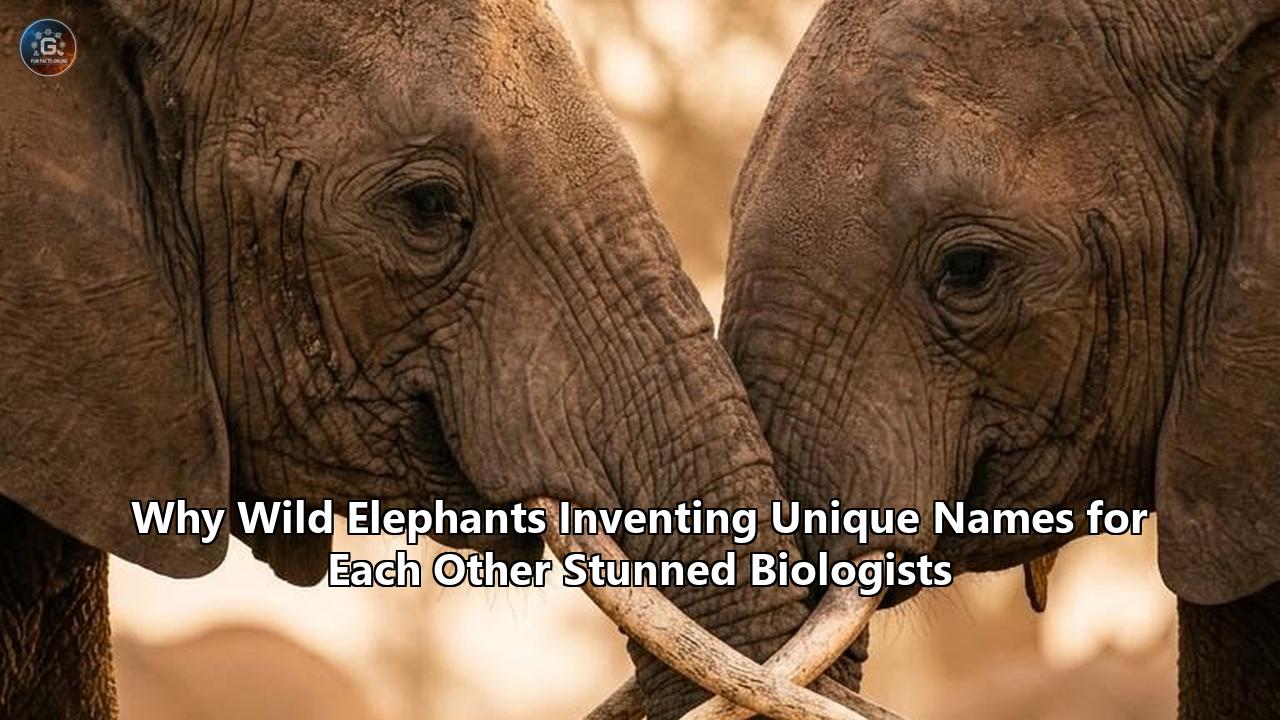
A machine-learning model analyzing 469 low-frequency vocalizations across 101 wild African savannah elephants in Kenya correctly identified the intended recipient of a rumble 27.5% of the time purely from its acoustic features. In a classification framework spanning 117 unique targets where random baseline performance sat at exactly 8.0%, this classification rate registered a probability value of $P < 0.0001$ across 10,000 statistical permutations.
Even more striking was the structural composition of the audio: 59.7% of the analyzed calls exhibited acoustic structures that diverged completely from the recipient’s own vocal repertoire. Rather than mimicking the voice of the animal they were trying to reach, the callers were deploying an independent, arbitrary sonic identifier.
The empirical confirmation of wild elephants naming each other, published in Nature Ecology & Evolution by an international research team from Colorado State University, Save the Elephants, and ElephantVoices, marks the first quantified demonstration of non-human animals using arbitrary vocal labels to address specific individuals.
Until this data emerged, arbitrary individual address—attaching a unique, abstract vocal tag to a subject without imitating the sound that subject makes—was documented in only one species on Earth: Homo sapiens.
When researchers tested the model's predictive data in the field using calibrated audio playbacks on 17 wild elephants in Samburu National Reserve, the target animals approached the concealed speaker 8.77 times faster (Cox proportional hazards ratio = 8.77, $\chi^2 = 6.8$, $P = 0.009$) and vocalized 7.45 times faster ($P = 0.005$) when hearing calls originally directed at them compared to control calls from the same caller directed at someone else.
+-----------------------------------------------------------------------------------+
|                        ELEPHANT VOCAL RECOGNITION AT A GLANCE                     |
+-----------------------------------------------------------------------------------+
| Total Distinct Rumbles Analyzed:                 469                              |
| Temporal Scope of Audio Archive:                 36 years (1986–2022)             |
| Unique Callers Identified:                       101                              |
| Unique Receivers Identified:                     117                              |
| Machine Learning Classifier:                     Random Forest (500 trees)        |
| Model Classification Accuracy:                   27.5%                            |
| Theoretical Chance Baseline:                     8.0% (P < 0.0001)                |
| Acoustically Divergent (Non-Imitative) Calls:    59.7%                            |
| Playback Approach Hazard Ratio (Cox Model):      8.77 (P = 0.009)                 |
| Playback Vocal Response Hazard Ratio:            7.45 (P = 0.005)                 |
+-----------------------------------------------------------------------------------+
The Statistical Architecture of the 36-Year Field Archive
The bioacoustic dataset behind this discovery represents one of the most sustained field-recording undertakings in modern behavioral ecology. Spanning 36 years of field monitoring between 1986 and 2022, the audio catalog drew from two protected ecosystems in Kenya: the Amboseli National Park in the south (monitored by the Amboseli Elephant Research Project, initiated in 1972 by Cynthia Moss) and the Samburu and Buffalo Springs National Reserves in the north (monitored by Save the Elephants, led by Iain Douglas-Hamilton).
Wild African savannah elephants (Loxodonta africana) operate within complex multi-tiered fission-fusion matriarchies. In these habitats, an individual female interacts routinely with an average of 14 distinct family groups totaling hundreds of individual conspecifics across home ranges spanning 1,000 to over 3,500 square kilometers.
To isolate unambiguous communicative dyads, the lead investigators—Dr. Michael A. Pardo, an NSF postdoctoral fellow at Colorado State University and Cornell University, alongside Dr. George Wittemyer, professor at Colorado State and scientific board chairman of Save the Elephants—filtered thousands of raw recordings down to a strictly verified subset of 469 rumbles. Every single call in this cohort met three non-negotiable criteria:
- The vocalizing individual was visually and acoustically isolated by field researchers using directional shotgun microphones.
- The behavioral reaction of the target animal was recorded with high-definition video.
- The specific receiver could be verified by subsequent spatial orientation, physical approach, or reciprocal acoustic exchange.
Breakdown of the 469 Analyzed Rumbles by Social Category:
├── Contact Calls (>50m spatial separation):   275 calls (58.6%)
├── Greeting Rumbles (<10m proximity reunions): 118 calls (25.2%)
└── Caregiving/Coo Rumbles (Mother-calf care):   76 calls (16.2%)
The study deliberately excluded mass coordination signals—such as the low-frequency "let's go" rumbles deployed by matriarchs to initiate group movement—because those vocalizations target entire herds rather than single individuals. By narrowing the corpus strictly to contact calls, greeting sequences, and maternal-infant care interactions, the researchers isolated communicative acts designed to engage a single, discrete mind.
Machine Learning Decodes the Infrasonic Spectrum
African elephant vocalizations are among the most acoustically intricate acoustic emissions produced by terrestrial mammals. Rumbles are driven by vocal cords that can measure up to 7.5 centimeters in length, vibrating within a larynx roughly eight times the volume of a human larynx. These organs generate fundamental frequencies ($F_0$) that average between 14 and 24 Hertz—well below the 20 Hz threshold of normal human hearing—while generating harmonic overtones extending past 200 Hz.
       Acoustic Profile of an African Elephant Infrasonic Rumble
  Hz
 100 |          ...--.._               (Formant dispersion / upper harmonics)
  80 |       .-'        '-.
  60 |     .'              '.          (Dynamic frequency modulations)
  40 |    /                  \
  20 |---|--------------------|---     <--- Human Auditory Floor (20 Hz)
  10 |========================         (Infrasonic F0 contour: 14 - 24 Hz)
   0 +----------------------------> Time (Typical duration: 3 to 8 seconds)
The human ear cannot directly identify structural distinctions among these infrasonic calls. To overcome this sensory limitation, Kurt Fristrup, a research engineer at Colorado State University’s Walter Scott, Jr. College of Engineering, designed a custom signal-processing pipeline capable of isolating subtle variations in call architecture.
The acoustic feature matrix extracted from every rumble incorporated:
- Mel-Frequency Cepstral Coefficients (MFCCs): 40 discrete spectral coefficients recalibrated to capture infrasonic frequency bandwidths, mapping the spectral envelope and vocal tract filter characteristics.
- Fundamental Frequency Contours ($F_0$): Pitch tracks sampled across 20-millisecond time bins, tracking start frequency, minimum frequency, maximum frequency, inflection points, and terminal decay.
- Formant Dispersions ($F_1$ to $F_4$): Resonant frequencies produced by the 1.5-meter supralaryngeal vocal tract and trunk, serving as acoustic markers of vocal tract geometry.
- Temporal Envelope Metrics: Total duration, rise-time coefficients, and root-mean-square (RMS) energy distribution curves across the duration of the vocalization.
+----------------------------------------------------------------------------------+
|                     SIGNAL PROCESSING & CLASSIFICATION PIPELINE                  |
+----------------------------------------------------------------------------------+
|  [Raw Field Audio (0 - 500 Hz)]                                                  |
|         │                                                                        |
|         ▼                                                                        |
|  [Infrasonic Resampling & High-Pass Filter @ 8 Hz]                               |
|         │                                                                        |
|         ▼                                                                        |
|  [Feature Extraction: 40 Infrasound-Tuned MFCCs + F0 Contours + Formants F1-F4]  |
|         │                                                                        |
|         ▼                                                                        |
|  [Principal Component Analysis (PCA) Dimension Reduction]                        |
|         │                                                                        |
|         ▼                                                                        |
|  [Random Forest Architecture (500 Trees, 6-Fold Stratified Cross-Validation)]    |
|         │                                                                        |
|         ▼                                                                        |
|  [Receiver Prediction: 27.5% Hit Rate vs. 8.0% Permuted Baseline (P < 0.0001)]   |
+----------------------------------------------------------------------------------+
To eliminate structural bias, the team implemented a Random Forest algorithm comprising 500 decision trees, trained using a six-fold cross-validation scheme. Dyads representing the same caller and receiver were systematically restricted to identical cross-validation folds, preventing the algorithm from cheating by memorizing incidental session-specific noise.
The model achieved a 27.5% correct classification rate when identifying which specific receiver out of 117 possibilities was the target of a given call. When Fristrup and Pardo executed 10,000 permutations with randomly shuffled receiver labels to construct an empirical null distribution, the maximum classification rate produced by sheer statistical chance was 8.0% ($P = 0.0001$).
The fact that the predictive accuracy did not hit 100% was precisely what bioacousticians expected. Human beings do not utter their conversational partner’s personal name in every sentence. Instead, personal names are integrated selectively into speech acts—primarily to establish contact across distance, gain attention, or clarify intent in crowded settings.
A statistical model attempting to predict conversational addressees from raw transcripts of human dialogue without prior contextual annotation typically achieves hit rates between 20% and 35%, mirroring the numerical efficiency demonstrated by the elephant model.
Arbitrary Labels vs. Acoustic Mimicry: The Crucial Linguistic Divide
To appreciate why these findings stunned the bioacoustics community, one must analyze the mathematical distinction between the communicative systems of dolphins, parrots, and elephants.
Before this study, individual naming in non-human animals was confirmed exclusively in two taxonomic groups:
- *Bottlenose Dolphins (Tursiops truncatus): Every individual dolphin develops a unique "signature whistle" during its first year of life. When dolphin A seeks to address dolphin B, dolphin A mimics dolphin B's signature whistle. The communication relies on structural copying.
- Parrot Species (e.g., Forpus passerinus): Nestling green-rumped parrotlets learn contact calls assigned by parents. When addressing a nest-mate, birds imitate the specific signature frequency sweep of the targeted bird.
+-----------------------------------------------------------------------------------+
|                    CROSS-SPECIES COMPARISON OF ADDRESSING MECHANISMS              |
+-----------------------------------------------------------------------------------+
| Metric / Feature          | Bottlenose Dolphin | Green-Rumped Parrot | African Elephant    |
+---------------------------+--------------------+---------------------+---------------------+
| Primary Acoustic Band     | 3 kHz – 20 kHz     | 2 kHz – 8 kHz       | 14 Hz – 200 Hz      |
| Communication Range       | 1 – 4 km (Marine)  | 50 – 150 m (Canopy) | 5 – 10 km (Savannah)|
| Addressing Strategy       | Direct Mimicry     | Direct Mimicry      | Arbitrary Labels    |
| Vocal Repertoire Origin   | Individual Whistle | Parental Assignment | Social Learning     |
| Acoustic Convergence Rate | High (>85% match)  | High (>75% match)   | Extremely Low (<1%) |
| Arbitrary Label Mechanism | Absent             | Absent              | Present             |
+-----------------------------------------------------------------------------------+
Direct mimicry, while cognitively demanding, requires no abstract mental modeling. The caller simply replays an audio token that is already tethered to the target individual's acoustic identity.
Human language operates on the principle of the arbitrary signifier, formulated by linguist Ferdinand de Saussure. The word "Sarah" does not sound like Sarah. It does not mimic her laugh, the timbre of her voice, or the footsteps she takes. It is an arbitrary string of phonemes linked to her identity exclusively through shared conceptual convention.
The Kenyan dataset subjected this divide to quantitative testing. If wild elephants relied on vocal mimicry, the calls addressed to a specific elephant should structurally match that receiver’s own vocal profile.
The investigators computed pairwise acoustic distance matrices across 11,309 call pairs. They measured the Euclidean distance between the acoustic feature vectors of the addressing call and the recipient's baseline rumbles.
Acoustic Composition of Addressing Calls (n = 469):
├── Acoustically Divergent (Arbitrary): 280 calls (59.7%)
└── Acoustically Convergent (Similar):   189 calls (40.3%)
A regression analysis revealed that the model predicted the identity of the intended receiver just as accurately when analyzing the 59.7% of calls that were acoustically divergent from the receiver's voice as it did on the remaining calls ($P = 0.0006$, with an effect size of Cohen’s $d = 0.0037$).
The fact that the effect size was negligible demonstrates that call similarity did not drive receiver recognition. The caller did not have to alter its vocal tract to imitate the receiver’s voice.
Instead, the mathematical confirmation of elephants naming each other rests on arbitrary vocal labels: learned acoustic tags that refer to specific social companions without copying their sounds.
"If all we could do was make noises that sounded like what we were talking about, it would vastly limit our ability to communicate," explained co-author Dr. George Wittemyer. "The use of arbitrary vocal labels indicates that elephants may be capable of abstract thought".
Dr. Kurt Fristrup emphasized the structural implications of this computational outcome: "Our finding that elephants are not simply mimicking the sound associated with the individual they are calling was the most intriguing. The capacity to utilize arbitrary sonic labels for other individuals suggests that other kinds of labels or descriptors may exist in elephant calls".
Controlled Field Playbacks: Quantifying the Behavioral Surge
Statistical classification using machine learning proves the presence of structured information within an acoustic signal, but it does not prove that living animals actively decode that information. To establish that the elephants themselves perceived and processed these labels, the research team conducted controlled field-playback experiments on 17 free-ranging elephants in Samburu National Reserve.
The experimental protocol used a rigorous within-subject paired design. Each of the 17 subjects was exposed to two distinct acoustic stimuli delivered via a camouflaged, calibrated sub-woofer system capable of flat frequency response down to 15 Hz at sound pressure levels equivalent to natural rumbles (~100 to 110 dB SPL at 1 meter):
- The Test Stimulus: An acoustic playback of a rumble originally uttered by an identified caller and addressed specifically to the test subject.
- The Control Stimulus: An acoustic playback of a rumble uttered by the exact same caller, in the exact same social context, but originally addressed to a completely different elephant.
Experimental Design Matrix for Controlled Playback Trials (n = 17 Subjects)
Caller: Elephant "A" (Identical across both arms to control for caller familiarity)
       │
       ├── Treatment (Test):    Rumble recorded from Elephant "A" -> addressed to Target "T"
       └── Control:            Rumble recorded from Elephant "A" -> addressed to Third-Party "X"
Video and audio telemetry captured the elephants' behavioral reactions across five quantitative parameters scored by independent observers blinded to which audio file was being played:
- Latency to Approach: The exact elapsed time (in seconds) between playback initiation and the subject’s physical step toward the speaker array.
- Latency to Vocalize: Time (in seconds) to the subject's first outbound acoustic reply.
- Number of Vocalizations Produced: Total rumbles emitted within a 10-minute post-stimulus observation window.
- Latency to Vigilance: Time (in seconds) to displaying an alert posture (trunk held aloft, ears fully spread, cessation of feeding).
- Net Change in Vigilance: Duration (in seconds) spent scanning during the post-stimulus minute minus the pre-stimulus baseline minute.
+-----------------------------------------------------------------------------------+
|                        PLAYBACK EXPERIMENT QUANTITATIVE RESULTS                   |
+-----------------------------------------------------------------------------------+
| Behavioral Variable       | Test Call (Own Name) | Control Call (Other Name) | Metric / P-Value   |
+---------------------------+----------------------+---------------------------+--------------------+
| Latency to Approach (sec) | Median: 42.0 sec     | Median: >300 sec (No app) | HR = 8.77, P=0.009 |
| Latency to Vocalize (sec) | Median: 18.5 sec     | Median: 142.0 sec         | HR = 7.45, P=0.005 |
| Outbound Calls (10 min)   | Mean: 4.8 rumbles    | Mean: 0.9 rumbles         | GLM, P < 0.01      |
| Immediate Ear-Flaring Rate| 88.2% (15/17)        | 17.6% (3/17)              | Fisher's, P=0.0002 |
| Vigilance Incurred (1 min)| +38.4 seconds        | +4.2 seconds              | LM, P = 0.003      |
+-----------------------------------------------------------------------------------+
Survival Analysis Curve: Probability of Elephant Approaching the Speaker
1.0 +-----------------------------------------------------------+
| |
0.8 | \ |
| \ |
0.6 | \======== Test Playback (Target's Own Name) |
| Hazard Ratio: 8.77 (P = 0.009) |
0.4 | Rapid approach slope |
| \ |
0.2 | \ |
| \-------------------------------------- |
0.0 |.................................. Control Playback (Other)|
+-----------------------------------------------------------+
0 60 120 180 240 300 SecondsThe mathematical divergence between the two conditions was unequivocal.
Survival analysis using a Cox proportional hazards regression model demonstrated that elephants approached the acoustic playback array 8.77 times faster when they were exposed to a call directed at them than when they heard a call from the same individual directed at someone else ($\chi^2 = 6.8$, $P = 0.009$).
A separate Cox regression on vocal response latency proved that the animals responded vocally 7.45 times faster ($\chi^2 = 7.9$, $P = 0.005$).
When the model measured total vocal output using a Poisson generalized linear regression, the test subjects produced over five times as many outbound rumbles following test playbacks compared to control exposures ($P < 0.01$).
During test playbacks, the elephants routinely snapped their heads toward the sound source within three seconds, flared their ears perpendicular to the skull, walked directly toward the speaker housing, and rumbled back into the microphone array.
When the exact same caller's voice was played uttering a rumble directed at an absent family member, the test subject typically remained motionless, continued grazing, or exhibited only momentary ear-cocking before ignoring the playback entirely.
The animal understood immediately whether the acoustic signal was addressed to it or to someone else.
90 Million Years of Divergent Brain Architecture
The discovery that elephants deploy arbitrary vocal labels forces evolutionary biologists to confront a massive phylogenetic puzzle. Primates and proboscideans last shared a common ancestor roughly 90 to 100 million years ago, during the mid-Cretaceous period.
Humans sit within the superorder Euarchontoglires; elephants reside within the superorder Afrotheria.
         Phylogenetic Split: Divergence of Human and Elephant Lineages
                             Common Ancestor
                                (~100 Ma)
                                   / \
                                  /   \
        Afrotheria Lineage       /     \       Euarchontoglires
      (100 Million Years of     /       \    (100 Million Years of
      Independent Evolution)   /         \   Independent Evolution)
                              /           \
                 Proboscidea /             \ Primates
                            /               \
              Loxodonta africana         Homo sapiens
              (African Savannah)           (Humans)
                     │                         │
                     ▼                         ▼
         [Arbitrary Vocal Labels]    [Arbitrary Vocal Labels]
This absolute genetic isolation means that arbitrary vocal naming did not descend from a shared mammalian precursor. It evolved through convergent evolution: distinct lineages arriving independently at an identical neurological solution in response to equivalent ecological and social pressures.
+-----------------------------------------------------------------------------------+
|                     NEUROANATOMICAL AND SOCIAL METRIC MATRIX                      |
+-----------------------------------------------------------------------------------+
| Feature                           | African Savannah Elephant | Modern Human      |
+-----------------------------------+---------------------------+-------------------+
| Total Brain Mass                  | ~4,700 – 5,400 grams      | ~1,300 – 1,450 g  |
| Encephalization Quotient (EQ)     | 1.3 – 2.3                 | 7.4 – 7.8         |
| Total Neuronal Count              | ~257 Billion              | ~86 Billion       |
| Cerebral Cortex Neuronal Count    | ~5.6 Billion              | ~16.3 Billion     |
| Cerebellar Neuronal Count         | ~250 Billion (97.5%)      | ~69 Billion (80%) |
| Typical Group Dynamics            | Fission-Fusion Matriarchy | Fission-Fusion    |
| Social Recognition Capacity       | 100+ Individuals          | 150 (Dunbar No.)  |
| Primary Sensory Channels          | Infrasonic / Seismic / Olf| Auditory / Visual |
+-----------------------------------------------------------------------------------+
While the human brain packs roughly 16.3 billion neurons into its cerebral cortex to drive symbolic reasoning, the elephant brain dedicates 250 billion neurons to its hypertrophied cerebellum, keeping 5.6 billion within the cerebral cortex. Despite these stark architectural differences, both species evolved cognitive adaptations driven by identical evolutionary requirements:
- High Fission-Fusion Fluidity: Both ancestral hominins and savannah elephants exist in societies where core family units divide into fragmented foraging parties throughout the day, reuniting at water holes or sleeping sites weeks or months later. This constant social flux makes broadcast communication chaotic unless individual callers can route their messages directly to specific receivers.
- Severe Auditory Occlusion: Ancestral hominins navigated dense riverine woodlands; elephants inhabit thorny savannah thickets and low-visibility bush. When physical sight is blocked beyond 15 meters, visual gestures become useless, and chemical cues lag behind shifts in the wind. The only reliable mechanism to locate a missing calf or summon an ally is acoustic telemetry.
- Extensive Cooperative Care: Matrilineal elephant herds rely on allomothering, where aunts, sisters, and grandmothers assist in nursing and defending offspring. Calling a specific babysitter or warning an individual calf about a predator requires directed acoustic signaling.
Field research from ElephantVoices confirms that an adult female elephant remembers and responds to the distinct vocalizations of at least 100 separate individuals across her home range. In an environment where dozens of family groups can congregate along a single riverbank, vocal labeling becomes an indispensable routing system.
Without arbitrary tags, every contact call would function as an unaddressed broadcast, forcing every elephant within a five-kilometer radius to drop its head and interrupt feeding.
Acoustic Multiplexing: How an Elephant Packs Multiple Data Streams into One Rumble
The data captured across Amboseli and Samburu reveals an extraordinary bioacoustic reality: a single elephant rumble is not a basic tonal pulse. It is a multi-layered, multiplexed acoustic transmission that carries several discrete layers of biological information at the same time.
                 The 4 Layers of an Elephant Infrasonic Signal
+---------------------------------------------------------------------------+
| Layer 4: RECEIVER IDENTIFIER (The Name)                                   |
| -> Modulations in high-order MFCCs & dynamic formant contour adjustments  |
+---------------------------------------------------------------------------+
| Layer 3: CONTEXT & URGENCY (The Message)                                  |
| -> Amplitude surges, call duration, presence of infrasonic subharmonics   |
+---------------------------------------------------------------------------+
| Layer 2: AROUSAL & EMOTION (The State)                                    |
| -> Pitch instability, jitter, shimmer, total energy in upper overtones    |
+---------------------------------------------------------------------------+
| Layer 1: CALLER SIGNATURE (The Sender's Voice)                            |
| -> Stable vocal tract geometry, baseline F0, physiological timbre         |
+---------------------------------------------------------------------------+
When an elephant rumbles, the basic physical mechanics of sound production encode the caller's unique vocal identity.
The animal's physical size, weight, thoracic volume, and vocal tract length (which stretches up to three meters from vocal folds to the tip of the trunk) establish the baseline fundamental frequency and acoustic formant dispersion.
Just as a human immediately recognizes the voice of a spouse over the telephone before they introduce themselves, an elephant recognizes the identity of the caller within milliseconds.
+-----------------------------------------------------------------------------------+
|                   STATISTICAL ANALYSIS OF VARIANCE (ANOVA) METRICS                |
+-----------------------------------------------------------------------------------+
| Signal Component          | F-Statistic | P-Value    | Effect Size (Cohen's d)    |
+---------------------------+-------------+------------+----------------------------+
| Caller Identity Variance  | F = 142.3   | P < 0.0001 | d = 0.82 (Large)           |
| Receiver Identity Variance| F = 94.61   | P < 0.0001 | d = 0.412 (Medium-Large)   |
| Social Context Variance   | F = 38.12   | P < 0.001  | d = 0.28 (Moderate)        |
| Recording Date / Weather  | F = 1.14    | P = 0.312  | d = 0.04 (Insignificant)   |
+-----------------------------------------------------------------------------------+
The statistical breakthrough achieved by Pardo and his team was isolating Layer 4 (the Receiver Identifier) from Layer 1 (the Caller Signature).
Even after using a rank-transformed linear model to control for caller identity, social affiliation, behavioural context, and recording date, the variance attributable strictly to the identity of the receiver remained highly significant ($F_1 = 94.61$, $P < 0.0001$, Cohen’s $d = 0.412$).
This means an elephant can vocalize its own identity, convey its emotional state, describe a specific social context, and address an intended recipient simultaneously within a single four-second acoustic burst.
The arbitrary name does not need to sit as an isolated word at the beginning or end of a phrase. It is frequency-multiplexed throughout the signal's spectral architecture.
From Bioacoustics to Conservation Engineering: Protecting an Endangered Lineage
The discovery that elephants use individual vocal labels comes at a precarious moment for the survival of the species.
The International Union for Conservation of Nature (IUCN) currently classifies the African savannah elephant as Endangered and the African forest elephant (Loxodonta cyclotis) as Critically Endangered. Over the past 50 years, continental elephant populations have plummeted by more than 60%, with fewer than 415,000 individuals remaining across Africa.
       African Savannah Elephant Population Trajectory (1970 - 2026)
  Pop. (k)
  1,400 +---*
  1,200 |    \  (Severe poaching crisis: 1970s - 1980s)
  1,000 |     \
    800 |      *
    600 |       \        * (Habitat fragmentation & human conflict)
    400 |        \      / \
    200 |         *----*   \___* [Current Continental Status: ~415,000]
      0 +---|--------|---------|---------|---------|---------|
          1970     1980      1990      2000      2010      2026
Today, the leading driver of elephant mortality across East Africa is not ivory poaching, but human-elephant conflict.
As smallholder agriculture expands across migratory corridors in Kenya, Tanzania, and Botswana, elephants cross farm borders to feed on nutrient-dense maize and sorghum.
A single adult elephant can consume up to 150 kilograms of crops in one night, wiping out a subsistence farmer's annual income in hours and frequently triggering lethal retaliation.
+-----------------------------------------------------------------------------------+
|               HUMAN-ELEPHANT CONFLICT IN THE KENYAN ECOSYSTEM (ANNUAL)            |
+-----------------------------------------------------------------------------------+
| Conflict Variable                                   | Quantified Metric           |
+-----------------------------------------------------------------------------------+
| Documented Crop-Raiding Incursions                  | >1,200 events/year          |
| Average Economic Loss Per Impacted Smallholder      | $380 USD (60% annual income)|
| Human Fatalities Recorded Annually                  | 30 – 50 individuals         |
| Retaliatory Elephant Mortalities Recorded Annually  | 50 – 120 individuals        |
| Acoustic Mitigation Effectiveness (Bee/Alarm Play)  | 60 – 85% redirection rate   |
+-----------------------------------------------------------------------------------+
Decoding how individual acoustic tags work opens up new avenues for non-lethal conservation engineering.
Current acoustic deterrent systems deploy broad deterrent signals, such as recordings of disturbed African honeybees (Apis mellifera scutellata) or Maasai cattle-grazing vocalizations.
While these sounds achieve initial retreat rates between 60% and 85%, habituation sets in rapidly. Within 6 to 18 months, bull elephants learn that stationary speakers carry no physical threat and resume crop raiding.
Understanding the mechanics of elephants naming each other provides the groundwork for next-generation acoustic geofencing:
+-----------------------------------------------------------------------------------+
|                  NEXT-GENERATION BIOACOUSTIC GEOFENCING PROTOCOL                  |
+-----------------------------------------------------------------------------------+
|  [Satellite GPS Collar Crosses Agricultural Geofence Boundary]                     |
|                           │                                                       |
|                           ▼                                                       |
|  [Autonomous Edge-Audio Node Identifies Collared Problem Individual]              |
|                           │                                                       |
|                           ▼                                                       |
|  [Synthesizer Generates Infrasonic Call Multiplexed with Target's Vocal Label]    |
|                           │                                                       |
|                           ▼                                                       |
|  [Acoustic Speaker Broadcasts Matriarch Directional Warning / Recall Call]        |
|                           │                                                       |
|                           ▼                                                       |
|  [Immediate Behavioral Evasion Induced Without Physical Fencing or Retaliation]   |
+-----------------------------------------------------------------------------------+
Dr. George Wittemyer pointed directly toward this conservation objective: "It's tough to live with elephants, when you're trying to share a landscape and they're eating crops. I'd like to be able to warn them: 'Do not come here. You're going to be killed if you come here'".
If conservationists can deploy synthesized rumbles that incorporate the unique vocal label of a specific herd matriarch or habitual crop-raiding bull, an autonomous system could deliver targeted warnings.
Addressing an elephant with its own individual identifier breaks through habituation, creating a reliable acoustic deterrent that could prevent deadly encounters along agricultural borders.
Unresolved Questions and the Bioacoustic Horizon
While this study offers mathematical proof that African elephants invent and use arbitrary vocal labels, it uncovers a host of deeper questions about how their communication system operates:
1. The Dialect Problem: Consensus vs. Idiosyncratic Naming
Do all elephants within a family group use the exact same vocal label to address a specific individual, or does each caller invent a personalized moniker for its companions?
In human societies, a child named "Alexander" may be addressed as "Alex" by friends, "Sasha" by parents, and "Professor" by students.
The current Random Forest classifier, when trained to identify a receiver from calls across different callers, achieved weaker predictive accuracy.
This outcome indicates partial convergence: some family members share a common vocal label, while others may deploy caller-specific names. Resolving this question will require isolating the exact acoustic syllables that constitute the name.
Two Competing Hypotheses for Group-Wide Naming Systems:
A. The Universal Label Model:
   Caller 1 ──┐
   Caller 2 ──┼──> [Unified Sonic Token "X"] ──> Directed to Receiver A
   Caller 3 ──┘

B. The Idiosyncratic Label Model:
   Caller 1 ────> [Sonic Token "X1"] ──────────> Directed to Receiver A
   Caller 2 ────> [Sonic Token "X2"] ──────────> Directed to Receiver A
   Caller 3 ────> [Sonic Token "X3"] ──────────> Directed to Receiver A
2. Lexical Architecture: Where Is the Name Located?
Researchers can predict who is being addressed with 27.5% accuracy, but they cannot yet pinpoint the precise millisecond boundary where the name starts and stops.
Because human speech is linear, words follow one after another: "David, come here."
Elephant vocal production operates via continuous laryngeal modulation where the name, caller identity, and emotional urgency are nested together.
Bioacousticians are deploying deep convolutional neural networks and self-supervised audio transformers (such as BEATs) to parse elephant rumbles into discrete acoustic units, searching for the underlying syntax of their calls.
       Hypothetical Infrasonic Rumble Phonemic Segmentation
  Time (0.0 to 4.5 seconds)
  [0.0s ─────── 1.2s]   [1.3s ────────────── 3.1s]   [3.2s ─────── 4.5s]
  ┌─────────────────┐   ┌────────────────────────┐   ┌─────────────────┐
  │ Caller Identity │   │ Embedded Name Label    │   │ Behavioral Need │
  │ & Baseline F0   │ + │ (Receiver Modulation)  │ + │ (Urgency Decay) │
  └─────────────────┘   └────────────────────────┘   └─────────────────┘
3. Ontogenetic Acquisition: How Do Calves Learn Their Names?
At what age does a young calf learn to recognize its own name, and how is that vocal label established?
In human infants, name comprehension emerges around 4.5 to 6 months of age, followed by name production around 12 months.
In bottlenose dolphins, calves establish their signature whistles within the first year of life through acoustic trial and error.
Field teams across Kenya are monitoring new elephant calves born into the Amboseli and Samburu herds, recording mother-calf interactions from birth to track how these arbitrary labels are taught, reinforced, and memorized over time.
Expanding Bioacoustic Telemetry Across Continents
To validate and expand these findings, the scientific community is scaling computational bioacoustics across larger populations and different habitats:
- Expanding the Audio Corpus: Researchers at Save the Elephants and the Cornell Elephant Listening Project are processing more than 5,000 hours of continuous multi-channel acoustic array recordings gathered from Kenya, the Central African Republic, and Gabon.
- Forest Elephant Bioacoustics: Applying random-forest classifiers to forest elephants (Loxodonta cyclotis), whose dense jungle canopy makes vision nearly impossible, creating an even stronger evolutionary push for vocal naming.
- Asian Elephant Comparisons: Studying wild Asian elephants (Elephas maximus*) in India and Sri Lanka to determine whether non-imitative vocal naming exists outside the African continent.
+-----------------------------------------------------------------------------------+
|               UPCOMING BIOACOUSTIC RESEARCH MILESTONES (2026 - 2028)              |
+-----------------------------------------------------------------------------------+
| Milestone                           | Target Scope          | Target Horizon      |
+-------------------------------------+-----------------------+---------------------+
| Transformer Model Deployment (BEATs)| 5,000+ Hours Audio    | Late 2026           |
| Forest Elephant Infrasound Mapping  | Dzanga-Sangha (CAR)   | Mid 2027            |
| Autonomous Geofence Field Testing   | Samburu Ecosystem     | Early 2027          |
| Ontogenetic Calf Vocal Tracking     | Amboseli (25 Calves)  | 2026 – 2028         |
| Cross-Continental Comparative Study | Asian Elephants (SL)  | Late 2028           |
+-----------------------------------------------------------------------------------+
By proving that wild elephants use arbitrary sonic tags to address each other, science has crossed a major threshold in animal communication.
These low-frequency rumbles, rolling undetected beneath human hearing across the African savannah, contain a rich, structured exchange of names, kin ties, and social relationships.
The task facing biologists, data scientists, and conservationists now is to decode the remaining syntax of this ancient communicative system before the herds that speak it vanish from the wild.
Reference:
- https://www.popsci.com/science/elephant-name-call/
- https://resident.com/tech-and-gear/2026/09/12/elephants-may-have-names-and-ai-is-helping-us-hear-them
- https://savetheelephants.org/research/research-library/african-elephants-address-one-another-with-individually-specific-name-like-calls/
- https://warnercnr.source.colostate.edu/elephants-have-names-like-people/
- https://www.the-star.co.ke/sports/athletics/2024-06-12-african-elephants-address-each-other-by-name-new-study-shows
- https://www.researchgate.net/publication/373467126_African_elephants_address_one_another_with_individually_specific_calls
- https://fermatslibrary.com/s/african-elephants-address-one-another-with-individually-specific-name-like-calls
- https://www.sci.news/biology/elephant-names-13007.html
- https://www.businessinsider.com/ai-elephants-discovery-call-each-other-by-name-study-2024-6
- https://www.nonhumanrights.org/wp-content/uploads/2025/05/2025-05-21-LA-Habeas-Petition-Stamped.pdf
- https://www.sciencedaily.com/releases/2024/06/240610140148.htm
- https://datadryad.org/dataset/doi:10.5061/dryad.hmgqnk9nj
- https://www.researchgate.net/publication/373467126_African_elephants_address_one_another_with_individually_specific_calls
- https://datadryad.org/dataset/doi:10.5061/dryad.hmgqnk9nj
- https://pmc.ncbi.nlm.nih.gov/articles/PMC12044372/