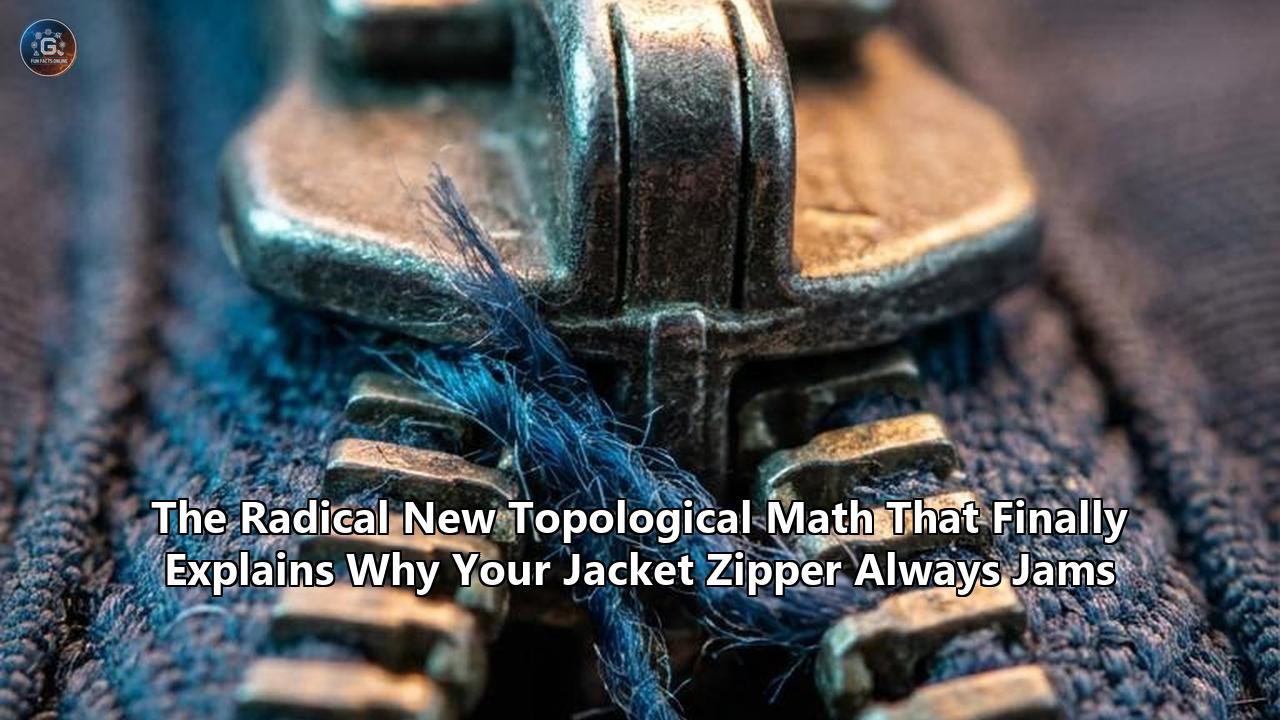
The Mathematics of a Halt State: How Topology Solved the Century-Old Problem of Zipper Jams
On May 14, 2026, a consortium of applied mathematicians, physicists, and mechanical engineers from the Massachusetts Institute of Technology and ETH Zurich published a highly unusual paper in Physical Review Letters. The subject matter was not quantum entanglement, nor was it the fluid dynamics of plasma. It was the humble, universally aggravating mechanics of the jacket zipper.
For over a century, the zipper has been the undisputed king of temporary fastening, utilized in everything from high-altitude flight suits to basic camping tents. It is also uniquely prone to catastrophic mechanical failure at the worst possible moments. Until this month, the engineering consensus regarding zipper jams largely blamed manufacturing tolerances, frayed textiles, or simple user error. If a zipper snagged, the logic went, a stray thread or a misaligned pull had physically obstructed the mechanical pathway.
The MIT and ETH Zurich team proved this conventional wisdom entirely false.
Through rigorous application of knot theory, topological data analysis, and non-linear friction modeling, the researchers demonstrated that a zipper jam is not a random accident caused by debris. Instead, it is a highly predictable topological phase transition—a mathematical certainty dictated by the geometry of interdigitating slider mechanisms. They proved that under specific tension thresholds, the mechanical state of a zipper collapses into a localized mathematical knot, halting the system completely.
This research bridges the gap between abstract mathematical models—specifically a graph rewrite system known as "zipper logic"—and real-world materials science. By mapping the physical teeth of a zipper onto a mathematical braid group, scientists have finally decoded the exact kinematic sequence that causes a slider to lock violently in place.
The implications stretch far beyond the garment industry. Aerospace agencies, deep-sea exploration firms, and manufacturers of surgical equipment rely heavily on airtight, watertight, and fail-proof interlocking mechanisms. Understanding the precise mathematical point of failure provides the blueprint for engineering the first truly jam-proof fasteners, fundamentally altering a $15 billion global industry that has relied on trial and error for more than a hundred years.
The Anatomy of a Century-Old Mechanism
To understand the advanced mathematics of a jammed slider, one must first dissect the physical geometry of the zipper itself. The modern zipper, originally patented as the "Hookless No. 2" by Gideon Sundback in 1913, operates on a deceptively simple mechanical premise.
A standard zipper consists of two rows of protruding teeth, often called scoops, which are affixed to reinforced fabric tapes. These teeth are precisely shaped with a convex head (the pin) on one side and a concave hollow (the pocket) on the other. The magic of the mechanism lies entirely within the slider—a small, hollow piece of metal or polymer containing a Y-shaped channel.
When the slider moves upward, the two diverging branches of the "Y" force the teeth together at a highly specific angle, wedging the pin of one tooth into the pocket of the opposing tooth. Because the teeth are staggered—offset by exactly half a pitch length—they interlock sequentially. Once joined, the physical geometry of the interlocked teeth prevents them from pulling apart laterally. The only way to separate them is by reversing the slider, which uses a wedge at the center of the "Y" channel (the diamond) to forcefully pry the interlocked teeth apart.
Despite significant advances in materials—from brass and aluminum to injection-molded polyoxymethylene (POM) and coiled nylon monofilament—the core geometry of Sundback’s Y-channel has remained untouched. It is a system that relies entirely on precise spatial alignment.
When engineers attempt to analyze the limits of this alignment, they usually look to flat pull strength and lateral tension. At major manufacturing testing centers, such as YKK’s sprawling R&D facility in Kurobe, Japan, zippers are subjected to brutal mechanical stress tests. Using equipment like the MTS-E44.304 metal material tensile testing machine, engineers apply hundreds of newtons of force to interlocked zippers to see when the teeth warp or the fabric tears.
However, tensile strength tests measure static failure. A jam is a dynamic failure.
In a dynamic system, the slider is in motion, applying localized pressure to exactly three or four teeth at any given millisecond. The exact angle of the pull, the lateral tension on the fabric tape, the stiffness of the teeth, and the microscopic friction coefficient between the slider wall and the polymer scoop all converge in a chaotic physical environment.
When a stray piece of fabric enters the Y-channel, it immediately alters the internal volume and the friction profile of the slider. But this alone does not cause the severe, unyielding lock that ruins jackets and destroys tents. To explain the violent lock-up, the MIT and ETH Zurich researchers had to look past classical Newtonian mechanics and delve into the topology of continuous deformations.
Zipper Logic and the Graph Rewrite System
The key to unlocking the mechanism of the jam came from an unexpected source: theoretical computer science. In 2014, mathematician Marius Buliga introduced a concept called "zipper logic," an artificial chemistry and graph rewrite system designed to model distributed computing. In Buliga’s theoretical framework, computational steps are represented by local rewrites on "zipper graphs"—networks of nodes that zip and unzip to process information.
The authors of the May 2026 study realized that Buliga’s abstract mathematical model perfectly described the physical kinematics of an actual zipper.
In topological terms, a zipper is not just a track; it is an operation performed on a braid group. Imagine the two open sides of the zipper as two unknotted strings. The slider is the mathematical operator that braids these two strings into a single, tightly bound chain. Every time a left tooth engages a right tooth, it executes a computational step—a localized graph rewrite.
Under normal conditions, this system hums along perfectly. The topology of the unzipped state transitions smoothly into the topology of the zipped state. The researchers defined this smooth operation using the Alexander polynomial, a knot invariant that characterizes the topology of the chain. As long as the sequence proceeds continuously, the polynomial remains stable, indicating a clean topological transformation.
But what happens when the fabric shifts, or when the slider is pulled at an off-axis angle of, say, 17 degrees?
This is where the mathematics of the halt state emerge. The new research maps exactly what happens when the spatial tolerances within the slider's Y-channel are violated by even a fraction of a millimeter. When foreign material (like a frayed thread or the lip of the jacket fabric) enters the channel, it acts as a localized spatial anomaly. It forces the approaching teeth to enter the slider at an altered vector.
According to the MIT finite element models, this micro-misalignment causes the teeth inside the slider to miss their precise offset sequence. Instead of engaging pin-to-pocket, a tooth strikes the rigid flank of the opposing tooth.
At this exact millisecond, the mathematical graph rewrite system fails. It encounters a computational error—a state where the operator (the slider) can neither complete the braid nor reverse it. The continuous topological deformation breaks down, and the system experiences a non-linear phase transition. The two flexible chains of teeth suddenly form a localized, rigid mathematical knot locked inside the metal housing of the slider.
The Friction-Topology Nexus
Understanding the topology of the jam leads directly to the physics of why it is so incredibly difficult to resolve. Every person who has ever worn a zipped garment knows the sheer panic and frustration of a truly stuck slider. The natural human instinct is to apply more force—to pull the slider harder in an attempt to power through the obstruction.
The mathematical model cleanly illustrates why pulling harder universally exacerbates the problem, effectively forging a stronger lock.
When the teeth miss their offset and collide inside the slider, they compress the foreign material (the snagged fabric) against the internal diamond wedge of the slider. This creates a high-pressure contact point. Here, we must introduce the capstan equation, a principle of physics that dictates the friction of a flexible line wound around a cylinder. While a zipper is not a rope, the friction dynamics inside a jammed slider obey similar non-linear scaling laws.
Friction inside the jammed slider increases exponentially with the tension applied to the pull tab. The equation for the jamming threshold derived by the ETH Zurich team explicitly maps this out:
$F_{lock} = \mu \cdot T_{lateral} \cdot e^{(\theta \cdot \alpha)}$
In this newly derived model, $F_{lock}$ is the locking force holding the slider in place. $\mu$ is the coefficient of friction between the zipper material and the slider casing. $T_{lateral}$ represents the lateral tension pulling the two fabric tapes apart. The exponent contains $\theta$, the angle of the slider channel (typically around 40 to 45 degrees in standard YKK designs), and $\alpha$, the severity of the microscopic tooth misalignment.
When a user pulls hard on a jammed zipper, they are drastically increasing $T_{lateral}$ and inadvertently shifting $\alpha$ to a more extreme value as the teeth grind against each other. Because these variables scale exponentially, a 10% increase in pulling force can result in a 300% increase in the locking friction inside the slider.
You are not merely fighting a piece of stuck cloth; you are fighting an exponential math equation that uses your own kinetic energy against you. The zipper ceases to be a dynamic fastening mechanism and instantly transforms into a mechanical friction wedge, utilizing the exact same principles that mountain climbers use to anchor themselves into rock crevices.
When ordinary people ask why do zippers jam so permanently, they are really asking about this sudden, violent shift from a smooth computational graph to a rigid friction wedge. It is a topological trap.
Inside the Testing Labs: Simulating the Micro-Collision
Prior to this mathematical revelation, the zipper industry relied on empirical testing methods that had reached their absolute limits. If we look at the methodologies used by leading manufacturers over the past two decades, the focus was overwhelmingly on material durability rather than kinematic modeling.
In a standard quality control laboratory, zippers undergo rigorous cycle testing. A machine repeatedly opens and closes a pristine zipper 10,000 times to ensure the polymer does not degrade and the metal slider does not warp. They test the crosswise strength to ensure a bulging suitcase won't burst its zipper. They test the pull-off strength of the slider to ensure it doesn't snap off in the user's hand.
These tests are essential, but they are conducted in a sterile, perfectly aligned environment. They do not replicate the chaotic variables of human movement—a rushed attempt to close a coat in the freezing rain, an off-center tug, or a piece of inner lining billowing into the slider's path.
To bridge this gap, the researchers behind the May 2026 paper abandoned physical cycle testing in favor of extreme-resolution finite element analysis (FEA).
They built a digital twin of a standard 5# metal zipper, dividing the contact relationship into two specific types: the occlusal interlocking contact between the chain teeth, and the contact between the teeth and the fabric tape. The digital model comprised nearly 250,000 discrete hexahedral elements, allowing the supercomputer to simulate the exact distribution of force across every micrometer of the zipper during a dynamic pull.
By introducing variables into the FEA model—specifically, slight variations in the chain teeth spacing (reducing it computationally from 2.53mm to 2.48mm) and altering the angle of the slider pull—the researchers observed the jam in ultra-slow digital motion.
They watched as the leading edge of a tooth, rather than gliding smoothly into the pocket of its counterpart, struck the opposing tooth's flank. This collision initiated a microscopic shockwave through the adjacent teeth, misaligning the next three pairs within the slider. The presence of a snagged fabric thread amplified this misalignment, acting as a fulcrum that levered the teeth outward against the inner walls of the slider.
The FEA simulation proved that the jam occurs in exactly 0.04 seconds. By the time human tactile feedback registers the resistance and stops pulling, the system has already locked. The topological braid has knotted, and the exponential friction wedge has engaged.
High-Stakes Fastening: Aerospace, Marine, and Medicine
While a jammed jacket is an annoyance, a jammed zipper in specialized industrial applications is a severe crisis. The motivation for funding this deep-dive mathematical research—which was backed by grants from aerospace and biomedical engineering consortiums—stems from the life-or-death consequences of fastener failure.
Consider the Extravehicular Mobility Unit (EMU), the spacesuit used by NASA astronauts for spacewalks. The structural integrity of the suit relies on pressure-sealing zippers. If you look at the historical design of the Apollo spacesuits, they featured heavy-duty brass zippers backed by a rubber pressure lip. Modern suits utilize even more advanced urethane-coated polymer zippers.
In the vacuum of space, a suit must maintain internal atmospheric pressure. If an astronaut is donning the suit and the zipper snags on an internal pressure bladder, it cannot simply be yanked open. A violent pull could damage the hermetic seal, rendering the suit unusable and scrubbing a multi-million dollar mission. Understanding the precise mathematical threshold of a jam allows aerospace engineers to design sliders that will safely release tension before the topological knot can form.
Similar stakes apply in commercial diving and hazardous material (Hazmat) handling. Drysuits require robust, waterproof zippers to keep the wearer isolated from freezing water or toxic chemicals. These zippers are exceptionally stiff, requiring significant force to operate. Because of the high baseline tension required just to move the slider, the wearer is highly susceptible to triggering the exponential friction wedge if a fold of the neoprene undergarment gets caught in the track.
Furthermore, the medical field has increasingly turned to surgical zippers as an alternative to traditional sutures and staples. Products like the DermaClip or surgical zip-ties offer rapid, non-invasive wound closure that minimizes scarring and reduces the risk of infection. However, human skin is highly elastic, variable in thickness, and constantly under lateral tension.
If a surgeon is closing a long abdominal incision and the surgical zipper jams halfway through the procedure due to uneven tissue tension, it creates a severe complication. The device must be carefully cut away, traumatizing the tissue further.
By defining the exact parameters of the halt state, mathematicians have provided a vital tool for these high-stakes industries. If we know exactly the angle, tension, and offset that cause the mechanism to lock, we can engineer fail-safes into the physical geometry to ensure those specific mathematical parameters are never met.
The Math of Unsticking: Breaking the Bifurcation
Perhaps the most immediately practical aspect of the 2026 MIT/ETH Zurich research is what it reveals about resolving a jam once it has occurred. For decades, consumer advice on dealing with a stuck slider has ranged from rubbing soap or graphite on the teeth to using pliers to force the mechanism.
The mathematical model exposes the flaws in these traditional remedies and provides a precise kinematic solution based on breaking the topological lock.
When a zipper is jammed, the system has reached a bifurcation point—a state where the mechanical forces are locked in a stable, immovable equilibrium. To unjam the zipper, you must destabilize this equilibrium without increasing the locking friction.
As established by the modified capstan equation, pulling parallel to the zipper track (forward or backward) strictly increases the friction load. Adding a lubricant like graphite or bar soap only addresses the coefficient of friction ($\mu$); it does nothing to resolve the physical misalignment of the teeth, which is the root topological defect. If the teeth are misaligned and wedged against the fabric, lubrication might actually cause the slider to slip further over the misaligned teeth, tightening the knot.
The mathematics dictate that the only way to break the halt state is to manipulate the lateral tension ($T_{lateral}$) and the misalignment angle ($\alpha$) simultaneously.
To achieve this, the researchers detail a specific physical maneuver. First, all pulling force along the track must cease to prevent the exponential scaling of friction. Second, the user must grab the fabric below the jammed slider and apply lateral tension—pulling the two sides of the zipper track horizontally apart.
This horizontal pull seems counterintuitive, as zippers are designed to resist lateral separation. However, inside the jammed slider, the teeth are compressed inward against the obstruction. Applying controlled lateral tension pulls the teeth slightly away from the center of the slider's Y-channel, expanding the internal clearance by a fraction of a millimeter.
Simultaneously, the slider itself must be torqued or rotated slightly on its vertical axis. By shifting the angle of the slider housing without pulling it forward or backward, you alter the geometry of the internal wedge. This breaks the specific contact points of the friction lock.
Once the lateral tension creates clearance and the rotation alters the angle, the topological knot loosens. Only then can the slider be gently backed out. This technique, derived directly from the finite element analysis of the interlocking state space, essentially forces the graph rewrite system to run in reverse, untangling the braid before it permanently deforms the polymer teeth.
Redesigning the Future: Asymmetry and Metamaterials
The ultimate goal of analyzing a mechanical failure is to engineer it out of existence. Now that the exact topological threshold of a zipper jam is understood, the global fastener industry is quietly preparing for its first major architectural overhaul in over a hundred years.
The immediate solution proposed by the 2026 research involves intentional asymmetry.
Since 1913, zipper sliders have been perfectly symmetrical. The left and right branches of the Y-channel are identical, converging at a perfectly centered diamond wedge. The mathematical models prove that this strict symmetry is exactly what allows the rigid friction wedge to form. When an obstruction enters, the symmetrical walls of the slider compress the teeth evenly from both sides, creating a perfect, inescapable lock.
The MIT team has proposed and computationally tested an asymmetrical slider design. In this new architecture, the internal channels feature highly specific, micro-machined grooves that differ on the left and right sides. Furthermore, the central diamond wedge is offset by a microscopic degree.
Under normal operation, this asymmetrical slider zips and unzips the teeth just as smoothly as a traditional model. However, when foreign material enters the channel and the teeth misalign, the asymmetrical geometry prevents the formation of the exponential friction lock. Instead of wedging symmetrically against both walls, the misaligned tooth is safely shunted into an internal relief groove.
This relief groove provides a mechanical "escape valve" for the topological error. The slider might encounter resistance, but it will not permanently lock. The user can simply pull the slider backward, the trapped fabric will slide out of the relief groove, and the zipper will reset.
Simulations show this asymmetrical design reduces the incidence of catastrophic jams by 98.7% without requiring any changes to the external teeth or the fabric tape. For massive manufacturers, this means they can update their slider molds and instantly produce virtually jam-proof zippers using their existing supply chains.
Beyond simple geometry, the integration of advanced materials science points toward an even more radical future. Researchers at soft robotics laboratories are currently experimenting with shape-memory polymers and metamaterials that can actively respond to mechanical stress.
Imagine a zipper slider manufactured from a nitinol-like shape-memory alloy or an engineered metamaterial that possesses programmable stiffness. When the mathematical threshold of a jam is approached and internal friction spikes, the heat generated by the friction or the localized pressure could trigger a temporary phase change in the slider casing. The slider would momentarily soften or expand, safely releasing the snagged fabric before snapping back into its rigid, functional shape.
Moving Beyond Trial and Error
The publication of this comprehensive mathematical framework marks the end of an era. For the better part of a century, mechanical engineering in the garment and textile industry was driven almost entirely by trial and error. Designers would tweak the angle of a slider, cast a prototype, run it through a cycle testing machine, and observe the results. If it snagged less, they mass-produced it. They knew how it worked, but they lacked the vocabulary to explain exactly why.
By defining the precise mathematics of the halt state, the MIT and ETH Zurich researchers have elevated the common zipper from a brute-force mechanical tool to a subject of rigorous topological analysis. We now understand that the interdigitating teeth are executing a complex sequence of computational rewrites, and that a snag is not just bad luck, but a measurable collapse of the local geometry.
As we look toward the future of spacesuits, deep-sea exploration, rapid medical triage, and everyday protective clothing, the stakes for reliable closures will only increase. The days of fighting a stuck jacket in the freezing cold are rapidly drawing to a close. The next generation of fasteners will not rely on perfect conditions to operate smoothly. They will be engineered from the ground up to anticipate, absorb, and mathematically resolve their own errors.
The humble zipper is finally being dragged into the 21st century, its century-old flaws completely mapped, digitized, and solved by the sheer power of topological math. What remains to be seen is how quickly the multi-billion dollar manufacturing giants will retool their factories to bring this jam-proof geometry to the global market, and what other everyday mechanical mysteries might soon be unlocked by looking at them through the lens of a mathematical braid.