For decades, social scientists assumed that human relationship structures were a byproduct of culture. We believed that our tendencies to group ourselves into tight-knit nuclear families, close circles of friends, and sprawling communities were the result of agricultural settled life, industrialization, or the rise of modern municipal governance.
A study published in the journal iScience by an international research team led by Utrecht University and Universidad Carlos III de Madrid turned that assumption on its head. By analyzing the intricate social dynamics of 24 separate groups of chimpanzees and bonobos—our closest living evolutionary relatives—the researchers discovered a startling pattern. Despite living in highly volatile jungle environments without taxes, smartphones, or legal codes, both species organize their relationships in the exact same layered, concentric circles of intimacy that humans do.
Most chimpanzees and bonobos dedicate the vast majority of their social energy to a tiny, elite core of trusted partners, while maintaining much weaker, less intensive connections with a wider circle of acquaintances. In other words, our apes have "best friends," "close friends," and "casual acquaintances".
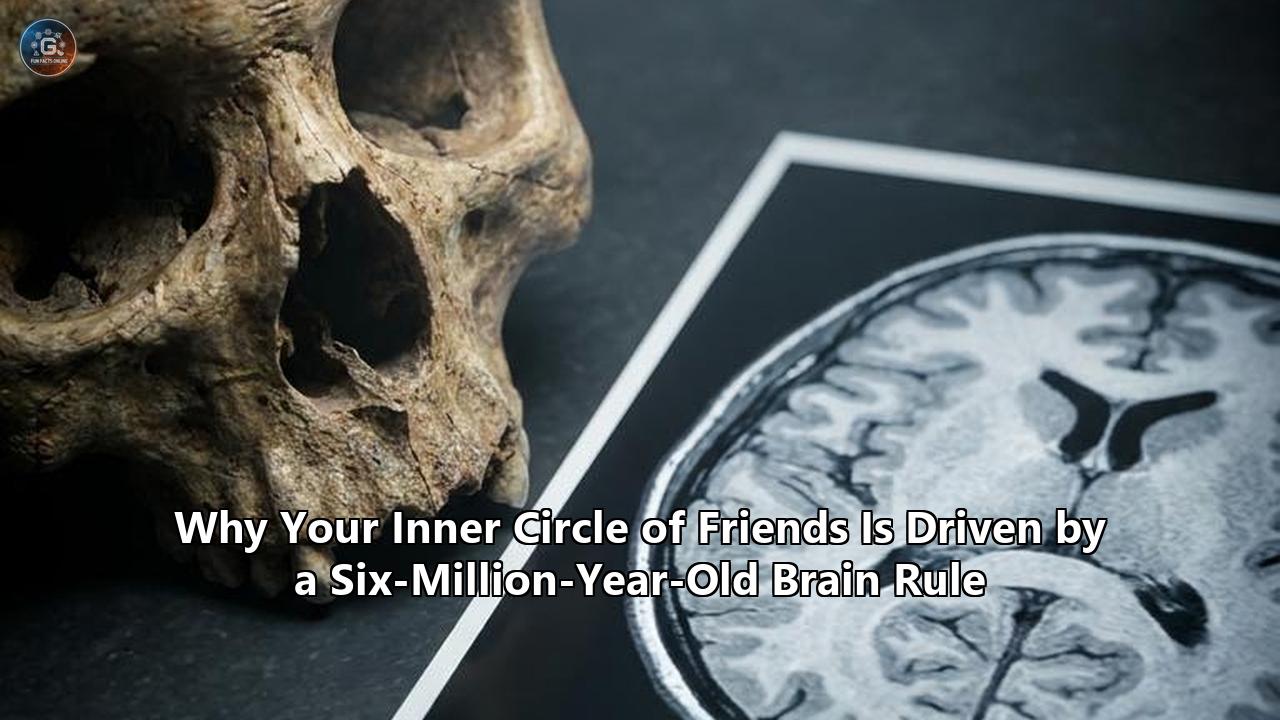
This means that the structural architecture of our social lives is not a product of the internet, modern school yards, or suburban planning. Instead, it is governed by an unyielding biological algorithm: a six-million-year-old brain rule that was hardwired into our lineage before our ancestors first walked upright.
At its core, the evolutionary psychology of friendship explores how our ancestral history shapes our modern social bonds. In an era where digital networks promise infinite connection, our ancient neuroanatomy is staging a quiet rebellion.
The Deep Biological Roots of Human Friendship Structure
The iScience study, authored by evolutionary biologist Edwin J.C. van Leeuwen and his colleagues, quantified "social resource distribution" among our closest relatives by measuring grooming behavior—the mammalian equivalent of checking in on a friend or grabbing a coffee. Grooming is the primary currency of social investment in the primate world. It is a physical act that requires time, attention, and mutual trust.
The researchers discovered that chimpanzees and bonobos show a highly skewed, power-law-like distribution in how they dole out this currency. Instead of grooming every member of their troop equally, they concentrate their efforts on a tiny, highly selective inner circle.
This finding is crucial for the evolutionary psychology of friendship because it proves that our layered social structures are not unique to human culture. They are deeply rooted in the cognitive architecture of the primate brain. Humans and the Pan genus (which includes chimpanzees and bonobos) diverged from a common ancestor roughly six to seven million years ago. This newly mapped social symmetry suggests that the cognitive blueprints regulating how many friends we can keep, and how deeply we can care about them, have remained fundamentally unchanged for millions of years.
       [ Outer Circle: ~150 Casual Acquaintances ]
     [ Mid-Tier Circle: ~50 Casual Friends/Social Band ]
   [ Inner Circle: ~15 Sympathy Group/Close Friends ]
 [ Core Circle: ~5 Support Clique/Loved Ones ]
When we look at our own social networks, we see the exact same architecture. Whether we look at ancestral hunter-gatherer bands, historical military units, or modern contact lists, human social worlds are divided into distinct, highly predictable concentric circles. These circles expand by a fractal multiplier of roughly three:
- The Support Clique (approx. 5 people): The emotional core. These are the individuals we rely on for intense emotional, physical, or financial support in moments of crisis.
- The Sympathy Group (approx. 15 people): The close circle. These are people we interact with regularly, whose deaths would leave us devastated, and with whom we share deep, reciprocal trust.
- The Social Band (approx. 50 people): The casual circle. The people we invite to backyard barbecues or birthday parties—individuals we like and catch up with periodically, but do not share deep daily intimacy with.
- The Active Network (approx. 150 people): The maximum limit of human community. This is the famous "Dunbar’s number"—the total number of people with whom we can maintain stable, functional, mutually recognized relationships.
Under the framework of the evolutionary psychology of friendship, this structural decay represents a cognitive optimization strategy. Our brains possess finite processing power, finite time, and finite metabolic energy. To survive, our ancestors had to calculate exactly how to ration their limited emotional and cognitive resources across their social landscape.
Decoding the Cognitive Mathematics: Why 150 is the Magic Number
The origin of this social architecture lies in the work of British anthropologist and evolutionary psychologist Robin Dunbar. In the early 1990s, Dunbar observed a striking correlation among non-human primates: the larger a species' brain—specifically the neocortex, the region responsible for high-level cognition, sensory perception, and spatial reasoning—the larger the social group that species lived in.
The neocortex serves as a biological hard drive for social data. Living in a stable group requires keeping track of an incredibly complex, constantly shifting web of information:
- Who is allied with whom?
- Who owes a favor to whom?
- Who is dominant, and who is subordinate?
- Who broke a social promise last week, and who can be trusted with food tomorrow?
Neocortex Volume Ratio ---> Determines Cognitive Bandwidth ---> Limits Active Group Size (Dunbar's Number)By plotting the neocortex ratio (the volume of the neocortex relative to the rest of the brain) against the typical group size of 38 different primate species, Dunbar identified a highly predictive linear relationship. When he plugged the neocortex ratio of modern Homo sapiens into this mathematical formula, the model spat out a theoretical group size: 147.8.
This number, rounded to 150, has since become known as Dunbar’s number. It represents a cognitive ceiling. Beyond 150, the human brain struggles to keep track of the identities, social histories, and reciprocal obligations of everyone in the network. Once a group exceeds this size, spontaneous social cohesion begins to break down. Without formal, artificial structures—such as laws, police forces, hierarchies, or written contracts—communities larger than 150 naturally splinter into smaller factions to prevent social free-riding and chaos.
Anthropological and historical data bear this limit out with startling consistency:
- Hunter-Gatherer Societies: Across historical hunter-gatherer populations, the average size of a nomadic clan or camp typically hovers around 150 individuals.
- Military Organization: From the Roman Empire’s centurions to modern infantry companies, military commanders have independently settled on a unit size of roughly 130 to 150 soldiers. This is the maximum size where soldiers can know everyone else’s character, skills, and loyalty on a personal level.
- Neolithic Villages: Archaeological excavations of early agricultural settlements in the Middle East reveal that when villages reached approximately 150 structures, they frequently split into two separate settlements.
- The Hutterites: This traditionalist Christian sect, which lives in communal agricultural communities, has a strict rule: once a colony reaches 150 members, it must buy new land and split into two. They have found that when a community exceeds 150, people can no longer be kept in line by peer pressure and mutual respect alone; formal laws and police forces become necessary, which destroys their egalitarian way of life.
The Chemistry of Connection: Why We Exchanged Grooming for Laughter
If our social structures are identical to those of chimpanzees and bonobos, how did humans manage to scale their communities to 150, while chimpanzee troops rarely exceed 50 or 60 individuals?
The answer lies in how primates build and maintain trust, and how the physical limits of that process forced our ancestors to undergo a major behavioral transition.
For chimpanzees and other primates, social bonding is an expensive, hands-on physical process. Grooming—picking dirt, dead skin, and parasites out of a peer's fur—is not just about hygiene. It is a form of tactile negotiation. The physical pressure of grooming stimulates the sensory nerves in the skin, triggering the release of beta-endorphins in the brain. These are the body’s natural, endogenous opiates. They induce a state of physical relaxation, lower the heart rate, and foster deep feelings of safety, warmth, and mutual trust.
[ Primate Grooming: One-on-One ]
Physical touch -> Beta-endorphin release -> Deep trust
*Constraint:* Can only groom one partner at a time. Capped at 20% of the day. Limits group size to ~50.

[ Human Vocal Grooming: One-to-Many ]
Laughter, song, storytelling -> Beta-endorphin release -> Group bonding
*Advantage:* Can groom multiple partners simultaneously. Scales group size to ~150.
However, physical grooming suffers from a severe bottleneck: it is strictly a one-on-one activity. A chimpanzee can only groom one partner at a time. To maintain social cohesion in a troop of 50, chimpanzees must spend up to 20% of their waking hours grooming their allies.
If humans were to use physical grooming to maintain a stable network of 150 people, we would have to spend an estimated 40% to 50% of our day picking at each other’s skin. Under those ecological conditions, our ancestors would have starved, leaving them unable to forage, hunt, or defend themselves against predators.
To bypass this ecological wall, the human lineage had to discover a way to groom at a distance. Our ancestors needed a mechanism that could trigger the exact same neurochemical, endorphin-driven trust as physical touch, but could scale to multiple people simultaneously.
According to research in evolutionary psychology, this pressure drove the development of several uniquely human social behaviors:
1. Laughter
Laughter is highly contagious and deeply physical. The rapid, involuntary exhalations that occur when we laugh cause physical exhaustion of the abdominal muscles, which in turn triggers a flood of beta-endorphins in the brain. Crucially, laughter is a "one-to-many" mechanism. One person can make three, four, or ten people laugh simultaneously, effectively grooming them all at once without touching a single one.
2. Music and Dance
Singing and dancing require synchronized, rhythmic physical exertion. When humans move or sing in perfect synchrony, their brains release massive amounts of endorphins, creating a powerful, collective sense of unity and shared identity. This allowed early hominin bands to bond large groups of 100 or more people during ritualistic gather-round ceremonies.
3. Language and Gossip
The ultimate breakthrough was the evolution of language. Language allowed our ancestors to transition from non-verbal vocal grooming to complex storytelling and social grooming. Gossip, in an evolutionary sense, is the ultimate social shorthand. It allows us to gather vital intelligence about who is trustworthy, who is slacking, and who is looking for a partner, without having to spend hours physically observing them or grooming them. Language enabled us to scale our active community size to the 150-person limit dictated by our neocortex.
The Energetic Tax on the Social Brain
Building and maintaining a large brain capable of processing these complex social computations is not free. In fact, from an evolutionary standpoint, the human brain is an absurdly expensive organ to run.
While the brain makes up only about 2% of our total body weight, it consumes more than 20% of our daily metabolic energy. Our ancestors had to overcome massive energetic hurdles to fuel this expanding social engine.
A study published in the Proceedings of the National Academy of Sciences (PNAS) sheds light on how our ancestors managed to pay this metabolic tax. Anthropologist Katie Amato and her research team at Northwestern University discovered that primate gut microbiomes co-evolved alongside brain size to help meet the intense energy demands of larger brains.
[ Specialized Gut Microbiome ] -> [ Higher Metabolic Energy Extraction ] -> [ Fuels Larger Neocortex ] -> [ Enables Complex Social Networks (150 limit) ]Amato’s team isolated gut microbes from large-brained primate species (such as humans and squirrel monkeys) and small-brained primates (such as macaques), implanting them into germ-free host mice. Within eight weeks, the mice hosting microbes from the larger-brained primates exhibited a significant increase in the expression of genes associated with energy production and synaptic plasticity in their brains.
This demonstrates that our ability to maintain complex, layered friendship networks is inextricably linked to our metabolic evolution. The gut microbiome of our ancestors evolved to extract more energy from our diet, which was then channeled directly into funding our highly demanding neocortex.
Once funded, how does this social brain operate in modern humans? In a study published in Evolution and Human Behavior, researchers Mila C. Roozen and Martien J.H. Kas analyzed data from the massive UK Biobank cohort to determine whether social complexity still relates to brain structure in contemporary humans.
Using structural equation modeling, Roozen and Kas found that individuals who managed more complex real-world social environments (measured by factors like household size, social club participation, and frequency of contact with friends and family) had significantly greater volume of grey matter in several key brain regions.
Crucially, these regions included not just the neocortex, but also older, evolutionary structures such as:
- The Cerebellum: Traditionally associated with motor control, but increasingly recognized as vital for timing, coordination, and predicting social sequences of behavior.
- The Pallidum: A deep subcortical structure involved in reward processing and social motivation.
- The Inferior Lateral Occipital Cortex: Key for visual processing of faces, gestures, and body language.
The researchers discovered that this relationship was heavily mediated by cognitive performance. In other words, navigating a complex social network acts like a continuous high-intensity workout for the brain. The cognitive demands of maintaining relationships keep our neural hardware robust, active, and physically larger. When we allow our social networks to decay, our cognitive capacity often decays alongside them.
The Digital Illusion: Why the Internet Cannot Hack the Neocortex
If our friendship structures are hardwired by evolutionary biology, metabolic budgets, and neural volume, what happens when we drop this prehistoric brain into a hyper-connected digital world?
With the rise of social media platforms, we are told that we can connect with thousands of people instantly. We have hundreds of "friends" on Facebook, thousands of followers on Instagram, and endless connections on LinkedIn. We can send messages to people on the other side of the planet with a single tap.
However, the evolutionary psychology of friendship reveals that this digital hyper-connectivity is a cognitive illusion. While technology can easily scale our address books, it cannot scale our biology.
                 [ The Digital Horizon: 1,000s of "Connections" ]
                    ----------------------------------------
                    |  Cognitive Boundary: Dunbar's 150    |
                    |   --------------------------------   |
                    |   |  Sympathy Group: 15          |   |
                    |   |   ------------------------   |   |
                    |   |   |  Support Clique: 5   |   |   |
                    |   |   ------------------------   |   |
                    |   --------------------------------   |
                    ----------------------------------------
You might have 2,000 connections on LinkedIn, but if you look at your actual interactions, you will find that you still obey the 5-15-50-150 rule. The human brain simply does not possess the cognitive bandwidth to maintain active, reciprocal, trust-based relationships with more than 150 people.
The critical word here is reciprocity. A true relationship requires mutual investment. It requires knowing who a person is, what their current life circumstances are, what their history is with you, and how they feel about other people in your shared network.
When we exceed 150 connections, our relationships degrade from active, reciprocal bonds into passive "weak ties". We no longer have friends; we have audiences. We are not practicing friendship; we are performing it.
This biological barrier explains why the hyper-connected world is experiencing an unprecedented epidemic of loneliness and social burnout. In late 2025, a consumer study conducted by Bumble For Friends found that over 60% of Gen Z users reported actively seeking deeper, emotionally aligned "micro-friendships" rather than sprawling circles of casual acquaintances.
The viral online discourse surrounding our drained "social batteries" is not just a meme; it is a clinical symptom of evolutionary mismatch. Our stone-age brains are being bombarded by a relentless firehose of digital social signals, status updates, and notifications from hundreds of distant acquaintances. We are trying to run a social network of 1,500 people on hardware designed to process a tight-knit clan of 150.
The result is chronic cognitive overload, leading to social fatigue, anxiety, and a profound sense of isolation. This has triggered a cultural pivot. By 2026, we are seeing a massive shift toward "intentional isolationism" and "micro-networks". People are actively leaving large, performative group chats, curating smaller close-friend lists, and prioritizing emotional reciprocity over sheer network size. We are, quite literally, retreating to the safety of our ancestral 5-15-50-150 layers because our biology is demanding it.
The Mentalizing Mind: Why Keeping Track of Social Dynamics is Hard Work
To truly understand why our brains cap our friendships so aggressively, we have to look at the sheer computational complexity of human social networks.
The primary cognitive mechanism that limits our social group size is what psychologists call Theory of Mind (ToM), or "mentalizing." This is the capacity to attribute mental states—beliefs, intents, desires, emotions, and knowledge—to ourselves and others, and to understand that others have beliefs and desires that are different from our own.
Mentalizing operates in a series of recursive cognitive levels, known as the intentionality hierarchy:
Level 1: I believe X. (Typical of young children and non-human primates)
Level 2: I believe that you believe Y. (Tactical deception, basic empathy)
Level 3: I believe that you think that she knows Z. (Standard adult human baseline)
Level 4: I want you to believe that she thinks that he wants us to do something.
Level 5: I want you to realize that he believes that she expects you to think that I am lying. (Typical cognitive limit)
Most healthy adult humans can comfortably manage up to five levels of intentionality. This fifth-order capacity is what allows us to write and enjoy complex literature. For instance, to appreciate Shakespeare's Othello, the audience must hold five distinct mental states in their head simultaneously:
I (1) want the audience to understand (2) that Othello believes (3) Iago is telling the truth when he claims (4) Cassio is having an affair with (5) Desdemona.
Once we try to push past the fifth order of intentionality, our working memory experiences a complete cognitive collapse.
Now, consider how this plays out inside a social network. In a group of five close friends, there are 10 unique bilateral relationships to keep track of. But friendship is rarely just bilateral. To navigate a group of five, you must also calculate how Alice feels about Bob, how Bob thinks Charlie feels about Dave, and how Dave believes Alice will react to Charlie.
As group size increases, the number of potential triadic and quadratic relationships does not grow linearly—it explodes exponentially:
| Group Size | Bilateral Relationships ($N(N-1)/2$) | Triadic Relationships ($N(N-1)(N-2)/6$) |
|---|---|---|
| 5 (Support Clique) | 10 | 10 |
| 15 (Sympathy Group) | 105 | 455 |
| 50 (Social Band) | 1,225 | 19,600 |
| 150 (Dunbar’s Limit) | 11,175 | 551,300 |
Inside a community of 150 people, there are 11,175 unique bilateral relationships and over half a million triadic dynamics.
When you enter a room containing 150 members of your community, your brain is working in the background like a supercomputer. It is scanning faces, reading micro-expressions, retrieving historical social data, and calculating the complex, multi-layered alliances and rivalries of everyone in the room. This mental heavy-lifting is incredibly taxing on our metabolic reserves. It is the ultimate reason why our inner circle of friends is so small: we simply do not have the neural processors required to run the social equations for any more than that.
Navigating the Modern World with a Stone-Age Brain
Understanding that our relationships are governed by a six-million-year-old biological rule is not just an academic exercise. It has profound, practical implications for how we design our workplaces, build our cities, manage our mental health, and structure our daily lives.
               [ Prehistoric Band: 150 members ]
                      (Natural Cohesion)
                              v
               [ Modern Mega-City: Millions ]
               (Erosion of Intimate Support)
                              v
         [ Solution: Intentional Micro-Communities ]
                 (Restoring the 5-15-50-150)
In the modern corporate world, organizations frequently suffer from "scale blindness." We assume that a department of 500 people can collaborate just as fluidly as a team of 10, provided they have the right communication software.
But history shows that once a corporate office, factory, or department exceeds 150 people, employees begin to feel alienated. The natural, self-policing social mechanisms of trust, pride, and peer pressure begin to break down, replaced by bureaucratic bloat, red tape, and political posturing.
To combat this, visionary leaders have long designed their companies around biological limits. One of the most famous examples is the "two-pizza team" rule coined by Amazon founder Jeff Bezos. Bezos mandated that no internal team should be larger than the number of people that can be fed by two large pizzas—effectively capping team sizes at around five to eight people. This aligns perfectly with the "Support Clique" layer of human evolution. By keeping teams small, companies can foster maximum trust, speed, and psychological safety without overloading their employees' cognitive bandwidth.
On a personal level, understanding the evolutionary psychology of friendship can help us build more resilient, balanced lives. In our hyper-connected culture, we are often told that the goal of social life is to be liked by everyone, to have a massive network, and to be constantly available to a wide array of people. We feel guilty when we cannot find the energy to reply to messages from distant acquaintances, or when we choose to stay home rather than attend a crowded social mixer.
But our biology tells us that social energy is a finite resource. You cannot be a great friend to 200 people. If you try to spread your cognitive and emotional currency too thinly across your entire network, you will inevitably bankrupt your inner circles. Your closest five and fifteen relationships—the people who keep you healthy, lower your physiological stress, and provide a buffer against mental illness—will suffer from neglect.
Ultimately, the evolutionary psychology of friendship teaches us that our cognitive limits are not failures of modern adaptiveness, but ancient boundary markers designed to preserve our sanity. By embracing these limits—by prioritizing depth over breadth, choosing laughter over digital vanity metrics, and investing heavily in our core ancestral circles—we can align our modern lives with the ancient, unyielding rules of our social brain.
References
"Bipedalism and brain expansion explain human handedness." PLOS Biology, May 22, 2026.
"Primate gut microbiota induce evolutionarily salient changes in mouse neurodevelopment." Proceedings of the National Academy of Sciences (PNAS), January 5, 2026.
"New Fossil Analysis Suggests Seven-Million-Year-Old Primate Walked on Two Legs." Smithsonian Magazine, January 5, 2026.
"Chimpanzees and bonobos have human-like friend circles, study finds." ScienceDaily / Utrecht University, May 31, 2026.
"The evolutionary origins of friendship." Annual Review of Psychology, July 5, 2011.
"The New Emotional Contract: How Gen Z is Rebranding Friendship." Ayerhs Magazine, November 12, 2025.
"The Social Brain Hypothesis: Evolution and Complexity." Psychology Town, October 22, 2025.
"Diet, Sociality, and the Evolution of Primate Brain Size." Journal of Human Evolution, February 2025.
"Cognitive mediation of social complexity–brain volume associations in a population-based sample." Evolution and Human Behavior, July 2026.
"Rethinking Dunbar's Number and the Limits of Social Contact." The Oxford Scientist, February 2, 2023.
"Understanding Dunbar's Number: How to Build Meaningful Networks." Wave Connect, 2026.
"Dunbar's Number and the Architecture of Human Community." Medium, March 15, 2026.
"The Biological Ceiling: Robin Dunbar and the 150 Rule." Psychological Safety, June 13, 2025.
"Rethinking Dunbar’s Number and the 150-Friend Limit." Rums Review, February 4, 2025.
Reference:
- https://www.sciencedaily.com/releases/2026/05/260530053432.htm
- https://www.sci.news/othersciences/anthropology/human-handedness-14787.html
- https://www.smithsonianmag.com/smart-news/why-is-nearly-every-person-right-handed-but-not-every-ape-and-monkey-new-research-explores-the-evolutionary-origins-of-human-handedness-180988776/
- https://oxsci.org/end-of-dunbars-number/
- https://wavecnct.com/blogs/manage-more-connections
- https://academic.oup.com/sysbio/article/72/2/404/6862053
- https://psychsafety.com/psychological-safety-82-dunbars-number-and-team-size/
- https://medium.com/@murpcortese/dunbars-number-and-the-architecture-of-human-community-part-1-895090330d71
- https://news.northwestern.edu/stories/2026/01/microbes-may-hold-the-key-to-brain-evolution
- https://www.eurekalert.org/news-releases/1111498
- https://research.rug.nl/en/publications/cognitive-mediation-of-social-complexitybrain-volume-associations/
- https://rumsreview.com/how-many-friends-can-you-really-have/
- https://ayerhsmagazine.com/2025/11/12/the-friendship-rebrand-of-2026/
- https://pubmed.ncbi.nlm.nih.gov/21740224/
- https://psychology.town/neuropsychology/significance-brain-size-human-evolution/