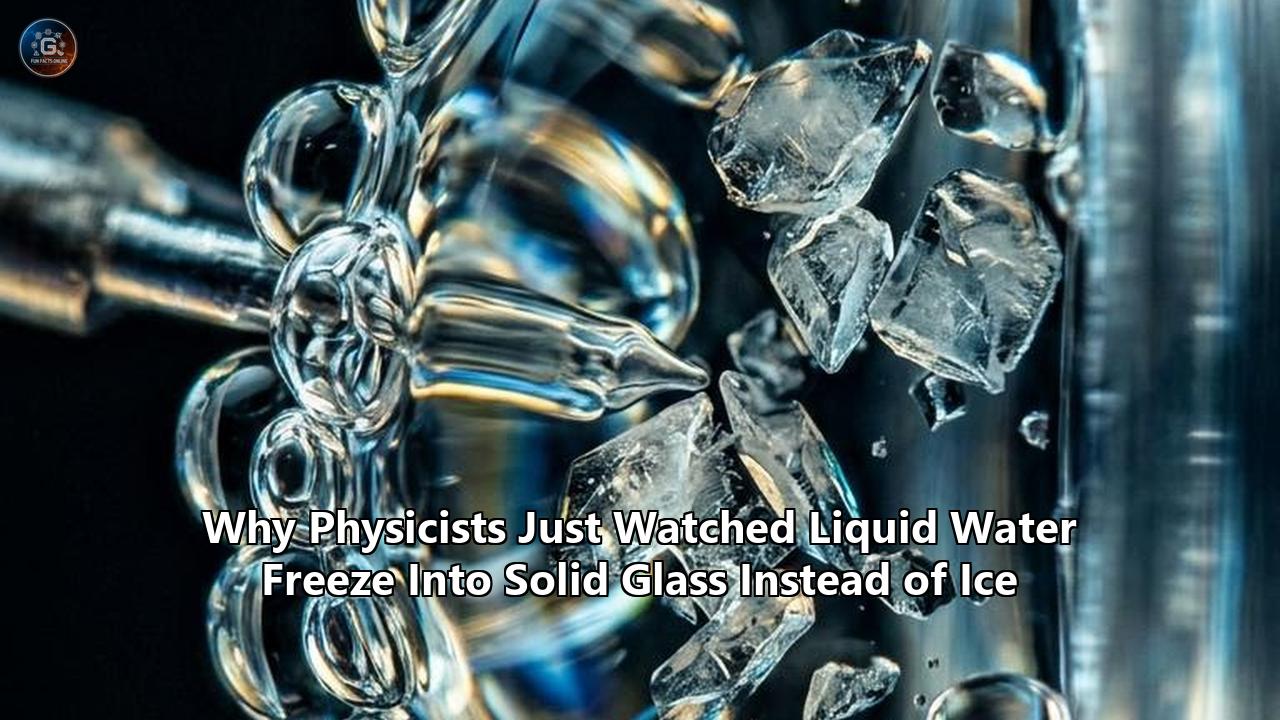
An international research team has achieved an experimental feat that eluded condensed-matter physicists for decades: directly capturing liquid water transforming into a solid, amorphous glass without crystallizing into ice.
The study, published in Nature Communications, details how physicists at ETH Zürich, working alongside instrument scientists at the Australian Nuclear Science and Technology Organisation (ANSTO), Synchrotron SOLEIL in France, and Sapienza University of Rome, physically barred water molecules from assembling into a crystal lattice. By trapping water within lipid channels less than a nanometer wide, the team bypassed the catastrophic crystallization event that normally occurs below zero degrees Celsius.
Instead of forming hexagonal ice, the molecules slowed to an absolute kinetic crawl, freezing into a disordered, glass-like state. This dynamic arrest occurred while the surrounding organic membranes remained entirely fluid.
The observation resolves a long-standing thermodynamic controversy surrounding the behavior of water in "no man’s land"—a subzero temperature corridor where liquid water has historically defied experimental observation due to instantaneous crystallization. The findings rewrite foundational assumptions about how water behaves under spatial confinement, offering empirical data that reaches far beyond theoretical physics into cryomedicine, deep-space exploration, and advanced material synthesis.
+-----------------------------------------------------------------------------------------+
|                                    THERMAL REGIMES                                      |
+-----------------------------------------------------------------------------------------+
|  0°C             -20°C to -35°C           -64°C to -74°C               -135°C           |
|   |                    |                        |                        |              |
|   v                    v                        v                        v              |
| Normal Freezing   Kinetic Slowdown        Static Vitrification      Bulk Glass          |
| Point of Bulk     (Diffusive motion       (Water forms solid        Transition Theory   |
| Water (Ice Ih)    drops dramatically)     glass; lipids stay fluid) (Historical model)  |
+-----------------------------------------------------------------------------------------+
Inside the Experiment: Capturing Vitrification at the Nanoscale
Under standard atmospheric conditions, pure liquid water supercools only to approximately -41 °C (232 Kelvin). At this threshold, known as the homogeneous nucleation limit, the thermodynamic drive for water molecules to establish an ordered, tetrahedral network becomes insurmountable. Ice crystals nucleate spontaneously and propagate through the sample at speeds exceeding several meters per second, creating ordinary hexagonal ice ($I_h$).
To prevent this immediate freezing, the research team—led by Dr. Patrick Züblin and Professor Raffaele Mezzenga at ETH Zürich—abandoned bulk containers. They turned to a biomimetic architecture known as a lipidic mesophase. The researchers synthesized matrices from phytantriol, an amphiphilic branched fatty alcohol. When mixed with precise quantities of water, phytantriol spontaneously self-assembles into a crystalline network of bicontinuous lipid membranes pierced by continuous, interconnected water channels.
These channels restricted the water to sub-nanometer dimensions—roughly 0.8 to 0.9 nanometers in diameter, an expanse equal to barely three water molecules side by side. Within this space, a water molecule cannot build the critical cluster nucleus of dozens of interconnected molecules required to seed an ice crystal. The geometry starves the freezing mechanism of room to operate.
The team mounted the nanoconfined samples across a battery of cutting-edge probe instruments. To track structural changes, they utilized Small-Angle and Wide-Angle X-ray Scattering (SAXS/WAXS) at the Australian Synchrotron, operating low-temperature stages down to -120 °C. To differentiate the behavior of water from the surrounding lipid matrix, the scientists leveraged the National Deuteration Facility at ANSTO. Because neutrons scatter strongly from normal hydrogen ($^1\text{H}$) but weakly from deuterium ($^2\text{H}$), the team selectively deuterated the phytantriol lipid backbones. This made the lipid matrix virtually "invisible" to neutron beams, exposing the dynamics of the water molecules.
                     SUB-NANOMETER LIPID CONFINEMENT

        [ Phytantriol Lipid Bilayer ]  <--- Fluid down to -105°C
     ~~~~~~~~~~~~~~~~~~~~~~~~~~~~~~~~~~~~~
        (H2O)  (H2O)  (H2O)  (H2O)     <--- 0.8–0.9 nm thickness (3 molecules)
        (H2O)  (H2O)  (H2O)  (H2O)     <--- Vitrifies between -64°C and -74°C
     ~~~~~~~~~~~~~~~~~~~~~~~~~~~~~~~~~~~~~
        [ Phytantriol Lipid Bilayer ]  <--- Fluid down to -105°C
Using elastic and quasi-elastic neutron scattering alongside far-infrared terahertz spectroscopy at Synchrotron SOLEIL’s AILES beamline, the physicists tracked molecular mobility across six orders of magnitude in time, from microseconds ($10^{-6}\text{ s}$) down to picoseconds ($10^{-12}\text{ s}$).
Between -20 °C and -35 °C, the diffusive motion of the trapped water molecules experienced a steep deceleration. As the cooling continued, the system crossed a static glass transition between -64 °C and -74 °C. At this threshold, the liquid water transformed entirely into an amorphous, structurally disordered solid: a biological glass.
Crucially, the surrounding phytantriol matrix remained fully flexible and diffusive down to temperatures below -105 °C. The researchers were directly observing the liquid water glass transition under soft nanoconfinement—watching water turn to rigid glass inside liquid walls.
Why Water Forms a Glass Instead of Ice
Crystallization and vitrification represent two radically opposing fates for a cooling liquid. Crystallization is a discontinuous, first-order thermodynamic phase transition. Molecules shed their entropy, organize into periodic repeating patterns, and release latent heat. In water, this means arranging into an open, hexagonal network held together by rigid directional hydrogen bonds.
Vitrification, or glass formation, is fundamentally kinetic. When a liquid vitrifies, its viscosity increases exponentially as the temperature drops. The molecules retain the disordered, jumbled topology of the liquid, but their translational and rotational motions become so sluggish that they cannot find thermodynamic equilibrium. Structurally, glass resembles a liquid frozen in time; mechanically, it is a rigid solid.
      CRYSTALLIZATION (ICE Ih)                   VITRIFICATION (GLASS)

           O           O                           O      O      O
          / \         / \                         / \      \      \
         H   H       H   H                       H   H      H      H
        /     \     /     \                           \    /      /
       O       O---O       O                     O-----O--O      O
      / \     /     \     / \                   / \   /    \    / \
     H   H   H       H   H   H                 H   H H      H  H   H

    • Highly ordered hexagonal lattice         • Disordered, randomized network
    • Lower density than liquid water          • Density closely matches liquid
    • Sharp thermodynamic freezing point       • Continuous kinetic glass transition
    • Expands violently, shearing cells        • Preserves native molecular layout
Most materials can be turned into glass if they are cooled rapidly enough to outrun crystal nucleation. Silica ($\text{SiO}_2$) forms glass with ease because its covalent network reconfigures slowly. Water, by contrast, is an exceptionally poor glass-former. Its low molecular weight and rapid hydrogen-bond rearrangement let ice nuclei assemble in fractions of a nanosecond.
Historically, physicists could only create glassy water—formally called amorphous solid water (ASW) or hyperquenched glassy water (HGW)—through extreme synthetic workarounds:
- Slow vapor deposition: Condensing individual water vapor molecules onto copper plates cooled to -263 °C (10 Kelvin) in ultra-high vacuum.
- Hyperquenching: Firing microdroplets of liquid water into cryogenic liquids at cooling rates exceeding $10^5\text{ Kelvin per second}$.
- Pressure amorphization: Crushing hexagonal ice under pressures exceeding 10,000 atmospheres ($1\text{ GPa}$) at -143 °C.
None of these historical methods allowed scientists to monitor equilibrium liquid water continuously cooling into a stable glass under ambient pressures. By using nanoscale lipid cavities, the researchers bypassed the requirement for extreme cooling rates or extreme pressures. By sidestepping crystallization entirely, the team documented the liquid water glass transition across a continuous temperature spectrum, shedding light on the molecular kinetics that govern supercooled liquids.
Who Is Affected: Sector-by-Sector Impact Analysis
The ability to induce and observe vitrification at warmer temperatures than previously thought possible carries profound consequences across multiple scientific disciplines and industrial fields.
+-----------------------------------+---------------------------------------------------------+
| SECTOR                            | DIRECT IMPACT OF WATER VITRIFICATION DISCOVERY          |
+-----------------------------------+---------------------------------------------------------+
| Cryopreservation & Organ Banking  | Eliminates toxic cryoprotectants (DMSO); enables        |
|                                   | crystallization-free tissue preservation.               |
| Structural Biology & Cryo-EM      | Improves vitreous ice prep without plunge artifacts;     |
|                                   | stabilizes fragile membrane protein interfaces.         |
| Planetary Science & Astrobiology  | Calibrates physical models of icy moons (Europa,        |
|                                   | Enceladus) and deep-space organic dust grains.          |
| Food Science & Cold Logistics     | Informs non-damaging freezing protocols for cellular    |
|                                   | food textures without structural destruction.           |
+-----------------------------------+---------------------------------------------------------+
1. Cryopreservation, Reproductive Medicine, and Organ Banking
The standard hurdle in preserving living biological tissues—sperm, eggs, embryos, stem cells, and full donor organs—is mechanical destruction wrought by ice. When intracellular or extracellular water freezes into crystalline ice, it expands by roughly 9%. Sharp ice dendrites slice through lipid membranes, rupture cellular organelles, and destroy protein infrastructure.
To prevent this, current medical protocols infuse biological systems with high concentrations of chemical cryoprotectants, primarily dimethyl sulfoxide (DMSO) or glycerol. These agents inhibit crystallization and force the system to vitrify upon immersion in liquid nitrogen. However, at concentrations required for effective vitrification (often 40% to 60% by volume), DMSO becomes cytotoxic. It induces osmotic shock, disrupts protein folding, and must be washed out through complex dilution procedures that frequently kill cells.
The finding that biological surfaces and nanoscale lipid matrices naturally drive water to vitrify at temperatures as warm as -64 °C gives medical researchers a structural alternative. Living cells are not open buckets of bulk water; their interior cytoplasm is densely crowded with macromolecules, actin filaments, and lipid boundaries spaced mere nanometers apart. Intracellular water already exists in varying states of nanoconfinement. By mimicking the phytantriol architecture with biocompatible synthetic lipid cubic phases or designer self-assembling peptides, tissue engineers can exploit confinement physics to vitrify biological samples with fractional amounts of cryoprotectant.
2. Structural Biology and Cryo-Electron Microscopy (Cryo-EM)
The 2017 Nobel Prize in Chemistry celebrated cryo-EM precisely because vitrifying water preserves proteins in their native states without crystallization artifacts. Yet, preparing cryo-EM grids remains an inconsistent, error-prone technique.
Researchers rapidly plunge micro-droplets on carbon grids into liquid ethane cooled by liquid nitrogen. If cooling lags by even a microsecond, microcrystalline ice nucleates. The resulting diffraction spots blind the microscope's detectors and tear apart delicate macromolecular complexes.
By defining how lipid-water interactions govern vitrification over a wider temperature window, structural biologists can develop optimized carrier substrates. Understanding the interplay between hydration layers and lipid boundaries allows researchers to stabilize membrane proteins within lipid nanodiscs or bicontinuous mesophases, locking them into a vitreous state under milder, reproducible cooling regimens.
3. Planetary Science and Astrobiology
While crystalline ice rules the surface of Earth, amorphous, glassy ice is the single most common phase of water in the cosmos. It coats interstellar dust grains, makes up the bulk of cometary interiors, and lines the crusts of icy moons such as Jupiter’s Europa and Ganymede, and Saturn’s Enceladus.
Astrobiologists studying the subsurface oceans of these icy worlds face a lingering question: how do organic molecules, amino acids, and potential biosignatures survive entrapment within icy planetary rifts?
The discovery shows that water trapped in mineral micropores or within ancient primitive lipid bilayers does not expand or crush surrounding chemistry when cooled. Instead, it solidifies into an amorphous glass that preserves organic structures intact. Furthermore, because the glass transition under confinement begins to alter dynamic properties at temperatures as high as -20 °C to -35 °C, metabolic or catalytic reactions could operate within semi-fluid interfacial spaces long after an environment was assumed to be frozen solid.
4. Advanced Food Science and Cryogenic Storage
Cellular agriculture, meat preservation, and high-value botanical shipping face identical challenges to organ banking. Freezing food creates ice crystals that tear plant cell walls and muscle fibers. Upon thawing, the tissue suffers "drip loss"—purging intracellular water, electrolytes, and flavor compounds, leaving behind a degraded texture.
Confirming that water can be converted to glass along soft, flexible lipid interfaces provides a template for food science. By introducing food-grade lipids or configuring formulation textures to confine water within nano-domains, agricultural processors can engineer preservation cycles that bypass crystallization completely. This locks cellular moisture in place without structural collapse.
What Changes: Rewriting the Thermodynamics of Water
The experimental results reported by Züblin and colleagues dismantle several long-held thermodynamic assumptions about water’s low-temperature behavior.
                               THE WATER ANOMALY PARADOX

  Bulk Water Assumption (Historical)             Nanoconfined Observation (Current)
  ----------------------------------             ----------------------------------
  • Spontaneous freezing: -41°C                  • Crystallization: Completely suppressed
  • "No Man's Land": Unmeasurable                • Accessible across -20°C to -120°C
  • Bulk Glass Transition (Tg): ~136 K (-137°C)  • Dynamic slowdown: -20°C to -35°C
  • Rigidity: All components freeze at once      • Static Vitrification (Tg): -64°C to -74°C
                                                 • Decoupling: Water freezes, matrix flows
1. Demolishing the 136 Kelvin Glass Transition Benchmark
For nearly five decades, chemical physics textbooks maintained that the glass transition temperature ($T_g$) of water sat at approximately 136 Kelvin (-137 °C). This benchmark was derived by warming vapor-deposited amorphous solid water and looking for a faint baseline shift in differential scanning calorimetry (DSC).
However, this metric has been fiercely contested. Critics pointed out that this heat capacity shift was suspiciously small—barely a fraction of what other hydrogen-bonded liquids display during glass transitions. Some theoretical camps argued that bulk water's genuine $T_g$ lay much higher, closer to 165 K or even 200 K, but was consistently obscured by instantaneous ice crystallization.
The new data directly supports this second camp. Under soft nanoconfinement, where the thermodynamic path is kept clear of crystallization, water enters its static glass transition between -74 °C and -64 °C (199 K to 209 K). This reveals that the molecular network of water undergoes structural arrest at temperatures far higher than the old 136 K metric suggested. The historically observed 136 K event was likely an interfacial relaxation or a shadow transition of local orientational defects, rather than the primary structural freezing of the water matrix.
2. Viscosity Decoupling: Rigid Water Inside Liquid Walls
One of the most striking revelations of the ETH Zürich experiment is the complete decoupling of physical states between water and its container.
In typical composite systems, a host matrix freezes first, imposing mechanical rigidity upon whatever sits inside it. Here, the inverse occurs. The neutron scattering and NMR spectroscopy data confirmed that the sub-nanometer water layer solidifies into a rigid glass between -64 °C and -74 °C, while the enclosing phytantriol lipid chains continue to rotate, diffuse, and flex freely. The lipid bilayer only arrests into a glass below -105 °C to -135 °C.
TEMPERATURE (DEGREES CELSIUS)
      0°C -------------------------------------------
          |  Water: Mobile Liquid
          |  Lipids: Highly Fluid
    -20°C -------------------------------------------
          |  Water: Dynamic deceleration commences
          |  Lipids: Highly Fluid
    -35°C -------------------------------------------
          |  Water: Strong kinetic slowdown
          |  Lipids: Fluid
    -64°C -------------------------------------------
          |  WATER GLASS TRANSITION: SOLID AMORPHOUS GLASS
          |  Lipids: Fluid and diffusive
    -74°C -------------------------------------------
          |  Water: Completely vitrified solid
          |  Lipids: Diffusive motion maintained
   -105°C -------------------------------------------
          |  Water: Solid Glass
          |  LIPID GLASS TRANSITION: Membranes solidify
This discovery shows that water does not require a rigid, immovable scaffold to undergo vitrification. Soft, pliable, biologically realistic boundaries can support a glassy aqueous state while retaining their own fluidity.
3. Illumination of Water’s Liquid-Liquid Hypothesis
The data adds empirical weight to one of modern physics' most provocative concepts: the two-liquid model of water. First proposed via computer simulations by Gene Stanley and colleagues in 1992, the hypothesis posits that at low temperatures and high pressures, water separates into two distinct liquid phases:
- Low-Density Liquid (LDL): An open, highly tetrahedral network.
- High-Density Liquid (HDL): A denser, more disordered, and packed arrangement.
These two liquids terminate at a second critical point hidden deep inside "no man's land". The broad dynamic slowdown observed by the researchers—spanning temperatures from -20 °C down to -63 °C across six orders of magnitude—mirrors the anomalous thermodynamic fluctuations expected as water approaches this hypothesized liquid-liquid critical boundary. Confinement exposes the structural evolution that bulk crystallization normally erases.
Short-Term Consequences: Immediate Laboratory Shifts
Over the next 12 to 36 months, the consequences of this experimental demonstration will ripple through experimental physical chemistry and materials science.
1. Overhaul of Molecular Dynamics Water Models
Computational chemists heavily rely on classical force fields—such as TIP4P/2005, SPC/E, and modern neural network-derived potentials like MB-pol—to simulate biological processes, drug binding, and membrane transport. However, these models are notoriously difficult to parameterize at low temperatures because empirical target data within "no man’s land" has been virtually non-existent.
Physicists now have precise, time-resolved kinetic data charting relaxation times, activation energies, and the static liquid water glass transition under nanoscale boundary conditions. Model developers must refine their simulations to replicate the exact slowing down of water observed between -20 °C and -63 °C, forcing structural revisions in computational biochemistry tools.
                 COMPUTATIONAL RECALIBRATION CYCLE

       +--------------------------------------------------+
       | Experimental Data: Nature Communications (2024+) |
       | • Viscosity scaling across 10^-6 to 10^-12 s     |
       | • Static Tg located at -64°C to -74°C            |
       +--------------------------------------------------+
                                |
                                v
       +--------------------------------------------------+
       | Algorithmic Adjustments to Water Force Fields    |
       | • TIP4P/2005, TIP5P, and Machine Learned Models  |
       | • Re-parameterization of Hydrogen Bond Angles    |
       +--------------------------------------------------+
                                |
                                v
       +--------------------------------------------------+
       | Downstream Impact on Drug Discovery Platforms    |
       | • Improved accuracy of protein hydration shells  |
       | • Realistic binding affinity calculations at     |
       |   cryogenic and physiological temperatures       |
       +--------------------------------------------------+
2. Standardization of Soft Nanoconfinement Beamline Methods
The protocol developed by Züblin, Mezzenga, and their collaborators provides a repeatable blueprint for international synchrotron and neutron facilities.
Facilities like the Australian Synchrotron and Synchrotron SOLEIL are already handling proposals to use phytantriol-based lipid matrices to study other stubbornly uncooperative liquids. Solutions of alcohols, cryoprotectant mixtures, and ionic liquids that previously crystallized during cooling can now be trapped and analyzed as stable glasses, transforming soft nanoconfinement into a standard tool for condensed matter physics.
Long-Term Consequences: Medicine, Planetary Science, and Materials
Looking beyond immediate laboratory adjustments, the ability to control and characterize water's glass transition under nanoconfinement unlocks radical possibilities over the next decade.
       LONG-TERM TRANSLATIONAL ROADMAP

       Year 1–3: Computational models calibrated to new Tg data.
                 Synthetic peptide scaffolds designed to replicate 0.8 nm pores.

       Year 3–6: Low-toxicity cryopreservation cocktails enter preclinical trials.
                 Advanced space probe sensors designed based on glassy ice spectra.

       Year 6–10: Ice-free whole-organ banking technologies realized.
                  Engineered glassy aqueous solid electrolytes deploy in extreme-cold batteries.
1. Realizing Non-Toxic, Ice-Free Organ Banking
The holy grail of transplant surgery is the ability to bank human organs—hearts, livers, kidneys—indefinitely. Currently, a donated heart must be transplanted within four to six hours; a liver within twelve. Thousands of donor organs are discarded annually simply because logistics cannot beat the biological clock.
Attempts to freeze organs fail because ice formation crushes capillary networks, while the volume of DMSO required to vitrify a whole organ causes fatal toxicity upon thawing.
Armed with an exact understanding of how soft lipid boundaries suppress crystallization and force vitrification, biomedical engineers can design biomimetic preservation fluids. Instead of relying on brute-force chemical antifreeze, future perfusion solutions may use transient, self-assembling amphiphilic nanostructures. By temporarily partitioning tissue water into nanoscale domains, these structures can induce vitrification at accessible temperatures without chemical toxicity, unlocking a viable path toward ice-free whole-organ cryopreservation.
2. Understanding Psychrophilic Life and Subzero Biology
Microorganisms known as psychrophiles thrive in polar ice sheets, permafrost, and supercooled high-altitude clouds. Biologists have long struggled to pinpoint the physical limits of life in these deep-freeze zones. If intracellular water froze solid into ice crystals, metabolic activity would cease and cells would rupture.
The observation that nanoconfined water slows down gradually over a 40-degree span—forming a stable glass that coexists with fluid membranes—provides a direct physical explanation for psychrophile survival.
                                 THE PSYCHROPHILE ADAPTATION

      ENVIRONMENT                        CELLULAR NANO-CHANNELS
  Subzero Polar / Cloud                Extracellular Space / Cytoskeleton
   Temperature (-30°C)                     Confinement: < 1 nanometer
           |                                           |
           v                                           v
  Bulk Water Outside Cell               WATER MOLECULES CANNOT FREEZE INTO ICE
  Freezes into Dangerous Ice            • Undergoes controlled dynamic arrest
           |                            • Maintains viscous, glass-like fluidity
           |                            • Prevents cellular shearing
           +-------------------------------------------+
                                |
                                v
               ORGANISM SURVIVES BONE-CHILLING COLD
Extremophiles adapt their inner membrane compositions and protein architectures to pack cellular water into tight compartments. In doing so, they exploit confinement thermodynamics, maintaining a glassy, non-crystalline intracellular state that prevents cellular shearing and preserves metabolic viability across hostile environments.
3. Next-Generation Solid Aqueous Electrolytes
Battery research is locked in an intense race to develop solid electrolytes that eliminate the flammability hazards of liquid organic solvents. Solid-state water-based batteries represent an intriguing branch of this research, but they typically fail at subzero temperatures as their aqueous components freeze into non-conductive crystalline ice.
By tailoring the pore geometry of polymer or ceramic scaffolds to sub-nanometer scales, battery architects could force aqueous electrolyte solutions into a permanent glass phase. Glassy water maintains high dielectric characteristics without undergoing the volumetric expansion and lattice contraction of ice. This could open the door to extreme-environment energy storage devices capable of operating reliably on the Martian surface, within the polar regions of Earth, or in deep-space exploration vehicles.
What to Watch Next
As the global physics and materials communities absorb the implications of this discovery, several milestones will signal the transition from fundamental experimental proof to practical deployment:
- Direct Imaging of Unconfined Liquid Water in Free-Electron Lasers: While nanoconfinement solves the ice crystallization problem, physicists still want to measure unconfined bulk water in "no man's land". Upcoming experiments at facilities like the European XFEL and the Linac Coherent Light Source (LCLS) will pair ultrafast, femtosecond laser-heating pulses with rapid X-ray probes to determine if pure, unconfined bulk water vitrifies along an identical pathway before crystals form.
- Reconciling the Medium-Density Amorphous (MDA) Ice Puzzle: In 2023, researchers at University College London discovered medium-density amorphous ice by ball-milling regular ice with steel spheres at cryogenic temperatures. Whether MDA represents the true glassy state of room-temperature liquid water, or if it is directly related to the glass observed in lipid nanoconfinement, remains a fiercely debated question. Comparative spectroscopic mapping between these two distinct forms is expected over the coming year.
- Translational Medical Trials: Watch for bio-engineering teams demonstrating low-cryoprotectant cell vitrification using synthetic, degradable lipidic cubic phases. Early benchmarks will involve preserving stem cell lines and complex 3D organoid cultures without liquid nitrogen plunge-freezing.
- Astrophysical Spectral Verification: Space telescopes, including the James Webb Space Telescope (JWST), are actively collecting infrared absorption signatures from the outer solar system and protoplanetary disks. Comparing JWST’s deep-space ice spectra against the new terahertz and infrared signatures gathered from this experiment could confirm whether water trapped in space mineral pores is identical to the lipid-confined glass observed in the lab.
The observation of water turning directly into glass within mobile organic walls ends an era of scientific speculation. By finding a way to tame water's relentless urge to crystallize, physicists have finally brought the most evasive phase transition of our planet's most important liquid into clear view.
Reference:
- https://www.nationaltribune.com.au/new-insights-into-fundamental-behaviour-of-water/
- https://massandmotion.com/news/soft-nanoscale-confinement-reveals-waters/
- https://www.synchrotron-soleil.fr/en/publications?field_lignes_de_lumiere_tid=11&page=7
- https://www.roma1.infn.it/~sciortif/publications.htm
- https://www.sciencealert.com/scientists-witness-water-transforming-into-a-weird-glass-instead-of-ice
- https://pubmed.ncbi.nlm.nih.gov/42103752/
- https://www.facebook.com/groups/303649262041653/posts/1111481737925064/
- https://scitechdaily.com/scientists-finally-crack-the-mystery-of-waters-strangest-behavior-after-decades-of-research/
- https://www.idc-online.com/technical_references/pdfs/chemical_engineering/Amorphous_ice_and_glassy_water.pdf
- https://www.iis.u-tokyo.ac.jp/en/news/2857/
- https://www.researchgate.net/profile/Patrick-Zueblin-2
- https://www.facebook.com/ScienceAlert/posts/whats-going-on-sciencenews-sciencealert-sciencediscoveries-staycurious-physics-w/1619626593087002/
- https://pmc.ncbi.nlm.nih.gov/articles/PMC13369869/
- https://www.reddit.com/r/chemistry/comments/1ai9ws9/when_a_liquid_substance_that_isnt_water/
- https://scitechdaily.com/scientists-finally-solved-one-of-waters-biggest-mysteries/
- https://www.pnas.org/doi/10.1073/pnas.1016520108
- https://www.acs.org/middleschoolchemistry/lessonplans/chapter2/lesson4.html
- https://research.princeton.edu/news/studies-amorphous-ice-reveal-hidden-order-glass
- https://pmc.ncbi.nlm.nih.gov/articles/PMC3816484/
- https://www.researchgate.net/publication/332218586_Crystallization_and_Dynamics_of_Water_Confined_in_Model_Mesoporous_Silica_Particles_Two_Ice_Nuclei_and_Two_Fractions_of_Water
- https://pubs.acs.org/jpcafh/article/115/23/5965/1703857/Bulk-and-Interfacial-Glass-Transitions-of-Water
- https://pubs.rsc.org/cp/article/21/42/23238/639320/Glass-polymorphism-and-liquid-liquid-phase
- https://www.researchgate.net/publication/368188976_Medium-density_amorphous_ice