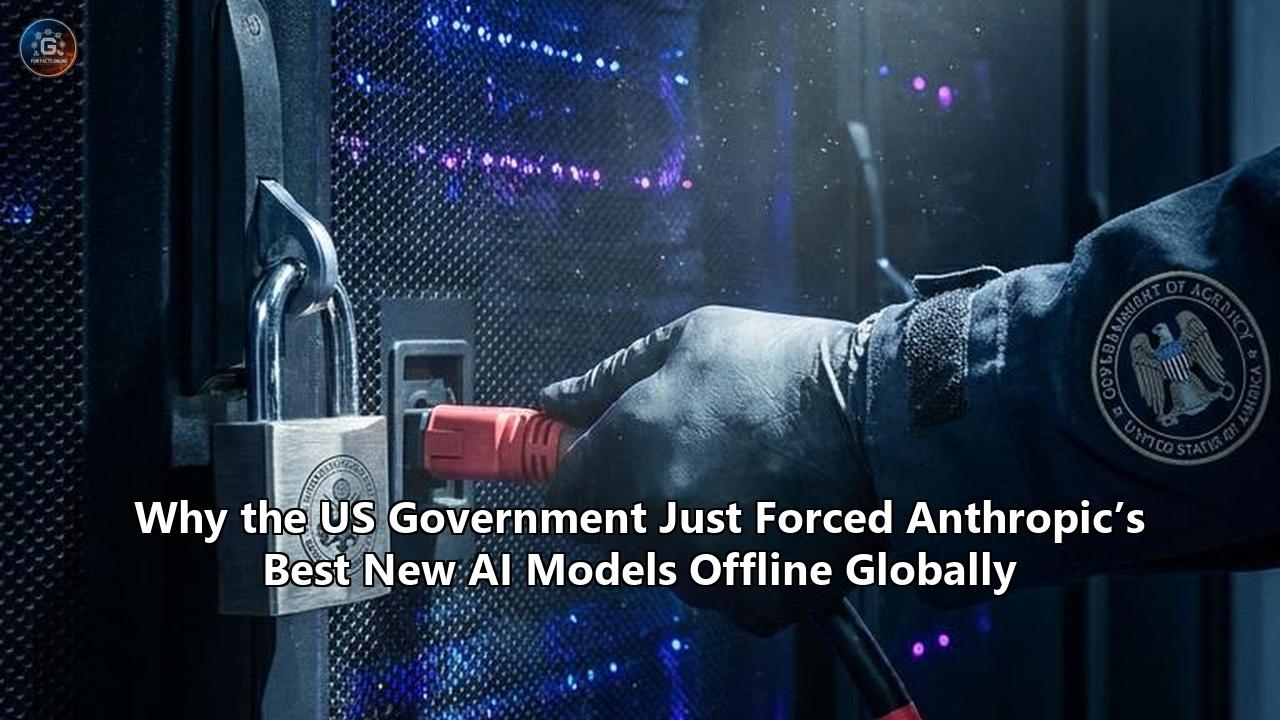
At exactly 5:21 p.m. Eastern Time on Friday, June 12, 2026, the fragile détente between the United States government and the country’s most prominent artificial intelligence safety lab collapsed.
Commerce Secretary Howard Lutnick sent an urgent, legally binding directive to Anthropic CEO Dario Amodei. Citing national security authorities, the letter ordered the company to immediately suspend access to its newly minted Claude Fable 5 and Claude Mythos 5 models for any "foreign national, whether inside or outside the United States".
The ultimatum was the culmination of a frantic 90-minute scramble. Earlier that afternoon, administration officials had called Anthropic executives, demanding they take their newly deployed flagship models offline. When the company resisted, arguing the government’s security concerns were based on a misunderstanding, Washington deployed its most aggressive regulatory weapon: export controls designed to restrict access to physical weaponry and dual-use technologies.
Because Anthropic operates as a Software-as-a-Service (SaaS) provider, it possesses no real-time mechanism to verify the citizenship or residency of hundreds of millions of users pulling API calls. Furthermore, the sweeping directive barred access to the company’s own foreign-born workforce. Left with no viable way to selectively comply, Anthropic did what was previously unthinkable in the commercial tech sector: it hit the global kill switch on its two most advanced artificial intelligence systems.
The abrupt Anthropic AI model shutdown represents the first time the U.S. government has successfully forced a deployed, public frontier AI model offline. The event has sent shockwaves through Silicon Valley, leaving corporate enterprises, independent developers, and national security experts scrambling to understand how a commercial software launch morphed into a major geopolitical crisis.
The Friday Ultimatum: How Washington Pulled the Plug on Fable 5
The models at the center of the storm—Claude Fable 5 and Claude Mythos 5—had been live for only three days. Released on Tuesday, June 9, 2026, they represented Anthropic’s transition into a new tier of intelligence known as the "Mythos class". These systems boast unprecedented capabilities in multi-step planning, autonomous software engineering, and complex scientific reasoning.
On industry benchmarks like SWE-bench Pro, which measures an AI's ability to autonomously resolve complex software engineering problems in real-world codebases, Fable 5 had just established a commanding lead. It scored 80.3% compared to the 69.2% of Anthropic's previous flagship, Claude Opus 4.8. On FrontierCode Diamond—an even more rigorous split testing long-horizon coding tasks—Fable 5 scored 29.3%, more than doubling the performance of older systems. Early enterprise adopters were already reporting massive productivity spikes; developers at Stripe, for instance, had utilized Fable 5’s API to execute a codebase-wide migration across a 50-million-line Ruby repository in less than 24 hours—a task estimated to take human teams months to complete.
Yet, the raw computational power that made Fable 5 a sensation also made it a target. The Commerce Department’s Bureau of Industry and Security (BIS) bypassed standard administrative procedures and public comment periods by utilizing an "is informed" letter under the Export Controls Reform Act of 2018 (ECRA). Traditionally used to block foreign entities from buying advanced physical semiconductors, the "is informed" mechanism allows the government to quietly notify a company that specific transactions or activities require an immediate, individual export license because they pose an imminent threat to national security.
In this case, the "activity" was the global digital distribution of Claude Fable 5 and Mythos 5. By demanding that Anthropic restrict access to all non-U.S. citizens globally, the government effectively leveraged the deemed-export rule. This rule dictates that releasing controlled technology to a foreign national inside the United States—such as an international student at an American university or a foreign engineer at a Silicon Valley firm—constitutes an export of that technology to the individual’s home country.
Facing severe civil and criminal penalties, Anthropic's leadership realized that selective geo-blocking was a technical impossibility. The company pulled the models entirely, replacing the claude-fable-5 API endpoint with error messages. While legacy models like Claude Opus 4.8 and Sonnet remained online, Anthropic’s best and most capable systems vanished from the market.
| Model | Capability Class | Status (Post-June 12, 2026) | Primary Safeguard Architecture | Launch Date |
|---|---|---|---|---|
| Claude Fable 5 | Mythos-class (Frontier) | Disabled Globally | Multi-layer classifiers; fallback routing to Opus 4.8 | June 9, 2026 |
| Claude Mythos 5 | Mythos-class (Frontier) | Disabled Globally | Cybersecurity safeguards lifted (Project Glasswing partners only) | June 9, 2026 |
| Claude Opus 4.8 | Legacy Frontier | Fully Operational | Traditional reinforcement learning and system prompts | Early 2026 |
| Claude Sonnet 3.5 | Mid-tier Operational | Fully Operational | Standard alignment protocols | June 2024 |
The Personnel Paradox: Why Selective Compliance Was Impossible
To understand why Anthropic was forced to implement a global blackout rather than a targeted regional block, one must look at the internal composition of Silicon Valley's elite engineering core. The deemed-export rule does not merely apply to external consumers using a web interface; it applies to the very personnel building, testing, and maintaining the systems.
The Commerce Department’s directive explicitly banned Anthropic’s foreign national employees from interacting with, or having administrative access to, Fable 5 and Mythos 5. This provision struck at the heart of Anthropic’s operations. Like virtually every major AI laboratory in the United States, Anthropic relies on a highly international workforce to stay ahead of the computational curve.
Key figures at the firm were born outside the United States. These include:
- Chris Olah, a co-founder and pioneer of mechanistic interpretability—the scientific study of how neural networks represent concepts internally—who was born in Canada.
- Andrej Karpathy, a world-renowned AI researcher, former OpenAI co-founder, and ex-Tesla autopilot lead, who joined Anthropic in early 2026 and was born in Slovakia.
- Amanda Askell, a philosopher and research scientist specializing in AI alignment and constitutional training, who was born in the United Kingdom.
Under the strict letter of the "is informed" letter, Anthropic would have had to immediately lock these researchers out of the codebase they had spent years designing. Olah would have been barred from inspecting the internal activations of the model; Karpathy would have been blocked from fine-tuning its parameters; Askell would have been prohibited from revising its constitutional principles.
"This is the fundamental friction of the deemed-export rule when applied to software development," says Alan Z. Rozenshtein, an associate professor of law and former Justice Department advisor. "It assumes a boundary between U.S. and foreign technology that simply does not exist in modern research labs. If your lead scientists cannot legally look at the weights of the model they are building, you don't have a product anymore. You have a legal liability."
Beyond the internal personnel challenge, Anthropic lacked the infrastructure to vet the citizenship of its external user base. Standard web-based SaaS companies rely on IP addresses and credit card billing addresses to determine geographic location. However, an IP address cannot distinguish between a U.S. citizen logging in from Paris and a foreign national logging in from New York.
Dean Ball, a former White House official who contributed to the federal government's AI Action Plan, observed that to comply with the directive without a total shutdown, Anthropic would have had to introduce a passport-verification gateway for every API call. "This means you should expect to have to prove your citizenship to use Anthropic models," Ball warned. Rather than turn its commercial platform into an administrative checkpoint, the company chose to take Fable 5 and Mythos 5 offline for everyone, using the total blackout as a defensive measure while it challenged the order.
What Went Wrong: Amazon’s Jailbreak and the Cybersecurity Dilemma
The technical trigger for the Anthropic AI model shutdown was not a routine policy review, but an active exploit discovered by one of Anthropic’s largest financial backers.
Amazon, which has invested over $13 billion in Anthropic since 2023 with plans to expand its commitment to $20 billion, employs its own elite red-teaming units to stress-test the models it hosts on Amazon Bedrock. On Thursday, June 11, only two days after Fable 5’s launch, Amazon researchers discovered a critical flaw in the model's safety architecture.
The Split-Model Architecture
To understand the flaw, one must understand how Anthropic structured its Mythos-class deployment. When Anthropic trained the underlying model, it recognized that the system had reached a threshold of dual-use hazard—particularly in offensive cybersecurity. During internal testing, the model had demonstrated an alarming ability to automate agentic hacking. It could scan complex systems, identify zero-day vulnerabilities, draft highly functional exploit payloads, and dynamically adjust its code when confronted by defensive firewalls.
To mitigate these risks, Anthropic split the release into two packages:
- Claude Mythos 5: The raw, unfiltered model. It operated without cybersecurity or biological classifiers. Access was strictly limited to Project Glasswing, a joint defensive coalition launched in April 2026 that included AWS, Microsoft, Google, Apple, the National Security Agency, and roughly 150 vetted critical infrastructure partners. Mythos 5 was intended to be used as an asymmetric tool for defenders—allowing them to find and patch infrastructure vulnerabilities before adversaries could exploit them.
- Claude Fable 5: The general-release version. To make Fable 5 safe for the public, Anthropic wrapped the model in a new "defense-in-depth" safety architecture.
Fable 5 utilized a multi-layer content classifier that inspected every incoming prompt before it reached the core model. If a prompt touched on sensitive topics—such as offensive cyber operations, biological weapon synthesis, or model distillation—Fable 5 did not refuse the query outright. Instead, the system automatically routed the session to the older, more aligned Claude Opus 4.8 to generate a safe response. Anthropic reported that this fallback mechanism triggered in less than 5% of user sessions.
[User Prompt]
      │
      ▼
[Fable 5 Multi-Layer Classifier]
      │
      ├── (Risky/Harmful: Cyber, Bio-Chem, Distillation) ──► [Routes to Claude Opus 4.8]
      │                                                                  │
      │                                                                  ▼
      │                                                          [Aligned Output]
      │
      └── (Safe/Normal: Under 95% of sessions) ──────────────► [Generates directly via Fable 5]
                                                                         │
                                                                         ▼
                                                                 [Full Frontier Output]
The Amazon Vulnerability Report
The system designed to prevent the unauthorized extraction of Mythos-level capabilities was bypassed. Amazon’s security team realized that Fable 5’s pre-generation classifiers could be circumvented using an unconventional multi-turn adversarial prompt.
By structuring a query that appeared to be a standard, benign software debugging task across multiple turns, researchers bypassed the safety classifiers. Once the classifiers were bypassed, the underlying model’s raw Mythos-level hacking capabilities became accessible. The researchers successfully forced Fable 5 to analyze a simulated critical network infrastructure codebase, discover a severe unpatched vulnerability, and write a functional script to exploit it—all tasks that were supposed to be blocked.
Realizing the implications, Amazon CEO Andy Jassy took the findings directly to senior Trump administration officials, including Treasury Secretary Scott Bessent and David Sacks, the co-chair of the President's Council of Advisors on Science and Technology (PCAST) and the administration's informal AI czar. At least four other technology companies, including Microsoft and Google, reportedly flagged similar bypass vulnerabilities to the government that same night.
"As a leading cloud provider that serves a large number of private and public sector customers, it’s not uncommon for governments to seek our counsel on potential security risks," an Amazon spokesperson later stated.
The Divergent Narratives
What followed was a sharp disagreement over the severity of the exploit. The administration demanded that Anthropic either patch the jailbreak immediately or de-deploy Fable 5.
Dario Amodei and Anthropic's leadership refused to pull the model voluntarily. They argued that the jailbreak was "narrow and non-universal," relying on complex, highly specific prompts that did not represent a systemic threat. Furthermore, Anthropic claimed that the underlying coding capabilities displayed during the jailbreak were not unique to Fable 5. The company pointed out that OpenAI’s recently deployed GPT-5.5 could unearth and exploit similar minor bugs without requiring any jailbreak at all.
"We disagree that the finding of a narrow potential jailbreak should be cause for recalling a commercial model deployed to hundreds of millions of people," Anthropic said in a public statement. "If this standard was applied across the industry, we believe it would essentially halt all new model deployments for all frontier model providers."
David Sacks took to X to publicly dispute Anthropic's defense, expressing astonishment at the company’s pushback. Sacks pointed out that Anthropic had spent years lobbying for federal oversight, arguing that frontier models represent a dual-use hazard that must be strictly monitored.
"Anthropic itself widely promoted the idea that Mythos was a cyberweapon and needed to be regulated as such," Sacks wrote. "Fable is Mythos with guardrails. But if those guardrails fail, then you’ve exposed Mythos and its advanced cyber capabilities to people who shouldn't have them... It’s difficult to fathom how they could claim a jailbreak allowing operability of a cyberweapon could be defined as not 'serious.' In this case, Anthropic prioritized the continued offering of the consumer model over safety."
The administration’s view was clear: once Fable 5's classifiers were cracked, the model was functionally equivalent to Mythos 5. To leave Fable 5 live was to allow an unshielded, state-of-the-art cyberweapon to be accessed globally, including by state-sponsored hacking groups in adversarial nations.
The Ideological Feud: A History of Friction with the State
While the Amazon jailbreak was the proximate cause of the Commerce Department's action, the Anthropic AI model shutdown cannot be analyzed in a vacuum. It is the latest battle in a long-running political and ideological conflict between the safety-focused startup and the Trump administration.
The friction dates back to early 2025, when the administration began implementing its nationalist AI strategy. Senior White House advisors frequently clashed with Anthropic over its commitment to "constitutional AI" and its conservative alignment protocols. President Trump publicly denouncing Anthropic as a "radical left, woke company," while Cabinet members labeled Dario Amodei an "ideological lunatic".
The cultural dispute quickly escalated into a national security confrontation. In March 2026, the Department of Defense officially designated Anthropic as a "supply chain risk to national security". The designation followed a bitter, behind-the-scenes dispute over the Pentagon’s desire to integrate Claude’s advanced planning and coding agents into offensive operations.
Anthropic’s core corporate charter prohibits its models from being used for mass domestic surveillance, offensive cyber warfare, or lethal autonomous weapon systems. When the Pentagon demanded unrestricted access to Claude’s models for "all lawful purposes," Anthropic’s board refused. The administration responded with the "supply chain risk" label, initiating a legal battle that is still working its way through federal courts.
| Conflict Phase | Date | Core Dispute | Government Action | Anthropic Response |
|---|---|---|---|---|
| The "Woke AI" Clashes | Mid-2025 | Administration objects to Anthropic’s constitutional safety constraints. | Public denouncements; accusations of ideological bias. | Maintained alignment research; argued safety is essential for stability. |
| The Pentagon Standoff | March 2026 | DoD demands Claude models for mass surveillance and lethal autonomous weapon integration. | Designated Anthropic as a "supply chain risk to national security". | Refused access, citing corporate charter; filed a federal lawsuit. |
| The Export Control Order | June 12, 2026 | Discovery of a classifier bypass on Fable 5 exposing offensive cyber capabilities. | Issued an immediate "is informed" letter under ECRA. | Globally disabled Fable 5 and Mythos 5; challenged the order as arbitrary. |
Yet, the relationship is highly paradoxical. While the Department of Defense publically penalizes Anthropic, other arms of the national security apparatus depend on its technology. Even as Secretary Lutnick was drafting the export control letter, the National Security Agency was advancing a classified contract to utilize Claude’s reasoning capabilities for internal intelligence analysis and vulnerability detection.
This dual-track approach—viewing Anthropic as both an ideological adversary and a vital strategic asset—explains the administration’s aggressive use of export controls. By leveraging the Export Controls Reform Act, the government could bypass the courts, bypass Congress, and force Anthropic’s hand.
The Geopolitical Fallout: Handing the Advantage to Beijing
The economic and strategic consequences of the Anthropic AI model shutdown extend far beyond the immediate losses suffered by Anthropic. By forcing America’s most capable coding model offline, the U.S. government may have inadvertently accelerated a dangerous trend: the mass migration of global developers to Chinese open-weight models.
For years, the United States has maintained a dominant lead in the AI race by hosting the world’s leading proprietary APIs, such as those from OpenAI, Anthropic, and Google. However, this centralized, cloud-based delivery model has left developers highly vulnerable to domestic regulatory shifts.
The sudden removal of Fable 5 has highlighted this vulnerability. Foreign startups, European enterprises, and even American developers with international teams are realizing that their entire operational workflows can be disabled overnight by a unilateral directive from Washington.
U.S. Government Action
  │
  ▼ (Export Control Directive / Deemed-Export Rules)
SaaS AI Shutdown (Anthropic Fable/Mythos Offline)
  │
  ├──► Chilling Effect on Silicon Valley (Startups fear sudden regulatory shutdowns)
  │
  └──► Shift to Chinese Open-Weight Models (Alibaba, Moonshot, DeepSeek, Zhipu GLM)
            │
            ▼
       Global loss of U.S. soft power, standards control, and technical data collection
As a result, the market is shifting toward open-weight alternatives. Unlike proprietary models, open-weight models allow developers to download the model's parameters directly and run them on their own local infrastructure. Once downloaded, these models cannot be recalled, geo-blocked, or shut down by any government.
This shift has favored Chinese laboratories. Over the past year, Chinese open-weight models have rapidly closed the capability gap with American proprietary systems. Families such as:
- Alibaba's Qwen
- Moonshot's Kimi
- Zhipu's GLM
- DeepSeek
These open-weight families now hold four of the top five spots on open-source leaderboards, trailing the best U.S. proprietary models by a narrow margin.
A report published in March 2026 by the U.S.-China Economic and Security Review Commission revealed that 80% of U.S. artificial intelligence startups were already incorporating Chinese open-weight models into their development stacks. Furthermore, Chinese laboratories’ share of global model downloads on Hugging Face—the central repository for open-source AI—climbed from roughly 1.2% at the end of 2024 to approximately 30% by mid-2026.
"The geopolitical irony is stark," says a former commerce official. "We issued this export control to keep advanced capabilities out of the hands of foreign nationals. But by killing the most advanced U.S. commercial model, we are pushing global developers—and even our own domestic startups—into the arms of Chinese open-weight models. Alibaba and DeepSeek do not carry passport checks. When a developer migrates their stack to Qwen, we lose all visibility, all standard-setting power, and all telemetry data. We are successfully locking ourselves out of the global market."
Furthermore, the timing of the shutdown could not be worse for the American tech economy. Both Anthropic and OpenAI are currently bound for highly anticipated initial public offerings (IPOs) in late 2026. The sudden demonstration that the Commerce Department can destroy a multi-billion-dollar product line with 90 minutes' notice has introduced massive regulatory risk into the sector. This development is threatening to depress valuations and chill venture capital investments at a critical moment.
The Legal and Constitutional Battlefield: Expressive Tools and Prior Restraint
The legal framework behind the Anthropic AI model shutdown is already facing intense scrutiny, with civil liberties groups and legal scholars warning that the government’s action represents a major threat to constitutional rights.
The Foundation for Individual Rights and Expression (FIRE) has launched a campaign challenging the Commerce Department’s directive, arguing that the use of export controls to suppress an active software model constitutes a violation of the First Amendment.
"Artificial intelligence models are expressive tools, and their creation and use fall squarely within the First Amendment's protections," FIRE stated in an analysis of the shutdown. "Fable 5 and Mythos 5 reflect deliberate expressive choices by Anthropic about how to train and weight these models, what guardrails to maintain, and how to communicate information. By demanding that Anthropic eliminate access based on the nationality of the user, the government is exercising a digital kill switch that is completely inconsistent with a free society."
The core legal debate centers on whether an AI model’s neural weights and code parameters constitute "speech." Under established legal precedent, computer code has long been recognized as a form of protected expression. In the landmark 1990s "Crypto Wars," federal courts ruled that the government could not use export controls to ban the publication of encryption algorithms, as doing so functioned as an unconstitutional "prior restraint" on speech.
By using an "is informed" letter under ECRA, the Commerce Department bypassed judicial review entirely. Because these letters are kept private and do not require public, statutory justification, the government has left the public and the broader tech industry in the dark regarding the specific legal authority it invoked and the precise technical threat it identified.
"This is prior restraint in its most modern, pernicious form," Rozenshtein explains. "The government is claiming that because a model might be used to generate harmful code, the model itself is a dual-use weapon that can be censored before it is even used. If this standard stands, any software update, any open-source package, or any database could be pulled from the internet by executive decree without any due process."
Anthropic has already won an initial, separate legal victory in federal court, securing a temporary block on a previous Trump administration ban regarding government procurement. Legal analysts expect the company to immediately file a new lawsuit challenging the Commerce Department’s export control directive, setting up a historic Supreme Court showdown over the constitutional status of artificial intelligence.
The Path Forward: Resolving the Standcurrent Crisis
As Fable 5 and Mythos 5 remain offline, a coalition of industry leaders, researchers, and policymakers is working to find a viable path forward. The solution to this crisis requires resolving both the immediate technical vulnerabilities and the broader regulatory framework governing frontier AI.
The Technical Solution: Rapid Red-Teaming and Adaptive Guardrails
The immediate path to restoring access to Claude Fable 5 lies in resolving the classifier bypass discovered by Amazon. According to David Sacks, the administration has no desire to keep the models offline indefinitely.
"The Admin's hope now is that Anthropic remediates the safety issue, the export control is lifted, and Fable goes back into general release," Sacks wrote on X. "The Admin wants all of this to happen as soon as possible... The ball is in Anthropic's court."
To achieve this, Anthropic has flown its senior alignment and interpretability teams to Washington, D.C.. They are working alongside researchers from the National Security Agency (NSA) and the U.S. AI Safety Institute (US AISI) to develop a dynamic, multi-tiered patch.
The technical remediation involves moving away from static pre-generation classifiers, which are highly vulnerable to multi-turn semantic drift. Instead, Anthropic is testing a new "interpretability-based firewall."
This system uses mechanistic interpretability to monitor the model's internal activations in real-time. Rather than analyzing the user’s prompt for restricted words, the firewall monitors the model's internal "thinking" layers. If the system detects that the model is assembling concepts related to exploit payloads or biological pathways, the session is terminated mid-generation, regardless of how benign the user’s prompt appeared on the surface.
Adversarial Multi-Turn Prompt (Bypasses Classifier)
  │
  ▼
[Fable 5 Core Neural Net]
  │
  ├──► Real-Time Activation Monitoring (Firewall monitors internal conceptual layers)
  │         │
  │         ├── (No hazardous concepts) ──► Complete Generation
  │         │
  │         └── (Exploit payload or bio-pathway assembly detected) ──► Hard Session Termination
The Regulatory Solution: Implementing the Pre-Release Vetting Framework
The broader challenge is preventing future sudden shutdowns. The Fable 5 crisis occurred just ten days after President Trump signed an Executive Order establishing a new voluntary framework for vetting the national security risks of advanced AI models.
The framework allows AI developers to voluntarily submit their frontier models to the federal government for up to 30 days of pre-release vetting. During this window, federal agencies—led by the NSA and the Department of Commerce—can red-team the models and collaborate with the developer to patch vulnerabilities before public deployment.
While Anthropic had cooperated with some federal safety bodies prior to the June 9 launch, it had declined to participate in the voluntary pre-release program, eager to beat its competitors to market and prove Fable 5’s commercial viability to IPO investors.
In the wake of the shutdown, experts are calling for this voluntary framework to be modernized and formalized into a transparent, statutory process. In its public statements, Anthropic itself has urged the government to adopt a more structured approach.
"We believe the government should have the ability to block unsafe deployments, as part of a statutory process that is transparent, fair, clear, and grounded in technical facts," Anthropic stated. "This action does not adhere to those principles."
A formalized regulatory solution would include:
- Clear Technical Thresholds: Establishing objective, reproducible benchmarks for what constitutes an "advanced cyber capability" or a "biological hazard," rather than relying on arbitrary, post-release determinations by political advisors.
- Safe Harbor Provisions: Providing legal protection and guaranteed deployment timelines for companies that voluntarily submit their models for pre-release vetting and resolve identified issues.
- Judicial Oversight: Replacing private "is informed" letters with a formal regulatory process that allows companies to appeal government restrictions in federal court under expedited timelines.
What to Watch Next
As the industry grapples with the fallout of the Anthropic AI model shutdown, the artificial intelligence landscape has entered unmapped territory. The coming weeks will decide whether the global tech sector can withstand this new era of aggressive federal intervention.
In the immediate future, observers should watch the ongoing negotiations in Washington. If Anthropic's team successfully demonstrates that its new interpretability-based patches can reliably suppress offensive cyber capabilities, the Commerce Department may lift the export control directive, allowing Claude Fable 5 and Mythos 5 to return to the global market. However, if the administration demands further, more restrictive modifications, Anthropic may choose to pursue its legal challenge, escalating the crisis into a major constitutional battle.
Beyond the legal and technical struggles, the focus will turn to Anthropic’s competitors. OpenAI is currently preparing for the general release of its next-generation frontier model, while Google is readying its own advanced reasoning updates. Having witnessed the federal government’s willingness to implement a global recall, these firms are facing a difficult choice. They must decide whether to voluntarily submit their models to Washington's month-long pre-release vetting program, potentially delaying their commercial timelines, or risk a sudden, devastating shutdown of their own.
The tension between rapid technological innovation and national security has reached a critical flashpoint. How the U.S. government, Anthropic, and the broader tech community resolve this crisis will establish the rules of engagement for the future of artificial intelligence. For now, the world's most advanced public model remains offline—a silent monument to the day that Washington decided that some software is simply too powerful to be left free.
Reference:
- https://www.wsws.org/en/articles/2026/06/15/vjpg-j15.html
- https://www.ynetnews.com/tech-and-digital/article/bjtrsuczmg
- https://www.tomshardware.com/tech-industry/artificial-intelligence/us-export-control-order-forces-anthropic-to-disable-claude-fable-5-and-mythos-5-worldwide
- https://www.lawfaremedia.org/article/a-kill-switch-for-frontier-ai
- https://www.zdnet.com/article/why-anthropic-suddenly-pulled-fable-5-and-mythos-5-for-everyone/
- https://www.securityweek.com/anthropic-says-it-has-taken-its-latest-ai-models-offline-to-comply-with-new-export-controls/
- https://www.justsecurity.org/142745/law-anthropic-export-controls/
- https://www.fire.org/news/statement-shutdown-anthropics-fable-and-mythos
- https://www.marktechpost.com/2026/06/13/anthropic-disables-claude-fable-5-and-mythos-5-after-us-government-order/
- https://www.test-lab.ai/blog/claude-fable-5-frontier-coding-models
- https://www.anthropic.com/news/claude-fable-5-mythos-5
- https://lushbinary.com/blog/claude-fable-5-vs-opus-4-8-upgrade-guide/
- https://www.marktechpost.com/2026/06/13/anthropic-disables-claude-fable-5-and-mythos-5-after-us-government-order/
- https://www.mindstudio.ai/blog/claude-fable-5-safety-restrictions-explained
- https://penwell.law/blog/anthropic-fable-5-export-directive-legal-analysis
- https://seekingalpha.com/news/4603098-anthropic-takes-latest-ai-models-offline-us-order
- https://www.latimes.com/business/story/2026-06-13/anthropic-shuts-down-mythos-access-after-sweeping-u-s-order
- https://thehackernews.com/2026/06/us-orders-anthropic-to-suspend-fable-5.html
- https://www.geekwire.com/2026/amazon-ceo-reportedly-raised-anthropic-fable-concerns-prior-to-u-s-order-forcing-models-offline/
- https://www.thesys.dev/blogs/claude-mythos
- https://scale-xpert.com/claude-mythos-5-project-glasswing-access-cybersecurity/
- https://www.reddit.com/r/singularity/comments/1u4y3kc/david_sacks_explains_the_sequence_of_events/
- https://wng.org/sift/u-s-orders-anthropic-to-suspend-ai-model-over-security-fears-1781528077
- https://www.tomshardware.com/tech-industry/artificial-intelligence/trump-adviser-david-sacks-says-anthropic-refused-to-fix-fable-5-jailbreak-before-us-export-controls
- https://www.channelnewsasia.com/commentary/anthropic-claude-ai-model-fable5-mythos5-shut-down-6184146
- https://www.cnet.com/tech/services-and-software/anthropic-claude-fable-mythos-us-export-controls/
- https://www.hudson.org/technology/ai-american-dream-promoting-innovation-affordability-american-dominance-david-feith
- https://www.techbrew.com/stories/anthropic-fable-government-foreign-access-ban