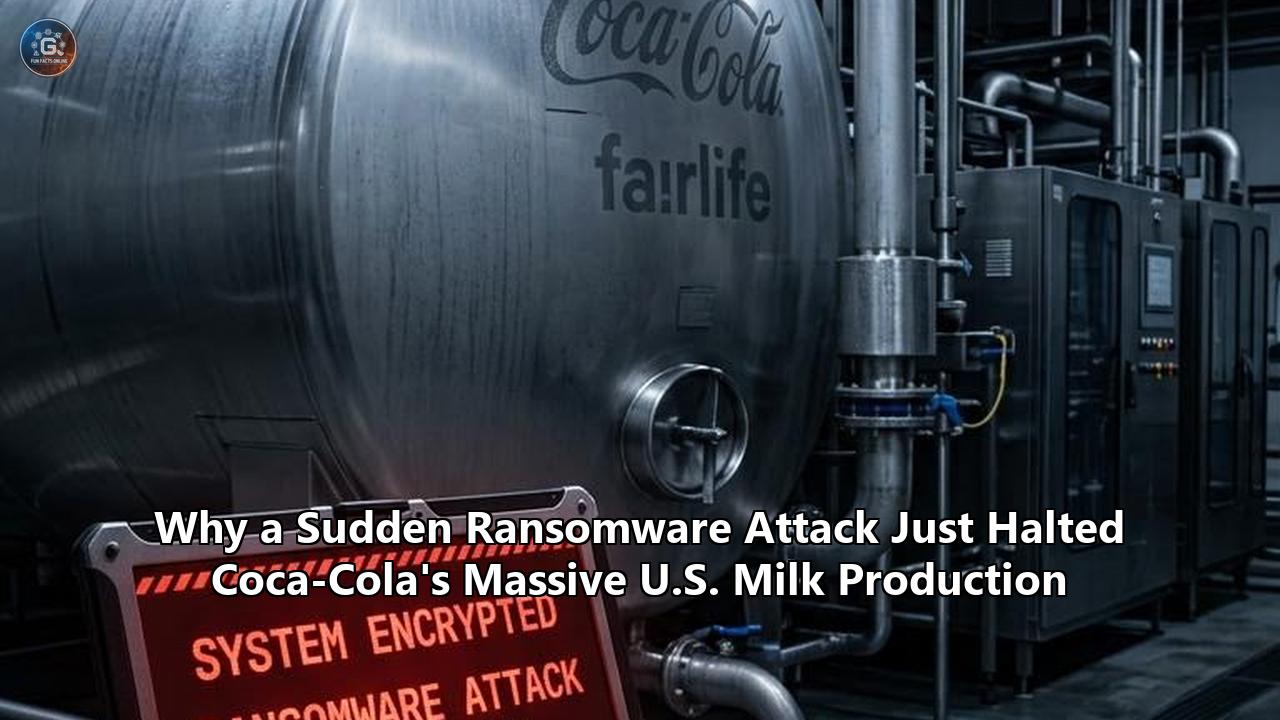
On July 16, 2026, the global beverage and agricultural sectors were thrown into sudden disarray when The Coca-Cola Company filed an emergency Form 8-K disclosure with the U.S. Securities and Exchange Commission (SEC). The filing revealed that its highly profitable, wholly owned dairy subsidiary, fairlife, LLC, had identified unauthorized third-party access to its digital environments—specifically targeting its physical production-related systems—in connection with a major ransomware event.
To contain the intrusion, Coca-Cola took the drastic step of temporarily suspending all U.S. production operations for the fairlife brand. Almost overnight, a primary engine of Coca-Cola’s domestic dairy supply chain was brought to a screeching halt.
The disruption was not just a localized IT failure; it was a physical blockade on a highly perishable supply chain. The fairlife brand, famous for its ultra-filtered, lactose-free milk and Core Power protein shakes, has grown into a multi-billion-dollar juggernaut. For a manufacturing operation of this scale, resolving a ransomware attack is far more complex than recovering encrypted office files or resetting compromised passwords. When malware invades the operational technology (OT) managing pasteurizers, clean-in-place sanitation cycles, and high-speed bottling lines, the recovery process requires meticulous physical validation to ensure public safety.
The sudden halt of fairlife's production facilities is the latest flashpoint in an escalating cyber campaign targeting the global food and agriculture supply chain. To understand how a global beverage giant’s dairy crown jewel was suddenly brought to its knees, we must trace the chronological development of this crisis—from early federal warnings to the critical system compromises that ultimately curdle milk production.
April 7, 2026: The Federal Red Alert on Operational Technology
The vulnerability that ultimately crippled fairlife’s production did not emerge in a vacuum. Months before the July breach, federal cyber defense agencies issued a stark, highly specific warning regarding the vulnerability of industrial automation systems.
+-----------------------------------------------------------------+
|                    CHRONOLOGY OF ESCALATION                    |
+-----------------------------------------------------------------+
|                                                                 |
|  [April 7, 2026]                                                |
|  Federal agencies issue Joint Advisory warning of OT target-    |
|  ing (Rockwell PLCs / CVE-2021-22681).                          |
|                                                                 |
|  [May-June 2026]                                                |
|  Food and Ag-ISAC reports sharp rise in sector-wide attacks;    |
|  72 active threat groups tracked globally.                      |
|                                                                 |
|  [July 13, 2026]                                                |
|  Nichirei Corp. hit by cyberattack in Japan; cold-chain         |
|  logistics and shipping ground to a halt.                       |
|                                                                 |
|  [July 15, 2026]                                                |
|  fairlife detects unauthorized access within U.S. production-   |
|  related networks.                                              |
|                                                                 |
|  [July 16, 2026]                                                |
|  Coca-Cola files Form 8-K; shuts down all U.S. fairlife milk    |
|  processing plants.                                             |
|                                                                 |
+-----------------------------------------------------------------+
On April 7, 2026, a coalition of six U.S. federal agencies—including the Federal Bureau of Investigation (FBI), the Cybersecurity and Infrastructure Security Agency (CISA), the National Security Agency (NSA), the Environmental Protection Agency (EPA), the Department of Energy (DOE), and the U.S. Cyber Command’s Cyber National Mission Force—released a joint cybersecurity advisory. The advisory warned of active, ongoing exploitation of internet-facing operational technology devices, specifically focusing on programmable logic controllers (PLCs) manufactured by Rockwell Automation.
PLCs are the unheralded workhorses of modern industrial plants. Unlike standard desktop computers, these dedicated industrial microcomputers monitor inputs from physical sensors and control output devices such as motors, valves, pumps, and heating elements. In a highly automated dairy processing plant like fairlife’s, PLCs dictate the precise timing and temperature of milk pasteurization, manage the pressure within ultra-filtration membranes, and orchestrate the high-speed movement of filling and packaging equipment.
The federal advisory warned that sophisticated nation-state threat actors, including Iranian-affiliated advanced persistent threat (APT) groups like CyberAv3ngers, were actively probing and manipulating these controllers. The primary point of exploitation was a known authentication bypass vulnerability, designated as CVE-2021-22681, located within Rockwell Automation’s Studio 5000 Logix Designer software.
By exploiting this vulnerability, attackers could bypass security protocols, extract cryptographic keys, and establish unauthorized connections to Logix controllers. Once inside, hackers could:
- Manipulate human-machine interface (HMI) displays to show false telemetry.
- Alter supervisory control and data acquisition (SCADA) project files.
- Inject malicious code to directly disrupt physical manufacturing processes.
According to data compiled by internet monitoring firm Censys at the time of the advisory, more than 5,200 Rockwell Automation Allen-Bradley devices were exposed to the public internet globally, with nearly 75% of them located in the United States. Many of these devices were connected via cellular modems directly to the open web, completely lacking protective firewalls, virtual private networks (VPNs), or multi-factor authentication.
Federal defense agencies warned that physical disruptions to these systems would not only cause catastrophic financial losses but could also trigger regional economic bottlenecks and compromise the physical safety of food and utility processing systems. The warning was clear, yet the structural backlog of industrial security patches meant that thousands of manufacturing plants remained vulnerable.
May–June 2026: The Rise of "Vibe Coding" and Food Sector Penetration
As spring transitioned into summer, threat intelligence groups noticed a profound tactical shift among cybercriminals targeting the agricultural sector. The Food and Agriculture Information Sharing and Analysis Center (Food and Ag-ISAC) issued its mid-year threat assessments, noting that the farm-to-table supply chain had transformed into a primary theater of cyber conflict.
Historically, the food sector was viewed as a lower-priority target compared to finance, healthcare, or defense. However, the rapid digitization of agriculture—characterized by autonomous machinery, smart-sensor networks, and cloud-integrated inventory management—radically expanded the industry’s digital attack surface. By June 2026, the Food and Ag-ISAC was monitoring more than 330 threat adversaries, identifying at least 72 highly active groups targeting food processors and distributors.
Ransomware-as-a-service (RaaS) operations, such as Qilin, Akira, CL0P, and Lynx, realized that food manufacturers were incredibly vulnerable to operational downtime. Because food processing is a continuous, tightly scheduled cycle dependent on highly perishable raw materials, even a brief production stoppage can result in millions of dollars of spoiled inventory and empty retail shelves. Hackers leveraged this extreme time-sensitivity to extract massive payments, knowing that victimized companies faced intense pressure to pay quickly and restore physical operations.
Global Ransomware Incidents (All Sectors)
2024: 3,508 cases
2025: 6,377 cases (82% increase)
Active Threat Groups Targeting Food/Ag (2026): 72 groups
Furthermore, the rise of modern industrial software development practices—often referred to in the tech sector as "vibe coding," where rapid, AI-assisted code generation is deployed to manage industrial IoT networks—introduced new security vulnerabilities. Legacy operations networks (OT), which were originally designed to be completely air-gapped and separated from corporate information technology (IT) networks, were increasingly connected to corporate databases for real-time telemetry and resource planning. This convergence undermined the traditional Purdue Model of network segmentation, creating direct pathways for ransomware starting in standard corporate email systems to jump across networks and lock down physical production lines.
July 13, 2026: The Japanese Cold-Chain System Failure
The physical reality of this vulnerability was demonstrated on a massive scale just days before fairlife was hit. On July 13, 2026, Nichirei Corporation, one of Japan's premier frozen food producers and cold-storage logistics providers, suffered a catastrophic cyberattack.
NICHIREI CORP. CYBERATTACK TIMELINE (JULY 2026)
July 13: Core servers compromised. Systems disconnected. Cold storage logistics halt.
July 14: Downstream disruption hits 5,000 customers, supermarkets, and restaurants.
July 16: Seafood and frozen food delivery backlogs escalate across Japan.
July 17: Gradual restoration of refrigerated warehouses begins with security oversight.
Nichirei, which operates the largest cold-storage logistics network in Japan with approximately 140 refrigerated distribution centers serving more than 5,000 customers, detected that its primary servers had been compromised. In an effort to contain the breach and protect proprietary partner and customer data, Nichirei disconnected all of its group systems.
The immediate result was an operational paralysis that sent shockwaves through Japan’s food supply chain:
- Refrigerated Warehouses Blocked: Inbound and outbound logistics at Nichirei Logistics Group’s massive refrigerated warehouses were immediately frozen, leaving trucks stranded and blocking food shipments.
- Retail and Restaurant Shortages: Major retail chains, supermarkets like Aeon and York Benimaru, and delivery networks reported severe shortages of frozen and refrigerated goods.
- Menu Disruption: Conveyor-belt sushi titan Kura Sushi was forced to announce shortages of core sushi toppings across dozens of its restaurants in the Kansai region.
- Store Closures and Reduced Hours: Kentucky Fried Chicken Japan issued urgent warnings of potential ingredient shortages, leading to reduced operating hours and temporary closures of select physical locations.
While Nichirei worked with external cybersecurity experts to gradually restore operations by July 17, the incident provided a vivid demonstration of the immense ransomware attack impact on physical logistics. It proved that cyber warfare in the food sector was no longer about data leaks or financial ledger manipulation; it was about the physical halting of refrigerated trucks, the spoilage of seafood, and the disruption of daily dining for millions of consumers.
As the security community analyzed the Nichirei incident, a far larger supply chain emergency was quietly unfolding in the agricultural heartland of the United States.
July 15, 2026: The fairlife System Intrusion
While public attention was focused on the logistics crisis in Japan, security operations centers at Coca-Cola’s dairy subsidiary, fairlife, LLC, began detecting anomalous behavior deep within their own systems.
On Wednesday, July 15, 2026, network monitoring tools at fairlife’s Chicago headquarters flagged unauthorized administrative activity. A third-party actor had bypassed perimeter security protocols and gained access to a portion of fairlife’s internal network, including systems that directly interface with physical production-related environments.
The breach was a worst-case scenario. Over the past decade, fairlife had grown from a promising joint venture with Select Milk Producers in 2014 into Coca-Cola's premier, high-margin dairy asset, following a full acquisition in 2020. By utilizing a specialized filtration process that separates milk into its five core components (water, butterfat, protein, lactose, and minerals) before recombining them to create high-protein, lactose-free milk, fairlife carved out a dominant position in the premium dairy market.
To support its exponential growth—which saw retail sales surge from $10 million in 2014 to nearly $4 billion by late 2025—fairlife built a network of highly automated, state-of-the-art production facilities across the United States. These included:
- Coopersville, Michigan: The site of a massive $650 million expansion project announced in March 2026 to scale milk and protein shake production.
- Goodyear, Arizona: A cutting-edge processing hub serving the southwestern United States.
- Dexter, New Mexico: Strategically located in the heart of dairy country.
- Webster, New York: A brand-new, 745,000-square-foot facility scheduled to open in late 2026 to capture the northeastern market.
fairlife's Rise to a Dairy Giant
2014: $10 Million Retail Value
2020: Coca-Cola acquires full ownership
2022: Surpasses $1 Billion in Annual Retail Sales
2025: Approaches $4 Billion in Annual Retail Sales
2026 (March): $650 Million expansion of Coopersville, MI plant
2026 (July): Cyberattack halts all U.S. processing facilities
Every single one of these plants relied on unified, highly computerized process controls to manage the complex physical chemistry of ultra-filtration. When the ransomware threat actors penetrated the production-related systems, they did not just encrypt administrative databases; they gained the capability to disrupt the delicate, computer-controlled valving and filtration sequences that keep the milk sterile and properly proportioned.
July 16, 2026: The SEC Disclosure and the U.S. Production Halt
Upon confirming the presence of ransomware within the production network, Coca-Cola’s executive leadership and incident response teams faced an immediate and high-stakes dilemma. They had to weigh the enormous cost of shutting down a multi-billion-dollar brand against the catastrophic risk of leaving compromised physical control systems online.
If the ransomware actors manipulated the PLCs governing pasteurization temperatures or CIP cleaning processes, the physical results could be devastating. A single batch of improperly pasteurized milk reaching the market could trigger widespread outbreaks of foodborne pathogens, permanently damaging the brand and risking public health. Alternatively, malware-induced physical pressure spikes in the ultra-filtration systems could damage millions of dollars of specialized filtration membranes and physical infrastructure.
Choosing safety over continuous operation, Coca-Cola promptly activated its incident response and business continuity protocols, engaged external cybersecurity experts, notified federal law enforcement, and ordered an immediate, total shutdown of all fairlife U.S. production facilities.
On Thursday, July 16, 2026, Monica Howard Douglas, Coca-Cola’s Executive Vice President and Global General Counsel, signed and submitted the company’s formal Form 8-K disclosure to the SEC. The document publicly confirmed the breach:
"On July 16, 2026, The Coca-Cola Company (the “Company”) announced that fairlife, LLC (“fairlife”), a dairy company owned by the Company, identified unauthorized access by a third party to a portion of its systems, including its production-related systems, in connection with a ransomware event... Product quality and safety have not been impacted. However, as a result of the incident, production operations at fairlife in the United States are temporarily suspended."
While the filing noted that fairlife’s Canadian operations remained unaffected and would continue to operate, the domestic shutdown was complete. Overnight, one of the nation's most critical high-protein milk supply lines went entirely dark.
The Logistical Nightmare: Why You Can’t Just "Flip a Switch"
To those unfamiliar with industrial manufacturing, the solution to a ransomware attack might seem straightforward: isolate the infected systems, restore the virtual environments from offline backups, and restart the computers. However, in physical process industries—and especially in dairy processing—the reality is far more challenging.
As Shane Barney, Chief Information Security Officer at Keeper Security, explained in the wake of the fairlife shutdown, the integration of legacy OT with modern IT has left facilities exposed to physical vulnerabilities that traditional software patches cannot easily fix. Barney noted:
"Production systems depend on specialized hardware and software that wasn't built for today's threat landscape. Resuming operations safely means validating process integrity, not just IT systems."
In a dairy processing plant, validating "process integrity" is an arduous, multi-phase physical operation:
1. Verification of Controller Logic
Before any physical machinery can be restarted, engineers must perform code-level audits of every single PLC and controller in the plant. They must confirm that the firmware and operational programs have not been altered, and that no malicious parameters have been injected into the system.
If a hacker has altered a valve-timing program by even a fraction of a second, or modified a temperature sensor's calibration file, the entire batch could fail or cause catastrophic equipment blockages.
2. Physical Clean-in-Place (CIP) Validation
Food and beverage facilities operate under strict FDA sanitation regulations. CIP systems are automated loops that flush piping, valves, and pasteurizers with chemical cleaning agents, sanitizers, and high-temperature water to prevent bacteria growth. These systems are run by PLCs.
If there is any suspicion that the PLC controlling the CIP cycle was compromised during the ransomware attack, the entire piping network must be physically inspected, manually cleaned, and run through repeatedly verified test cycles to ensure there is zero risk of bacterial contamination.
3. Raw Milk Supply Line Purges
Dairy is a continuous-flow industry. Raw milk is delivered to processing plants daily in massive insulated tankers. Once milk enters the facility, it must be cooled, filtered, and processed within a highly restricted timeframe.
When the fairlife plants abruptly shut down on July 16, millions of gallons of milk already inside the plant's piping and storage silos were stranded. As hours turned into days, this milk began to spoil inside the closed systems. To resume operations, teams must physically drain, flush, and sterilize miles of stainless steel pipelines before fresh raw milk can be introduced.
The Perishable Cascade: Pain for Dairy Farmers
The immediate ransomware attack impact extends far beyond the walls of fairlife’s closed facilities; it cascades backward to the very start of the agricultural supply chain: the dairy farmers.
Dairy cows are biological systems that cannot be turned off. A cow must be milked twice—and often three times—every day to maintain animal health and prevent mastitis, a painful and potentially fatal udder infection. This means that dairy farms produce a continuous, unyielding stream of highly perishable raw milk that must be shipped to a processing plant within 24 to 48 hours.
THE DAIRY COOPERATIVE BOTTLENECK
[Daily Cow Milking] ──> [On-Farm Silo Storage (24-48 hr limit)] ──> [Processing Plant Shutdown (Ransomware)] ──> [Milk Dumping]
When fairlife's massive processing facilities in Coopersville, Goodyear, and Dexter abruptly suspended intake, local dairy cooperatives were suddenly left with millions of gallons of raw milk with nowhere to go. The storage silos on individual dairy farms quickly filled to capacity, forcing farmers to make a painful decision: milk dumping.
Milk dumping is a logistical and environmental nightmare. Because raw milk has an extremely high biological oxygen demand, dumping it directly into local waterways or standard municipal sewage systems can trigger catastrophic ecological collapses, killing fish and overwhelming wastewater treatment plants.
Instead, farmers must dump the milk into manure lagoons or spread it across agricultural fields, effectively throwing away their primary source of income. For the regional family farms and large cooperatives that supply fairlife, the physical halt in processing operations translated directly into immediate, unrecoverable financial losses.
Downstream Pressures: Retail Shortages and the Extortion Threat
While dairy farmers deal with excess supply at the source, consumers and retailers are beginning to feel the squeeze on the other end of the chain.
Even before the July 2026 cyberattack, fairlife’s premium products—especially its high-protein Core Power shakes and nutritional drinks—were frequently subject to retail stockouts due to soaring consumer demand and limited manufacturing capacity. With the brand’s major U.S. processing hubs offline, distributors are warning of rapid, severe supply shortages across major national grocery chains, convenience stores, and fitness centers.
PROJECTED DOWNSTREAM IMPACTS
* Complete stockouts of Core Power and fairlife ultra-filtered milk within 7 to 14 days of shutdown.
* Allocation limits placed on high-protein beverage categories by major grocery distributors.
* Immediate localized financial losses for agricultural transport and logistics providers.
* Increased supply chain overhead for Coca-Cola as security teams conduct manual system validation.
Beyond the immediate product shortages, cybersecurity analysts are deeply concerned about the threat of double-extortion. In modern ransomware campaigns, encrypting a company’s operational systems is only half the battle. Prior to locking down the network, threat actors almost always exfiltrate vast quantities of sensitive corporate, employee, and customer data.
As of late July 2026, no major ransomware group has publicly claimed responsibility for the fairlife attack, and Coca-Cola has declined to comment on whether it has received a formal ransom demand or if data was stolen. However, the threat remains highly potent. If the hackers managed to steal fairlife’s proprietary ultra-filtration recipes, internal logistics documents, or partner contract details, they could threaten to leak the information on the dark web unless a multi-million-dollar payment is made.
The Broader Crisis: A Sector Caught in the Crosshairs
The attack on Coca-Cola’s fairlife unit is not an isolated incident; it represents a sharp, systemic escalation in cyber threats targeting global critical infrastructure.
According to data released by the Food and Ag-ISAC, the food and agriculture sector has experienced an unprecedented surge in cyber activity. In 2026 alone, the sector has been hit with approximately 205 recorded cyberattacks, representing roughly 4.9% of all monitored attacks across all global critical infrastructure.
2026 Critical Infrastructure Cyberattack Share
Critical Manufacturing: ~22.7%
Commercial Facilities: ~17.5%
Food and Agriculture: ~4.9% (205 documented attacks in 2026)
This represents a major shift from previous years. Cybercriminals have realized that food and beverage manufacturers are often "soft targets" compared to highly fortified financial institutions or defense contractors, yet they possess an equivalent, if not greater, urgency to pay ransoms due to the immediate real-world consequences of downtime.
As the Food and Ag-ISAC detailed in its threat reports, the sector's reliance on "just-in-time" logistics and highly integrated digital operations means that a breach at a single large processor or cold-chain provider can trigger systemic shocks. We saw this with the JBS meatpacking shutdown in 2021, the Dole salad facility closures in 2023, the Nichirei logistics freeze in Japan earlier this July, and now, with the halt of Coca-Cola’s premier U.S. milk production.
Decrypting the Ransomware Attack Impact: Structural Vulnerabilities of Modern Dairy
The fairlife incident exposes several structural vulnerabilities that are common across the modern dairy and food processing industries:
1. The IT/OT Convergence Trap
For decades, the safest way to protect physical industrial machinery was physical isolation—keeping the operational technology (OT) completely separate from the company's information technology (IT) network.
However, the pursuit of maximum efficiency has dismantled these boundaries. Modern dairy plants rely on continuous telemetry, sending real-time processing data up to corporate ERP (Enterprise Resource Planning) databases to optimize shipping schedules, track inventory, and predict machine maintenance. This interconnectedness means that an attack vector as simple as a phishing email in the corporate office can provide hackers with a path to pivot directly into physical production networks.
2. Legacy Patching Limitations
Industrial machinery is built to last for decades. It is common to find PLCs and control hardware that have been in continuous operation for 15 to 20 years.
Unlike consumer operating systems, which can be patched automatically overnight, updating the firmware on an industrial controller requires taking the machine completely offline, risking production downtime, and manually testing the system to ensure compatibility. Consequently, many facilities choose to delay critical security updates, leaving known vulnerabilities like CVE-2021-22681 active and exposed on their networks for years.
3. Supply Chain Fragility
The consolidation of the agricultural industry has concentrated massive production volumes into a handful of mega-facilities.
While this consolidation yields massive economies of scale, it also creates high-value targets for cybercriminals. By compromising just one or two key facilities, hackers can effectively shut down entire regional markets, amplifying the pressure on the parent company to pay the ransom to avoid massive contractual penalties and market-share losses.
The Road Ahead: What to Watch For
As cybersecurity specialists and agricultural engineers work around the clock to restore fairlife’s U.S. processing plants, several critical, unresolved questions remain:
- Will Coca-Cola Pay the Ransom? Coca-Cola has not disclosed whether they are negotiating with the attackers. Paying a ransom is highly controversial, as it funds future criminal activities and does not guarantee that stolen data will not be leaked. However, the mounting daily costs of halted production, spoiled milk, and retail stockouts may place immense pressure on leadership to resolve the crisis quickly.
- The Attribution Factor: Cybersecurity researchers are actively analyzing the attack signature to identify the ransomware group responsible. If the attack is linked to a nation-state actor, such as the Iranian-affiliated groups warned of in the April federal advisory, it could elevate the incident from a commercial cybercrime to a major geopolitical dispute.
- Regulatory Reporting and Materiality: Under the SEC’s rules regarding cybersecurity disclosures, Coca-Cola must eventually determine whether this incident will have a "material impact" on its overall financial health. While the company's initial filing stated that a determination had not yet been made, a prolonged shutdown of a multi-billion-dollar brand like fairlife could easily cross the threshold of material financial damage.
- Industry-Wide Security Reforms: This incident is likely to serve as a wake-up call for the entire food and beverage sector. We are likely to see a massive push to dismantle legacy, internet-exposed PLCs, enforce strict multi-factor authentication on all remote OT connections, and re-establish rigid air-gaps between corporate IT and physical production systems.
Ultimately, the sudden ransomware attack on Coca-Cola’s fairlife unit has demonstrated that in the modern industrial landscape, cyber security is directly tied to food security. When digital systems are compromised, the consequences are immediate, physical, and highly disruptive—reminding us that the smooth flow of the modern food supply chain is far more fragile than it appears.
Reference:
- https://www.michiganfarmnews.com/coca-cola-company-s-fairlife-targeted-in-ransomware-attack
- https://industrialcyber.co/__sentry?ctype=balanced&uri=/manufacturing/coca-cola-discloses-ransomware-attack-on-fairlife-production-systems-temporarily-halts-us-operations/
- https://www.inc.com/amaya-nichole/hackers-pulled-off-food-manufacturers-worst-nightmare-coca-cola-fairlife-shut-down/91375955
- https://www.bleepingcomputer.com/news/security/coca-cola-says-fairlife-ransomware-attack-halts-us-dairy-production/
- https://industrialcyber.co/__sentry?ctype=balanced&uri=/reports/food-and-ag-isac-reports-82-surge-in-ransomware-attacks-as-qilin-akira-and-cl0p-lead-campaigns-against-sector/
- https://www.supplychaindive.com/news/ransomware-attack-forces-coca-cola-to-suspend-us-production-at-dairy-unit/825598/
- https://www.foodnavigator.com/Article/2026/07/17/coca-cola-confirms-ransomware-attack-as-fairlife-us-production-halts/
- https://www.cisa.gov/news-events/cybersecurity-advisories/aa26-097a
- https://www.mitchellwilliamslaw.com/cybersecurity-advisory-to-water-systems-regarding-iranian-affiliated-cyber-attacks-epa-fbi-cisa-nsa-issue-joint-advisory
- https://www.scantime.co.uk/plc-cyber-security-what-manufacturers-need-to-know/
- https://www.cybersecuritydive.com/news/iran-linked-hackers-targeting-water-energy-in-us-fbi-and-cisa-warn/816949/
- https://www.secureworld.io/industry-news/perishable-security-food-agriculture
- https://cybersecurityguide.org/industries/food-and-agriculture/
- https://industrialcyber.co/__sentry?ctype=balanced&uri=/reports/food-and-ag-isac-finds-72-active-threat-actors-behind-persistent-sophisticated-cyber-attacks-targeting-food-supply-chains/
- https://www.hstoday.us/subject-matter-areas/cybersecurity/new-cybersecurity-guide-targets-rising-threats-to-food-and-agriculture-smbs/
- https://securityaffairs.com/195543/security/a-cyberattack-hit-nichirei-one-of-japans-largest-food-companies.html
- https://radar.offseq.com/threat/cyberattack-disrupts-operations-of-japanese-frozen-91933b5f9fbdf63b
- https://www.salmonbusiness.com/nichirei-cyberattack-sends-shockwaves-through-japans-food-supply-chain/
- https://industrialcyber.co/__sentry?ctype=balanced&uri=/critical-infrastructure/nichirei-cyberattack-disrupts-food-and-cold-chain-operations-as-kudankulam-data-leak-flags-rising-infrastructure-threats/
- https://www.securityweek.com/cyberattack-disrupts-operations-of-japanese-frozen-food-giant-nichirei/
- https://www.securityweek.com/coca-cola-suspends-us-fairlife-production-due-to-ransomware-attack/
- https://www.helpnetsecurity.com/2026/07/17/coca-cola-fairlife-ransomware-attack/
- https://www.pcmag.com/news/ransomware-attack-halts-milk-production-at-coca-colas-fairlife-brand
- https://www.akingump.com/en/insights/alerts/iran-conflict-spurs-cisa-warning-for-us-critical-infrastructure