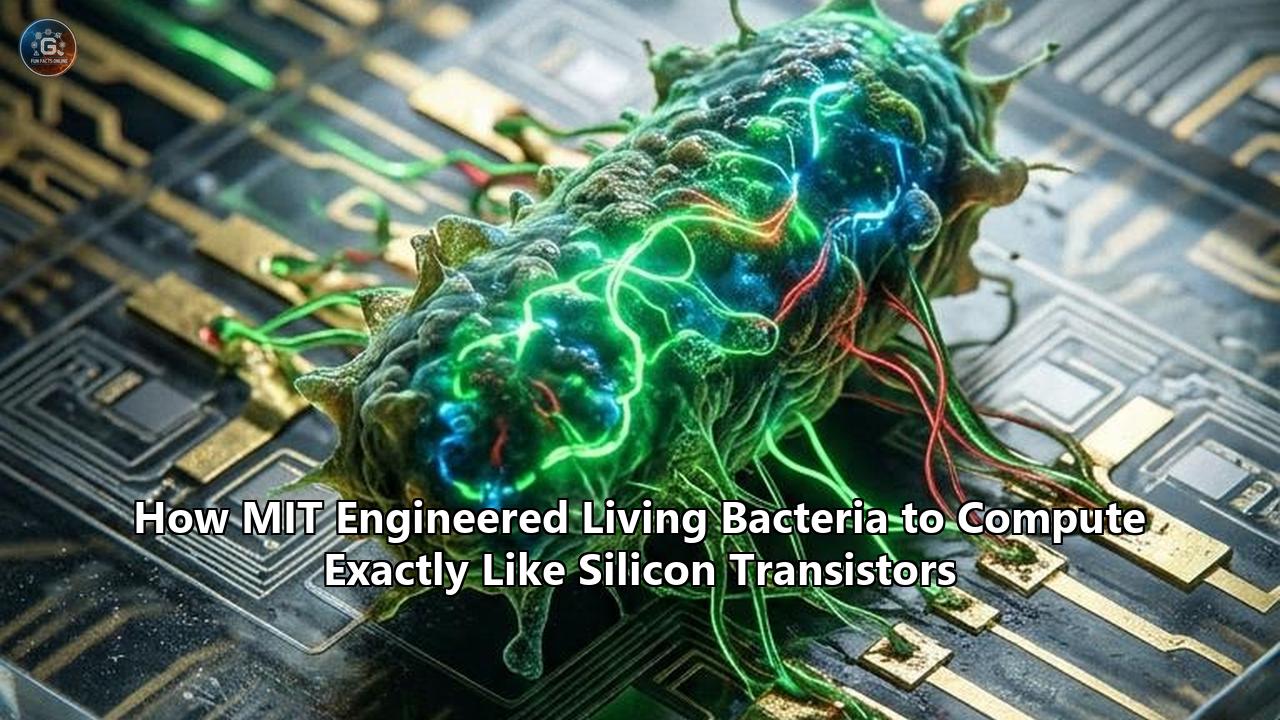
In a publication in Nature Chemical Biology, a research team at the Massachusetts Institute of Technology unveiled living circuit boards built from colonies of the bacterium Pantoea agglomerans engineered to function as biological transistors. By decoupling computational tasks across physically separated bacterial colonies on an agar substrate, the researchers built biological integrated circuits capable of binary addition, signal routing, and multi-gate Boolean logic without requiring a different bespoke genetic design for every application.
Led by MIT biological engineer Hamid Doosthosseini and Christopher Voigt, head of MIT’s Department of Biological Engineering, the work addresses a persistent failure mode in synthetic biology: the genetic and metabolic exhaustion that occurs when engineers try to cram complex electronic-style logic inside a single living cell. By substituting electronic switching with spatial chemical diffusion between modular bacterial strains, the MIT platform demonstrates a scalable path toward deployable biocomputers engineered for agriculture, environmental defense, and living therapeutics.
                 [ Control Molecule: OC-6 (Gate) ]
                                 │
                                 ▼
[ Input Molecule: OC-12 ] ──► [ Bacterial Colony ] ──► [ Output Molecule: OHC-14 ]
  (Source Signal)               Transistor Strain        (Passed to Downstream Relay)
The Intracellular Bottleneck: Why Single-Cell Computation Stalled
For more than two decades, synthetic biologists operated under an electrical engineering metaphor: treat DNA as code, promoters as switches, and regulatory proteins as wires. Early proofs-of-concept delivered elementary toggle switches, biological oscillators, and simple two-input logic gates. Yet attempts to scale these systems into complex microprocessors inside single microbes consistently encountered fundamental biophysical barriers.
Conventional Monolithic Approach (High Failure Rate):
┌────────────────────────────────────────────────────────┐
│ Single Cell Chassis                                    │
│ ┌───────────────┐  ┌───────────────┐  ┌──────────────┐ │
│ │ Logic Gate 1  ├─►│ Logic Gate 2  ├─►│ Logic Gate 3 │ │
│ └───────┬───────┘  └───────┬───────┘  └──────┬───────┘ │
│         ▼                  ▼                 ▼         │
│  Metabolic Load     Signal Crosstalk   Ribosome Drain  │
└────────────────────────────────────────────────────────┘
The primary breakdown occurs at the level of cellular resource allocation. A host bacterium maintains a finite pool of core molecular machinery:
- RNA polymerases for transcription
- Ribosomes for translation
- Chaperones for protein folding
- Universal energy intermediates such as ATP and NADPH
When a single cell is engineered with multi-layered cascades containing eight, ten, or twelve synthetic genes, the synthetic construct hijacks a crippling share of the host’s transcriptional and translational bandwidth. The cell enters metabolic stress, growth rates crater, and evolutionary pressure selects for non-functional mutants that purge or silence the engineered payload.
Beyond resource exhaustion lies the problem of biochemical crosstalk. Electronic circuits isolate signals through physical copper traces and dielectric insulators. Inside a single bacterial cytoplasm, all components float in the same aqueous solution. To build complex logic within one cell, bioengineers must find distinct, fully orthogonal transcription factors that bind only to their intended cognate promoters without cross-reacting with one another or interfering with endogenous genomic networks.
The catalog of well-characterized, non-cross-reactive transcription factors is narrow. Even when insulated by modern design frameworks like Cello, combining more than three or four consecutive logic tiers in a single cell induces "retroactivity"—a phenomenon where downstream genetic loads pull transcription factors away from upstream targets, warping signal thresholds and causing computational states to collapse.
The MIT Strategy: Spatial Computing Through Modular Biological Transistors
To bypass the constraints of single-cell synthetic biology, the MIT team abandoned the monolithic paradigm entirely. Instead of demanding that an individual bacterium execute an entire algorithm, they distributed the computation across a grid of specialized colonies, mimicking the architecture of a printed circuit board.
The team chose Pantoea agglomerans, a resilient plant-colonizing bacterium found naturally on roots and leaves. By genetically programming five specialized strains of P. agglomerans, they created an interchangeable standard parts kit:
- Two Switching Strains: Act as discrete biological transistors that regulate the production of downstream chemical messages based on incoming molecular triggers.
- Three Relay Strains: Function as biological wires and signal level-shifters, receiving one chemical input and enzymatically converting it into a different signaling molecule to bridge non-adjacent colonies without cross-talk.
MIT Distributed Architecture:
┌─────────────────┐       Diffusion       ┌─────────────────┐
│ Bacterial       ├──────────────────────►│ Bacterial       │
│ Transistor A    │    (5 mm Spacing)     │ Transistor B    │
│ (Pantoea St. 1) │                       │ (Pantoea St. 2) │
└─────────────────┘                       └─────────────────┘
Table 1: Architectural Comparison of Biocomputing Strategies
─────────────────────────────────────────────────────────────────────────────────
Metric Single-Cell Monoliths MIT Spatial Biocomputer
─────────────────────────────────────────────────────────────────────────────────
Physical Footprint Single cytoplasm (~1 µm³) Colony array on agar (~cm²)
Signal Transmission Intracellular proteins Intercellular AHL diffusion
Orthogonality Limits Strict (crosstalk at >4 gates) High (spatial isolation)
Metabolic Burden High per cell Evenly distributed
Circuit Modification Requires genomic redesign Requires spatial rearranging
Failure Modes Mutational escape, silencing Diffusion boundary errors
─────────────────────────────────────────────────────────────────────────────────The Transistor Mechanism: Chemical Gates and Switches
Electronic transistors operate as three-terminal devices where voltage applied to a gate terminal regulates current between a source and a drain. The MIT team designed their biological transistors using acyl-homoserine lactone (AHL) quorum-sensing molecules as the working fluid of the circuit:
- Gate Input (Switch): $N$-(3-oxohexanoyl)-L-homoserine lactone (OC-6).
- Source/Data Input: $N$-(3-oxododecanoyl)-L-homoserine lactone (OC-12).
- Drain/Output: $N$-(3-hydroxyoctanoyl)-L-homoserine lactone (OHC-14).
Transistor Logic States:
                       ┌──────────────┐
  [Data: OC-12] ──────►│ N-type Cell  ├──────► [Output: OHC-14]
                       │ (Active ON)  │         (Produced ONLY if
  [Gate: OC-6]  ──────►└──────────────┘          OC-12 AND OC-6 are present)

                       ┌──────────────┐
  [Data: OC-12] ──────►│ P-type Cell  ├──────► [Output: OHC-14]
                       │ (Active OFF) │         (Produced if OC-12 present
  [Gate: OC-6]  ──────►└──────────────┘          AND OC-6 is absent)
The first transistor strain mimics an N-type metal-oxide-semiconductor field-effect transistor (MOSFET). In this strain, the presence of OC-6 acts as an activating gate. If and only if OC-6 is present, the presence of the data signal OC-12 triggers the enzymatic machinery to synthesize and secrete the output molecule OHC-14.
The second strain mimics a P-type transistor. Here, OC-6 acts as an inhibitory gate. In the absence of OC-6, the input signal OC-12 freely drives the expression of OHC-14. When OC-6 is added, it engages an engineered repressor that shuts off output production, pulling the output down to zero.
By assigning the computationally heavy tasks of signal inversion, threshold switching, and amplification to specialized populations, no individual bacterial cell carries more than a manageable genetic circuit.
Physical Implementation: Microfluidic Printing and Spatial Signal Isolation
To wire these components together without physical wires, the MIT engineers turned to spatial patterning. Using automated droplet-printing systems, colonies of the five strains are deposited onto nutrient agar plates at precise 5-millimeter center-to-center spacings.
Physical Layout of a Demultiplexer Circuit:
        Colony 1 (Transistor)        Colony 2 (Relay)
             [ (N-Type) ] ────────► [ (Relay 1) ] ──► Output Route A
             ▲          ▲
             │          │
Input Signal ┼──────────┤ Diffusion Barrier (5 mm)
             │          │
             ▼          ▼
             [ (P-Type) ] ────────► [ (Relay 2) ] ──► Output Route B
        Colony 3 (Transistor)        Colony 4 (Relay)
The 5-millimeter interval was determined via empirical diffusion modeling. At shorter distances (under 2 millimeters), signaling molecules diffuse too quickly in all directions, creating spatial cross-talk and causing unintended adjacent nodes to switch prematurely. At distances greater than 8 millimeters, the concentration of the signaling molecules decays below the activation thresholds of the downstream promoter systems, introducing signal dropout.
At exactly 5 millimeters, molecular diffusion profiles generate a directional gradient. A colony acting as an active logic node produces an AHL output that reaches the immediate downstream receiver colony at an effective operational concentration within a defined temporal window, while maintaining concentrations below the noise floor at non-adjacent nodes.
To prevent retroactivity—where a downstream colony might alter the behavior of its upstream source—the relay strains act as unidirectional enzymatic diodes. A relay absorbs Molecule A and metabolizes it while independently expressing and secreting Molecule B. Because the synthesis of Molecule B does not consume Molecule A in a reversible chemical equilibrium, signals move strictly forward across the plate.
Validating the Architecture: From Basic Logic to Full Binary Adders
To evaluate whether this spatial paradigm could match the functional building blocks of electronic computation, the MIT researchers constructed a hierarchy of computational devices.
Logic Truth Tables Implemented by the Platform:

1. Demultiplexer Logic:
┌─────────────────┬──────────────────┬──────────────┬──────────────┐
│ Data In (OC-12) │ Control (OC-6)   │ Out Route A  │ Out Route B  │
├─────────────────┼──────────────────┼──────────────┼──────────────┤
│ 0               │ 0                │ 0            │ 0            │
│ 1               │ 0 (P-transistor) │ 0            │ 1            │
│ 0               │ 1                │ 0            │ 0            │
│ 1               │ 1 (N-transistor) │ 1            │ 0            │
└─────────────────┴──────────────────┴──────────────┴──────────────┘

2. Half-Adder Logic:
┌─────────┬─────────┬───────────────┬────────────────┐
│ Input A │ Input B │ Sum (A XOR B) │ Carry (A AND B)│
├─────────┼─────────┼───────────────┼────────────────┤
│ 0       │ 0       │ 0             │ 0              │
│ 1       │ 0       │ 1             │ 0              │
│ 0       │ 1       │ 1             │ 0              │
│ 1       │ 1       │ 0             │ 1              │
└─────────┴─────────┴───────────────┴────────────────┘
Logic Routing and Demultiplexing
In classical hardware, demultiplexers direct an incoming data stream to one of multiple distinct lines based on a control input. The MIT team paired an N-type transistor colony with a P-type transistor colony, feeding the same OC-12 data stream to both simultaneously.
- When the control chemical OC-6 was absent (0), the P-type colony was active, routing the calculation to Output Path B.
- When OC-6 was added to the plate (1), the P-type colony switched off and the N-type colony switched on, routing the signal to Output Path A.
Binary Addition Across 24 Colonies
The crowning demonstration of the study was the construction of multi-input arithmetic adders. In digital logic, addition requires calculating two separate outputs for any given set of binary inputs: a Sum bit and a Carry bit. Implementing this behavior requires assembling AND, OR, and XOR (exclusive OR) logic functions within the same integrated framework.
The MIT team wired together 24 distinct colonies of P. agglomerans across a single agar plate. The circuit parsed two binary input states and three input states (implementing a full adder), reliably producing fluorescent protein outputs corresponding to correct mathematical sums.
Crucially, when the engineers needed to change the mathematical operation from an adder to a demultiplexer, they did not have to re-engineer a single DNA sequence. They simply altered the spatial deposition pattern of the same five strains on the plate. The functional logic resided in the spatial topology of the colonies rather than the internal genetic complexity of any single cell.
Performance Dynamics: The Trade-off Between Clock Speed and Environmental Compatibility
Silicon microprocessors operate at gigahertz frequencies, executing billions of switching operations per second. The MIT bacterial circuit board takes approximately eight hours to complete a single computation, with larger multi-node arrays requiring up to 72 hours for full signal equilibrium across all colonies.
Performance Comparison: Silicon Transistor vs. Biological Transistor
─────────────────────────────────────────────────────────────────────────────
Property              Silicon MOSFET             Pantoea agglomerans Node
─────────────────────────────────────────────────────────────────────────────
Charge Carrier        Electrons / Holes          Small Molecule AHLs
Switching Speed       Sub-nanosecond (<10⁻⁹ s)   Hours (~2.8 × 10⁴ s)
Operational Medium    Solid-state silicon        Aqueous agar / Plant tissue
Power Requirement     External DC voltage        Endogenous carbon metabolism
Self-Repair           None (permanent failure)   Autonomous (cellular division)
Environmental Sense   Requires transducers       Direct biochemical reception
─────────────────────────────────────────────────────────────────────────────
This speed differential is not an engineering failure; it reflects fundamentally different design objectives.
"We're not trying to replace computers, but rather put computational control into biology," Christopher Voigt explained. "If you have bacteria on the root of a plant, or the plant itself is doing the computing, running a simple calculation overnight is fast enough relative to a growth season".
In biological environments—such as an agricultural crop field, a municipal water basin, or the mammalian gastrointestinal tract—environmental state changes occur across hours, days, or weeks. A silicon processor placed in these settings requires waterproof packaging, energy-harvesting hardware, analogue-to-digital sensor interfaces, and mechanical actuators to affect its environment.
A bacterial computing array, by contrast, is native to the target environment. It operates without batteries, repairs itself through regular cellular division, feeds on ambient carbon sources, directly detects environmental molecules, and synthesizes tangible biochemical outputs such as enzymes, antimicrobial peptides, or phytohormones.
Deployable Applications: Transforming Agriculture and Environmental Biocontrol
The choice of Pantoea agglomerans as the cellular host was deliberate. P. agglomerans is an epiphyte and endophyte that naturally colonizes the roots, stems, and leaf phyllosphere of agricultural crops, including wheat, corn, and tomatoes.
The immediate deployment goal for this technology is autonomous agricultural monitoring and response. Modern crop management relies on blanket applications of synthetic fertilizers and chemical pesticides, largely because field-scale diagnostics cannot discern localized stress before visible damage occurs.
Agricultural Implementation Architecture:
┌─────────────────────────────────────────────────────────────────────────┐
│ Plant Leaf Surface (Phyllosphere)                                      │
│                                                                         │
│  [ Drought Stress (Abscisic Acid) ]      [ Fungal Infection (Chitin) ]  │
│                   │                                    │                │
│                   ▼                                    ▼                │
│         ┌───────────────────┐                ┌───────────────────┐      │
│         │ Colony 1: Sense A │                │ Colony 2: Sense B │      │
│         └─────────┬─────────┘                └─────────┬─────────┘      │
│                   │ AHL Signal 1                       │ AHL Signal 2   │
│                   └──────────────────┬─────────────────┘                │
│                                      ▼                                  │
│                         ┌──────────────────────────┐                    │
│                         │ Colony 3: AND Gate Logic │                    │
│                         └────────────┬─────────────┘                    │
│                                      │ Trigger Signal                   │
│                                      ▼                                  │
│                         ┌──────────────────────────┐                    │
│                         │ Colony 4: Actuator Strain│                    │
│                         │ (Produces Antifungal)    │                    │
│                         └──────────────────────────┘                    │
└─────────────────────────────────────────────────────────────────────────┘
Using the MIT framework, seeds or seedlings can be inoculated with patterned consortia of the five strains. The bacterial collective can be configured to execute multi-variable condition checks:
- Condition Check 1: Has the soil moisture fallen below a critical threshold?
- Condition Check 2: Is an exogenous pathogen-associated molecular pattern (such as fungal chitin or bacterial flagellin) present?
- Condition Check 3: Is the plant expressing elevated systemic stress hormones (such as salicylic acid or abscisic acid)?
If and only if the logic conditions resolve to TRUE (e.g., Condition 1 AND Condition 2 are met, but Condition 3 is NOT met), the final actuator strain in the array triggers the synthesis and secretion of a targeted antifungal peptide or an auxin growth stimulant. This localizes chemical production strictly to infected or stressed tissues, reducing chemical runoff and preventing pests from developing broad resistance.
Industrial and Defense Strategic Context
The development of the spatial bacterial circuit board is part of a broader pivot across synthetic biology away from isolated bio-parts toward structured biological materials. The research received significant backing from the Defense Advanced Research Projects Agency (DARPA).
Key Research Stakeholders:
* Christopher Voigt, PhD — Head of MIT Department of Biological Engineering
* Hamid Doosthosseini, PhD — Lead Author, MIT Biological Engineering
* DARPA Biological Technologies Office (BTO) — Research Funder
Defense and industrial interest centers on three structural advantages of biological computing architectures:
- Zero Supply-Chain Dependency on Rare Earths: Unlike semiconductor fabrication facilities that require ultrapure silicon, gallium arsenide, neon gas, and advanced photolithography, biological transistors reproduce autonomously via standard microbial fermentation.
- Resilience to Electromagnetic Disruption: Biological circuits operate via chemical diffusion and enzymatic catalysis, making them immune to electromagnetic pulses (EMP), high-voltage interference, and traditional electronic jamming.
- Passive Environmental Surveillance: Arrays deployed in aquatic environments or soil beds can remain dormant for weeks, consuming minimal nutrients until an illicit chemical agent, toxic heavy metal, or explosive signature initiates the logic cascade.
Technical Challenges: Mutations, Hydrology, and Biocontainment
While the proof-of-concept establishes the validity of distributed spatial biocomputing, moving these systems from controlled laboratory agar plates to open environmental ecosystems presents engineering challenges.
Major Technical Hurdles Ahead:
┌─────────────────────────────────────────────────────────────────────────┐
│ 1. Evolutionary Drift                                                   │
│    Spontaneous mutations in repressors or synthases over generations.   │
├─────────────────────────────────────────────────────────────────────────┤
│ 2. Environmental Hydrology                                              │
│    Rainfall, wind, and humidity fluctuations disrupting AHL diffusion.  │
├─────────────────────────────────────────────────────────────────────────┤
│ 3. Ecological Competition                                               │
│    Native microbial flora displacing or consuming the engineered strains│
├─────────────────────────────────────────────────────────────────────────┤
│ 4. Regulatory Biocontainment                                            │
│    Preventing horizontal gene transfer into wild soil microbiomes.      │
└─────────────────────────────────────────────────────────────────────────┘
1. Evolutionary Stability
In laboratory conditions, bacteria divide rapidly. Over dozens of generations, spontaneous mutations in the transcription factors, synthetic promoters, or synthase enzymes can render a colony unresponsive. Because spatial circuits rely on every node in the chain functioning correctly, a single loss-of-function mutation in an upstream relay breaks the entire computational pathway. To combat this, researchers are integrating toxin-antitoxin addiction modules and essential gene dependencies that automatically kill cells if they mutate or eject the synthetic payload.
2. Environmental Fluid Dynamics
On an agar plate inside a sealed Petri dish, molecular diffusion is predictable and undisturbed. On the surface of an agricultural leaf, rainfall, high winds, and fluctuating ambient humidity can dilute or wash away AHL signaling molecules, interrupting signal continuity. Solving this requires encapsulating the bacterial colonies within hydrogel micro-droplets or bio-compatible porous membranes that allow nutrient and gas exchange while stabilizing local signaling micro-environments.
3. Native Microbiome Competition
Pantoea agglomerans must compete with established native microflora for surface area and nutrients. If wild strains outcompete the engineered strains, the physical distance between functional colonies will drift beyond the operational 5-millimeter threshold.4. Biocontainment and Gene Flow
Deploying genetically modified organisms into open environments triggers regulatory oversight. The synthetic circuits must feature fail-safe containment mechanisms, such as synthetic auxotrophy (requiring unnatural amino acids for survival) or CRISPR-based self-destruct circuits to prevent horizontal gene transfer of synthetic switches into native soil bacteria.
The Next Milestones for Spatial Biological Computing
With the fundamental five-strain toolkit validated in peer-reviewed literature, the MIT team and collaborating synthetic biology laboratories are working toward several concrete milestones:
Development Roadmap for Biological Transistor Architectures:

Phase 1: Proof of Concept [COMPLETED]
└── 5-Strain Pantoea toolkit demonstrated on agar plates
└── Boolean gates (IMPLY, OR, multi-input), demultiplexers, full adders validated
└── 24-colony physical integration achieved

Phase 2: Solidification & Storage [Current Focus]
└── Integration of DNA recombinase non-volatile biological memory registers
└── Transition from 2D agar plating to 3D printed hydrogel living materials
└── Automated Bio-CAD compiler development (HDL to physical colony print-maps)

Phase 3: Field Trials & In Vivo Deployment [Target Horizons]
└── Plant phyllosphere trials for automated drought/pathogen detection
└── Gut microbiome deployment using human commensal strains (e.g., Bacteroides)
└── Autonomous living biosensors for municipal water infrastructure
1. Integrating Non-Volatile Biological Memory
Current living circuit boards calculate purely combinational logic: once the chemical input signal dissipates, the circuit returns to its baseline state. To perform sequential logic (which depends on current inputs and past history), the platform requires memory. Researchers are engineering DNA recombinases and integrases into the transistor strains, enabling the colonies to flip DNA segments permanently upon receiving a signal. This will allow the living circuit board to record historical exposure events even if the original chemical inducer has vanished.
2. Automated Bio-CAD Spatial Compilers
In electronic chip design, engineers do not manually position individual silicon gates; they write high-level behavioral code in languages like Verilog, which automated compilers (such as Electronic Design Automation tools) translate into physical layout masks. The next step for the MIT platform is building spatial Bio-CAD compilers. A user will define a target biological truth table, and the software will compute the precise coordinates, colony strains, and droplet volumes needed for a 3D bioprinter to construct the living circuit board automatically.
3. Moving to 3D Structured Hydrogel Matrices
Agar Petri dishes are research tools, not field-deployable platforms. Research is shifting toward printing bacterial transistors inside self-healing, bio-compatible hydrogels. These matrices can be molded into thin coatings for agricultural seeds, woven into reactive textiles, or applied as bio-sensing bandages over chronic wounds to monitor infection biomarkers and synthesize antimicrobials on demand.
By shifting synthetic biology’s focus from dense intracellular engineering to distributed spatial computation, the development of these five bacterial building blocks proves that computation is not an exclusive property of silicon. By organizing living matter according to electronic circuit design principles, biological systems can be programmed to sense, decide, and act directly within the physical environments they inhabit.
Reference:
- https://news.mit.edu/2026/mit-engineers-connect-bacteria-to-create-living-transistors-0817
- https://www.sciencedaily.com/releases/2026/09/260901070526.htm
- https://www.zmescience.com/science/news-science/scientists-turn-bacteria-into-transistors-to-build-living-circuit-boards/
- https://community.element14.com/technologies/sensor-technology/b/blog/posts/engineers-develop-living-circuit-boards-using-bacteria-that-work-like-transistors
- https://timesofindia.indiatimes.com/education/news/mit-engineers-turn-living-bacteria-into-circuit-boards-that-can-perform-computer-like-calculations/articleshow/133398156.cms
- https://circuitdigest.com/news/mit-built-logic-circuits-from-bacteria-using-living-cells-as-transistors
- https://epigenie.com/cello-an-automated-composer-for-gene-circuits/
- https://sbg.mit.edu/wp-content/uploads/2013/03/synthetic-circuits-integrating-logic-and-memory-in-living-cells.pdf
- https://www.cidarlab.org/cello
- https://www.hackster.io/news/mit-scientists-build-computer-circuits-out-of-living-bacteria-f4f34d2a06b0
- https://news.mit.edu/2015/basic-computing-for-bacteria-0709