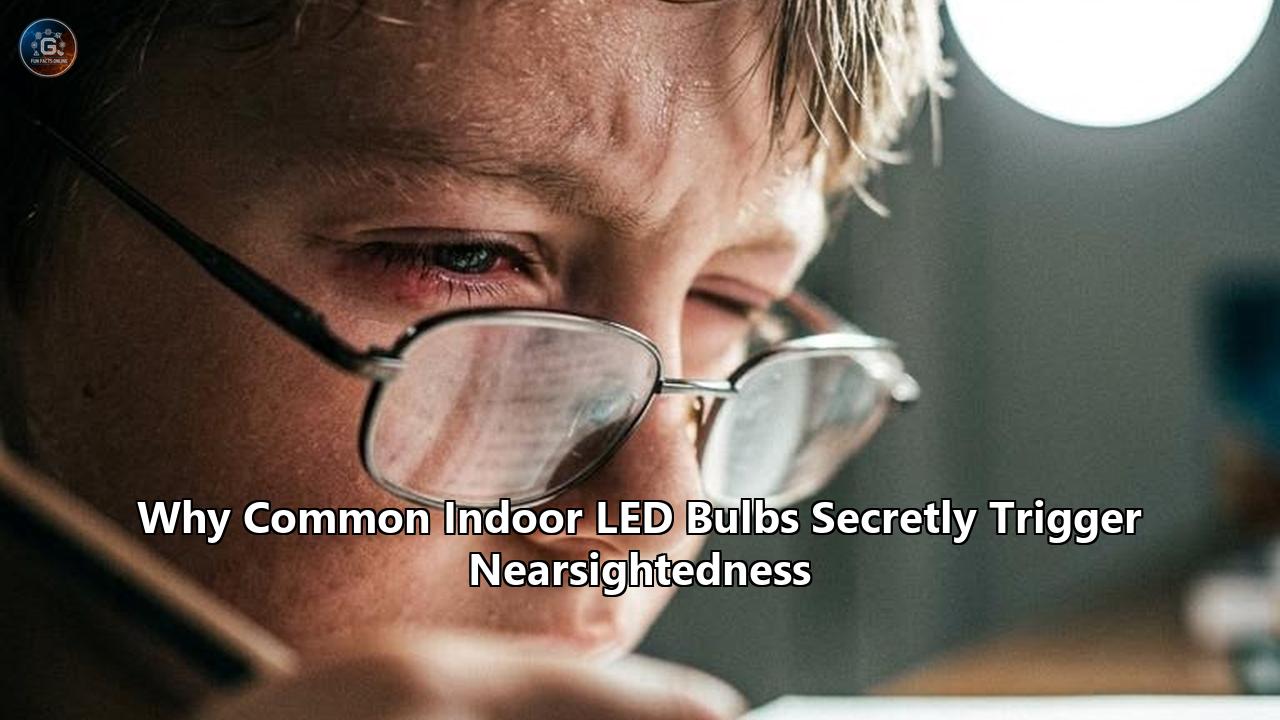
A team of visual scientists and biomedical engineers from Cincinnati Children’s Hospital and the University of Alabama at Birmingham (UAB) has uncovered why modern indoor illumination is driving a global surge in juvenile nearsightedness. In a study published in Cell Reports Medicine, the researchers demonstrated that standard indoor light-emitting diodes (LEDs) possess a critical spectral defect: they lack a narrow band of indigo light (419 to 446 nanometers) that developing eyes rely upon to regulate their physical shape.
When juvenile tree shrews—near-primates whose optical architecture mirrors human ocular anatomy—were reared under standard commercial warm-white LEDs, their eyeballs elongated uncontrollably along the visual axis. The resulting condition was severe axial myopia. Yet, when the scientists reintroduced that single missing band of indigo photons into ordinary indoor fixtures, the pathological elongation ceased entirely.
"We evolved outside in the full-spectrum light provided by our sun," explained Richard Lang, director of research in the Division of Ophthalmology at Cincinnati Children’s and corresponding author of the study. "When we live inside, we don't get all the wavelengths the eye needs for normal refractive development, and so we get myopia. That's the basic message."
The findings arrive alongside human clinical data published in Graefe's Archive for Clinical and Experimental Ophthalmology, where researchers tracked school-aged children exposed to full-spectrum indoor lighting designed to match the solar profile between 430 and 780 nanometers. Over 12 months, replacing conventional indoor classroom and home LEDs with balanced spectral light significantly slowed both axial elongation and refractive degradation, while simultaneously thickening the subfoveal choroid—a protective vascular layer at the back of the eye.
Standard Phosphor-Converted White LED Spectrum:
Relative
Power
  ^
  |       Sharp Blue Pump Peak (~450 nm)
  |            |
  |           / \
  |          /   \     Missing Indigo/Violet Valley
  |         /     \   (380–440 nm)
  |        /       \  |              Broad Phosphor Hump (~550–600 nm)
  |       /         \ |                  . - - - .
  |      /           \|                /           \      Depleted Deep Red
  |     /             \               /             \     (>650 nm)
  |    /               \             /               \   |
  +---+-----------------+-----------+-----------------+--+---------> Wavelength
    380 nm            450 nm      500 nm            600 nm  700 nm
For two decades, public health officials attributed the global explosion of nearsightedness almost exclusively to scholastic intensity, book reading, and smartphone screens. The new evidence, however, points toward an environmental culprit hiding in plain sight: the engineered light spectrum emitted by the billions of solid-state bulbs installed worldwide. Tracing the LED lights myopia link reveals an escalation that began with an international push for energy conservation, evolved through laboratory experiments on animal eyes, and has now arrived at a reckoning for the architectural lighting industry.
2007–2012: The Great Energy Pivot and the Vanishing Spectrum
The origins of the crisis trace back to legislative chambers rather than medical laboratories. In 2007, the United States passed the Energy Independence and Security Act, mandating aggressive efficiency baselines for general-service light bulbs. The European Union followed shortly thereafter with phased sales bans on traditional incandescent lighting starting in 2009.
Incandescent bulbs were notoriously inefficient, converting upwards of 90 percent of their electrical input into heat rather than visible light. But from a biological standpoint, incandescent filaments had an unappreciated virtue: they produced a continuous thermal blackbody spectrum. Because they worked by heating a tungsten coil until it glowed white-hot, their emission was unbroken, extending seamlessly from the near-ultraviolet through visible violet, indigo, blue, green, amber, red, and far into the restorative near-infrared.
To meet the new federal and international efficiency standards, commercial manufacturers pivoted rapidly. First came compact fluorescents (CFLs), plagued by toxic mercury and harsh, spike-filled spectral profiles. Soon after came the savior of modern green infrastructure: solid-state light-emitting diodes (LEDs).
Commercial white LEDs were cheap, rugged, and miraculously energy-efficient. Yet their physical architecture relied on an optical illusion. True white light requires a mixture across the entire visible continuum. Semiconductor chips, however, naturally emit monochromatic radiation.
To overcome this, manufacturers relied on an invention recognized by the 2014 Nobel Prize in Physics: the phosphor-converted white LED (pc-LED). Engineers used a gallium nitride (GaN) or indium gallium nitride (InGaN) semiconductor that discharged an intense, highly concentrated spike of narrow-band blue light, typically centered around 450 nanometers. They coated this blue-emitting chip with a phosphor blend, primarily cerium-doped yttrium aluminum garnet (YAG:Ce).
The phosphor absorbed a portion of the high-energy blue photons and re-emitted them at longer, lower-energy wavelengths, producing a broad, gentle dome of yellow-green light spanning 500 to 650 nanometers. When human cone photoreceptors in the eye simultaneously captured the piercing blue spike and the broad yellow phosphor glow, the brain synthesized the sensation of crisp, clean "white" light.
+----------------------------------------------------------------------------+
|             THE TWO SPECTRAL WORLDS: SUNLIGHT VS. STANDARD LED             |
+--------------------------+-----------------------+-------------------------+
| Spectral Parameter       | Natural Solar Light   | Standard pc-White LED   |
+--------------------------+-----------------------+-------------------------+
| Violet Band (380–400 nm) | Rich, continuous      | Absent (< 1% of solar)  |
| Indigo Band (419–446 nm) | High, balanced        | Deep notch/trough       |
| Blue Spike (~450 nm)     | Balanced continuum    | Disproportionate spike  |
| Deep Red (>650 nm)       | Abundant, sustained   | Precipitous drop-off    |
| Near-Infrared (NIR)      | Broad thermal warmth  | Zero emission           |
+--------------------------+-----------------------+-------------------------+
Human eyes had evolved over millions of years beneath the unbroken, wide-band spectral dome of natural sunlight. Suddenly, within less than a single human generation, the primary habitat of modern children shifted indoors under fixtures characterized by:
- A massive, unnatural radiometric blue spike at 450 nanometers
- A steep spectral valley between 400 and 440 nanometers (the indigo-violet transition)
- An absolute void below 400 nanometers
- An abrupt drop-off in red and deep-red wavelengths beyond 630 nanometers
At the time, lighting engineers viewed these invisible spectral gaps as a triumph of design. The human eye's daytime visual response curve—the photopic luminous efficiency function, designated $V(\lambda)$ by the International Commission on Illumination (CIE)—peaks sharply at 555 nanometers in the green portion of the spectrum. It tapers away toward zero in the violet and deep red bands.
By eliminating violet, indigo, and deep-red wavelengths, manufacturers were not wasting electricity generating photons that human vision could barely discern. Every milliwatt was concentrated directly where human rods and cones produced perceived brightness. The bulbs delivered record-breaking ratings of lumens per watt.
No one stopped to consider whether non-visual structures within the human eye depended on those discarded wavelengths to measure optical growth.
2013–2016: The Screen Time Red Herring
As phosphor-converted LEDs swept through schools, daycares, universities, and residential homes, epidemiologists began sounding alarms over an escalating ophthalmological crisis. In metropolitan centers across East and Southeast Asia—including Singapore, Hong Kong, Seoul, and Shanghai—myopia rates among teenagers completing secondary school spiked past 80 to 90 percent. In Western Europe and the United States, pediatric clinics reported that myopia rates had roughly doubled compared to the late 20th century.
Because the eye grows continuously throughout childhood, nearsightedness rarely begins as an acute injury. Instead, the eyeball subtly lengthens along its anterior-posterior axis. In a healthy eye (an emmetropic eye), the cornea and internal crystalline lens focus incoming light rays precisely onto the surface of the retina.
If the eyeball elongates by as little as one millimeter beyond its ideal focal distance, distant objects slip out of focus, their focal plane landing millimeters ahead of the retina. The eye becomes permanently myopic. While concave optical lenses can compensate for the refractive error, the underlying elongation stretches the delicate layers of the retina, choroid, and sclera. This physical stretching permanently inflates the lifetime risk of choroidal neovascularization, retinal detachment, open-angle glaucoma, and early cataracts.
Throughout the mid-2010s, public health agencies identified a convenient culprit: the rise of digital screens. Steve Jobs unveiled the iPad in 2010, kicking off an explosion of mobile devices, tablets, and interactive classroom displays. Parents and educators naturally assumed that children holding smartphones inches from their noses were over-accommodating their ciliary muscles, physically distorting their lenses through near-work stress.
Yet the near-work theory failed to match rigorous observational field data. Large-scale epidemiological trials led by vision researchers Kathryn Rose and Ian Morgan revealed that children who engaged in high levels of intensive near-work—such as reading books for hours every day—did not develop myopia if they also spent two or more hours outside each day.
Even more confusingly, children who engaged in minimal near-work still developed myopia at alarming rates if they remained indoors. Sunlight was protective, but researchers could not isolate why.
                                  +-----------------------------+
                                  |   Childhood Environment     |
                                  +--------------+--------------+
                                                 |
                        +------------------------+------------------------+
                        |                                                 |
                        v                                                 v
         +------------------------------+                  +------------------------------+
         |     High Near-Work Task      |                  |      Low Near-Work Task      |
         |    (Reading, Screen Time)    |                  |    (Resting, Passive Play)   |
         +--------------+---------------+                  +--------------+---------------+
                        |                                                 |
           +------------+------------+                       +------------+------------+
           |                         |                       |                         |
           v                         v                       v                         v
   +---------------+         +---------------+       +---------------+         +---------------+
   |   Outdoors    |         |    Indoors    |       |   Outdoors    |         |    Indoors    |
   | (>2 hrs/day)  |         | (Under LEDs)  |       | (>2 hrs/day)  |         | (Under LEDs)  |
   +-------+-------+         +-------+-------+       +-------+-------+         +-------+-------+
           |                         |                       |                         |
           v                         v                       v                         v
   [Normal Growth]          [Axial Elongation]       [Normal Growth]          [Axial Elongation]
    (Myopia Halted)         (Myopia Progression)     (Myopia Halted)          (Myopia Progression)
Initial theories suggested that outdoor light was simply far brighter. Outdoor daylight routinely exceeds 10,000 to 100,000 lux, whereas modern indoor classroom lighting generally hovers between a dim 300 and 500 lux. Vision scientists argued that bright light caused the pupil to constrict, sharpening retinal image contrast and boosting depth of field while prompting retinal amacrine cells to release dopamine—a known biochemical brake on eye growth.
Yet when researchers attempted to prevent myopia in animal models by merely raising the brightness of conventional indoor lighting, the results were inconsistent. Something qualitative, rather than purely quantitative, was missing from the interior visual environment.
2017–2019: The Violet Clue and the Retina’s Non-Visual Eyes
The first critical crack in the indoor lighting mystery appeared in Tokyo. In early 2017, a research team led by Kazuo Tsubota and Toshihide Kurihara at the Keio University School of Medicine published findings in EBioMedicine that challenged prevailing assumptions.
Tsubota, an ophthalmologist tracking patients who had undergone phakic intraocular lens (IOL) surgery, noticed an unexpected pattern. Patients implanted with a specific brand of lens that permitted the transmission of violet light showed significantly less myopia progression than patients who received standard ultraviolet-blocking lenses.
Taking the observation into the laboratory, the Keio team exposed chicks to light across various narrow bands. They discovered that violet light—occupying the narrow electromagnetic corridor between 360 and 400 nanometers—dramatically suppressed axial elongation. At the molecular level, violet illumination prompted retinal and choroidal tissue to upregulate EGR1 (Early Growth Response 1), a crucial transcription factor known in visual physiology as the genetic "stop signal" for ocular growth.
The Keio Discovery: How Violet Photons Trigger the Stop Signal

   Sunlight (360–400 nm)
            │
            ▼
   Cornea & Clear Lens
            │
            ▼
   OPN5 Photoreceptors (Retinal Ganglion Cells)
            │
            ▼
   Choroidal Vasculature Activation
            │
            ▼
   Upregulation of EGR1 Transcription Factor
            │
            ▼
   Dopamine Secretion via Amacrine Cells
            │
            ▼
   Scleral Fibroblast Stabilization (Axial Elongation Blocked)
The Keio researchers surveyed the modern human environment and pointed out a troubling reality: violet light was essentially non-existent inside contemporary architecture. Window glass, treated with modern laminates to block ultraviolet radiation, filtered out wavelengths below 400 nanometers.
More crucially, the energy-efficient phosphor-converted white LEDs used in schools, offices, and homes emitted zero violet light. Modern indoor life, they argued, was starving children's eyes of the exact photonic catalyst required to activate EGR1.
Shortly thereafter, a collaborative effort involving Keio University, Cincinnati Children’s Hospital, Georgia Institute of Technology, and Emory University identified the physical receptor governing this process: opsin 5 (OPN5), also known as neuropsin. Unlike the rhodopsin in rods or the photopsins in color-sensing cones, OPN5 is a non-visual pigment expressed in specific subsets of retinal ganglion cells.
OPN5 does not help construct the conscious images sent to the visual cortex. Instead, it measures ambient spectral quality. The researchers proved that when OPN5 is stimulated by short-wavelength light, it acts as a metabolic valve, stimulating ocular dopamine synthesis and sustaining blood perfusion through the vascular choroid. When researchers knocked out the OPN5 gene in laboratory mice, violet light lost all ability to stop axial elongation. Without functional OPN5 signaling, the choroid thinned, scleral cross-linking degraded, and the eye expanded unchecked.
The discovery gave rise to early commercial experiments, including glasses designed to emit or transmit violet wavelengths. But a major physiological roadblock soon emerged.
While small laboratory animals like mice possess crystalline lenses transparent to deep ultraviolet and violet radiation, the human eye undergoes rapid developmental changes. By late childhood, the natural human lens begins to absorb heavily below 400 nanometers, yellowing naturally to protect the delicate neural retina against photochemical damage.
If the human lens blocks violet light below 400 nanometers, how could solar light suppress myopia across human populations so effectively? The scientific narrative stalled, pointing to an incomplete puzzle.
2020–2023: The Physics of Deception: Longitudinal Chromatic Aberration
As biochemists worked to identify the eye's molecular opsins, optical physicists and visual biomechanists attacked the problem from an entirely different angle: ocular refraction. Their research brought to light how the spectral imbalance of solid-state fixtures actively deceived the ocular feedback loop.
The human eye is not an achromatic instrument; it functions like an uncorrected simple spherical lens. Because shorter wavelengths bend more sharply when passing through refractive media than longer wavelengths, the eye suffers from substantial Longitudinal Chromatic Aberration (LCA).
Longitudinal Chromatic Aberration (LCA) in the Developing Eye:

                Short Wavelengths (Blue/Indigo, ~430–450 nm)
                           Bend Steeply
                                \
                                 \  Retina
                                  \ |
  Parallel Light ------------------\+------------------ (Focus: In Front of Retina)
  Rays Entering                     |\
  the Eye                           | \
                                    |  \
  ----------------------------------+---\-------------- (Focus: Behind Retina)
                                    |    \
                                    |     \
                               Long Wavelengths (Red, ~650 nm)
                                    Bend Shallowly
Under natural solar illumination, LCA spreads incoming light along an axis roughly two diopters deep:
- Short-wavelength blue rays refract most sharply, coming to a focus in front of the retina (myopic defocus).
- Mid-spectrum green rays focus directly on the retina.
- Long-wavelength red rays refract least, falling to a focal point behind the retina (hyperopic defocus).
Work by researchers including Ian Flitcroft, Siegfried Wahl, and Arne Ohlendorf demonstrated that the juvenile eye exploits this chromatic spread to calibrate its growth. The retina does not possess a physical tape measure to check its axial dimensions. Instead, it reads the relative contrast, color fringing, and phase differences between its cone photoreceptors across different wavelengths.
If an eye is physically too short (hyperopic), the red end of the spectrum lands far behind the retina, producing significant blur in the long-wavelength sensitive (L-cone) channels, while mid-spectrum green light remains in sharp focus. This chromatic cue signals scleral fibroblasts to synthesize extracellular matrix, lengthening the eyeball until the visual spectrum balances out.
Conversely, when the eye senses short-wavelength blue light focusing in front of the retina, it interprets this myopic blur as a signal that the eye is approaching its ideal length or growing too fast, activating the brakes on axial expansion.
This biological guidance system evolved under daylight, which provides an even, unbroken distribution of energy across every single nanometer from violet to far-red. But when a child enters a room illuminated by standard phosphor-converted LEDs, the guidance system receives conflicting signals:
- The massive 450-nanometer blue spike saturates short-wavelength cones with an unnatural, hyper-concentrated photonic blast.
- Simultaneously, the steep spectral valley in the indigo-violet range deprives the eye of mid-short balance.
- The abrupt drop-off in red past 630 nanometers deprives long-wavelength cones of the natural red reference plane.
By skewing the chromatic balance, standard pc-LEDs corrupt the retinal contrast signals that tell the eye when to stop growing. The eye becomes optically disoriented. Misinterpreting the artificial spectral profile as an indication of poor focus, the retina signals the sclera to remodel and stretch, chasing an optical equilibrium that does not exist under standard solid-state lighting.
2024–2025: The Evidence Moves to the Classroom
By 2024, the theoretical and optical mechanisms had converged into clinical urgency. If artificial spectral composition was confusing eye development, altering the indoor light spectrum should demonstrate measurable, therapeutic results in human trials.
Attention initially shifted to the opposite end of the spectrum: red light. Over a dozen multicenter randomized controlled trials conducted primarily across China and published between 2022 and 2024 evaluated Repeated Low-Level Red Light (RLRL) therapy.
Children were instructed to look into specialized desktop devices emitting continuous-wave red light at 650 nanometers for three minutes at a time, twice daily. The clinical results were dramatic: RLRL therapy achieved a 60 to 80 percent reduction in axial elongation compared to controls, with some children even exhibiting a temporary shortening of axial length driven by rapid, robust thickening of the choroid.
The RLRL trials proved that delivering specific, isolated spectral bands could physically reshape human ocular tissues. But low-level laser therapy had drawbacks: it required high compliance, expensive standalone hardware, and raised persistent clinical concerns regarding potential long-term photothermal retinal toxicity if devices were improperly calibrated.
Vision researchers realized that the optimal intervention was not treating children with targeted lasers after school, but engineering safe, passive illumination directly into classroom ceilings.
In December 2025, the International Myopia Institute (IMI) published a landmark white paper titled The Role of Light in Refractive Development and Myopia: Evidence from Animal and Human Studies in Investigative Ophthalmology & Visual Science (IOVS). The global consortium synthesized decades of epidemiological datasets, animal models, and clinical interventions.
For the first time, the IMI formally recognized that light intensity alone could no longer explain juvenile emmetropization. The white paper noted that narrow-band chromatic signals profoundly influence refractive development across species, warning that the artificial spectral composition of common solid-state indoor lights represents a plausible modifiable risk factor for childhood myopia.
The white paper laid bare the growing clinical consensus around the LED lights myopia link, establishing that solid-state lighting can no longer be evaluated merely as a passive illumination tool, but must be understood as an active optical influence on human ocular biology.
2026: The Tipping Point: Isolating the Missing Band
The theoretical debate shifted dramatically in 2026 with back-to-back human and mammalian studies that isolated the precise wavelengths responsible for artificial light-induced eye growth.
In March 2026, a team of clinical investigators led by Jia-Yan Bao at Soochow University published findings from a prospective cohort trial in Graefe's Archive for Clinical and Experimental Ophthalmology. Rather than testing handheld optical gadgets or laser desktop units, Bao’s team targeted the physical environment itself. They retrofitted both the school classrooms and the residential homes of fourth-grade students with customized full-spectrum lighting fixtures.
Human Clinical Results (Bao et al., Graefe's Archive, 2026):
Modifying Classroom & Home LED Spectrum (430–780 nm) vs. Conventional LEDs

Parameter Measured             Control (Standard LED)   Full-Spectrum Intervention
----------------------------------------------------------------------------------
Spherical Equivalent Change:    -0.81 Diopters           -0.63 Diopters (p < 0.001)
Axial Length Elongation:        +0.77 mm                 +0.72 mm       (p = 0.003)
Subfoveal Choroid (SFCT):       Progressive Thinning     Significant Thickening
The fixtures discarded the sharp blue spike of conventional commercial LEDs in favor of a smooth, balanced continuum covering 430 to 780 nanometers. The results after 12 months were clear: children studying and living beneath full-spectrum illumination experienced a statistically significant reduction in axial elongation and a noticeable slowing of refractive error progression.
Crucially, high-resolution optical coherence tomography (OCT) revealed that within months of exposure to full-spectrum light, the children’s subfoveal choroidal thickness increased substantially. The choroid, acting as a vascular cushion, expanded to protect the eye against scleral stretching.
Five months later, in August 2026, Richard Lang of Cincinnati Children's and Rafael Grytz of the University of Alabama at Birmingham published the definitive animal mechanism in Cell Reports Medicine.
Lang and Grytz set out to solve the paradox that had stalled the field since Keio University’s early violet-light experiments: if human crystalline lenses block violet light below 400 nanometers, how does natural solar light stop myopia?
They turned to tree shrews (Tupaia belangeri), small near-primates whose optical properties, crystalline lens transmission curves, and scleral biomechanics closely match those of humans. The researchers fitted young tree shrews with minus-10-diopter spectacle lenses over one eye—an optical intervention that shifts the focal plane behind the retina, triggering rapid, compensatory axial lengthening.
           THE CINCINNATI-UAB TREE SHREW TRIAL (2026)

  [Standard Warm-White LED Light]       [Indigo-Supplemented LED Light]
         (Missing 419-446 nm)                   (With 419-446 nm Added)
                  │                                        │
                  ▼                                        ▼
   Compensatory Hyperopic Defocus           Compensatory Hyperopic Defocus
           Induced via -10D                         Induced via -10D
                  │                                        │
                  ▼                                        ▼
   Severe Axial Length Elongation           Pathological Elongation Halted
    Myopic Shift: -11.6 Diopters             Axial Length Maintained Normal
                  │                                        │
                  ▼                                        ▼
       [Eye Deforms into High Myopia]             [Myopia Completely Prevented]
When the shrews were housed under standard warm-white indoor LEDs, their eyes elongated rapidly, developing severe myopia averaging minus-11.6 diopters.
The researchers then tested different narrow bands of the spectrum. Confirming earlier suspicions, violet light near 380 nanometers failed to halt myopia in the shrews, because the tree shrew’s crystalline lens—just like a child’s natural lens—filtered out those ultra-short wavelengths before they could reach the retina.
Then the team moved slightly up the spectrum into the indigo band, testing wavelengths between 419 and 446 nanometers.
The effect was instantaneous and absolute. Exposure to indigo light at 419 to 446 nanometers completely abolished myopia development, preventing axial elongation despite the strong optical defocus from the -10D lenses. Longer wavelengths, including standard blue light at 450 to 480 nanometers, showed no protective capacity.
The team realized they had discovered the operational window of OPN5 neuropsin in animals with human-like lens transmission. The opsin receptor was not tuned exclusively to deep ultraviolet; its spectral absorption curve reached upward into the 420-to-445-nanometer indigo corridor.
Sunlight delivers abundant indigo photons throughout the day. But commercial phosphor-converted white LEDs, by relying on an InGaN semiconductor tuned specifically to 450 nanometers alongside broad yellow phosphors, create a spectral dead zone directly over the 419–446 nanometer indigo band.
To quantify what this meant for human children, Lang’s team mapped the physical lighting conditions of an actual school classroom in Seattle, Washington, featuring south-facing double-paned windows. They measured spectral irradiance at various desks in June and December.
Outside in open summer shade, the protective indigo/violet photon density was 11.2 times higher than the therapeutic threshold identified in the animal experiments. Inside the classroom, the double-paned window glass filtered out natural solar short waves, while the interior warm-white LED ceiling fixtures contributed almost zero indigo energy.
At a student desk immediately adjacent to the window, the protective photonic dose dropped 7.6-fold compared to outdoors. At a desk against the back wall, under standard LED ceiling fixtures, protective short-wavelength radiation dropped by an astonishing factor of 41.
Children sitting at the back of the classroom had plenty of photopic lux to read their books, but their retinas were operating in a state of absolute spectral starvation.
Inside the Sclera: The Molecular Cascade of Axial Elongation
The 2026 revelations by Lang, Grytz, and Bao finally resolved how the LED lights myopia link operates inside the human eye. The process is not a behavioral failure of posture or screen discipline, but a multi-step biomechanical cascade triggered by spectral deprivation.
+----------------------------------------------------------------------------+
|        THE BIOMECHANICAL CASCADE: FROM LED DEFICIT TO AXIAL MYOPIA        |
+----------------------------------------------------------------------------+
| 1. Spectral Starvation:                                                    |
|    Indoor phosphor-converted LEDs omit the 419–446 nm indigo band.         |
|                                                                            |
| 2. Receptor Inactivity:                                                    |
|    Retinal ganglion OPN5 (neuropsin) photoreceptors remain dormant.        |
|                                                                            |
| 3. Neurotransmitter Deficit:                                               |
|    Retinal amacrine cells fail to synthesize and secrete dopamine.         |
|                                                                            |
| 4. Choroidal Ischemia & Thinning:                                          |
|    Choroidal blood flow declines, reducing choroidal thickness by up to   |
|    30 micrometers within weeks.                                            |
|                                                                            |
| 5. Scleral Hypoxia:                                                        |
|    Thinning choroid starves the outer scleral coat of oxygen and nutrients.|
|                                                                            |
| 6. Fibroblast Transdifferentiation:                                        |
|    Hypoxia triggers TGF-beta signaling; scleral fibroblasts convert to     |
|    myofibroblasts, degrading collagen type I fibrils.                      |
|                                                                            |
| 7. Structural Creep:                                                       |
|    Scleral tensile strength drops; intraocular pressure pushes the back    |
|    of the eye outward, permanently elongating the eyeball.                 |
+----------------------------------------------------------------------------+
The cascade begins in the inner plexiform layer of the retina. When a child spends 8 to 10 hours indoors beneath standard LEDs, the non-visual OPN5 receptors embedded across the retina receive virtually zero photons within their 419–446 nanometer activation threshold.
Without OPN5 activation, dopamine release stalls. Dopamine is the primary biochemical "stop" signal in ocular physiology; when its concentration drops, the biological default state is continuous growth.
As retinal signaling falters, the choroid—the dense vascular network sandwiched between the retina and the outer white sclera—begins to contract. Under healthy full-spectrum solar light, the choroid swells with blood, thickening by up to 20 to 30 micrometers and pushing the retina slightly forward, directly neutralizing hyperopic blur. Under indigo-deficient LED lighting, choroidal blood flow drops, and the layer thins.
This thinning has catastrophic consequences for the outer coat of the eyeball. The sclera is composed of densely packed, cross-linked collagen fibrils produced by scleral fibroblasts. The sclera contains no direct blood vessels of its own; it relies entirely on oxygen and nutrients diffusing across from the choroid.
When the choroid thins, the posterior sclera enters a state of chronic hypoxia. Scleral hypoxia upregulates hypoxia-inducible factor 1-alpha (HIF-1$\alpha$), which in turn activates transforming growth factor-beta (TGF-$\beta$).
Under the influence of TGF-$\beta$, normal scleral fibroblasts stop producing robust type I collagen. Many transdifferentiate into myofibroblasts, which secrete matrix metalloproteinases (MMPs)—enzymes that systematically break down and digest the existing collagen framework.
With its collagen matrix degraded, the structural rigidity of the scleral shell collapses. The eye’s normal internal fluid pressure (intraocular pressure, typically 12 to 20 millimeters of mercury) begins to push the weakened posterior wall outward.
The eyeball stretches, expanding from a spherical shape into an elongated, prolate spheroid. Once this collagen remodeling occurs and the scleral wall stretches, the structural damage is irreversible.
The Metric Trap: How Building Codes Blinded Society
The discovery that modern lighting designs are physically deforming children's eyes exposes a massive failure in architectural and energy regulation.
For nearly a century, lighting standards have been dictated by a single, narrow calculation: the photopic luminous efficiency function, $V(\lambda)$. Adopted by the CIE in 1924, $V(\lambda)$ measures light exclusively through the lens of human visual task performance—how bright a green-yellow surface appears to an adult human sitting in a room reading black text on white paper.
Relative
Sensitivity
  1.0 +                             CIE V(lambda) Peak
      |                                  (555 nm)
  0.8 +                                     ^
      |                                   /   \
  0.6 +                                  /     \
      |                                 /       \
  0.4 +                                /         \
      |          Biologically Vital   /           \
  0.2 +          Indigo Window       /             \
      |            (419–446 nm)     /               \
  0.0 +-------------|---**|--------+-----------------+---------> Wavelength
    380 nm        430 nm         500 nm            600 nm     700 nm
                    |
              Discarded by Lighting Standards as "Visually Inefficient"
Because human cone photoreceptors are most sensitive to green light, $V(\lambda)$ assigns a value of 1.0 to 555 nanometers. At 430 nanometers (the center of the therapeutic indigo band), the $V(\lambda)$ sensitivity curve drops to 0.0116. In simple terms: from a purely photometric standpoint, an indigo photon is valued at barely one percent the efficiency of a green-yellow photon.
When global regulatory agencies designed green building codes—such as the U.S. Title 24, Energy Star, and the EU's Ecodesign Directives—they established strict minimum quotas for "luminous efficacy," measured in lumens per watt.
To maximize luminous efficacy, fixture manufacturers had to strip out any photon that did not register on the $V(\lambda)$ curve. Radiating electrical energy into the 419–446 nanometer band lowered a bulb’s energy-efficiency rating because human eyes cannot easily perceive those photons as brightness. Generating deep-red wavelengths above 650 nanometers penalized manufacturers in the exact same manner.
Consequently, modern architectural standards legally mandated the creation of lighting environments that are spectrally deficient. Schools, hospitals, and homes were filled with fixtures engineered to satisfy energy meters while starving the human eye's non-visual opsins.
Even when manufacturers introduced "circadian lighting" fixtures in the early 2020s, they calibrated them to melanopic lux—a metric based on melanopsin (OPN4), an opsin in intrinsically photosensitive retinal ganglion cells (ipRGCs) that controls melatonin suppression and pupil constriction, peaking around 480 nanometers.
Circadian lights adjusted their blue pump output between 450 and 480 nanometers to simulate morning wakefulness or evening wind-down. But these commercial fixtures remained completely blind to OPN5 neuropsin and the narrow 419–446 nanometer indigo band needed to halt scleral elongation.
The industry optimized fixtures for vision and circadian rhythms while entirely ignoring ocular growth regulation.
The Road Ahead: Re-Engineering the Indoor World
The mounting evidence surrounding the LED lights myopia link has triggered an urgent push to reform international lighting manufacturing and building standards.
Following the publication of the Cincinnati Children’s-UAB study, researchers and lighting engineers have moved to translate laboratory breakthroughs into physical retrofits. Vision scientist Rafael Grytz launched a specialized spinout, Electric Indigo, focused on developing active wearable eyewear that delivers targeted indigo emissions directly to juvenile eyes.
Concurrently, Richard Lang partnered with lighting manufacturers to develop daylight-simulating luminaires for public schools and early childcare centers. Lang's team is launching field trials across daycares and primary schools in Ohio and Alabama, installing indigo-supplemented LED arrays in classrooms and tracking axial length variations using non-invasive optical biometers over two-year development windows.
+----------------------------------------------------------------------------+
|           THE EVOLUTION OF ARTIFICIAL INDOOR ILLUMINATION                  |
+--------------------------+-----------------------+-------------------------+
| Generation               | Technological Base    | Ocular Biology Impact   |
+--------------------------+-----------------------+-------------------------+
| Incandescent             | Continuous thermal    | Low energy efficiency;  |
| (Late 19th–Early 21st C) | blackbody radiation   | full-spectrum continuum |
|                          | (broadband)           | preserves ocular cues   |
+--------------------------+-----------------------+-------------------------+
| Fluorescent & CFL        | Mercury discharge &   | Fragmented mercury      |
| (1980s–2010s)            | tri-phosphor peaks    | spikes; high flicker;   |
|                          |                       | inconsistent spectrum   |
+--------------------------+-----------------------+-------------------------+
| First-Gen White LED      | 450 nm GaN blue pump  | High efficiency;        |
| (2010s–Present)          | with YAG:Ce phosphor; | indigo-depleted;        |
|                          | steep spectral voids  | triggers axial myopia   |
+--------------------------+-----------------------+-------------------------+
| Next-Gen Biological LED  | Multi-emitter or      | Restores 419–446 nm     |
| (Emerging 2026+)         | violet-pump arrays;   | indigo; balances LCA;   |
|                          | balanced 420–700 nm   | halts scleral expansion |
+--------------------------+-----------------------+-------------------------+
Architectural changes are already underway across Asia. In China, where childhood myopia is treated as a matter of national security and economic vitality, municipal school districts in Jiangsu and Zhejiang provinces have begun piloting municipal standards based on full-spectrum fixtures like those studied by Bao and colleagues. These systems replace standard 450-nanometer blue-pump chips with violet-pump LEDs (emitting around 405 to 415 nanometers) paired with multi-phosphor coatings that deliver an unbroken spectral continuum spanning 420 to 750 nanometers.
Yet replacing hundreds of millions of commercial luminaires across global school systems and residential buildings will take years. For parents, pediatricians, and optometrists navigating the current landscape, researchers emphasize several immediate, evidence-based steps:
- Prioritize Outdoor Daylight Exposure: Nothing indoors currently matches the spectral balance of the sun. Children must accumulate a minimum of 120 minutes of outdoor exposure daily, irrespective of overcast or sunny conditions. Even on cloudy days, outdoor daylight provides an abundance of indigo and violet photons that completely surpass the output of any commercial interior bulb.
- Reconsider Window Strategies: Standard double-paned low-emissivity (low-E) architectural glass blocks nearly all natural short-wavelength light. Desks placed directly against untreated open windows receive substantially higher biological light doses than desks positioned toward interior walls.
- Avoid Monochromatic Blue-Pump Desk Lamps: Parents should avoid cheap, ultra-cool-white (6500 Kelvin) LED desk lamps for children's study desks. These lamps concentrate energy into a 450-nanometer blue spike while exacerbating the indigo-violet deficiency. Where full-spectrum violet-pump LEDs are unavailable, warmer bulbs with a high Color Rendering Index (CRI > 95 or SunLike-type continuous emitters) provide a more balanced chromatic profile across mid- and long-wavelengths.
- Monitor Axial Length, Not Just Visual Acuity: Standard eye charts measure only visual acuity (20/20 vision). Mildly myopic eyes can often accommodate through squinting, masking underlying physical eye changes. Annual pediatric ophthalmic examinations using non-contact optical biometry can track millimeter-scale axial elongation years before severe refractive shifts occur.
The discovery that standard solid-state lighting drives childhood myopia represents a fundamental shift in vision science. As research continues to unravel the LED lights myopia link, the conversation has permanently expanded beyond screen time and near-work.
The immediate challenge now falls to lighting manufacturers, building code authorities, and public health regulators. Society has spent two decades re-engineering its indoor world to save energy. The work of the coming decade will be re-engineering that same indoor world to save human sight.
Reference:
- https://scienceblog.cincinnatichildrens.org/restoring-a-missing-slice-of-sunshine-to-indoor-light-may-help-prevent-myopia/
- https://www.thedoctorwillseeyounow.com/content/new_treatments/art7517.html
- https://www.prnewswire.com/news-releases/restoring-a-missing-slice-of-sunshine-to-indoor-light-may-help-prevent-myopia-302854227.html
- https://www.market-scope.com/pages/news/9354/indigo-light-prevents-myopia-in-animal-model-researchers-find
- https://www.earth.com/science/indigo-light-myopia-children/
- https://www.researchgate.net/publication/401924147_Effect_of_full_spectrum_indoor_lighting_on_myopia_progression_in_school-aged_children_a_prospective_cohort_study
- https://www.researchgate.net/publication/401924147_Effect_of_full_spectrum_indoor_lighting_on_myopia_progression_in_school-aged_children_a_prospective_cohort_study
- https://www.keio.ac.jp/files/5afc9b857843c0b843e55f70cb74a8fa3bfe3bbbfb3f932a8fa850b88bec3a63
- https://www.aao.org/eyenet/academy-live/detail/violet-light-hypothesis
- https://www.mdpi.com/1996-1073/14/13/3827
- https://www.keio.ac.jp/files/f2681ee37a43e12d6bdeb8dbb0c897eba1cdc4a8755026ae9406bf300392d6cc
- https://tvst.arvojournals.org/article.aspx?articleid=2800706
- https://www.keio-innovation.co.jp/en/portfolio/1869/
- https://reviewofmm.com/the-role-of-light-in-refractive-development-and-myopia/
- https://pmc.ncbi.nlm.nih.gov/articles/PMC11253990/
- https://www.clspectrum.com/news/2026/indigo-light-prevents-myopia-in-animal-model/
- https://reviewofmm.com/light-as-a-tool-for-myopia-control/
- https://myopiainstitute.org/imi-whitepaper/imi-the-role-of-light-in-refractive-error-development-and-myopia/
- https://www.tovima.com/science/violet-light-may-help-protect-children-from-myopia/
- https://reviewofmm.com/imi-white-paper-light-in-myopia-development/
- https://pubmed.ncbi.nlm.nih.gov/41817718/
- https://www.smorescience.com/science-news-1347/