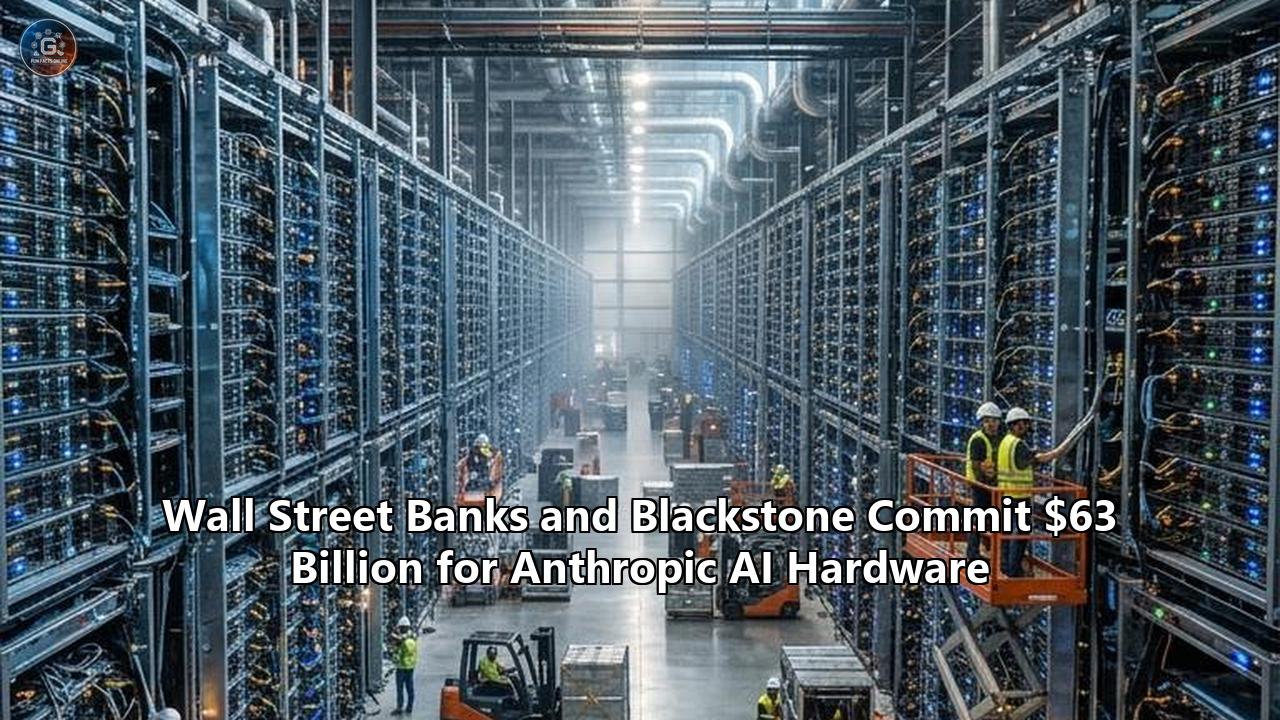
In the largest debt transaction ever assembled for artificial intelligence infrastructure, a syndicate of Wall Street powerhouses and private credit titan Blackstone committed $63 billion on October 26, 2026, to finance dedicated computing hardware for Anthropic. Arranged by Bank of America, Citigroup, and Morgan Stanley alongside Blackstone, the capital package funds the acquisition and operational deployment of custom artificial intelligence accelerators and high-throughput networking hardware engineered by Broadcom.
The transaction marks a decisive turning point in Anthropic AI funding, shifting the artificial intelligence pioneer away from dilutive venture equity rounds and cloud rental agreements toward an asset-backed, debt-financed capital structure. Executed through an off-balance-sheet special purpose vehicle (SPV), the multi-billion-dollar arrangement coincides with Anthropic’s formal submission of its Form S-1 registration statement with the U.S. Securities and Exchange Commission for an initial public offering targeting a valuation between $1.5 trillion and $2 trillion.
Under the structure, the newly formed SPV will purchase Broadcom’s custom XPU accelerators and specialized networking equipment, leasing the hardware back to Anthropic with hardware deliveries scheduled to commence in calendar year 2027. Senior commercial banks are underwriting $43.5 billion in first-lien debt—accounting for roughly 69% of the facility—while Blackstone is committing the remaining second-lien mezzanine financing. To insulate the banking syndicate against asset depreciation, Broadcom has stepped forward with an unprecedented residual value guarantee that backstops the senior lenders up to the full value of the first-lien tranche.
This escalation did not occur in a vacuum. It represents the culmination of a multi-year sprint where computing requirements outpaced venture capital, forcing frontier AI developers, semiconductor manufacturers, and institutional credit markets into an intricate web of structured balance-sheet engineering.
THE ESCALATION PATHWAY: ANTHROPIC'S CAPITAL EVOLUTION
────────────────────────────────────────────────────────────────────────────────────────
2021–2024: Equity & Hyperscaler Phase
  └─ Seed to Series C ($1B–$7B) ──> Corporate cloud tie-ups (Amazon, Google)
2025–Early 2026: Mega-Equity Exhaustion
  └─ Series G ($30B) & Series H ($65B) ──> Run-rate hits $47B; net losses surge
Summer 2026: The Structured Debt Pilot
  └─ Apollo & Blackstone $35B facility ──> 1 GW pilot; Broadcom $29B backstop
October 2026: Breaking Syndication
  └─ S-1 IPO Filing ($1.5T–$2T) + $63B Wall St/Blackstone SPV for Broadcom XPUs
────────────────────────────────────────────────────────────────────────────────────────
2021–2024: The Equity Phase and the Limits of Hyperscaler Alliances
The financial trajectory that culminated in the $63 billion credit facility began in 2021, when former OpenAI research executives Dario Amodei, Daniela Amodei, and several senior colleagues departed to establish Anthropic as a public benefit corporation. Their stated objective was building reliable, steerable frontier systems under a safety methodology known as Constitutional AI.
In its earliest stages, Anthropic funded its computing clusters through conventional Silicon Valley venture capital, raising hundreds of millions from early-stage institutional backers. Yet as model architectures evolved from early Claude iterations toward multi-modal foundation models requiring training runs on clusters of tens of thousands of processors, cash-based venture equity proved insufficient.
By late 2023, the scale of capital required to procure leading-edge compute forced Anthropic into bilateral alliances with hyperscale cloud providers:
- Amazon's Multi-Billion Anchor: Amazon committed an initial $4 billion investment in Anthropic, structured largely around compute credits on Amazon Web Services (AWS) and access to AWS Trainium and Inferentia chips alongside Nvidia silicon.
- Google's Minority Stake: Alphabet followed with an injection of $2 billion, pairing equity capital with commitments for Anthropic to deploy models across Google Cloud Platform and run workloads on Google’s proprietary Tensor Processing Units (TPUs).
These arrangements provided Anthropic with operational oxygen, but they carried profound strategic compromises. Equity stakes diluted the founding team and early employees, while antitrust regulators in Washington, London, and Brussels opened market inquiries into whether tech conglomerates were circumventing merger controls through quasi-exclusive compute partnerships.
By the close of 2024, the frontier AI sector recognized a fundamental ceiling: tech giants could not indefinitely supply compute via cloud credits without running afoul of balance-sheet constraints and regulatory scrutiny. If Anthropic intended to build frontier systems scaling beyond 100,000 clustered chips, it required an independent computing footprint unburdened by cloud provider margins.
Early 2026: The Mega-Equity Squeeze and the Hardware Bottleneck
By the first half of 2026, the computing requirements for post-training reasoning models and enterprise inference exploded. Anthropic’s internal telemetry revealed that customer adoption of Claude had escalated exponentially, pushing the company's annualized revenue run-rate past $47 billion by May 2026.
However, revenue expansion came accompanied by cash burn on a scale rarely seen in corporate history. Anthropic closed two gargantuan equity rounds within four months:
- A $30 billion Series G round in February 2026.
- A $65 billion Series H round in May 2026.
Even as venture-style Anthropic AI funding shattered global private fundraising records, the economics of hardware procurement remained brittle. Purchasing merchant graphics processing units (GPUs) on the open market tied Anthropic to hyper-inflated component prices, persistent supply backlogs, and standard enterprise depreciation schedules that punished financial statements.
Frontier labs faced an architectural dilemma. Commercial GPUs, while versatile, incurred high overhead in power consumption and memory latency when deployed purely for the matrix multiplications central to transformer architectures. To establish durable unit economics, Anthropic required bespoke application-specific integrated circuits (ASICs)—custom silicon optimized strictly for Claude’s core inference and training loops.
This dynamic brought Anthropic to Broadcom. Led by President and Chief Executive Officer Hock Tan, Broadcom had spent years dominating custom ASIC design for hyper-scalers, pairing proprietary intellectual property in Ethernet switching, SerDes (serializer/deserializer) interfaces, and optical interconnects with advanced packaging from Taiwan Semiconductor Manufacturing Company (TSMC).
Anthropic initiated technical discussions with Broadcom to engineer dedicated XPU AI accelerators, aiming to deploy clusters capable of delivering multi-gigawatt compute capacity. Yet procuring custom silicon at that magnitude introduced a balance-sheet crisis: Broadcom was unwilling to act as an unhedged bank, and Anthropic could not fund tens of billions of dollars in silicon manufacturing upfront without liquidating its operational reserves.
Summer 2026: The $35 Billion Pilot and the Entry of Private Credit
The first major structural breakthrough occurred in mid-2026, when private debt managers stepped into the vacuum left by traditional equity investors. Recognizing that sovereign wealth funds and venture syndicates were reaching exposure limits, alternative asset managers Blackstone and Apollo Global Management engineered a preliminary $35 billion financing vehicle to underwrite an initial expansion of Anthropic's computing capacity.
THE SUMMER 2026 PRECEDENT
┌────────────────────────────────────────────────────────┐
│  Broadcom Commitments:                                  │
│  - Deliver custom accelerators & networking gear       │
│  - Provide $29 billion residual value backstop         │
└──────────────────────────┬─────────────────────────────┘
                           │
                           ▼
┌────────────────────────────────────────────────────────┐
│  $35 Billion Structured Private Credit SPV             │
│  - Blackstone & Apollo provide senior/mezzanine credit │
│  - Initial footprint: ~1 Gigawatt of compute capacity  │
│  - Collateral: Physical compute hardware & leases      │
└──────────────────────────┬─────────────────────────────┘
                           │
                           ▼
┌────────────────────────────────────────────────────────┐
│  Anthropic Operational Benefit:                        │
│  - Access to dedicated capacity without equity dilution │
│  - Lease model preserves corporate cash for R&D        │
└────────────────────────────────────────────────────────┘
The summer transaction served as a working laboratory for what would follow. Apollo and Blackstone, controlling a combined asset base exceeding $1.2 trillion, treated the hardware not as speculative venture collateral, but as essential infrastructure akin to midstream energy pipelines, fiber networks, and power plants.
Crucially, Broadcom entered that pilot with a $29 billion residual value backstop, agreeing to absorb hardware depreciation if market clearing prices for used processors plummeted. The arrangement demonstrated three structural realities to institutional capital:
- Hardware Can Be Ring-Fenced: AI processors, when paired with high-speed switching fabrics and power contracts, could be placed in an isolated bankruptcy-remote SPV, protecting lenders from the software lab's operational risks.
- Vendor Guarantees Unlock Cheap Capital: Broadcom’s willingness to guarantee underlying asset value eliminated the risk discount typically demanded by commercial credit desks.
- Energy Capacity Is the Real Asset: The initial commitment targeted one gigawatt of compute capacity—equivalent to the power consumed by roughly 750,000 residential homes—establishing power access as the definitive benchmark for enterprise credit underwriting.
While the $35 billion facility stabilized Anthropic’s immediate roadmap, internal capacity forecasts for 2027 and 2028 indicated an urgent need for an exponential increase in physical infrastructure. The pilot had established the legal and structural template; the task was syndicating it across global investment banks.
October 2026: Pre-IPO Disclosure and the $80.7 Billion Squeeze
By October 2026, internal preparations for Anthropic’s public market debut reached an inflection point. On Monday, October 26, Anthropic formally filed its registration statement on Form S-1 with the SEC, setting in motion an IPO that Wall Street analysts estimated could value the entity at up to $2 trillion.
The regulatory disclosures, however, laid bare the extraordinary capital costs required to maintain frontier AI parity.
For the first half of 2026, Anthropic reported:
- Revenue: $16.3 billion, demonstrating widespread enterprise integration of Claude across finance, engineering, and national security sectors.
- Net Loss: $80.7 billion, driven by massive infrastructure procurement, compute lease commitments, and accounting fair-value revisions tied to convertible debt instruments.
The disclosures rattled public market observers. With over $80 billion in accounting losses logged across just six months, equity investors balked at the idea that upcoming IPO proceeds would be incinerated entirely on chip purchases. Equity markets demanded revenue growth unencumbered by direct capital expenditure; engineering teams demanded gigawatts of dedicated compute.
Broadcom’s executive team, led by Hock Tan, recognized that their hardware order book was directly contingent on solving this impasse. Over the three weeks leading up to the IPO filing, Broadcom’s financial advisors at Evercore engaged Wall Street’s primary debt syndication desks to craft a solution that would offload hardware capex entirely from Anthropic’s corporate balance sheet.
The Breaking Syndicate: Inside the $63 Billion Hardware Facility
On October 26, 2026, hours after Anthropic filed its S-1 prospectus, the syndicate announced its completed capital mobilization: a $63 billion credit agreement engineered specifically to purchase and lease Broadcom AI systems.
The scale of the financing exceeded nearly every telecom and technology debt placement in capital markets history, placing it within the top 1% of post-IPO technology credit facilities. Legal counsel worked around the clock to finalize documents, with Kirkland & Ellis advising Blackstone, Latham & Watkins representing the bank syndicate, and Sullivan & Cromwell guiding Broadcom alongside financial advisor Evercore.
$63 BILLION SPECIAL PURPOSE VEHICLE (SPV) FINANCING ARCHITECTURE
┌────────────────────────────────────────────────────────────────────────┐
│                        CAPITAL INJECTION: $63B                         │
│                                                                        │
│  ┌─────────────────────────────────┐ ┌──────────────────────────────┐  │
│  │     First-Lien Senior Debt      │ │      Second-Lien Debt        │  │
│  │         $43.5 Billion           │ │        $19.5 Billion         │  │
│  │           (~69%)                │ │           (~31%)             │  │
│  │  Bank of America, Citi,         │ │  Blackstone Credit &         │  │
│  │  Morgan Stanley                 │ │  Insurance Funds             │  │
│  └────────────────┬────────────────┘ └──────────────┬───────────────┘  │
└───────────────────┼─────────────────────────────────┼──────────────────┘
                    │                                 │
                    ▼                                 ▼
┌────────────────────────────────────────────────────────────────────────┐
│                 SPECIAL PURPOSE VEHICLE (SPV)                          │
│                                                                        │
│  • Holds legal title to Broadcom XPUs & networking equipment           │
│  • Fully bankruptcy-remote from Anthropic parent company               │
│  • Backed by Broadcom "Residual Value Support" matching senior debt    │
└───────────────────────────────────┬────────────────────────────────────┘
                                    │
                                    │ Equipment Leases
                                    ▼
┌────────────────────────────────────────────────────────────────────────┐
│                            ANTHROPIC                                   │
│  • Receives hardware deliveries starting calendar 2027                 │
│  • Pays operational lease expenses from business revenue               │
│  • Shields corporate balance sheet ahead of $1.5T–$2T IPO             │
└────────────────────────────────────────────────────────────────────────┘
The mechanics of the SPV divide institutional liability through a carefully structured credit waterfall:
1. The Senior First-Lien Tranche ($43.5 Billion)
Bank of America, Citigroup, and Morgan Stanley arranged the $43.5 billion senior secured tranche, which constitutes roughly 69% of the overall facility. As senior lenders, these commercial banks maintain first-priority legal liens over the physical silicon, network switches, and optical interconnects housed within the data centers.
2. The Second-Lien Mezzanine Tranche ($19.5 Billion)
Blackstone serves as the committed institutional provider of the subordinated second-lien financing. Subordinated to the bank consortium, Blackstone absorbs a higher structural loss position in exchange for elevated private credit yields, deploying dry powder from its flagship infrastructure credit and institutional insurance strategies.
3. Broadcom’s Residual Value Guarantee
The linchpin that made the bank underwriting legally viable is Broadcom’s residual value support. Under this covenant, Broadcom acts as a structural backstop for senior lenders. Should Anthropic default or the market value of the hardware collapse due to rapid technical obsolescence, Broadcom is legally bound to absorb asset depreciation losses up to an amount matching the senior first-lien facility—effectively insuring the banks against down-market volatility.
Deliveries of the hardware packages—consisting of Broadcom’s customized XPU accelerators and specialized optical networking nodes—are scheduled to deploy across dedicated North American and international data center hubs starting in calendar year 2027.
Executive Voices: The Strategic Imperative
Statements issued by the transaction's chief architects highlighted the structural transformation reshaping technology finance.
Jim DeMare, Co-President of Bank of America, positioned the deal as a model for physical capacity expansion:
"Advancing AI responsibly requires turning ambitious technology plans into tangible compute infrastructure. This transaction brings together Broadcom's leading technology and significant bank capital to accelerate the buildout of compute capacity that will power the next wave of AI innovation".
Jon Gray, President and Chief Operating Officer of Blackstone, emphasized the scale of alternative private credit deployment:
"The rapidly growing demand for AI is creating an enormous opportunity to finance compute capacity at scale. We're proud to help advance this buildout with Broadcom".
Hock Tan, President and Chief Executive Officer of Broadcom, framed the facility as confirmation of enterprise compute demand:
"Fundamentally, the need for AI compute continues to grow at an extraordinary pace. This validates that there is capital available to finance such growth and that Broadcom is uniquely positioned to enable it".
Vis Raghavan, Head of Banking and Executive Vice Chair at Citigroup, pointed to the unprecedented financial engineering required:
"Financing AI demands capital solutions at unprecedented scale. Citi is proud to pioneer innovative structures and leverage our global capital markets structuring and distribution expertise to help accelerate the buildout of critical AI infrastructure that will power the future of technology for years to come".
Dan Simkowitz, Co-President of Morgan Stanley, noted the strategic bridge between corporate expansion and capital markets:
"This transaction represents an important milestone in enabling the next buildout of AI compute capacity. Morgan Stanley has been at the forefront of innovation in designing scalable capital solutions for AI infrastructure, and we are proud to continue to advance new financing structures".
Technical Architecture: Why Broadcom XPUs Disrupted the GPU Monopoly
The financial syndicate’s willingness to commit $63 billion rested entirely on the viability of Broadcom's underlying hardware platform. While merchant GPUs from companies like Nvidia had powered early generative AI breakthroughs, the operational requirements of running multi-billion-parameter models at enterprise scale introduced severe architectural friction.
MERCHANT GPUS VS. BROADCOM CUSTOM XPUS
┌──────────────────────────────┬──────────────────────────────┐
│  General-Purpose GPUs        │  Bespoke Broadcom XPUs       │
├──────────────────────────────┼──────────────────────────────┤
│  Fixed hardware architecture │  Custom matrix-engine design │
│  Standard PCIe/NVLink limits │  Co-packaged optics (CPO)    │
│  High generalized energy draw│  Optimized power-per-FLOP    │
│  Substantial vendor margin   │  Direct-to-foundry cost base │
│  Volatile secondary pricing  │  Underwritten SPV guarantees │
└──────────────────────────────┴──────────────────────────────┘
Broadcom's alternative model centers on application-specific compute:
Application-Specific Acceleration
Unlike GPUs, which maintain legacy hardware logic for rasterization, complex graphics pipelines, and scientific floating-point routines, Broadcom’s XPUs strip away extraneous silicon real estate. The entire die area is optimized around low-precision tensor operations (FP8, FP4, and INT8) and high-bandwidth memory (HBM) interfaces specifically matched to Claude's attention mechanisms. This design yields significantly higher throughput per watt, reducing data center power consumption—the primary gating factor in AI scaling.
Optical Interconnects and Co-Packaged Optics (CPO)
At cluster scales involving tens of thousands of compute nodes, copper cabling encounters severe physical resistance and thermal degradation. Broadcom integrates co-packaged optics, integrating fiber-optic transceivers directly onto the processor substrate alongside the compute silicon. This drastically lowers input/output serialization latency, enabling distributed training runs to communicate across nodes without encountering network choke points.
Standardized Open Networking
Broadcom avoids proprietary cluster fabrics by utilizing enhanced Ethernet architectures built on its Tomahawk and Jericho switching silicon. By leveraging open networking protocols, the SPV's physical assets retain broader utility; the networking backbones can be repurposed or repurposed across different data center hosting facilities without discarding proprietary interconnect switches.
Risk Engineering: Who Carries the Exposure?
The construction of the $63 billion vehicle represents an elaborate exercise in cross-corporate risk redistribution. By examining the balance sheets involved, the distribution of market exposure becomes clear.
THE RISK-RETURN MATRIX
┌──────────────┬─────────────────────────┬─────────────────────────┐
│ Participant  │ Primary Exposure        │ Structural Protection   │
├──────────────┼─────────────────────────┼─────────────────────────┤
│ Senior Banks │ Counterparty liquidity  │ First-lien collateral + │
│ (BofA, Citi, │ and short-term defaults │ Broadcom residual value │
│ Morgan St.)  │                         │ support guarantee       │
├──────────────┼─────────────────────────┼─────────────────────────┤
│ Blackstone   │ Subordinated repayment  │ High-yield return profile│
│              │ default (Second-Lien)   │ + physical hardware lien│
├──────────────┼─────────────────────────┼─────────────────────────┤
│ Broadcom     │ Hardware obsolescence & │ Secures $63B product    │
│              │ $43.5B value guarantee  │ sales; custom silicon   │
│              │                         │ lock-in through 2030    │
├──────────────┼─────────────────────────┼─────────────────────────┤
│ Anthropic    │ Multi-year lease debt   │ Zero equity dilution;   │
│              │ operational liabilities │ off-balance-sheet       │
│              │                         │ infrastructure access   │
└──────────────┴─────────────────────────┴─────────────────────────┘
The Institutional Banks
Bank of America, Citigroup, and Morgan Stanley secured an enviable credit position. By holding first-lien claims on physical assets combined with Broadcom’s dollar-for-dollar residual value guarantee, the banks are effectively insulated against direct market fluctuations. Even if Anthropic were to fail completely and custom silicon asset valuations collapsed, the banks maintain legal recourse to call upon Broadcom’s investment-grade corporate treasury for full debt satisfaction.
Blackstone’s Private Credit Desk
Blackstone operates in the mezzanine slot. While subordinate to senior lenders, the private credit giant extracts premium yields that match institutional infrastructure return mandates. Furthermore, because Blackstone also commands vast real estate and power infrastructure assets through data center platforms like QTS, the firm holds unique operational leverage: in a liquidation scenario, Blackstone could theoretically repurpose the physical nodes directly into its own data center pipelines.
Broadcom’s High-Stakes Bet
Broadcom absorbs the substantive long-term structural risk. By guaranteeing $43.5 billion in hardware value, Hock Tan is wagering that compute demand will remain high enough through the late 2020s that Broadcom XPUs will not suffer catastrophic economic depreciation. Credit rating agency Moody’s Investor Service highlighted this dynamic, noting that while Broadcom maintains an exceptionally resilient balance sheet, risks escalate if multiple vendor-backed facilities are extended across competing labs without pause.
Anthropic’s Balance Sheet Decoupling
For Anthropic, the SPV avoids equity dilution at an essential moment. This structure decouples Anthropic AI funding from direct equity dilution, allowing the company to enter its public roadshow without an immediate $63 billion direct debt liability recorded on its corporate balance sheet. Instead, the commitments appear as future operational lease payments, funded directly out of expanding top-line enterprise software cash flows.
Market Precedents: The Industrial Transformation of AI Finance
The scale of the Wall Street–Blackstone syndicate represents the financial maturation of the artificial intelligence sector. In previous technology cycles, software companies relied primarily on high-margin, low-capex venture models: capital was deployed into headcounts, code deployment, and customer acquisition. Compute costs were treated as minor variable operational expenses.
Frontier AI development has fundamentally broken that paradigm. Frontier labs now resemble industrial utilities, semiconductor fabrication facilities, or capital-intensive aerospace initiatives. Models require continuous, dedicated baseload electricity and immense capital outlays simply to maintain operational capabilities.
The broader tech ecosystem is rapidly mimicking this asset-backed syndication model:
- Nvidia’s Capital Network: In August 2026, Nvidia established relationships with six premier financial institutions—including Blackstone—to establish dedicated debt facilities designed to finance customer purchases of its next-generation architectures.
- Hyperscaler Joint Ventures: Microsoft, Amazon, and Alphabet have increasingly partnered with Brookfield Asset Management and Global Infrastructure Partners to fund dedicated nuclear and geothermal energy arrays through off-balance-sheet equity structures.
- OpenAI’s Custom Silicon Roadmaps: Broadcom has engaged in exploratory discussions with OpenAI regarding similar multi-billion-dollar financing vehicles for custom inference silicon, demonstrating that vendor-backed structured debt is rapidly becoming the industry standard.
The shift signals an end to the era where venture equity funds the hardware layer. Private credit, investment bank syndicates, and hardware guarantees now dictate which artificial intelligence models possess the physical capacity to scale.
The Horizon: Critical Milestones and Structural Vulnerabilities
As the financial ink dries on the $63 billion package, market scrutiny shifts from corporate structuring to physical execution. Several variables will determine whether this financial vehicle stands as a blueprint for the future of tech finance or a warning about balance-sheet overextension.
FORWARD TIMELINE: KEY OPERATIONAL PHASES
────────────────────────────────────────────────────────────────────────────────────────
Late 2026 – Early 2027: Public Offering Execution
  └─ SEC approval of Anthropic Form S-1; Wall Street pricing of $1.5T–$2T valuation
Mid-2027: Hardware Deployment Phase
  └─ First tranches of Broadcom XPUs ship from TSMC fabrication lines to data centers
Late 2027 – 2028: Interconnect & Power Energization
  └─ Multi-gigawatt electrical interconnects go live; lease repayments ramp up
2028+: Residual Value Testing
  └─ Secondary market pricing of XPUs determines Broadcom guarantee exposure
────────────────────────────────────────────────────────────────────────────────────────
The forward path contains several operational pivot points:
1. Public Market Digestion of the S-1 Prospectus
Institutional public investors must evaluate whether Anthropic’s $80.7 billion net loss in the first half of 2026 can be normalized as structural infrastructure investments. If public markets penalize the company's valuation during the IPO roadshow, the cost of capital across all Anthropic-related debt instruments will increase, complicating future syndications.
2. TSMC Packaging and Supply Chain Bottlenecks
Engineering Broadcom’s XPUs requires access to TSMC’s most advanced packaging lines, specifically Chip-on-Wafer-on-Substrate (CoWoS) and advanced optical assembly nodes. Any disruptions in semiconductor fabrication schedules or packaging yields will delay physical hardware handoffs, postponing lease activation and challenging the SPV's cash flow models.
3. Grid Energization Delays
Hardware delivery is meaningless without power delivery. Securing permits, high-voltage transformers, and utility substation interconnections to energize hundreds of thousands of high-density accelerators remains a major logistical barrier across North American energy grids. If completed hardware clusters sit unenergized in data center shells, the SPV will bear interest costs while generating zero compute output.
4. Systemic Contagion in Vendor Guarantees
Broadcom’s $43.5 billion residual value backstop binds a premier semiconductor blue-chip to the residual secondary value of custom AI hardware. Should a fundamental shift occur in model architecture—such as an algorithmic breakthrough reducing inference compute demands by orders of magnitude—the market value of specialized ASICs could decline steeply, triggering Broadcom's guarantee covenants and testing the vendor's balance sheet resilience.
As the scope of Anthropic AI funding shifts from traditional capital raises to debt-financed compute syndicates, the boundary between technology labs and Wall Street credit desks has evaporated. The race to achieve frontier AI capability is no longer fought solely inside algorithmic research laboratories; it is governed by the structural engineering of global capital markets.
Reference:
- https://wsau.com/2026/10/26/wall-street-banks-blackstone-line-up-63-billion-to-finance-broadcom-chips-for-anthropic/
- https://www.channelnewsasia.com/business/wall-street-banks-blackstone-line-up-63-billion-finance-broadcom-ai-chips-anthropic-6494381
- https://www.connectmoney.com/stories/banks-blackstone-line-up-63b-to-finance-broadcom-ai-chips-for-anthropic/
- https://finovate.com/banks-structure-63-billion-anthropic-ai-financing-deepening-exposure-to-ai-infrastructure/
- https://www.marketscreener.com/news/wall-street-banks-and-blackstone-will-provide-63bn-to-finance-anthropic-s-ai-equipment-ce785cdddd81fe24
- https://w.media/blackstone-and-banks-commit-us-63-billion-deal-to-fund-anthropics-ai-infrastructure/
- https://www.ksl.com/article/51641301/wall-st-banks-blackstone-line-up-63-billion-to-finance-broadcom-ai-chips-for-anthropic
- https://energy.media/energy-deals/blackstone-apollo-make-35-billion-deal-with-anthropic-ai/
- https://dealroom.co/news/166809-blackstone-banks-line-up-63b-to-fund-broadcom-ai-chips-for-anthropic/
- https://qz.com/broadcom-anthropic-63-billion-chip-financing-102726
- https://www.kucoin.com/news/flash/wall-street-banks-and-blackstone-provide-63-billion-financing-for-anthropic-s-ai-chip-procurement