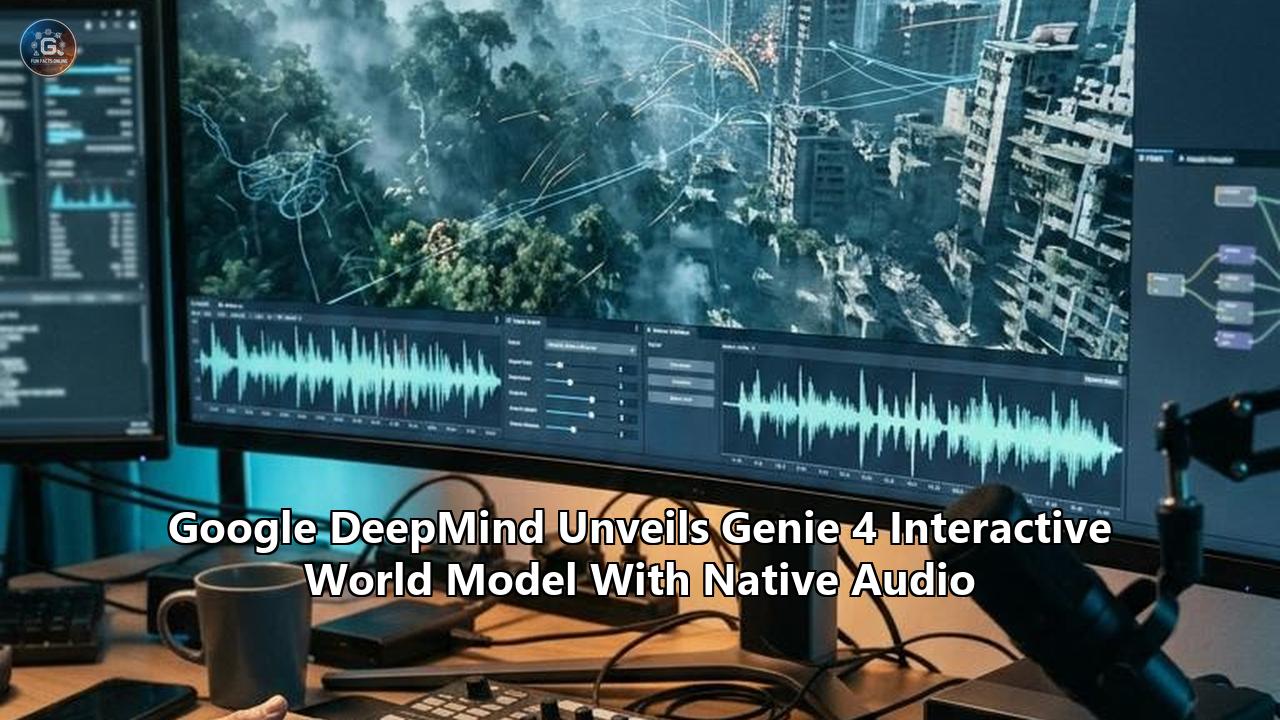
Google DeepMind has introduced Genie 4, a foundation world model capable of generating real-time, interactive three-dimensional environments that produce synchronized native audio and spoken character dialogue directly alongside visual pixels. Unveiled as a research preview on October 27, 2026, the system represents an architectural departure from conventional generative video tools. Rather than rendering static, non-interactive clips from a prompt, Google DeepMind Genie 4 functions as an interactive neural simulation that users navigate using standard keyboard controls while actively reshaping the simulation mid-flight with plain-language instructions.
The announcement marks the resolution of an engineering hurdle that has vexed artificial intelligence researchers for years: synthesizing coherent, physics-grounded audio—including reverberant ambient soundscapes, situational musical scoring, and contextually aware character conversation—in lockstep with generative visual rendering.
Authored by DeepMind researchers Raia Hadsell, Diego Rivas, and Hang Qi, the technical release details a dual-model framework where Gemini models operate directly within the simulation loop. Gemini Omni grounds visual physics and environmental behaviors, while Gemini 3.8 Flash acts as an automated director, continuously inspecting generated frames, maintaining temporal causality, and adapting user prompts to the running scene.
The laboratory has doubled the temporal coherence horizon over its predecessor, maintaining spatial stability and memory for up to two minutes of continuous exploration. The release is currently accessible to a select cohort of trusted external testers across entertainment, robotics, game development, and journalism, with public access slated to roll out to Google AI Ultra subscribers through Project Genie and enterprise developers via Google AI Studio and the Gemini API.
GENIE ARCHITECTURAL EVOLUTION (2024–2026)
===================================================================================
Model      Year     Dimension   Frame Rate   Horizon    Audio    Control Paradigm
-----------------------------------------------------------------------------------
Genie 1    2024     2D          1 FPS        Variable   None     Latent Actions (8)
Genie 2    2024     3D          Non-RT       10–20s     None     Keyboard / Mouse
Genie 3    2025     3D          24 FPS       60s        None     Text Pre-prompt
Genie 4    2026     3D          Real-Time    120s       Native   In-Flight Gemini Loop
===================================================================================
Phase I: The 2D Silent Genesis (February 2024)
Turning Point 1: Unsupervised Action Discovery from Video
The technical lineage of generative world simulation began not with photorealistic three-dimensional spaces, but with flat, silent platforming levels. In February 2024, Google DeepMind published its original Genie paper: Generative Interactive Environments. At the time, the artificial intelligence industry was consumed by generative text and text-to-video diffusion engines like OpenAI’s Sora. These early video models were passive; they allowed users to type a prompt and watch an unalterable MP4 file materialize.
DeepMind's foundational premise, championed by Tim Rocktäschel and his team, took a radically different direction: artificial general intelligence would require models that do not simply hallucinate videos of reality, but understand reality by acting inside it.
Genie 1 was an 11-billion parameter model built around three discrete components:
- A spatiotemporal video tokenizer that compressed raw video frames into compact discrete tokens.
- A latent action model trained in an entirely unsupervised manner across 200,000 hours of public gameplay videos from 2D side-scrolling platformers.
- An autoregressive dynamics model that predicted the next frame given previous frames and a chosen action.
The technical feat of Genie 1 was its unsupervised latent action space. DeepMind did not tell the network what the "up," "jump," or "run" buttons did, nor did it supply ground-truth action annotations. Instead, the latent action model observed adjacent video frames, inferred eight discrete action vectors that explained the state transitions between them, and handed those vectors to the dynamics model.
A user could feed Genie 1 a hand-drawn sketch on a napkin, a synthetic image, or a vintage photograph, and instantly pilot a character through that environment using those eight discovered keys.
Yet the limitations of Genie 1 underscored the steep mountain ahead. The model operated at an agonizingly sluggish single frame per second. It possessed no concept of depth, volumetrics, or third-dimensional perspective, and it had no auditory dimension whatsoever. Environments began to decay rapidly after several state transitions, hallucinating impossible geometry or dissolving the character into visual noise. It was a proof of concept—proving that a transformer could learn to simulate interactive causality from passive video data alone—but it remained fundamentally trapped in two dimensions.
Phase II: The Leap into Three Dimensions (December 2024)
Turning Point 2: Spatial Volumetrics and Embodied Navigation
By late 2024, the internal escalation at DeepMind pivoted around spatial perception. To make world models useful for physical robotics and generalist embodied agents, the model had to leave flat tilemaps behind and tackle camera coordinate systems, depth buffers, perspective shifts, and complex occlusions. On December 4, 2024, DeepMind unveiled Genie 2.
GENIE 1 vs. GENIE 2 LATENT DYNAMICS
-------------------------------------------------------------
Genie 1: [2D Tokens] ---> [8 Latent Action Codes] ---> 1 FPS
Genie 2: [3D Patches] --> [Continuous WASD + Mouse] -> 360p Interactive
-------------------------------------------------------------
Genie 2 was trained on vastly expanded datasets of three-dimensional video game environments. It abandoned the rigid discrete action codes of its predecessor in favor of an interface supporting continuous keyboard and mouse inputs. For the first time, an operator could supply a single prompt image—a photograph of a waterfall in California, an isometric rendering of a ruined castle, or a stylized sci-fi corridor—and navigate through it using traditional first-person (WASD) or third-person isometric controls.
The model demonstrated emergent 3D properties that had previously required dedicated rendering engines like Unreal Engine or Unity:
- Parallax effects: foreground objects moved faster across the field of view than background horizons.
- Complex occlusions: walking behind a pillar hidden behind a wall and having that structure remain intact when stepping back out.
- Interactive agent deployment: DeepMind demonstrated that its SIMA (Scalable Instructable Multiworld Agent) could be deployed directly into Genie 2 simulations. The SIMA agent could interpret language commands such as "climb the hill" or "open the container" within an imagined world that existed only in the weights of the neural network.
Despite the breakthrough, Genie 2 remained severely constrained. Generations were locked at a low 360p resolution. The temporal horizon was painfully short, lasting only 10 to 20 seconds before the autoregressive context collapsed into hallucinations. Objects that left the camera frustum frequently failed to return in the same spatial configuration when the player turned around—a critical failure of object permanence.
Crucially, the worlds remained eerily dead and silent. There was no ambient rustle of wind, no sound of footsteps, no collision impact audio, and no facility to modify the environment dynamically while playing. If an engineer wished to change the weather from sun to rain, the entire simulation had to be aborted and re-prompted from scratch.
Phase III: Real-Time Latency and the Street View Crucible (August 2025 – January 2026)
Turning Point 3: The 24 FPS Threshold and the Waymo Transition
The transition from academic artifact to functional system occurred over the course of late 2025. In August 2025, DeepMind introduced Genie 3, a milestone defined by real-time latency. The engineering team broke through the inference bottleneck, shifting from slow iterative frame generation to an optimized autoregressive spatiotemporal transformer capable of generating 720p resolution at 24 frames per second.
INFERENCE LATENCY EVOLUTION
=============================================================
Genie 1 (2024):  |████████████████████ 1,000 ms / frame (1 FPS)
Genie 2 (2024):  |█████████ 450 ms / frame (~2.2 FPS offline)
Genie 3 (2025):  |█ 41.6 ms / frame (24 FPS, Real-time)
Genie 4 (2026):  |█ 33.3–41.6 ms / frame (24–30 FPS with Audio)
=============================================================
Genie 3 extended the memory horizon to a full 60 seconds. This was achieved through hierarchical context caching, allowing the model to recall structural geometry viewed a minute prior without recomputing the entire past token history at full precision.
Simultaneously, DeepMind integrated massive datasets of real-world driving and spatial footage, notably Google Street View. This development allowed users to type a prompt describing a bustling Parisian boulevard or a muddy mountain switchback and pilot an egocentric vehicle through continuous, physically believable terrain.
The real-world stakes of this architecture escalated rapidly outside the entertainment space. DeepMind collaborated with sister Alphabet company Waymo to create the Waymo World Model. Rather than depending entirely on physical autonomous vehicle testing on public roads, Waymo engineers deployed Genie 3 to hallucinate rare, high-stakes edge cases:
- A mattress flying off a flatbed trailer on a rainy highway at twilight.
- A pedestrian in dark clothing darting through dense fog behind an occluded delivery van.
- Unpredictable multi-vehicle collisions requiring immediate evasive maneuvers.
Waymo could test its autonomous software stack directly against these synthetic, interactive neural scenarios. If the autonomous vehicle turned left, Genie 3 rendered the downstream consequences of that left turn in real time; if it braked, the world responded accordingly.
In January 2026, Google pushed the boundaries of public deployment by launching Project Genie—a web-based portal made available to Google AI Ultra subscribers across the United States. Users could log into a browser, type a prompt, and immediately explore a 3D landscape using standard keyboard inputs.
However, the computational economics remained stark. Project Genie strictly capped each session at 60 seconds. The sheer GPU and TPU overhead required to autoregressively predict tens of millions of continuous image tokens per second meant longer sessions caused server clusters to throttle, with exponential costs per user query.
Furthermore, users quickly discovered the model's structural limitations. The worlds were unpopulated wastelands. Avatars could navigate past rocks and trees, but interacting with characters was impossible. If a human figure appeared in the scene, they remained inert, drifting like statues. Most noticeably, despite the fluid visual rendering, the experience was silent. The sensory disconnect of exploring a photorealistic, stormy ocean shore without hearing the sound of crashing waves, or walking down a bustling street without hearing engine hums or footfalls, created a persistent uncanny valley.
Phase IV: The Architectural Crossroads (Mid-2026)
Turning Point 4: Decoupling Physics from Pixels and Adding a Director
By the middle of 2026, DeepMind’s leadership confronted a mathematical reality: scaling up a single autoregressive video transformer was yielding diminishing returns on long-horizon reasoning.
A pure pixel-predicting neural network operates on statistical visual correlation. It predicts the next token based on spatial patterns in the preceding tokens. But human navigation, realistic game logic, and physical operations require persistent causal logic:
- If an operator drops an iron key behind a couch at second 12, that key must remain behind that couch at second 90.
- If an operator prompts the simulation to set a building on fire, smoke must drift downwind according to consistent atmospheric physics, and NPCs (non-player characters) must react rationally rather than standing placidly in the flames.
- Most critically, audio could no longer be treated as an afterthought. Conventional video production relied on post-production audio models (like AudioCraft, Soundify, or ElevenLabs) stitched onto video clips after generation was finished. In an interactive, unscripted world model where the player can turn in any direction at any millisecond, post-hoc audio generation is functionally useless. Audio had to be synthesized live, spatialized, and tied directly to physical collisions and vocal exchanges.
DeepMind solved this by ending the isolation of the Genie architecture. Instead of running the world model as an autonomous island, the research team fused it directly into the Gemini multimodal family.
THE GENIE 4 HYBRID COGNITIVE-SPATIAL LOOP
┌────────────────────────────────────────────────────────┐
│                      Human User                        │
│             [Keyboard Nav] + [Live Prompts]            │
└──────────────┬─────────────────────────┬───────────────┘
               │ Navigation Inputs       │ Text Directives
               ▼                         ▼
┌─────────────────────────┐   ┌──────────────────────────┐
│                         │   │   Gemini 3.8 Flash       │
│                         │   │   (The Director)         │
│                         │   │   - Deconstructs Goals   │
│                         │   │   - Validates Causality  │
│                         │   │   - Adapts Running State │
│                         │   └─────────────┬────────────┘
│  Genie 4 Spatiotemporal │                 │
│  Diffusion Transformer  │◄────────────────┘
│                         │ Dynamic Scene Guidance
│  - Native Audio Latents │
│  - Spatial Tokenizer    │
│  - Aerodynamics Engine  │
│  - Skeletal Kinematics  │
│                         │
└──────────────┬──────────┘
               │
               ▼
┌─────────────────────────┐
│       Gemini Omni       │
│  Visual Grounding &     │
│  Physical World Bounds  │
└─────────────────────────┘
The new paradigm split the labor between three interlinked neural systems:
- The Spatial Engine (Genie 4 Core): A massive spatiotemporal transformer optimized for high-throughput, low-latency token projection that handles raw frame-by-frame rendering and native audio synthesis.
- The Perception Anchor (Gemini Omni): A perceptual foundation model that conditions the spatial engine on real-world photorealism, material reflectance, optical depth, and physical motion constraints.
- The Executive Director (Gemini 3.8 Flash): A high-speed, lightweight reasoning agent running concurrently inside the execution loop. It continuously watches generated frames, monitors environmental coherence, breaks user text inputs into actionable state transformations, and guarantees multi-step event continuity.
This breakthrough set the stage for the formal unveiling of the system in late October 2026.
Phase V: The Breaking Event — Unpacking Google DeepMind Genie 4 (October 2026)
On October 27, 2026, Google DeepMind formally revealed Google DeepMind Genie 4, categorizing it as its most significant leap in real-time interactive world simulation. Authoring the release, Raia Hadsell, Diego Rivas, and Hang Qi framed the model as an entirely native multimodal environment.
The system does not generate images and then guess the soundtrack; it synthesizes the visual environment, spatial ambient acoustics, complex aerodynamics, physical collision sounds, and interactive spoken dialogue simultaneously within a unified token stream.
Native Audio and Acoustic Physicality
The defining technical leap of Google DeepMind Genie 4 is its native audio generation pipeline. During each forward pass, the model projects joint audiovisual latents. Audio is not treated as a disconnected waveform appended to a finished file, but as an intrinsic physical consequence of visual events:
- Spatial and Material Acoustics: The system models environmental reverberation profiles based on visible surfaces. A user walking through a cathedral rendered with stained-glass windows and stone flooring generates sharp, reverberant footsteps; stepping out onto a damp lawn instantly transitions the acoustic profile to soft, low-frequency dampening. Wind whistling through pine branches carries authentic high-frequency friction, while ocean waves colliding with coastal cliffs produce low-end acoustic thuds that dynamically scale in volume as the user steers the camera closer.
- Real-Time Spoken Dialogue: Characters inside Genie 4 worlds are no longer static visual props. DeepMind demonstrated interactive non-player characters capable of holding live conversations. When a user approaches an avatar and speaks or types a query, the character responds dynamically with phoneme-accurate lip synchronicity, natural human pauses, and appropriate vocal timbre. In one demonstration featuring a crowded 1980s Japanese subway station, the background murmurs of commuters, train track squeals, and automated platform announcements intermingle into a continuous acoustic landscape.
JOINT AUDIOVISUAL TOKEN STREAM IN GENIE 4
┌────────────────────────────────────────────────────────┐
│ Time Slice t (33.3 ms Window)                          │
├────────────────────────────┬───────────────────────────┤
│ Visual Tokens:             │ Audio Tokens:             │
│ - Water droplet impact     │ - High-frequency splash   │
│ - Stone plinth surface     │ - Reverberant stone slap  │
│ - Camera dolly vector      │ - Binaural spatial pan    │
│ - Speaker lip position     │ - Phoneme audio formant   │
└────────────────────────────┴───────────────────────────┘
In-Flight Dynamic Steering and Prompt Modulation
In all prior iterations of world models, a prompt was immutable once generation began. If the prompt described a sunny desert, the user could only navigate the sunny desert until the compute session expired.
Genie 4 fundamentally dismantles this barrier through in-flight steering. While navigating a world using standard keyboard keys (WASD for translation, arrow keys for rotation, space for elevation), an operator can type natural language instructions directly into a live console overlay:
- "Make it a stormy downpour and turn the gravel into mud."
- "Drop an old wooden rowboat into the center of the lake."
- "Have the saxophonist stop playing and look up at the sky."
When an instruction is entered, Gemini 3.8 Flash intercepts the command. It analyzes the current frame buffer, computes the contextual delta, and modifies the latent conditioning vectors feeding the diffusion engine.
The transition does not flash or cut like a video edit. Instead, the weather transitions organically: clouds darken over several frames, raindrops hit the lake surface with authentic ripples, splashing audio blends into the mix, and the ground texture shifts from dry stone to wet, reflective mud showing specular highlights.
PROMPT TRANSITION TIMELINE (IN-FLIGHT EDIT)
Frame 000: [Sunny Lake Shore] -> User Inputs: "Transition to sudden thunderstorm"
Frame 030: Cloud density increases; ambient illumination drops 40%.
Frame 060: First rain strikes render; white-noise rain audio fades in.
Frame 090: Lake surface generates dynamic wave rings; wind acoustics rise.
Frame 120: Puddle accumulation on dirt path; specular light reflections activate.
Kinematics, Physics, and Aerodynamics
DeepMind demonstrated that Google DeepMind Genie 4 models intricate real-world physics that previously required heavy numerical simulation software:
- Fluid Dynamics: In a demonstration following a wooden rowboat drifting along a river, the interaction between water currents and the wooden hull exhibits realistic wake turbulence, fluid displacement, and bobbing momentum.
- Complex Aerodynamics: A macro simulation demonstrated a winged maple seed falling from a branch into deep grass. The model correctly rendered the gyroscopic autorotation (the "helicopter effect"), reacting to simulated gusts of wind with authentic drag and rotational velocity.
- Human Locomotion: Previous iterations struggled with human figures, often generating nightmarish anatomical shifts or sliding "skating" feet. DeepMind highlighted simulations of an actor walking backstage through a cluttered musical theatre. The figure moved with believable skeletal weight distribution, sidestepped stage cables, adjusted their posture around stagehands, and brushed aside velvet curtains with natural physical resistance.
PHYSICAL BENCHMARK BEHAVIORS VALIDATED IN GENIE 4
-----------------------------------------------------------------------------------
Physics Domain        Demonstrated Capability               Prior Bottleneck
-----------------------------------------------------------------------------------
Fluid Dynamics        Wake turbulence, boat displacement   Gooey, gelatinous water
Aerodynamics          Autorotating maple seed drag          Linear, falling descent
Skeletal Kinematics   Backstage actor weight/foot balance  Foot-sliding, limb morphing
Rigid Collisions      Watermelon cracking on stone plinth   Rubber-like deformation
-----------------------------------------------------------------------------------
Phase VI: The Technical Core: How the Gemini-Genie Stack Operates
To understand why Genie 4 represents a departure from tools like Sora, Runway Gen-3, or Pika, one must look at how the neural architecture handles compute, state memory, and watermarking.
COMPREHENSIVE RUNTIME LOOP
┌────────────────────────────────────────────────────────┐
│ User Navigation Inputs (WASD, Mouse Camera Directives) │
└───────────────────────────┬────────────────────────────┘
                            │
                            ▼
┌────────────────────────────────────────────────────────┐
│ Current Frame Cache t-1 ... t-N (Latent State Buffer)  │
└───────────────────────────┬────────────────────────────┘
                            │
                            ▼
┌────────────────────────────────────────────────────────┐
│           Genie 4 Spatiotemporal Transformer           │
│  - Generates Visual Frame Token Candidates             │
│  - Generates Spatial Audio Waves (24–48 kHz equivalent)│
└───────────────────────────┬────────────────────────────┘
                            │
                            ▼
┌────────────────────────────────────────────────────────┐
│              Gemini Omni Perceptual Gate               │
│  - Verifies Physical Plausibility & Optical Coherence  │
└───────────────────────────┬────────────────────────────┘
                            │
                            ▼
┌────────────────────────────────────────────────────────┐
│              Gemini 3.8 Flash Critic Loop              │
│  - Evaluates Object Permanence                         │
│  - Steps Task State Machine                            │
│  - Modulates Prompts for Contextual Adherence          │
└───────────────────────────┬────────────────────────────┘
                            │
                            ▼
┌────────────────────────────────────────────────────────┐
│ Output Frame Projection (Real-Time Display + SynthID)  │
└────────────────────────────────────────────────────────┘
The Gemini 3.8 Flash Director Loop
The integration of Gemini 3.8 Flash is the structural linchpin of the system. In earlier systems, the world model generated frames purely autoregressively: $P(x_t \mid x_{ In Genie 4, Gemini 3.8 Flash operates as an asynchronous critic and planner:
Provenance and Watermarking: SynthID Integration
With the leap into unscripted, real-time audiovisual photorealism comes a massive vector for misuse, impersonation, and fraudulent media creation. DeepMind confirmed that every frame and audio sample produced by Genie 4 carries SynthID watermarking.
Developed by DeepMind's safety research division, SynthID inserts an imperceptible digital signature directly into the visual pixels and the audio frequency spectrum during generation.
This watermark is mathematically engineered to survive downstream compression, screen recording, MP3 encoding, format conversion, and aggressive image cropping. Any clip recorded from a Genie 4 session can be instantly identified by detection algorithms, preventing actors from passing off synthetic interactive simulations as genuine historical footage or authentic documentary recordings.
Phase VII: The Industry Shockwave and Tester Findings
The release of Google DeepMind Genie 4 has sent shockwaves through multiple high-technology sectors, ranging from traditional Hollywood visual effects departments to game development studios and industrial robotics laboratories.
SECTOR IMPACT ASSESSMENT
┌────────────────────┬─────────────────────────────┬───────────────────────────┐
│ Industry           │ Application                 │ Displaced Workflow        │
├────────────────────┼─────────────────────────────┼───────────────────────────┤
│ Hollywood / Film   │ Real-time virtual drafting  │ Days of manual storyboard │
│                    │ & multi-take pre-vis        │ and rough 3D blocking     │
├────────────────────┼─────────────────────────────┼───────────────────────────┤
│ Game Development   │ Zero-asset rapid prototyping│ Weeks of grey-boxing and  │
│                    │ of mechanics and sound      │ placeholder sound design  │
├────────────────────┼─────────────────────────────┼───────────────────────────┤
│ Physical Robotics  │ Infinite synthetic edge     │ Expensive real-world      │
│                    │ cases with native audio     │ hardware stress testing   │
├────────────────────┼─────────────────────────────┼───────────────────────────┤
│ Journalism / Archival│ 3D spatial re-creation    │ Flat photo archives and   │
│                    │ from single archival images │ speculative artist prints │
└────────────────────┴─────────────────────────────┴───────────────────────────┘
Pre-Visualization and Virtual Cinematography
In traditional filmmaking, pre-visualization (pre-vis) requires teams of digital artists to spend weeks in Maya, Unreal Engine, or Blender setting up rough polygonal assets, placing lights, rigging rudimentary character skeletons, and timing camera paths.
Early trusted testers in the film industry are using Genie 4 as a rapid interactive sketchpad:
- Directors step directly into the scene using keyboard controls, directing virtual actors live while testing camera lenses and lighting conditions.
- Because the camera is unconstrained, a cinematographer can run dozens of distinct "takes" through an identical scene—trying an over-the-shoulder tracking shot on the first pass, a crane shot on the second pass, and a low-angle handheld perspective on the third.
- DeepMind highlighted an example prompt that instructed the model to use an archival photograph as its exact first frame, apply a soft 16mm low-contrast documentary film stock aesthetic, and glide an independent camera freely across a misty lake around an improvising saxophone player. The model rendered the spatial acoustic decay of the saxophone reverberating over open water while letting the user freely orbit the musician.
Diego Rivas addressed this creative friction in an interview with Bloomberg:
"We're still in the research journey. We're not necessarily in the end product journey. The real-time aspect is particularly valuable in the ideation and storyboarding phases, where a rapid creative flow is needed".
The Synthetic Crucible for Autonomous Robotics
While creative applications dominate visual headlines, DeepMind’s core strategic objective for Genie 4 is the creation of infinite, self-supervised training gyms for embodied artificial intelligence.
Training physical humanoid robots or robotic arms in the real world is notoriously hazardous and slow. If a robot attempts to learn how to catch a falling glass bottle by trial and error in a real kitchen, it will shatter thousands of bottles, damage its mechanical actuators, and pose hazards to human handlers.
Using Genie 4, an embodied policy can be dropped into an endless variety of simulated rooms. Crucially, the introduction of native audio gives robotic agents access to acoustic feedback loops:
- A robotic gripper can learn to gauge the grip pressure needed to grasp a plastic cup by the specific crinkling acoustic signature generated during contact.
- Autonomous drones can learn to navigate turbulent air corridors by correlating the sound of wind shear against visual leaf sway.
- Humanoid assistants can practice conversational interaction with human inhabitants in dynamic domestic environments before a physical prototype ever steps into a real home.
Tejas Kulkarni, Director of Research at Google DeepMind, outlined the vision:
"Genie 4 will enable a combination of world models, where Gemini will write code and text, while Genie simulates reality in real-time. This will open new opportunities for testing robotic scenarios before they occur in the real world".
THE ROBOTIC AGENT TRAINING COMPARISON
=============================================================================
Vector                 Traditional Simulators (Isaac Gym)  Genie 4 Simulation
-----------------------------------------------------------------------------
Asset Production       Months of manual CAD & rigging      Zero-shot from text/image
Acoustic Realism       Synthetic sound-clips / None        Dynamic material audio
Physics Diversity      Pre-programmed rigid-body bounds    Emergent aerodynamic/fluid
Distribution Shift     High ("Sim-to-Real" gap)            Low (Photorealistic tokens)
Compute Profile        Deterministic CPU/GPU Physics       Massive TPU Neural Inference
=============================================================================
Phase VIII: The Unresolved Frontiers and Technical Friction
Despite its capabilities, DeepMind’s technical authors and independent researchers are candid regarding the severe engineering hurdles that remain unsolved in the Genie 4 architecture.
The Fragility of Long-Horizon Permanence
Genie 4 doubles the coherence horizon of Genie 3, extending stable simulation to roughly two minutes. However, two minutes remains a sharp technical boundary, not a guarantee.
Hang Qi, DeepMind research engineer and co-author, emphasized to reporters that reaching the 120-second mark does not ensure complete scene stability. As simulations lengthen—especially when a user issues repeated, complex mid-flight prompt transformations—details begin to drift:
- A car parked on the side of a street may subtly change make, color, or wheel design after the user turns 360 degrees three times.
- Interior architectural plans may shift: entering a kitchen, exploring a hallway, and returning to the kitchen can result in windows migrating to different walls or cupboards changing color.
- In-world typography remains fundamentally broken. Street signs, book titles, computer monitors, and wall posters generate garbled, pseudo-linguistic glyphs rather than clear, stable text.
COHERENCE DECAY OVER EXTENDED SESSIONS
[00:00 - 00:30] : Near-perfect spatial geometry, locked textures, sharp acoustics.
[00:30 - 01:00] : Minor specular drift; secondary background objects shift slightly.
[01:00 - 01:30] : Geometry memory begins lossy compression; off-screen items mutate.
[01:30 - 02:00] : High risk of structural hallucination following complex prompt edits.
[02:00 +      ] : Current hard boundary; autoregressive attention limits require reset.
Acoustic Hallucinations and In-Flight Desynchronization
While native audio generation functions seamlessly during steady navigation, extreme edge cases expose neural artifacts:
- Rapid, contradictory user prompts—such as commanding "Spawn a marching band" followed immediately by "Total absolute silence in a vacuum"—can cause the audio latent space to produce digital buzzing, high-frequency clipping, or speech fragments that loop endlessly in memory.
- Dialogue coherence over multi-minute interactions still suffers from conversational amnesia. An avatar can engage in snappy situational banter, but holding a complex, multi-turn discussion that references a detailed fact established 90 seconds prior frequently results in logical contradictions.
The Compute Wall and Monetization Hurdles
The infrastructure required to run a dual-stack model of this scale in real time is staggering. Generating 24 to 30 frames per second of 720p photorealistic video alongside spatial binaural audio requires dedicated allocations of Google’s latest TPU clusters.
Because of this, Google has not provided general public access, nor has it published an API pricing model. Even for trusted testers, exploration sessions are metered.
When Genie 4 formally rolls out to Project Genie subscribers in the coming weeks, it will be restricted to Google AI Ultra tier members—a subscription commanding a high premium (currently $99.99 per month)—and sessions will likely remain time-capped to prevent catastrophic server overload. The transition from a privileged research demo to a commercially viable, infinitely scalable cloud service remains the model's most perilous hurdle.
Phase IX: The Road Ahead: What to Watch Next
The unveiling of Genie 4 changes the trajectory of generative artificial intelligence research. The technology is transitioning out of the static "prompt-and-wait" paradigm of text-to-image and text-to-video generators and moving squarely into real-time interactive simulation.
As Google DeepMind prepares to widen access to Google AI Ultra subscribers and Gemini API developers, researchers and industry analysts are monitoring several milestones:
UPCOMING MILESTONES & MONITORING RADAR
=============================================================================
Milestone                      Target Window        Key Performance Indicator
-----------------------------------------------------------------------------
Project Genie Consumer Beta    Late 2026 / Q1 2027  Stability under public scale;
                                                    average session length caps
Enterprise Gemini API Access   Early 2027           Token pricing per minute;
                                                    latency metrics across regions
Robotics Sim-to-Real Benchmark Mid-2027             Transfer efficiency of policies
                                                    trained in Genie 4 to hardware
Spatial Hardware Integration   2027 Horizon         Native stereoscopic rendering
                                                    for mixed-reality headsets
=============================================================================- The Sim-to-Real Metric Releases: Watch for DeepMind’s robotics division to publish formal empirical data demonstrating whether policies trained inside Genie 4's audiovisual worlds achieve higher task-completion rates on real humanoid hardware than agents trained in conventional simulators.
- The Long-Context Architecture: Research teams are actively working on replacing standard sliding-window attention with external state-graph databases. If DeepMind can decouple memory from the transformer’s immediate token context, session limits could expand from two minutes to indefinite, persistent worlds where a house or city retains its layout forever.
- Mixed-Reality Spatial Integration: Although current demos are rendered for standard 2D displays with keyboard navigation, the next technical phase is stereoscopic projection. Rendering independent, latency-matched left-eye and right-eye perspectives at 90 frames per second within an interactive headset remains world simulation's ultimate summit.
By closing the sensory loop between visual physics, real-time user agency, and native spatial acoustics, DeepMind has constructed more than a creative tool. Genie 4 provides an early blueprint for how artificial intelligence will construct, simulate, and inhabit synthetic reality on the long march toward Artificial General Intelligence.
Reference:
- https://deepmind.google/blog/genie-4-a-new-generation-of-world-simulation/
- https://www.vp-land.com/stories/genie-4-is-google-deepminds-new-world-model-with-live-text-steering-and-native-audio
- https://www.datacamp.com/blog/genie-4
- https://www.marktechpost.com/2026/10/28/google-deepmind-genie-4-world-model/
- https://mlq.ai/news/google-deepminds-genie-4-adds-real-time-audio-and-steering-to-simulated-worlds/
- https://qz.com/google-deepmind-genie-4-world-model-audio-102726
- https://en.wikipedia.org/wiki/Genie_(world_model))
- https://deepmind.google/research/publications/60474/
- https://arxiv.org/html/2402.15391v1
- https://www.eachlabs.ai/blog/genie-4-is-coming-what-we-know
- https://deepmind.google/blog/genie-3-a-new-frontier-for-world-models/
- https://deepmind.google/blog/genie-2-a-large-scale-foundation-world-model/
- https://www.cbsnews.com/news/google-deepmind-ceo-demonstrates-genie-2-world-building-ai-model-60-minutes/
- https://medium.com/@cognidownunder/genie-2-google-deepminds-leap-into-interactive-3d-world-generation-d6cee1647e44
- https://www.unite.ai/google-deepmind-rolls-out-genie-4-world-model-in-research-preview/
- https://time.com/collections/best-inventions-2025/7318419/google-deepmind-genie-3/
- https://www.marketingaiinstitute.com/blog/google-genie-3
- https://mashable.com/article/google-launches-project-genie-3-how-to-try
- https://www.eesel.ai/blog/genie-4
- https://hyperight.com/google-deepmind-debuts-genie-4/
- https://deepmind.google/models/genie/
- https://deepmind.google/blog/genie-4-a-new-generation-of-world-simulation/
- https://www.nacionale.com/en/articles/google-deepmind-launches-genie-4-interactive-simulations
- https://en.wikipedia.org/wiki/Genie_(world_model))