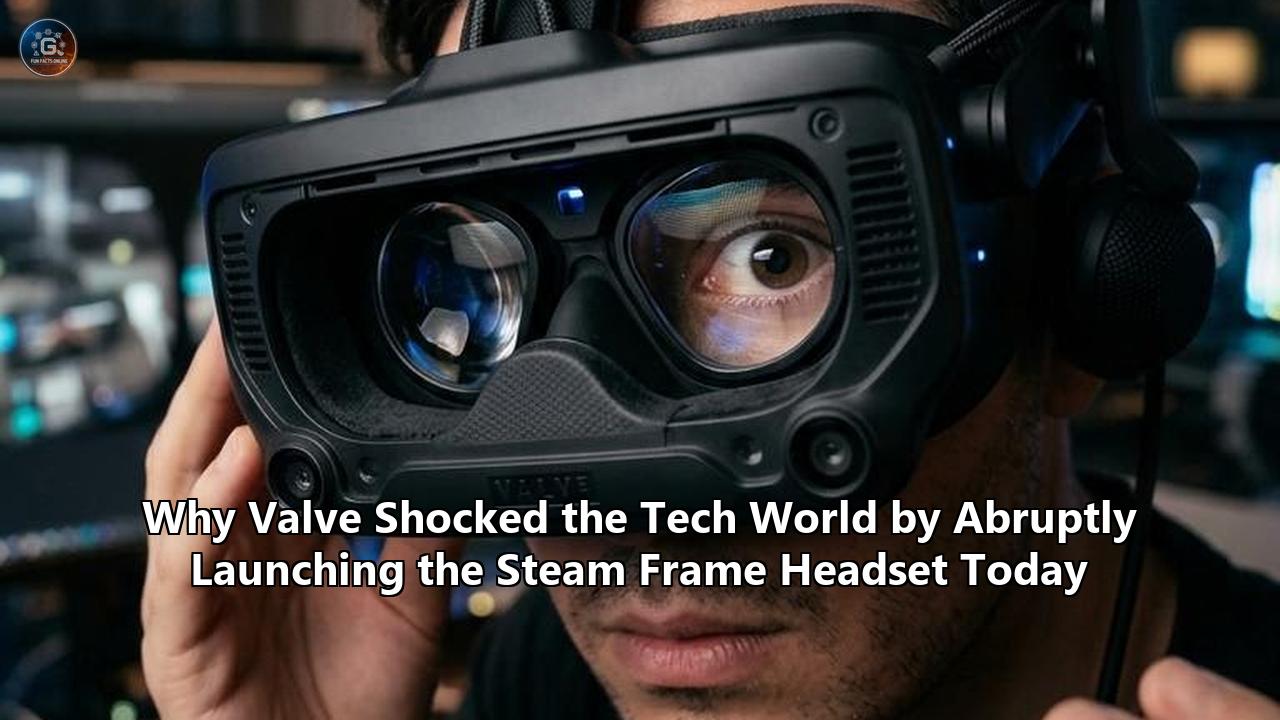
Valve opened reservation queues on Monday morning for its long-awaited standalone virtual reality system, catching the interactive entertainment industry off guard with an immediate rollout and a premium price tier. At 10:01 AM Pacific, the company published store listings and technical documentation for the Valve Steam Frame headset, confirming that the device codenamed "Deckard" is entering consumer hands after years of internal development and speculation.
The launch follows an aggressive hardware deployment cycle from Valve Corporation, coming three months after the release of the living-room-oriented Steam Machine and four months after the updated Steam Controller hit shelves. Rather than hosting an elaborate press conference or trailing the launch through a multi-month promotional tour, Valve published the product pages directly to the Steam storefront, pairing the hardware drop with an immediate 72-hour randomized reservation lottery designed to bludgeon the reseller market.
The headset enters the market across two configurations: a 256GB base kit priced at $1,059 and a 1TB edition at $1,299. Both packages bundle two tracked controllers, an ultra-low-latency 6GHz wireless PC streaming adapter, and a digital entitlement to Half-Life: Alyx.
                               STEAM FRAME ARCHITECTURE
  +---------------------------------------------------------------------------------+
  |                               CORE HARDWARE                                     |
  |  SoC: Snapdragon 8 Gen 3 (SM8650)  |  RAM: 16GB Unified LPDDR5X                |
  |  Displays: Dual 2160x2160 LCDs      |  Optics: Multi-Element Pancake            |
  |  Weight: 185g (Core Visor) / 440g   |  Battery: 21.6 Wh Rear Modular Counter    |
  +---------------------------------------------------------------------------------+
                                       |
                                       v
  +---------------------------------------------------------------------------------+
  |                           COMPATIBILITY SOFTWARE                                |
  |  SteamOS (Arch Linux) | Proton (Win-to-Linux) | FEX-Emu (x86-on-ARM) | Lepton   |
  +---------------------------------------------------------------------------------+
                                       |
                   +-------------------+-------------------+
                   |                                       |
                   v                                       v
  +---------------------------------+     +---------------------------------+
  |        STANDALONE PLAY          |     |      LOW-LATENCY STREAMING      |
  |  - Native ARM / Vulkan Builds   |     |  - Dedicated 6GHz Wi-Fi 6E Dongle|
  |  - Android/AOSP APK Execution   |     |  - Dual Wi-Fi 7 Radios (Headset)|
  |  - Emulated Flat Steam Catalog  |     |  - Eye-Tracked Foveated Stream  |
  +---------------------------------+     +---------------------------------+
Prospective buyers must register through their Steam accounts before the reservation window closes at 10:00 AM Pacific on Thursday, September 17. Valve stated that accounts must have recorded a verified purchase prior to April 27, 2026, to qualify for the initial randomization, after which successful applicants will receive 72-hour checkout allocations starting Friday, September 18.
The abrupt appearance of the Valve Steam Frame headset has sent reverberations across the extended reality (XR) landscape. It challenges Meta’s consumer dominance with a dramatically lighter physical footprint, an open Linux software architecture, and a dedicated local wireless streaming pipeline designed to dismantle the barrier between tethered fidelity and standalone convenience.
The Hardware Architecture: Extreme Counterbalancing and Silicon Decisions
The core engineering mandate behind the hardware centers on a fundamental refusal to place heavy computational and battery payloads on the user's face. While competitors like the Meta Quest 3 mount the full processing package, optics, and power cells within a single front-heavy 515-gram chassis, Valve designed the Steam Frame around an aggressive weight-distribution philosophy.
The front-facing visor module weighs 185 grams on its own. Fully assembled with the facial interface, rigid strap, dual stereo ear drivers, and the rear-mounted counterweight battery pack, the total operational weight reaches 440 grams.
Headset Weight Comparison (Total vs. Front Visor Load)

Valve Steam Frame (Visor Only):  [=====] 185g
Valve Steam Frame (Total Setup): [=============] 440g
Meta Quest 3 (All-in-Front):     [===============] 515g
Apple Vision Pro (Front Bias):   [====================] 600-650g
Valve Index (Legacy Tethered):   [==========================] 809g
By placing the 21.6 Wh lithium-ion battery on the rear occipital cradle, Valve shifted the center of gravity directly over the wearer's cervical spine. This approach virtually eliminates the downward rotational torque that causes neck strain and cheekbone fatigue during extended simulations.
Inside the visor, the optical stack relies on custom multi-element pancake lenses paired with dual fast-switch LCD panels. Each display outputs 2160 × 2160 pixels per eye, delivering a combined resolution of 4320 × 2160—a roughly 15 percent increase in linear pixel density over the Quest 3’s 2064 × 2208 per-eye panels. The optical engine delivers a conservative 110-degree horizontal and vertical field of view, adjusted mechanically through a continuous physical interpupillary distance (IPD) dial seated along the bottom edge of the frame. Display refresh rates scale across 72Hz, 80Hz, 90Hz, and 120Hz native modes, with an experimental 144Hz mode accessible through developer settings for high-bandwidth streaming configurations.
Optical and Compute Specifications:
• Silicon: Qualcomm Snapdragon 8 Gen 3 (SM8650, 4nm ARM64 architecture)
• System Memory: 16GB Unified LPDDR5X RAM
• Display Panels: Dual Fast-Switch LCD, 2160 × 2160 pixels per eye (4.67 MP/eye)
• Refresh Capabilities: 72Hz, 80Hz, 90Hz, 120Hz, and experimental 144Hz
• Optical Path: Multi-element custom pancake lenses
• Field of View: 110° horizontal × 110° vertical
• Tracking: 4 outward-facing monochrome cameras + active IR illuminator
• Eye Tracking: Dual internal IR sensor arrays for gaze detection and foveated streaming
• Expansion: User-accessible PCIe Gen 4 / camera expansion interface
• Battery: 21.6 Wh swappable rear pack with USB-C 45W Power Delivery
To drive local rendering and handle high-throughput video decompression, Valve bypassed off-the-shelf XR platform silicon, selecting Qualcomm’s 4-nanometer Snapdragon 8 Gen 3 system-on-chip paired with 16GB of unified LPDDR5X memory. The decision to deploy 16GB of system RAM—double the memory pool found in competing consumer standalone headsets—was non-negotiable for Valve’s software ambitions.
"Work started on Steam Frame basically as soon as we shipped the Index," said Valve hardware developer Jeff Leinbaugh during a technical briefing. "The goals that we aligned on for what became the Steam Frame was to make it much easier to use, which to us meant a lighter, more comfortable, easier to get into and out of VR headset. We picked the Qualcomm 8650 chip because it had immense capability, but in order to make use of that, our engineers had to solve severe thermal management and power delivery challenges. We approached this like building an ultra-compact personal computer that just happens to run mobile silicon."
The physical interface includes a high-speed peripheral expansion slot located behind a removable bezel plate on the forehead. Featuring a native PCIe Gen 4 bus and high-throughput camera pipelines, this port invites third-party hardware developers to create custom modules, ranging from facial-tracking arrays to specialized depth sensors. Storage configurations are split between 256GB and 1TB UFS internal modules, both augmented by an external high-speed microSD card slot integrated directly into the front brow assembly. MicroSD cards can be transferred hot between the Steam Frame, the Steam Deck, and the Steam Machine, allowing users to move shared game libraries across form factors without redownloading local assets.
The "Roy" Controllers: Engineering Gamepad Parity for Flat and Spatial Titles
The tracked input devices accompanying the system abandon the bulky outer tracking rings characteristic of earlier spatial hardware. Instead, the Steam Frame Controllers—developed under the internal codename "Roy"—use a constellation of 18 infrared LEDs embedded flush beneath infrared-transparent structural plastics. The headset’s four outward monochrome tracking cameras track these markers alongside integrated six-axis inertial measurement units (IMUs), producing sub-millimeter positioning even through high-velocity hand gestures.
                 STEAM FRAME "ROY" CONTROLLER INPUT TOPOLOGY

          LEFT CONTROLLER                           RIGHT CONTROLLER
       +--------------------+                    +--------------------+
       |  [Menu]    [D-Pad] |                    |  [A] [B]   [Steam] |
       |     \        /     |                    |   \   /            |
       |      (Thumbstick)  |                    |  (Thumbstick)      |
       |      /            \ |                    |  /           \    |
       |  [Bumper] [Trigger]|                    | [Bumper]  [Trigger]|
       |                    |                    |      [X] [Y]       |
       |  [Dual-Stage Grip] |                    |  [Dual-Stage Grip] |
       |  Capacitive Array  |                    |  Capacitive Array  |
       +--------------------+                    +--------------------+
The functional breakthrough of the controllers lies in their input topology. Rather than adopting the minimalist button layout standard on VR motion controllers—which typically restricts players to two action buttons per hand—Valve mapped a traditional game controller's entire input footprint across the split handles.
- Right Hand Controls: Houses physical A, B, X, and Y face buttons alongside a clickable analog stick, a digital shoulder bumper, an analog index trigger, a system guide button, and a dual-stage grip plate.
- Left Hand Controls: Houses a full four-way directional pad, an analog thumbstick, a shoulder bumper, an analog trigger, an application menu button, and a matching dual-stage grip.
- Sensor Hardware: Both thumbsticks use tunneling magnetoresistance (TMR) magnetic sensors rather than conventional mechanical potentiometers, completely insulating the input assemblies against physical contact wear and mechanical stick drift.
- Capacitive Sensing: Capacitive detection meshes cover the thumbstick surfaces, thumb rests, analog triggers, and the body grips, enabling full five-finger open-hand gesture estimation without physical finger straps.
This layout ensures input parity with the standard Xbox, PlayStation, and Steam Deck controller schemas. When wearing the headset to play non-spatial, standard desktop games projected on a floating virtual display, players do not need to put down their motion controllers to reach for a conventional gamepad. The split halves function natively as a standard PC input device, recognized by the operating system through the Steam Input abstraction layer.
Valve also opted for an unexpected power configuration: each controller operates on a single AA alkaline or rechargeable battery, yielding approximately 40 hours of continuous operational runtime. By avoiding integrated lithium pouches, Valve eliminated battery degradation as a failure point, allowing immediate battery swaps during play sessions without necessitating charging downtime.
Breaking the x86 Barrier: Inside the SteamOS ARM Software Pipeline
The most consequential technical feat executed within the Valve Steam Frame headset is not its mechanical design, but its software architecture. For more than a decade, high-end PC gaming has remained bound to x86 processor architectures and Windows APIs. The Steam Frame breaks both dependencies simultaneously.
The headset runs an ARM64-compiled version of SteamOS 3, constructed atop an Arch Linux foundation. Because the underlying Snapdragon 8 Gen 3 processor cannot natively execute standard compiled x86 PC instructions, Valve engineered a multi-tiered runtime bridge that translates instructions and graphics calls in real time.
                        STEAM FRAME SOFTWARE RUNTIME
  +--------------------------------------------------------------------------+
  |              STEAM CATALOG APPLICATIONS (x86 Windows Binaries)           |
  +--------------------------------------------------------------------------+
                                       |
                                       v
  +--------------------------------------------------------------------------+
  |                   PROTON API TRANSLATION LAYER                           |
  |        Maps DirectX 11/12 & Windows Syscalls -> Vulkan / POSIX APIs      |
  +--------------------------------------------------------------------------+
                                       |
                                       v
  +--------------------------------------------------------------------------+
  |                         FEX-EMU BINARY CORE                              |
  |             Translates x86-64 Machine Code -> ARM64 Native Code          |
  +--------------------------------------------------------------------------+
                                       |
                                       v
  +--------------------------------------------------------------------------+
  |               STEAM ENGINE & WAYLAND COMPOSITOR (Gamescope)              |
  |                     Custom Turnip Open-Source Drivers                    |
  +--------------------------------------------------------------------------+
                                       |
                                       v
  +--------------------------------------------------------------------------+
  |            QUALCOMM SNAPDRAGON 8 GEN 3 HARDWARE (Adreno 750)             |
  +--------------------------------------------------------------------------+
This stack integrates three distinct virtualization and compatibility mechanisms:
- FEX-Emu Translation: A specialized instruction-level emulator that translates compiled x86 and x86-64 binaries into native ARM64 instructions with minimal execution latency, bypassing the heavy overhead characteristic of conventional virtual machines.
- Proton Runtime Layer: Valve’s established translation layer, intercepting Windows API and DirectX 9/11/12 calls and routing them dynamically through Vulkan graphics and native Linux kernel systems.
- Lepton Execution Subsystem: A customized fork of Waydroid built on the Android Open Source Project (AOSP). Lepton provides a sandboxed execution layer capable of running native Android APK files directly inside the Linux user environment.
The Lepton subsystem represents a strategic move against closed platform stores. Because the vast majority of standalone VR software developed over the past six years was compiled for Android-based headsets like the Meta Quest and Pico series, Lepton allows developers to deploy their existing ARM/Android APK builds onto Steam without rewriting their foundational engines for desktop operating systems. Furthermore, Valve integrated open sideloading support directly into SteamOS, enabling users to install arbitrary APK packages, third-party Android storefronts, or community emulators without modifying device firmware or voiding manufacturer warranties.
Compatibility Layer Responsibilities:
• FEX-Emu: Handles x86/x86-64 CPU instruction emulation onto ARM64 silicon
• Proton: Translates Windows Direct3D, audio, and input hooks into Vulkan and Linux calls
• Lepton: Provides an AOSP Android container to run standalone mobile VR APKs
• Gamescope: Valve's Wayland compositor managing foveated displays, refresh timing, and UI
"If folks on an experience that's more curated and more closed off are having a good experience, that's fine," Valve developer Pierre-Loup Griffais noted regarding the software environment. "We see that people who are trying to experience a variety of games in different ways want options we haven't thought of. There is immense value distributed laterally across the PC community when users can share tools, compatibility configs, and mods without an ecosystem gatekeeper standing in the middle."
To demonstrate local computational performance, Valve confirmed that an internal, standalone port of its flagship title, Half-Life: Alyx, is nearing completion. The standalone build eliminates x86 overhead by running natively on ARM64 silicon, using aggressive Vulkan pipeline optimizations and fixed foveated rendering driven by internal eye tracking to maintain a stable 72 frames per second without tethering to an external computer. The company verified that because the standalone release retains the original desktop asset geometry and textures, all existing Steam Workshop custom campaigns and level modifications will function out of the box upon deployment.
Foveated Streaming: How Valve Solved the Wireless Latency Conundrum
While the headset includes an onboard Snapdragon SoC for standalone execution, Valve positions high-fidelity wireless PC streaming as the primary operational mode for heavy desktop titles. Historically, wireless PC-to-headset streaming has suffered from variable radio congestion, compression artifacting, high latency, and complex network configurations requiring dedicated third-party Wi-Fi routers.
Valve engineered a two-pronged solution combining dedicated radio silicon with internal eye tracking.
                     FOVEATED STREAMING PIPELINE OVERVIEW
  +-------------------------------------------------------------------------+
  |                          HOST PC (STEAMVR)                              |
  |  1. Eye-Tracking Vectors Received from Frame (Sub-5ms Network Loop)     |
  |  2. Fovea Extraction: Retinal focus target rendered at 100% resolution   |
  |  3. Peripheral Zone: Resolution downsampled up to 75% across outer edges|
  |  4. Hardware H.265/AV1 Encode: Stream compressed dynamically            |
  +-------------------------------------------------------------------------+
                                       |
                                       | Dedicated 6GHz Wireless Channel
                                       | (Included Plug-and-Play USB Adapter)
                                       v
  +-------------------------------------------------------------------------+
  |                     VALVE STEAM FRAME HEADSET                           |
  |  1. Hardware Decoder extracts incoming compressed frame                 |
  |  2. Image composited to dual 2160x2160 panels via pancake lenses        |
  |  3. Eye tracking cameras poll gaze positions at 120Hz for next pass     |
  +-------------------------------------------------------------------------+
Every kit ships with an ultra-low-latency 6GHz wireless adapter that connects directly to the user’s host PC via USB 3.2. The adapter establishes an ad-hoc, point-to-point wireless bridge using the uncongested 6GHz frequency band, completely isolating the video transmission stream from the user’s home Wi-Fi network. The headset itself incorporates two separate Wi-Fi 7 radios: one radio remains dedicated exclusively to the high-bandwidth 6GHz direct connection to the host PC, while the second radio maintains a 5GHz connection to the local internet router for background downloads, matchmaking, and voice communications.
Bandwidth constraints are managed through eye-tracked foveated streaming. Two internal infrared camera rings monitor the user's pupil positions at 120Hz. The headset transmits coordinate data back to the host computer’s graphics card with under 5 milliseconds of transmission overhead.
The host graphics card renders and encodes the central foveal area—a 15-degree cone matching the user’s precise focal point—at full 2160 × 2160 per-eye resolution with zero lossy compression. Simultaneously, the peripheral regions outside the user's immediate visual focus are downsampled and compressed heavily.
Bandwidth and Latency Metrics:
• Raw Display Data Pipeline: ~24.8 Gbps (Uncompressed Dual 2160×2160 @ 90Hz)
• Conventional Wireless Link: Requires high compression, introducing 35-50ms latency
• Steam Frame Foveated Stream: Reduces transmission footprint by up to 10×
• Effective Wireless Bitrate: 150 Mbps to 400 Mbps dynamically allocated
• Measured Motion-to-Photon Streaming Latency: 12ms to 16ms (Adapter to Display)
"When you have eye-tracking cameras that know where your eyes are looking, there's a lot of potential, but the one we rely on constantly is foveated streaming," explained Leinbaugh. "In VR streaming, you are moving a staggering amount of visual data across the air, making you hyper-sensitive to radio bandwidth and video decode limits. Because the headset knows where your gaze is pointed, we treat that visual focal point as high-priority data and let the peripheral data drop in fidelity. To the human visual cortex, the entire field of view looks pristine, but the radio link only has to push a fraction of the raw data."
The $1,059 Price Shock: Component Inflation, AI Hyperscalers, and Missing Bricks
While the technical capabilities have drawn praise, the commercial pricing announced today triggered immediate sticker shock across consumer forums and developer communities. At $1,059 for the 256GB model and $1,299 for the 1TB SKU, the Valve Steam Frame headset commands nearly double the entry price of Meta’s Quest 3 ($499–$599) and lands well above the original $999 package price of the Valve Index kit released in 2019.
Historical and Market VR System Pricing Tiers

Apple Vision Pro (2024):         $3,499 [========================================]
Valve Steam Frame 1TB (2026):     $1,299 [==============Custom Enterprise/Prosumer]
Valve Steam Frame 256GB (2026):   $1,059 [============Enthusiast Baseline]
Valve Index Full Kit (2019):       $999 [===========Legacy Benchmark]
PlayStation VR2 + PC Link (2024):  $599 [======Console Dependent]
Meta Quest 3 128GB/512GB (2023):   $499-$599 [======Heavily Subsidized Entry]
Addressing the pricing during launch interviews, Pierre-Loup Griffais pointed directly to global semiconductor constraints and structural cost surges in memory packaging.
"As far as component conditions go, we are operating in the same market realities as everyone else," Griffais stated. "We have worked tirelessly to secure parts at the lowest possible cost, but the reality across the tech supply chain over the past two years has been brutal. High-density LPDDR5X memory and high-speed flash storage have experienced dramatic cost increases due to intense enterprise demand from artificial intelligence data centers. Even fundamental components like copper interconnects, multilayer motherboards, and worldwide freight logistics are significantly more expensive than when we designed the Index. Every single line item on the bill of materials reflects that pressure."
Key Factors Driving Steam Frame Unit Costs:
1. 16GB Unified LPDDR5X Memory: Competing directly with enterprise AI infrastructure for wafer allocations.
2. Custom Dual Pancake Assemblies: High reject rates and optical coating costs for wide-field 4K-per-eye clarity.
3. Dual Internal Gaze-Tracking Arrays: Custom IR high-speed camera sensors paired with dedicated ISP silicon.
4. Bundled 6GHz Dedicated Link: Inclusion of custom USB radio transceivers directly in every commercial package.
5. Zero Hardware Subsidization: Valve avoids aggressive hardware-loss strategies funded by personal data collection.
Unlike Meta, which subsidizes consumer hardware pricing through advertising infrastructure, platform taxation, and user data monetization, Valve operates on a traditional personal computing hardware model. The price of the Steam Frame reflects a hardware margin that sustains itself on physical sales rather than ecosystem rent-seeking.
Adding to the commercial friction is Valve’s decision to omit a charging power brick from the retail packaging. Both the $1,059 and $1,299 tiers ship with USB-C charging cables, but require customers to provide their own USB-PD compliant power adapter delivering at least 45W. For customers lacking an existing Steam Deck power supply or modern high-wattage laptop charger, Valve offers an official 45W Steam Hardware Power Adapter as an optional accessory for $29. Other first-party accessories rolled out today include an Ergonomic Accessories Kit for $59 (containing top-support elastic straps and elongated light-blocking facial gaskets) and an Accessory Replacement Pack for $49.
Market Positioning: The Clash of Open and Walled Ecosystems
The arrival of the Valve Steam Frame headset sets up a stark ideological and structural confrontation across the virtual reality sector. Over the past half-decade, the XR landscape fractured into two opposing extremes: highly subsidized, tightly locked mobile ecosystems exemplified by Meta’s Horizon OS, and ultra-expensive, enterprise-tethered productivity spatial computers represented by Apple’s $3,499 Vision Pro.
Valve is carving out a distinct third territory: the open enthusiast compute node.
                        HEADSET ECOSYSTEM TOPOLOGY

  META HORIZON OS                 APPLE VISIONOS               VALVE STEAMOS
  [Closed Platform]              [Walled Garden]              [Open Computing]
  -----------------              ----------------             ----------------
  • Android Core                 • iPadOS/macOS Fork          • Arch Linux Base
  • Mandatory Meta Login         • Strict App Store Only      • Open Root Access
  • Locked Bootloader            • No Direct Sideloading      • Unrestricted Sideload
  • Proprietary SDKs             • Enterprise Spatial Focus   • OpenXR / Proton / AOSP
  • Ad-Supported Subsidies       • $3,499 Prosumer Price      • Direct PC Hardware
By maintaining an unlocked bootloader, full root access, and native OpenXR compliance, Valve positions the Steam Frame as an open personal computer that happens to sit on the face. Users can bypass the Steam storefront entirely, boot alternative Linux distributions from the microSD slot, install development runtimes, or configure native Android emulation trees without developer authorization keys or corporate approvals.
"We don’t block anyone from doing what they want to do with their device," Valve designer Lawrence Yang affirmed during hardware roundtables. "If a user wants to wipe SteamOS and treat the device as an untethered Linux robotics development station or run alternative display compositors, the hardware will let them do that. That open computing philosophy made the PC what it is, and it’s the philosophy that guides our hardware division."
This open stance directly addresses enterprise developers, simulation researchers, and sim-racing enthusiasts who found themselves increasingly alienated by the consumer data collection, mandatory account integrations, and hardware deprecation cycles common to mobile VR ecosystems. By pairing an open platform with uncompromising low-latency PC streaming, the Steam Frame provides a clear upgrade path for millions of legacy tethered headset owners who refused to trade visual fidelity for mobile convenience.
The Verification Roadmap and the Expanding SteamOS Footprint
The abrupt launch today marks the beginning of an expansive ecosystem transition for Valve. Much like the verified compatibility program that propelled the Steam Deck from an experimental handheld into an industry benchmark, Valve rolled out the "Steam Frame Verified" categorization badges across the Steam storefront this morning.
The program establishes three explicit operational tiers:
                  STEAM FRAME STOREFRONT CLASSIFICATION
  +-------------------------------------------------------------------------+
  |  [FRAME VERIFIED NATIVE]                                                |
  |  Executes locally on ARM silicon via native ARM64 Linux builds or       |
  |  optimized Lepton Android containers. Zero PC hardware required.        |
  +-------------------------------------------------------------------------+
                                       |
  +-------------------------------------------------------------------------+
  |  [FRAME VERIFIED STREAMING]                                             |
  |  High-end PC VR titles verified to support 120Hz/144Hz foveated         |
  |  eye-tracked streaming and native Roy Controller input mapping.         |
  +-------------------------------------------------------------------------+
                                       |
  +-------------------------------------------------------------------------+
  |  [DESKTOP COMPATIBLE]                                                   |
  |  Standard non-VR flat PC titles verified to run seamlessly on a 140-inch |
  |  virtual curved cinema display using split Roy gamepad controls.        |
  +-------------------------------------------------------------------------+
Valve reported that over 100 standalone applications and several hundred streamed PC VR titles passed certification for day-one compatibility. Furthermore, tens of thousands of flat games across the back catalog function out of the box through Gamescope’s virtual cinema mode, giving owners an immediate entertainment library on delivery day.
Beyond individual software sales, the launch carries sweeping implications for the broader hardware manufacturing space. Valve engineers confirmed that the underlying ARM translation stack—spanning FEX-Emu, custom Wayland compositing, and Proton integration—will eventually roll out into general SteamOS distribution builds. This software maturation lays the technical groundwork for third-party original equipment manufacturers (OEMs) to license and deploy SteamOS onto alternative VR visors, smart glasses, and portable hardware forms.
With reservation allocations now active and the first retail shipments rolling out on September 18, Valve has once again challenged the computing industry’s accepted conventions. By rejecting closed platform architectures, bypassing heavy tether cables, and engineering an ARM-to-x86 translation pipeline that preserves user libraries, the Valve Steam Frame headset represents a comprehensive attempt to anchor the future of spatial gaming firmly to the open personal computer. Whether enthusiast players are willing to absorb a four-figure entry cost amid widespread economic pressures will determine whether this ambitious wireless architecture becomes the new open-source standard for spatial computing or remains an elite tool for the simulation vanguard.
Reference:
- https://gameinformer.com/2026/09/14/heres-how-to-get-a-steam-frame-valves-vr-headset-and-how-much-it-costs
- https://vr.org/steam-frame
- https://www.dexerto.com/gaming/valve-reveals-steam-frame-price-and-release-date-starting-at-1059-3408909/
- https://en.wikipedia.org/wiki/Steam_Frame
- https://vr.org/steam-frame-specs
- https://guslok.com/en/steam-frame-valve-streaming-steamos/
- https://www.uploadvr.com/valve-steam-frame-catalog-whole-compatible/
- https://www.tomshardware.com/virtual-reality/valve-engineers-discuss-the-duality-of-the-steam-frame-and-pricing-valves-newest-vr-headset-pivots-steamos-to-arm
- https://en.wikipedia.org/wiki/Steam_Frame
- https://www.tomshardware.com/virtual-reality/valve-steam-frame-interview-why-it-costs-up-to-usd1-300-snapdragon-power-and-10x-foveated-streaming
- https://roadtovr.com/everything-you-should-know-steam-frame/
- https://glitchwire.com/news/valves-steam-frame-is-here-1099-a-lottery-to-buy-one-and-half-life-alyx-in-the-b/
- https://www.reddit.com/r/SteamFrame/comments/1ovcbs5/steam_frame_official_specs_features_details/
- https://store.steampowered.com/hardware/steamframe
- https://steamhardware.io/steam-frame/specs/
- https://en.hwlibre.com/Steam-Frame--Valve%27s-headset-that-will-revolutionize-virtual-reality/
- https://www.pcgamer.com/hardware/vr-hardware/steam-frame-specs-availability/
- https://vr-compare.com/headset/steamframe
- https://heldgames.com/guides/can-you-emulate-on-steam-frame
- https://roadtovr.com/valve-half-life-alyx-coming-steam-frame-date/
- https://www.ign.com/articles/steam-frame-the-valve-interview
- https://www.tomshardware.com/virtual-reality/valve-engineers-discuss-the-duality-of-the-steam-frame-and-pricing-valves-newest-vr-headset-pivots-steamos-to-arm
- https://www.engadget.com/2257150/valves-steam-frame-vr-headset-starts-at-1059-and-ships-with-half-life-alyx/