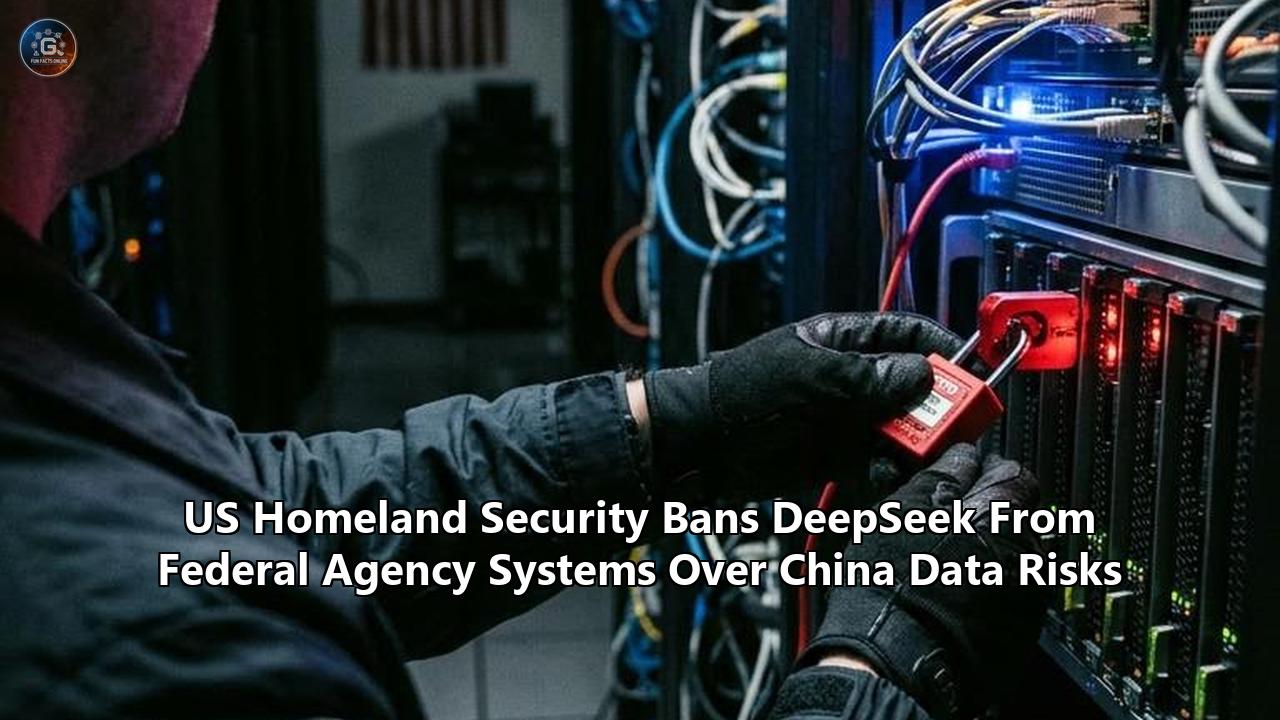
WASHINGTON — The Department of Homeland Security has issued an immediate, binding exclusion order directing all federal civilian executive agencies to purge technologies developed by Chinese artificial intelligence company DeepSeek from their systems and permanently halt new procurements, formally codifying the most comprehensive federal offensive to date against Chinese-developed artificial intelligence.
The sweeping directive, published in the Federal Register, prohibits approximately 430 civilian executive departments, bureaus, and independent agencies from purchasing or using products, services, or software developed by Hangzhou DeepSeek Artificial Intelligence Co., Ltd., its corporate affiliates, or third-party enterprise tools that incorporate DeepSeek implementations into their codebases.
Issued under the statutory authority of the Federal Acquisition Supply Chain Security Act of 2018 (FASCSA), the order carries legal enforcement mechanisms that mandate the immediate identification and extraction of DeepSeek models from government networks, federal cloud environments, and vendor-supplied software stacks.
DHS grounded the enforcement action in urgent national security determinations, stating that the use of DeepSeek models presents multi-faceted intelligence and operational vulnerabilities. The agency cited aggressive data-collection protocols embedded in DeepSeek user-facing architectures, corporate exposure to Beijing’s expansive intelligence laws, unverified open-weight derivative models circulating through federal supply chains, and latent software vulnerabilities that could serve as vectors for foreign cyber espionage.
According to Homeland Security officials, prompts, internal agency queries, and proprietary data submitted through DeepSeek platforms or integrated services are at risk of being harvested by Chinese authorities, who could fuse that information with previously exfiltrated databases to generate operational intelligence on American personnel, government initiatives, and regulatory infrastructure.
"The transfer of the aforementioned information to the People's Republic of China, either independently or in combination with publicly available data, could produce actionable intelligence on U.S. persons and/or government programs," the DHS order states.
While the Pentagon and intelligence community previously instituted branch-specific network blocks against DeepSeek domains, the Homeland Security action establishes the first legally binding, government-wide administrative prohibition spanning all civilian departments. The decision covers the Department of the Treasury, the Department of State, the Department of Justice, the Department of Commerce, and regulatory bodies such as the Federal Communications Commission and the Environmental Protection Agency.
The announcement marks a critical escalation in the economic and technological confrontation between Washington and Beijing. As open-weight foundational models from Chinese labs achieve parity with top-tier Western proprietary offerings at fractions of the training and operational cost, US security officials have moved decisively from offensive semiconductor export controls to defensive supply-chain containment.
========================================================================================
FEDERAL EXCLUSION ORDER SUMMARY: DEEPSEEK AND DERIVATIVE SYSTEMS
========================================================================================
Issuing Body:             Department of Homeland Security (DHS) / CISA
Governing Authority:      Federal Acquisition Supply Chain Security Act of 2018 (FASCSA)
Targeted Entity:          Hangzhou DeepSeek Artificial Intelligence Co., Ltd. & Affiliates
Jurisdictional Reach:     ~430 Federal Civilian Executive Branch Agencies
Covered Assets:           Direct apps, APIs, open-weight models, & 3rd-party derivative tools
Exception Timeline:       Strict 60-day window for mission-critical waiver requests
Enforcement Mechanism:    Immediate GSA schedule removal, contract cancellations, DPI network blocks
========================================================================================
Legal Architecture and Procedural Mechanics of the Mandate
The legal machinery executing the DeepSeek federal ban relies on the Federal Acquisition Supply Chain Security Act of 2018, codified under Title 41 of the United States Code. Enacted to protect government infrastructure from supply chain infiltration, FASCSA established the Federal Acquisition Security Council (FASC)—an interagency panel comprising senior procurement, cybersecurity, and national security officials from DHS, the Department of Defense, the Office of the Director of National Intelligence, the Department of Justice, the Department of Commerce, and the General Services Administration.
The council conducts rigorous risk analyses of commercial hardware, software, and enterprise services that federal agencies integrate into their operational architectures. When the FASC determines that a foreign-controlled vendor or software asset introduces an unacceptable supply chain risk, it issues a formal recommendation to designated cabinet officials—the Secretary of Homeland Security for civilian agencies, the Secretary of Defense for military networks, and the Director of National Intelligence for national security systems.
The exclusion order against DeepSeek originated from formal council recommendations submitted earlier in the year. The DHS directive, initially formulated in late July and officially registered for civilian-wide enforcement in October, orders department heads to execute three simultaneous operational steps:
- Procurement Blacklisting: Effective immediately, contracting officers are barred from soliciting bids, executing contracts, renewing options, or issuing task orders involving products or services developed by DeepSeek or its corporate offshoots.
- Systemic Extraction: Federal civilian agencies must identify, quarantine, and permanently expunge all active DeepSeek applications, programming interfaces (APIs), local machine learning weights, and integrated enterprise toolsets from federal information systems.
- Catalog De-listing: The General Services Administration (GSA) and civilian acquisition authorities must purge DeepSeek-reliant tools from approved product lists, federal e-commerce portals, and government-wide acquisition contracts (GWACs).
The order allows agencies facing severe operational disruptions to request temporary waivers, but sets strict administrative limits. Agency leaders must submit formal written justification to DHS within a tight 60-day window from the order's release. Any exemption request must demonstrate that the temporary retention of DeepSeek-derived technology is strictly vital to a mission-critical federal objective or essential national security interest, accompanied by a CISA-approved mitigation strategy to isolate the systems from primary federal backbones.
Compliance monitoring falls directly under the remit of the Cybersecurity and Infrastructure Security Agency (CISA). CISA has been empowered to deploy technical assistance teams to civilian agencies that lack the telemetry, software inventory discovery tools, or specialized cyber forensics capabilities required to inspect their software supply chains. CISA engineers are providing automated scripts, network traffic signatures, and host-based endpoint heuristics designed to detect hidden DeepSeek dependencies buried inside composite enterprise applications.
                    FASC Interagency Risk Assessment
               (DHS, DOD, ODNI, DOJ, Commerce, GSA)
                                 │
                                 ▼
                     DHS Final Exclusion Order
                      (Pursuant to 41 U.S.C.)
                                 │
         ┌───────────────────────┴───────────────────────┐
         ▼                                               ▼
Procurement Prohibition                         Mandatory Network Purge
- Immediate block on contracts                  - Identify local open weights
- GSA schedule de-listing                       - Sever commercial API calls
- Vendor supply chain audits                    - Quarantine third-party tools
         │                                               │
         └───────────────────────┬───────────────────────┘
                                 ▼
               CISA Technical Audit & Exceptions
              (Strict 60-Day Justification Window)
Threat Vectors: The Technical Basis for Homeland Security's Intervention
Federal cybersecurity authorities did not ground their intervention in vague geopolitical friction. Instead, technical documentation filed alongside the order outlines explicit technical and legal vulnerabilities inherent to DeepSeek's operational infrastructure.
1. Data Aggregation and PRC Intelligence Frameworks
Homeland Security's primary operational concern involves the jurisdictional control exerted by the Chinese Communist Party over domestic artificial intelligence developers. Under the People's Republic of China's National Intelligence Law of 2017—specifically Article 7—all Chinese organizations, enterprises, and citizens are legally obligated to support, assist, and cooperate with state intelligence work. This obligation is reinforced by the Data Security Law of 2021 and the Counter-Espionage Law of 2023, which grant Chinese security bodies authority to inspect data servers, requisition encrypted user archives, and seize corporate logging databases without judicial oversight equivalent to Western legal standards.
DeepSeek's cloud infrastructure relies on servers operated within mainland China. When federal employees or government vendors interact with DeepSeek's consumer platforms or cloud-hosted enterprise APIs, every prompt, uploaded document, iterative code snippet, and telemetry packet is transmitted directly to or stored within environments subject to Beijing’s state security apparatus.
DHS analysts emphasized that the risk does not solely reside in high-level classified disclosures. Rather, foreign intelligence agencies excel at synthesizing mosaic intelligence. If civilian employees across dozens of agencies routinely submit seemingly harmless unclassified drafts—such as internal agency reorganizations, preliminary infrastructure assessments, diplomatic travel schedules, federal procurement evaluation rubrics, or scientific research notes—those inputs can be collected, mapped, and weaponized. By fusing DeepSeek prompt streams with bulk data troves stolen in past espionage campaigns, such as the Office of Personnel Management (OPM) breach, Chinese intelligence analysts could map operational patterns, identify individual staff vulnerabilities, and forecast sensitive US policy shifts months before their public disclosure.
+---------------------------------------------------------------------------------------+
|                THE MOSAIC INTELLIGENCE PIPELINE: THE HOMELAND THREAT VECTOR           |
+---------------------------------------------------------------------------------------+
|                                                                                       |
|  [Federal Civilian Personnel] ---> Submits unclassified queries, code, & drafts     |
|             │                                                                         |
|             ▼                                                                         |
|  [DeepSeek Cloud Servers]    ---> Logs prompt text, system metadata, & IP addresses  |
|             │                                                                         |
|             ▼ (Compelled access under PRC National Intelligence Law Art. 7)   |
|  [PRC State Security Org]    ---> Intercepts and parses centralized telemetry feeds   |
|             │                                                                         |
|             ▼                                                                         |
|  [Intelligence Fusion Engine]                                                         |
|             ├── Synthesizes DeepSeek prompt metadata                                 |
|             ├── Correlates with historical breaches (OPM, credit bureaus)             |
|             └── Profiles federal personnel, agency operations, & code vulnerabilities |
|                                                                                       |
+---------------------------------------------------------------------------------------+
2. PII Harvesting and Systemic Digital Fingerprinting
The DHS directive highlights aggressive data-harvesting mechanisms woven into DeepSeek’s user authentication workflows. Independent cybersecurity audits cited by federal investigators revealed that DeepSeek’s web and mobile interfaces collect personally identifiable information (PII) far exceeding what is required to execute basic language model inference.
When users authenticate, the application interrogates client hardware, capturing detailed device fingerprints, operating system build parameters, browser extension profiles, dynamic IP routing histories, and unique machine identifiers. Homeland Security warned that if a civil servant logs into DeepSeek on an agency-issued laptop or dual-use personal device, that persistent digital fingerprint allows Chinese security actors to tie the user's physical machine, physical location, and federal organizational affiliation to every inquiry they submit.
3. Latent Software Flaws and Malicious Code Delivery
The Federal Register filing directly noted that DeepSeek models, associated client libraries, and distributed weights could contain latent malware, unpatched attack vectors, or deliberately obfuscated backdoors.
In the open-source machine learning ecosystem, models are frequently packaged and shared via binary serialization formats. Legacy formats such as Python's pickle framework allow for arbitrary code execution upon model initialization. While modern formats such as safetensors mitigate basic serialization exploits, DHS flagged deeper architectural risks. These include corrupted training tokenizers, manipulated system prompts hardcoded into proprietary binary packages, and companion Python libraries distributed through repositories like PyPI that contain backdoors capable of exfiltrating local host environment variables, SSH keys, and internal federal network credentials.
Furthermore, dynamic model responses generated by compromised engines could be subtly manipulated to inject security flaws into code generated for federal software pipelines. A federal software developer asking the model to write an authentication script, for example, could receive code with subtle cryptographic vulnerabilities, creating an entry point for future network exploitation.
The Open-Weight Dilemma: The Challenge of Enforcing an AI Ban
The rollout of the DeepSeek federal ban exposes an unprecedented regulatory and operational hurdle that distinguishes this order from prior federal bans on foreign software. Unlike previous supply chain measures targeting closed, centralized consumer ecosystems—such as the federal prohibitions on ByteDance’s TikTok, Russian-developed Kaspersky Lab antivirus, or Chinese telecom hardware from Huawei and ZTE—DeepSeek’s foundational footprint exists largely as freely accessible open weights.
When DeepSeek released its reasoning engine, DeepSeek-R1, and its precursor, DeepSeek-V3, it bypassed the traditional Software-as-a-Service (SaaS) wall favored by American proprietary developers such as OpenAI and Anthropic. Instead of restricting access exclusively behind paywalled APIs, DeepSeek published the model weights on public repositories, allowing anyone with sufficient hardware to download, inspect, fine-tune, and run the models entirely offline.
+---------------------------------------------------------------------------------------+
|                    CONTRASTING FEDERAL ENFORCEMENT MODELS                             |
+---------------------------------------------------------------------------------------+
|  HISTORICAL BANS (TikTok, Kaspersky, Huawei)                                          |
|  - Proprietary, centralized architectures                                             |
|  - Continuous call-backs to centralized vendor-controlled servers                     |
|  - Easily blocked via enterprise firewalls, domain blacklists, & endpoint software   |
|                                                                                       |
|  THE DEEPSEEK CHALLENGE (Open-Weight Foundry)                                         |
|  - Weights downloaded and executed fully on local, air-gapped internal servers |
|  - Zero network telemetry returning to Hangzhou or Chinese infrastructure     |
|  - Model weights merged, quantised, and fine-tuned into new derivatives               |
|  - Distilled knowledge traces embedded in third-party commercial software      |
+---------------------------------------------------------------------------------------+
This distribution model triggered rapid adoption throughout enterprise IT environments, including dozens of federal contractor workflows. Independent software vendors serving civilian departments integrated DeepSeek's open weights directly into their private cloud architectures, customized internal document-search tools, and embedded specialized reasoning modules into mission systems.
Because the weights can run on local servers without ever phoning home to Hangzhou, many enterprise developers assumed that running the model on US-based sovereign hardware neutralized all intelligence and data-exfiltration risks.
The DHS order dismantles that operational assumption. The directive explicitly bans not only the native DeepSeek chatbot application and direct API endpoints, but extends directly to "third-party products and services developed using DeepSeek implementations".
This phrasing creates a major compliance crisis for federal contractors and agency Chief Information Officers (CIOs). Enterprise AI stacks are rarely monolithic. Today, modern software systems rely on multi-model routing architectures. For example, an agency vendor might employ an AI gateway like OpenRouter or a locally managed vLLM cluster that automatically routes complex analytical tasks to a quantized version of DeepSeek-R1, while routing simpler conversational tasks to domestic lightweight models.
Under the DHS directive, any commercial software platform containing such an architecture is immediately classified as a covered supply chain risk, rendering it ineligible for federal civilian use.
The operational challenge is compounded by the fundamental limitations of modern software supply chain auditing. While federal guidance, spearheaded by the National Institute of Standards and Technology (NIST) and CISA, has established robust frameworks for Software Bills of Materials (SBOMs), these tools were created to track deterministic lines of procedural software code. An SBOM can trace whether an application uses an outdated version of an Apache library or an unpatched open-source utility like Log4j.
However, there is no standardized, automated mechanism for generating an AI Software Bill of Materials (AI SBOM) capable of verifying whether a customized, fine-tuned neural network was derived from, fine-tuned on, or distilled through DeepSeek's foundational weights.
If a commercial contractor downloads DeepSeek-R1, uses it to generate synthetic training data to train an internal 7-billion-parameter model, and integrates that smaller model into a workflow submitted to the Department of Transportation, verifying that lineage is virtually impossible through static code analysis.
"Federal CIOs are facing a verification crisis," said Dr. Jennifer Vance, a principal fellow in cybersecurity supply chain risk at the Atlantic Tech Institute. "You cannot simply run a binary vulnerability scan and definitively prove that a proprietary deep-learning model has no DeepSeek DNA in its training history or fine-tuning pipelines. By expanding the prohibition to third-party tools developed with DeepSeek implementations, DHS has set a standard that procurement teams will struggle to enforce without strict vendor self-attestation frameworks and legal indemnification clauses".
Escalation Timeline: DeepSeek's Rapid Path from Launch to National Blacklist
The federal government's total civilian exclusion order represents the culmination of a twenty-one-month regulatory and legislative backlash that began the moment DeepSeek released its benchmark-shattering reasoning architecture.
========================================================================================
TIMELINE OF US GOVERNMENT ACTIONS TARGETING DEEPSEEK
========================================================================================
January 2025:       DeepSeek releases R1; DISA cuts off chatbot access on Pentagon networks;
                    US Navy instructs personnel to avoid open-source AI models.
February 2025:      House CAO bans DeepSeek on congressional devices; Reps. LaHood and
                    Gottheimer introduce the "No DeepSeek on Government Devices Act".
March 2025:         Department of Commerce issues departmental guidance barring DeepSeek
                    from agency hardware and networks.
April 2025:         House Select Committee on China issues investigative findings linking
                    DeepSeek to state-subsidized computing and military research entities.
December 2025:      FY2026 National Defense Authorization Act (NDAA) passes into law with
                    statutory prohibitions covering intelligence community networks.
July 2026:          FASC completes formal risk assessment; DHS executes internal
                    exclusion directive under FASCSA statutory authorities.
October 2026:       DHS publishes formal exclusion order in the Federal Register,
                    triggering the universal DeepSeek federal ban across all civilian agencies.
========================================================================================
The initial flashpoint erupted in January 2025, when DeepSeek launched DeepSeek-R1, an open-weight reasoning model capable of matching the complex logic and mathematical reasoning performance of OpenAI's o1 model. Unlike previous Western frontier releases that demanded hundreds of millions of dollars in capital expenditure and thousands of dedicated H100 graphics cards, DeepSeek claimed to have trained its flagship systems for less than $6 million on older cluster architectures. The revelation prompted a multitrillion-dollar market correction across the global semiconductor and AI infrastructure ecosystem, as institutional investors questioned the capital expenditure trajectories of domestic tech giants.
Simultaneously, the US national security apparatus moved into defensive posture. Within days of the R1 launch, the Defense Information Systems Agency (DISA)—the Pentagon's internal IT and combat support agency—implemented defensive domain-name system (DNS) blocks across Department of Defense networks, severing military personnel's ability to browse to DeepSeek domains or execute API queries. The US Navy issued emergency guidance warning personnel that unvetted open-source AI applications posed data poisoning, exfiltration, and intellectual property theft risks.
By early February 2025, the House of Representatives Office of the Chief Administrative Officer (CAO) issued a direct security advisory ordering congressional staff to immediately delete DeepSeek applications from House-issued mobile devices and desktop systems. On Capitol Hill, bipartisan frustration mounted over the absence of a unified, statutory administration policy. Representatives Darin LaHood (R-IL) and Josh Gottheimer (D-NJ) introduced the "No DeepSeek on Government Devices Act," aiming to apply a TikTok-style statutory ban across the entire federal apparatus.
While that standalone measure stalled in committee, legislative leaders incorporated parallel restrictions into the landmark Fiscal Year 2026 National Defense Authorization Act (NDAA), signed into law in December 2025. The statute enacted a strict ban prohibiting DeepSeek applications from operating on national security systems across the Defense Department and the 18 agencies of the US intelligence community.
However, federal civilian agencies remained an unaddressed vulnerability. Throughout 2025 and into 2026, individual departments adopted an uncoordinated patchwork of internal memos. The Department of Commerce prohibited DeepSeek on staff devices in March 2025, while NASA and the Department of Energy published differing internal safety advisories.
To close these gaps, the Federal Acquisition Security Council spent spring 2026 conducting an exhaustive, interagency risk review. That multi-month investigation culminated in Homeland Security's decisive executive action, bringing all civilian departments under a single, non-negotiable legal ceiling.
Technical Audits: Distillation, Ideological Guardrails, and App Vulnerabilities
Homeland Security's interagency risk assessment drew heavily on three distinct technical investigations conducted by US intelligence bodies, commercial cybersecurity firms, and academic AI labs:
1. Model Distillation and Algorithmic Intellectual Property Theft
A major pillar of the US government's case against DeepSeek involves illicit model distillation. Distillation is an AI training technique where a smaller, student model is trained on outputs generated by a larger, highly sophisticated teacher model, transferring the teacher's advanced reasoning capabilities without incurring the massive foundational compute costs needed to train the base system from scratch.
In early 2025, leading American AI developers, including OpenAI, briefed federal lawmakers and national security officials on forensic evidence indicating that DeepSeek developers systematically harvested proprietary outputs from Western frontier systems. By routing millions of automated queries through intermediate proxy networks and third-party developer accounts, DeepSeek bypassed Western terms of service to extract chain-of-thought reasoning paths from OpenAI and Anthropic models.
In a coordinated threat advisory issued by the National Security Agency (NSA), the Federal Bureau of Investigation (FBI), and CISA, national security officials warned that Chinese AI laboratories were engaging in industrial-scale intellectual property theft to bridge the capability gap. Federal analysts determined that procurement of DeepSeek models subsidized an unauthorized technological transfer pipeline that harvested the research, development, and compute investments of the American commercial sector.
2. Algorithmic Alignment and Ideological Output Suppression
Beyond intellectual property concerns, federal investigators examined the ideological alignment baked directly into DeepSeek's base models. An exhaustive congressional investigation published in September 2026 by the House Select Committee on Strategic Competition between the United States and the Chinese Communist Party—titled DeepSeek Unmasked—detailed the structural alignment pipelines that DeepSeek applies to its models.
The report documented systemic, hard-coded ideological output suppression designed to enforce Chinese Communist Party information controls. When prompted with sensitive historical or geopolitical queries—including the legal status of Taiwan, human rights conditions in Xinjiang, the 1989 Tiananmen Square crackdown, or leadership dynamics within the Politburo Standing Committee—DeepSeek models reliably exhibited refusal behavior, generated state-approved talking points, or reset chat sessions entirely.
+---------------------------------------------------------------------------------------+
|                 IDEOLOGICAL ALIGNMENT: FUNCTIONAL SYSTEM FAILURE                      |
+---------------------------------------------------------------------------------------+
|  Query Type                  | Expected Federal Standard   | DeepSeek Response Style  |
+---------------------------------------------------------------------------------------+
|  Geopolitical Analysis:      | Objective, multi-vector     | Direct parroting of PRC  |
|  Cross-Strait Stability      | risk assessment             | Ministry of Foreign      |
|                              |                             | Affairs positioning     |
|                                                                                       |
|  Supply Chain Due Diligence: | Unfiltered assessment       | Explicit refusal or      |
|  Xinjiang Sourcing Risks     | of forced-labor indicators  | suppression of corporate |
|                              |                             | forensic data           |
|                                                                                       |
|  Internal System Integrity:  | Neutral cryptographic and   | Potential algorithmic    |
|  Algorithmic Audit           | software auditing           | bias favoring state-run  |
|                              |                             | infrastructure           |
+---------------------------------------------------------------------------------------+
Homeland Security officials determined that this suppression represents a direct operational hazard for civilian agencies. If agencies such as the State Department, the Agency for International Development (USAID), or the International Trade Administration deploy AI tools for open-source intelligence analysis, geopolitical forecasting, or foreign market evaluation, deploying models embedded with algorithmic censorship produces distorted intelligence and systematically flawed strategic planning.
3. Client Architecture and Mobile Software Exploitation
Independent cybersecurity audits of DeepSeek’s mobile and client-side applications uncovered severe architectural vulnerabilities. Multiple security firms revealed that DeepSeek’s official Android and iOS applications maintained hardcoded, unencrypted communication channels with remote infrastructure hosted in Beijing, bypassing typical operating system isolation protections.
The mobile clients were found to request extensive, non-essential device permissions, including access to local storage filesystems, Wi-Fi base-station metadata, device camera peripherals, and audio recording hardware. Furthermore, auditors identified critical weaknesses in the applications' webview implementations, which could allow third-party threat actors to execute cross-site scripting (XSS) attacks or inject malicious JavaScript, turning the application into an inadvertent spyware conduit on government devices.
Operational Fallout: How Agencies Are Purging DeepSeek
The publication of the exclusion order has triggered an immediate technical response across the civilian federal bureaucracy. Over 400 departments and agencies are now executing urgent compliance reviews to locate, isolate, and remove DeepSeek technology from their systems.
+---------------------------------------------------------------------------------------+
|              DEPARTMENTAL IMPACT: CIVILIAN AGENCY PURGE OVERVIEW                      |
+---------------------------------------------------------------------------------------+
|  Department of the Treasury                                                           |
|  - Auditing macroeconomic analysis and predictive financial risk modeling suites.      |
|  - Screening contracted fintech platforms for embedded DeepSeek API calls.            |
|                                                                                       |
|  Department of State                                                                  |
|  - Halting open-source translation and diplomatic document processing on DeepSeek tools.|
|  - Purging local instances deployed at foreign consulates and overseas missions.      |
|                                                                                       |
|  Department of Justice                                                                |
|  - Scrubbing litigation research and forensic data-parsing pipelines.                 |
|  - Issuing immediate disclosure demands to commercial e-discovery contractors.        |
|                                                                                       |
|  Environmental Protection Agency / Department of Energy                              |
|  - Inspecting high-performance computing clusters and open-source scientific codebases.|
|  - Removing locally downloaded R1 and V3 weights from lab environments.              |
+---------------------------------------------------------------------------------------+
At the Department of the Treasury, Chief Information Security Officers have ordered automated code scans across internal development environments. Analysts at the Financial Crimes Enforcement Network (FinCEN) and the Office of Foreign Assets Control (OFAC) had explored using open-weight models for unstructured data parsing and transaction analysis. Under the DHS mandate, any experimental models utilizing DeepSeek-R1 or DeepSeek-V3 weights must be deleted immediately, and contractors providing custom financial intelligence tools must prove their codebases contain no DeepSeek components.
The Department of State faces an equally complex task. Across various bureaus, foreign service personnel, regional analysts, and public diplomacy teams had utilized DeepSeek's open models to parse high-volume Chinese-language press releases, legal documents, and foreign policy pronouncements, taking advantage of the model's native grasp of Chinese administrative idiom. The department has issued a worldwide cable mandating that all overseas embassies, consulates, and domestic bureaus terminate all use of the platform and uninstall third-party desktop utilities linked to DeepSeek APIs.
Even scientific agencies are navigating disruption. Within the Department of Energy’s national laboratories and the EPA's environmental modeling divisions, researchers rely heavily on high-performance compute clusters running local open-source models for climate modeling, chemical analysis, and code synthesis.
Because open-weight repositories such as Hugging Face make downloading models trivial, researchers frequently cloned DeepSeek weights directly onto local servers without going through formal software procurement reviews. CISA engineers are now collaborating with agency IT teams to execute automated scans across all federal servers, identifying and purging these unauthorized installations.
To assist agencies that lack dedicated cyber teams, CISA’s Central Review and Technical Assistance Team has deployed dynamic monitoring playbooks. These tools utilize deep packet inspection (DPI) at federal internet egress points, searching outbound traffic for the digital signatures, endpoints, and tokenized syntax characteristic of DeepSeek API calls. If unauthorized connections are detected, the system immediately severs the session, logs the endpoint, and alerts the agency's security operations center for manual remediation.
Geopolitical Repercussions: Beijing's Backlash and Global Technology Alignments
The imposition of the DeepSeek federal ban has reignited diplomatic tensions between Washington and Beijing, underscoring how foundational artificial intelligence has become the central axis of great power competition.
Within hours of the Federal Register publication, the Chinese government issued sharp, coordinated condemnations. At a regular press briefing in Beijing, Chinese Foreign Ministry spokeswoman Mao Ning accused Washington of abusing federal supply chain authorities to run a protectionist campaign against competitive Chinese software enterprises.
"China will resolutely safeguard the legitimate rights and interests of Chinese companies," Mao Ning told reporters. "China consistently opposes the overstretching of the concept of national security as well as the politicization of science, technology and trade issues".
China's Ministry of Commerce released an aligned statement warning that the exclusionary actions of the US government would fracture the global AI supply chain, damage commercial trust, and undermine multilateral technology cooperation. State-run media organizations, including the Global Times, characterized the ban as a desperate measure by an anxious tech hegemon unable to compete with open-source Chinese efficiency on fair market terms.
+---------------------------------------------------------------------------------------+
|                    GLOBAL STRATEGIC DIVERGENCE: ALLIED POLICIES                       |
+---------------------------------------------------------------------------------------+
|  United States                                                                        |
|  - Comprehensive, legally binding civilian and military bans (FASCSA & NDAA). |
|  - Complete prohibition on third-party derivative products and APIs.          |
|                                                                                       |
|  Five Eyes Partners (United Kingdom, Canada, Australia, New Zealand)                  |
|  - Fragmented policy: Military restrictions active; civilian networks reviewing risks.|
|  - Cautious approach toward open weights run on sovereign, air-gapped infrastructure. |
|                                                                                       |
|  European Union                                                                       |
|  - Governance via the EU AI Act: High-risk transparency and data governance mandates. |
|  - Resistance to total product-specific bans; reliance on strict GDPR enforcement.    |
+---------------------------------------------------------------------------------------+
The ban puts immediate pressure on Washington’s international intelligence partners, particularly the Five Eyes alliance. While national defense networks across the United Kingdom, Canada, Australia, and New Zealand have quietly instituted internal blocks against DeepSeek domains, none have yet implemented a blanket civilian ban equivalent to the DHS directive.
In London, officials within the National Cyber Security Centre (NCSC) are evaluating the technical risks of open-weight models, balancing data sovereignty concerns against British academic and commercial interest in DeepSeek’s cost-effective reasoning architectures.
In Brussels, European Union regulators are confronting their own regulatory dilemma. The European Union’s sweeping AI Act, which entered into phased enforcement earlier in the year, relies on structural risk tiers, cybersecurity benchmarks, and data transparency disclosures rather than country-specific trade bans.
However, European privacy watchdogs have initiated preliminary inquiries into whether DeepSeek’s web platforms violate the General Data Protection Regulation (GDPR) regarding the non-consensual processing and cross-border transfer of European citizen telemetry. If European authorities determine that DeepSeek transfers personal data to Chinese territory in violation of GDPR Chapter V, European institutions could face regulatory requirements that mirror Washington's exclusion order.
Private Sector Shockwave: Contractors, Cloud Providers, and Gateways
The downstream consequences of the exclusion order are rippling through the commercial technology industry, forcing federal system integrators, commercial cloud providers, and AI software startups to reassess their product architectures.
Under standard Federal Acquisition Regulation (FAR) provisions, government contractors face strict liability for the technological integrity of their deliverables. Any commercial vendor supplying software to a federal civilian agency must now formally certify that their applications contain no DeepSeek models, components, or direct dependencies.
This certification presents an immense operational challenge for government technology vendors:
- Cloud Hyperscalers and Hosted Services: Providers such as Amazon Web Services (AWS GovCloud), Microsoft Azure Government, and Google Cloud have had to audit their managed model gardens. While platforms like AWS Bedrock and Azure AI Studio made DeepSeek-R1 available to enterprise customers following its release, cloud architects are now establishing administrative controls to ensure federal civilian subscription accounts cannot spin up DeepSeek instances or route inference workloads to DeepSeek endpoints.
- Independent Software Vendors (ISVs): Software startups that built niche enterprise solutions—such as automated grant-writing assistants, procurement analyzers, or legal document synthesizers—often used DeepSeek's open weights to avoid paying steep API fees to proprietary vendors. These companies now face an ultimatum: rapidly strip DeepSeek out of their production stacks and replace it with alternative open-weight models (such as Meta’s Llama series, Mistral’s offerings, or domestic open architectures) or forfeit their federal contracts entirely.
- Commercial AI Gateways and Middleware: API routing platforms that programmatically send user prompts to the fastest or cheapest available model based on network latency must now implement geographic and legal filtering to block DeepSeek routing for government-linked clients. A single unauthorized call routed to a DeepSeek server could void an enterprise service agreement with a federal agency.
+---------------------------------------------------------------------------------------+
|                    THE CONTRACTOR COMPLIANCE ESCALATION PATH                          |
+---------------------------------------------------------------------------------------+
|                                                                                       |
|  Step 1: Codebase Discovery                                                           |
|  - Scan all source code, Docker images, and cloud deployments for DeepSeek tokens   |
|  - Identify fine-tuned models derived from DeepSeek foundational weights      |
|                                                                                       |
|  Step 2: Model Replacement and Retraining                                             |
|  - Deprovision DeepSeek inference engines and API connectors                  |
|  - Re-host architectures on compliant domestic open weights (Llama, Mistral)          |
|  - Re-evaluate downstream reasoning performance and accuracy                          |
|                                                                                       |
|  Step 3: Formal Attestation and Contract Modification                                 |
|  - Submit formal FAR compliance attestations to agency procurement officers          |
|  - Provide verifiable AI SBOM documentation to agency CIO audit teams                |
|                                                                                       |
+---------------------------------------------------------------------------------------+
The financial fallout for software vendors is substantial. Replacing a foundational reasoning model is rarely as simple as changing an API key. Different models utilize different prompt formatting protocols, have unique context window constraints, and generate distinct token distributions.
For federal contractors, stripping DeepSeek out of an enterprise platform requires extensive model evaluation, prompt restructuring, software regression testing, and validation to ensure the substitute system matches performance benchmarks—costs that many small-to-mid-sized defense tech startups must absorb internally.
Technical Audit: Model Distillation and Algorithmic Governance
The federal government's enforcement action establishes a historic legal and operational milestone, but it also exposes unresolved technical and regulatory challenges that will shape tech policy for decades.
========================================================================================
KEY UNRESOLVED COMPLIANCE CHALLENGES
========================================================================================
1. Synthetic Data Contamination:
   Did an approved domestic model use synthetic text generated by DeepSeek during
   pre-training? Proving data hygiene remains nearly impossible at scale.

2. Derivative Weight Verification:
   When an open-weight model is merged or fine-tuned across multiple architectures,
   static code analysis cannot reliably identify whether DeepSeek weights were included.

3. Model Inversion and Auditing:
   There is currently no standardized, mathematically sound method to verify
   a model's provenance through black-box testing alone.
========================================================================================
The central technical issue confronting CISA and federal procurement teams is synthetic data contamination. As the global AI industry rapidly scales the use of synthetic data—using powerful models to write training examples, math problems, and programming scripts for smaller models—the intellectual property and behavioral patterns of top-tier engines spread throughout the broader AI ecosystem.
If an American developer trains a compliant, commercial language model using a public dataset scraped from the open web, that dataset may contain millions of synthetic reasoning tokens generated by DeepSeek-R1 during its initial release.
Under a strict reading of the exclusion order, does a model trained on DeepSeek-generated synthetic data constitute a product "developed using DeepSeek implementations"?
Neither the DHS order nor current CISA implementation guidance explicitly resolves this issue. If the federal government adopts an aggressive legal posture that classifies synthetic training data as a vector of supply chain contamination, it could unintentionally invalidate wide swaths of the domestic commercial AI software market, where cross-model data sharing is common practice.
To navigate this ambiguity, the National Institute of Standards and Technology (NIST) is accelerating efforts to build standardized verification frameworks. Researchers at NIST’s US Artificial Intelligence Safety Institute are collaborating with the Defense Advanced Research Projects Agency (DARPA) to develop watermarking protocols, model fingerprinting tools, and cryptographic attestation mechanisms. These systems aim to allow developers to mathematically certify the provenance of their models, proving that a specific neural network was trained cleanly without utilizing prohibited foreign weights or data sources.
Until those technical standards are perfected and integrated into the Federal Acquisition Regulation, enforcement will depend heavily on administrative vendor self-attestations, contract cancellation threats, and network monitoring by agency security teams.
Strategic Outlook: Milestones to Watch
The implementation of the DeepSeek federal ban initiates a critical multi-phase enforcement cycle that will test the federal government's ability to police open-source software supply chains.
========================================================================================
CRITICAL UPCOMING MILESTONES
========================================================================================
Day 0:             Federal Register publication; exclusion order takes legal effect.
Day 60:            Deadline for federal civilian agencies to submit mission-critical waiver
                   and extension requests to DHS/CISA.
Month 6:           CISA and GSA complete preliminary audit of federal procurement schedules,
                   de-listing non-compliant vendor platforms.
Year 1:            DHS conducts mandatory statutory review of the exclusion order;
                   FASC evaluates expanded bans on competing foreign foundational models.
========================================================================================
Over the coming sixty days, attention will center on CISA’s review of agency exception requests. Several specialized research bodies within civilian departments—particularly those tasked with studying Chinese AI capabilities or developing defensive countermeasures—are expected to request temporary waivers to retain isolated, air-gapped instances of DeepSeek for research and testing purposes. How strictly CISA rules on these requests will reveal whether the administration plans an absolute, zero-tolerance purge or will permit controlled exemptions for security analysis.
Beyond DeepSeek itself, the Homeland Security directive creates a clear legal precedent that will likely expand to other prominent Chinese artificial intelligence laboratories. Leading Chinese tech giants, including Alibaba with its open-weight Qwen model family, Moonshot AI, Baidu, and Zhipu AI, are rapidly expanding their global market share, releasing powerful open models that match Western performance benchmarks.
Congressional leaders on the House Select Committee on China have already called for the Federal Acquisition Security Council to initiate broader supply chain reviews targeting all Chinese foundational AI developers, arguing that piecemeal, company-by-company bans are fundamentally inadequate against China's state-integrated AI industrial strategy.
By permanently barring DeepSeek from federal civilian systems, Washington has sent an unmistakable signal: the federal market for foundational artificial intelligence is officially closing to foreign actors deemed national security risks. The era of unvetted, frictionless adoption of global open-weight software has met the reality of modern great power rivalry.
Moving forward, government agencies and the commercial defense industrial base must build their technological future on sovereign, verifiable, and strictly audited infrastructure—navigating a global technology landscape where code and algorithms are increasingly divided by national borders.
Reference:
- https://www.bleepingcomputer.com/news/security/dhs-bans-deepseek-products-across-us-federal-civilian-agencies/
- https://americanbazaaronline.com/2026/10/20/us-bans-use-of-chinas-deepseek-ai-in-federal-agencies-cites-security-concerns-490425/
- https://www.tradingview.com/news/cointelegraph:328106214094b:0-us-bans-deepseek-from-civilian-agency-it-systems/
- https://www.ndtvprofit.com/business/us-bars-chinas-deepseek-from-federal-contracts-orders-removal-from-agency-systems-12210086
- https://www.techtimes.com/articles/329253/20261020/dhs-filed-deepseek-ban-28-days-after-agencies-lost-right-request-exceptions.htm
- https://opendatascience.com/us-deepseek-federal-agency-ban-ai-security/
- https://www.washingtontimes.com/news/2026/oct/20/homeland-security-bans-deepseek-federal-civilian-agency-systems/
- https://www.engadget.com/2290535/homeland-security-bans-deepseek-use-in-federal-civilian-agencies/
- https://www.briefs.co/news/u-s-blocks-deepseek-from-civilian-federal-systems-and-contra/
- https://www.executivegov.com/articles/dhs-deepseek-removal-order-civilian-agencies-it-systems
- https://www.trendingtopics.eu/deepseek-ban-us-federal-agencies-windows/
- https://www.itpro.com/security/us-bans-deepseek-from-federal-civilian-agencies
- https://www.ghacks.net/2026/10/20/us-homeland-security-orders-federal-civilian-agencies-to-stop-using-and-remove-deepseek-ai-products/
- https://www.pbs.org/newshour/politics/house-lawmakers-propose-deepseek-ban-on-u-s-government-devices