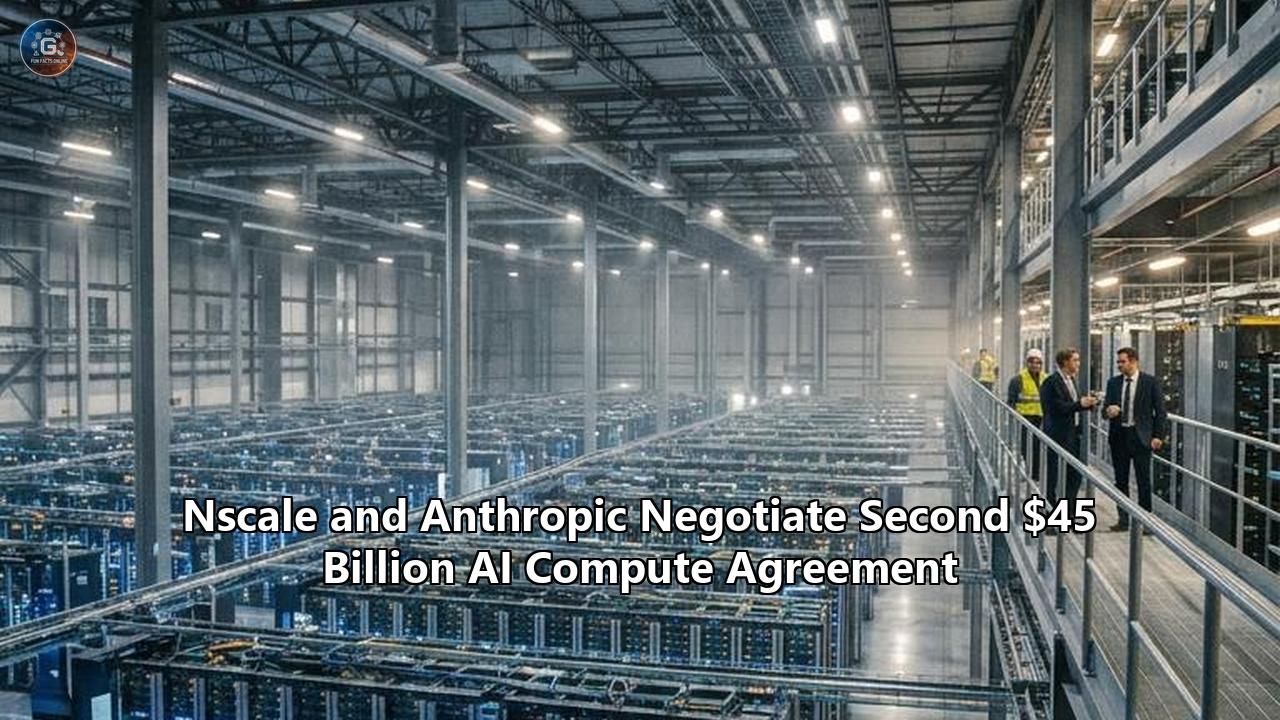
Anthropic is finalizing negotiations with British artificial intelligence cloud provider Nscale for a second compute contract valued at approximately $45 billion. The transaction, which would double the AI safety lab’s financial commitments to Nscale to nearly $90 billion across two adjacent facilities, covers an entire 460-megawatt data center building at Nscale’s sprawling Monarch campus in West Virginia.
The prospective agreement arrives at an extraordinarily delicate moment for both companies and the broader artificial intelligence infrastructure market. Nscale, a London-headquartered upstart that spun out of a cryptocurrency mining outfit just two years ago, filed a Form S-1 registration statement with the U.S. Securities and Exchange Commission in September 2026 for a planned New York Stock Exchange initial public offering. Meanwhile, Anthropic filed confidentially for its own public offering in June 2026.
Behind the eye-popping $45 billion figure lies a labyrinth of high-stakes financial engineering, grid-interconnection end-runs, and fierce competition for next-generation silicon. The transaction would secure Anthropic hundreds of thousands of Nvidia’s forthcoming Vera Rubin graphics processing units (GPUs), but it relies on an off-grid, natural-gas microgrid whose critical state environmental permits remain unresolved. The deal must also overcome severe skepticism among institutional investors following the recent collapse of Nscale agreements with both Microsoft and OpenAI.
The expanding Nscale Anthropic partnership marks one of the most aggressive private capital commitments in computational history, yet the mechanics behind closed doors reveal how brittle the foundation supporting frontier AI scaling has become.
The Ghost of Microsoft and the Monarch Vacuum
To understand why Nscale is pushing to finalize this second $45 billion commitment, one must look at the empty capacity left in the wake of Big Tech’s recent retrenchment.
The Monarch campus—a 2,250-acre parcel of former industrial land nestled in the Appalachian basin of West Virginia, acquired by Nscale in March 2026—was never intended to be an Anthropic-only enclave. Nscale originally designed the master site plan to accommodate multiple hyperscalers. In early 2026, Microsoft signed a letter of intent to lease 1.35 gigawatts of capacity across the campus to support its sprawling OpenAI compute commitments.
That arrangement quietly unraveled over the summer of 2026. Microsoft executives balked at Nscale’s projected delivery timelines, lingering questions regarding high-voltage utility interconnects, and escalating infrastructure costs. Microsoft formally walked away from Monarch.
The blow was compounded in October 2026 when Microsoft terminated another high-profile agreement with Nscale: a planned data center development in Loughton, Essex, outside London. In that instance, the UK’s National Grid informed developers that regional substation capacity constraints would delay energization until the early 2030s. Microsoft exercised its exit clause immediately. When combined with OpenAI’s decision in April 2026 to sever its preliminary deployment pipeline with Nscale, the British neocloud provider faced an existential void in its pre-IPO order book.
Enter Anthropic. The Claude developer, co-founded by former OpenAI research executives Dario and Daniela Amodei, found itself squeezed for dedicated training compute. While its primary cloud partners, Amazon Web Services (AWS) and Google Cloud, continue to pour billions into proprietary clusters, Anthropic’s compute consumption has outpaced what any single hyperscaler is willing to allocate without demanding punitive exclusivity or massive equity concessions.
Anthropic signed its first $45 billion agreement (officially booked in regulatory filings as $44.6 billion) with Nscale in August 2026 for Monarch Building 1, locking down 460 MW of planned capacity. The second agreement currently on the negotiating table mirrors the structure of the August deal: another 460 MW across a second standalone data hall, scheduled for phased energization beginning in late 2027 and running through 2028. The prospective contract also grants Anthropic a formal right of first refusal on a planned third 460 MW facility on the West Virginia campus.
Should the negotiations conclude as expected, the Nscale Anthropic partnership will govern more than 920 MW of dedicated compute capacity at a single site, absorbing nearly the entire phase-one footprint that Microsoft abandoned.
Anatomy of the $90 Billion Figure: Cash Flow Versus Capital Backlog
Headline figures in the AI infrastructure sector frequently obscure cash reality. Neither Anthropic nor its venture backers are wiring $45 billion to Nscale’s accounts upon signature.
According to sources familiar with the draft terms and disclosures embedded in Nscale’s SEC filings, the $45 billion headline represents the cumulative gross contracted value over a six-year operational lease. Broken down annually, the agreement equates to approximately $7.5 billion per year per building once the facilities achieve full commercial operation.
+---------------------------------------------------------------------------------+
|               MONARCH CAMPUS: THE $90B CONTRACTUAL BREAKDOWN                   |
+---------------------------------------------------------------------------------+
|  Phase / Asset     |  Capacity  |  Primary Hardware   |  Contract Value | Status |
+---------------------------------------------------------------------------------+
|  Building 1        |  460 MW    |  Nvidia Rubin NVL72 |  $44.6 Billion  | Signed |
|  Building 2        |  460 MW    |  Nvidia Rubin NVL72 |  ~$45.0 Billion | Talks  |
|  Building 3 (ROFR) |  460 MW    |  Undisclosed        |  Option Only    | ROFR   |
+---------------------------------------------------------------------------------+
|  Total Committed Footprint: 920 MW | Aggregate Value: ~$89.6B - $90B            |
+---------------------------------------------------------------------------------+
The underlying cash mechanics function as an elaborate triad between customer commitments, equipment vendors, and private credit:
- Staged Availability Milestones: Anthropic does not begin paying full capacity charges until individual "data pods" pass site-acceptance testing, which requires sustained, uninterrupted cluster performance at target power usage effectiveness (PUE) ratios.
- Performance-Contingent Penalty Structures: If Nscale fails to deliver contracted power density, or if cooling inefficiencies trigger thermal throttling across the GPU clusters, Anthropic possesses contractual rights to reduce lease disbursements proportionally or terminate the agreement entirely.
- Debt Securitization Collateral: Nscale uses the signed, multi-year take-or-pay agreement from an investment-grade-adjacent counterparty (Anthropic) as the underwriting collateral to borrow billions of dollars from institutional private credit syndicates.
- Silicon Procurement Flow-Through: The proceeds from that debt are immediately routed to Nvidia to secure allocation slots and purchase the Vera Rubin chip packages, networking switchgear, and liquid cooling systems.
The fundamental risk profile of this arrangement was laid bare in Nscale’s S-1 filing. In the prospectus, the company explicitly acknowledged that it has not yet secured the debt financing necessary to purchase the actual AI chips required to satisfy its first $44.6 billion agreement with Anthropic. Securing hardware for a second $45 billion facility depends entirely on the company’s ability to tap debt capital markets that have suddenly turned hostile toward neocloud operators.
Silicon Architecture: Inside the Vera Rubin NVL72 Deployment
At the technological heart of the second Monarch contract is Nvidia’s next-generation architecture: the Vera Rubin platform.
While mainstream cloud providers are still wrestling with the mechanical deployment of Nvidia’s Blackwell Ultra (B200) architectures, Anthropic has architected its mid-to-late-decade model roadmaps around the Vera Rubin NVL72 rack-scale systems. Deploying this silicon at an unprecedented 460 MW scale introduces profound mechanical and network engineering challenges that few existing data centers can accommodate.
+------------------------------------------------------------------------------+
|                     RACK-LEVEL ARCHITECTURAL EVOLUTION                       |
+------------------------------------------------------------------------------+
| Metric                 | Hopper (H100)      | Blackwell (B200) | Vera Rubin  |
+------------------------------------------------------------------------------+
| Architecture           | Discrete PCIe/SXM  | NVL72 Liquid-Co. | Rubin NVL72 |
| Thermal Design Power   | ~700W per chip     | ~1,200W per chip | >1,800W+    |
| Rack Density           | 35 - 40 kW / rack  | 100 - 120 kW     | ~180-220 kW |
| Cooling Architecture   | Air / Hybrid       | Direct-to-Chip   | Full Liquid |
| Memory Subsystem       | HBM3 / HBM3e       | HBM3e            | HBM4        |
| Interconnect           | InfiniBand Quantum | Quantum-X800     | Quantum-X   |
+------------------------------------------------------------------------------+
Thermal Realities and Fluid Dynamics
The Vera Rubin NVL72 architecture shifts power consumption and heat dissipation into extreme territory. Individual Rubin compute units integrate the Vera central processing unit (CPU) with Rubin GPUs, pushing total socket power past 1,800 watts under peak matrix multiplication routines.
A single Rubin NVL72 cabinet concentrates 72 Rubin GPUs and 36 Vera CPUs into an integrated, liquid-cooled footprint demanding between 180 and 220 kilowatts (kW) of power per rack. For perspective, the legacy enterprise data centers built during the 2010s were engineered to deliver 5 to 10 kW per rack. Standard direct-expansion air cooling is physically incapable of removing heat at this density; air molecules simply cannot move fast enough across the heat sink surfaces without generating hurricane-force acoustic shockwaves and catastrophic component failures.
To service Building 2, Nscale is implementing a 100% direct-to-chip liquid cooling loop paired with secondary fluid cooler infrastructures. The system circulates dielectric fluids and treated demineralized water directly over high-density copper cold plates mounted to the Rubin silicon and High Bandwidth Memory 4 (HBM4) stacks. The facility will operate without mechanical chillers during much of the Appalachian winter, utilizing dry coolers and ambient air economization to dump heat, targeting an annualized design PUE of 1.12.
Optical Fabric and Ultra-Low Latency Interconnects
Anthropic’s frontier models—designed to cross the threshold into autonomous agentic behavior and multimodal reasoning—require trillion-parameter training runs that cannot be cleanly split across distant geographic nodes. The entire cluster must behave as an integrated supercomputer.
Under the mechanics of the Nscale Anthropic partnership, the 460 MW facility will deploy Nvidia’s next-generation Quantum InfiniBand and Spectrum-X Ethernet networking fabrics. The interconnect architecture employs liquid-cooled leaf-spine switching topologies utilizing co-packaged optics (CPO) and active optical cables (AOCs). The physical run lengths of the fiber between compute pods inside Building 2 are restricted to under 150 meters to minimize optical propagation delay, which degrades throughput during distributed gradient descent updates.
Every computational pod requires dedicated non-blocking optical switching fabrics that allow hundreds of thousands of Rubin cores to maintain all-to-all communication without packet drop or buffer congestion. If Nscale encounters even minor cabling or thermal issues across these switch arrays, cluster utilization plummets—triggering the financial SLA penalty clauses Anthropic has demanded in the draft contract.
The Appalachian Bypass: Gas Engines, Microgrids, and PJM Deadlocks
The primary barrier to scaling frontier artificial intelligence in North America is no longer chip supply; it is utility interconnect queues. The story of how Nscale landed in West Virginia—and why Anthropic is willing to stake its future compute needs on this specific campus—is an energy story.
Throughout the primary American data center hub in Northern Virginia (PJM Interconnection territory), regional utilities like Dominion Energy have implemented strict capacity rationing. In Loudoun and Prince William counties, requests for new 100-plus megawatt substations routinely face queue backlogs stretching eight to ten years. Tech giants cannot wait until 2035 to train their next-generation models.
To circumvent this transmission logjam, Nscale took a radical engineering route at Monarch: developing a dedicated, off-grid microgrid capable of generating its own baseload power on-site.
       +-------------------------------------------------------------+
       |               MONARCH ON-SITE POWER ARCHITECTURE            |
       +-------------------------------------------------------------+
                                      |
         +----------------------------+----------------------------+
         |                                                         |
         v                                                         v
+------------------+                                     +-------------------+
|  Marcellus Shale |                                     | High-Voltage PJM  |
| Natural Gas Feed |                                     | Regional Intertie |
+------------------+                                     +-------------------+
         |                                                         |
         v                                                         |
+------------------+                                               |
| Caterpillar      |                                               |
| G3500-Series     |                                               |
| Natural Gas Gens |                                               |
+------------------+                                               |
         |                                                         |
         +----------------------------+----------------------------+
                                      |
                                      v
                       +-----------------------------+
                       | Microgrid Paralleling       |
                       | & Switchgear Substation     |
                       +-----------------------------+
                                      |
         +----------------------------+----------------------------+
         |                                                         |
         v                                                         v
+------------------+                                     +-------------------+
|   Building 1     |                                     |    Building 2     |
| 460 MW (Anthropic|                                     | 460 MW (Anthropic |
| First Contract)  |                                     | Second Contract)  |
+------------------+                                     +-------------------+
The Caterpillar Engine Strategy
Rather than waiting for the local electrical utility, Appalachian Power, to build out long-range high-voltage transmission lines, Nscale partnered with Caterpillar to install a colossal bank of fast-response natural gas generator sets—specifically Caterpillar’s G3500 series reciprocating internal combustion engines.
The site sits directly atop the rich natural gas reserves of the Marcellus and Utica shale formations. By tapping regional gas pipeline corridors, Nscale intends to generate power on-site at a wholesale fuel cost significantly lower than retail industrial utility rates in the mid-Atlantic. The Caterpillar engines provide black-start capabilities, ramp-up speeds measured in seconds, and islanded operational capacity, insulating the data halls from external grid fluctuations.
However, operating nearly a gigawatt of gas-fired internal combustion engines generates severe regulatory friction:
- Air Quality and Emissions Permitting: In filings with the West Virginia Department of Environmental Protection (WVDEP), Nscale’s operating subsidiaries must secure major-source air quality permits under Title V of the Clean Air Act. Environmental monitoring groups have already signaled intent to challenge these permits, citing nitrogen oxide (NOx), carbon monoxide, and volatile organic compound (VOC) emissions from hundreds of reciprocating engine blocks running continuously.
- Consumptive Water Sourcing: The evaporative heat load of the secondary cooling loops requires substantial industrial water withdrawals. The state water discharge and withdrawal permits for the Monarch site remain actively pending in Charleston.
- Pipeline Interconnect Capacity: While the gas is physically present underground, securing firm gas transport capacity during peak winter demand—when heating needs spike across the eastern seaboard—requires dedicated pipeline lateral construction and compressor station upgrades that remain subject to federal and state approvals.
If West Virginia regulators or federal challenges stall these environmental approvals, Nscale’s microgrid cannot achieve full commercial operation on schedule, presenting Anthropic with an acute operational exposure.
Financial Fragility: Neocloud Economics Under the Microscope
The second $45 billion negotiation cannot be separated from the financial turbulence ripping through the alternative cloud sector.
For the past three years, so-called "neoclouds"—specialized GPU data center developers including Nscale, CoreWeave, and Nebius—have commanded stratospheric valuations by marketing themselves as faster, leaner, and more AI-aligned than legacy hyperscalers like AWS, Microsoft Azure, and Google Cloud. But the business model is built upon enormous capital leverage.
+------------------------------------------------------------------------------+
|                    THE NEOCLOUD LEVERAGE FLYWHEEL                            |
+------------------------------------------------------------------------------+
|                                                                              |
|  [ Anthropic Signs Take-or-Pay Commitment (~$45B) ]                         |
|                           │                                                  |
|                           ▼                                                  |
|  [ Nscale Pledges Contract to Debt Syndicates & Credit Funds ]               |
|                           │                                                  |
|                           ▼                                                  |
|  [ Billions in Asset-Backed Debt Secured at 8-12% Interest Rates ]           |
|                           │                                                  |
|                           ▼                                                  |
|  [ Cash Transferred to Nvidia for Rubin GPUs & Liquid-Cooled Infrastructure] |
|                           │                                                  |
|                           ▼                                                  |
|  [ Data Center Constructed & Energized via Gas-Fired Microgrid ]             |
|                           │                                                  |
|                           ▼                                                  |
|  [ Anthropic Disburses Monthly Lease Fees -> Pays Down Infrastructure Debt ] |
|                                                                              |
+------------------------------------------------------------------------------+
This model works smoothly during periods of cheap debt and insatiable equity expansion. But in late 2026, the wheels have begun to wobble across the industry:
- The CoreWeave Bellwether: CoreWeave, the pioneer of the GPU-as-a-service model, saw its secondary debt plummet into distressed territory in early October 2026. Credit markets took fright at CoreWeave’s $50 billion aggregate debt load, questioning whether its underlying software margins and contract rollover terms could service high-yield interest payments once the initial training boom normalizes.
- Debt-Service Squeeze: Unlike tech platforms that build software with negligible marginal costs, neoclouds are asset-heavy utility operators. They borrow capital at 8% to 12% to purchase physical assets (GPUs) that depreciate mechanically and technologically over three to four years. If cluster utilization drops even 10% below internal targets, debt-service coverage ratios collapse.
- The Backlog Mirage: Nscale boasts an impressive headline contracted backlog exceeding $103 billion. But as its own prospectus clarifies, customer backlog is not revenue. It represents long-dated conditional promises to pay.
If Nscale successfully signs the second Anthropic deal, its paper backlog will swell toward $150 billion. But its near-term balance sheet tells a radically different story.
Dissecting Nscale’s S-1: A $1 Billion Loss and Extreme Concentration
When Nscale publicly lodged its Form S-1 with the SEC ahead of its targeted New York listing, analysts received their first unvarnished look at the company's internal finances. The numbers reveal a business undergoing violent hyper-expansion while burning unprecedented amounts of cash.
+------------------------------------------------------------------------------+
|                     NSCALE LIMITED: FINANCIAL HIGHLIGHTS                     |
+------------------------------------------------------------------------------+
| Metric                      | FY 2025              | H1 2026 (Six Months)    |
+------------------------------------------------------------------------------+
| Total Revenue               | $33.0 Million        | $140.6 Million          |
| Net Loss                    | -$368.9 Million (est)| -$1.02 Billion          |
| Top Revenue Contributor     | ByteDance (73%)      | Microsoft / Backlog     |
| Total Backlog Value         | ~$12 Billion         | $103.0 Billion          |
| Backlog Concentration       | Fragmented           | Microsoft & Anthropic: 85%|
| Cash & Liquid Equivalents   | ~$180 Million        | ~$890 Million           |
+------------------------------------------------------------------------------+
The $1 Billion H1 Hemorrhage
For the six months ending June 30, 2026, Nscale generated $140.6 million in revenue—a 1,252% increase over the $10.4 million reported during the equivalent period in 2025. But against that $140.6 million in top-line intake, the company posted a staggering net loss of $1.02 billion.
The burn is driven by monumental leasehold acquisitions, site prep across thousands of acres, early-stage equipment reservation deposits to Nvidia and server OEMs, and an explosion in professional administrative and specialized engineering payroll.
The ByteDance Legacy
The S-1 also revealed an operational past that Nscale’s marketing materials rarely highlight. In fiscal year 2025, Nscale generated a modest $33 million in full-year revenue. A staggering 73% of that revenue—roughly $24 million—came from a single client: ByteDance, the Beijing-based parent company of TikTok.
While servicing ByteDance was critical to Nscale’s early cash flow as it transitioned away from Arkon Energy’s crypto operations, it creates substantial geopolitical friction in Washington. With the Committee on Foreign Investment in the United States (CFIUS) and Congress maintaining intense scrutiny over advanced AI hardware access for Chinese entities, Nscale has had to actively pivot its customer base toward domestic American frontier labs to survive regulatory review.
Dangerous Customer Concentration
That pivot has succeeded in scale, but it has introduced staggering customer concentration risk. According to Nscale’s SEC disclosures, just two corporate entities—Microsoft and Anthropic—account for roughly 85% of the company’s entire $103 billion forward contract backlog.
Now that Microsoft has terminated its Loughton engagement and walked from Monarch, Anthropic stands virtually alone as Nscale’s primary commercial engine. If the prospective second agreement closes, Anthropic will represent well over 60% of Nscale’s total future business on its own.
This extreme imbalance has sparked an intense valuation battle among institutional underwriters. While Nscale’s executive leadership and lead bookrunners—Goldman Sachs, J.P. Morgan, and Morgan Stanley—have pitched the IPO at an equity valuation between $30 billion and $35 billion, a consortium of prospective institutional crossover investors has aggressively pushed back. Citing the CoreWeave selloff and Nscale’s razor-thin customer base, investors have demanded that the listing valuation be slashed into the range of $16 billion to $19 billion.
Announcing a second $45 billion commitment with Anthropic is Nscale’s ultimate counterpunch to defend its $30 billion-plus price tag before pricing its shares.
The Anthropic Calculus: Why Dario Amodei Is Hedging the Hyperscalers
From Anthropic’s perspective, locking up an additional $45 billion in compute capacity with an upstart neocloud carries real execution hazards. Why would an AI lab that already counts Amazon and Google among its primary strategic investors commit tens of billions of dollars to an unproven campus in the hills of West Virginia?
The answer lies in the shifting, adversarial dynamics between frontier model builders and the tech titans that host them.
       +-----------------------------------------------------------+
       |             ANTHROPIC'S COMPUTE ALLOCATION STRATEGY       |
       +-----------------------------------------------------------+
                                     │
         ┌───────────────────────────┼───────────────────────────┐
         ▼                           ▼                           ▼
+------------------+        +------------------+        +------------------+
|   Amazon AWS     |        |   Google Cloud   |        |   Neocloud Tier  |
|  (Core Strategic |        |  (Secondary Tier |        |     (Nscale)     |
|   Anchor / Bedrock)       |   / TPU & GPU)   |        |                  |
+------------------+        +------------------+        +------------------+
         │                           │                           │
         ▼                           ▼                           ▼
* Enterprise Claude         * Model Redundancy          * Unconstrained
  Distribution                & Co-location               Frontier Training
* Trainium / Inferentia     * Strategic Cloud Buffer    * Zero IP Sharing
  Exploration               * TPU Access                * Full Cluster
* Commercial Lock-in                                      Bespoke Tuning
The Hyperscaler Golden Cage
While Amazon has committed billions to Anthropic, that capital came bundled with significant strings: deep integration with AWS Bedrock, mandates to utilize Amazon’s proprietary Trainium and Inferentia silicon, and persistent pressure to structure training architectures around AWS’s virtualized cloud software layers.
For Anthropic’s leadership, relying entirely on Amazon and Google represents an intolerable strategic vulnerability. If AWS allocates its next massive Blackwell or Rubin clusters to internal Amazon artificial general intelligence (AGI) teams—or if Google prioritizes its internal Gemini development over Anthropic’s Claude workloads—Anthropic’s research cadence stalls.
For Dario Amodei, the Nscale Anthropic partnership serves as a critical operational hedge. Neocloud providers offer something hyperscalers will not: "bare-metal" sovereignty. At Nscale’s Monarch campus, Anthropic is not renting slices of a multi-tenant virtualization stack. It is leasing raw, bare-metal physical hardware engineered exclusively to its precise scientific specifications.
Anthropic’s engineers control the networking parameters, cluster topologies, low-level scheduling algorithms, and physical cooling cycles. There is no commercial friction, no fear of IP leakage to an anchor tenant, and no algorithmic queuing behind rival enterprise workloads.
The Race Toward Continuous Trillion-Parameter Training
Anthropic’s primary competitor, OpenAI, has signaled its intention to consume gigawatt-scale power clusters through its multi-cloud orchestration and projects like Stargate. To compete, Anthropic must field training infrastructure that operates non-stop, absorbing dozens of megawatts per run without latency bottlenecks.
Building 1 at Monarch (460 MW) gives Anthropic the foundation to train its Claude 4 and 5 class architectures. Building 2, with another 460 MW of Vera Rubin silicon, is explicitly earmarked for the subsequent generation of iterative self-improving agents—systems that require constant, low-latency synthetic data generation and automated reinforcement learning loops running across parallel clusters. If Anthropic failed to secure Building 2, that capacity would have likely been snapped up by a rival lab or sovereign AI fund.
Power Politics and the Boardroom: Clegg, Sandberg, and Sovereign AI
The corporate evolution of Nscale from a Melbourne-born Bitcoin mining operation into an infrastructure player orchestrating $90 billion deals is an extraordinary chapter in modern financial history. The architect of this transition is 32-year-old Australian entrepreneur Josh Payne.
Payne recognized early that the core constraints of cryptocurrency mining—securing cheap, stranded energy assets, deploying specialized compute hardware, and running dense, high-temperature compute modules—were the identical skills required to construct the physical base layer of AI. He spun Nscale out of Arkon Energy, acquired distressed infrastructure sites across Norway, Portugal, and the United States, and began pitching institutional capital on a vision of vertically integrated AI factories.
In March 2026, Nscale stunned the technology sector by closing a $2 billion Series C round valuing the business at $14.6 billion. The round was led by Norwegian industrial giant Aker ASA and 8090 Industries, with strategic participation from Nvidia, Nokia, Dell, Citadel, and Jane Street.
Alongside the capital came a geopolitical transformation of Nscale’s governance board. Payne recruited three of the most connected operators in modern technology and transatlantic politics:
- Sir Nick Clegg: The former Deputy Prime Minister of the United Kingdom and former President of Global Affairs at Meta. Clegg provides Nscale with an elite diplomatic conduit into European and British regulators, championing the concept of European "compute sovereignty" and shielding Nscale from regulatory blowback over its legacy Chinese ties.
- Sheryl Sandberg: The legendary former Chief Operating Officer of Meta, who scaled Facebook into a global corporate powerhouse. Sandberg’s presence was engineered to instill governance confidence in Wall Street institutional underwriters ahead of the S-1 filing, bringing operational rigor to an executive suite dominated by young crypto-native operators.
- Susan Decker: The former President of Yahoo! and an experienced public-company board director who serves as a vital audit and compliance anchor.
+------------------------------------------------------------------------------+
|                         NSCALE BOARD OF DIRECTORS                            |
+------------------------------------------------------------------------------+
| Director                | Key Background               | Strategic Focus     |
+------------------------------------------------------------------------------+
| Josh Payne              | Founder & CEO; Ex-Arkon      | Vision, Capital     |
| Sir Nick Clegg          | Ex-UK Deputy PM; Ex-Meta     | Global/EU Politics  |
| Sheryl Sandberg         | Former Meta COO              | Scale, Governance   |
| Susan Decker            | Former Yahoo! President      | Audit, Public Mkts  |
+------------------------------------------------------------------------------+
This boardroom architecture was deliberately assembled to navigate the political cross-currents that threaten modern data center construction. In West Virginia, Nscale has capitalized on local political eagerness to replace dying coal mining revenues with high-tech computational investment.
State leaders have rolled out aggressive tax exemptions on data center equipment and streamlined industrial zoning across the Monarch site. Yet, the environmental footprint of hundreds of natural gas engines poses severe political liability. Clegg and Sandberg are actively involved in positioning Monarch not as a fossil-fuel retreat, but as a transitional microgrid hub designed to eventually integrate Appalachian nuclear small modular reactors (SMRs) and utility-scale solar arrays as those technologies mature.
Critical Fault Lines: What Could Derail the Monarch Mega-Project
Despite the breathless scale of the $45 billion negotiations, veterans of the infrastructure and energy sectors know that a signed contract is merely a license to begin solving impossible engineering and financial problems.
Several structural fault lines could still severely disrupt or invalidate the second Nscale agreement before commercial energization takes place:
1. The High-Yield Credit Market Revolt
If the public markets continue to punish neocloud balance sheets following CoreWeave’s debt volatility, Nscale may find it mathematically impossible to raise the billions in debt required to procure Nvidia’s Vera Rubin systems. If interest rates on private asset-backed credit climb past 13% or 14%, the capital expenditure yield drops below the contracted return thresholds, turning a $45 billion headline deal into a cash-flow drain.
2. The Environmental Permitting Quagmire
The West Virginia Department of Environmental Protection is under intense scrutiny. While the state government is friendly to industrial development, federal environmental organizations have perfected the playbook of challenging Title V air quality permits and Clean Water Act discharge permits in federal appellate courts. If environmental litigation forces an injunction on construction or operation of the Caterpillar gas generator plant, Nscale will be unable to energize Building 2, triggering Anthropic’s penalty and termination clauses.
3. Supply Chain Vulnerabilities in Electrical Switchgear
Even if Nvidia delivers the Rubin GPUs on schedule, the unheralded bottleneck of modern data center construction is electrical switchgear, high-voltage transformers, and busbars. Global lead times for large-scale step-down transformers currently sit at 120 to 160 weeks. Sourcing enough transformers to step down nearly a gigawatt of generation to server-rack voltages is an epic logistical hurdle. Any failure in the switchgear supply chain halts deployment.
4. Valuation Collapse During the IPO
Nscale’s planned New York listing is intended to generate hundreds of millions—if not billions—in primary equity proceeds to pad its balance sheet and fund early infrastructure deployments. If the IPO underperforms, or if Nscale is forced to price its shares at the bottom of the contested $16 billion to $19 billion range demanded by defensive investors, the company’s capital-raising flywheel will slow, crimping its capacity to finance two parallel 460 MW mega-builds simultaneously.
The New Frontier of Industrial Compute
The ongoing negotiations between Nscale and Anthropic demonstrate that the race for superintelligence has completely severed its ties from traditional software economics.
Artificial intelligence has become a heavy civil engineering discipline. It is measured in hundreds of megawatts, thousands of acres of land, pipeline cubic feet of natural gas, specialized fluid dynamic loops, and billions of dollars in asset-backed securitization. The entities that control the physical base layer—those capable of acquiring the power, pouring the concrete, securing the silicon, and surviving the brutal financial leverage cycles—hold the keys to the kingdom.
For Anthropic, finalizing this second agreement is a statement of uncompromising ambition. It signals to OpenAI, Google, and the financial markets that it intends to match its rivals gigawatt-for-gigawatt, regardless of the operational complexity involved.
For Nscale, the deal is a bid for corporate survival and validation. By replacing lost hyperscaler tenants with the world's most prominent pure-play AI safety lab, Josh Payne’s upstart is attempting to prove that a lean, aggressive neocloud can out-maneuver the tech giants and construct the industrial engine of the next computational era.
Whether the Nscale Anthropic partnership will ultimately be remembered as the triumphant blueprint for sovereign AI infrastructure—or as the high-water mark of a debt-fueled compute bubble—will be decided not in boardroom negotiation rooms, but in the muddy trenches, gas compressor stations, and switchgear yards of West Virginia.
Reference:
- https://dealroom.co/news/164157-dumped-by-microsoft-nscale-nears-second-45b-anthropic-deal/
- https://coinpaper.com/37619/anthropic-in-talks-for-another-45-billion-ai-cloud-deal-with-nvidia-backed-nscale
- https://www.ft.com/content/26a604d8-1a9d-4801-bd73-6ac588b63bdc?syn-25a6b1a6=1
- https://en.wikipedia.org/wiki/Nscale
- https://theenergymag.com/news/2026-03-09/nscale-ai-2-billion
- https://thetechcapital.com/nscale-files-ipo-prospectus-for-nyse-listing/
- https://w.media/nscale-filed-for-proposed-ipo/
- https://www.datacenterdynamics.com/en/news/anthropic-and-nscale-in-talks-for-second-45bn-deal-report/
- https://www.investing.com/news/stock-market-news/nscale-in-talks-for-45-billion-anthropic-ai-deal-as-ipo-looms-4958181
- https://www.theenergymag.com/news/market-news/nscale-anthropic-second-ai-compute
- https://qz.com/nscale-anthropic-second-45-billion-computing-deal-102026
- https://www.fool.com/investing/2026/10/20/anthropic-is-in-talks-for-another-45-billion-ai-deal-nvidia-could-be-a-big-winner/
- https://datacenters.economictimes.indiatimes.com/news/ai-compute-infrastructure/nscale-plans-us44-6-billion-anthropic-compute-deal-in-west-virginia/135073196?utm_source=top_news&utm_medium=homepage
- https://w.media/nscale-shops-second-anthropic-deal-at-monarch-data-center-campus-report/
- https://www.investing.com/news/stock-market-news/nscale-anthropic-in-talks-for-45-billion-cloud-computing-deal-bloomberg-news-reports-4958188
- https://www.nscale.com/press-releases/nscale-series-c?ref=runtimewire
- https://www.nscale.com/press-releases/nscale-files-initial-public-offering
- https://time.com/collection/time100-ai/2026/josh-payne/
- https://time.com/article/2026/06/03/ai-norway-nscale-data-center/
- https://bmmagazine.co.uk/news/nick-clegg-sheryl-sandberg-join-nscale-board-ai-datacentre-startup/
- https://theweek.com/business/wall-street/nscales-usd35bn-ipo-off-the-scale-ambition
- https://leverageshares.com/us/insights/nscale-ipo-what-investors-should-know-about-the-risks/