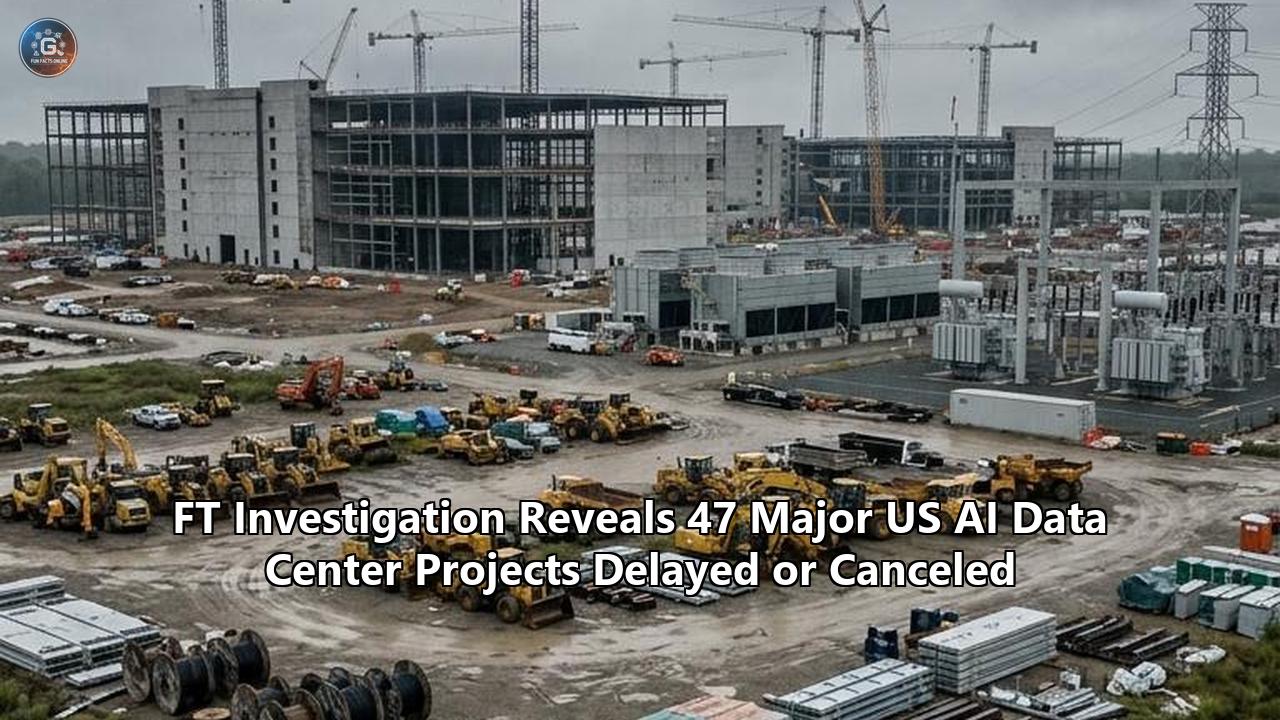
A wide-ranging investigation published by the Financial Times on October 18, 2026, has revealed that at least 47 major artificial intelligence data center projects across the United States have been formally delayed, withdrawn, or rejected since the beginning of the year. The disclosures, drawn from proprietary records compiled by regulatory intelligence firm RegLayer, mark the first comprehensive accounting of the physical, political, and financial bottlenecks threatening to stall the commercialization of generative artificial intelligence.
According to the investigation, the derailed developments represent tens of gigawatts of planned computing capacity and tens of billions of dollars in allocated capital. Compounding the findings, an equity research report from investment bank Bernstein cited by the Financial Times estimated that merely 35 percent of the currently planned US data center pipeline remains commercially and operationally credible. The remaining 65 percent faces indefinite postponement or outright abandonment due to multi-year electrical transmission queues, severe component supply shortfalls, local zoning revolts, and souring private credit markets.
The revelation has sent immediate shockwaves through equity and debt markets. Specialized cloud infrastructure providers—known in the industry as "neoclouds," which borrow heavily against specialized processing chips to finance facility construction—saw their equity valuations tumble and bond spreads widen to levels indicative of distressed credit. Shares of CoreWeave plunged 23.6 percent in the days surrounding the report, with its secondary debt trading at sharp discounts. Simultaneously, Australian computing operator Firmus Grid indefinitely shelved its planned initial public offering, while SoftBank-controlled SB Energy delayed a targeted $50 billion public listing.
The scale of the friction exposes a structural disconnect at the heart of the modern technology economy: while cutting-edge artificial intelligence models operate on software update schedules measured in weeks and semiconductor design cycles measured in months, the physical infrastructure needed to power them—substations, generator step-up transformers, natural gas hookups, and high-voltage transmission lines—operates on civil engineering timelines measured in half-decades.
Columbia Business School economist Stijn Van Nieuwerburgh, whose research for the Brookings Institution projects cumulative US artificial intelligence infrastructure capital expenditures to exceed $10 trillion between 2025 and 2032 (roughly 3.6 percent of US gross domestic product per year), warned that the sheer magnitude of debt accumulation creates acute systemic vulnerability if physical construction fails to keep pace with debt service schedules. That vulnerability has now breached the surface. Tracing the trajectory of this infrastructure crunch reveals how unchecked capital, industrial supply chains, and municipal politics collided to produce the current crisis.
THE ESCALATION PATHWAY
─────────────────────────────────────────────────────────────────────────────
Nov 2022 – Dec 2023    The Speculative Land Grab
                       • Capex floods into AI compute; "neocloud" model emerges
                       • Interconnection queues swamped with speculative filings
─────────────────────────────────────────────────────────────────────────────
Jan 2024 – Dec 2024    The Supply Chain Fractures
                       • Silicon constraints give way to high-voltage equipment shortages
                       • Large power transformer lead times surge past 120 weeks
─────────────────────────────────────────────────────────────────────────────
Jan 2025 – Dec 2025    The Grassroots and Municipal Revolt
                       • Over 1,000 US communities organize pushback
                       • First major multi-billion-dollar zoning rejections hit key hubs
─────────────────────────────────────────────────────────────────────────────
Jan 2026 – June 2026   The Grid Operators Hit the Power Wall
                       • PJM Interconnection projects a 60 GW regional deficit
                       • Regulators crack down on speculative capacity reservations
─────────────────────────────────────────────────────────────────────────────
July 2026 – Sept 2026  The Financial and Contractual Fracture
                       • Oracle files force majeure on Stargate's 2.45 GW campus
                       • Neocloud bond yields enter distressed territory; IPOs shelved
─────────────────────────────────────────────────────────────────────────────
October 2026           The FT Investigation and Sector Reckoning
                       • RegLayer documents 47 major US project cancellations/delays
                       • Bernstein calculates only 35% of the US pipeline is viable
Act I: The Speculative Land Grab (November 2022 – December 2023)
The roots of the current paralysis trace directly to the commercial release of OpenAI's ChatGPT in late 2022 and the subsequent corporate panic across enterprise technology. Hyperscale operators—principally Microsoft, Alphabet, Amazon Web Services, and Meta Platforms—embarked on an unprecedented capital expenditure expansion, signaling plans to deploy tens of billions of dollars per quarter into computing facilities tailored for high-density training clusters.
During this initial window, the primary operational bottleneck was single-faceted: access to advanced graphics processing units (GPUs), specifically Nvidia’s A100 and H100 Hopper architecture silicon. Companies that could secure allocations of these processors raised billions of dollars almost overnight. The market saw the aggressive rise of neoclouds—startups that procured chips, leveraged those hardware assets as collateral to issue massive tranches of asset-backed debt, and broke ground on specialized data centers designed to host high-power racks consuming between 40 and 100 kilowatts each, compared to 7 to 10 kilowatts for traditional cloud workloads.
By mid-2023, access to chips began loosening, but it was replaced by an aggressive, largely unregulated land rush. Developers, private equity infrastructure funds, and cloud operators descended upon regional utility territories, submitting massive power requests. What industry insiders described to the Financial Times as a "Wild West" mentality took hold. Due diligence was truncated. Frontier model laboratories accepted higher short-term leasing costs and signed non-binding letters of intent across dozens of prospective sites simultaneously to ensure they would not be caught without capacity.
Speculative developers began "land banking" and submitting speculative interconnection requests to regional transmission organizations (RTOs) like PJM Interconnection, which coordinates the movement of wholesale electricity across 13 states and the District of Columbia. Developers frequently placed requests for 500 megawatts to 1 gigawatt on parcels of agricultural land where they held only nominal purchase options, hoping to secure a favorable spot in the utility queue before flipping the shovel-ready site to a hyperscaler at enormous markups.
This practice created a phantom pipeline. By late 2023, interconnection queues across the United States were congested with hundreds of gigawatts of speculative requests. Utility planners, legally obligated to study the grid impacts of each request in the order received, found themselves overwhelmed by engineering studies for facilities that lacked confirmed financing, structural designs, or end-user commitments.
HYPERSCALE VS. TRADITIONAL POWER CONSUMPTION
┌─────────────────────────────────┬──────────────────────────────────────────┐
│ Facility Type                   │ Power Density / Typical Site Demand      │
├─────────────────────────────────┼──────────────────────────────────────────┤
│ Standard Enterprise Data Center │ 5–10 kW per rack / 15–30 MW total site   │
│ Early Hyperscale Cloud (2020)   │ 10–15 kW per rack / 40–80 MW total site  │
│ AI Training Cluster (2024–2026) │ 40–100+ kW per rack / 300–1,000+ MW site │
└─────────────────────────────────┴──────────────────────────────────────────┘
Act II: The Supply Chain Fractures (January 2024 – December 2024)
By the spring of 2024, the primary constraint on artificial intelligence infrastructure completed its migration from the digital realm to the physical electromechanical supply chain. Developers who had successfully secured site control and preliminary utility approvals ran headlong into an acute global shortage of heavy electrical distribution equipment.
At the center of this breakdown sat large power transformers (LPTs) and generator step-up (GSU) units. These devices, weighing upwards of 200 metric tons and assembled with specialized grain-oriented electrical steel (GOES) and copper windings, are vital for stepping down extreme transmission voltages (typically 230 kV to 500 kV) to intermediate substation levels suitable for industrial distribution.
ELECTRICAL EQUIPMENT LEAD TIMES (WEEKS)
Component                         2021 Baseline   Late 2024   Late 2026
────────────────────────────────────────────────────────────────────────
Generator Step-Up (GSU) Units          50            115         144–160+
Large Power Transformers (>100 MVA)    60            105         128–140
High-Voltage Circuit Breakers          45             80         125
Medium-Voltage Switchgear              30             65          95–100
2MW+ Backup Diesel/Gas Generators      35             52          78
Liquid Cooling Distribution Units      18             40          68
Historical lead times for utility-scale transformers had sat reliably between 40 and 60 weeks. By late 2024, data from Wood Mackenzie and the Department of Energy revealed that average procurement windows had stretched past 120 weeks. For custom generator step-up configurations, lead times reached an unprecedented 144 to 160 weeks—over three full years.
The reasons were structural:
- Domestic Manufacturing Atrophy: Decades of industrial offshoring left the United States with only a tiny domestic manufacturing footprint for high-voltage transformers, forcing developers to import approximately 80 percent of large power transformers.
- Raw Material Scarcity: Global production of grain-oriented electrical steel was monopolized by a handful of mills in Japan, Europe, and China, with domestic US capacity constrained to a single producer. Section 232 trade duties and tariff regimes elevated unit prices by 45 to 95 percent.
- Compounding Component Delays: Critical infrastructure is strictly sequential. If a developer's medium-voltage switchgear arrived on schedule at week 70, but the primary generator step-up transformer faced delivery delays until week 140, the entire site sat idle. Capital expenses continued to accrue interest while concrete pads sat empty.
Simultaneously, the physical thermal density of the hardware escalated the crisis. The transition to advanced architectures, such as Nvidia’s GB200 NVL72 platform requiring direct-to-chip liquid cooling, exposed severe manufacturing shortages in coolant distribution units (CDUs), specialized manifolds, and fluid heat exchangers. Builders who had engineered facilities for air cooling were forced to execute costly engineering redesigns mid-construction, adding 6 to 14 months to project execution schedules. By the close of 2024, the earliest systemic AI data center delays began appearing in corporate disclosures, though they were broadly dismissed by Wall Street as transient growing pains.
Act III: The Grassroots and Municipal Revolt (January 2025 – December 2025)
The operational friction shifted during 2025 from procurement logjams to intense social and political opposition. For years, state and municipal governments had welcomed data center developers with open arms, dangling lucrative property and gross-receipts tax abatements to attract capital investment. In 2025, that dynamic inverted.
Local communities began organizing sophisticated opposition campaigns across rural and suburban districts that had been earmarked for massive hyperscale campuses. The Financial Times investigation highlighted data revealing that more than 1,000 municipalities, county commissions, and town councils across the country introduced moratoria, zoning amendments, or outright bans targeting data center development in 2025 and 2026.
NOTABLE 2025–2026 MUNICIPAL REJECTIONS AND PAUSES
┌──────────────────────┬──────────────────────┬──────────┬─────────────────────────────┐
│ Location             │ Developer / Project  │ Value    │ Core Issue Cited            │
├──────────────────────┼──────────────────────┼──────────┼─────────────────────────────┤
│ St. Joseph County, IN│ New Carlisle Campus  │ $12.0B   │ Water draw, grid strain     │
│ Chandler, AZ         │ Active Infra         │ $2.5B    │ Residential noise, power    │
│ Howell Township, MI  │ Randee / Stantec     │ $1.0B    │ Agricultural rezoning push  │
│ Doña Ana County, NM  │ Project Jupiter      │ $50.0B+  │ Gas pipeline, public funds  │
│ Loudoun County, VA   │ County-wide (ZOAM)   │ Multiple │ 12-month legislative freeze │
│ Prince William, VA   │ Comprehensive Plan   │ Multiple │ Transmission line proximity │
└──────────────────────┴──────────────────────┴──────────┴─────────────────────────────┘
The municipal revolt was fueled by four distinct community impacts:
1. Water Consumption and Aquifer Depletion
Evaporative cooling systems for a standard 300-megawatt data center can consume between 1 million and 3 million gallons of potable water daily—equivalent to the consumption of a small city. In drought-stressed western regions, such as Arizona's Salt River Basin and southern New Mexico, suburban residents packed municipal utility board hearings to protest data centers drawing from declining aquifers. In Chandler, Arizona, an organized citizen coalition successfully pressured the city council in late 2025 to deny zoning approvals for a $2.5 billion advanced computing campus, pointing to regional water allocation risks.
2. High-Frequency Acoustic Pollution
The industrial chillers, rooftop cooling fans, and high-velocity air handlers necessary to dissipate the thermal output of high-density clusters emit a continuous low-frequency hum, typically between 50 and 65 decibels within a half-mile radius. In residential communities across Northern Virginia, Georgia, and Indiana, homeowners organized noise-monitoring brigades. In Howell Township, Michigan, local officials enacted emergency zoning changes to reject a $1 billion project after neighboring landowners demonstrated that noise mitigation plans failed to protect surrounding residential zones.
3. Utility Bill Shifting and Ratepayer Anger
Grid upgrades required to connect gigawatt-scale data centers—such as new 500 kV transmission lines, advanced circuit breakers, and substations—traditionally carry costs that regulated utilities socialize across their entire customer rate base. By mid-2025, consumer advocacy boards began warning state utility regulators that residential households were seeing their monthly utility bills surge by 15 to 30 percent to subsidize capital upgrades demanded exclusively by hyperscale developers. The issue broke partisan lines: progressive environmental organizations allied with fiscal conservatives to demand that tech operators fund 100 percent of dedicated grid infrastructure upfront.
4. Backlash Over Tax Abatements
For over a decade, states competed in a race to the bottom, offering long-term exemptions on sales, use, and property taxes to secure data centers. In St. Joseph County, Indiana, county commissioners balked at approving an expanded tax-abatement package for a proposed $12 billion multi-building campus in New Carlisle. Commissioners pointed to the minimal local job creation—facilities of that size often require fewer than 150 permanent operations staff—relative to the enormous burden placed on county roads, water reserves, and emergency service providers. The commission voted down the rezoning ordinance in late 2025, shelving the project indefinitely.
By the end of 2025, developers could no longer assume that rural counties would rubber-stamp land permits. The timeline required to secure municipal zoning entitlements expanded from six months to more than two years, introducing deep unpredictability into the construction pipeline.
Act IV: The Grid Operators Hit the Power Wall (January 2026 – June 2026)
If 2025 was defined by municipal pushback, the first half of 2026 saw the physical energy grid reach a breaking point. The geographic concentration of data center development in specific utility zones overwhelmed the capacity of transmission system operators to safely maintain grid stability.
Nowhere was this crisis more acute than within PJM Interconnection. Serving over 65 million people across Mid-Atlantic and Midwestern states, PJM had absorbed the bulk of early hyperscale construction due to Northern Virginia’s historical role as the global capital of internet traffic. On April 10, 2026, PJM leadership took unprecedented emergency action: the grid operator announced an emergency procurement plan to solicit 15 gigawatts of new power generation.
PJM’s internal load forecasting revealed that data center interconnection requests had climbed to over 60 gigawatts of incremental load projected over the coming decade—a volume of demand the existing transmission network was physically incapable of serving without causing regional brownouts. PJM officials warned that if bilateral contracts between developers and independent power producers failed to materialize, the operator would enact mandatory backstop procurement mechanisms, passing hundreds of millions of dollars in capital costs directly to utilities and regional consumers.
The emergency measures accelerated regulatory scrutiny at the federal level. The Federal Energy Regulatory Commission (FERC) stepped in, approving a strict registry system within PJM to audit and track real data center power requests, distinguishing binding industrial commitments from speculative applications. FERC also rejected controversial utility tariff schemes that would have allowed hyperscalers to secure preferential interconnection priority ahead of regional clean-energy installations or residential hookups.
REGIONAL TRANSMISSION BACKLOG (PJM INTERCONNECTION)
─────────────────────────────────────────────────────────────────────────────
Total Active Queue Size:                     >320,000 MW
Data Center Direct Interconnection Requests:  >62,000 MW
Average Time from Queue Entry to Service:     4.8 to 7.2 Years
Rejected / Postponed Applications (2026):     18,400 MW
─────────────────────────────────────────────────────────────────────────────
Data: PJM Interconnection Planning Proceedings & FERC Regulatory Filings (2026)
In Northern Virginia, the strain reached legislative boiling points. In Loudoun County, the Board of Supervisors initiated a formal 12-month moratorium on legislative approvals for data centers and substations while it overhauled its Comprehensive Plan and Zoning Ordinance. Meanwhile, in Richmond, Virginia State Senator Russet Perry introduced Senate Bill 843, proposing a three-year statewide freeze on state-level approvals for data center planning applications.
"This billion-dollar industry has grown unchecked and without guardrails for years while families face rising electric bills, massive transmission lines threaten our homes, schools, churches, and farms, and while we don't have anywhere near the infrastructure needed to protect our grid," Perry stated during legislative hearings.
State regulators across Texas, New York, Pennsylvania, and Oregon followed suit, tightening utility rules. In Texas, the Electric Reliability Council of Texas (ERCOT) faced a flood of large-load interconnection requests exceeding 40 gigawatts. State utility commissioners refused to authorize standard grid interconnects unless developers proved they had procured behind-the-meter generation or could operate on interruptible load contracts, agreeing to shut down facilities entirely during periods of extreme summer and winter weather.
The regulatory message had inverted entirely: developers could no longer build wherever land was cheap. Access to firm, non-curtailable power had become a hard ceiling, driving systemic AI data center delays across every primary US market.
Act V: Financial Fractures, Distressed Debt, and Broken Contracts (July 2026 – September 2026)
By the late summer of 2026, operational delays and grid bottlenecks collided directly with financial leverage. The economic model of the AI infrastructure boom relied on high capital turnover: developers borrowed heavily at elevated interest rates to construct facilities, anticipating that high-margin cloud contracts signed by frontier labs would immediately service that debt the moment the facilities were energized.
When completion timelines slipped by 12, 18, or 24 months, the math turned punishing. Interest expenses continued to compound, chip hardware purchased for specific clusters aged inside warehouse crates, and corporate buyers exercised strict contractual termination clauses.
NEOCLOUD CAPITAL PROFILE & CONTRACTUAL VULNERABILITY
┌─────────────┬──────────────────────────┬──────────────────────┬─────────────────────────┐
│ Company     │ Target Capital Need      │ Primary Anchor Client│ Current Status          │
├─────────────┼──────────────────────────┼──────────────────────┼─────────────────────────┤
│ Nscale      │ $35B target IPO valuation│ Anthropic / Microsoft│ MSFT contract canceled; │
│             │                          │                      │ $45B deal at risk     │
│ SB Energy   │ $174B capital to deliver │ OpenAI               │ IPO delayed; zero       │
│             │ $430B contracted revenue │                      │ completed campuses     │
│ Nebius      │ $250B for 5 GW buildout  │ Enterprise Cloud     │ Only ~20% funded;      │
│             │                          │                      │ CapEx shortfall warned  │
│ CoreWeave   │ Multi-billion debt/ABS   │ Inflection / OpenAI  │ Stock -23.6%; debt      │
│             │                          │                      │ in distressed band      │
│ Blue Owl    │ Multi-billion private    │ Oracle / Stargate    │ Shares -40%; force      │
│ Capital     │ credit facilities        │                      │ majeure triggered      │
└─────────────┴──────────────────────────┴──────────────────────┴─────────────────────────┘
The vulnerabilities unfolded in rapid succession across several high-profile enterprise deals:
The Nscale Contract Terminations
London-headquartered neocloud provider Nscale faced immediate operational retrenchment. The company had announced aggressive plans to scale a multi-gigawatt footprint across North America and Europe, planning to deploy nearly 500,000 advanced accelerators. By August 2026, the company had brought only 25,000 processors online.
In September, Microsoft formally terminated its contract for Nscale's planned AI computing campus in Loughton, England. The facility had been designed as a 50-to-90 megawatt campus housing 23,040 Nvidia GB300 GPUs dedicated to Microsoft Azure. However, regional grid operator UK Power Networks notified Nscale that sufficient electrical capacity could not be delivered to the site until the early-to-mid 2030s—years past the agreed commercial operational date. With the site unable to energize, Microsoft walked away.
The cancellation triggered alarm bells in the United States, where Anthropic maintains a massive $45 billion compute reservation with Nscale in West Virginia. Under the terms of that agreement, Anthropic holds explicit walk-away rights if Nscale fails to meet strict phased delivery and financing milestones, creating existential risk for Nscale’s planned New York public listing at a $35 billion valuation.
The Stargate Shocker: Project Jupiter Force Majeure
The most dramatic escalation occurred within the Stargate program, the flagship $500 billion artificial intelligence infrastructure partnership backed by OpenAI, Oracle, and SoftBank. The centerpiece of Stargate’s initial deployment was Project Jupiter, a planned 1,400-acre, 2.45-gigawatt computing installation situated in Santa Teresa, Doña Ana County, New Mexico.
Designed to utilize behind-the-meter power architecture featuring natural gas fuel cells supplied by Bloom Energy, the project was intended to bypass regional utility delays. However, the development hit an unexpected regulatory barrier when Stephanie Garcia Richard, the New Mexico State Land Commissioner, repeatedly denied right-of-way permits for a vital Energy Transfer natural gas pipeline required to supply the fuel cell farm, citing regional environmental and groundwater impacts. The pipeline’s completion date slipped by nearly six months to February 2027, while critical state air-quality permits for the fuel cells stalled.
Facing compounding delays, Oracle filed a formal force majeure notice on September 24, 2026, to the site’s developer, an infrastructure unit of private credit giant Blue Owl Capital. While Oracle publicly maintained that it remained committed to the project’s eventual 2028 operational target, the force majeure declaration was an aggressive contractual maneuver designed to halt scheduled milestone payments to Blue Owl.
The move sent immediate shockwaves through the financial sector. Blue Owl’s stock, already under pressure from rising defaults in real estate and software lending, dropped sharply, trading down nearly 40 percent year-to-date. Construction debt tied to Project Jupiter saw its trading price drop into the range of 89 to 91 cents on the dollar, signaling that bond investors no longer viewed full, timely recovery as guaranteed.
PROJECT JUPITER TIMELINE (DOÑA ANA COUNTY, NM)
─────────────────────────────────────────────────────────────────────────────
Sept 23, 2025:  OpenAI, Oracle, and STACK Infrastructure announce 1,400-acre,
                $50B+ Project Jupiter campus; Doña Ana County approves up to
                $165B in Industrial Revenue Bonds.
March 2026:     Regional environmental coalitions and community groups submit
                formal legal challenges against local bond authorizations.
June 2026:      NM State Land Commissioner denies right-of-way permit for the
                Energy Transfer natural gas feeder pipeline, citing resource risks.
Sept 24, 2026:  Oracle sends a formal force majeure notice to developer
                Blue Owl Capital to pause capital outlays; construction debt
                slumps to 89-91 cents on the dollar.
Oct 14, 2026:   Oracle attempts to salvage early testing phases by offering a
                contested $10M/year direct interconnect to El Paso Electric,
                triggering an immediate dispute with county commissioners.
─────────────────────────────────────────────────────────────────────────────
Sources: Doña Ana County Commission Filings, Bloomberg, Albuquerque Journal (2026)
The Cost Overrun Absorption at Cipher
Other operators saw their margins eroded by escalating electrical construction expenses. In late September, digital infrastructure developer Cipher agreed to absorb the first $359 million in structural cost overruns at its primary domestic computing site to prevent its anchor cloud tenant from exercising cancellation rights. Across the sector, balance sheets were bearing the costs of supply chain friction.
Act VI: The Anatomy of the 47 Delays (October 2026 FT Investigation)
When the Financial Times published its investigation on October 18, 2026, it synthesized these disparate supply chain failures, municipal votes, and corporate filings into a single industry-wide diagnosis: the physical foundation of the US AI boom had hit a wall.
The 47 projects identified by RegLayer are not modest server rooms; they represent large-scale hyperscale campuses designed for operations exceeding 100 megawatts each. RegLayer emphasized that its tally was a "conservative estimate" that tracked only the largest, publicly documented facilities, noting that scores of smaller tier-2 developments had quietly slipped their timelines without formal disclosure.
ANATOMY OF 47 DERAILED US AI DATA CENTER PROJECTS
Primary Failure Cause                        Share of Affected Sites
────────────────────────────────────────────────────────────────────
1. Grid Interconnection / Transmission Wait           44.7% (21 sites)
2. Local Permitting / Municipal Moratoria             29.8% (14 sites)
3. Electromechanical Equipment Lead Times             14.9% ( 7 sites)
4. Financing / Counterparty Contract Cancellation     10.6% ( 5 sites)
────────────────────────────────────────────────────────────────────
Data: RegLayer Regulatory Intelligence / Financial Times Investigation (October 2026)
1. Grid Interconnection Queue Failure (44.7% of Projects)
The single most prevalent cause of project derailment was the inability to secure binding, near-term interconnection dates from regional transmission organizations. In major hubs across Virginia, Ohio, and North Carolina, utilities informed developers that initial estimates of 24 to 36 months for power energization had formally stretched to five to eight years. Hyperscale tenants, unable to wait until the next decade to deploy current-generation silicon, routinely terminated their leases, forcing developers to mothball active construction sites.
2. Municipal Pushback and Moratoria (29.8% of Projects)
Local government actions were the second leading driver. Town councils and county boards utilized local zoning codes, environmental review mandates, and water protection ordinances to block or withdraw permits. In multiple instances across the Midwest and South, community referendums successfully repealed previously approved tax breaks, altering the financial assumptions of projects and rendering them economically unviable.
3. Equipment Procurement Deficits (14.9% of Projects)
Delays in delivering large power transformers, high-voltage switchgear, and liquid cooling distribution units forced developers into operational default. Without generator step-up units in place, completed concrete structures could not receive test power, preventing the environmental commissioning required before high-value server racks could be installed.
4. Financing and Counterparty Dissolution (10.6% of Projects)
Rising debt service costs, combined with counterparty disputes, directly collapsed several sites. Neocloud developers that had financed site construction using high-yield short-term debt found themselves unable to refinance in a deteriorating corporate bond market. When anchor tenants signaled they would not accept delayed handovers, private credit syndicates froze secondary funding tranches, halting work mid-construction.
The Bernstein 35 Percent Assessment
The most damning metric highlighted in the Financial Times investigation came from investment bank Bernstein, which calculated that only roughly 35 percent of the planned US data center pipeline was viable under current infrastructure conditions.
Bernstein’s model subjected every announced project in the United States to a three-part feasibility screen:
- Did the facility possess an executed, legally binding interconnection agreement with an operational date prior to 2029?
- Had the developer secured confirmed delivery slots for primary power transformers with Tier 1 manufacturers?
- Had all local zoning variances, environmental impact statements, and water usage permits cleared municipal review without active litigation?
When applied across the roughly 40 gigawatts of capacity currently advertised across the US market, nearly two-thirds of the pipeline failed. Bernstein’s analysts noted that while marketing materials routinely projected massive capacity online by 2027, the industrial reality pointed toward a steep plateau in capacity additions.
THE PIPELINE REALITY GAP (US DATA CENTER CAPACITY BY 2028)
┌───────────────────────────────────────────────┐
│ Planned / Announced Pipeline: ~42.0 GW (100%) │
├───────────────────────────────────────────────┴───────────────┐
│ [██████████████] Bernstein Viable Baseline: 14.7 GW (35%)     │
├───────────────────────────────────────────────────────────────┤
│ [░░░░░░░░░░░░░░░░░░░░░░░░░░] Delayed / Speculative / Blocked: │
│                             27.3 GW (65%)                     │
└───────────────────────────────────────────────────────────────┘
Sources: Bernstein Equity Research, RegLayer Database, SemiAnalysis Audits (Oct 2026)
The Broader Economic Toll
The fallout from these widespread AI data center delays extends far beyond canceled real estate permits; it is beginning to distort corporate capital expenditure strategies across the entire technology and energy sectors.
The Neocloud Solvency Dilemma
The neocloud business model faces immediate structural strain. Companies like CoreWeave, Lambda Labs, Nebius, and Nscale built their corporate balance sheets on a simple arbitrage: borrow cash at 7 to 10 percent interest to purchase Nvidia GPUs, install them in contracted facilities, and lease them out at gross operating margins exceeding 50 percent.
This model functions smoothly when facilities open on schedule. But when a facility is delayed by two years, the underlying silicon suffers rapid technological depreciation while sitting in cardboard boxes. An Nvidia H100 or B200 processor loses a significant portion of its economic value once newer architectures reach high-volume manufacturing.
Nebius chief executive Arkady Volozh conceded the scale of the capital requirements at a Citi investor conference, noting that delivering the company's planned 5-gigawatt footprint would require roughly $250 billion, of which the company had managed to finance only about one-fifth. If capital markets close to neocloud debt issuances, these providers will be forced to sell hardware at deep discounts to hyperscalers or file for balance sheet restructuring.
THE ASSET-LIABILITY DEPRECIATION CYCLE
  ┌─────────────────────────────────────────────────────────────┐
  │ Neocloud issues debt backed by latest-gen GPUs              │
  └──────────────────────────────┬──────────────────────────────┘
                                 ▼
  ┌─────────────────────────────────────────────────────────────┐
  │ Facility faces 18-month transmission & transformer delay    │
  └──────────────────────────────┬──────────────────────────────┘
                                 ▼
  ┌─────────────────────────────────────────────────────────────┐
  │ Hardware sits in crates; chip generation ages & depreciates │
  └──────────────────────────────┬──────────────────────────────┘
                                 ▼
  ┌─────────────────────────────────────────────────────────────┐
  │ Anchor customer terminates lease via operational delay clause│
  └──────────────────────────────┬──────────────────────────────┘
                                 ▼
  ┌─────────────────────────────────────────────────────────────┐
  │ Cash flow vanishes; debt coverage ratios fail; debt enters  │
  │ distressed trading territory                                │
  └─────────────────────────────────────────────────────────────┘
The $10 Trillion Macro Risk
The findings give weight to the systemic financial warnings raised by Columbia Business School economist Stijn Van Nieuwerburgh. In his Brookings research, Van Nieuwerburgh highlighted that the projected $10 trillion AI infrastructure buildout between 2025 and 2032 is equivalent to roughly one and a half times the peak of the 19th-century railroad expansion and more than three times the size of the 1996–2003 telecommunications buildout.
"The issue is not that artificial intelligence is an illusory technology," Van Nieuwerburgh argued in commentary following the FT report. "The issue is that the financing structures deployed over the past three years assumed friction-free physical execution. When you issue high-yield debt, private credit, and off-balance-sheet municipal bonds against revenues that cannot physically materialize until the 2030s, you create structural solvency risk. If cash flow falls by even 10 to 15 percent across this ecosystem, substantial equity value simply vanishes".
The Industrial Distortion
The unprecedented capital redirected into data center construction has crowded out other critical sectors of the US industrial economy. Wood Mackenzie analysts note that lead times for distribution transformers and basic switchgear needed to repair aging regional grids, connect new domestic manufacturing plants, and link renewable energy projects have lengthened by 30 to 50 percent.
Industrial manufacturers and municipal public utilities are finding themselves outbid for factory assembly slots by hyperscale developers willing to pay 100 percent cash premiums to expedite equipment delivery. The result is a growing national supply deficit: North American utility infrastructure is deteriorating while available manufacturing capacity is consumed by the race for artificial intelligence compute.
Industrial Countermeasures and Strategic Pivots
Faced with an increasingly gridlocked domestic landscape, technology giants and infrastructure funds are deploying radical countermeasures to bypass the traditional utility grid.
INFRASTRUCTURE MITIGATION STRATEGIES
Strategy              Mechanism                        Trade-offs & Constraints
───────────────────────────────────────────────────────────────────────────────
Behind-the-Meter      Build dedicated on-site gas      High carbon emissions; pipeline
Power Generation      turbines or fuel cells (Bloom)   permitting bottlenecks (e.g. Jupiter)
───────────────────────────────────────────────────────────────────────────────
Nuclear Co-location   Buy power directly from existing Regulatory pushback; FERC limits
                      operating nuclear stations       on taking public baseload offline
───────────────────────────────────────────────────────────────────────────────
Geographic Arbitrage  Shift future builds to Texas     Extreme weather risks; local grid
                      ERCOT, rural Midwest, or overseas instability; high transmission costs
───────────────────────────────────────────────────────────────────────────────
Synthetic Software    Optimize distributed training    Network latency; algorithmic limits;
Optimization          across smaller, separated sites  cannot fully replace mega-clusters
The Push for Behind-the-Meter and Nuclear Power
Recognizing that public transmission queues are jammed through the end of the decade, hyperscalers are attempting to sever ties with the regulated grid entirely. Companies are pursuing "behind-the-meter" generation, constructing dedicated natural gas generation plants or contracted small modular nuclear reactors (SMRs) directly adjacent to computing sites.
However, as Oracle discovered with Project Jupiter in New Mexico, going off-grid simply exchanges one set of regulatory headaches for another. Even on-site fuel cells require natural gas feeder pipelines, which require environmental impact statements, land rights-of-way, and local air quality permits. Pipeline projects face intense opposition from environmental coalitions and state conservation agencies, meaning behind-the-meter strategies can encounter the same multi-year delays as standard grid connections.
Similarly, efforts to co-locate data centers at existing nuclear power facilities—such as Amazon Web Services’ arrangement with Talen Energy’s Susquehanna nuclear plant in Pennsylvania—have drawn scrutiny from FERC and regional utility operators, who argue that diverting baseload clean energy away from the public grid threatens reliability and increases costs for ordinary consumers.
Geographic Displacement
The concentration of AI data center delays in traditional hubs like Northern Virginia and Silicon Valley is forcing capital into alternative regions. Developers are scouting sites across the rural Midwest, the inland Pacific Northwest, and international markets such as the Nordic countries, where geothermal and hydroelectric power are abundant.
Yet geographic relocation introduces operational compromises. Remote installations face shortages of specialized construction labor, lack high-density low-latency fiber backbones, and encounter local communities equally skeptical of industrial disruption.
The Road Ahead: What to Watch Through 2027
The revelations brought to light by the Financial Times investigation indicate that the American AI infrastructure expansion has entered a protracted period of consolidation and reassessment. The initial gold rush, characterized by unconstrained capital deployment and rapid real estate acquisition, has ended. Moving into 2027, the trajectory of the market will be determined by several pivotal indicators:
- The Resolution of Virginia SB 843 and Local Freezes: State-level legislative votes in Richmond in early 2027 will determine whether Virginia enacts an unprecedented multi-year moratorium on data center planning. If the largest digital infrastructure market in the world closes its doors to new development, capital will be forced into secondary regional markets that are far less equipped to handle the electrical load.
- The Neocloud Shakeout: As debt maturities loom and delayed facilities fail to generate anticipated cash flows, industry observers expect a wave of distressed asset sales. Hyperscalers with deep corporate balance sheets—specifically Microsoft, Alphabet, and Amazon—are likely to acquire stranded hardware clusters and half-finished facilities from distressed neocloud operators at significant discounts.
- FERC’s National Grid Modernization Mandates: Federal energy regulators are preparing comprehensive rulemakings regarding cost allocation for large-load data center interconnections. The outcome will dictate whether hyperscalers must fully fund dedicated high-voltage transmission lines or if public utilities can continue to pass grid modernization costs down to residential and small-business ratepayers.
- Domestic Transformer Capacity Additions: New North American manufacturing facilities for large power transformers announced by suppliers such as Hitachi Energy, Siemens Energy, and Eaton are not scheduled to reach commercial output until late 2027 or 2028. Until domestic manufacturing output scales substantially, the physical delivery of step-up equipment will remain the governing speed limit for new computing facilities.
- Restructuring of Frontier Lab Compute Commitments: AI research laboratories, including OpenAI and Anthropic, will face increasing pressure to renegotiate their multi-billion-dollar compute reservations. If execution constraints prevent partners like Oracle and Nscale from delivering contracted megawatt capacity, laboratories will either have to moderate the pace of model scaling or re-architect their software frameworks to train across smaller, decentralized computing nodes.
The physical reality of the power grid, local politics, and supply chains has caught up with the digital ambition of artificial intelligence. As the 47 stalled projects documented across the United States demonstrate, software may scale effortlessly across algorithms, but the infrastructure that powers it remains firmly bound to concrete, copper, transformers, and the physical constraints of the electrical grid.
Reference:
- https://en.fnnews.com/news/202610190933437281
- https://www.ft.com/content/9ea5a37d-15c9-4d5b-94d6-719048c9cd3c?syn-25a6b1a6=1
- https://www.profilenews.com/en/ai-data-center-projects/
- https://aiweekly.co/alerts/ft-47-large-us-data-center-projects-delayed-withdrawn-or-blocked-in-2026
- https://dealroom.co/news/163868-americas-10tn-ai-build-out-runs-into-towns-grids-and-lenders-at-least-47/
- https://www.power-eng.com/renewables/america-data-center-construction-delays/
- https://keyt.com/stacker-technology/2026/10/19/tech-companies-need-more-data-centers-so-why-are-nearly-half-of-all-planned-projects-delayed-or-canceled/
- https://keyt.com/stacker-technology/2026/10/19/tech-companies-need-more-data-centers-so-why-are-nearly-half-of-all-planned-projects-delayed-or-canceled/
- https://www.beri.net/article/ai-power-wall-infrastructure-crisis-2026
- https://syaala.com/blog/transformer-lead-times-2026
- https://www.gamechangeenergy.com/news/transformer-lead-times-in-2026-what-pad-mounted-and-substation-buyers-can-expect
- https://datacentredigest.com/the-transformer-shortage-nobody-saw-coming-how-a-quiet-component-crisis-is-throttling-data-center-power-delivery/
- https://gridreadiness.com/blog/power-transformer-lead-times-ai-data-center-2026
- https://www.datacenterknowledge.com/build-design/microsoft-exits-nscale-data-center-deal-over-uk-power-delays
- https://suedatacenters.org/data-centers/stargate-project-jupiter-dona-ana-nm
- https://www.datacenterdynamics.com/en/news/virginia-senator-proposes-three-year-state-wide-data-center-moratorium/
- https://programs.com/resources/data-center-project-tracker/
- https://www.datacenterwatch.org/report
- https://www.loudoun.gov/CivicAlerts.aspx?AID=10874
- https://usdatacenterprojects.com/virginia/virginia-senator-proposes-three-year-state-wide-data-center-moratorium
- https://broadbandbreakfast.com/virginia-democratic-senator-proposes-statewide-3-year-data-center-moratorium/
- https://www.tomshardware.com/tech-industry/data-centers/300-plus-local-data-center-bans-have-only-delayed-just-three-us-projects-bans-much-more-bark-than-bite-only-2-3-gigawatts-of-data-centers-are-held-up-versus-38-gigawatts-expected-online-in-2027
- https://theaiinsider.tech/2026/09/25/oracle-issues-force-majeure-notice-on-stargates-project-jupiter-ai-data-center-in-new-mexico/
- https://www.reddit.com/r/datacenter/comments/1wqaaoe/new_mexico_project_jupiter_is_on_life_support/
- https://www.konsulteer.com/article/oracle-issues-force-majeure-notice-over-new-mexico-stargate-data-center
- https://primexbt.com/news/oracle-files-force-majeure-notice-on-stargate-data-center-project-after-permitti/