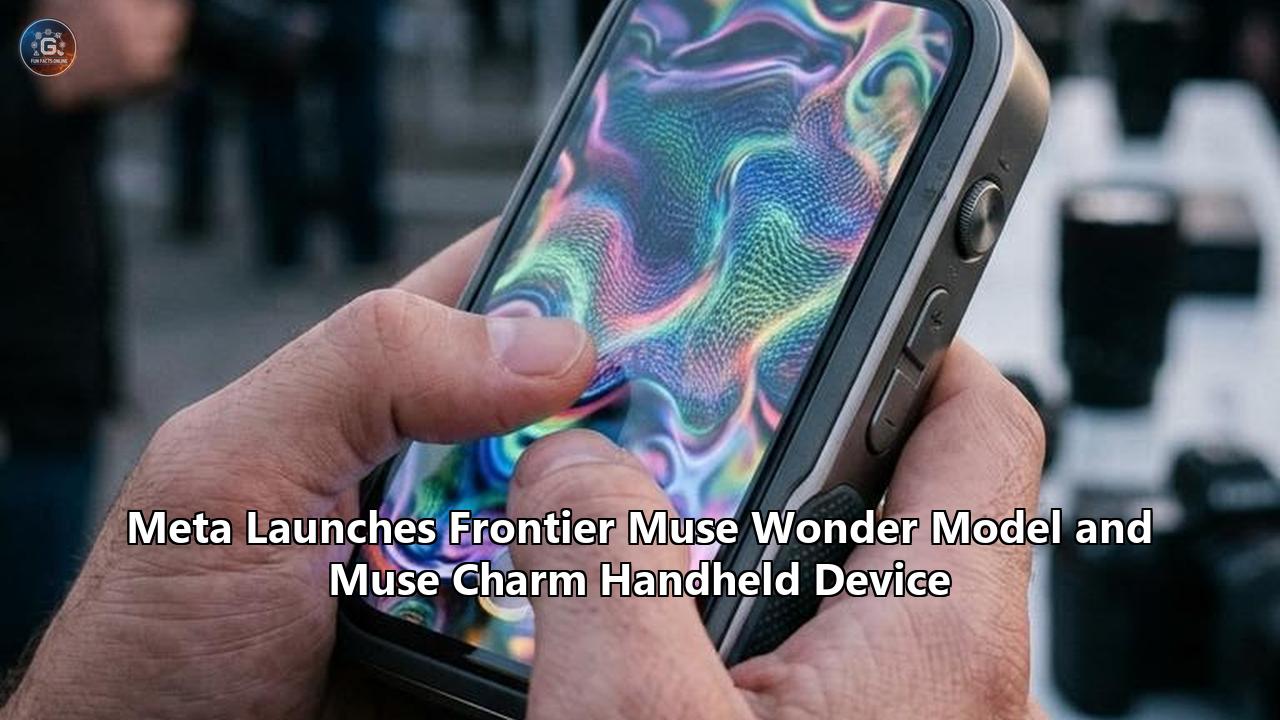
Meta has officially launched its flagship foundation system, the Muse Wonder model series, while setting a December release window for Muse Charm, a dedicated handheld companion device designed to give the company’s personal agent physical form. Unveiled by Meta Superintelligence Labs and showcased across developer channels, the dual rollout represents an aggressive maneuver to bridge generative software with physical consumer hardware. Yet behind the headline benchmark victories and the playful, retro aesthetic of its pocket terminal, the release lays bare an industry-wide crisis: the operational gap between static benchmark dominance and reliable real-world autonomous agency.
The release includes two primary variants: Muse Wonder, accessible through the Meta Model API and the Muse Code terminal, and Muse Wonder Full, an augmented system reserved for high-tier developer subscriptions. Alongside these releases, Meta introduced Muse Spark Open, an 816-billion-parameter open-weight mixture-of-experts model optimized for local execution on high-memory workstation hardware like Apple’s M5 Ultra. On paper, the closed flagship marks Meta’s arrival at the absolute frontier of closed-source intelligence. Muse Wonder posted a score of 79% on the Deep Suite coding benchmark—surpassing Anthropic’s Claude Opus 5.5 and Google’s Gemini 4 Argon—and reached 56 on the Artificial Analysis Intelligence Index, landing just two points behind Claude Opus 5.5.
Concurrently, Meta Chief Executive Mark Zuckerberg showcased Muse Charm, a palm-sized, 5G-connected device featuring a roughly two-inch OLED display, dual cameras, directional microphones, and a biometric fingerprint trigger. Created by Meta’s design lab under former Apple interface design executive Alan Dye, the gadget embodies the agent as an animated mascot—such as a cartoon character named Jolly or a slice of toast wearing sunglasses—that interacts via real-time voice, executes multi-step web transactions, and interprets real-world surroundings without tethering to a smartphone.
This combined deployment exposes a fundamental tension. While Meta is attempting to normalize autonomous digital agents by housing them in approachable, tactile form factors, the software powering these interactions faces persistent friction. In production tests, long-running agentic tasks suffer from rapid API cost escalation, unexpected permission drift, token quota bottlenecks, and active resistance from external platforms—exemplified by Amazon blocking Muse instances from executing automated purchases. As Meta attempts to outmaneuver mobile operating system gatekeepers, engineers and enterprise architects are left confronting the real operational hazards of deploying autonomous agents into an unprepared digital economy.
The Core Challenge: The Friction of Real-World Autonomous Agency
The transition from passive language models to autonomous systems has fundamentally disrupted conventional software development. For years, foundational models served as text predictors: a user supplied a prompt, the system returned an answer, and the interaction concluded. With the arrival of the Meta Frontier Muse model, software labs have shifted toward agentic paradigms where systems plan complex tasks, invoke software tools, write to external databases, and browse the public internet across hours or days.
Traditional LLM Pipeline (Stateless & Ephemeral)
[User Prompt] ───> [Context Window] ───> [Next-Token Prediction] ───> [Static Output]

Meta Frontier Muse Agentic Pipeline (Stateful & Tool-Coupled)
                 ┌─────────────────────────────────────────────────────────┐
                 │                   Persistent State                      │
                 │         (Active Memory / Cross-Session Graph)           │
                 └────────────────────────────┬────────────────────────────┘
                                              ▼
[User Objective] ───> [Sub-Agent Planner] ───> [Active Focus Execution Loop]
                             ▲                               │
                             │ (Failure / Error Traps)        ▼
                             └─────────────────────── [Tool / API Execution]
                                                             │
                                                             ├─ Cloud Web VM (Chromium)
                                                             ├─ Shell / File System Writes
                                                             └─ Merchant & Bank APIs
                                                             │
                                                             ▼ (Human Validation Gate)
                                                    [Stateful Execution]
This evolution alters the consequences of system errors. A conversational hallucination wastes seconds of a user's attention; an agentic failure, however, can corrupt production repositories, drain API budgets, delete calendar databases, or execute unauthorized financial transactions.
The challenge centers on three operational fractures:
1. The Persistence Degradation Problem
Long-horizon autonomy requires agents to retain semantic consistency across extended chains of action. When an agent spends several hours debugging an enterprise application or parsing conflicting insurance documents, context windows degrade. Models frequently suffer from context drift, forgetting earlier constraints, hallucinating intermediate variables, or looping indefinitely through error states. Although Meta built Muse Wonder to address this through architectural frameworks dubbed Active Memory and Active Focus, early developer feedback highlights severe rate limits, system 429 quota exhaustion, and stability drops when sub-agents encounter unstructured operational obstacles.
2. The Adversarial Web and Platform Gatekeeping
To accomplish personal errands, Muse uses what Meta calls a Muse Secure VM—a cloud-hosted sandbox running a Chromium browser designed to navigate web forms, compare commercial offerings, and book travel. However, the internet is not configured for non-human agency. Days before Meta Connect, Amazon moved to block the IP ranges and fingerprint signatures of Muse’s automated browsers.
Web architectures rely on CAPTCHAs, bot defenses, and anti-scraping protocols to protect margins and infrastructure. When an agent faces these barriers, it cannot simply think harder; it hits a wall. For consumer platforms, synthetic users that make automated purchasing decisions threaten ad-driven monetization models, turning agent integration into a multi-front platform war.
3. The Affective Trust Trap
By embedding the Muse agent within the Muse Charm—a handheld gadget evoking 1990s digital pets—Meta has paired high-risk autonomy with deliberate cuteness. Former Apple design executive Alan Dye and his team designed the Charm with animated mascots that speak with personalized accents, laugh, and emote through an OLED display.
Psychological research confirms that cuteness triggers caretaking behavior and lowers suspicion. Handing over bank credentials, email access, home camera feeds, and health records to an enterprise cloud model prompts rational consumer hesitation. Disguising that same pipeline behind a cheerful cartoon character softens the perceived danger. Data from financial analysts indicates that only 8% of United States consumers initially express trust in Meta handling their banking passwords. Lowering friction through anthropomorphic design risks outpacing the user's awareness of system failures, creating a gap between user confidence and model reliability.
Architectural Anatomy: Inside the Meta Frontier Muse Model
To overcome the fragility of early autonomous agents, Meta Superintelligence Labs built Muse Wonder from the ground up for agentic execution rather than simple conversational benchmarks. Led by Chief AI Officer Alexandr Wang—the Scale AI co-founder recruited to oversee Meta’s foundation model research—the lab structured the model family around stateful execution loops, tool-calling concurrency, and deep context management.
+-----------------------------------------------------------------------------------+
|                        MUSE WONDER ARCHITECTURAL STACK                            |
+-----------------------------------------------------------------------------------+
|  Input Modalities: Text, Audio, Video, Image, High-Resolution PDF (1M Tokens)     |
+-----------------------------------------------------------------------------------+
|  Context Engine: Dynamic Active Memory Indexer & Semantic Graph Store             |
+-----------------------------------------------------------------------------------+
|  Reasoning Core: Meta Frontier Muse Model                                         |
|  - Active Focus Controller (Branch Evaluation & Recursive Error Recovery)         |
|  - Parallel Tool-Calling Engine (Multi-Agent Sub-Task Delegation)                 |
+-----------------------------------------------------------------------------------+
|  Execution Layer:                                                                 |
|  - Local: Muse Code Terminal Environment (Sandbox Shell, Git Integration)         |
|  - Cloud: Muse Secure VM (Headless Chromium Browser, Auth Session Containers)     |
+-----------------------------------------------------------------------------------+
|  Safety & Control: Superintelligence Scaling Framework (CBRN / Cyber Redlines)  |
+-----------------------------------------------------------------------------------+
Active Memory and Active Focus
Standard transformer architectures treat past conversations as ephemeral. When a context window fills up, older tokens are truncated, or retrieval-augmented generation (RAG) is used to pull unstructured snippets back into the prompt. Meta takes a more structural approach with Active Memory. The system continuously runs an indexing process over user interactions, extracting explicit preferences, project requirements, organizational hierarchies, and operational decisions into an internal state graph. When a task resumes after weeks of inactivity, Muse Wonder retrieves structured procedural context rather than raw text, allowing it to sustain continuous workflows.
Working alongside memory is Active Focus, an inference-time reasoning mechanism explicitly trained on failure recovery. In typical multi-step code generation or document analysis, an unexpected compiler error or missing API token causes an agent to panic, hallucinate, or stop entirely.
Meta trained the Meta Frontier Muse model to treat errors as standard state transitions. Under Active Focus, the system:
- Detects runtime failures or tool rejections immediately.
- Isolates the specific operation that failed without tearing down the parent plan.
- Spawns internal sub-agents to test alternate approaches in a simulated sandbox.
- Halts execution and generates a structured clarification request only when human intervention is strictly required, avoiding unnecessary interruptions for minor issues.
| Metric / Dimension | Meta Muse Wonder | Claude Opus 5.5 | Gemini 4 Argon | GPT-6 Astra |
|---|---|---|---|---|
| Deep Suite (Coding) | 79.0% | 74.2% | 73.8% | 74.1% |
| SWE-Marathon (Ultra-Long Horizon) | 57.5% (Wonder Full) | 46.3% | 44.9% | 45.1% |
| Artificial Analysis Index v4.3 | 56.0 | 58.0 | 55.1 | 54.8 |
| Context Window Capacity | 1,048,576 tokens | 2,000,000 tokens | 2,000,000 tokens | 1,000,000 tokens |
| API Cost: Input (per 1M tokens) | $4.00 | $4.00 | $2.00 (promotional) | $2.00 |
| API Cost: Output (per 1M tokens) | $20.00 | $20.00 | $10.00 (promotional) | $10.00 |
| Cached Input (per 1M tokens) | $0.20 | $0.20 | $0.10 | $0.10 |
| Deployment Modality | API / Terminal / Hardware | API / Web | API / Cloud Ecosystem | API / Web Ecosystem |
The "Benchmaxing" Disconnect
Despite dominating synthetic evaluations, Meta faces pushback from developers pointing out the gap between formal benchmarks and unstructured workflows. On the developer-built Busey Bench—which evaluates real-world coding, multi-modal asset generation, and rendering versatility—Muse Wonder dropped to 14th place.
While the model excelled at well-defined benchmarks like Harvey’s Legal Agent Benchmark (LAB) and structured financial modeling, independent testers noted that community tests involving creative logic, spatial-visual computing, and non-linear task switching frequently triggered repetitive token loops. Critics argue that Meta heavily tuned the system for static benchmark leaderboards ("benchmaxing"), masking its vulnerabilities in real-world application environments.
Hardware Decoupling: Why Meta Built the Muse Charm
The announcement of Muse Charm reveals Meta’s underlying hardware motivations. Historically, Meta’s software ambitions have been constrained by Apple and Google. Every mobile application Meta ships is subject to App Store policies, API sandboxing rules, telemetry restrictions, and in-app purchase commissions. For an agent built to automate life by directly interacting with credit cards, local operating files, and third-party web portals, the mobile operating system sandbox is an insurmountable barrier.
+-----------------------------------------------------------------------------------+
|                           MUSE CHARM HARDWARE SPECS                               |
+-----------------------------------------------------------------------------------+
|  Chassis: Translucent Polycarbonate with Internal Circuit Visuals                 |
|  Display: ~2.0-inch OLED Capacitive Touchscreen (Full-Face Dynamic Avatar UI)    |
|  Biometrics: Integrated Capacitive Fingerprint Sensor (Corner Tap-to-Talk)        |
|  Connectivity: Integrated Standalone 5G Cellular Modem, Wi-Fi 6E, Bluetooth 5.4   |
|  Sensors & Audio: Front Context Camera, Rear Wide-Angle Computer Vision Camera,   |
|                   Dual Beamforming Microphones, High-Excursion Micro-Speaker      |
|  Compute: Dedicated Ultra-Low Power Neural Processing Unit (On-Device Audio/Wake) |
|           Upstream Cloud Routing to Meta Prometheus Supercomputing Clusters       |
|  Wearability: Integrated Lanyard Loop, Keychain Attachment, Detachable Wrist Strap |
+-----------------------------------------------------------------------------------+
Escaping the Mobile Ecosystem Trap
Meta’s smart glasses division demonstrated that users welcome ambient computing if the form factor is comfortable and unobtrusive. However, camera-equipped glasses face persistent social and legal hurdles. The public pushback against glasses that discreetly record in locker rooms, restaurants, and corporate offices remains an obstacle for always-on vision models.
Muse Charm circumvents this issue by altering the device's physical presence. Worn on a neck lanyard, attached to a keychain, or carried in a pocket, the Charm requires deliberate physical manipulation. Users do not wear the camera on their faces; they actively hold the device and point its rear lens at a document, product, or error screen. This intentional physical action reduces social unease while preserving the multimodal visual context the agent requires to operate.
           SMART GLASSES                            MUSE CHARM
    [Facial Mount / Ambient]              [Physical Device / Intentional]
                 │                                       │
     High Social Pushback                     Lower Social Friction
   Continuous Surveillance Concern          Visible, Point-and-Capture Action
                 │                                       │
                 ▼                                       ▼
    Strict Platform Controls               Direct Proprietary Connection
   (iOS/Android Bluetooth Pipe)               (Independent Cellular 5G)
Furthermore, by integrating a standalone 5G cellular modem, Meta completely bypasses the smartphone. The Charm is not a peripheral; it is an independent cloud terminal. It does not route audio through iOS or rely on Android background services that can be suspended by the host operating system. When a user taps the Charm’s corner fingerprint sensor, it opens a direct socket to Meta’s Prometheus data center clusters, entirely outside the surveillance and fee structures of rival tech platforms.
Lessons from Previous Hardware Stumbles
The consumer landscape is filled with failed standalone AI devices. Humane’s AI Pin suffered from extreme thermal throttling, poor laser projection, and short battery life. The Rabbit R1 faced backlash after teardowns revealed that its custom operating system was largely an Android app relying on fragile web-scraping scripts.
Meta’s design team, spearheaded by Alan Dye and Billy Sorrentino, avoided these specific failure modes by deliberately constraining the Charm's scope:
- No General App Platform: The device runs no app store, no browser, and no video media player. It operates entirely as an ambient agent endpoint.
- Tactile Biometrics Over Voice Wake-Words: Voice-activated gadgets fail in loud environments and trigger deep acoustic privacy anxieties. The Charm relies on a capacitive fingerprint sensor: users tap and hold to speak. This tactile trigger verifies user identity, unlocks encrypted authentication tokens, and eliminates false-positive wake words.
- Cloud Execution with Local Compression: The device avoids heavy on-device LLM inference. It handles voice encoding and wake-word verification locally on an ultra-low-power NPU, streaming compressed vector tokens directly over 5G to the Meta Frontier Muse model in the cloud. This keeps the physical unit cool, lightweight, and capable of operating across standard consumer duty cycles.
Where the System Breaks Down: Operational Hazards
Despite these hardware and software advancements, deploying the Muse series in the wild reveals systemic operational vulnerabilities. When enterprises and developers integrate Muse Wonder via API or Muse Code, the reality of running autonomous loops exposes immediate technical and financial risks.
                              ENTERPRISE RUNTIME
                                      │
                         [Initiate Agentic Objective]
                                      │
                                      ▼
                        ┌───────────────────────────┐
                        │ Recursive Loop Iteration  │
                        └─────────────┬─────────────┘
                                      │
                ┌─────────────────────┴─────────────────────┐
                │                                           │
                ▼                                           ▼
   [Unchecked State Drift]                     [Exponential Token Burn]
 - Hallucinated variables                    - Sub-agent spawning explosion
 - Infinite compiler retries                 - Long context re-ingestion
 - Security permission leaks                 - Enterprise budget depletion
                │                                           │
                └─────────────────────┬─────────────────────┘
                                      │
                                      ▼
                           [Operational Failure]
                         - Cloud Infrastructure Halts
                         - Hostile API Lockouts
                         - Damaged Production Environments
The Runaway Cost Spiral of Agentic Execution
Standard language model pricing is linear: a question in, an answer out. Agentic workflows, by contrast, are non-linear and computationally expensive. Under Muse Wonder’s pricing structure—$4 per million input tokens and $20 per million output tokens—a single open-ended software refactoring task can spiral rapidly.
When Muse Wonder encounters a broken dependency or a transient API error, its Active Focus engine delegates tasks to multiple parallel sub-agents. Each sub-agent ingests the codebase, generates candidate patches, executes tests, and feeds the resulting log files back into the primary context window. Within a few hours, millions of tokens are consumed. In production audits, autonomous multi-agent debugging sessions cost upwards of $40 to $70 for complex code fixes that a human engineer could manually resolve in minutes. For non-enterprise users using Muse Code, quota exhaustion (HTTP 429 errors) frequently halts workflows mid-execution, leaving software projects in broken, partially committed states.
Task Execution Cost Modeling (Complex Agentic Workflow)
---------------------------------------------------------------------------------
Phase 1: Initial Repository Ingestion (450,000 tokens @ $4.00/M)         = $1.80
Phase 2: Sub-Agent Planning & Delegation (120,000 tokens @ $20.00/M)     = $2.40
Phase 3: Parallel Test Generation (8 Sub-Agents, 3.2M tokens total)     = $28.80
Phase 4: Active Focus Error Trapping & Retries (4 Loops @ $6.50/loop)    = $26.00
Phase 5: Final Merge and Semantic State Graph Update                    = $4.20
---------------------------------------------------------------------------------
TOTAL ESTIMATED COST FOR A SINGLE DEBUG SUITE                           = $63.20
Identity and Authentication Vulnerabilities
To make purchases or manage personal data, Muse must act on behalf of the user. This requires storing authentication cookies, OAuth session tokens, and financial permissions inside the Muse Secure VM.
This architecture creates an attractive target for prompt injection attacks. If an agent reads a third-party webpage or an incoming email containing malicious instructions (indirect prompt injection), it can be tricked into exfiltrating the user's active session data or making purchases without explicit consent.
While Meta claims that Muse Wonder incorporates its strongest alignment safeguards to date, cybersecurity researchers have shown that complex, long-running agent contexts remain susceptible to indirect jailbreaks. An injected instruction disguised as an innocent invoice PDF can instruct the agent's Active Focus mechanism to override default boundaries and post sensitive data to an external server.
Ambient Surveillance and Third-Party Privacy
The hardware architecture of the Muse Charm poses unique privacy risks. Equipped with dual cameras and microphones capable of streaming over 5G, the device is designed to accompany users everywhere.
Alan Butler, Executive Director of the Electronic Privacy Information Center (EPIC), warned that pocketable, internet-connected cameras and microphones create privacy hazards regardless of the software guardrails implemented. Because the Charm is intended to be worn on a lanyard or clipped to clothing, it inevitably captures third parties who have not consented to being recorded. In professional environments, healthcare facilities, or private spaces, deploying an unshielded, cellular-connected recording endpoint introduces major corporate and legal liability.
Solutions in Practice: How Engineers and Policymakers Are Responding
The release of the Muse series has accelerated efforts across the software industry to build defensive architectures, containment protocols, and verification standards to keep autonomous agents within safe operational boundaries.
                     ENTERPRISE CONTAINMENT ARCHITECTURE
                                      │
                        [Meta Frontier Muse Model]
                                      │
                                      ▼
                        ┌───────────────────────────┐
                        │   Deterministic Sandbox   │
                        │     (Zero Write Access)   │
                        └─────────────┬─────────────┘
                                      │
                                      ▼
                        ┌───────────────────────────┐
                        │ Structured Diff Generator │
                        └─────────────┬─────────────┘
                                      │
                                      ▼
                 ╔═════════════════════════════════════════╗
                 ║   HUMAN-IN-THE-LOOP (HITL) GATEWAY      ║
                 ║   - Cryptographic Policy Signature      ║
                 ║   - Webhook Authorization Verification  ║
                 ╚═════════════════════════════════════════╝
                                      │
                                      ▼
                        ┌───────────────────────────┐
                        │  Target Enterprise System │
                        │  (ERP, Prod DB, Git Main) │
                        └───────────────────────────┘
1. Deterministic Human-in-the-Loop Gateways
Enterprise engineering teams are actively neutralizing agent risks by treating model outputs as untrusted suggestions rather than direct commands. Instead of granting the Meta Frontier Muse model direct access to production databases or administrative APIs, organizations are inserting deterministic Human-in-the-Loop (HITL) gateways.
Under this framework:
- The agent operates inside an isolated sandbox with zero write permissions.
- System actions—such as updating code, sending payments, or altering database tables—are formatted as structured changesets or transaction proposals.
- A human operator must provide a cryptographic signature via a secure dashboard before any proposal is applied to production systems.
This architecture preserves the productivity advantages of agentic systems while preventing unauthorized state drift and uncontrolled operational damage.
2. Meta's Internal Superintelligence Scaling Framework
Within Meta, Chief AI Officer Alexandr Wang established new containment protocols governing the deployment of models from the Superintelligence Lab. The Meta Superintelligence Scaling Framework introduces strict safety redlines.
Before models like Muse Wonder Full can be released to developers, they must undergo red-teaming against CBRN (chemical, biological, radiological, and nuclear) weaponization risks and automated cyber offensive actions.
To protect against cyber weaponization while aiding defenders, Meta tuned Muse Wonder to identify code vulnerabilities defensively while restricting its ability to generate novel cyber exploits or orchestrate malicious autonomous penetration loops.
                              TASK INGESTION
                                     │
                                     ▼
                      [Complexity & Risk Classifier]
                                     │
           ┌─────────────────────────┼─────────────────────────┐
           │ Low Risk                │ High Reasoning          │ Deep Engineering
           ▼                         ▼                         ▼
   [Muse Spark Open]          [Muse Wonder API]        [Muse Wonder Full]
   - Edge / Local NPU        - Enterprise Workflows    - High-Value Refactors
   - Simple Q&A / Routing    - Cloud VM Web Actions    - Terminal Coding Loop
   - Minimal Compute Cost    - $4 / $20 Token Pricing  - Premium Subscription
3. Tiered Model Hierarchies and Local Compute Offloading
To address high token costs, enterprise architects are abandoning single-model agent pipelines in favor of tiered routing architectures:
- Edge Triage: Low-complexity queries, voice encoding, and basic routing are handled directly on the client or by lightweight, open-weight models like Muse Spark Open. Running an 816-billion-parameter MoE model on dedicated local hardware allows organizations to process high-volume text and maintain operational privacy without incurring external API costs.
- Intermediate Planning: Standard procedural agent workflows are delegated to Muse Wonder via the Meta Model API, utilizing prompt caching ($0.20 per million tokens) to reduce context re-ingestion expenses.
- High-Value Reasoning: Only critical, unconstrained debugging and high-liability tasks are escalated to Muse Wonder Full within subscription-backed, rate-protected terminal sessions.
Cost Mitigation Flow
[Raw Ingestion] ───> [Local Filter (Muse Spark Open)] ───> Cache Match?
                            │                                   │
                     (Yes) ─┴─ Zero API Cost             (No) ──┴──> [Cached API Wonder]
4. Hardware Containment and Controlled Sensors
To protect against ambient recording concerns, Meta and third-party security teams are implementing hardware-level constraints on devices like Muse Charm.
- Physical Circuit Indicators: The Charm’s translucent casing includes hardware-tied LED indicators that illuminate whenever the camera sensor draws power, preventing covert background image capture.
- Ephemeral Memory Sandboxing: Audio and visual data streamed to the Muse Secure VM is processed within memory-only micro-VMs that are destroyed after the interaction concludes, preventing the creation of persistent biometric tracking databases.
- Context Scrubbing: Before visual frames from the Charm's cameras are forwarded to the Meta Frontier Muse model, local vision filters blur detected faces, license plates, and sensitive documents unless the user explicitly commands the agent to read them.
The Competitive and Geopolitical Horizon
Meta’s launch of Muse Wonder and Muse Charm moves the battlefield beyond chat interfaces toward complete, vertical AI platforms. By controlling foundation model architecture, terminal coding tools, cloud browser sandboxes, and dedicated consumer hardware, Meta is building a vertically integrated agent stack that challenges traditional mobile operating systems.
                        THE AGENT PLATFORM STACK
┌────────────────────────────────────────────────────────────────────────┐
│ Hardware Endpoint: Muse Charm (5G Independent Palm Terminal)           │
├────────────────────────────────────────────────────────────────────────┤
│ Application Layer: Muse Code / Standalone Muse Agent Suite             │
├────────────────────────────────────────────────────────────────────────┤
│ Cloud Sandbox: Muse Secure VM (Ephemeral Isolated Chromium Runtime)   │
├────────────────────────────────────────────────────────────────────────┤
│ Foundation Model: Meta Frontier Muse Model (Wonder / Wonder Full)      │
├────────────────────────────────────────────────────────────────────────┤
│ Infrastructure: Meta Prometheus Supercomputing Clusters (Ohio)         │
└────────────────────────────────────────────────────────────────────────┘
This strategy puts Meta into direct competition with its primary industry rivals:
- Anthropic: The release of Claude Opus 5.5 established a standard for reasoning and computer use. While Opus remains slightly ahead on composite intelligence evaluations (58 versus Wonder Full’s 56), Anthropic lacks consumer hardware distribution and depends entirely on third-party cloud platforms and app ecosystems.
- OpenAI: While OpenAI continues developing specialized pocket hardware with former Apple design chief Jony Ive, Meta has moved faster to production. By shipping Muse Charm ahead of the 2026 holidays, Meta is establishing consumer hardware presence while OpenAI’s devices remain in development.
- Google: Google’s Gemini 4 Argon offers strong pricing competition ($2 input / $10 output) and deep Android integration. However, Google faces an organizational dilemma: unconstrained autonomous agents that browse and purchase goods directly undermine the search-ad model that drives the company’s revenue. Meta, which monetizes primarily through social engagement and planned merchant transaction fees, faces fewer conflicts when automating commercial interactions.
At the same time, open-weight alternatives from international labs—notably China’s Qwen and DeepSeek models—continue to exert downward pricing pressure on frontier capabilities. By launching Muse Wonder as a premium closed API alongside the open-weight Muse Spark Open, Meta is attempting to straddle both worlds: monetizing closed enterprise compute while maintaining favor within the open-source developer ecosystem.
Future Milestones and Unresolved Questions
As Meta prepares to ship Muse Charm and expand access to Muse Wonder, the industry faces several key milestones that will determine whether autonomous agents can deliver on their promises:
- Carrier Pricing and Hardware Economics: Meta has not yet revealed the retail price of Muse Charm or the ongoing cellular service costs required for its 5G modem. If the hardware demands an expensive monthly cellular subscription on top of a $20 to $100 monthly Muse service tier, mainstream consumer adoption will face steep resistance.
- Platform Countermeasures: How major internet platforms respond to automated traffic will shape agent utility. If retailers, banks, and travel providers follow Amazon in aggressively blocking synthetic users, the practical usefulness of the Muse Secure VM will shrink, leaving agents unable to complete tasks without constant human intervention.
- Long-Term Memory Coherence: Independent labs will monitor whether Muse Wonder’s Active Memory can operate over months of real-world use without suffering from semantic decay. If outdated habits and resolved tasks pollute an agent's memory graph, clearing the context could prove just as frustrating as having no persistence at all.
- Regulatory and Surveillance Scrutiny: European and US data protection regulators are preparing to review ambient personal AI devices under existing privacy frameworks and the European Union’s AI Act. The prospect of thousands of cellular-connected, camera-equipped devices gathering multimodal real-world training data will face strict regulatory examination.
The arrival of the Meta Frontier Muse model and the Muse Charm demonstrates that the technology for autonomous agents has progressed from theory into physical products. However, successfully bridging that technology with the real world requires solving deep structural problems around cost, platform compatibility, and ambient privacy. Making synthetic autonomy reliable, secure, and genuinely useful requires more than outscoring rivals on benchmark leaderboards or wrapping machine intelligence in approachable design; it requires hardening the software against failure and proving that autonomous systems can operate safely in an unpredictable digital world.
Reference:
- https://about.fb.com/news/2026/10/introducing-muse-wonder-models/
- https://thepcenthusiast.com/meta-muse-charm-ai-device/
- https://kie.ai/blog/what-is-muse-wonder
- https://www.mindstudio.ai/blog/meta-muse-wonder-benchmarks
- https://www.fastcompany.com/91612532/with-metas-muse-charm-ai-enters-its-kawaii-era
- https://www.jamiiforums.com/threads/frontier-ai-parity-shifts-the-competitive-battleground-from-raw-benchmarks-to-applications-and-pricing.2483905/?amp=1
- https://www.mindstudio.ai/blog/muse-spark-open-local
- https://www.reddit.com/r/aicuriosity/comments/1wp46bp/meta_introduces_palm_sized_muse_charm_for_on_the/
- https://www.dezeen.com/2026/09/25/meta-debuts-tamagotchi-style-ai-agent/
- https://www.irishtimes.com/business/2026/09/24/theres-nothing-like-it-meta-unveils-dedicated-charm-device-for-using-muse-ai/
- https://osintteam.blog/meta-built-an-ai-agent-that-reads-your-texts-then-wrapped-it-in-a-tamagotchi-ab9a760c4b9b
- https://www.mindstudio.ai/blog/meta-muse-wonder-launch
- https://futurumgroup.com/insights/can-metas-muse-charm-create-enough-value-to-survive-its-own-initial-hype-cycle/
- https://www.techfabric.com/blog/muse-wonder-meta-frontier-models-agents
- https://dev.meta.ai/models/muse-wonder
- https://medium.com/@sdntechdemo/muse-wonder-is-here-metas-frontier-model-wants-to-be-your-agent-s-brain-b84cbd6ad1ef
- https://research.meta.ai/blog/muse-wonder
- https://app.therundown.ai/guides/muse-wonder-guide
- https://medium.com/dare-to-be-better/why-is-muse-so-cute-010d0c31b5c9
- https://www.pymnts.com/news/artificial-intelligence/2026/meta-bets-tamagotchi-style-device-can-sell-personal-ai/
- https://www.layer3labs.io/guides/who-is-alexandr-wang
- https://medium.com/codetodeploy/meta-muse-wonder-explained-active-memory-active-focus-and-the-future-of-ai-agents-aa03955b4bd1
- https://www.mindstudio.ai/blog/meta-muse-wonder-benchmarks
- https://daily.dev/posts/ai-news-6-new-models-a-nano-banana-killer-cmtcs0dnj
- https://openrouter.ai/meta/muse-wonder
- https://www.axios.com/2026/09/23/meta-muse-ai-hardware-handheld-glasses
- https://www.theguardian.com/fashion/2026/sep/26/charming-and-disarming-how-metas-technology-packed-muse-harnesses-the-power-of-cuteness
- https://www.meta.com/blog/meta-connect-2026-everything-we-announced/
- https://www.cnet.com/tech/services-and-software/meta-muse-and-wonder-ai-models/
- https://fortuneprimeglobal.com/daily-economic-news/metas-muse-wonder-features-active-memory-and-active-focus/