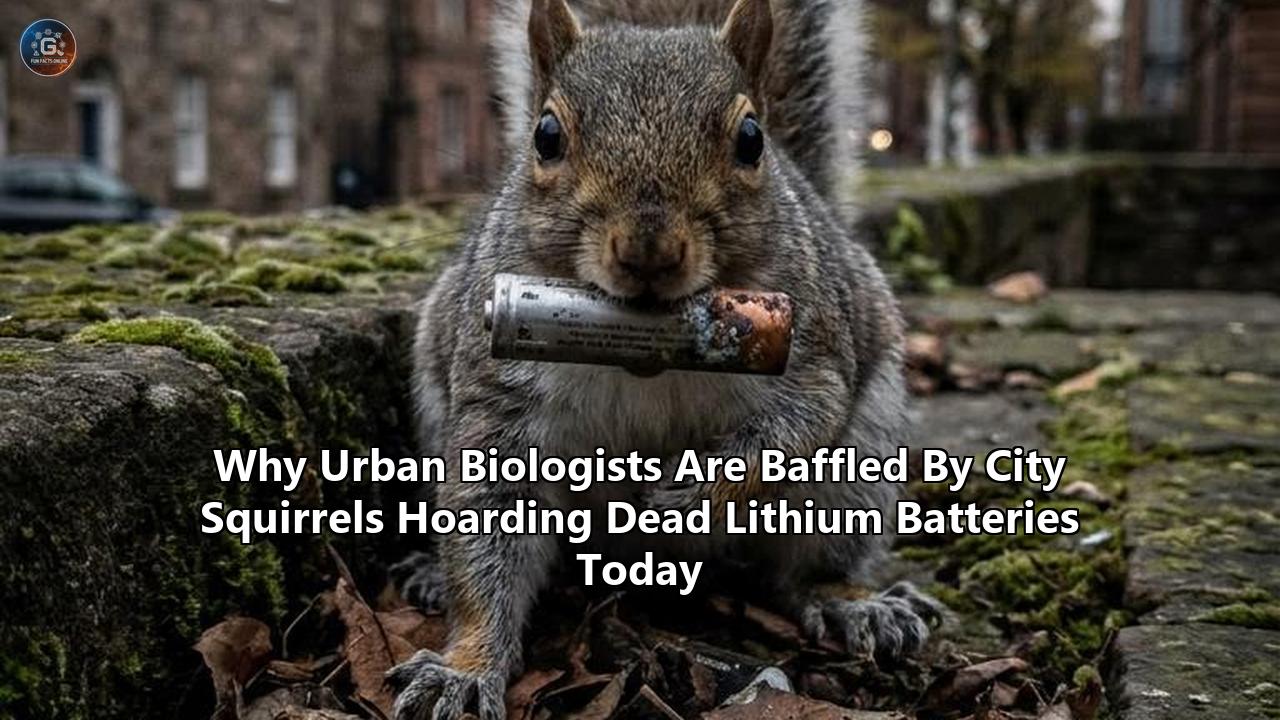
The canopy of Philadelphia’s Fairmount Park is quietly turning into an unregulated e-waste facility.
Over the past three weeks, arborists and urban ecologists removing storm-damaged oak branches discovered something startling: gray squirrel nests packed not with acorns or hickory nuts, but with dead lithium-ion batteries. In one massive drey—a squirrel’s primary nesting structure—researchers cataloged 47 distinct battery cells, ranging from AA-sized disposable vape power supplies to degraded 18650 cells cannibalized from discarded electronics.
Similar reports are suddenly flooding in from municipal wildlife managers in London, New York, and Chicago. What initially presented in March 2026 as a viral, albeit troubling, social media trend of squirrels appearing to "vape" discarded e-cigarettes has rapidly metastasized into a structural ecological crisis. The rodents are no longer just chewing on sweet-smelling garbage; they are actively and systematically caching high-density, toxic energy storage devices alongside their winter food supplies.
The immediate threat is immense. A compromised lithium-ion cell experiencing thermal runaway can reach 1,800 degrees Fahrenheit in milliseconds. When that reaction occurs inside a nest constructed of dry twigs, leaves, and highly flammable pine debris, the resulting fire is near-instantaneous. Vermillion Fire Chief Matt Callahan, who recently battled a string of landfill fires caused by improperly discarded batteries, notes the difficulty of extinguishing these chemical fires even in controlled industrial environments. Moving that fire risk into the urban tree canopy introduces a terrifying new vector for municipal property damage.
Yet, for the biologists tracking the phenomenon, the sheer danger of the situation is overshadowed by a profound scientific mystery. Tree squirrels are highly adapted foragers with millions of years of evolutionary programming designed to identify, assess, and store organic calories. Why are they suddenly expending immense caloric energy to drag heavy, biologically inert metal cylinders up fifty-foot trees?
The answers lie at the messy intersection of synthetic chemistry, behavioral ecology, and a global supply chain that treats highly volatile metals as disposable commodities.
The Olfactory Hijack
To understand the hoarding mechanism, you have to look at the source of the batteries. The vast majority of the cells recovered from nests thus far are attached to, or stripped from, single-use electronic cigarettes.
Millions of disposable vapes are discarded into gutters, parks, and public trash cans every week. These devices are tightly packed tubes containing a heating element, a lithium battery, and a sponge soaked in synthetic liquid. This liquid is the primary culprit trickling down into the squirrel’s sensory pathways.
Craig Shuttleworth, a red squirrel specialist at Bangor University in Wales, recently pointed out that rodents have entirely ignored discarded tobacco products for decades. Cigarette butts litter every city street on earth, yet squirrels do not build nests out of them. The difference is the chemical payload. Modern vapes rely heavily on synthetic esters and aldehydes to produce flavors like strawberry, mango, bubblegum, and watermelon.
To a human, these chemicals smell like candy. To a squirrel, which relies overwhelmingly on its olfactory bulb to locate hidden food, these compounds are exact chemical mimics of ripe, high-value fruit. The synthetic esters are essentially hacking the animal’s foraging algorithms. The squirrel smells a concentrated burst of fruit, locates the bright, cylindrical object in the grass, and registers it as an extraordinarily dense piece of food.
The tragedy of the interaction is that the "food" never perishes. Because the battery casing is made of aluminum or steel, it does not rot. It continues to emit the sticky, sweet scent of leaked propylene glycol and synthetic fruit flavor for months. The squirrel, unable to crack the metal shell immediately, defaults to its secondary survival instinct: caching.
Weight, Density, and the Biomechanics of the Cache
If the smell draws the animal in, the physical properties of the battery seal the deal. This is where the study of urban wildlife behavior takes a deeply biomechanical turn.
When a gray squirrel evaluates a nut for storage, it performs a complex physical assessment. It picks up the item, manipulates it in its front paws, and often gives it a rapid shake. This process, known as assessing the "handling time," tells the animal how heavy the object is relative to its size, and whether the shell contains a dense, nutritious kernel or has been hollowed out by a weevil. Heavy, dense objects are prioritized for long-term storage because they represent a high return on investment.
A standard 18650 lithium-ion battery, commonly used in larger electronics and older EV packs, weighs roughly 45 grams. A disposable vape battery weighs between 15 and 20 grams. A large black walnut—one of the highest-value natural forage items in North America—weighs about 20 grams.
When a squirrel picks up a dead vape battery, its tactile feedback mechanisms register a massive success. The object is perfectly cylindrical, smooth, highly dense, and emits a powerful fruit scent. To the biological programming of a scatter hoarder, a lithium battery is the ultimate super-nut. It feels like a calorie bomb that will easily survive the winter without degrading.
Scatter Hoarding vs. Larders in the Concrete Jungle
The sudden influx of batteries into the canopy is forcing researchers to rethink fundamental concepts of urban wildlife behavior.
In natural environments, squirrels employ two primary strategies for storing food: larder hoarding and scatter hoarding. Red squirrels, for example, are famous for larder hoarding. They build massive "middens"—centralized piles of pine cones, debris, and scales that can grow to considerable depths at the base of trees. They defend these middens fiercely because their entire winter survival relies on a single geographical point.
Gray squirrels, which dominate American urban centers, are typically scatter hoarders. They bury individual nuts across a wide territory, relying on spatial memory and scent to recover them months later. This scatter hoarding plays a critical ecological role in forest regeneration; the nuts they forget become the next generation of oak and hickory trees.
However, the battery phenomenon is revealing a bizarre shift in tactics. Urban biologists are finding these toxic cylinders not buried in the soil, but stockpiled directly inside the arboreal nests (dreys) located high in the branches. The squirrels are treating the batteries as high-value larder items rather than scatter-hoard items.
Researchers from the Mt. Graham Biology Programs, who study hoarding flexibility, note that environmental conditions—particularly population density and competition—dictate hoarding strategies. In crowded city parks where thousands of squirrels compete for limited resources, burying a sweet-smelling, brightly colored metal tube in shallow dirt is highly risky. Other squirrels, or urban rats, will easily smell the synthetic strawberry scent and steal the cache.
Consequently, the squirrels are adapting. They are expending the extra energy to haul these heavy, dangerous objects vertically, hiding them deep within the woven sticks of their nests where thieves cannot easily access them. This behavioral adaptation is a stunning, albeit fatal, display of evolutionary flexibility.
The Chemistry of the Bite
While the hoarding itself is an ecological curiosity, the physical interaction with the batteries is an acute biological hazard.
Despite their metallic exterior, these batteries are not invincible to the bite force of a determined rodent. A gray squirrel’s incisors grow continuously throughout its life, and their jaw muscles are evolved to crack the rock-hard shells of hickory nuts and walnuts. They gnaw on wood, bone, and even automotive wiring to keep their teeth filed down—a habit that has long plagued mechanics dealing with chewed engine bays.
When a squirrel eventually decides to tap into its cached "super-nut," the consequences are often disastrous. Puncturing the thin outer casing of a lithium-ion cell exposes the highly reactive internal chemistry to oxygen and moisture.
Inside the battery, a thin, porous separator keeps the anode and cathode apart. If a squirrel's tooth pierces that separator, it creates an immediate short circuit. The localized heat boils the liquid electrolyte, releasing highly toxic, flammable gases. Within seconds, the cell enters thermal runaway.
Even if the battery does not catch fire, the chemical exposure is deadly. The leaked electrolyte solutions contain heavy metals, organic solvents, and lithium salts. Biologically, lithium has no physiological role in animal biology; while it is sometimes used in highly controlled human pharmaceuticals, it is highly toxic in uncontrolled concentrations. Furthermore, the nicotine residue left inside discarded vape casings presents an extreme poisoning risk. Animals have no natural exposure to concentrated nicotine, and ingesting even trace amounts from the chewed plastic can lead to violent seizures, respiratory failure, and death.
The Accidental E-Waste Aggregators
There is a grim irony in the fact that city squirrels are hoarding lithium while human industries desperately scramble to secure the exact same resource.
The global transition to electric vehicles and renewable energy storage has driven lithium demand to unprecedented heights. Manufacturers are exploring aggressive mining operations, extracting lithium from subterranean saline aquifers and strip-mining hard rock deposits. Yet, while the automotive and tech sectors hunt for fresh lithium, staggering amounts of the processed metal are tossed into urban gutters.
A recent study published by researchers at Edith Cowan University (ECU) in Australia highlighted this massive inefficiency. They found that lithium batteries dumped in landfills often retain nearly 80% of their functional lithium capacity. The researchers calculated that in Australia alone, lithium battery waste could reach 137,000 tons annually. Tapping into this discarded, highly purified lithium could provide a sustainable alternative to environmentally destructive mining practices, drastically reducing carbon emissions, energy usage, and water consumption associated with raw extraction.
Instead of routing these valuable cells into recycling infrastructure, human consumers are treating them as disposable trash. The squirrels, acting on ancient survival instincts, are unwittingly stepping in as the city’s most efficient—and tragic—e-waste aggregators. They are collecting the purified lithium that human supply chains are too fractured to reclaim.
Wildlife managers are now collaborating with sanitation departments in an attempt to locate and safely remove these aerial battery stockpiles. It is a painstakingly slow process. Arborists must deploy bucket trucks to visually inspect nests, often finding a dozen or more highly degraded batteries woven tightly into the fabric of a single drey.
Municipal Gridlock and the Political Fallout
The realization that urban canopies are being seeded with incendiary devices has triggered a chaotic political response.
City councils have long debated bans on disposable vapes, primarily framing the issue around youth nicotine addiction and plastic litter. The sudden integration of these devices into urban wildlife behavior has radically changed the legislative math. The argument is no longer just about public health; it is about mitigating extreme fire risks in public parks and preventing the wholesale toxic contamination of the local biome.
Waste management companies are caught in the crossfire. Traditional municipal recycling sorting facilities are not equipped to handle the influx of small lithium batteries. When a vape battery is accidentally thrown into a residential recycling bin, it is often crushed by the compaction equipment on the garbage truck or pulverized by the sorting belts at the facility. These impacts routinely cause fires, threatening the lives of sanitation workers and causing millions of dollars in structural damage.
Now, wildlife advocates are demanding that sanitation departments deploy specialized hazard teams to clean up parklands before the squirrels can reach the debris. Sanitation unions counter that their workers cannot be expected to comb through miles of grass looking for thumb-sized batteries.
The pressure is mounting for absolute prohibitions at the point of sale. Lawmakers in several major municipalities are drafting emergency ordinances to ban the sale of any single-use product containing a lithium-ion battery. They point out that manufacturing a rechargeable, highly volatile chemical energy storage device simply to boil flavored liquid for a few days before being tossed onto the street represents a catastrophic failure of industrial design.
Tracking the Phenomenon
Behind the scenes, the scientific community is mobilizing to map the exact parameters of this crisis. Biologists need to know how fast the behavior is spreading and whether it is being learned through observation.
Squirrels are highly attuned to their social environment. Research on red squirrels has proven that when individuals hear or see competitors caching food, they alter their own hoarding behavior, rushing to secure resources before they can be stolen. If urban gray squirrels are visually observing their peers hauling metallic cylinders up oak trees, the behavior could transmit culturally through the population, rapidly accelerating the rate of collection.
To track this, urban ecologists are deploying sophisticated camera trap networks in affected parks. Ironically, the equipment required to monitor the battery-hoarding behavior is powered by the same chemical family. Biologists rely heavily on Energizer Ultimate Lithium AA batteries to keep their remote trail cameras running through extreme temperatures and extended deployments. The specialized power supplies allow the cameras to operate in the field for months, patiently recording the exact moments when squirrels interact with the toxic litter.
Researchers are also experimenting with dummy batteries—inert, 3D-printed cylinders weighted to exactly match the density of a real lithium cell, coated in the synthetic ester compounds used in vapes, and fitted with tiny RFID tags. By distributing these dummy devices in controlled park sectors, scientists can track exactly where the objects go, how high they are stored, and how long they remain in the cache before the squirrel attempts to consume them.
The early data is deeply unsettling. The RFID tracking shows that squirrels are not simply grabbing the nearest object; they are actively bypassing natural forage, such as acorns, in favor of the chemically scented decoys. The synthetic olfactory stimulus is simply too overpowering for the animal’s natural instincts to ignore.
The Toxicity of the Urban Diet
The hoarding behavior is just one facet of a much broader contamination of the urban food web. What happens to the predator that eats the squirrel that chewed the battery?
The bioaccumulation of heavy metals and synthetic chemicals is a chronic issue in city environments. While acute battery punctures result in fire and immediate death, the slow degradation of weathered batteries in the nest introduces a slow-drip of toxins into the animal’s environment.
Lithium salts, cobalt, nickel, and the complex polymers used in battery casings slowly leach out as the cells are exposed to rain and humidity in the canopy. The squirrel absorbs these compounds transdermally while sleeping in the nest, or ingests them while grooming.
Furthermore, the liquid remaining in the vapes contains concentrated nicotine. While there is no current evidence to suggest the squirrels are developing chemical dependencies to the nicotine itself—they are merely after the fruit scent—the neurological impacts of chronic, low-dose nicotine exposure on small mammals are well documented. It acts as a powerful stimulant, increasing heart rates, altering metabolic demands, and potentially leading to erratic behavior that makes the animal more susceptible to traffic strikes or predation by urban hawks and feral cats.
When a red-tailed hawk consumes a squirrel carrying a heavy toxic load of cobalt, nickel, and synthetic vape chemicals, those compounds move up the trophic ladder. The urban wildlife behavior we are witnessing is not just a localized anomaly; it is the injection of complex industrial waste directly into the biological cycle of the city.
Engineering a Solution
Solving this crisis requires intervening at the manufacturing level. Biological instincts evolved over millions of years cannot be legislated away. As long as objects that smell like food and feel like food are available, wildlife will treat them as food.
Engineers and environmental toxicologists are beginning to propose mandates for the chemical profiles of consumer electronics. If manufacturers are permitted to continue producing disposable devices containing toxic components, they may be legally required to incorporate aversive olfactory agents into the plastic housings.
This concept is not unprecedented. For decades, manufacturers of toxic antifreeze have added bittering agents to prevent pets and children from consuming the sweet-tasting liquid. Similarly, the agricultural industry coats certain chemically treated seeds with compounds that repel birds and rodents.
By impregnating the external casings of lithium batteries and vapes with powerful bittering agents or specific pheromones known to repel rodents, manufacturers could theoretically break the sensory illusion. The squirrel might still see the bright cylinder, but the moment it approaches, the chemical signature would clearly signal "inedible" rather than "strawberry."
However, implementing such a change across a global supply chain—much of which operates through unregulated, overseas manufacturing of black-market vape products—is a monumental logistical challenge. And it does not solve the underlying issue of the lithium waste itself; it merely stops the wildlife from doing our trash collection for us.
The Path Forward
The situation unfolding in city parks this May is a stark indicator of how rapidly human technology can derail ancient ecological systems. The boundary between the natural world and the industrial environment no longer exists. Our urban centers are hybrid ecosystems where concrete, synthetic chemistry, and biological imperatives collide on a daily basis.
In the immediate future, the burden falls on municipal governments and local citizens to break the cycle. Park clean-up initiatives are being aggressively pivoted away from general litter and specifically targeted at micro-e-waste. Public awareness campaigns, initially focused on the human health impacts of vaping, are being retooled to highlight the ecological devastation caused by improper disposal.
For the urban biologists perched in bucket trucks, cataloging the charred remains of squirrel dreys, the work continues. They are documenting a bizarre, dangerous new chapter in urban wildlife behavior. The data they collect over the next several months will be critical in driving the legislative push for extended producer responsibility—forcing the companies that manufacture these toxic devices to pay for their safe recovery and recycling.
Until that systemic change occurs, the urban canopy remains a ticking time bomb. The squirrels, driven by the inescapable programming of survival, will continue their hazardous harvest. They will smell the synthetic sugar, feel the weight of the metal, and carry the discarded remnants of human convenience high into the trees, preparing for a winter that the technology was never meant to survive. The city’s waste problem has gone airborne, and the consequences are entirely out of our control.
Reference:
- https://gulfnews.com/entertainment/the-deadly-viral-trend-why-squirrels-vaping-is-a-crisis-for-wildlife-1.500485717
- https://www.youtube.com/watch?v=qXP-vcZ_y14
- https://news.arizona.edu/news/squirreling-it-away-unraveling-food-hoarding-behavior-conserve-endangered-squirrels
- https://www.reddit.com/r/Justrolledintotheshop/comments/j56wre/cs_squirrels_ate_my_battery/
- https://uaex.uada.edu/environment-nature/musings-on-nature-blog/posts/lithium.aspx
- https://gizmodo.com/dead-ev-batteries-are-hoarding-a-shocking-amount-of-useful-lithium-2000643598
- https://perdixwildlifesupplies.com/products/energizer-ultimate-lithium-batteries-aa-pack-of-12