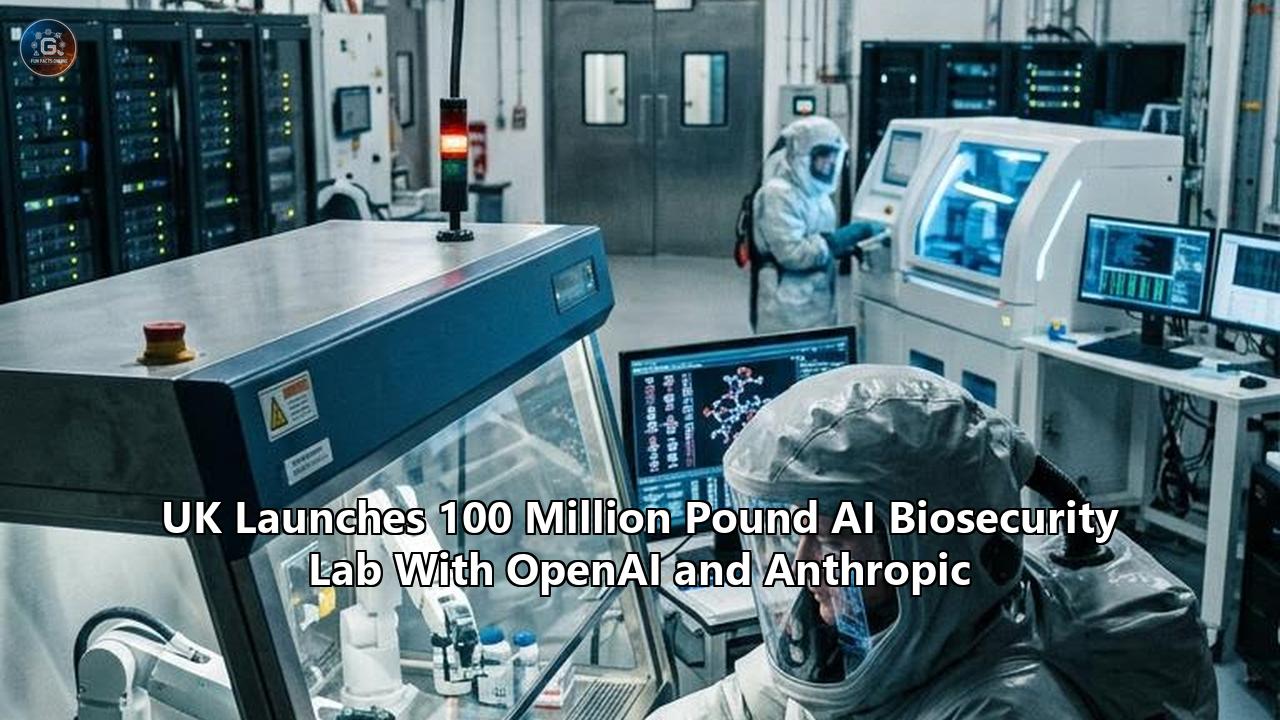
On a damp Saturday morning in Whitehall, the British government unveiled what it described as a first-of-its-kind defensive fortress for the biological age. Tucked inside an omnibus tech-security package exceeding £600 million ahead of the autumn budget, Chancellor John Healey and AI Minister Kanishka Narayan announced the creation of the AI Biosecurity Lab (AIBL). The headline figure was striking: £100 million in taxpayer capital, matched by up to £200 million in commitments from American artificial intelligence frontrunners OpenAI and Anthropic, alongside operational support from Google DeepMind and British synthetic biology firm Basecamp Research.
The mandate handed to this new body is stark. Working as an independent non-profit entity closely aligned with national security agencies, the UK AI biosecurity lab will deploy the world’s most advanced computational models to scan environmental data for unknown biological agents, simulate synthetic pathogens before they emerge in the wild, and dramatically compress the timeline needed to engineer life-saving vaccines and molecular countermeasures.
Behind the patriotic rhetoric of national resilience and global scientific leadership lies an unresolved operational contradiction. Modern artificial intelligence is dual-use by design. The identical algorithmic systems that can map the folds of a novel antibody or identify an aberrant genomic sequence in municipal wastewater can also be directed to engineer viral escape mutations, bypass DNA synthesis security screening, or lower the technical barrier for non-state actors seeking to synthesize chemical and biological toxins.
An examination of internal planning documents, agency mandates, and technical partnerships reveals a high-stakes public experiment. In attempting to protect its population against algorithmic biological threats, Britain is tethering its national biodefense apparatus directly to the proprietary compute architectures of the very commercial companies whose breakneck development schedules are generating those existential risks in the first place.
Following the Money: Hard Sterling Versus Computational IOUs
When Chancellor Healey stepped before cameras to frame the initiative, the political presentation pointed to a £300 million combined war chest. A forensic look at the financing ledger tells a different, more nuanced story about how modern sovereign capabilities are procured.
               ┌────────────────────────────────────────────────────────┐
               │    £165M National AI Biosecurity Initiative (Gov)      │
               └───────────┬────────────────────────────────┬───────────┘
                           │                                │
            ┌──────────────▼───────────────┐  ┌─────────────▼─────────────┐
            │ £100M Public Cash Allocation │  │ £65M Pathogen Surveillance│
            │   to UK AI Biosecurity Lab   │  │   & Countermeasure Fund   │
            └──────────────┬───────────────┘  └───────────────────────────┘
                           │
      ┌────────────────────┴────────────────────┐
      ▼                                         ▼
┌───────────────────────────┐      ┌───────────────────────────┐
│ OpenAI: £100M Commitments │      │Anthropic: £100M Commitment│
│  - Rosalind Biodefense    │      │  - Model Credits & API    │
│  - Compute & Model Access │      │  - Dedicated Red-Teaming  │
└───────────────────────────┘      └───────────────────────────┘
The British Treasury is committing £100 million of direct public cash to the lab as the anchor of a £165 million National AI Biosecurity Initiative. The remaining £65 million of public money is ring-fenced separately for biological surveillance infrastructure and the rapid development of medical countermeasures across regional health bodies.
The £200 million pledged by Silicon Valley is not cash. It will not buy centrifuges, hire bench scientists, or fund negative-pressure containment suites. Instead, it consists entirely of compute resources, API access vouchers, and internal engineering support split between OpenAI and Anthropic.
OpenAI has earmarked £100 million in compute allocations and privileged access to its frontier models through its proprietary Rosalind Biodefense programme. Anthropic has countered with an equivalent £100 million pledge comprising model credits, trusted system access, and specialized safety engineering time.
This corporate contribution model mirrors a strategy increasingly deployed by technology monopolists seeking to ingratiate themselves with sovereign states. By providing in-kind access to digital infrastructure rather than capital, the vendors offset taxes, train their models on proprietary state data, and cement their platforms as the indispensable operational substrate of national security.
"Compute credits are the digital equivalent of company scrip," observed one senior biosafety policy adviser who previously consulted for the Cabinet Office, speaking on condition of anonymity. "The government announces an eye-catching aggregate valuation, but every single token consumed runs through proprietary cloud infrastructure owned by Microsoft or Amazon. If Britain wants to build sovereign defensive capability, relying on corporate promotional credit lines from overseas commercial entities creates fundamental structural vulnerabilities."
The operational structure of the lab also raises questions about administrative oversight. While the government has formally declared that the institution will operate as an independent non-profit modeled after the UK AI Security Institute (AISI)—which itself secured a fresh £120 million injection in the same budget tranche—key operational mechanics remain unsettled. The official launch failed to name an inaugural director, omitted a permanent physical location, and left the multi-year timeline for capital expenditure ambiguous.
What is established is the sprawling institutional web designed to interact with the facility. The lab will sit at the center of a collaborative nexus involving:
- The Defence Science and Technology Laboratory (Dstl) at Porton Down
- The UK Health Security Agency (UKHSA)
- The Animal and Plant Health Agency (APHA)
- The Medicines and Healthcare products Regulatory Agency (MHRA)
- Commercial life sciences innovators Google DeepMind and Basecamp Research
The political calculations driving this move run directly through 11 Downing Street. Confronted with volatile domestic economic conditions and intense pressure to prevent deindustrialization, Chancellor Healey framed the wider £600 million tech allocation as an effort to protect public welfare while capturing frontier industrial gains.
"AI will transform daily life: every firm, community, hospital, school, and every aspect of our economy can benefit," Healey declared when announcing the funding. He pointed to a "distinctively British approach to AI—one that doesn't leave workers behind and defends our national interest".
Yet within intelligence and biodefense networks, the tone is significantly less celebratory and far more urgent.
The Threat Vector: When Frontier Reasoning Meets Synthetic Biology
To understand why ministers agreed to spend £100 million amid sweeping public sector budget constraints, one must examine the classified threat dossiers circulating across Whitehall over the past eighteen months.
The democratization of biological weapons design has long been constrained by tacit knowledge—the physical, intuitive laboratory expertise that cannot be gleaned purely from textbook study. An aspiring bad actor might obtain the genomic sequence of an orthopoxvirus or a filovirus, but successfully culturing, modifying, and weaponizing the agent historically required years of specialized, trial-and-error bench experience, access to high-containment facilities, and sophisticated equipment.
Frontier AI systems are rapidly degrading these physical bottlenecks. The danger does not stem from simple text bots scraping Wikipedia for historical smallpox recipes. The emergent threat is driven by multimodal models and reasoning engines capable of parsing biological data structures, troubleshooting wet-lab execution steps in real time, and designing entirely novel functional proteins.
┌────────────────────────────────────────────────────────────────────────┐
│                        THE BIO-THREAT PROGRESSION                      │
└────────────────────────────────────────────────────────────────────────┘

    Traditional Bottleneck               Frontier AI Disruption
    ──────────────────────               ──────────────────────
 1. Tacit Lab Knowledge             ►►   Real-time wet-lab troubleshooting
    (Years of bench experience)          and step-by-step synthesis prompts.

 2. Gene Synthesis Screening        ►►   De-obfuscation tools and split-gene
    (Providers blocking pathogens)       design to bypass sequence flags.

 3. Pathogen Fitness Limitations    ►►   Generative protein design optimizing
    (Virulence vs. stability trade-off)   receptor binding and immune evasion.
Government biosecurity teams point to three primary risk profiles:
1. The Removal of the Human Apprenticeship Barrier
Large reasoning models, particularly those trained on extensive corpora of scientific literature, biochemical protocols, and laboratory manuals, can act as automated lab assistants. Red-teaming operations carried out by the AI Security Institute found that advanced models could walk non-expert users through the end-to-end steps of sourcing precursor chemicals, optimizing bacterial growth conditions, and evading biological safety measures during gene ordering.
2. Systematic Evasion of DNA Synthesis Screening
Commercial gene synthesis providers screen customer orders against databases of regulated pathogens and toxins. However, generative models can now assist bad actors in systematically obfuscating biological designs. By designing split-gene sequences, introducing silent mutations that preserve toxic functionality while confusing sequence-matching algorithms, or generating chimeric variants that fall outside regulatory watchlists, rogue actors can weaponize benign synthesis pipelines.
3. De Novo Pathogen Optimization
Beyond assisting in the reconstruction of known agents, frontier computational biology tools can model how mutations impact pathogenicity, stability, and transmissibility. With algorithms like Google DeepMind’s AlphaFold transforming the structural prediction of proteins, tools designed to model how therapeutics bind to human cells can be inverted to optimize how an engineered pathogen binds to human ACE2 or immune receptors.
In an interview conducted inside the Department for Science, Innovation and Technology (DSIT), a government biosecurity specialist outlined the practical scenario that galvanized the Cabinet Office:
"Imagine a scenario where a fringe ideological actor does not possess a PhD in virology. Historically, that individual would fail at the culturing stage, or alert intelligence services when attempting to buy synthesis fragments. Today, an unaligned multimodal agent can generate the exact sequences to order under false pretenses, specify substitutions that evade current DNA screening heuristics, and instruct the user on how to adapt off-the-shelf consumer laboratory hardware to brew the pathogen. That is the vulnerability window the UK AI biosecurity lab is tasked with closing."
Traditional Threat Vector:
[Actor] ──► [Academics / Textbooks] ──► [Failed Culturing / Bench Failure] ──► Threat Neutralized

Emergent AI-Assisted Vector:
[Actor] ──► [Frontier Reasoning Model] ──► [Screening-Evading Sequences] ──► [Automated Bench Tools] ──► Viable Agent
This dynamic explains the defensive urgency behind the government’s move. AI Minister Kanishka Narayan, speaking shortly after the announcement, positioned the laboratory not as an academic exploratory think tank, but as a defensive response unit.
"As AI becomes more powerful, Britain must have the capabilities to protect its people and shape its own future," Narayan said. "That means staying ahead of emerging threats, from cyber attacks to biological risks, while building more of the critical technology our security depends on. Our new AI Biosecurity Lab will be a major new global institution, bringing together world-leading scientific expertise to protect people from emerging biological threats and ensure Britain leads the world in AI safety and security".
The critical question remains: can an institution rely on the very developers driving this algorithmic leap forward to deliver the shield?
The Architecture of the UK AI Biosecurity Lab: Defense in Depth
To counter these vulnerabilities, the AIBL is structured around three functional pillars that link academic life sciences, frontier tech firms, and military defense intelligence.
┌─────────────────────────────────────────────────────────────────────────┐
│                      AIBL OPERATIONAL TRIDENT                           │
└────────────────────────────────────┬────────────────────────────────────┘
                                     │
         ┌───────────────────────────┼───────────────────────────┐
         │                           │                           │
         ▼                           ▼                           ▼
┌──────────────────┐       ┌──────────────────┐        ┌──────────────────┐
│  EARLY-WARNING   │       │   EVASION-PROOF  │        │   ACCELERATED    │
│  METAGENOMICS    │       │    SCREENING     │        │ COUNTERMEASURES  │
├──────────────────┤       ├──────────────────┤        ├──────────────────┤
│ Real-time        │       │ Algorithmic      │        │ AI-generated     │
│ environmental &  │       │ audits for DNA   │        │ binders, mAbs &  │
│ clinical genomic │       │ synthesis        │        │ rapid-response   │
│ threat triage.   │       │ providers.       │        │ mRNA blueprints. │
└──────────────────┘       └──────────────────┘        └──────────────────┘
Pillar I: Computational Biosurveillance and Early Warning
The lab's first assignment is building systemic early-detection engines. By analyzing raw, unstructured metagenomic data collected from hospital clinical isolates, animal reservoirs via the Animal and Plant Health Agency, and municipal wastewater surveillance networks, the lab’s algorithms will search for anomalous functional patterns.
Instead of searching strictly for known viral signatures—which fails when confronted with de novo engineered threats—the AIBL will deploy models trained on vast biodiversity datasets, including proprietary natural genomic libraries provided by London-based Basecamp Research. These systems are designed to identify suspicious molecular adaptations, such as unnatural cleavage sites or engineered toxic motifs, weeks before clinical syndromic surveillance flags an escalating epidemic.
Pillar II: Next-Generation Gene Synthesis Auditing
The second operational front focuses on setting enforceable algorithmic standards for synthetic biology providers. Working in tandem with the MHRA and international standards bodies, the lab will create automated red-teaming pipelines that continuously challenge DNA synthesis companies.
These pipelines will generate thousands of obfuscated sequence variations to test whether synthesis providers' safety filters can be circumvented. Facilities that fail to detect these AI-designed biological exploits will face regulatory interventions under the UK’s broader Biological Security Strategy.
Pillar III: Accelerated Molecular Countermeasures
The defensive doctrine assumes that prevention will occasionally fail. When an unidentified or engineered agent is detected, the lab will pivot from surveillance to molecular response.
Leveraging structural biology models from Google DeepMind, such as Gemini-backed chemical engines and advanced iterations of AlphaFold, alongside model access from Anthropic and OpenAI, the lab will simulate how the pathogen targets human cellular machinery. Computational models will then design candidate neutralizing binders, monoclonal antibodies, and mRNA vaccine sequences in silico.
The £65 million pathogen countermeasure fund will finance the immediate wet-lab synthesis and preclinical testing of these AI-generated constructs through pre-arranged fast-track pipelines managed by the UKHSA and Dstl.
"Used safely and securely, the same technology can help us detect threats earlier and design lifesaving vaccines faster, fundamentally changing what is possible in pandemic preparedness," noted an official statement from the Coalition for Epidemic Preparedness Innovations (CEPI), which is liaising with the project.
Oliver Vince, co-founder of Basecamp Research, echoed this focus on biological resilience: "Basecamp Research is proud to support the AI Biosecurity Lab. It's great that the UK government is deploying cutting edge AI capabilities to strengthen our resilience".
The technical vision is coherent on paper. Yet the internal mechanics of how OpenAI and Anthropic are interfacing with this defensive perimeter reveal a deep divergence in philosophy, corporate posturing, and technical execution.
Inside the Silicon Valley Alliance: Project Rosalind and Anthropic’s Protocol
The involvement of OpenAI and Anthropic is framed publicly as corporate citizenship. A review of the two companies' technical contributions, however, reveals contrasting approaches to biological risk and divergent corporate strategies for navigating state oversight.
┌────────────────────────────────────────────────────────────────────────┐
│                   COMPETING ARCHITECTURES OF ENGAGEMENT                │
└────────────────────────────────────────────────────────────────────────┘

Feature              OpenAI (Project Rosalind)     Anthropic
───────────────────  ────────────────────────────  ──────────────────────
Model Access         Tiered, Sandboxed Access      Direct API & Technical
                     via Proprietary Gateway       Red-Teaming Enclave
Compute Focus        Compute Credits via Azure     Bedrock/GCP Multi-cloud
Primary Capability   Reasoning & Multimodal Tool   Constitutional AI &
                     Integration (o-series/GPT-4)  Automated Threat Probing
Primary Motivation   Product Integration & Legal   Safety-Centric Positioning
                     De-risking via State Testing  and Tiered Gating
OpenAI’s involvement runs through its Rosalind Biodefense programme, an internal initiative designed to apply reasoning models toward bioprotection while strictly siloing hazardous wet-lab outputs. OpenAI's £100 million contribution provides the AIBL with trusted access to specialized, high-tier reasoning models that are not accessible to the general public.
"The phrase 'trusted access' signals a tiered arrangement, in which vetted users reach capabilities that are not open to the general public," explained a computer scientist familiar with OpenAI’s government deployment strategy. "Labs want biology-capable models in the hands of defenders, but they cannot release those capabilities into public APIs without courting catastrophe. The UK government is essentially serving as a sanctioned testing enclave".
OpenAI has steadily positioned itself alongside sovereign defense institutions. Only days prior to the UK announcement, the company completed its acquisition of biological interface specialist Orchestra Bio, signaling an aggressive commercial expansion into life sciences and therapeutic discovery. By routing its Rosalind initiative through the UK government, OpenAI secures a premier proving ground to validate its biological reasoning agents alongside seasoned national defense scientists.
Anthropic has approached the partnership from a distinct vantage point. Known for its focus on frontier AI risk and its pioneering work on Constitutional AI, the company is committing up to £100 million in model credits alongside technical deployment teams. Anthropic’s internal biosecurity research unit has been among the most vocal in warning about the near-term risk of large language models facilitating biological attacks.
In late 2023, Anthropic published red-teaming evaluations demonstrating that state-of-the-art models were uncomfortably close to providing actionable instructions for synthesizing hazardous agents. The company has since developed rigorous internal safety levels (Responsible Scaling Policies), requiring specific containment and safety protocols before training more powerful models.
"Our agreement with the British government reflects our view that defensive biological capabilities must systematically outpace offensive capabilities," a source within Anthropic’s safety team explained. "If model capabilities are scaling exponentially, sovereign defense teams must have direct access to un-degraded, frontier-grade reasoning systems to build corresponding protective shields. You cannot defend against a threat you cannot simulate."
Yet this reliance on the frontier models of private corporations creates operational dependency. The UK AI biosecurity lab will be building its detection algorithms and defensive pipelines on model architectures whose internal weights, training corpora, and alignment filters remain closely guarded commercial trade secrets.
If an Anthropic or OpenAI model undergoes a silent capability update or fine-tuning adjustment, the performance of the government's defensive biosecurity tools could fluctuate unpredictably. British biodefense is effectively building its house on leased computational land.
The Porton Down Nexus: Bridging Whitehall and the Laboratory Bench
No initiative addressing British biological defense can operate in a vacuum. Five miles northeast of Salisbury lies Porton Down, home to the Defence Science and Technology Laboratory (Dstl) and the historical epicenter of Britain’s military chemical and biological defense programs.
The creation of the AIBL has forced an uneasy cultural synthesis between the secretive, cautious world of Porton Down defense scientists and the rapid, iterate-in-public ethos of Silicon Valley engineering teams.
           ┌──────────────────────────────────────────────┐
           │        THE DUAL-TRACK DEFENSIVE PIPELINE     │
           └──────────────────────┬───────────────────────┘
                                  │
     ┌────────────────────────────┴────────────────────────────┐
     ▼                                                         ▼
┌───────────────────────────┐             ┌───────────────────────────┐
│ Computational Sphere      │             │ Physical Sphere           │
│ (AIBL, OpenAI, Anthropic) │             │ (Dstl Porton Down, UKHSA) │
├───────────────────────────┤             ├───────────────────────────┤
│ • Algorithmic In Silico   │  Digital    │ • High-Containment BSL-4  │
│   Screening               │  Genomic    │   Validation Suites       │
│ • Diffusion-based Protein │  Pipeline   │ • Live Pathogen Neutral-  │
│   Optimization            │ ──────────► │   ization Assays          │
│ • Molecular Docking &     │             │ • Wet-Lab Countermeasure  │
│   Binding Simulation      │             │   Synthesizers            │
└───────────────────────────┘             └───────────────────────────┘
For decades, Dstl operated under doctrines dictated by international treaties, primarily the 1972 Biological Weapons Convention. Work at Porton Down has focused strictly on defensive countermeasures: testing protective suits, operating biological detection sensors on naval vessels, developing decontamination agents, and maintaining reference strains of high-consequence pathogens such as anthrax, plague, and Ebola.
The arrival of the new lab fundamentally shifts the defensive timeline from retrospective reaction to computational pre-emption.
"Historically, Porton Down worked on physical materials—a powder found in an envelope, a soil sample collected from a suspected site, an unexplained outbreak among sheep in Wiltshire," said a former Ministry of Defence scientific adviser. "The UK AI biosecurity lab shifts the locus of defense to the computational sphere. The battlefield is now in the algorithmic prediction space: can a neural network anticipate an unnatural viral mutation before that virus is ever cultured in an overseas lab?"
This operational integration is directly supported by the Medicines and Healthcare products Regulatory Agency (MHRA). Under arrangements mapped out in the launch protocol, the MHRA will embed regulatory specialists within the lab to solve a long-standing biosecurity bottleneck: the validation gap.
If the lab's computational models successfully generate a bespoke monoclonal antibody against a newly identified synthetic viral vector in 72 hours, current regulatory processes would still require months or years of clinical safety trials before that treatment could be legally manufactured and administered to emergency personnel or the public. The MHRA’s task is to design an agile, adaptive regulatory sandbox capable of evaluating the safety of algorithmically generated medical countermeasures in compressed, emergency timeframes.
This integration with national health infrastructure reflects lessons learned from the COVID-19 pandemic. The UK Vaccine Taskforce’s historic success was driven by pre-purchasing agreements, agile clinical trials, and deep scientific integration across the NHS and academic centers. The biosecurity lab seeks to institutionalize that posture into a permanent, algorithmically driven infrastructure.
However, the intersection of military intelligence, commercial artificial intelligence, and biological sciences introduces significant risks of miscalculation. If the AIBL uses frontier AI systems to simulate novel, immune-evasive variations of known pathogens to design countermeasures, the lab is inherently engaged in dual-use research.
Under international law, the distinction between developing a defensive countermeasure and researching an enhanced offensive agent hinges entirely on intent and transparency. Should a sovereign adversary or an international inspection team review the lab’s computational repositories, the algorithmic blueprints for a hyper-transmissible synthetic virus designed as a simulation stress-test look identical to the blueprints for a biological weapon.
The Regulatory Capture Conundrum: Who Truly Benefits?
Beyond the operational logistics and technical challenges lies an unresolved political dilemma: is the British government leading a global safety initiative, or is it providing liability cover and state subsidies to an unregulated commercial sector?
The broader funding package unveiled by Chancellor Healey contains several initiatives that signal an aggressive state intervention in artificial intelligence:
- £100 million for the AI Biosecurity Lab
- £65 million for pathogen countermeasures and bio-surveillance
- £120 million for the AI Security Institute to expand frontier model red-teaming
- £130 million for cybersecurity, encompassing a £60 million National Cyber Shield and a £70 million National Exposure and Real-Time Vulnerability (Nerv) centre
- £120 million to expand the Sovereign AI Fund into physical robotics and manufacturing
- £23 million for an AI Economics Institute to assess labor displacement and workforce effects
┌────────────────────────────────────────────────────────────────────────┐
│             £600M+ GOVERNMENT AI SECURITY ALLOCATION                   │
└────────────────────────────────────────────────────────────────────────┘

  £165M ─── National AI Biosecurity Initiative (AIBL & Countermeasures)
  £130M ─── Cybersecurity (National Cyber Shield & Nerv Centre)
  £120M ─── AI Security Institute (Testing & Evaluation Expansion)
  £120M ─── Sovereign AI Fund (Robotics, Physical AI & Manufacturing)
  £23M  ─── AI Economics Institute (Workforce & Labor Impacts)
  Other ─── Innovator Challenge Funds & Regulatory Sandboxes
This represents one of the largest single commitments of public funds to defensive AI infrastructure anywhere in the Western world. Yet critics within Parliament and across the academic AI safety community argue that the government has structured its partnerships backward.
Over the past year, several high-profile researchers have resigned from leading AI labs, warning of cultures that systematically prioritize rapid commercial deployment over fundamental safety assurances. In hearings before the UK Parliament’s Science, Innovation and Technology Committee, former researchers warned MPs that the frontier developers are taking existential risks while presenting modest safety collaborations to governments as evidence of responsible stewardship.
"There is an acute danger of regulatory capture," argued Dr. Stuart Armstrong, a researcher focused on existential risk. "When governments accept tens of millions of pounds in compute credits from OpenAI and Anthropic, those tech giants become structurally embedded within the state's national security architecture. It becomes politically and institutionally difficult for Whitehall to aggressively regulate, audit, or penalize those same companies when their commercial models trigger systemic safety failures."
Furthermore, the public-private partnership structure shields companies from liability. By donating compute credits to the UK AI biosecurity lab, companies like OpenAI and Anthropic gain access to rare, state-curated biological risk data.
The state's top biologists will effectively spend taxpayer hours red-teaming these commercial models, flagging vulnerabilities, identifying hallucinated chemical reactions, and troubleshooting capability blind spots. The technology companies receive an invaluable, state-funded auditing service, enabling them to refine and harden their proprietary commercial models at virtually no cost.
The economic framing has also faced scrutiny. In public appearances, ministers have tried to weave defense spending together with job protection.
Chancellor Healey stated that the package is designed to reassure workers worried about technological unemployment, promising a framework that "does not leave workers behind". Yet linking biological weapon defense spending to industrial labor policy strikes many as disconnected.
"Biological security is a non-negotiable public health emergency mandate," said an Oxford university biosecurity fellow. "Attempting to market an AI biosecurity laboratory as an engine of economic growth and blue-collar job protection reveals a government attempting to be all things to all constituencies, obscuring the grim reality that these technologies are inherently hazardous."
The Global Chessboard: Sovereign Defense vs. American Tech Supremacy
The UK’s initiative must also be viewed through a geopolitical lens. Since hosting the Bletchley Park AI Safety Summit, the British government has sought to carve out a unique role as the world's independent referee on artificial intelligence.
Britain lacks the domestic private venture capital to match Silicon Valley's tech giants, nor does it possess the state-directed digital apparatus of China. Whitehall’s gambit has been to lead in governance, evaluation, and defensive infrastructure.
┌────────────────────────────────────────────────────────────────────────┐
│                    THE TRANSATLANTIC LEVERAGE DYNAMIC                  │
└────────────────────────────────────────────────────────────────────────┘

          UNITED KINGDOM                          UNITED STATES
┌─────────────────────────────────┐    ┌─────────────────────────────────┐
│ • Independent Scientific Audit  │    │ • Hyperscale Compute Capital    │
│ • State Defense Legitimacy      │    │ • Proprietary Frontier Weights  │
│ • NHS Metagenomics Data Access  │    │ • Domestic Regulatory Gridlock  │
│ • Sovereign Regulatory Shield   │    │ • Commercial Export Dominance   │
└────────────────┬────────────────┘    └────────────────┬────────────────┘
                 │                                      │
                 │          ASYMMETRIC ALLIANCE         │
                 └──────────────────►◄──────────────────┘
                    UK secures state-of-the-art tools;
                    US firms secure regulatory cover and
                    national security validation.
By establishing the world’s first dedicated AI biosecurity lab, Britain hopes to replicate the institutional success of the AI Security Institute, whose red-teaming evaluations are now utilized by foreign governments, including the United States and Japan. The lab provides Britain with a seat at the highest tables of international intelligence-sharing networks, notably the Five Eyes alliance.
Yet this strategy exposes a deeper European vulnerability. Despite the government’s concurrent £120 million investment in its Sovereign AI Fund, British defense remains dependent on American foundation models.
Neither the UK nor the European Union possesses an indigenous artificial intelligence developer operating at the scale of OpenAI, Anthropic, or Google. The computational pipelines that will safeguard British water supplies, agricultural systems, and clinical networks will execute on models trained, governed, and ultimately controlled from San Francisco and Seattle.
The announcement also follows a massive computational pledge from Nvidia, which committed $250 million in compute infrastructure to UK safety research. In both cases, the currency of cooperation is access to foreign Silicon Valley processing power.
If diplomatic relations fray, or if an incoming United States administration decides to restrict foreign access to frontier dual-use models under export-control regimes, the UK’s biological defenses could find their underlying software access throttled overnight.
AI Minister Narayan has acknowledged that technological independence is a long-term goal, noting in recent interviews that Britain must have the domestic capacity to understand and intervene in the code that governs its societal security.
"We need to build critical sovereign technology while managing risks that are already live," Narayan remarked. But for the foreseeable future, British biodefense will operate as a client state to American commercial innovation.
Horizon Scan: What Comes Next for the Lab
As Whitehall prepares to operationalize the facility ahead of the comprehensive spending review, the team guiding the transition confronts critical deadlines and unresolved logistical questions.
1. The Physical Location and Operational Leadership
The Cabinet Office must finalize a site for the lab. Three primary options are currently under consideration:
- The Golden Triangle (London-Oxford-Cambridge): Locating the lab near the Francis Crick Institute or Oxford’s scientific cluster would facilitate the recruitment of elite computational biology and machine learning talent.
- Porton Down (Wiltshire): Co-locating with Dstl would provide seamless integration with existing high-containment Biosafety Level 4 (BSL-4) facilities, though it would hamper recruitment of non-security-cleared international engineers.
- A Distributed Model: The most probable path is an administrative and algorithmic headquarters in central London linked to specialized wet-lab testing facilities at Porton Down and the UKHSA’s Colindale laboratories.
A recruitment search is actively underway for an inaugural Chief Executive. Whitehall insiders suggest the government is seeking a hybrid figure—someone who bridges the cultural divide between high-end academic computational biology, commercial venture capital, and national intelligence services.
2. The Verification Protocols for Synthesis Providers
By mid-2027, the lab is expected to publish its first comprehensive framework for AI-resistant gene synthesis screening. This framework will establish clear, verifiable standards for synthesis providers operating within the UK.
It will force companies to demonstrate that their automated screening engines cannot be fooled by AI-generated obfuscation strategies. The lab will conduct unannounced computational audits, injecting synthetic digital orders into commercial pipelines to test detection rates.
3. Integration with the National Cyber Shield
The AIBL will not operate in clinical isolation. The £60 million National Cyber Shield announced in the same funding package will deploy autonomous AI agents to defend critical infrastructure.
Whitehall defense planners intend to link the cyber shield directly with the biosecurity lab. As biological laboratory hardware—including automated liquid handlers, DNA synthesizers, and bioreactors—becomes increasingly automated and internet-connected, the line between a cyber breach and a biological release blurs.
A cyber-attack that modifies the digital sequence files of an automated pharmaceutical manufacturing plant could trigger the accidental production of toxic peptides. The two laboratories will run joint simulations to safeguard against these hybrid bio-cyber attack vectors.
                     HYBRID BIO-CYBER ATTACK VECTOR
                     ──────────────────────────────
         Cyber Breach                         Physical Impact
 ┌───────────────────────────┐           ┌───────────────────────────┐
 │ Rogue actor infiltrates   │           │ Automated bioreactor      │
 │ pharmaceutical plant's    │ ────────► │ synthesizes toxic peptide │
 │ cloud-connected sequence  │           │ batches disguised as      │
 │ instructions.             │           │ insulin precursors.       │
 └───────────────────────────┘           └───────────────────────────┘
               ▲                                       ▲
               │                                       │
       Defended by AIBL / National Cyber Shield Cross-Audit
4. International Treaty Alignment
The lab faces an immediate diplomatic hurdle: establishing transparent verification protocols under the Biological Weapons Convention.
The UK plans to present the AIBL’s operational blueprint at international disarmament forums in Geneva, offering it as a template for allied nations seeking to construct defensive biological screens without violating non-proliferation pacts.
The trajectory of this ambitious initiative will reveal whether a mid-sized sovereign state can effectively hedge against the risks of advanced artificial intelligence by partnering with the entities generating those risks.
The British government has placed a £100 million bet that algorithmic defenses can run faster than algorithmic weapons. In the biological arena, where a single computational blind spot can manifest as an uncontainable pandemic, the margin for error is nonexistent.
The servers are powering on, the model credits have been issued, and the world will soon observe whether Britain's computational fortress can withstand the biological challenges of the machine age.
Reference:
- https://www.unite.ai/uk-establishes-ai-biosecurity-lab-backed-by-openai-and-anthropic/
- https://thenextweb.com/news/uk-funds-100m-ai-biosecurity-lab-with-openai-and-anthropic
- https://www.cityam.com/google-openai-and-anthropic-back-100m-uk-ai-biosecurity-lab/
- https://www.briefs.co/news/uk-pledges-100-million-for-ai-biosecurity-lab-backed-by-tech/
- https://www.gov.uk/government/news/chancellor-unveils-britains-ambitious-plan-for-ai
- https://shattered.io/uk-ai-biosecurity-lab-100m-openai-anthropic-200m-credits-2026/
- https://www.independent.co.uk/news/uk/home-news/john-healey-government-budget-anthropic-openai-b3072549.html
- https://newscord.org/article/uk-government-establishes-national-ai-biosecurity-lab-with-100m-budget-openai-an--Story_20261024_UKtoinvest100minworl9b4f3fab
- https://www.youtube.com/shorts/THzkPNMM9DA