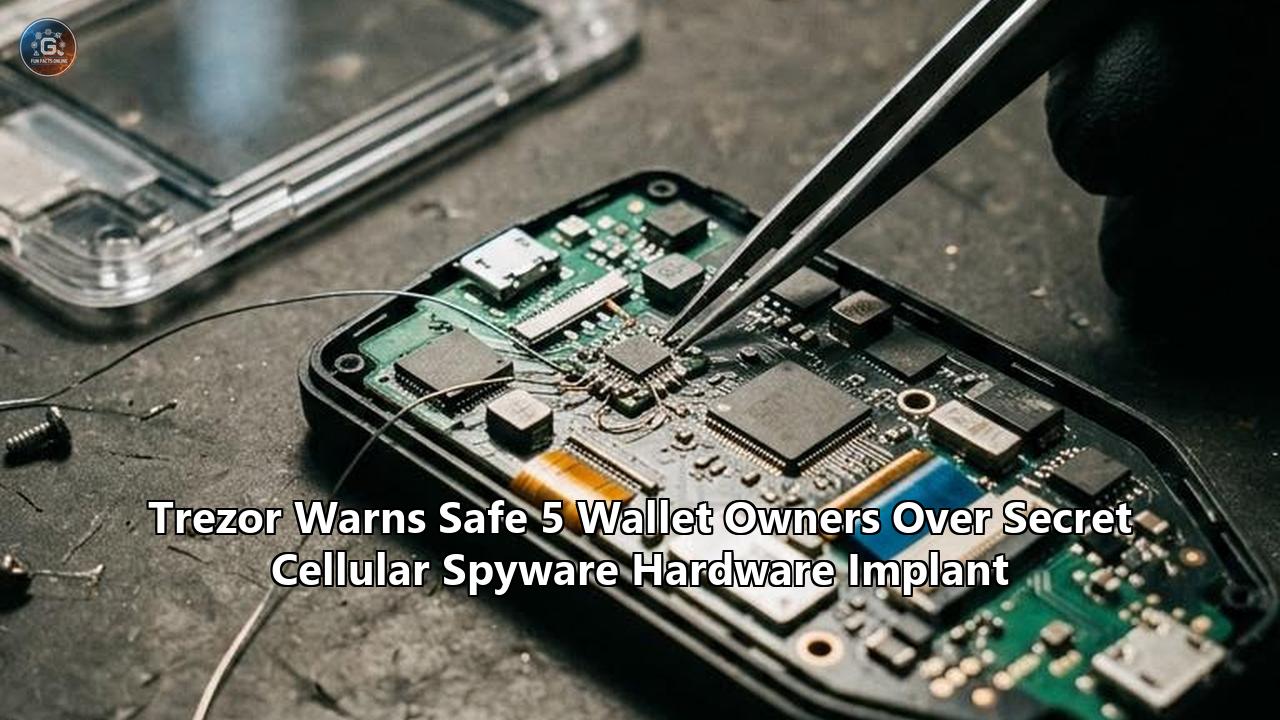
Hardware wallet manufacturer Trezor issued an urgent advisory to cryptocurrency owners on October 30, 2026, warning that a Trezor Safe 5 device purchased in Southeast Asia had been physically compromised with an internal surveillance implant capable of exfiltrating private seed phrases over cellular networks. The alert follows a responsible disclosure submitted to Trezor’s security team on October 28 by an Indonesian customer who discovered an unauthorized printed circuit board spliced between the wallet's motherboard and color touchscreen.
The customer had purchased the flagship device in August 2026 through the e-commerce marketplace Tokopedia from CryptoBilis, a major regional distributor. According to the disclosure, the rogue hardware component carried an embedded cellular communication modem and antenna. Operating as a display bus tap, the implant was engineered to silently read data sent to the screen during initialization—specifically capturing the wallet's 20-word or 12-word master recovery seed phrase—and transmit those plain-text credentials to remote attackers over mobile network bands whenever the device was connected to power.
The official Trezor Safe 5 security warning applies to anyone who purchased any Trezor model supplied by CryptoBilis from March 2026 onward. Trezor advised affected owners to immediately sweep their digital assets into newly created wallets generated with completely independent recovery phrases.
The discovery has sent shockwaves through the hardware wallet sector because it confirms that physical supply-chain poisoning in commercial distribution channels is no longer an isolated anomaly targeting a single brand. Earlier in October, rival manufacturer Ledger confirmed a parallel supply-chain breach linked to the exact same vendor, CryptoBilis, after attackers drained an estimated $93 million from hundreds of Ledger devices across Southeast Asia.
By intercepting confidential recovery phrases directly at the physical display interface, attackers have bypassed the primary cryptographic and silicon-level defenses of modern cold storage without needing to break encryption or alter device firmware.
The Interposer Threat: How the Spy Implant Defeated Device Defenses
The hardware implant discovered inside the Safe 5 represents an interposer attack, a physical tap executed directly on the data bus connecting the microchip controller to the screen. To appreciate how this bypasses hardware wallet protections, it helps to examine how the device was designed to function.
Standard Secure Flow:
[Secure Element / MCU] === (Protected Internal Trace) ===> [Color Display]
                                                                  |
Rogue Interposer Tap:                                             v
[Secure Element / MCU] === [Rogue Interposer PCB] ========> [Color Display]
                                  |
                                  +---> [Cellular Modem & Antenna] ---> (Cellular Network)
The Trezor Safe 5 relies on an EAL6+ certified Secure Element paired with open-source firmware running on an embedded microcontroller. Cryptographic key generation takes place inside the silicon boundaries using on-chip true random number generators. Private keys never leave the secure boundary; during routine operations, transaction hashes are sent into the device via USB, signed internally, and returned to the host computer.
However, every hardware wallet has an unavoidable architectural vulnerability: human verification. During initial configuration, the device must generate a cryptographic root key and display its plain-text representation—the mnemonic recovery phrase—so the user can write it down.
At that precise moment, raw pixel data or serialized display commands must travel from the processor across the printed circuit board traces to the 1.54-inch color display.
+--------------------------------------------------------------------------+
|                     TREZOR SAFE 5 ENCLOSURE INTERIOR                     |
|                                                                          |
|   +------------------------------------------------------------------+   |
|   |                  Color Display Module (1.54")                    |   |
|   +------------------------------------------------------------------+   |
|                                    ^                                     |
|             Display Interface Lines| (Sniffed by Interposer)             |
|                                    v                                     |
|   +------------------------------------------------------------------+   |
|   |         MALICIOUS IMPLANT PCB (Sandwiched Interposer)            |   |
|   |                                                                  |   |
|   |   [Bus Sniffing Circuit] ---> [eSIM / Cellular Modem + Antenna]  |   |
|   +------------------------------------------------------------------+   |
|                                    ^                                     |
|                      Mainboard Bus | Connection                          |
|                                    v                                     |
|   +------------------------------------------------------------------+   |
|   |                  Trezor Safe 5 Mainboard                         |   |
|   |                                                                  |   |
|   |   [EAL6+ Secure Element]      [Microcontroller (MCU)]            |   |
|   +------------------------------------------------------------------+   |
+--------------------------------------------------------------------------+
The rogue implant found inside the compromised Safe 5 exploited this transition point. According to technical documentation provided during the disclosure, an aftermarket printed circuit board was physically inserted into the display stack. By splicing into the display controller traces, the implant’s sniffing logic recorded the exact characters rendered on the screen.
Because the implant was equipped with its own cellular baseband chip and micro-antenna, it did not need to communicate with the host computer through the USB controller. Host-based intrusion detection tools, network firewalls, and air-gapped operating systems were blind to the intrusion. The moment the user plugged the Safe 5 into a standard USB-C port or wall adapter, the rogue board drew power, recorded the mnemonic sequence shown on the screen, registered onto a commercial mobile carrier network, and transmitted the phrase to the attacker's infrastructure.
This methodology neutralizes core security assumptions. The Secure Element performed its job without flaw. The cryptographic randomness of the seed was mathematically sound. Yet, by converting the device into an autonomous mobile transmitter, the attackers made the strength of the silicon irrelevant.
Crisis Management Compared: Trezor’s Immediate Disclosure Versus Ledger’s Latency
The handling of this supply-chain intrusion reveals contrasting approaches to disclosure between the industry’s two largest hardware wallet manufacturers.
CRITICAL TIMELINE: SOUTHEAST ASIAN SUPPLY-CHAIN INCIDENTS (2025–2026)

[Dec 2025]   Early reports of tampered Ledger devices flagged by regional educators.
[Mar 4, 2026] Researcher Joe Grand warns Ledger of an implanted Nano X from Lazada Thailand.
[Aug 2026]   Indonesian buyer purchases Trezor Safe 5 via Tokopedia from CryptoBilis.
[Oct 9, 2026] Coordinated drains hit Ledger users (~$93M). Trezor drops CryptoBilis.
[Oct 10, 2026]Ledger confirms unauthorized hardware implant in a CryptoBilis-sold device.
[Oct 28, 2026]Indonesian buyer submits responsible disclosure of Safe 5 implant to Trezor.
[Oct 30, 2026]Trezor issues urgent public warning and initiates device replacement program.
When Ledger confronted physical tampering within its CryptoBilis distribution pipeline, the company faced sharp criticism from independent researchers over its communication timeline. Security researcher Joe Grand alerted Ledger on March 4, 2026, about a malicious implant found inside a Ledger Nano X purchased through an online marketplace in Thailand. Former Mt. Gox CEO Mark Karpelès disclosed that regional users had reported altered hardware as early as December 2025.
Despite these early warnings, Ledger kept its inquiries internal until October 9, 2026, when on-chain forensic firms documented coordinated automated drains that siphoned between $86 million and $95.35 million from more than 1,400 user addresses. On October 9 alone, attackers pulled $80.6 million out of compromised wallets within a 51-minute window. Ledger subsequently asked retailers across seven Asian markets to pull inventory from shelves and confirmed on October 10 that an unauthorized hardware implant had intercepted setup phrases.
+---------------------------+-----------------------------------+-----------------------------------+
| Metric / Approach         | Trezor (Safe 5 Incident)          | Ledger (CryptoBilis Breach)       |
+---------------------------+-----------------------------------+-----------------------------------+
| Discovery-to-Alert Time   | Under 48 hours                    | Several months from researcher    |
|                           | (Report Oct 28 -> Alert Oct 30)   | reports to public admission       |
+---------------------------+-----------------------------------+-----------------------------------+
| Laboratory Requirement    | Alerted users prior to lab test,  | Waited for internal teardowns     |
|                           | relying on video and photo data   | and mass on-chain fund drains     |
+---------------------------+-----------------------------------+-----------------------------------+
| Preemptive Channel Action | Severed CryptoBilis on Oct 9      | Severed CryptoBilis on Oct 9,     |
|                           | based on competitor's exposure    | after on-chain thefts began       |
+---------------------------+-----------------------------------+-----------------------------------+
| Impact on Customer Funds  | Zero funds reported lost          | $86M to $95.35M drained           |
|                           | at time of public alert           | across 300+ to 1,400+ wallets     |
+---------------------------+-----------------------------------+-----------------------------------+
| Remedy Offered            | Direct replacement devices        | Device replacement,               |
|                           | and vouchers issued to buyers     | sales halts across 7 markets      |
+---------------------------+-----------------------------------+-----------------------------------+
Trezor took an alternative path. The company acted preemptively on October 9 by severing ties with CryptoBilis the moment Ledger’s reseller crisis emerged, even though Trezor had not yet detected any tampering within its own inventory.
When the Indonesian customer contacted Trezor on October 28 with photographic evidence and detailed schematics of the modified Safe 5, the manufacturer skipped the traditional waiting period required for laboratory teardowns. Trezor’s security engineers conducted a technical video interview with the customer, verified the credibility of the physical layout, and published the Trezor Safe 5 security warning on October 30.
Danny Sanders, Chief Commercial Officer at Trezor, underscored the strategic calculus behind issuing the alert before the physical unit arrived at their European laboratories. Waiting for laboratory confirmation would have left buyers exposed to immediate financial theft.
By trading institutional certainty for operational speed, Trezor managed to get ahead of the adversary. At the time of disclosure, no customer who purchased a Trezor wallet through CryptoBilis had reported stolen funds. The reporting user had already swept their balances to safety before initiating the teardown that uncovered the module.
Silicon Attestation Versus Analog Interception: The Limits of Genuine Checks
The emergence of cellular spyware implants exposes a core vulnerability shared by diverse hardware architectures: cryptographic attestation checks cannot verify the analog periphery of an electronic device.
Manufacturers have long relied on competing architectural philosophies to reassure customers that their products have not been compromised. Ledger champions a closed-architecture model centered on its proprietary operating system, BOLOS, and STMicroelectronics Secure Elements.
Every time a Ledger device boots or connects to the Ledger Live client, it executes a cryptographic protocol known as a "Genuine Check". The host application challenges the Secure Element with a cryptographic nonce; the chip signs the challenge using a private key burned into the silicon during factory manufacturing. If the signature matches Ledger’s public key infrastructure, the software declares the hardware genuine.
CRYPTOGRAPHIC ATTESTATION VS. ANALOG BUS INTEGRITY

+--------------------------------------------------------------------------+
| HOST COMPUTER / APPLICATION (Trezor Suite / Ledger Live)                 |
+--------------------------------------------------------------------------+
         |                                                 |
         | Cryptographic Challenge                         | Result:
         | to Secure Element                               | "GENUINE HARDWARE"
         v                                                 | (Cryptographically
+------------------------------------------------------+   |  Verified)
| SECURE ELEMENT (Silicon Integrity Intact)            |---|
+------------------------------------------------------+
         |
         | Raw Pinout Signal to Display (Unprotected Analog Gap)
         v
+--------------------------------------------------------------------------+
| PHYSICAL INTERPOSER / CELLULAR SPY MODEM (Invisible to Attestation)     |
+--------------------------------------------------------------------------+
         |
         v
+--------------------------------------------------------------------------+
| DISPLAY SCREEN                                                           |
+--------------------------------------------------------------------------+
The CryptoBilis supply-chain attack proved that this attestation model contains a blind spot. The attackers never tampered with the Secure Element, nor did they alter the signed firmware binaries. The chip remained authentic. Consequently, every tampered Ledger Nano X and Flex passed the Genuine Check with flying colors, offering users false confidence while an LTE modem rested just millimeters away behind the screen padding.
Trezor pursued an open-source philosophy, utilizing transparent pinouts and an NDA-free Secure Element in the Safe 5 alongside public firmware codebases. The company’s defense model rests on auditability and structural transparency.
Users can inspect the source code, verify reproducible builds, and examine official board schematics. Yet, open-source transparency offers no native defense against an interposer spliced between genuine components. An intercept board that snoops the display bus operates downriver from the processor; the microcontroller’s firmware has no way of detecting that its electrical signals are being passively sampled by a secondary circuit.
The technical parameters of the display interfaces deployed on these devices illustrate the engineering hurdles:
+------------------------------+---------------------------------+---------------------------------+
| Specification / Factor       | Trezor Safe 5                   | Ledger Nano X / Flex            |
+------------------------------+---------------------------------+---------------------------------+
| Display Interface            | Color Touchscreen               | OLED / E-Ink Display            |
|                              | (SPI/Parallel display bus)      | (SPI/I2C serialized bus)        |
+------------------------------+---------------------------------+---------------------------------+
| Silicon Architecture         | EAL6+ Secure Element + MCU      | EAL6+ STMicroelectronics SE     |
|                              | (Transparent/NDA-free)          | (Proprietary BOLOS OS)          |
+------------------------------+---------------------------------+---------------------------------+
| Enclosure Construction       | Ultrasonic sealed plastic body  | Brushed stainless steel &       |
|                              | with Gorilla Glass 3 face       | plastic housing                 |
+------------------------------+---------------------------------+---------------------------------+
| Factory Integrity Validation | Holographic security tamper     | Host-based cryptographic        |
|                              | seals on retail packaging       | "Genuine Check" challenge       |
+------------------------------+---------------------------------+---------------------------------+
| Physical Attack Target       | Display interface header        | Display trace ribbon buffer     |
|                              | below touch assembly            | behind screen bezel             |
+------------------------------+---------------------------------+---------------------------------+
Neither holographic tamper seals nor ultrasonic plastic welding stopped the attackers. The criminal group responsible possessed industrial fabrication tools. They opened enclosures cleanly, soldered custom-milled circuit boards containing baseband processors, routed wiring to power inputs, and resealed the wallets in counterfeit packaging matching factory specifications.
Trezor’s security team warned users against attempting to verify device authenticity by weighing devices on precision scales. While the Indonesian customer who submitted the disclosure initially grew suspicious due to a slight physical irregularity, Trezor clarified that micro-tolerances in battery cells, adhesive layers, and plastic injection molds produce standard weight variations. Relying on retail scales to detect an integrated circuit weighing fractions of a gram is unreliable and risks granting a false bill of health to a bugged wallet.
Supply Chain Realities: Direct-to-Consumer Purity Versus Regional Distribution
The incident highlights the operational vulnerabilities of outsourced hardware distribution. Building dedicated cold-storage hardware requires solving a cross-border logistics problem. While cryptocurrency users in Western Europe and North America purchase devices directly from manufacturers, users across emerging crypto hubs face steep barriers to Direct-to-Consumer (D2C) shipments.
+--------------------------------------------------------------------------+
|               HARDWARE WALLET SUPPLY CHAIN VULNERABILITY MAP             |
+--------------------------------------------------------------------------+

[Manufacturer Factory (Europe)]
       |
       | Trusted Freight Transit
       v
[Regional Importer / Reseller (e.g., CryptoBilis - Southeast Asia)]
       |
       | <-- COMPROMISE POINT: Corporate takeover / warehouse infiltration
       |     Devices intercepted, opened, fitted with cellular implants,
       |     resealed in cloned packaging.
       v
[Secondary E-Commerce Marketplaces (Tokopedia, Shopee, Lazada, Retail)]
       |
       | Unwitting consumer purchase
       v
[End User] === (Exfiltrates Seed via Cellular) ===> [Attacker Infrastructure]
In markets across Indonesia, Malaysia, Thailand, Vietnam, and the Philippines, importing consumer electronics directly from Europe incurs aggressive customs processing, unexpected tariff assessments, clearance delays, and unreliable last-mile courier services.
To achieve commercial adoption, Trezor and Ledger established authorized reseller arrangements with third-party logistics firms. Resellers purchase inventory in bulk, manage customs clearance through commercial ports of entry, and distribute stock through domestic hubs and storefronts such as Tokopedia, Shopee, Lazada, and regional shopping mall electronics kiosks.
This logistical necessity opened the door for supply-chain interception. Corporate investigations into CryptoBilis revealed a vulnerability: corporate shell acquisitions.
CryptoBilis, founded in Malaysia, built a trusted reputation as an authorized distributor for both Ledger and Trezor. However, corporate filings indicate that the original founders sold the operating entity in March 2026, transferring ownership to an offshore shareholder registered in China’s Heilongjiang province.
Following that ownership transfer, legitimate retail units passing through the distributor’s logistics facilities were systematically altered. A criminal enterprise intercepted authentic devices, installed hardware taps, repackaged the units with replicated security seals, and fulfilled orders placed on e-commerce platforms.
The fallout from this incident has forced manufacturers to rethink their retail partner strategies:
- Trezor’s Structural Pivot: Beyond issuing the Trezor Safe 5 security warning, the manufacturer announced plans to downsize its global distribution network, removing unvetted intermediaries and ending authorized reseller status for multiple third-party suppliers by January 1, 2027. Trezor is shifting toward regional fulfillment centers managed directly by the company.
- Ledger’s Regional Halt: Following on-chain thefts that spread to airport retail outlets in Singapore—including consumer electronics shops at Changi Airport and retail chains in central malls—Ledger ordered an immediate freeze on all hardware sales across seven Southeast Asian markets.
These shifts highlight real trade-offs. Cutting third-party authorized resellers improves custody tracking, but it raises purchasing costs and shipping wait times for retail users across the developing world, driving some toward unauthorized gray-market sellers.
Air-Gap Assumptions Broken: The Radio Frequency Blind Spot
The discovery of cellular implants inside hardware wallets challenges traditional thinking about cold-storage architecture.
Within the cryptocurrency security community, debate has long focused on communication protocols: wired USB connections versus air-gapped data transfers. Proponents of air-gapped devices—such as Keystone, Foundation Passport, and Coldcard—argue that eliminating physical USB data pins and relying strictly on camera-scanned animated QR codes or MicroSD cards isolates the device from malware-infected host computers.
Conversely, companies like Trezor and Ledger have historically maintained that robust cryptographic protocols over USB provide equal security without the usability trade-offs of optical scanning.
TRADITIONAL AIR-GAP PARADIGM (Host-Isolation Focus)

[Infected PC] --- (Blocked: No USB Data / Isolated) ---X [Air-Gapped Wallet]
*Assumes the device cannot transmit data externally without host involvement.*

THE OUT-OF-BAND RADIO FREQUENCY REALITY

[Wall Charger / PC] === (Provides 5V DC Power Only) ===> [Tampered Hardware]
                                                                  |
                                      Autonomous RF Exfiltration  |
                                      via Cellular Baseband       v
                                      ====================> (Cellular Tower)
                                                                  |
                                                                  v
                                                        [Attacker Server]
The CryptoBilis cellular implants rendered this entire debate moot. An air-gap architecture assumes that a device isolated from a local computer cannot reach the outside world.
However, an implant equipped with an integrated eSIM, baseband processor, and cellular transceiver creates its own out-of-band communication link. The device requires nothing from the host computer except basic 5-volt DC electrical current.
Even if a user generated their keys using an air-gapped workflow, powered the device using a dumb power bank with data lines physically severed, and verified transactions using QR codes, an onboard mobile modem connects directly to local cellular towers. It bypasses local network protections entirely.
This architectural circumvention has forced hardware designers to evaluate hardware-level defenses capable of neutralizing interposer taps:
Bus Encryption
Encrypting the communications channel between the secure microcontroller and the display controller chip. By utilizing ephemeral symmetric keys negotiated between the silicon and an integrated display driver, data passing over physical board traces remains encrypted ciphertext until it enters the display glass. Spliced interposer taps would capture only encrypted noise.
Direct Chip-on-Glass (CoG) Integration
Eliminating exposed interface wiring by bonding the controller silicon directly onto the glass substrate of the display panel. By encasing the bus lines within microscopic layers of glass and optical adhesive, attackers cannot insert a physical tap without breaking the display itself.
Active Capacitive Tamper Meshes
Wrapping internal circuitry within a continuous, flexible PCB trace layer carrying an active micro-current loop. If an attacker drills into or opens the enclosure to splice an interposer board, the break or change in electrical capacitance triggers a cryptographic wipe of the Secure Element, rendering the wallet permanently inoperable.
Cryptographic Multi-Share Backups (Shamir)
Using distributed recovery shares rather than a single master mnemonic phrase. The Trezor Safe 5 includes native support for multi-share backups, which divide seed generation into separate mathematical shares.
If a user generates a 20-word multi-share backup where a threshold of multiple shares is required across separate devices or sessions, an implant that captures only one share cannot reconstruct the root private key.
Actionable Protections and the Road Ahead for Hardware Custody
The Trezor Safe 5 security warning requires immediate steps from anyone who purchased hardware through CryptoBilis or its affiliated Southeast Asian storefronts. Because an altered device exposes the recovery phrase during setup, fixing the vulnerability requires a complete migration of assets, not a simple firmware reinstall.
ACTION PROTOCOL: CRYPTOBILIS HARDWARE WALLET OWNERS

1. RECOGNIZE EXPOSURE
   Did you buy any Trezor or Ledger device via CryptoBilis since March 2026?
   |
   +---> YES: The recovery phrase generated on that device is compromised.

2. PREPARE UNCOMPROMISED DESTINATION
   Set up a fresh wallet using hardware bought directly from the manufacturer,
   or temporarily use an established software wallet on an uncompromised machine.
   *DO NOT re-enter your old recovery phrase on the new wallet.*

3. SWEEP ASSETS
   On-chain transfer all tokens, NFTs, and balances to the newly generated addresses.
   Verify full receiving strings on-screen.

4. RETIRE COMPROMISED DEVICE
   Disconnect the suspect hardware. Keep it preserved for investigation.
   Contact official manufacturer support for authorized replacement vouchers.
Trezor’s security team has laid out guidelines for exposed owners:
- Migrate, Do Not Restore: Transfer all cryptocurrency holdings to a new wallet built on a freshly generated recovery phrase. Simply entering the old phrase into an uncompromised hardware wallet does not fix the problem; if an implant captured that phrase during setup, attackers already hold the keys.
- Avoid Unverified Units: Devices purchased through CryptoBilis that have never been configured should remain uninitialized. Do not power them on, test them, or enter existing wallet recovery phrases into them.
- Temporary Migrations: If a replacement hardware wallet is not immediately available, Trezor recommends temporarily transferring funds to an established software wallet or major exchange account rather than leaving them tied to a suspect recovery phrase.
- Replacement Programs: Customers with proof of purchase from CryptoBilis since March 2026 can contact Trezor Support to receive a direct replacement wallet or a store voucher.
- Watch for Phishing Campaigns: Attackers frequently exploit public security alerts by sending phishing emails, SMS messages, or fake support links that prompt users to enter their seed phrases into recovery portals. Legitimate support teams never ask for recovery seeds.
The coordinated tampering across Ledger and Trezor hardware marks a shift in how cold-storage security must be approached. Over the past decade, manufacturers hardened cryptographic algorithms, eliminated side-channel leaks, and integrated certified Secure Elements.
In response, adversaries changed tactics. Instead of attempting complex attacks against hardened silicon chips, they targeted third-party supply chains, using basic display taps and cellular modems to intercept private keys in plain text.
Securing the self-custody ecosystem now demands verified integrity across the entire manufacturing and distribution lifecycle. Until hardware builders implement encrypted display pathways and cryptographically sealed physical assemblies, the golden rule of cold storage remains tied to chain of custody: how a device reaches the user's hands matters just as much as the cryptography running inside it.
Reference:
- https://cryptorank.io/news/feed/895a9-trezor-warns-hardware-wallet-buyers-after-suspected-cellular-implant-found-inside-safe-5
- https://the420.in/trezor-warns-cryptobilis-buyers-after-report-of-suspected-hardware-implant/
- https://financefeeds.com/trezor-warns-cryptobilis-buyers-of-wallet-implant/
- https://trezor.io/trezor-safe-5
- https://bitcoinfoundation.org/news/security/trezor-orders-cryptobilis-buyers-to-move-funds-after-safe-5-implant-report/
- https://thehackernews.com/2026/10/trezor-warns-of-suspected-hardware.html
- https://news.bitcoin.com/security/trezor-warns-compromised-hardware-wallet-93m-ledger-security-scare/
- https://chainup.com/blog/ledger-cryptobilis-attack-hardware-wallet-limits-mpc-custody/
- https://coinpaper.com/38166/trezor-warns-hardware-wallet-buyers-after-suspected-cellular-implant-found-inside-safe-5
- https://tangem.com/en/learning-hub/post/ledger-cryptobilis-incident/
- https://bitbo.io/news/trezor-cryptobilis-implant-warning/
- https://www.halborn.com/blog/post/explained-ledger-supply-chain-attack-october-2026
- https://incrypted.com/en/trezor-warned-about-hardware-implant-in-safe-5-wallet/
- https://www.rootdata.com/news/792220
- https://www.weex.com/weexview/detail/ledgers-cryptobilis-implant-incident-leaves-earlier-warnings-unanswered-ydxnenz1l5d3xcxvwsir8lug
- https://www.kucoin.com/news/flash/cryptobilis-ledger-scam-steals-95m-singapore-warns-of-tampered-wallets
- https://defiprime.com/ledger-singapore-police-advisory
- https://www.cryptotimes.io/2026/10/30/trezor-warns-cryptobilis-buyers-after-safe-5-implant-report/
- https://trezor.io/blog/news/implant-reported-in-a-trezor-sold-by-cryptobilis
- https://cryptouniversity.network/news/hardware-wallet-supply-chain-attack-ledger-implant
- https://www.forbes.com/sites/digital-assets/2026/10/23/ledgers-spy-chip-attack-what-we-know-so-far/
- https://en.cryptonomist.ch/2026/10/30/trezor-hardware-implant-warning/
- https://startupfortune.com/singapore-police-warn-tampered-ledger-wallets-drained-s35-million/
- https://aviatrix.ai/threat-research-center/ledger-cryptobilis-unauthorized-hardware-implant-2026/
- https://www.youtube.com/shorts/MG8mY9LA4LA
- https://forklog.com/en/trezor-warns-of-possible-implant-in-safe-5-bought-from-cryptobilis/
- https://www.bleepingcomputer.com/news/security/trezor-warns-of-suspected-crypto-theft-implant-in-hardware-wallet/