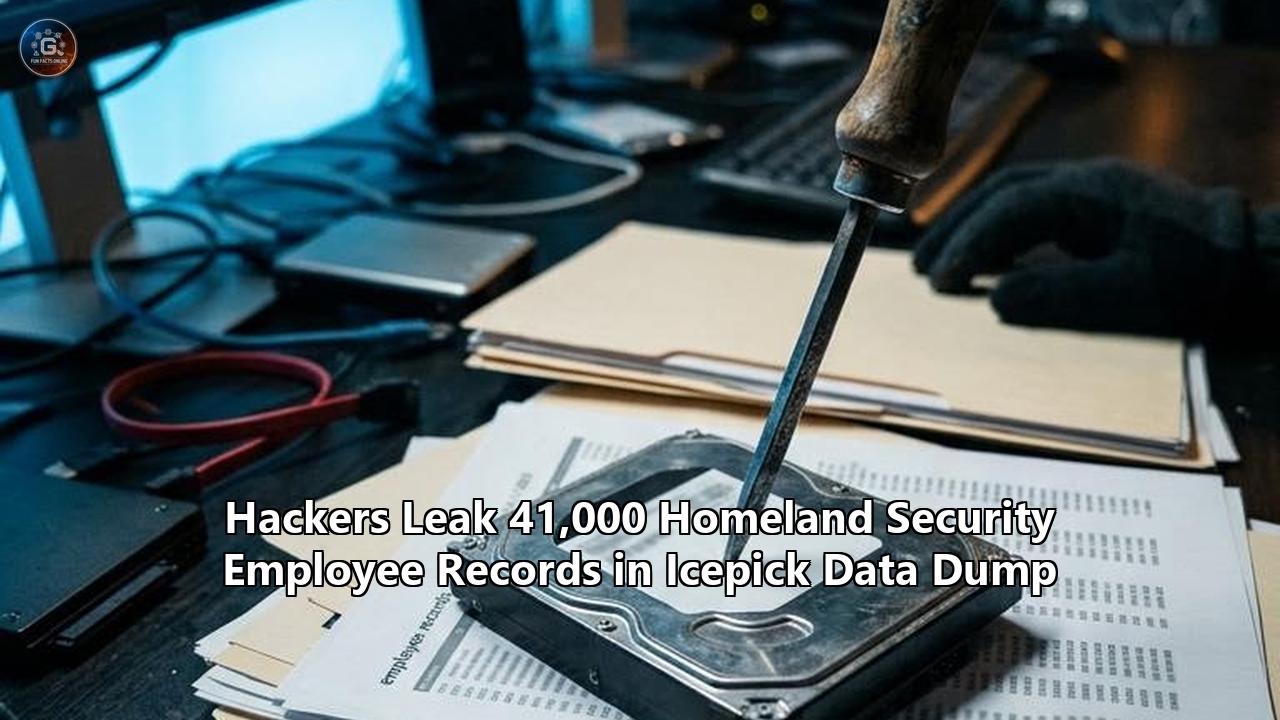
On October 28, 2026, a hacktivist collective calling itself the "Department of Peace" published a massive internal directory containing 41,191 employee and contractor records belonging to the Department of Homeland Security. Distributed through the transparency archive Distributed Denial of Secrets (DDoSecrets) under the project codename "Icepick," and quickly rendered into a searchable public interface by Swiss security researcher and journalist maia arson crimew, the repository exposes the operational framework of the nation's domestic security apparatus.
"They have our information, so it's only fair that we have theirs," the leakers declared in an accompanying manifesto.
The files do not contain case dockets, interception transcripts, or diplomatic cables. Instead, they expose something far more operationally dangerous: a comprehensive blueprint of DHS personnel, their physical desks, private direct extensions, work email addresses, and granular system permission tags. The dataset lays bare 55,000 discrete permission groups, mapping exactly who within the federal government holds administrative privileges, who operates domestic wiretaps, and who works inside certified undercover deployments.
The breach triggered immediate alarm throughout Washington and the intelligence community. The Department of Homeland Security issued a terse statement confirming that it was "aware of a potential breach and is actively working to address the situation swiftly and effectively," adding that it takes all security threats against personnel and officers seriously.
Simultaneously, federal contractors scrambled to wipe the searchable mirror offline, sparking an international hosting standoff across multiple jurisdictions.
+-------------------------------------------------------------------------------+
|                        THE ICEPICK DATASET AT A GLANCE                        |
+-------------------------------------------------------------------------------+
| Total Records Exposed:            41,191 Personnel & Contractors              |
| Snapshot Timestamp:               August 19, 2026                             |
| Publishing Collective:            Department of Peace / DDoSecrets            |
| Search Engine Author:             maia arson crimew                           |
| Core Systems Tagged:              Palantir Falcon, PenLink, Mobile Fortify    |
| Specialized Identifiers:          39 Certified Undercover Operation (CUC) tags|
| Internal Permission Groups:       55,000+ System Access Designations          |
+-------------------------------------------------------------------------------+
Behind the sensational headlines lies a technical failure with structural ramifications. The incident illustrates how identity architecture—the cloud software that verifies who you are when you log in to work—has become both the nervous system and the single point of failure for modern nation-states.
Understanding the true severity of the Icepick leak requires looking beneath the political debate to examine the mechanics of enterprise identity providers, the intelligence value of metadata, and the operational collapse that occurs when an agency's access directories are stripped bare.
Anatomy of the Dump: The 41,191 Personnel Records
The Icepick archive represents roughly one-seventh of the entire DHS enterprise. It captures an operational snapshot dated August 19, 2026.
The directory records are structured not as arbitrary text dumps, but as structured identity schemas typical of enterprise directory services. Each entry features a standardized series of fields: full legal name, federal email address, desk and official mobile phone numbers, organizational division, office location codes, physical street addresses, and assigned roles.
Independent verifications conducted by news organizations including Reuters, WIRED, and Nextgov/FCW confirmed the authenticity of the records by matching details against credit bureau databases, historical federal directories, and by placing direct phone calls to numbers listed in the dump. In multiple instances, active agents and analysts answered their listed phones, learning of their compromise only when contacted by reporters.
+-------------------------------------------------------------------------------+
|                        AGENCY-BY-AGENCY RECORD BREAKDOWN                      |
+-------------------------------------------------------------------------------+
| Component Agency                                | Records Exposed | Share (%) |
+-------------------------------------------------+-----------------+-----------+
| U.S. Customs and Border Protection (CBP)        | 21,329          | 51.8%     |
| Immigration and Customs Enforcement (ICE)       | 6,598           | 16.0%     |
| U.S. Citizenship & Immigration Services (USCIS) | 6,245           | 15.2%     |
| Homeland Security Investigations (HSI)          | 3,421           | 8.3%      |
| DHS Headquarters Elements                       | 1,755           | 4.3%      |
| Cybersecurity & Infrastructure Security (CISA)  | 980             | 2.4%      |
| Federal Protective Service (FPS)                | 394             | 1.0%      |
| Federal Law Enforcement Training Centers (FLETC)| 337             | 0.8%      |
| Science and Technology Directorate (S&T)        | 132             | 0.3%      |
+-------------------------------------------------+-----------------+-----------+
| Total Documented Records                        | 41,191          | 100.0%    |
+-------------------------------------------------+-----------------+-----------+
The composition of the leak strikes at the operational core of American border control, immigration enforcement, and cyber defense. Customs and Border Protection accounts for more than half of the published data, encompassing officers stationed at international airports, maritime shipping hubs, and remote land checkpoints along the northern and southern frontiers.
Another 10,000 files trace back to Immigration and Customs Enforcement and its premier investigative division, Homeland Security Investigations (HSI).
Perhaps most uncomfortably for federal cyber defense, the dump names 980 personnel affiliated with the Cybersecurity and Infrastructure Security Agency (CISA)—the very agency charged with safeguarding federal networks from unauthorized intrusions. More than half of those CISA records belong to private technology contractors.
The Danger of Exposing Undercover Operations
What transforms Icepick from an administrative inconvenience into a counterintelligence emergency is the exposure of specific program assignments and internal privilege groups.
Within Homeland Security Investigations, the archive documents 39 personnel explicitly assigned to system access groups bearing the tag "CUC". In federal law enforcement and court filings, CUC is the formal acronym for Certified Undercover Operations.
These are agents operating under assumed identities, embedded within transnational narcotics rings, weapons-smuggling cartels, money-laundering syndicates, and child exploitation networks.
A single link between an undercover officer's actual identity, corporate single sign-on profile, and field operations can compromise multi-year investigations. It can also place operatives and their confidential informants in physical danger.
+-------------------------------------------------------------------------------+
|                     SPECIALIZED SYSTEM CLEARANCES IDENTIFIED                  |
+-------------------------------------------------------------------------------+
| System Platform     | Operational Use Case Exposed in Directory Leak          |
+---------------------+---------------------------------------------------------+
| Palantir Falcon     | Big-data graph analytics, entity correlation, and       |
|                     | investigative link analysis across multiple databases   |
+---------------------+---------------------------------------------------------+
| PenLink             | Real-time electronic surveillance, Title III wiretaps,  |
|                     | cell tower analysis, and lawful telecom interception    |
+---------------------+---------------------------------------------------------+
| Mobile Fortify      | Field-level facial recognition, mobile biometric ID,    |
|                     | and automated warrant/watch-list cross-referencing      |
+---------------------+---------------------------------------------------------+
| CUC Permissions     | Certified Undercover Operations access lists, including |
|                     | operational oversight accounts and handler identities   |
+---------------------+---------------------------------------------------------+
Beyond undercover designations, the metadata names personnel cleared to use Palantir's Falcon platform—an analytics workspace that aggregates federal intelligence, law enforcement tips, financial records, and commercial tracking information to generate predictive link maps of targeted suspects.
It catalogues investigators who maintain active access to PenLink, an interception and surveillance tool designed to process telecommunications metadata, Internet service intercepts, social media communications, and real-time Title III wiretaps.
It also unmasks users assigned to Mobile Fortify, an edge facial recognition and biometric identification tool deployed by field personnel during raids, vehicle checkpoints, and transit interdictions.
When anti-secrecy group DDoSecrets published the archive, co-founder Emma Best was explicit about why they prioritized this specific dataset: "Rather than an indiscriminate directory of every DHS employee, Icepick identifies many of the architects and drivers of DHS policy and operations". Best emphasized that the files uncover "the officials responsible for overseeing covert and undercover operations, the government's hunt for leakers and the failed BlueLeaks investigation—along with key personnel in DHS's ever-escalating rendition and deportation programs".
Emma Best's reference to BlueLeaks looks back to June 2020, when DDoSecrets published 269 gigabytes of internal law enforcement data obtained through the compromise of a Houston web development firm, Netsential. BlueLeaks revealed intelligence logs, suspect trackers, and tactical guides across 200 state, local, and federal fusion centers.
Icepick is not a dump of raw tactical intelligence. It is something far more precise: a human map of who operates those systems.
The Technology of Single Sign-On: How Identity Architecture Becomes a Target
The hackers who carried out the intrusion stated that they harvested the 41,000 files directly by subverting an internal Okta Single Sign-On (SSO) service used by DHS employees and contractors to log into federal cloud systems.
Okta quickly moved to limit brand fallout. "We are aware of this report. Okta is secure, and we have no evidence our data or systems were compromised," an Okta spokesperson said in an official statement.
To non-specialists, these statements may appear contradictory. If Okta's core software was not hacked, how did hackers pull tens of thousands of staff records from an Okta identity directory?
Answering this question requires understanding how Single Sign-On and modern identity management function inside large-scale organizations.
                               IDENTITY FEDERATION IN ACTION

   +--------------------+                      +--------------------+
   |   User / Agent     |                      | Okta Identity Cloud|
   | (Browser / Device) |                      |    (IdP Service)   |
   +---------+----------+                      +---------+----------+
             |                                           |
             |  1. Access Request                        |
             +------------------------------------------>|
             |                                           |
             |  2. Multi-Factor Challenge & Evaluation   |
             |<------------------------------------------+
             |                                           |
             |  3. Valid Credentials & Biometrics Sent   |
             +------------------------------------------>|
             |                                           |
             |  4. Cryptographic Assertion (SAML/OIDC)   |
             |<------------------------------------------+
             |                                           |
   +---------v----------+                                |
   | DHS Enterprise App |                                |
   |  (Palantir/Email)  |                                |
   +---------+----------+                                |
             |                                           |
             |  5. Present Token / Authenticated Session |
             +-------------------------------------------+
The Evolution from Local Logins to Centralized Identity Providers
In earlier IT systems, every internal program required its own isolated database of usernames, passwords, and permissions. An ICE investigator might have one set of credentials for agency email, a different username and password for a database hosted on local servers, and a third credential for a case filing system.
This model created severe security liabilities. Employees recycled weak passwords, system administrators struggled to revoke access when staff departed, and auditing who did what was nearly impossible.
Enterprise technology solved this problem through Identity and Access Management (IAM) and Identity Federation. Under this model, all access flows through a centralized authority known as the Identity Provider (IdP). Okta is an IdP. When an agency adopts an IdP, individual applications (such as email, Palantir Falcon, or cloud file stores)—known as Service Providers (SPs)—no longer maintain independent password databases.
Instead, they trust the IdP.
When an employee attempts to log in:
- The user goes to the application (Service Provider).
- The application bounces the user to the central IdP (e.g., a DHS Okta login screen).
- The user inputs their credentials, presents their multi-factor authentication (MFA) token or federal PIV card, and authenticates.
- The IdP generates a cryptographically signed ticket called a SAML Assertion or a JSON Web Token (JWT) via OpenID Connect (OIDC).
- The user's browser presents this token back to the application.
- The application verifies the digital signature against the IdP's public key, reads the permissions baked into the token, and grants access.
This setup enables Single Sign-On (SSO): a worker signs in once to their identity provider, and that single cryptographic session unlocks their entire authorized software catalog throughout the day.
The Systemic Trade-Off: Centralization vs. Blast Radius
SSO provides clear administrative and operational benefits. It simplifies access, enforces uniform security controls like multi-factor authentication, and allows administrators to revoke an employee's access with a single click.
Yet it also introduces a serious vulnerability. In computer security, this vulnerability is known as the blast radius of identity compromise.
When you consolidate access rules, user registries, and operational authorizations into a single engine, that engine becomes the central target. If an adversary breaches a standalone case database, they compromise only that database.
If an adversary breaches the Identity Provider, finds a misconfiguration in its management tenant, or compromises an administrative account, they can pull the entire structural map of the enterprise.
+-------------------------------------------------------------------------------+
|                       HOW IDENTITY DIRECTORIES OPERATE                        |
+-------------------------------------------------------------------------------+
| Protocol / Component  | Function within Federal IT Environments               |
+-----------------------+-------------------------------------------------------+
| IdP (Identity Provider)| The central identity server (e.g., Okta, Entra ID)   |
|                       | that authenticates staff and signs cryptographic tokens|
+-----------------------+-------------------------------------------------------+
| SAML 2.0 / OIDC       | Protocols that carry digitally signed statements      |
|                       | verifying a worker's identity and operational role    |
+-----------------------+-------------------------------------------------------+
| SCIM (System for      | An open standard that automates user provisioning     |
| Cross-domain Identity)| between directories, syncing names, groups, and roles |
+-----------------------+-------------------------------------------------------+
| Tenant Environment    | A dedicated, isolated cloud instance operated by DHS;  |
|                       | vulnerabilities can stem from tenant configs, not Okta|
+-----------------------+-------------------------------------------------------+
| RBAC (Role-Based)     | Access model linking users to specific software tools |
|                       | based on their organizational clearance and job title |
+-----------------------+-------------------------------------------------------+
Clarifying the Technical Distinction: Okta System Breach vs. Tenant Exploitation
When Okta announced that "Okta is secure, and we have no evidence our data or systems were compromised," they were making a specific technical point that general audiences often misunderstand.
Okta operates a multi-tenant cloud service. The underlying code, physical servers, and core infrastructure managed by Okta represent the platform. If a vulnerability in Okta's software allows attackers to break through isolation boundaries and siphon data across customers, that constitutes a platform breach.
A tenant breach, on the other hand, occurs when the customer's specific deployment is compromised through:
- Stolen administrative API keys or administrative account takeover.
- An over-permissioned service account connected to an external integration.
- A misconfigured SCIM (System for Cross-domain Identity Management) connector syncing Active Directory entries to cloud instances without network access restrictions.
- Session hijacking targeting a privileged contractor workstation.
If an attacker steals an administrative API credential configured by a DHS contractor, they can query the identity provider's directory endpoints via standard REST APIs. To the identity platform, the attacker looks like a legitimate administrative query.
No vulnerability in the platform's core code is exploited, yet every record in the tenant can be exfiltrated.
This mechanism explains how hacktivists could harvest thousands of personnel records from an agency's Okta deployment while the vendor's core architecture remains technically intact.
The recent DHS data breach underscores how a vulnerability anywhere within the management loop can compromise the entire tenant.
How Directory Dumps Turn into Operational Reconnaissance
Public reactions to data breaches often equate risk with the exposure of direct personal information, like Social Security numbers, banking details, or passwords. When news broke that Icepick was an employee directory dump, some commentators downplayed its severity, treating it like a standard corporate phone book.
That view misses how modern intelligence and cybersecurity operations work. In offensive tradecraft, access maps are often more valuable than leaked credentials.
"The most concerning part of this breach is the access information that came with it," explained Gary Barlet, public sector Chief Technology Officer at cybersecurity firm Illumio. "If an attacker knows which employees have access to which systems and applications, they've essentially been handed a roadmap for where to go next and who to target to get there".
                            THE RECONNAISSANCE PIPELINE

    Directory Dump (Icepick)                Targeted Spear-Phishing / Social Eng.
 +----------------------------+            +------------------------------------+
 | Names, Titles, Extensions  |            | Craft hyper-realistic lure referencing|
 | System Permission Groups   | ---------> | real supervisor, Palantir Falcon,  |
 | Department Office Codes    |            | or active internal software project|
 +----------------------------+            +-----------------+------------------+
                                                             |
                                                             v
    Total Lateral Compromise                Credential Capture / Token Hijack
 +----------------------------+            +------------------------------------+
 | Adversary pivots directly  |            | Target executes payload or logs in |
 | into sensitive databases   | <--------- | to proxy, handing over active SAML |
 | using elevated credentials |            | session token to restricted systems|
 +----------------------------+            +------------------------------------+
The Value of Role-Based Access Control (RBAC) Mapping
Modern enterprise directories rely on Role-Based Access Control (RBAC). Instead of assigning access permissions to individuals one by one, administrators create groups—such as SEC-PALANTIR-FALCON-ANALYST-TIER3 or INV-HSI-CUC-SPECIAL-OPS—and place employees into those groups.
When hackers download a directory containing 55,000 permission groups, they acquire an index of the agency's operational machinery.
They do not need to guess who manages sensitive technical programs, who runs intelligence analysis on specific targets, or which contractor administers the network's domain controllers. The directory names them directly.
For foreign intelligence services—such as China's Ministry of State Security (MSS) or Russia's Foreign Intelligence Service (SVR)—the Icepick dataset functions as an organizational chart of the DHS counterintelligence and border security footprint.
Adversaries running cyber campaigns typically spend months conducting Open-Source Intelligence (OSINT) and network reconnaissance just to figure out who to target.
Icepick eliminates that effort.
Anatomy of an Advanced Spear-Phishing Campaign
With the leaked directory in hand, targeting a high-value DHS employee shifts from guesswork to an exercise in social engineering:
- Identifying the Asset: An attacker searches the Icepick database for individuals holding administrative rights over the Palantir Falcon platform or PenLink intercept tools.
- Contextual Triangulation: The attacker notes the target's physical office location, their supervisor's name, their official phone extension, and the exact software groups they use.
- Designing the Lure: The attacker registers a lookalike domain and sends a spear-phishing email directly to the employee's inbox.
Instead of a generic phishing prompt, the email references actual internal nomenclature:
> "Agent [Last Name], your provisioning for the PenLink Title-III analytics cluster (Group: PEN-NET-OPS) requires security certificate re-validation following the August 19 identity sync. Please authenticate through the DHS single sign-on portal here to prevent account suspension."
- Credential and Session Harvesting: The employee clicks the link, which directs them to an Adversary-in-the-Middle (AiTM) reverse-proxy designed to mirror the agency's real login page. The employee enters their credentials and completes an MFA prompt.
- Session Hijacking: The proxy captures the resulting session cookie. The attacker injects that cookie into their own browser, bypassing MFA entirely and gaining direct access to DHS systems under the targeted employee's account.
Directory metadata provides the context that makes targeted social engineering so effective. By exposing names, operational groups, and system permissions, Icepick gives attackers the exact building blocks needed to pull off these compromises.
The Public Dissemination and the Cross-Border Hosting Battle
The technical release of Icepick triggered an immediate legal and digital proxy fight over how the data was hosted and accessed online.
Unlike traditional criminal ransomware crews who post stolen data behind the Tor anonymity network on dark web leak sites, the Department of Peace chose open-web distribution. They handed the files to Distributed Denial of Secrets, an established nonprofit transparency organization that hosts leaked materials for researchers and journalists.
Simultaneously, Swiss hacktivist and researcher maia arson crimew built an interactive search engine for the directory and hosted it online at icepi.cx.
Crimew, a prominent figure in international hacking circles based in Lucerne, Switzerland, gained international attention in 2021 after uncovering an open credential that exposed over 150,000 security camera feeds from enterprise vendor Verkada. In 2023, crimew located an unsecured server belonging to an American regional airline and downloaded an outdated copy of the U.S. government's secret No Fly List.
Indicted by the U.S. Department of Justice in 2021 on federal computer fraud and identity theft charges, crimew remains in Switzerland, which does not extradite its own citizens for political or computer-tampering offenses absent equivalent Swiss criminal convictions.
                     THE INTERNATIONAL TAKEDOWN DISPUTE

   +----------------------+                        +----------------------+
   | Department of Homeland|                       | Hacktivists & DDoSec |
   | Security Contractors |                        | (maia arson crimew)  |
   +----------+-----------+                        +----------+-----------+
              |                                               |
              | 1. Retains ZeroFox to issue                   | 2. Mounts searchable
              |    aggressive takedown demands                |    archive on icepi.cx
              v                                               v
   +----------------------+                        +----------------------+
   | CentralNic Registrar |                        | FlokiNET (Iceland)   |
   | (Domain Controller)  |                        | (Hosting Provider)   |
   +----------+-----------+                        +----------+-----------+
              |                                               |
              | 3. Places icepi.cx on                         | 4. Rejects takedowns:
              |    'serverHold' (DNS dead)                    |    "Icepick publishes
              v                                               |    work identities,
   +----------------------+                                   |    not doxxing."
   | Domain Resolves Dead |                                   +----------+
   +----------------------+                                              |
              ^                                                          v
              | 5. New domain deployed, torrent swarms active,           |
              +----------------------------------------------------------+
                 raw PostgreSQL database mirrors propagated across web
The Hostmaster Standoff: ZeroFox, CentralNic, and FlokiNET
Within twenty-four hours of the database going live, federal security teams launched a takedown campaign.
ZeroFox, an external threat-intelligence and brand-protection contractor working on behalf of the Department of Homeland Security, dispatched urgent notices to hosting providers and domain registries, categorizing the searchable database as a malicious doxxing operation.
The domain icepi.cx was registered through CentralNic, an international domain registry. Under pressure from federal contractors, CentralNic placed the domain on serverHold status—an administrative flag that suspends domain name resolution, rendering the URL unreachable from the public internet.
However, ZeroFox's efforts hit a wall when it targeted the website's physical hosting provider, FlokiNET.
FlokiNET, an offshore hosting provider founded in Iceland with infrastructure tailored to defend freedom of speech and whistleblower communications, refused to comply with the federal contractor's demands.
FlokiNET publicly posted the takedown demands alongside their formal refusal, taking direct issue with ZeroFox's characterization of the data dump:
"Doxxing publishes private details about private people so that others can find them at home. Icepick publishes work identities of government employees. Who they work for. What their role is."
While federal contractors managed to knock the search interface offline temporarily by targeting its domain registrar, the campaign had little impact on the data's availability.
Hacktivists quickly registered alternative domains, established mirror networks, and distributed the full dataset as a 2.5-gigabyte compressed PostgreSQL database archive across the BitTorrent network.
Once a dataset is seeded across decentralized peer-to-peer swarms, permanent removal is virtually impossible.
The Social Web's Moderation Dilemma
The distribution of the Icepick files also sparked a moderation debate across decentralized social media networks.
On Bluesky, an open-protocol network that had absorbed millions of users seeking an alternative to commercial microblogging services, the platform's moderation system began automated filtering of any posts linking directly to the Icepick database. Bluesky’s automated trust and safety systems initially flagged the leak using labels designed for malicious malware links.
The decision provoked blowback from digital civil liberties advocates, transparency researchers, and journalists, who argued that blocking access to primary reporting sources echoed the controversial handling of prior political leaks on traditional platforms.
Bluesky safety officials acknowledged the tension, stating that while the site’s policies prohibit posting individuals’ private contact information without consent, the internal labeling system had incorrectly conflated the directory link with malware distribution, promising algorithmic adjustments.
Transparency Tool or Retaliatory Doxxing?
The fallout from the leak extends beyond technical vulnerabilities to touch an ongoing debate over government transparency, civil liberties, and federal accountability.
The hacktivists behind the Department of Peace explicitly stated that their release was ideological retaliation. They highlighted their opposition to mass-deportation operations, controversial immigration arrests in residential neighborhoods, and the practice of federal immigration agents wearing ski masks, sunglasses, and tactical gear without visible nameplates or identifying credentials during field operations.
Advocates for government transparency argue that federal agencies have steadily restricted public access to basic staffing information.
Historically, the federal government published annual registers that cataloged every employee, their title, and their salary. In recent decades, however, security concerns have led agencies to classify or withhold employee rosters across large swaths of the Department of Defense, Homeland Security, and the Department of Justice.
+-------------------------------------------------------------------------------+
|                      THE COMPETING ARGUMENTS OVER ICEPICK                     |
+-------------------------------------------------------------------------------+
| The Transparency / Research Perspective | The Counterintelligence/Safety View |
+-----------------------------------------+-------------------------------------+
| Enables journalists and watchdogs to     | Exposes rank-and-file staff to real  |
| file precise, targeted FOIA requests    | threats of harassment, stalking, and |
| without being stonewalled by agencies   | physical harm outside their workplaces|
+-----------------------------------------+-------------------------------------+
| Pierces operational anonymity of        | Destroys deep-cover identities,      |
| tactical units operating in communities | endangering lives of undercover      |
| without visible identifying badges      | operatives in transnational cartels  |
+-----------------------------------------+-------------------------------------+
| Maps corporate-contractor ties and      | Hands foreign intelligence services  |
| private surveillance procurement paths  | an organizational map for cyber-     |
| (Palantir, PenLink, facial recognition) | targeting and spear-phishing attacks |
+-----------------------------------------+-------------------------------------+
Dr. Ryan Shapiro, executive director of the nonprofit transparency organization Property of the People, framed the release as an indispensable accountability mechanism:
"Email addresses and phone numbers are indispensable tools for FOIA researchers, often making the difference between a vague records request that gets stonewalled and one that gets results. Given the administration's contempt for even basic transparency, the need for such tools is urgent."
For investigative journalists and legal watchdogs, having a roster of agency personnel makes it possible to track the authors of policy changes, map who uses commercial surveillance tools, and submit targeted public records requests that avoid agency processing delays.
The counter-perspective, raised by law enforcement associations and national security officials, focuses on operational safety and personal privacy.
Rank-and-file immigration officers, administrative personnel, and IT contractors do not set national border policy. Publishing their direct phone lines, work email addresses, and specific office assignments opens them up to harassment, digital intimidation, and physical threats.
"DHS can't just lock the barn door after the horse was stolen," warned Thomas Warrick, a former DHS deputy assistant secretary for counterterrorism policy, who called for an immediate congressional inquiry.
Warrick pointed out that the leak provides adversaries with actionable information to target the devices and workstations of personnel running sensitive investigations, undermining field operations.
The Compounding Federal Cybersecurity Crisis
The Icepick dump did not happen in a vacuum. It represents the third breach of a United States federal agency in roughly a month, highlighting systemic vulnerabilities across the civilian national security perimeter.
+-------------------------------------------------------------------------------+
|                      RECENT FEDERAL PERSONNEL BREACH TIMELINE                 |
+-------------------------------------------------------------------------------+
| Incident Date   | Target Agency / System  | Attack Vector / Impact Scope      |
+-----------------+-------------------------+-----------------------------------+
| Late Sept 2026  | Federal Bureau of       | ShinyHunters breaches public-     |
|                 | Investigation (FBI)     | facing talent portals; exfiltrates|
|                 |                         | employee & applicant medical data |
+-----------------+-------------------------+-----------------------------------+
| Early Oct 2026  | Defense Manpower Data   | Vulnerable enterprise file-share  |
|                 | Center (DMDC)           | exploited; 3,000,000 DoD personnel|
|                 |                         | Social Security numbers stolen    |
+-----------------+-------------------------+-----------------------------------+
| Late Oct 2026   | Department of Homeland  | Single Sign-On tenant compromise; |
|                 | Security (Icepick)      | 41,191 employee directory profiles|
|                 |                         | and 55,000 system groups exposed  |
+-----------------+-------------------------+-----------------------------------+
In late September, the criminal extortion group ShinyHunters broke into web portals used by the Federal Bureau of Investigation, exfiltrating the records and medical assessments of FBI employees and prospective special agent applicants.
Days later, the Pentagon’s Defense Manpower Data Center (DMDC) began issuing formal notification letters to more than 3,000,000 active-duty service members, defense civilians, and veterans after unauthorized hackers exploited a vulnerability in an enterprise file-sharing system to access databases containing full names and Social Security numbers.
DHS itself has faced a recurring series of network breaches:
- 2014: Hackers compromised background investigation contractors, exposing the personal details of 390,000 current and former Homeland Security employees, job applicants, and contractors.
- 2018: An internal breach within the DHS Office of the Inspector General exposed the personal identifiable information (PII) of nearly 250,000 employees.
- Early 2026: Security firm GitGuardian uncovered a publicly exposed GitHub code repository containing administrative credentials for privileged AWS GovCloud accounts and internal CISA networks that had been open to the internet since late 2025.
- Mid-2026: Unauthorized hackers penetrated the Homeland Security Information Network (HSIN), the primary communications channel used by federal, state, and local law enforcement. DHS security teams dismissed anomalous intrusion alerts twice before finally confirming that an active breach had occurred.
This run of security failures points to a wider institutional gap.
In May 2021, the White House issued Executive Order 14028, mandating that all federal civilian agencies adopt a Zero Trust Architecture—a security model built on the principle that no user, device, or network zone should ever be trusted by default.
Under guidelines published by the Office of Management and Budget (OMB) and CISA, agencies were ordered to consolidate their authentication, deploy hardware-bound multi-factor authentication, segment their internal networks, and log all anomalous behavior.
Yet Icepick shows the unexpected risks that can arise during this transition. When agencies consolidate disconnected identity silos into modern single sign-on systems, they often fail to implement the controls needed to secure the resulting directory.
Setting up an IdP without strictly limiting user directory lookups, without monitoring automated API exfiltration, and without isolating privileged service accounts simply builds a single point of failure.
Rather than stopping intrusions, an insecure implementation turns the identity layer into an open highway for anyone who finds a way inside. The latest DHS data breach shows that securing identity infrastructure requires strict least-privilege policies across the entire tenant, not just deploying single sign-on.
Operational and Economic Fallout: The True Costs of Identity Exposure
The operational and financial costs of a large-scale personnel compromise go well beyond standard credit-monitoring services.
                                DIRECT COSTS OF EXPOSURE

   +--------------------------------------------------------------------------+
   |                        Direct Remediation Expenses                       |
   |                                                                          |
   |  * Operational Extraction: Pulling compromised undercover agents        |
   |  * Identity Rebuilding: Generating legal covers, credit, and credentials |
   |  * Digital Asset Protection: Commercial PII scrubbing for home addresses |
   |  * Infrastructure Hardening: Enterprise token revocation, cert renewals  |
   +--------------------------------------------------------------------------+
                                       |
                                       v
   +--------------------------------------------------------------------------+
   |                        Systemic Operational Drag                         |
   |                                                                          |
   |  * Paused Investigations: Transnational narcotics/trafficking cases cold|
   |  * Inter-Agency Distrust: Allies limit intelligence sharing with DHS    |
   |  * Recruitment & Morale: Decreased retention across ICE, CBP, and HSI   |
   +--------------------------------------------------------------------------+
The Immediate Human and Investigative Cost
The most urgent operational challenge is protecting the 39 agents flagged under Certified Undercover Operations.
When an undercover officer’s identity is exposed, the agency faces an immediate operational dilemma:
- The officer must be pulled from the field immediately, halting ongoing operations.
- Years of investigative momentum against targeted cartels or criminal networks can be lost.
- Confidential human sources who dealt directly with the agent may find themselves exposed to retaliation.
- The agent’s operational cover, built using state IDs, corporate shells, and credit histories, must be decommissioned.
For the broader workforce, DHS sent internal memos urging personnel to take proactive defensive steps, pointing employees to government-contracted data-scrubbing services to remove their personal home addresses and phone numbers from public data brokers.
Yet removing personal data from consumer broker databases does little to scrub files from an unindexed PostgreSQL dump circulating across BitTorrent swarms.
Federal officers now face long-term risks of online harassment, swatting attacks, and physical stalking at their homes, forcing the Federal Protective Service to step up home security details and threat monitoring for high-risk personnel.
Economic Costs of Remediation
The price tag for remediating a directory breach of this size across 41,000 federal employees runs into tens of millions of dollars:
- Digital Infrastructure Auditing: DHS must retain external forensic firms to audit every system tenant, review access configurations, and trace the path attackers used to pull the directory.
- Access Revocation and Token Rotation: Security teams must invalidate every API token, change shared service account secrets, and revoke and reissue digital certificates and PIV configurations for all exposed accounts.
- Identity-Protection Retainers: Federal contracting regulations mandate providing multi-year identity theft protection, credit monitoring, and cyber protection packages for compromised personnel.
- Litigation and Administrative Defenses: The exposure of contractor records introduces legal liability, as defense and IT firms review government contracts to determine whether DHS failed to uphold mandatory cybersecurity protocols for handling contractor details.
Beyond these financial outlays lies a less visible cost: the blow to inter-agency cooperation.
When DHS intelligence units request sensitive operational records from the FBI, the DEA, or international partners like Interpol, those agencies will now evaluate the request knowing that DHS's internal personnel directories were exfiltrated by hacktivists.
A breach that compromises internal systems inevitably damages an agency's working relationships across the intelligence community.
Technical Lessons: How to Secure the Identity Perimeter
The Icepick incident offers practical lessons for enterprise and government cybersecurity teams.
Modern defensive security must treat the identity tier not merely as an administrative directory, but as tier-zero critical infrastructure—subject to the same defense-in-depth requirements as a core database or internal network controller.
+-------------------------------------------------------------------------------+
|                       HARDENING THE IDENTITY PERIMETER                        |
+-------------------------------------------------------------------------------+
| Defensive Discipline    | Technical Implementation Architecture               |
+-------------------------+-----------------------------------------------------+
| Directory Query Limiting| Block indiscriminate mass LDAP/SCIM queries; trigger |
|                         | automated alerts on anomalous read spikes           |
+-------------------------+-----------------------------------------------------+
| Fine-Grained RBAC/ABAC  | Move away from broad role tags; apply Attribute-Based|
|                         | Access Control incorporating device posture and time|
+-------------------------+-----------------------------------------------------+
| Token Cryptographic     | Implement FIDO2/WebAuthn hardware keys; enforce     |
| Binding                 | DPoP (Demonstrating Proof-of-Possession) on tokens  |
+-------------------------+-----------------------------------------------------+
| ITDR Implementation     | Deploy Identity Threat Detection and Response tools |
|                         | to monitor token anomalies and identity plane abuse |
+-------------------------+-----------------------------------------------------+
1. Limiting Directory Queries and Harvesting
In many enterprise setups, any logged-in user can query the entire corporate directory to look up a colleague's email address or phone extension. This open default configuration is a major vulnerability.
Organizations must implement Rate Limiting and Query Throttling on directory services, SCIM synchronization connectors, and identity API endpoints:
- If a single user account or API key queries more than 50 or 100 employee profiles within an hour, the system should automatically throttle access and trigger a high-severity security incident.
- Directory data should be compartmentalized based on operational division. A Customs and Border Protection officer at a port of entry has no business need to read the directory profiles or permission tags of CISA cyber incident responders or HSI undercover handlers.
- Access to specialized group tags (such as CUC or software permissions like Palantir and PenLink) should be restricted so only authorized system administrators can see them, not general users.
2. Moving from Role-Based to Attribute-Based Access Control (ABAC)
Role-Based Access Control (RBAC) worked well in earlier computing environments, but it has become an operational liability in the cloud. When permissions are baked into permanent group names, the group names themselves turn into an intelligence target.
Organizations are increasingly adopting Attribute-Based Access Control (ABAC):
- Instead of static groups, access decisions are calculated dynamically in real time based on changing contextual factors:
$$\text{Access Granted} = f(\text{User Clearance}, \text{Device Health}, \text{Current Location}, \text{Assigned Case Number})$$
- Permissions are evaluated and granted on the fly for each session, rather than remaining permanently linked to an employee's directory entry.
- If an attacker exfiltrates the employee directory, they find only names and office codes—not an itemized list of sensitive software programs and investigative roles.
3. Identity Threat Detection and Response (ITDR)
Traditional Endpoint Detection and Response (EDR) software monitors laptops and servers for malicious files and unauthorized processes. But when an attacker targets cloud identity providers, they leave no footprint on local hard drives.
Organizations need Identity Threat Detection and Response (ITDR) to monitor the identity layer itself:
- ITDR platforms monitor authentication flows, tracking token generation, changes to service accounts, and modifications to access groups.
- They identify anomalous activity, such as an administrative account pulling thousands of identity records during off-hours, an unexpected IP address using an exfiltrated session token, or authentication requests that bypass standard network checkpoints.
- They enforce Cryptographic Token Binding via standards like Demonstrating Proof-of-Possession (DPoP).
Under DPoP, even if an attacker steals a valid SAML or JSON Web Token, they cannot use it from their own machine. The token is cryptographically bound to the private key of the legitimate device that requested it, neutralizing the value of stolen session cookies.
What to Watch Next: The Unfolding Fallout
The compromise of more than 41,000 personnel records in the Icepick dump will shape federal technology policy, cybersecurity spending, and congressional oversight for months to come.
Several key developments will determine the long-term impact of this breach:
                           CRITICAL MILESTONES TO WATCH

   +--------------------+     +--------------------+     +--------------------+
   | Technical Root     |     | Congressional      |     | Physical Security  |
   | Cause Findings     |     | Inquiries          |     | Operational Shifts |
   +---------+----------+     +---------+----------+     +---------+----------+
             |                          |                          |
             v                          v                          v
   Forensic confirmation     House Homeland Security    Review of mask/gear
   of whether compromise     subpoenas on contractor    policies for field
   was tenant misconfig,     access, identity security, operations amid rising
   stolen API key, or        and systemic gaps in       concerns over digital
   third-party breach.       federal IT deployments.    and physical safety.
1. The Forensic Attribution
Investigators have yet to release a detailed root-cause analysis explaining how the "Department of Peace" exfiltrated the directory.
The primary question is whether attackers compromised an administrative service account maintained by an external technology contractor, bypassed access controls on a misconfigured SCIM synchronization endpoint, or leveraged stolen session credentials from a contractor's workstation.
Forensic findings from DHS's incident response teams will establish who bears legal and financial responsibility for the breach.
2. Congressional Scrutiny and Hearing Schedules
The House Committee on Homeland Security and the Senate Homeland Security and Governmental Affairs Committee are already preparing formal inquiries.
Lawmakers will focus their questions on:
- Why low-level access directories contained sensitive tags detailing undercover and surveillance roles.
- How the breach went undetected until hacktivists published the records online.
- What steps CISA—an agency that suffered compromises to its own contractor personnel records in this dump—took to secure the broader federal identity infrastructure.
The political friction surrounding federal immigration enforcement guarantees that these hearings will be contentious. Lawmakers will challenge agency leaders not only on technical failures, but on how those failures intersect with domestic border operations and public accountability.
3. The Future of the Identity Security Mandate
The fallout from the latest DHS data breach is pushing the federal government toward a fundamental reassessment of how it deploys identity systems.
Consolidating legacy user directories into cloud-based Single Sign-On environments is no longer sufficient on its own. Unless agencies lock down their directory search permissions, compartmentalize internal roles, and continuously monitor identity APIs for mass harvesting, centralized identity architectures will continue to function as single points of failure.
The Icepick dump demonstrates that modern cybersecurity is not just about keeping intruders off the network. It is about understanding the intelligence value of basic system metadata.
When a directory mapping 41,191 public servants, their phone extensions, their software tools, and their covert assignments can be pulled down and uploaded to the public internet, the perimeter hasn't just failed.
The directory itself has become the threat.
Reference:
- https://captaincompliance.com/news/dhs-icepick-leak-41000-employee-records-sso/
- https://shattered.io/dhs-icepick-leak-agency-breakdown-cbp-21329-of-41191-2026/
- https://timesofindia.indiatimes.com/world/us/trumps-dhs-hit-by-data-breach-as-hackers-expose-records-of-41000-employees/articleshow/135294676.cms
- https://www.engadget.com/2300661/hackers-leaked-details-more-than-41000-homeland-security-personnel/
- https://www.bitdefender.com/en-us/blog/hotforsecurity/hackers-leak-41-000-dhs-staff-data
- https://thenextweb.com/news/dhs-leak-icepick-41000-employees-ice-cbp
- https://www.securityweek.com/over-41000-dhs-employee-records-leaked-online/
- https://cyberscoop.com/dhs-employee-breach-icepick-database-takedown/
- https://www.nextgov.com/cybersecurity/2026/10/dhs-personnel-leak-exposes-contact-details-and-sensitive-job-information/416901/
- https://www.helpnetsecurity.com/2026/10/29/icepick-dhs-leak-ice-undercover-agents/
- https://shattered.io/icepick-leak-41000-dhs-staff-seven-data-fields-risk-map-2026/
- https://cyberscoop.com/dhs-employee-data-leak-ddosecrets/
- https://edition.cnn.com/2026/10/29/politics/hackers-dhs-workers-leak